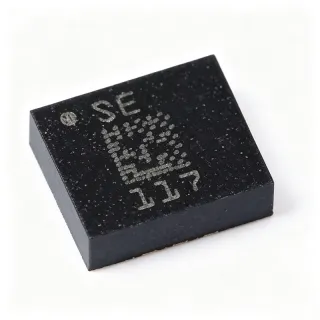
LM324PT - Quad Low-Power Op-Amp, 1.3MHz, TSSOP-14 | STMicroelectronics
MPN: LM324PT ✓ Active| Qty | Unit Price | Extended |
|---|---|---|
| 1 | $0.45 | $0.45 |
| 10 | $0.4 | $4.00 |
| 100 | $0.34 | $34.00 |
| 500 | $0.29 | $145.00 |
| 1,000 | $0.25 | $250.00 |
LM324PT Overview
An operational amplifier (op-amp) is a high-gain differential voltage amplifier that, with external feedback networks, performs mathematical operations such as amplification, filtering, comparison, and integration. The op-amp sits at the foundation of the analog signal-chain hierarchy: op-amp -> amplifier IC -> analog front end -> signal conditioning system. Quad op-amps like the LM324 family pack four independent channels sharing one supply, reducing board area and BOM cost versus four single amplifiers.
Key features of the LM324PT include an input common-mode voltage range that extends down to ground (ground-sensing inputs on single-supply rails), a large DC voltage gain of 100dB, and a very low supply current of approximately 375uA per amplifier. These characteristics make it a cost-effective workhorse for battery-powered and single-supply industrial designs.
Architecturally, the LM324 uses a classic bipolar process with PNP input stages that enable the ground-sensing common-mode range, and class-AB output stages that can swing close to the negative rail. The four channels are well matched and thermally coupled, which minimizes offset drift between channels in multi-channel signal conditioning.
Typical applications include transducer amplification, active RC filters, voltage comparators and level shifters, LED drivers, and DC gain blocks in consumer and industrial equipment.
Design consideration: the LM324 is not a rail-to-rail output device - the output saturates roughly 1.5V below VCC, so set signal swings accordingly to avoid clipping near the positive rail.
This page consolidates verified datasheet parameters, drop-in alternatives, pricing tiers, design notes, and comparison data not found together on the manufacturer datasheet.
Drop-in alternatives for LM324PT — same package, pin-to-pin compatible. Different-package parts requiring PCB rework are excluded.
Quick Comparison Tool — Select alternative parts for side-by-side comparison:
LM2904PT
✅ Drop-In ⚠️ 参数待验证📋 Reference alternative (not in catalog)
LM324PWRG4
✅ Drop-In📋 Reference alternative (not in catalog)
LM324BPWR
✅ Drop-In📋 Reference alternative (not in catalog)
LM2904PWR
✅ Drop-In📋 Reference alternative (not in catalog)
LM324PT Maximum Ratings & Electrical Characteristics
| Amplifier Type | Standard general-purpose operational amplifier |
| Number of Channels | 4 |
| Gain Bandwidth Product | 1.3 MHz |
| Slew Rate | 0.4 V/us |
| Supply Voltage Range (Single) | 3 V to 32 V |
| Supply Voltage Range (Dual) | +/-1.5 V to +/-16 V |
| Supply Current per Amplifier | 375 uA (typ) |
| Large Signal Voltage Gain | 100 dB (typ) |
| Input Common-Mode Range | Includes ground (negative rail) |
| Package | 14-pin TSSOP |
| Mounting Type | Surface Mount |
| Packaging | Tape & Reel (TR) |
| RoHS Status | ROHS3 Compliant |
| Export Classification | EAR99 |
LM324PT Pin Configuration
| Pin 1 | OUT1 — Amplifier 1 output |
| Pin 2 | IN1- — Amplifier 1 inverting input |
| Pin 3 | IN1+ — Amplifier 1 non-inverting input |
| Pin 4 | VCC — Positive supply |
| Pin 5 | IN2+ — Amplifier 2 non-inverting input |
| Pin 6 | IN2- — Amplifier 2 inverting input |
| Pin 7 | OUT2 — Amplifier 2 output |
| Pin 8 | OUT3 — Amplifier 3 output |
| Pin 9 | IN3- — Amplifier 3 inverting input |
| Pin 10 | IN3+ — Amplifier 3 non-inverting input |
| Pin 11 | GND/VEE — Ground (single supply) or negative supply (dual supply) |
| Pin 12 | IN4+ — Amplifier 4 non-inverting input |
| Pin 13 | IN4- — Amplifier 4 inverting input |
| Pin 14 | OUT4 — Amplifier 4 output |
Typical Applications
LM324PT is suitable for 6 applications: Transducer Signal Amplification, Active RC Filters, Voltage Comparators and Level Detection, LED Driver and Indicator Circuits, Battery-Powered Portable Instruments, Automotive Body and Supervision Electronics.
Transducer Signal Amplification
The LM324PT is widely used to amplify low-level signals from sensors such as thermistors, strain gauges, and photodiodes in single-supply industrial equipment. Its input common-mode range extending to ground allows direct coupling of ground-referenced sensor outputs without biasing networks or a negative rail, and the 100dB typical voltage gain covers most transducer conditioning needs. One TSSOP-14 package provides four channels, so multi-sensor boards use a single footprint instead of four discrete amplifiers, cutting board area and assembly cost. With roughly 375uA per amplifier, battery-powered sensor nodes keep analog front-end current in the microamp range. Designers should keep closed-loop bandwidth below a few hundred kHz given the 1.3MHz gain-bandwidth product, and remember the output cannot swing above VCC minus about 1.5V.
Recommended
Active RC Filters
Multiple Sallen-Key and multiple-feedback filter stages fit naturally on one LM324PT: the four channels implement, for example, a four-pole low-pass anti-aliasing filter in a single 14-pin TSSOP. The 1.3MHz gain-bandwidth product supports corner frequencies up to tens of kilohertz with reasonable Q accuracy - as a rule of thumb, keep the filter cutoff below roughly fGBW/100 so gain peaking and phase error stay acceptable. The ground-sensing input range simplifies single-supply filter biasing at mid-rail or at ground for DC-coupled designs. Supply current of 375uA per amplifier keeps filter power modest in portable instruments. For filters above ~100kHz or with high Q requirements, choose a wider-bandwidth quad such as the TI LM324B in the identical footprint to preserve the PCB layout.
Recommended
Voltage Comparators and Level Detection
Although dedicated comparators are preferred for speed, the LM324PT is routinely used as a low-speed comparator and window detector in cost-sensitive consumer and appliance boards. Its differential input stage tolerates input voltages down to ground, letting one input sit directly on ground-referenced thresholds. Four independent channels allow multi-threshold battery gauges, undervoltage/overvoltage detectors, and level indicators in one package. Because the output stage is a current-limited class-AB emitter-follower rather than an open-collector comparator output, designers should add external pull-up or transistor buffering when driving logic loads and expect slow transitions (~0.4 V/us slew). Response times in the microsecond range are acceptable for supervision and indication functions, not for fast protection loops - use a true comparator IC for those.
Recommended
LED Driver and Indicator Circuits
The LM324PT frequently drives LED indicator strings and simple constant-current sinks in panel and appliance front-ends. Operating the output stage as a feedback-controlled current source, each amplifier regulates LED current through a sense resistor; with a 3V-to-32V supply range, stacks of LEDs can be driven directly from 12V or 24V rails. The four channels enable bargraph-style multi-LED indicators from one TSSOP-14 package, and the low 375uA-per-channel quiescent draw matters in always-on status lighting. Design constraint: the output saturates about 1.5V below VCC at moderate current, so budget headroom when sizing LED stack voltage versus supply, and respect the device output current limit (tens of mA, not amps) when calculating sense-resistor values per the STMicroelectronics datasheet typical applications.
Recommended
Battery-Powered Portable Instruments
With about 375uA supply current per amplifier and single-supply operation from 3V, the LM324PT fits battery-operated multimeters, gas detectors, and handheld meters where analog channels must run continuously. The 3V low end allows direct operation from two alkaline cells or a single lithium cell through regulation, and the ground-sensing inputs interface electrochemical and thermistor sensors referenced to system ground. Four channels in one package consolidate the analog front end - typically bridge amplifier, filter, and buffer - into one device, minimizing quiescent budget and board space. Designers should note that precision performance is modest (LM324-class offset), so for sub-millivolt accuracy either add offset calibration in firmware or select the enhanced TI LM324B drop-in variant with the same TSSOP-14 footprint.
Recommended
Automotive Body and Supervision Electronics
For 12V automotive supervision circuits - battery-level monitors, lamp diagnostics, and sensor conditioning - the automotive-qualified LM2904 family variants (ST LM2904PT, TI LM2904PWR) provide the same TSSOP-14 footprint and LM324-style behavior with temperature grades suited to under-hood and cabin environments. The wide supply range absorbs automotive load-dump-protected 12V rails, and the ground-referenced input range suits chassis-referenced sensors. Signal bandwidths required in body electronics (lamp currents, fluid levels, temperature) sit comfortably under the 1.3MHz gain-bandwidth limit. Engineers transitioning a commercial LM324PT design into an automotive program can typically retain the PCB layout unchanged by substituting the LM2904 variant, but must re-verify offset drift, ESD rating, and AEC qualification documentation against the automotive datasheet before release.
Recommended
Recommended Products Summary
Engineering reference data for LM324PT — comparison, design guidance, and compliance information.
Selection Guide
Comparison with Alternatives
| Parameter | This Product | LM2904PT | LM324PWRG4 | LM324BPWR | LM2904PWR |
|---|---|---|---|---|---|
| Package | TSSOP-14 | TSSOP-14 - same | TSSOP-14 - same | TSSOP-14 - same | TSSOP-14 - same |
| Brand | STMicroelectronics | STMicroelectronics | Texas Instruments | Texas Instruments | Texas Instruments |
| Channels | 4 | 4 | 4 | 4 | 4 |
| Gain Bandwidth | 1.3 MHz | 1.3 MHz | 1.2 MHz | 1.2 MHz (improved) | 1.2 MHz |
| Supply Voltage Range | 3 V to 32 V | 3 V to 32 V | 3 V to 32 V | 3 V to 36 V | 3 V to 32 V |
| Slew Rate | 0.4 V/us | 0.4 V/us | 0.4 V/us | 0.5 V/us | 0.4 V/us |
| Automotive Qualification | No | Yes (automotive variant) | No | Enhanced industrial | Yes (automotive variant) |
| Input Common-Mode Includes Ground | Yes | Yes | Yes | Yes | Yes |
Key Differentiators
- Ground-sensing inputs enable true single-supply designs (vs TL074)
- Four amplifiers in one low-cost TSSOP-14 (vs LM324PWRG4)
- Trade-off: limited positive output swing (vs LM324BPWR)
Design Notes
Estimated: at a 24V single supply with all four amplifiers biased at the typical 375uA each, quiescent dissipation is about 36mW, negligible thermally. However, each output sourcing load current adds (VCC - VOUT) x ILOAD; with a 24V rail and 20mA output loads, that is roughly 0.3W per channel. Keep total package dissipation under the TSSOP-14 thermal limit and verify with worst-case loads. On dual +/-16V supplies, halve load currents or add series resistors to protect the output stage.
Two frequent LM324 issues: (1) the output cannot approach the positive rail - it saturates roughly 1.5V below VCC - so gain stages clipping near VCC are a symptom, not a fault; either lower the gain, reduce the supply, or use a rail-to-rail amplifier. (2) The output stage is not a true push-pull to the negative rail under sinking loads below ~50uA, which causes crossover distortion near ground; add a small pull-down resistor (~1k to ground) on the output to bias the stage continuously in precision audio or slow AC applications.
Place a 100nF ceramic decoupling capacitor directly across pins 4 (VCC) and 11 (GND/VEE), within a few millimeters of the package, plus bulk 10uF per board region. Keep high-impedance input traces short and guarded away from outputs to limit capacitive coupling between the four internally adjacent channels - crosstalk in quads rises when one channel switches while another amplifies microvolt signals. The TSSOP-14 has no exposed pad; thermal relief relies on signal pins, so no special thermal design is needed at LM324-class dissipation.
Compliance Information
ROHS3 compliant and EAR99 export classification per distributor data (partsearch.io, DigiKey). REACH and halogen-free status not stated in provided data.