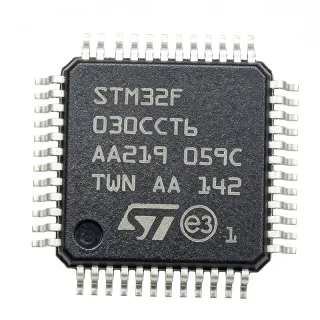
PIC16C54C-04/SS - 4MHz 8-bit CMOS OTP MCU, 768B | Microchip
MPN: PIC16C54C-04/SS ✓ Active| Qty | Unit Price | Extended |
|---|---|---|
| 1 | $0.92 | $0.92 |
| 10 | $0.86 | $8.60 |
| 100 | $0.78 | $78.00 |
| 500 | $0.71 | $355.00 |
| 1,000 | $0.65 | $650.00 |
PIC16C54C-04/SS Overview
What is a PIC16C5x microcontroller? The PIC16C5x series is Microchip Technology's baseline family of 8-bit CMOS microcontrollers that launched the PIC architecture. It belongs to the broader hierarchy: microcontroller -> embedded microcontroller -> 8-bit MCU -> CMOS RISC MCU -> PIC architecture. These parts use One-Time-Programmable (OTP) EPROM program memory, distinguishing them from later PIC16F flash parts that allow in-circuit reprogramming. The PIC16C5x family remains widely deployed in cost-sensitive, high-volume, single-purpose applications such as appliance controls and consumer electronics.
Key features of the PIC16C54C include 12 I/O pins, 768 bytes of OTP program memory, 25 bytes of data RAM, two-level deep hardware stack, and seven or eight special function hardware registers. It supports direct, indirect, and relative addressing modes for both data and instructions, and operates across a 2.5V to 5.5V supply range (commercial temperature grade). The 4 MHz maximum clock frequency and 1 microsecond instruction cycle make it well-matched to simple real-time control loops.
Architecturally, the PIC16C54C uses a Harvard architecture with separate program and data buses, allowing instruction fetch and operand access to occur in the same instruction cycle. The 12-bit instruction word is symmetrical and highly orthogonal, typically delivering close to 2:1 code compression versus other 8-bit microcontrollers in its class. The OTP EPROM program memory requires a high-voltage programming pulse (typically 13V) and cannot be erased, so firmware must be verified externally before programming.
Typical applications include appliance controls, security system peripherals, simple sensor interfaces, low-end consumer products, and legacy industrial timers where the 4 MHz clock and OTP one-time programming provide the simplest possible bill of materials. New designs generally migrate to PIC16F5x flash parts (e.g. PIC16F54) for in-circuit reprogrammability, but the PIC16C54C remains a strong choice for high-volume, cost-optimized production.
When designing with the PIC16C54C-04/SS, ensure the oscillator configuration matches the target frequency (RC, XT, LP, or HS mode) and respect the OTP programming voltage requirement of approximately 13V on the MCLR/VPP pin. Because the program memory is OTP, plan for firmware verification using windowed or sample parts before committing to the SSOP production units. SSOP package selection enables compact PCB layouts but requires careful handling during PCB assembly due to the fine 0.65 mm pitch.
This page synthesizes distributor pricing, drop-in alternatives, pinout data, and practical design notes not found in the manufacturer datasheet alone, enabling faster sourcing decisions for engineers maintaining legacy designs or planning cost-optimized new products.
Drop-in alternatives for PIC16C54C-04/SS — same package, pin-to-pin compatible. Different-package parts requiring PCB rework are excluded.
Variants in this series
Same-series models that are drop-in compatible with PIC16C54C-04/SS (same form factor and footprint) — differing in Core Architecture, Package, Timers, Operating Temperature, Program Memory Size.
Quick Comparison Tool — Select alternative parts for side-by-side comparison:
PIC16C54C-04I/SS
✅ Drop-In✓ In Stock
$1.34 / Unit
View Datasheet →PIC16C54A-04/SS
✅ Drop-In✓ In Stock
$1.18 / Unit
View Datasheet →PIC16C54A-20I/SS
✅ Drop-In✓ In Stock
$2.51 / Unit
View Datasheet →PIC16C54A-04E/SS
✅ Drop-In✓ In Stock
$1.32 / Unit
View Datasheet →PIC16F54-I/SS
✅ Drop-In📋 Reference alternative (not in catalog)
PIC16C54C-04/SS Maximum Ratings & Electrical Characteristics
| Core Architecture | PIC 8-bit RISC |
| Family | PIC16C5x |
| Program Memory Type | OTP EPROM (One-Time-Programmable) |
| Program Memory Size | 768 bytes (512 x 12) |
| Data RAM | 25 bytes |
| CPU Speed | 4 MHz |
| Instruction Cycle | 1 us at 4 MHz |
| I/O Pins | 12 |
| Timers | 1 x 8-bit (TMR0) |
| Hardware Stack | 2-level |
| Instruction Width | 12-bit |
| Data Path Width | 8-bit |
| Addressing Modes | Direct, Indirect, Relative |
| Supply Voltage | 2.5 V to 5.5 V |
| Operating Temperature | 0C to +70C (commercial) |
| Package | 20-pin SSOP (5.30 mm body width) |
| Mounting Type | Surface Mount |
| Pin Pitch | 0.65 mm |
| RoHS Status | Compliant |
PIC16C54C-04/SS Pin Configuration
| Pin 1 | RA2 — Port A bit 2 (bidirectional I/O) |
| Pin 2 | RA3 — Port A bit 3 (bidirectional I/O) |
| Pin 3 | RB0 — Port B bit 0 (bidirectional I/O, interrupt-on-change) |
| Pin 4 | MCLR/VPP — Master Clear reset (active low) / Programming voltage input |
| Pin 5 | VSS — Ground reference |
| Pin 6 | RB1 — Port B bit 1 (bidirectional I/O) |
| Pin 7 | RB2 — Port B bit 2 (bidirectional I/O) |
| Pin 8 | RB3 — Port B bit 3 (bidirectional I/O) |
| Pin 9 | RB4 — Port B bit 4 (bidirectional I/O) |
| Pin 10 | RB5 — Port B bit 5 (bidirectional I/O) |
| Pin 11 | RB6 — Port B bit 6 (bidirectional I/O) |
| Pin 12 | RB7 — Port B bit 7 (bidirectional I/O) |
| Pin 13 | RB7 — Port B bit 7 (alternate location, ICSP data on some revisions) |
| Pin 14 | VDD — Positive supply voltage (2.5 V to 5.5 V) |
| Pin 15 | OSC2/CLKOUT — Oscillator output / Clock output |
| Pin 16 | OSC1/CLKIN — Oscillator input / External clock input |
| Pin 17 | RA0 — Port A bit 0 (bidirectional I/O) |
| Pin 18 | RA1 — Port A bit 1 (bidirectional I/O) |
| Pin 19 | VSS — Ground reference (secondary) |
| Pin 20 | VDD — Positive supply voltage (secondary) |
Typical Applications
PIC16C54C-04/SS is suitable for 7 applications: Appliance Control Boards, Security System Peripherals, Simple Sensor Interfaces, Low-End Consumer Electronics, Legacy Industrial Timers, Educational and Hobbyist Projects, Automotive Aftermarket Accessories.
Appliance Control Boards
The PIC16C54C-04/SS suits appliance control boards (microwave oven keypads, washing machine timers, dishwasher controllers) where its 4 MHz clock, 768-byte OTP program memory, and 12 I/O pins handle button scanning, relay drivers, and LED indicators. The OTP EPROM prevents field firmware tampering and locks unit-cost at roughly $0.70, well below flash-MCU alternatives. The SSOP-20 footprint keeps the controller under 6 mm x 7 mm, leaving PCB room for power-supply isolation and TRIAC driver stages typical in 120 VAC / 230 VAC white goods. Industrial designers value the PIC16C5x deterministic instruction cycle for time-critical TRIAC zero-cross switching without RTOS overhead.
Recommended
Security System Peripherals
The PIC16C54C-04/SS is widely used in PIR motion detector boards, glass-break sensor modules, and door/window contact transmitters where a low-cost, low-power 8-bit controller supervises the analog front end, drives a status LED, and toggles an alarm relay. With only 25 bytes of RAM and 768 bytes of code space, the design focuses on a single purpose: filter the sensor signal, debounce inputs, and signal events. The OTP EPROM ensures the firmware cannot be reverse-engineered or reflashed in the field, a security plus in alarm products. The 4 MHz instruction cycle is fast enough for 1 ms polling loops that capture PIR amplifier pulses reliably.
Recommended
Simple Sensor Interfaces
For low-cost sensor interface boards (thermistor readers, photodiode loggers, simple threshold detectors), the PIC16C54C-04/SS provides just enough compute: 768 bytes of code accommodates look-up tables for linearization, while the single 8-bit TMR0 handles periodic sampling without external timers. The 12-bit instruction word is symmetrical and easy to hand-assemble for very small firmware footprints. Operating from 2.5 V to 5.5 V lets the part share the same 3.3 V LDO that powers the sensor, simplifying the BOM. SSOP-20 surface-mount packaging fits inside sealed sensor housings as small as 10 mm x 10 mm.
Recommended
Low-End Consumer Electronics
The PIC16C54C-04/SS drives remote-control transmitters, electronic toys, novelty gadgets, and simple LED animators where the bill of materials is the dominant design constraint. At roughly $0.70 in volume, the MCU undercuts most flash-based alternatives while delivering deterministic 1 microsecond instruction cycles for smooth LED multiplexing and IR carrier generation. The 12 I/O pins comfortably drive 8 LEDs plus 4 control buttons, and the OTP program memory prevents unauthorized cloning of high-volume consumer products. The SSOP-20 0.65 mm pitch supports compact remote housings under 6 mm thick.
Recommended
Legacy Industrial Timers
Long-lifecycle industrial timer modules (motor start-delay relays, conveyor sequencing, machine-tool interlock timers) often specify the PIC16C54C-04/SS because Microchip has guaranteed supply for the PIC16C5x family since the mid-1990s, and second-source compatible OTP parts are widely available. The 4 MHz clock and 2-level hardware stack are adequate for fixed-timing sequences, and the OTP memory protects the proprietary timing logic from unauthorized modification. Industrial designers appreciate the wide 2.5 V to 5.5 V supply range that tolerates 24 V industrial rails after regulation. The SSOP-20 surface-mount form factor supports modern reflow assembly while remaining mechanically robust in vibration-prone industrial enclosures.
Recommended
Educational and Hobbyist Projects
The PIC16C54C-04/SS remains a popular teaching tool in university embedded systems courses and hobbyist electronics because the PIC16C5x architecture is straightforward to learn: 12-bit instructions, 2-level stack, only seven special function registers. Students can program the OTP EPROM with low-cost PIC programmers and immediately observe execution on simple I/O projects (LED chasers, button debouncers, square-wave generators). The 4 MHz instruction cycle is slow enough to follow in real time with a logic analyzer. The SSOP-20 variant suits modern breakout boards, while the SOIC-20 and PDIP-20 variants in the same family suit breadboard prototypes.
Recommended
Automotive Aftermarket Accessories
The PIC16C54C-04/SS, when paired with the industrial-grade PIC16C54C-04I/SS variant for -40C to +85C operation, drives automotive aftermarket modules such as LED light controllers, headlight delay timers, and alarm system sensors. The wide 2.5 V to 5.5 V supply range tolerates automotive 12 V battery rails after regulation, and the OTP memory prevents unauthorized tampering with vehicle accessory firmware. The 4 MHz clock and 12 I/O pins support PWM-like software bit-banging for LED dimming without requiring a dedicated CCP module. Surface-mount SSOP-20 keeps the PCB compact enough to fit inside aftermarket switch panels and small enclosures.
Recommended
Recommended Products Summary
Engineering reference data for PIC16C54C-04/SS — comparison, design guidance, and compliance information.
Selection Guide
Comparison with Alternatives
| Parameter | This Product | PIC16C54C-04I/SS | PIC16C54A-04/SS | PIC16C54A-20I/SS | PIC16F54-I/SS |
|---|---|---|---|---|---|
| Package | SSOP-20 (5.30 mm body) | SSOP-20 (5.30 mm body) - same | SSOP-20 (5.30 mm body) - same | SSOP-20 (5.30 mm body) - same | SSOP-20 (5.30 mm body) - same |
| Brand | Microchip Technology | Microchip Technology - same | Microchip Technology - same | Microchip Technology - same | Microchip Technology - same |
| Max Clock Frequency | 4 MHz | 4 MHz | 4 MHz | 20 MHz | 20 MHz |
| Program Memory Type | OTP EPROM (768B / 512x12) | OTP EPROM (768B / 512x12) | OTP EPROM (768B / 512x12) | OTP EPROM (768B / 512x12) | Flash (768B) |
| Temperature Grade | Commercial (0C to +70C) | Industrial (-40C to +85C) | Commercial (0C to +70C) | Industrial (-40C to +85C) | Industrial (-40C to +85C) |
| Supply Voltage | 2.5 V to 5.5 V | 2.5 V to 5.5 V | 2.5 V to 5.5 V | 2.5 V to 5.5 V | 2.0 V to 5.5 V |
| Silicon Revision | C | C | A | A | F (Flash family) |
| In-Circuit Programming | No (OTP requires external programmer with 13V VPP) | No (OTP requires external programmer) | No (OTP requires external programmer) | No (OTP requires external programmer) | Yes (Flash, in-circuit serial programming) |
Key Differentiators
- Single lowest-cost Microchip drop-in alternative in SSOP-20 with industrial temperature (vs PIC16C54C-04I/SS)
- Higher 20 MHz clock option available in pin-compatible SSOP-20 footprint (vs PIC16C54A-20I/SS)
- Flash reprogrammability in identical SSOP-20 footprint (vs PIC16F54-I/SS)
Design Notes
The PIC16C54C-04/SS operates from 2.5 V to 5.5 V and typically draws 1.8 mA at 4 MHz and 5 V. Decouple VDD with a 100 nF ceramic capacitor placed within 5 mm of the VDD pin (pin 14 or 20), with a parallel 10 uF tantalum or aluminum polymer bulk capacitor on the same rail. The baseline PIC16C5x does not include internal brown-out reset, so for industrial applications add an external voltage supervisor (e.g. MCP100 or equivalent) on the MCLR pin to ensure defined reset behavior during supply dips below 2.0 V. Estimated power dissipation at 4 MHz and 5 V is approximately 9 mW, well within the SSOP-20 thermal limits.
Route the SSOP-20 0.65 mm pitch pads with NSMD (non-solder mask defined) land patterns for reliable paste release during reflow. Place the 4 MHz crystal or ceramic resonator within 5 mm of the OSC1 (pin 16) and OSC2 (pin 15) pins, with the load capacitors grounded to a low-impedance ground pour. Keep high-current switching traces (relay drivers, TRIAC controls) physically separated from the oscillator circuit to prevent clock noise injection. MCLR (pin 4) requires a 10 kohm pull-up to VDD and a 100 nF capacitor to ground for noise immunity; the MCLR/VPP pin also serves as the high-voltage programming input for OTP EPROM.
The PIC16C54C-04/SS OTP EPROM cannot be erased and re-programmed - once programmed, the device is permanently locked. Plan firmware verification using a PIC16C54C/JW windowed ceramic package during prototype phase, or use the PIC16F54-I/SS Flash variant if multiple firmware iterations are expected during development. Do not apply DC voltages above 5.5 V to VDD or any I/O pin; the absolute maximum ratings listed in the Microchip datasheet are 7 V DC. Ensure the ICSP programmer delivers 13 V on MCLR/VPP during OTP programming, and verify the configuration bits (oscillator mode, watchdog timer, code protection) before programming production units because the PIC16C5x configuration fuses are also OTP.
Compliance Information
RoHS compliant per Microchip product page. Lead-free reflow compatible per JEDEC J-STD-020. AEC-Q100 not applicable - automotive applications should select PIC16C54C-04I/SS industrial grade instead. Halogen-free status unknown from provided data.