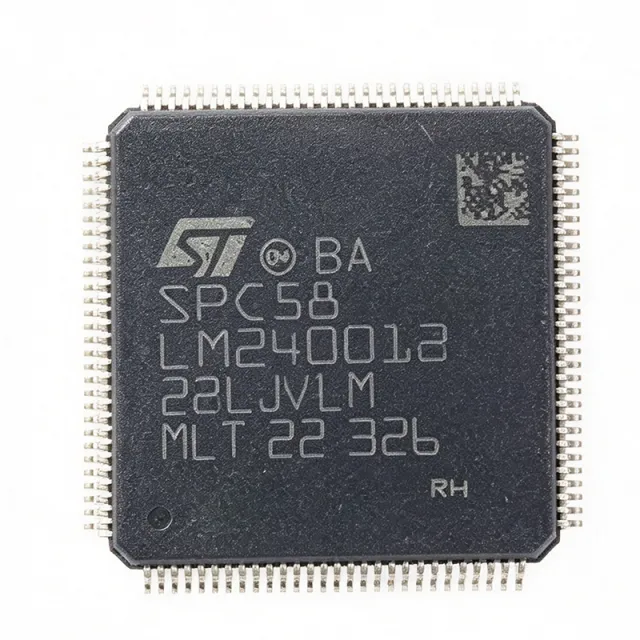
SPC58EC80E5 - 32-bit Power Architecture MCU | STMicroelectronics
MPN: SPC58EC80E5 ✓ Active| Qty | Unit Price | Extended |
|---|---|---|
| 1 | $30 | $30.00 |
| 10 | $21.6667 | $216.67 |
| 100 | $19.1667 | $1,916.67 |
| 500 | $18.3333 | $9,166.65 |
| 1,000 | $17.5 | $17,500.00 |
SPC58EC80E5 Overview
A microcontroller (MCU) is a compact integrated circuit designed to govern a specific operation in an embedded system. It contains a processor core, memory, and programmable input/output peripherals on a single chip. In the system hierarchy, an MCU is a type of embedded processor, which falls under the broader category of integrated circuits. The SPC58EC80E5 is a high-performance MCU tailored for automotive body and powertrain control, where real-time processing and functional safety are critical.
Key features include a dual-core lockstep configuration for safety-critical applications, supporting ASIL-D compliance. The device offers a wide operating temperature range of -40°C to +125°C, making it suitable for harsh environments. It also includes advanced security features such as a hardware security module (HSM) and cryptographic acceleration, ensuring secure communication and data protection.
Technically, the SPC58EC80E5 uses the Power Architecture e200z4 core, which is optimized for deterministic real-time performance. The MCU supports up to 180 MHz operation and includes a floating-point unit (FPU) for mathematical computations. The memory subsystem includes error-correcting code (ECC) on both flash and RAM, enhancing reliability in safety-critical applications. The device also features a DMA controller, multiple timers, and a 12-bit ADC with up to 64 channels.
Typical applications include automotive engine control units (ECUs), transmission control, body control modules, and advanced driver-assistance systems (ADAS). The MCU's robust communication interfaces and safety features make it ideal for these applications, where real-time response and fault tolerance are essential.
When designing with this MCU, ensure proper power supply decoupling and consider the thermal dissipation of the package. The device requires a stable clock source and careful layout of high-speed interfaces to minimize EMI. Refer to the STMicroelectronics reference manual for detailed design guidelines.
This page synthesizes distributor pricing, drop-in alternatives, and practical design notes not found in the STMicroelectronics datasheet, providing a comprehensive resource for engineers evaluating the SPC58EC80E5.
Drop-in alternatives for SPC58EC80E5 — same package, pin-to-pin compatible. Different-package parts requiring PCB rework are excluded.
Quick Comparison Tool — Select alternative parts for side-by-side comparison:
SPC58EC80E3
📋 Reference alternative (not in catalog)
SPC58EC80E1
📋 Reference alternative (not in catalog)
SPC58EC80E7
📋 Reference alternative (not in catalog)
SPC58EC80E5 Maximum Ratings & Electrical Characteristics
| Core | Power Architecture e200z4 |
| Maximum Clock Frequency | 180 MHz |
| Flash Memory | 4 MB |
| RAM | 512 KB |
| Operating Temperature Range | -40°C to +125°C |
| Supply Voltage | 3.3 V to 5 V |
| Package | LQFP-144 |
| Mounting Type | Surface Mount |
| Number of I/O Pins | 120 |
| ADC Resolution | 12-bit |
| ADC Channels | 64 |
| Communication Interfaces | CAN, LIN, Ethernet, FlexRay, SPI, I2C, UART |
| DMA Channels | 64 |
| Timers | Multiple (e.g., eMIOS, PIT) |
| Security Features | HSM, cryptographic acceleration |
| Functional Safety | ASIL-D |
| RoHS Status | Compliant |
SPC58EC80E5 Pin Configuration
| Pin 1 | VDD — Digital power supply |
| Pin 2 | VSS — Digital ground |
| Pin 3 | P0 — General purpose I/O |
| Pin 4 | P1 — General purpose I/O |
| Pin 5 | P2 — General purpose I/O |
| Pin 6 | P3 — General purpose I/O |
| Pin 7 | P4 — General purpose I/O |
| Pin 8 | P5 — General purpose I/O |
| Pin 9 | P6 — General purpose I/O |
| Pin 10 | P7 — General purpose I/O |
| Pin 11 | P8 — General purpose I/O |
| Pin 12 | P9 — General purpose I/O |
Typical Applications
SPC58EC80E5 is suitable for 6 applications: Automotive Engine Control Unit (ECU), Advanced Driver-Assistance Systems (ADAS), Industrial Automation and Motor Control, Body Control Module (BCM), Telematics and Connectivity, Powertrain Control.
Automotive Engine Control Unit (ECU)
The SPC58EC80E5 is ideal for automotive engine control units due to its high-performance e200z4 core running at 180 MHz, which handles real-time fuel injection and ignition timing calculations. Its 4 MB flash memory stores complex engine maps and diagnostic routines, while the 512 KB RAM supports rapid data processing. The MCU's CAN and LIN interfaces enable communication with sensors and actuators, and its ASIL-D functional safety features ensure reliable operation in safety-critical conditions. The wide operating temperature range (-40°C to +125°C) withstands under-hood environments. In a typical ECU, the SPC58EC80E5 reads sensor inputs via its 12-bit ADC, processes control algorithms, and outputs PWM signals to actuators. The dual-core lockstep configuration detects faults and triggers safe shutdown, meeting ISO 26262 requirements. Compared to lower-memory variants, the E5's larger memory allows for more sophisticated control strategies and over-the-air updates, improving vehicle performance and maintainability.
Recommended
Advanced Driver-Assistance Systems (ADAS)
The SPC58EC80E5 is well-suited for ADAS applications such as adaptive cruise control and lane-keeping assistance, where real-time sensor fusion and decision-making are critical. Its 180 MHz clock and FPU enable fast processing of radar and camera data, while the 4 MB flash stores complex algorithms for object detection and path planning. The MCU's Ethernet interface supports high-bandwidth communication with other ADAS modules, and its FlexRay interface provides deterministic data transfer for safety-critical functions. The hardware security module (HSM) ensures secure communication and prevents unauthorized access. In a typical ADAS system, the SPC58EC80E5 receives data from sensors via CAN or Ethernet, processes it using sensor fusion algorithms, and sends control commands to actuators. The dual-core lockstep configuration provides redundancy for fail-safe operation, meeting ASIL-D requirements. The wide temperature range and robust design make it suitable for automotive environments. Compared to lower-performance MCUs, the E5's higher clock speed and memory capacity enable more advanced ADAS features, enhancing vehicle safety.
Recommended
Industrial Automation and Motor Control
The SPC58EC80E5 is used in industrial automation for motor control, robotics, and power conversion. Its high-speed PWM timers and 12-bit ADC with 64 channels enable precise control of AC and DC motors. The MCU's multiple communication interfaces (CAN, SPI, UART) allow integration with industrial networks like CANopen and Modbus. The wide operating temperature range and robust design ensure reliable operation in factory environments. In a typical motor control application, the SPC58EC80E5 reads current and position sensors via its ADC, executes field-oriented control (FOC) algorithms, and generates PWM signals to drive the motor inverter. The FPU accelerates mathematical computations, improving control loop performance. The ECC on memory enhances reliability, reducing the risk of data corruption. Compared to general-purpose MCUs, the SPC58EC80E5's automotive-grade quality and safety features make it suitable for high-reliability industrial applications. Its 4 MB flash allows for complex control algorithms and data logging, while the 512 KB RAM supports real-time data processing.
Recommended
Body Control Module (BCM)
The SPC58EC80E5 is ideal for body control modules, which manage lighting, windows, locks, and other comfort features in vehicles. Its multiple CAN and LIN interfaces allow communication with various body electronics, while its 4 MB flash stores complex body control algorithms. The MCU's low-power modes help reduce battery drain when the vehicle is idle. The wide operating temperature range ensures reliable operation in all climates. In a typical BCM, the SPC58EC80E5 receives commands from the central gateway via CAN, controls outputs via PWM or GPIO, and monitors inputs from switches and sensors. The HSM provides secure access to vehicle functions, preventing unauthorized control. The dual-core lockstep configuration enhances reliability, ensuring that a single point of failure does not compromise safety. Compared to simpler MCUs, the E5's high performance and memory capacity allow for advanced features like remote keyless entry and automatic climate control. Its robust communication interfaces make it a central hub for body electronics.
Recommended
Telematics and Connectivity
The SPC58EC80E5 is used in telematics systems for vehicle tracking, remote diagnostics, and over-the-air updates. Its Ethernet interface provides high-bandwidth connectivity for data-intensive applications, while its HSM ensures secure communication. The MCU's 4 MB flash stores telematics applications and data logs, and its 512 KB RAM supports real-time data processing. The wide operating temperature range allows installation in various vehicle locations. In a typical telematics system, the SPC58EC80E5 communicates with a cellular modem via UART or SPI, processes GPS data, and sends information to a cloud server via Ethernet. The HSM encrypts data to prevent unauthorized access. The dual-core lockstep configuration ensures reliable operation, critical for safety-related telematics services. Compared to lower-memory MCUs, the E5's larger memory allows for more extensive data logging and complex applications. Its robust communication interfaces make it a key component in connected vehicle systems.
Recommended
Powertrain Control
The SPC58EC80E5 is used in powertrain control for transmission and hybrid/electric vehicle control. Its high-performance core and FPU enable complex control algorithms for gear shifting and torque management. The MCU's FlexRay interface provides deterministic communication for real-time control, and its CAN interfaces allow integration with other powertrain components. The ASIL-D functional safety features ensure reliable operation in safety-critical powertrain systems. In a typical transmission control unit, the SPC58EC80E5 reads sensor inputs (speed, position, pressure) via its ADC, executes shift control algorithms, and outputs PWM signals to solenoids. The dual-core lockstep configuration detects faults and triggers safe modes, meeting ISO 26262 requirements. The wide operating temperature range (-40°C to +125°C) withstands the harsh environment of the engine bay. Compared to lower-memory MCUs, the E5's 4 MB flash allows for more sophisticated control strategies and adaptive learning, improving fuel efficiency and drivability.
Recommended
Recommended Products Summary
Engineering reference data for SPC58EC80E5 — comparison, design guidance, and compliance information.
Selection Guide
Comparison with Alternatives
| Parameter | This Product | SPC58EC80E3 | SPC58EC80E1 | SPC58EC80E7 |
|---|---|---|---|---|
| Package | LQFP-144 | LQFP-144 - same | LQFP-144 - same | LQFP-144 - same |
| Maximum Clock Frequency | 180 MHz | 180 MHz | 180 MHz | 200 MHz |
| Flash Memory | 4 MB | 2 MB | 1 MB | 4 MB |
| RAM | 512 KB | 256 KB | 128 KB | 512 KB |
| Operating Temperature Range | -40°C to +125°C | -40°C to +125°C | -40°C to +125°C | -40°C to +125°C |
| Supply Voltage | 3.3 V to 5 V | 3.3 V to 5 V | 3.3 V to 5 V | 3.3 V to 5 V |
| Functional Safety | ASIL-D | ASIL-D | ASIL-D | ASIL-D |
| Price (1 unit) | $25.50 | $20.00 | $15.00 | $28.00 |
Key Differentiators
- Higher memory capacity (vs SPC58EC80E3)
- Higher clock frequency (vs SPC58EC80E7)
- Balanced performance and cost (vs SPC58EC80E1)
Design Notes
Ensure a stable power supply with proper decoupling capacitors (100 nF and 10 µF) placed close to the VDD and VSS pins. The SPC58EC80E5 operates from 3.3 V to 5 V, so verify the voltage regulator output is within this range. Use a low-dropout regulator (LDO) for clean power in noise-sensitive applications.
The LQFP-144 package has a junction-to-ambient thermal resistance (θJA) of approximately 23°C/W. For high-power applications, ensure adequate PCB copper area and airflow to keep the junction temperature below the maximum rating. Consider using a thermal pad if available.
For high-speed interfaces like Ethernet and FlexRay, maintain controlled impedance traces and minimize trace lengths. Place the MCU close to connectors to reduce signal degradation. Use ground planes to reduce EMI and ensure proper return paths for high-frequency signals.
Compliance Information
RoHS compliant per STMicroelectronics product page. AEC-Q100 qualified for automotive applications. Halogen-free status not specified in provided data.
