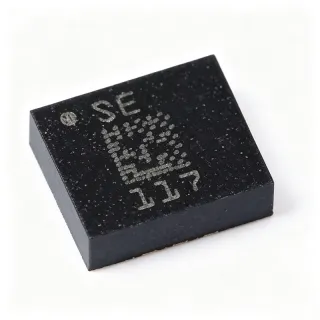
STM8S003F3P6TR - 8-bit MCU, 8KB Flash, 16MHz | STMicroelectronics
MPN: STM8S003F3P6TR ✓ Active| Qty | Unit Price | Extended |
|---|---|---|
| 1 | $0.85 | $0.85 |
| 10 | $0.76 | $7.60 |
| 100 | $0.68 | $68.00 |
| 500 | $0.61 | $305.00 |
| 1,000 | $0.55 | $550.00 |
STM8S003F3P6TR Overview
An 8-bit microcontroller (MCU) is a compact integrated circuit that contains a processor core, memory, and programmable input/output peripherals on a single chip. The STM8 core is an 8-bit CISC architecture designed for high code density and efficient performance in low-cost applications. As a member of the STM8S series, this MCU sits within the broader hierarchy of microcontrollers, which are themselves a subset of embedded processors used in everything from consumer electronics to industrial control systems.
Key features include 8KB of Flash program memory, 1KB of SRAM, and 640 bytes of true data EEPROM with write protection. The device integrates a 10-bit analog-to-digital converter (ADC) with up to 5 channels, a UART, SPI, and I2C interface, and a 16-bit timer with PWM capability. It also includes a watchdog timer, a clock security system, and a low-power mode to minimize energy consumption.
The STM8S003F3P6TR is built on a robust 8-bit architecture with a 3-stage pipeline, enabling most instructions to execute in a single clock cycle. The device supports a wide operating temperature range from -40°C to +85°C, making it reliable for industrial environments. The TSSOP-20 package offers a compact footprint of 6.4mm x 4.4mm, ideal for space-constrained PCB designs.
Typical applications include home appliances, small appliances, lighting control, power tools, and sensor interfaces. Its rich peripheral set and low cost make it a popular choice for high-volume consumer products where cost efficiency is paramount.
When designing with this MCU, ensure proper decoupling of the VDD pin with a 100nF capacitor placed close to the device. The NRST pin should be connected to VDD through a 100nF capacitor and a pull-up resistor to prevent spurious resets. For programming, the SWIM interface requires a single-wire connection, simplifying in-circuit programming.
This page synthesizes distributor pricing, drop-in alternatives, and practical design notes not found in the ST datasheet, providing engineers with a comprehensive resource for evaluating the STM8S003F3P6TR.
Drop-in alternatives for STM8S003F3P6TR — same package, pin-to-pin compatible. Different-package parts requiring PCB rework are excluded.
Variants in this series
Same-series models that are drop-in compatible with STM8S003F3P6TR (same form factor and footprint) — differing in ADC Resolution, Core, Package.
Quick Comparison Tool — Select alternative parts for side-by-side comparison:
STM8S003F3P6
✅ Drop-In✓ In Stock
$0.36 / Unit
View Datasheet →STM8S003K3T6C
✅ Drop-In📋 Reference alternative (not in catalog)
STM8S103F3P6
✅ Drop-In📋 Reference alternative (not in catalog)
STM8S003F3P6TR Maximum Ratings & Electrical Characteristics
| Core | STM8 8-bit CISC |
| Maximum Clock Frequency | 16 MHz |
| Flash Memory | 8 KB |
| RAM | 1 KB |
| EEPROM | 640 bytes |
| Supply Voltage | 2.95 V to 5.5 V |
| ADC Resolution | 10-bit |
| ADC Channels | 5 |
| UART | 1 |
| SPI | 1 |
| I2C | 1 |
| Timers | 1x 16-bit, 1x 8-bit |
| Operating Temperature | -40C to +85C |
| Package | TSSOP-20 |
| Mounting Type | Surface Mount |
| RoHS Status | Compliant |
STM8S003F3P6TR Pin Configuration
| Pin 1 | PD4 — Port D4, general purpose I/O |
| Pin 2 | PD5 — Port D5, general purpose I/O |
| Pin 3 | PD6 — Port D6, general purpose I/O |
| Pin 4 | NRST — Reset input, active low |
| Pin 5 | PA1 — Port A1, general purpose I/O |
| Pin 6 | PA2 — Port A2, general purpose I/O |
| Pin 7 | VSS — Ground |
| Pin 8 | VDD — Power supply |
| Pin 9 | PA3 — Port A3, general purpose I/O |
| Pin 10 | PB4 — Port B4, general purpose I/O |
| Pin 11 | PB5 — Port B5, general purpose I/O |
| Pin 12 | PC3 — Port C3, general purpose I/O |
| Pin 13 | PC4 — Port C4, general purpose I/O |
| Pin 14 | PC5 — Port C5, general purpose I/O |
| Pin 15 | PC6 — Port C6, general purpose I/O |
| Pin 16 | PC7 — Port C7, general purpose I/O |
| Pin 17 | PD1/SWIM — Single wire interface module |
| Pin 18 | PD2 — Port D2, general purpose I/O |
| Pin 19 | PD3 — Port D3, general purpose I/O |
| Pin 20 | PA0 — Port A0, general purpose I/O |
Typical Applications
STM8S003F3P6TR is suitable for 6 applications: Home Appliances, Lighting Control, Power Tools, Sensor Interfaces, Consumer Electronics, Industrial Control.
Home Appliances
The STM8S003F3P6TR is ideal for home appliances such as washing machines, microwaves, and air conditioners. Its 8KB Flash and 1KB RAM are sufficient for control algorithms, while the 10-bit ADC reads temperature and pressure sensors. The UART interface enables communication with user interfaces or external modules. The wide operating voltage range (2.95V to 5.5V) ensures compatibility with common power supplies. The low-power modes help meet energy efficiency standards. In a typical appliance, the MCU manages relay drivers, reads keypad inputs, and drives LED indicators. The 16-bit timer generates PWM for motor speed control or heater duty cycles. The robust design and -40°C to +85°C temperature range ensure reliable operation in demanding environments. Compared to more powerful MCUs, the STM8S003F3P6TR offers a cost-effective solution without sacrificing essential features. Its small TSSOP-20 package saves PCB space, enabling compact appliance designs. The SWIM interface simplifies firmware updates during production and field service.
Recommended
Lighting Control
The STM8S003F3P6TR is well-suited for lighting control systems, including LED dimmers and smart lighting. Its 16-bit timer with PWM output can generate high-frequency dimming signals, while the ADC reads ambient light sensors for automatic brightness adjustment. The I2C interface allows connection to digital potentiometers or color sensors. The MCU's low-power modes are beneficial for battery-powered or energy-harvesting lighting nodes. In a typical LED driver, the STM8S003F3P6TR reads a potentiometer or receives commands via UART, then adjusts the PWM duty cycle to control LED brightness. The 8KB Flash stores calibration data and user settings. The device's 5V tolerance on I/O pins simplifies interfacing with LED drivers. The compact TSSOP-20 package fits into small form-factor lighting modules. The wide operating voltage range supports both 3.3V and 5V systems. The STM8S003F3P6TR's cost-effectiveness makes it a popular choice for high-volume lighting products. Its reliability and long-term availability ensure stable supply for mass production.
Recommended
Power Tools
The STM8S003F3P6TR is used in power tools for motor control, battery monitoring, and safety features. Its 10-bit ADC monitors battery voltage and current, while the 16-bit timer generates PWM for brushless DC motor control. The UART interface can communicate with a host for diagnostics. The MCU's robust design handles the harsh electrical environment of power tools, including voltage spikes and vibration. In a typical cordless drill, the STM8S003F3P6TR reads the trigger position via ADC, controls the motor speed via PWM, and monitors battery temperature. The 8KB Flash stores motor control algorithms and safety routines. The device's low-power modes extend battery life during idle periods. The wide operating temperature range (-40°C to +85°C) ensures reliable operation in outdoor or industrial settings. The TSSOP-20 package is compact enough for the tight spaces inside tool housings. The STM8S003F3P6TR's cost-effectiveness is critical for competitive power tool pricing. Its integrated EEPROM stores calibration and usage data, enhancing product functionality.
Recommended
Sensor Interfaces
The STM8S003F3P6TR excels as a sensor interface hub, reading analog and digital sensors and transmitting data via UART, SPI, or I2C. Its 10-bit ADC with 5 channels can interface with multiple analog sensors, while the SPI and I2C interfaces connect to digital sensors like temperature, humidity, and pressure sensors. The MCU's low-power modes are ideal for battery-powered sensor nodes. In a typical environmental monitoring system, the STM8S003F3P6TR reads a temperature sensor via I2C, a humidity sensor via SPI, and an analog light sensor via ADC, then transmits the data over UART to a gateway. The 8KB Flash stores sensor calibration coefficients and communication protocols. The device's 5V tolerance simplifies interfacing with various sensor modules. The compact TSSOP-20 package allows for small sensor board designs. The wide operating voltage range supports both 3.3V and 5V sensors. The STM8S003F3P6TR's cost-effectiveness makes it suitable for large-scale sensor deployments. Its robust EEPROM ensures data retention across power cycles.
Recommended
Consumer Electronics
The STM8S003F3P6TR is widely used in consumer electronics such as remote controls, toys, and small appliances. Its low cost and rich peripheral set make it ideal for high-volume products. The UART interface enables communication with other devices, while the ADC reads user inputs like potentiometers. The MCU's low-power modes extend battery life in portable devices. In a typical TV remote control, the STM8S003F3P6TR scans the keypad matrix, encodes the key presses, and transmits IR signals via a timer-generated carrier frequency. The 8KB Flash stores the IR code library. The device's 5V tolerance allows direct connection to IR LEDs and photodiodes. The compact TSSOP-20 package fits into slim remote control designs. The wide operating voltage range supports 2xAA or 3xAAA battery configurations. The STM8S003F3P6TR's cost-effectiveness is crucial for consumer products with tight margins. Its reliable operation and long-term availability ensure product longevity.
Recommended
Industrial Control
The STM8S003F3P6TR is employed in industrial control systems for monitoring and control tasks. Its robust design and wide temperature range make it suitable for factory automation. The ADC reads process variables like temperature and pressure, while the UART communicates with PLCs or HMIs. The 16-bit timer generates precise PWM for actuator control. In a typical industrial temperature controller, the STM8S003F3P6TR reads a thermocouple via ADC, implements a PID control algorithm, and outputs a PWM signal to a heater. The 8KB Flash stores the control algorithm and configuration parameters. The device's EEPROM retains settings across power cycles. The MCU's 5V tolerance simplifies interfacing with industrial sensors and actuators. The TSSOP-20 package is suitable for DIN-rail mount modules. The wide operating voltage range (2.95V to 5.5V) accommodates industrial power supplies. The STM8S003F3P6TR's cost-effectiveness is beneficial for distributed control nodes. Its reliability in harsh environments ensures minimal downtime.
Recommended
Recommended Products Summary
Engineering reference data for STM8S003F3P6TR — comparison, design guidance, and compliance information.
Selection Guide
Comparison with Alternatives
| Parameter | This Product | STM8S003F3P6 | STM8S003K3T6C | STM8S103F3P6 |
|---|---|---|---|---|
| Package | TSSOP-20 | TSSOP-20 - same | TSSOP-20 - same | TSSOP-20 - same |
| Flash Memory | 8 KB | 8 KB | 8 KB | 8 KB |
| RAM | 1 KB | 1 KB | 1 KB | 1 KB |
| EEPROM | 640 bytes | 640 bytes | 640 bytes | 640 bytes |
| ADC Channels | 5 | 5 | 5 | 7 |
| UART | 1 | 1 | 1 | 2 |
| SPI | 1 | 1 | 1 | 1 |
| I2C | 1 | 1 | 1 | 1 |
| 16-bit Timers | 1 | 1 | 1 | 1 |
| Automotive Grade | No | No | No | No |
Key Differentiators
- Cost-effective 8-bit MCU with integrated EEPROM (vs STM8S103F3P6)
- Tape-and-reel packaging for automated assembly (vs STM8S003F3P6)
- Pin-compatible with STM8S103F3P6 for easy upgrades (vs STM8S103F3P6)
Design Notes
Decouple the VDD pin with a 100nF ceramic capacitor placed as close as possible to the pin, and a 1uF capacitor for bulk decoupling. The supply voltage range is 2.95V to 5.5V; ensure the supply is stable and within this range to avoid brown-out resets. The device has an internal brown-out reset (BOR) that monitors VDD and resets the MCU if the voltage drops below a threshold, but external filtering is still recommended for noisy environments.
For the NRST pin, connect a 100nF capacitor to ground and a 10k ohm pull-up resistor to VDD to prevent spurious resets from noise. The SWIM pin (PD1) is used for programming and debugging; keep the trace short and avoid routing high-speed signals nearby. For the crystal oscillator (if used), place the crystal and load capacitors close to the OSC pins and keep the traces short to minimize parasitic capacitance. Ensure a solid ground plane under the MCU to reduce EMI.
Do not leave unused I/O pins floating; configure them as outputs or enable internal pull-ups to reduce current consumption and avoid undefined states. The ADC input pins have a maximum input voltage of VDD; ensure external signals do not exceed this. When using the internal RC oscillator, note that accuracy is +/-2% over temperature, which may be insufficient for time-critical applications; use an external crystal for better accuracy. Also, the EEPROM has a limited write endurance (100k cycles), so avoid frequent writes in high-cycle applications.
Compliance Information
RoHS compliant per STMicroelectronics. Not AEC-Q100 qualified. Halogen-free status not specified in the provided data.