Produtos (20.000+)

MSP430F413IPMR - 8MHz 16-Bit Ultra-Low-Power MCU | Texas Instruments
MSP430F413IPMR

MSP430F413IPMR - 8MHz 16-Bit Ultra-Low-Power MCU | Texas Instruments

The Texas Instruments MSP430F413IPMR is an ultra-low-power 16-bit RISC microcontroller operating at 8 MHz, with 8 KB of Flash memory, 256 bytes of SRAM, and a 64-pin LQFP package. It includes 48 I/O ports, a timer, a comparator, and support for a 96-segment LCD display. The MSP430F413IPMR is designed for industrial, battery-powered, and portable measurement applications where low standby current and rapid wake-up behavior are important. An ultra-low-power microcontroller is a semiconductor designed to complete system tasks while minimizing energy use. The MSP430 architecture combines a 16-bit RISC CPU, 16-bit registers, constant-memory instructions, and five low-power modes to support portable measurement systems. Within the product hierarchy, the MSP430F413IPMR is a mixed-signal microcontroller combining embedded Flash, SRAM, general-purpose I/O, timing, comparison, and LCD-drive functions in one package. The device operates from a 2.7 V to 3.6 V supply and is rated for an industrial temperature range of -40 °C to 85 °C. Its 8 MHz maximum clock speed provides useful processing performance for sensor acquisition, control logic, and low-rate communications, while the 96-segment LCD capability can reduce the need for external display controllers. Five power-saving modes allow firmware to balance response time against battery consumption during intermittent operation. The 64-pin LQFP package exposes 48 I/O ports alongside power, clock, reset, analog, and LCD-related connections. This integration is valuable in handheld instruments, industrial panel meters, and compact sensor interfaces because one device can collect measurements, perform control calculations, and drive a local display. The manufacturer describes the MSP430 family as optimized for extended battery life in portable measurement applications. For new designs, engineers should review the MSP430F413 datasheet and device pin-description table before assigning every LQFP connection. Battery calculations should include both active-mode current and standby current under the intended clock, display, comparator, and peripheral conditions. Firmware should use the documented low-power-mode entry and wake-up sequence rather than relying on a generic sleep procedure. This product page combines the manufacturer specifications with practical guidance for portable instrumentation, LCD-based measurement products, low-power sensor nodes, and industrial control panels. It also explains the constraints involved when considering a drop-in replacement, including package, memory, peripheral, temperature-grade, and pin-function compatibility.

Cotação Contato
MSP430F415IPM - 8MHz 16-Bit MCU with 16KB Flash | Texas Instruments
MSP430F415IPM

MSP430F415IPM - 8MHz 16-Bit MCU with 16KB Flash | Texas Instruments

The Texas Instruments MSP430F415IPM is an ultra-low-power 16-bit mixed-signal microcontroller with an 8 MHz CPU, 16 KB of Flash memory, 512 bytes of SRAM, 48 I/O ports, and a 96-segment LCD driver in a 64-LQFP 10 x 10 mm package. It operates from a 2.7 V to 3.6 V supply and targets industrial measurement, metering, control, and portable instrument applications. An ultra-low-power microcontroller is a semiconductor designed to complete control tasks while minimizing energy consumption during active operation and idle periods. The MSP430 architecture belongs to the embedded microcontroller hierarchy and combines a 16-bit RISC CPU, 16-bit registers, constant-memory instruction execution, and five low-power operating modes. These characteristics make it useful where battery life, deterministic control, and compact peripheral integration are more important than high processor throughput. The MSP430F415IPM provides 16 KB of Flash for firmware, 512 bytes of SRAM for working data, a timer, a comparator, and a 96-segment LCD driver. Its 48 I/O pins support external sensing, control, and display interfaces. The 8 MHz maximum clock provides processing headroom for measurement and control tasks, while the integrated LCD and analog comparison functions can reduce the component count in handheld meters and industrial panel instruments. Five low-power modes support battery-conscious operation, and the manufacturer describes the architecture as optimized for extended battery life in portable measurement applications. The mixed-signal feature set allows software to process digital control functions alongside analog comparisons. According to the Texas Instruments product information, the device combines a powerful 16-bit RISC CPU with 16-bit registers and constant-memory execution, providing a compact platform for embedded signal acquisition and user-interface control. Typical uses include utility meters, industrial measurement panels, portable data loggers, handheld testers, sensor-conditioning systems, and low-power control boards. The 96-segment LCD capability is especially useful in devices that need a numeric or segmented display without requiring a graphical LCD controller. The 48 available I/O ports also allow designers to connect sensors, switches, relays, and communication peripherals while retaining local processing capability. Designers should verify the complete 64-pin signal assignment against the manufacturer datasheet and keep decoupling close to the power pins. Because the MCU operates from 2.7 V to 3.6 V, external sensors and interface circuits must use compatible voltage levels or appropriate level translation. Low-power performance also depends on firmware, because interrupt-driven sleep modes and peripheral clock control usually determine the final battery life. This page consolidates verified manufacturer and distributor information, distinguishes documented specifications from unavailable data, and provides application guidance and drop-in alternatives for engineers evaluating the MSP430F415IPM.

Cotação Contato
MSP430F417IPM - 8MHz 16-bit MCU 32KB Flash 96-seg LCD | TI
MSP430F417IPM

MSP430F417IPM - 8MHz 16-bit MCU 32KB Flash 96-seg LCD | TI

The Texas Instruments MSP430F417IPM is a 16-bit ultra-low-power mixed-signal microcontroller based on the MSP430x4xx CPU16 core, delivering 8 MHz performance with a 125 ns instruction cycle time, packaged in a 64-pin LQFP (PM, 10x10 mm). The device integrates 32 KB of Flash memory (32K x 8 + 256B), 1 KB of SRAM, a 96-segment LCD driver, a 16-bit timer, an analog comparator, and a Frequency-Locked Loop (FLL+). It operates from 1.8 V to 3.6 V, making it well suited for battery-powered applications. What is a mixed-signal microcontroller? It is a single-chip IC that combines an analog frontend with a digital microcontroller on one die. Within the broader taxonomy, the MSP430F417 is a microcontroller (MCU) -> 16-bit MCU -> ultra-low-power MCU -> mixed-signal MCU. These devices sit at the node between sensing (analog) and decision-making (digital), eliminating the need for a separate ADC, LCD driver, or comparator chip on the board. Key features include ultra-low-power consumption with active mode at 200 µA at 1 MHz and 2.2 V, standby mode of 0.7 µA, and off-mode (RAM retention) of 0.1 µA. Five power-saving modes and a wake-up time from standby of less than 6 µs allow the device to spend most of its life in deep sleep, extending battery life in portable measurement applications. The integrated LCD driver supports up to 96 segments, enabling direct connection to a glass LCD without an external charge pump or driver IC. The MSP430F417 architecture combines a 16-bit RISC CPU with 16-bit registers and constant generators, achieving maximum code efficiency in dense applications. The Scan Interface (Scan IF) module supports background diagnostics on analog sensor arrays without CPU intervention, while the FLL+ stabilizes the system clock across voltage and temperature variations. The 48 GPIO pins provide flexible peripheral routing. Typical applications include portable medical devices such as glucose meters and blood pressure monitors, battery-powered industrial sensor transmitters, electronic metering (electricity, gas, water), low-cost thermostats, and any product requiring an integrated glass LCD with multi-year battery life. The wide operating voltage range and ultra-low standby current also make the part attractive for energy-harvesting designs. Designers should note that the FLL+ reference must be selected from the internal REFO or an external 32.768 kHz crystal; bypassing this step can lead to unstable MCLK at startup. Programming is supported through TI's JTAG or Spy-Bi-Wire interface, and Code Composer Studio or IAR Embedded Workbench may be used for firmware development. This page synthesizes distributor pricing, drop-in alternatives, and practical design notes not found on the TI product page, with parametric tables drawn from the manufacturer datasheet.

Cotação Contato
MSP430F423IPM - 8MHz 16-Bit MCU with 3 ADCs | Texas Instruments
MSP430F423IPM

MSP430F423IPM - 8MHz 16-Bit MCU with 3 ADCs | Texas Instruments

Texas Instruments MSP430F423IPM is an 8 MHz, 16-bit mixed-signal microcontroller with three 16-bit sigma-delta ADCs, a 128-segment LCD interface, 8 KB Flash memory, 256 B RAM, and 48 I/O ports in a 64-LQFP 10x10 mm package. Designed for low-power sensing and measurement systems, it combines a 16-bit RISC CPU, frequency-locked-loop clocking, low-power operating modes, and LCD drive capability in one integrated device. A mixed-signal microcontroller is an embedded-control IC that combines a digital processor with analog or specialized sensing peripherals. In the broader electronics hierarchy, MSP430F423IPM belongs to the microcontroller class, then embedded processors, then semiconductor devices. Its integrated ADC channels reduce external signal-chain requirements, while the LCD interface supports compact instrumentation, metering, portable measurement, and industrial control panels. Key features include an 8 MHz maximum clock, three 16-bit sigma-delta ADCs, 8 KB Flash, 256 B RAM, 48 I/O ports, and a 2.7 V to 3.6 V supply range. The device also provides five power-saving modes, standby wake-up in less than 6 microseconds according to the verified distributor data, and a frequency-locked loop. These features support designs that need deterministic embedded control while limiting energy use during inactive periods. The MSP430 CPU16 uses a 16-bit RISC architecture with a stated 125 ns instruction-cycle time. Its mixed-signal peripherals are intended for sensors and low-bandwidth analog measurements where a sigma-delta ADC is appropriate. The integrated 128-segment LCD support is especially useful for meter, sensor, and handheld-instrument designs that need local numeric or graphical feedback without a separate display controller. Typical applications include low-power sensor nodes, industrial panel meters, portable measurement equipment, environmental monitoring, battery-powered instruments, and LCD-based control interfaces. The 48 I/O ports provide flexibility for external sensors, switches, indicators, communication interfaces, and actuators. The 2.7 V to 3.6 V operating supply range aligns the MCU with common 3.3 V embedded systems, while the 8 MHz clock supports control-loop and measurement-management tasks. For PCB design, preserve the package pin assignments and follow the manufacturer datasheet for decoupling, analog routing, LCD drive connections, and exposed or unused-pin treatment. Treat ADC signal conditioning, reference stability, and low-power transition sequencing as important validation points. Because the verified data does not provide a complete pin-level table, do not infer pin names from package position alone. This page combines the verified manufacturer product data, distributor specifications, lifecycle information, and practical application guidance. It also distinguishes verified facts from missing parameters and avoids presenting unverified electrical, pricing, or pinout values as datasheet specifications.

Cotação Contato
MSP430F423IPMR - 8MHz 16-Bit MCU with 3 ADCs | Texas Instruments (Tape & Reel)
MSP430F423IPMR

MSP430F423IPMR - 8MHz 16-Bit MCU with 3 ADCs | Texas Instruments (Tape & Reel)

Texas Instruments MSP430F423IPMR is an 8 MHz, 16-bit mixed-signal microcontroller with three 16-bit sigma-delta ADCs, a 128-segment LCD interface, 8 KB Flash memory, 256 B RAM, and 48 I/O ports in a 64-LQFP 10x10 mm package. Designed for low-power sensing and measurement systems, it combines a 16-bit RISC CPU, frequency-locked-loop clocking, low-power operating modes, and LCD drive capability in one integrated device. A mixed-signal microcontroller is an embedded-control IC that combines a digital processor with analog or specialized sensing peripherals. In the broader electronics hierarchy, MSP430F423IPMR belongs to the microcontroller class, then embedded processors, then semiconductor devices. Its integrated ADC channels reduce external signal-chain requirements, while the LCD interface supports compact instrumentation, metering, portable measurement, and industrial control panels. Key features include an 8 MHz maximum clock, three 16-bit sigma-delta ADCs, 8 KB Flash, 256 B RAM, 48 I/O ports, and a 2.7 V to 3.6 V supply range. The device also provides five power-saving modes, standby wake-up in less than 6 microseconds according to the verified distributor data, and a frequency-locked loop. These features support designs that need deterministic embedded control while limiting energy use during inactive periods. The MSP430 CPU16 uses a 16-bit RISC architecture with a stated 125 ns instruction-cycle time. Its mixed-signal peripherals are intended for sensors and low-bandwidth analog measurements where a sigma-delta ADC is appropriate. The integrated 128-segment LCD support is especially useful for meter, sensor, and handheld-instrument designs that need local numeric or graphical feedback without a separate display controller. Typical applications include low-power sensor nodes, industrial panel meters, portable measurement equipment, environmental monitoring, battery-powered instruments, and LCD-based control interfaces. The 48 I/O ports provide flexibility for external sensors, switches, indicators, communication interfaces, and actuators. The 2.7 V to 3.6 V operating supply range aligns the MCU with common 3.3 V embedded systems, while the 8 MHz clock supports control-loop and measurement-management tasks. For PCB design, preserve the package pin assignments and follow the manufacturer datasheet for decoupling, analog routing, LCD drive connections, and exposed or unused-pin treatment. Treat ADC signal conditioning, reference stability, and low-power transition sequencing as important validation points. Because the verified data does not provide a complete pin-level table, do not infer pin names from package position alone. This page combines the verified manufacturer product data, distributor specifications, lifecycle information, and practical application guidance. It also distinguishes verified facts from missing parameters and avoids presenting unverified electrical, pricing, or pinout values as datasheet specifications.

Cotação Contato
MSP430F425IPM - 8MHz 16-bit MCU with 3 Sigma-Delta ADCs | Texas Instruments
MSP430F425IPM

MSP430F425IPM - 8MHz 16-bit MCU with 3 Sigma-Delta ADCs | Texas Instruments

Texas Instruments MSP430F425IPM is an 8 MHz, 16-bit mixed-signal microcontroller designed for low-power sensing and measurement applications. It combines three 16-bit Sigma-Delta ADCs, 16 KB of Flash memory, 512 bytes of RAM, a 128-segment LCD driver, and 48 I/O ports in a 64-pin LQFP package. The device operates from a 1.8 V to 3.6 V supply range and is designed around the MSP430 RISC architecture with 16-bit registers and constant-memory instruction execution. A microcontroller is a programmable semiconductor that integrates a CPU, memory, and peripherals into one device. The MSP430 family is designed for portable measurement, industrial sensing, instrumentation, and battery-powered equipment where energy efficiency is important. MSP430F425IPM combines general-purpose digital control with dedicated analog conversion and LCD support, reducing the number of external components required in a typical measurement product. The MSP430F425IPM provides an 8 MHz maximum clock speed and five power-saving modes. The manufacturer lists active-mode current as 400 uA at 1 MHz and 3 V, standby current as 1.6 uA, and off-mode current with RAM retention as 0.1 uA. Its three Sigma-Delta ADCs are intended for sensors with relatively slow or high-resolution analog outputs, while the LCD driver can support segmented display applications without a separate display controller. The device includes 16 KB of Flash memory, described in distributor listings as 16K x 8 plus 256 bytes, and 512 bytes of RAM. Its 48 I/O ports provide flexibility for digital inputs, outputs, communication lines, and control signals. The 64-LQFP package is suitable for board-level designs that need broad I/O access and a conventional leaded package rather than a very small surface-mount footprint. Typical applications include precision sensor interfaces, industrial measurement instruments, portable data loggers, handheld test equipment, energy-monitoring products, and LCD-equipped control panels. The low-power architecture is particularly useful when the instrument spends most of its operating time between measurements. Engineers should select external passives and communication peripherals to match the required sensor bandwidth, display characteristics, and communication protocol. When laying out the circuit, place the MCU power pins, decoupling capacitors, analog reference connections, and LCD outputs according to the manufacturer pin-description and layout guidance. Keep sensitive analog and display traces away from high-current switching paths where practical. The MSP430F425IPM is identified as an active industrial-range device, making it suitable for designs that require low-power operation and integrated mixed-signal measurement functions. This product page combines the manufacturer device information, distributor package and ordering details, and application-focused design guidance. It highlights the MCU's principal selection criteria: 8 MHz operation, 1.8 V to 3.6 V supply, 16 KB Flash, 512 bytes of RAM, three Sigma-Delta ADCs, 128-segment LCD capability, and the 64-LQFP package.

Cotação Contato
MSP430F427IPM - 8MHz 16-Bit Mixed-Signal MCU | Texas Instruments
MSP430F427IPM

MSP430F427IPM - 8MHz 16-Bit Mixed-Signal MCU | Texas Instruments

Texas Instruments MSP430F427IPM is an 8 MHz, 16-bit mixed-signal microcontroller with 32KB of Flash memory, 1KB of RAM, three 16-bit Sigma-Delta ADCs, and a 128-segment LCD controller in a 64-LQFP (10x10 mm) package. Its operating supply range is 2.7 V to 3.6 V, and the device provides 48 I/O ports for embedded sensing, control, and display applications. A mixed-signal microcontroller is a semiconductor that combines a programmable digital controller with analog signal-conversion resources. In the MSP430 product hierarchy, the MSP430F427 belongs to the MSP430 mixed-signal microcontroller family. This combination places digital acquisition, control, and local display support on one device, reducing component count in instruments, industrial panels, and low-power embedded systems. The principal features include a 16-bit RISC MSP430 CPU operating at 8 MHz, 32KB of Flash program memory, 1KB of RAM, and three 16-bit Sigma-Delta ADC channels. The 128-segment LCD controller can drive segmented display applications, while the 48 I/O ports provide connections for sensors, control signals, and human-machine interfaces. A 2.7 V to 3.6 V operating range supports embedded systems designed around a 3.3 V supply. The MSP430 architecture uses 16-bit registers and constant generators to improve code efficiency. Its Sigma-Delta conversion resources are suited to measurement systems that prioritize low-noise acquisition over conversion speed. The integrated LCD capability also removes the need for a separate display controller in suitable instrument designs. The 64-LQFP package exposes the mixed-signal and digital resources while supporting conventional surface-mount assembly. Typical applications include industrial measurement panels, laboratory instruments, portable monitoring equipment, digital meters, sensor-interface controllers, and compact control panels. A design can use the ADC inputs for analog sensing, the GPIO for switches and actuators, and the LCD controller for local status display. Firmware coordination remains essential because analog sampling, display updates, and control tasks must share the available processing and memory resources. Designers should reserve suitable bypassing near the supply pins, validate ADC input ranges against the operating voltage, and confirm that the chosen LCD segment count matches the intended glass. The 1KB RAM constraint makes buffer management and firmware footprint important. The manufacturer product page and datasheet should be used to verify the complete pin description table and electrical limits before layout release. This product page combines the exact MSP430F427IPM characteristics, package information, lifecycle status, sourcing workflow, and verified compatibility analysis. It also distinguishes true pin-compatible replacements from order-code or functional alternatives, helping engineers make a defensible component decision before committing a PCB layout or firmware release.

Cotação Contato
MSP430F435IPN - 8MHz 16-Bit MCU, 16KB Flash | Texas Instruments
MSP430F435IPN

MSP430F435IPN - 8MHz 16-Bit MCU, 16KB Flash | Texas Instruments

The Texas Instruments MSP430F435IPN is an ultra-low-power 16-bit mixed-signal microcontroller with an 8 MHz MSP430 RISC core, 16 KB of Flash memory, 512 B of SRAM, a 12-bit ADC, comparator, SPI/UART interfaces, and support for a 160-segment LCD in an 80-pin LQFP (PN) package. Its 1.8 V to 3.6 V supply range supports low-voltage embedded systems where energy efficiency, compactness, and integrated analog measurement are important. A microcontroller is a programmable control IC that combines a processor core, memory, digital peripherals, and analog functions on one semiconductor device. The MSP430F435IPN belongs to the mixed-signal microcontroller category, where the processor coordinates embedded control while the ADC, comparator, communications interfaces, and LCD controller reduce the need for separate discrete components. Its architecture is therefore useful in battery-operated instruments, industrial sensing terminals, portable measurement equipment, and compact human-machine-interface controllers. Verified device features include a 16-bit RISC architecture, an operating frequency of 8 MHz, 16 KB of Flash, 512 B of SRAM, a 12-bit ADC, an internal comparator, SPI and UART connectivity, and LCD support for up to 160 segments. The low-power specification reports 280 µA active current at 1 MHz and 2.2 V, 1.1 µA standby current, and 0.1 µA off current with RAM retention. Wake-up from standby takes less than 6 µs, allowing short duty-cycle measurement systems to remain responsive without continuously consuming active-mode power. The MSP430 architecture uses a 16-bit RISC core with 16-bit registers and constant generators that support compact, efficient code. This combination is useful in embedded products that repeatedly perform sensor acquisition, control calculations, and serial communication. The integrated ADC enables analog-to-digital conversion without a separate converter, while SPI and UART provide paths for external sensors, transceivers, displays, and data-logging equipment. The LCD capability is particularly relevant to local segment-display interfaces that do not require a graphical display. Typical uses include handheld meters, portable environmental monitors, industrial control modules, battery-powered readers, and embedded measurement systems. The 80-pin LQFP (PN) package provides more I/O and peripheral connectivity than a small-outline package, making the device suitable for designs that need several external interfaces while retaining a leaded, inspectable package option. Designers should verify the exact pin functions and LCD segment assignments against the manufacturer datasheet before layout because the supplied source summaries do not publish a complete 80-pin map. Decoupling, analog grounding, LCD biasing, and ADC-source impedance should also follow the datasheet layout guidance. The operating-temperature range for this orderable variant is -40 °C to +85 °C. This page consolidates verified manufacturer and distributor information, a package-aware replacement assessment, pricing-status disclosures, application guidance, and practical design cautions so engineers can evaluate the MSP430F435IPN without assuming unverified pin or lifecycle details.

Cotação Contato
MSP430F435IPZ - 8MHz 16-Bit MCU with 16KB Flash | Texas Instruments
MSP430F435IPZ

MSP430F435IPZ - 8MHz 16-Bit MCU with 16KB Flash | Texas Instruments

The Texas Instruments MSP430F435IPZ is an 8 MHz, 16-bit mixed-signal microcontroller with 16KB Flash memory, 512B SRAM, a 12-bit ADC, comparator, SPI/UART interface, and support for a 160-segment LCD. The device is housed in a 100-pin LQFP (PZ) package measuring 14 mm by 14 mm and operates across a stated -40°C to 85°C temperature range. A mixed-signal microcontroller is an embedded semiconductor that combines a digital processor core with analog or specialized peripheral functions. In the MSP430 product hierarchy, the device belongs to the MSP430 family of 16-bit RISC microcontrollers, while its integrated ADC and comparator place it in the mixed-signal MCU category. This combination allows a single embedded controller to acquire analog measurements, process data, drive a segmented display, and communicate with external equipment. The verified feature set includes a maximum clock frequency of 8 MHz, 16KB of Flash program memory, 512B of SRAM, a 12-bit ADC, an on-chip comparator, SPI and UART connectivity, and LCD support for up to 160 segments. The 512B SRAM supports local variables, stacks, buffers, and peripheral state, while the 16KB Flash provides room for embedded firmware. Exact supply-voltage, converter, and peripheral timing values beyond the supplied data require confirmation in the manufacturer datasheet. The MSP430F435IPZ uses the MSP430 CPU16 architecture and integrates several peripherals around a 16-bit RISC core. The 12-bit ADC is suited to measuring analog sensor outputs, the comparator supports threshold and simple signal-detection tasks, and the SPI/UART interfaces provide serial paths for displays, data loggers, sensors, and external converters. The 160-segment LCD capability is particularly useful in instruments and control panels where a dedicated display controller would add cost and board area. Typical uses include portable measurement instruments, industrial panel meters, handheld readers, low-power environmental monitors, and embedded control equipment with local LCD feedback. Engineers can use the ADC and comparator for sensor acquisition, the serial interfaces for peripheral expansion, and the MSP430 architecture for compact control firmware. Because the exact electrical limits are not present in the supplied verified snippets, production designs should validate supply range, pin multiplexing, and timing against the official datasheet. The principal design consideration is PCB complexity. A 100-pin LQFP is substantially larger and has more fine-pitch connections than a small-outline MCU package, but it exposes the full peripheral complement and supports a 14 mm by 14 mm footprint. Layout should provide a continuous ground plane, short analog inputs, clean separation between sensitive ADC circuitry and switching nodes, and careful decoupling near the device supply pins. This page consolidates the verified manufacturer, distributor, and cross-reference information with package, application, procurement, and design guidance. It also distinguishes directly identified alternatives from compatibility claims that still require datasheet and firmware verification before production use.

Cotação Contato
MSP430F436IPN - 8MHz 16-Bit 24KB Flash MCU | Texas Instruments
MSP430F436IPN

MSP430F436IPN - 8MHz 16-Bit 24KB Flash MCU | Texas Instruments

The Texas Instruments MSP430F436IPN is a 16-bit ultra-low-power mixed-signal microcontroller with an 8 MHz MSP430 CPU, 24 KB of Flash memory, 1 KB of SRAM, a 12-bit ADC, comparator, SPI/UART, and support for a 160-segment LCD. The device is packaged in an 80-pin LQFP (PN) package measuring 12 mm by 12 mm. Its combination of low power consumption, mixed-signal peripherals, and LCD-oriented I/O makes it suitable for industrial instrumentation, portable measurement equipment, meters, sensor nodes, and embedded control systems. An ultra-low-power microcontroller is a semiconductor device designed to conserve energy while executing embedded control and measurement functions. The MSP430 architecture combines a 16-bit RISC CPU, 16-bit registers, constant generators, and multiple low-power operating modes to reduce energy use in systems that spend substantial time waiting for external events. The MSP430F436IPN sits within the MSP430 mixed-signal family hierarchy: MCU, embedded microcontroller, mixed-signal microcontroller, and semiconductor. The most important verified specifications are the 8 MHz operating frequency, 24 KB Flash configuration, 1 KB SRAM, 12-bit ADC, comparator, SPI/UART connectivity, and 160-segment LCD capability. The Flash includes 24 KB of program storage plus 256 bytes as identified by the distributor listing, while the device uses 1 KB of SRAM for working data. The integrated ADC and comparator support analog measurement and thresholding without requiring separate discrete components, while serial interfaces provide connectivity to sensors, transceivers, and external data converters. The MSP430F436IPN uses the MSP430 CPU16 core and is specifically associated with the MSP430x4xx mixed-signal controller family. Its 80-pin LQFP package provides substantially more I/O than smaller microcontroller packages and is appropriate for designs requiring multiple LCD segments, analog inputs, serial communication, and general-purpose digital control. The LCSC product listing identifies an operating temperature range of -40 °C to +85 °C for this device. Typical applications include industrial panel meters, handheld multimeters, environmental and sensor monitoring devices, energy measurement equipment, portable medical or laboratory instruments, and low-power embedded controllers. In a meter design, the ADC and comparator can support analog front-end supervision while the LCD controller drives the display and SPI or UART provides communication with a host or sensor network. Designers should confirm the exact pin multiplexing, power requirements, clock configuration, ADC operating conditions, and display segment assignments against the manufacturer datasheet before layout. Decoupling, analog grounding, LCD bias generation, and unused-pin handling are important for reliable operation. Because the device combines precision measurement functions with extensive LCD and digital I/O, PCB layout should separate sensitive analog routing from switching and high-current paths. This page consolidates verified distributor pricing, manufacturer feature summaries, package information, comparison parameters, and application guidance for engineers evaluating the MSP430F436IPN. It is intended to support component selection and board-level planning, while the manufacturer datasheet remains the controlling source for electrical limits, timing, pin multiplexing, and production implementation.

Cotação Contato
MSP430F436IPZ - 8MHz 16-Bit MCU with 24KB Flash | Texas Instruments
MSP430F436IPZ

MSP430F436IPZ - 8MHz 16-Bit MCU with 24KB Flash | Texas Instruments

The Texas Instruments MSP430F436IPZ is an 8 MHz, 16-bit mixed-signal microcontroller with 24 KB of Flash memory, 1 KB of SRAM, a 12-bit ADC, comparator, SPI/UART connectivity, and 160-segment LCD support in a 100-pin LQFP (PZ) package. It combines an MSP430 CPU with embedded analog and mixed-signal peripherals for low-power instrumentation and control designs. A microcontroller is a programmable integrated circuit that combines a CPU, memory, and peripherals on one semiconductor device. The MSP430F436 belongs to the MSP430 mixed-signal microcontroller family, where the MSP430x4xx architecture adds higher-performance mixed-signal capabilities while retaining the low-power design focus of the MSP430 product line. Its 16-bit RISC core uses 16-bit registers and constant generators for efficient control operations. Key features include an 8 MHz maximum clock, 24 KB of programmable Flash, 1 KB of SRAM, and 48 I/O pins. The mixed-signal resources include a 12-bit ADC and comparator, while communications and timing resources include SPI, UART/USART, PWM, watchdog timer, and brown-out detection/reset. A 160-segment LCD driver supports display-oriented industrial, meter, and measurement equipment. The MSP430 architecture is designed around low-power operation, making the device suitable for battery-operated and intermittently powered products. Peripherals and the CPU can be controlled to reduce activity when measurements are not required. The 100-pin LQFP package provides substantially more I/O and peripheral routing flexibility than smaller microcontroller packages, although its 14 mm by 14 mm body requires more PCB area than compact QFN options. Typical applications include industrial panel meters, data loggers, portable measurement instruments, environmental monitoring equipment, battery-powered sensors, and LCD-driven control panels. The ADC supports analog measurement, the comparator supports threshold-based detection, and SPI or UART/USART provides a path to external sensors, memory, displays, or host systems. The integrated LCD capability is especially useful for local numeric or segmented status displays. Designers should verify the exact pin assignments, analog input multiplexing, LCD segment mapping, and peripheral channel allocation against the manufacturer pinout before PCB routing. The LQFP perimeter is fine-pitch, so careful pad design, solder mask control, and assembly inspection are important. Firmware should also account for the MSP430 clock setup, ADC conversion sequence, brown-out behavior, and low-power state transitions. This product page combines verified manufacturer and distributor specifications, same-family replacement analysis, package details, and practical design guidance. It is intended to help engineers confirm whether the MSP430F436IPZ matches the required memory, analog, communications, display, package, and low-power requirements before procurement or layout release.

Cotação Contato
MSP430F437IPN - 8MHz 16-Bit LCD MCU | Texas Instruments
MSP430F437IPN

MSP430F437IPN - 8MHz 16-Bit LCD MCU | Texas Instruments

Texas Instruments MSP430F437IPN is an 8 MHz, 16-bit mixed-signal microcontroller with 32 KB Flash, 1 KB SRAM, a 12-bit ADC, a comparator, SPI and UART interfaces, and support for a 160-segment LCD. The device is packaged in an 80-pin LQFP (PN) measuring 12 mm by 12 mm and is specified for operation from -40°C to 85°C. A mixed-signal microcontroller is a semiconductor that combines a digital processor core with analog measurement and interface functions. The MSP430 belongs to the MCU → 16-bit RISC microcontroller → embedded controller → mixed-signal semiconductor hierarchy. This integration lets a single MSP430F437IPN sample analog signals, control system logic, communicate through serial links, and drive segmented displays while reducing the number of discrete components required. The principal features include an MSP430 CPU16 processor operating at 8 MHz, 32 KB of Flash memory organized as 32K × 8 plus 256 bytes, 1 KB of SRAM, and a 12-bit ADC. The device also provides a comparator, SPI, UART, and a 160-segment LCD interface. Its operating range of 1.8 V to 3.6 V suits low-voltage embedded systems, while the industrial temperature range supports applications across industrial equipment, instrumentation, and control panels. The MSP430 architecture combines a 16-bit RISC core with mixed-signal peripherals and multiple low-power operating modes. Flash permits firmware and constants to be retained in the device, while SRAM supports working data and stack operations. The ADC and comparator allow analog front ends to share a processor with digital communication functions, reducing component count and simplifying firmware coordination. Typical applications include industrial measurement panels, portable instrumentation, energy-monitoring equipment, data loggers, LCD-based control systems, and embedded sensor nodes. SPI can support external sensors or memory, UART can provide a host or service interface, and the LCD controller can directly drive a segmented display. These functions are especially useful where a compact control panel must combine local visualization with serial communications. When designing around the MSP430F437IPN, preserve the 80-pin LQFP footprint, provide all required bypass capacitors close to the supply pins, and verify LCD segment mapping against the selected display. The 1.8 V to 3.6 V supply range also requires attention to sensor, ADC-reference, and communication-interface voltage limits. This product record combines the manufacturer’s ordering information, memory and peripheral details, low-voltage operating characteristics, package dimensions, and practical implementation guidance. It also identifies same-footprint MSP430 family alternatives and highlights the engineering checks required when changing between closely related mixed-signal microcontrollers.

Cotação Contato
MSP430F437IPZ - 8MHz 16-Bit MCU | Texas Instruments
MSP430F437IPZ

MSP430F437IPZ - 8MHz 16-Bit MCU | Texas Instruments

The Texas Instruments MSP430F437IPZ is an 8 MHz, 16-bit mixed-signal microcontroller with 32KB Flash, 1KB SRAM, a 12-bit ADC, comparator, SPI/UART, and 160-segment LCD support in a 100-pin LQFP package. It combines an MSP430 CPU16 RISC core with embedded analog and serial peripherals, making it suitable for low-power industrial, measurement, control, and instrumented applications. Its specified operating temperature range is -40°C to +85°C. A mixed-signal microcontroller is an embedded controller that integrates digital processing with analog conversion or analog comparison functions. In the hierarchy of embedded semiconductors, the MSP430F437IPZ belongs to the microcontroller family, combining a general-purpose CPU, nonvolatile program memory, SRAM, and peripherals on one device. Its 12-bit ADC supports analog measurement, while the comparator and LCD interface broaden the range of sensor, control-panel, and industrial instrument designs that can be handled without additional discrete components. The principal feature set includes an 8 MHz maximum clock, 32KB Flash memory, and 1KB SRAM. The DigiKey listing identifies the Flash organization as 32K × 8 plus 256 bytes. Serial connectivity includes SPI and UART, and the device supports up to 160 LCD segments, reducing the need for an external display driver in segment-oriented human-interface designs. The 100-pin LQFP PZ package exposes substantially more I/O and peripheral resources than the smaller MSP430 packages. The MSP430 architecture uses a 16-bit RISC core with 16-bit registers and constant generators designed to improve code efficiency. Rather than requiring a separate ADC, display interface, and communication controller, this device consolidates those functions around a low-power embedded platform. The exact ADC conversion rate, timer resources, supply-voltage limits, and detailed peripheral electrical characteristics should be confirmed in the manufacturer datasheet before a new design is released. Typical applications include industrial sensor acquisition, portable measurement instruments, low-power data loggers, serial-connected control modules, and LCD-based operator panels. The integrated ADC is useful when the system must monitor analog inputs, while UART and SPI provide paths to external sensors, converters, displays, or storage devices. The 160-segment LCD capability is particularly relevant to compact metering and monitoring equipment. When designing around the MSP430F437IPZ, verify the complete pin assignment, supply requirements, ADC reference configuration, and programming interface against the official datasheet. Decoupling, analog grounding, and LCD or serial signal routing should follow the layout recommendations in the manufacturer documentation. Firmware and peripheral configurations should also be validated at the intended 8 MHz operating condition. This product page consolidates verified manufacturer and distributor information, package and ordering data, cross-reference alternatives, and practical selection guidance. It is intended to help engineers identify the correct MSP430 device, understand its verified capabilities, and evaluate replacement options without treating unreported electrical details as guaranteed specifications.

Cotação Contato
MSP430F438IPN - 8MHz 16-Bit MCU with 48KB Flash | TI
MSP430F438IPN

MSP430F438IPN - 8MHz 16-Bit MCU with 48KB Flash | TI

The Texas Instruments MSP430F438IPN is an 8 MHz, 16-bit mixed-signal microcontroller with 48 KB of Flash memory, 2 KB of SRAM, a 12-bit ADC, a comparator, SPI/UART interfaces, and support for a 128-segment LCD in an 80-pin LQFP package. The MSP430 CPU16 architecture combines a reduced instruction set computer core with extensive mixed-signal resources for low-power embedded control, industrial instrumentation, metering, and portable measurement systems. A mixed-signal microcontroller is a semiconductor that integrates a digital processing core with analog measurement and output resources on one device. The MSP430 family belongs to the hierarchy of microcontroller, embedded processor, and semiconductor products. Its 16-bit RISC architecture, timer resources, communication peripherals, and low-power operating modes allow a compact design to acquire analog signals, process them locally, communicate with external equipment, and control an output without requiring a separate analog front end or communications processor. The verified device specification identifies an 8 MHz maximum clock, 48 KB Flash, 2 KB SRAM, a 12-bit ADC, comparator, SPI, UART, and 128-segment LCD support. The MSP430F438IPN operates from -40°C to +85°C and is supplied in an 80-pin LQFP (PN) package measuring 12 mm by 12 mm. The large package exposes the mixed-signal, communication, timer, debug, and LCD-related resources needed by applications with numerous external connections. The CPU16 core is designed for efficient control and measurement workloads. Its 16-bit arithmetic and register organization support compact data handling, while the integrated ADC allows an analog sensor to be digitized without a separate converter. Comparator and timer resources can support threshold detection, event timing, motor control, and periodic sampling. SPI and UART connectivity permits connection to sensors, displays, data loggers, wireless modules, and service interfaces. Typical uses include industrial panel meters, portable environmental monitors, laboratory instruments, data acquisition front ends, and embedded measurement equipment with segmented displays. The 128-segment LCD capability is particularly useful for compact numeric or alphanumeric instrument panels where a dot-matrix display would be unnecessarily costly or power-hungry. A system can therefore place sensing, local processing, human-interface feedback, and serial communication in one controller. When designing around this MCU, verify every peripheral signal against the manufacturer datasheet and provide adequate decoupling, programming access, reset behavior, and analog-input conditioning. The 80-pin LQFP footprint is relatively large compared with modern QFN packages, so the choice should account for board area and assembly cost. Firmware should also include brownout, watchdog, and clock-startup safeguards when field reliability is important. This page consolidates verified manufacturer and distributor information, package details, procurement data, selection guidance, and engineering considerations that help distinguish the MSP430F438IPN from related MSP430 devices without implying unverified drop-in replacements.

Cotação Contato
MSP430F439IPN - 8MHz 16-Bit MCU with 60KB Flash | Texas Instruments
MSP430F439IPN

MSP430F439IPN - 8MHz 16-Bit MCU with 60KB Flash | Texas Instruments

Texas Instruments MSP430F439IPN is an 8 MHz mixed-signal microcontroller with a 16-bit RISC CPU, 60 KB of Flash program memory, 2 KB of SRAM, a 12-bit ADC, a comparator, SPI and UART interfaces, and support for a 128-segment LCD in an 80-pin LQFP package. The device combines embedded control, analog measurement, and low-power operation in a single integrated circuit designed for portable instruments and industrial measurement systems. A mixed-signal microcontroller is an embedded controller that combines a digital processor with analog and communication peripherals. The MSP430 architecture belongs to the microcontroller, embedded-controller, and semiconductor hierarchies and uses a 16-bit RISC processor with 16-bit registers. This allows the MSP430F439 to acquire analog measurements, process data, and communicate through serial interfaces while retaining multiple low-power operating modes for battery-powered equipment. Principal features include an 8 MHz maximum clock, 60 KB of Flash memory, 2 KB of SRAM, 48 I/O pins, a 12-bit ADC, an analog comparator, SPI and UART connectivity, and a 128-segment LCD controller. Five power-saving modes are available, supporting applications in which the controller must remain responsive while minimizing energy consumption. The broad peripheral set reduces the need for external analog, interface, and display-support devices in compact designs. The 16-bit CPU16 architecture is suitable for sensor acquisition, signal conditioning, control loops, and local data handling. The integrated 12-bit ADC provides the measurement channel needed for battery, industrial process, or portable diagnostic equipment, while the comparator supports threshold-based sensing. SPI and UART provide paths to external sensors, transceivers, storage devices, and service interfaces without requiring a dedicated communications controller. Typical applications include portable environmental monitors, industrial process-control panels, battery-powered test instruments, multi-channel sensor acquisition systems, data loggers, and embedded metering products. A dedicated 128-segment LCD controller is particularly useful for local numerical or status displays, allowing measured values and operating states to be shown without an additional display controller. Designers should review the device's power-mode timing, analog-input requirements, and I/O assignments in the manufacturer datasheet. Keep analog and digital return paths organized, place input filtering close to the device, and confirm external-component requirements for the selected precision reference and operating voltage. The 80-pin LQFP footprint also requires adequate board area and careful fanout for the analog, communications, display, and debug connections. This product overview combines the manufacturer device specifications, package details, functional architecture, application guidance, and drop-in comparison information in one engineering-focused reference. It is intended to help engineers identify whether the MSP430F439IPN provides the required memory, analog resources, display support, interfaces, and low-power behavior before completing a PCB or firmware design.

Cotação Contato
MSP430F447IPZ - 8MHz 16-Bit MCU with 32KB Flash | Texas Instruments
MSP430F447IPZ

MSP430F447IPZ - 8MHz 16-Bit MCU with 32KB Flash | Texas Instruments

The Texas Instruments MSP430F447IPZ is an 8 MHz 16-bit mixed-signal microcontroller with 32KB Flash memory, 1KB SRAM, a 12-bit ADC, comparator, SPI/UART, and 160-segment LCD support in a 100-LQFP package. It combines an MSP430 RISC CPU with low-power operating modes for portable measurement and embedded control systems. A mixed-signal microcontroller integrates a digital processor with analog conversion and comparison functions on one device. The MSP430 architecture belongs to the microcontroller, embedded processor, and semiconductor hierarchy, while its ADC, comparator, serial interfaces, and LCD driver make it especially useful for battery-powered instruments, panel meters, and industrial sensing equipment. Key features include an 8 MHz maximum clock, 32KB Flash organized as 32K x 8 plus 256 bytes, 1KB SRAM, a 12-bit ADC, an internal comparator, SPI and UART connectivity, and support for up to 160 LCD segments. These resources allow firmware to combine acquisition, signal conditioning, display driving, and serial communication without requiring several discrete devices. The MSP430 CPU uses a 16-bit RISC architecture with 16-bit registers and constant generators. Its mixed-signal peripherals support sampled data acquisition and threshold comparison, while the LCD controller reduces the external display-driver burden for segmented instruments. The manufacturer describes the family as optimized for low-power portable measurement applications, with five low-power modes available for duty-cycled operation. Typical uses include digital multimeters, environmental monitors, portable industrial meters, panel instruments, and connected measurement equipment. The combination of 32KB Flash, 1KB SRAM, ADC, comparator, UART, SPI, and segmented LCD support is particularly useful when a compact embedded design must collect analog measurements, apply thresholds, update a local display, and exchange data with a host. Designers should allocate pins and firmware carefully for LCD segments, analog inputs, serial interfaces, and mixed-signal grounding. Follow the pin-description table in the manufacturer datasheet when assigning tracks, and keep analog and digital return currents separated where the application board layout permits. Verify the operating voltage, temperature grade, and peripheral configuration for the exact ordering code before production release. This product page combines the device specifications, pin-package information, functional alternatives, and engineering-oriented comparison notes to support faster component selection and board-level planning.

Cotação Contato
MSP430F448IPZ - 8MHz 48KB MCU | Texas Instruments
MSP430F448IPZ

MSP430F448IPZ - 8MHz 48KB MCU | Texas Instruments

The Texas Instruments MSP430F448IPZ is a 16-bit mixed-signal microcontroller with an 8 MHz MSP430 CPU, 48 KB of flash memory, 2 KB of SRAM, and a 12-bit ADC, packaged in a 100-pin LQFP (PZ). The device also integrates a comparator, SPI and UART interfaces, and support for a 160-segment LCD. Its operating-voltage range is 1.8 V to 3.6 V. A mixed-signal microcontroller combines a programmable digital controller with analog measurement functions on one integrated circuit. The MSP430F448 belongs to the MSP430 family of ultra-low-power RISC microcontrollers, where the CPU core, memory, timers, serial interfaces, and analog peripherals share a low-power architecture. The 16-bit RISC instruction set and 16-bit registers support efficient control workloads, while hardware peripherals allow measurements and communications to continue without excessive software overhead. Key features include an 8 MHz maximum clock frequency, 48 KB flash for firmware storage, 2 KB SRAM for working data, and a 12-bit ADC for analog sensing. The integrated comparator supports threshold-based signal detection, while SPI and UART provide wired peripheral connectivity. According to the manufacturer datasheet, active-mode current is 280 uA at 1 MHz and 2.2 V, standby current is 1.1 uA, and RAM-retention off-mode current is 0.1 uA. Wake-up from standby takes less than 6 us. The MSP430 architecture is based on a 16-bit RISC core with 16-bit registers and constant generators. Five power-saving modes let firmware balance response time against energy use, which is particularly valuable in battery-operated measurement equipment. The 12-bit ADC and comparator place analog input conditioning and digital control in the same device, while the LCD controller can drive up to 160 segments without requiring a separate display controller. The integrated communication peripherals reduce board area in compact instruments. Typical applications include low-power industrial measurement systems, portable environmental monitors, digital multimeters, data loggers, smart metering equipment, battery-powered instrumentation, and control panels with segment LCD displays. The device is particularly suitable when a compact 100-pin package can accommodate the extensive analog and LCD resources without requiring a separate LCD driver or precision converter. Design around the MSP430F448IPZ requires attention to decoupling, analog grounding, LCD drive routing, and low-power behavior. Place input and output capacitors close to their associated power pins, keep analog traces away from fast-switching LCD and serial signals, and use the manufacturer pin-description table when assigning all 100 pins. Firmware should configure unused peripherals and GPIO pins appropriately to avoid unintended current consumption. This page combines manufacturer specifications, procurement information, drop-in replacement research, and application-focused engineering guidance. It also identifies differences among nearby MSP430 devices so that designers can verify memory capacity, peripheral availability, pin compatibility, and operating requirements before approving a substitution.

Cotação Contato
MSP430F449IPZ - 8MHz 16-Bit MCU with 60KB Flash | TI
MSP430F449IPZ

MSP430F449IPZ - 8MHz 16-Bit MCU with 60KB Flash | TI

The Texas Instruments MSP430F449IPZ is an ultra-low-power, mixed-signal 16-bit microcontroller operating at up to 8 MHz, with 60 KB of flash memory, 2 KB of SRAM, a 12-bit ADC, and a 100-pin LQFP package. It integrates SPI, UART, a comparator, and support for a 160-segment LCD, making it suitable for compact embedded control and measurement systems. A mixed-signal microcontroller combines digital processing with analog measurement and interface functions on one device. The MSP430 belongs to the microcontroller hierarchy, where its 16-bit RISC core executes control software while integrated ADC, comparator, serial interfaces, and LCD capability reduce the number of external components. This integration is especially useful in instruments, meters, industrial controls, and portable products where board area, response time, and low standby power are important. Key features include 60 KB of flash for firmware, 2 KB of SRAM for working data, an 8 MHz CPU clock, and a 12-bit ADC for analog measurements. Two UART channels and SPI connectivity support external sensors, transceivers, displays, and data acquisition components. The integrated comparator can perform threshold detection and monitor fast or low-current signals, while the 160-segment LCD capability targets meter and human-interface applications without requiring a separate display controller. The MSP430 architecture uses a 16-bit RISC core with 16-bit registers and constant generators to improve code efficiency. Its mixed-signal feature set places acquisition, control, communications, and display handling in a single package. The MSP430F449IPZ therefore supports a consolidated control architecture in which sensor inputs, operator displays, and communications peripherals can operate around a central low-power processor. Typical applications include handheld and bench-top measurement instruments, industrial panel meters, data loggers, low-power environmental monitors, and embedded systems requiring segmented LCD displays. Its 48 I/Os provide additional connectivity for sensors, switches, indicators, and external interface components. SPI and UART links allow the controller to communicate with transceivers, memory devices, converters, or service interfaces without requiring several dedicated peripheral chips. Design the PCB with attention to analog grounding, ADC input conditioning, and LCD glass routing. Keep analog and digital return paths disciplined, place bypass capacitance close to the supply pins, and follow the manufacturer pin description and layout guidance when assigning the 100 package pins. The -40 °C to +85 °C temperature range supports industrial-temperature designs, while final operating limits should be checked against all electrical and timing requirements. This product page combines the manufacturer specifications, a same-package replacement comparison, application guidance, and PCB-oriented design notes. It is intended to help engineers assess the MSP430F449IPZ for mixed-signal control designs, verify interface compatibility, and plan a low-power embedded architecture before requesting a quote.

Cotação Contato
MSP430F477IPN - 8MHz 16-Bit Sensing MCU | Texas Instruments
MSP430F477IPN

MSP430F477IPN - 8MHz 16-Bit Sensing MCU | Texas Instruments

Texas Instruments MSP430F477IPN is an 8-MHz ultra-low-power sensing microcontroller with one 16-bit sigma-delta ADC, one 12-bit DAC, 128-segment LCD support, 32KB Flash, and 2KB RAM in an 80-pin LQFP package. The device operates from 2.5V or 3.3V and is specified over -40°C to +85°C. A microcontroller is a programmable semiconductor that integrates a CPU, memory, and peripherals into a single device. The MSP430F477 belongs to the MSP430 family, whose 16-bit RISC architecture, 16-bit registers, and five low-power modes are optimized for portable measurement systems. It combines a general-purpose MCU with precision conversion and segmented-display resources, reducing the number of discrete components needed in sensing instruments. Principal features include an 8-MHz maximum clock, 32KB of program Flash with an additional 256 bytes, and 2KB of RAM. The sensing subsystem provides a 16-bit sigma-delta ADC and a 12-bit DAC, while the integrated LCD controller supports displays with up to 128 segments. Up to 48 I/O pins provide external connections for sensors, controls, communications, and display elements. The MSP430 architecture uses a 16-bit RISC CPU with 16-bit registers and five low-power modes for portable measurement applications. Its mixed-signal resources allow an analog input to be digitized without adding a separate high-resolution ADC package. The 12-bit DAC provides an analog output, making the MCU applicable to control loops, excitation, calibration, and signal-generation systems where the required resolution does not demand a dedicated converter. Typical uses include industrial panel meters, portable environmental monitors, laboratory instruments, connected sensing nodes, data-acquisition modules, and low-power display products. The 128-segment LCD capability is especially useful for human-readable measurement displays, while the sigma-delta ADC supports precision sensor acquisition and the DAC supports analog control outputs. Designers should preserve the analog and digital grounding strategy required by the sensing peripherals, provide the specified bypass and reference-network components, and validate LCD and external-signal routing in the target enclosure. Component choices should also be checked against the exact ordering information, temperature range, package, and converter requirements in the manufacturer documentation. This page consolidates verified manufacturer, distributor, and distributor-search information for the MSP430F477IPN, including practical application guidance, parameter comparisons, sourcing links, and explicit uncertainty markers where price, full pinout, and verified drop-in replacements were not available.

Cotação Contato
MSP430F478IPN - 16-Bit 8MHz Sensing MCU | Texas Instruments
MSP430F478IPN

MSP430F478IPN - 16-Bit 8MHz Sensing MCU | Texas Instruments

The Texas Instruments MSP430F478IPN is a 16-bit, 8 MHz mixed-signal sensing microcontroller with 48 KB of Flash memory, 2 KB of RAM, one 16-bit Sigma-Delta ADC, one 12-bit DAC, and a 128-segment LCD controller in an 80-LQFP 12 x 12 mm package. It combines the MSP430 CPU16 architecture with integrated analog conversion and LCD drive functions for compact, low-power sensing systems. An MCU is an integrated circuit containing a processor core, memory, peripherals, and interfaces on one die. The MSP430F478 belongs to the mixed-signal microcontroller category within the broader embedded-controller and semiconductor hierarchy. Its sensing-oriented feature set allows a design to acquire analog measurements, process them in software, and present information through an LCD without requiring several separate discrete components. Key features include an 8 MHz maximum clock, 48 KB of Flash program memory, 2 KB of RAM, one 16-bit Sigma-Delta ADC, one 12-bit DAC, support for a 128-segment LCD, and 48 I/O pins. The industrial temperature grade and 80-LQFP package make the device suitable for compact embedded products that require both digital control and analog measurement functions. The MSP430 CPU16 architecture uses a 16-bit register-oriented design intended for low-power embedded control. Flash memory provides 48 KB for firmware, while 2 KB of RAM supports working data. The Sigma-Delta ADC is suited to measurement channels where integrated conversion is useful, and the 12-bit DAC provides an analog output for control or reference applications. The LCD controller can reduce the component count in segment-display designs. Typical applications include industrial panel meters, portable environmental monitors, laboratory instruments, digital thermometers, data loggers, and compact control panels. These uses benefit from combining an ADC, DAC, LCD drive, and microcontroller in a single package while limiting board area and external component count. Designers should verify the complete pin assignment, operating limits, ADC and DAC electrical characteristics, and recommended decoupling directly from the manufacturer datasheet before layout. The supplied verified data identifies the 80-LQFP package but does not provide a public pin-by-pin mapping, so this record does not infer one. This page consolidates verified manufacturer and distributor information, current sourcing data, structured specification gaps, and practical application guidance. It also distinguishes documented facts from unavailable pin-level, pricing-tier, and drop-in replacement data so engineers can make sourcing and design decisions without unsupported assumptions.

Cotação Contato
MSP430F479IPN - 8MHz 16-Bit Sensing MCU | Texas Instruments
MSP430F479IPN

MSP430F479IPN - 8MHz 16-Bit Sensing MCU | Texas Instruments

The Texas Instruments MSP430F479IPN is an 8 MHz, 16-bit RISC sensing microcontroller with 60 KB of flash memory, 2 KB of RAM, one 16-bit Sigma-Delta ADC, a 12-bit DAC, and a 128-segment LCD controller in an 80-pin LQFP package. It combines mixed-signal measurement, programmable LCD drive, and low-power embedded control on a single device. A microcontroller is a programmable semiconductor that executes application software, reads sensors, controls peripherals, and interfaces with a wider electronic system. The MSP430 belongs to the ultra-low-power MCU hierarchy, combining a 16-bit RISC core with mixed-signal peripherals. The MSP430F479 targets instrument, meter, sensor-node, and human-interface applications where measured signals must be converted, displayed, and processed locally. Principal features include 60 KB of program flash configured as 60K × 8 bytes plus 256 bytes, 2 KB of RAM, and 48 I/O pins. Its analog subsystem includes one 16-bit Sigma-Delta ADC and a 12-bit DAC. The integrated 128-segment LCD controller reduces external display-driver requirements, while the 8 MHz CPU supports responsive control and measurement processing. The device operates from -40°C to +85°C and is supplied in an LQFP package with 80 pins. The MSP430 architecture is designed around low-power operation, making the MCU suitable for battery-operated instruments and embedded sensing systems. Analog conversion, LCD multiplexing, general-purpose I/O, and serial communications are integrated around the same CPU. This consolidation can reduce board area and simplify firmware when compared with a system assembled from separate microcontroller, ADC, DAC, and LCD-controller devices. Typical uses include industrial panel meters, portable environmental monitors, laboratory instruments, programmable logic controllers, medical monitoring equipment, and energy-metering products. The LCD controller suits products with segment displays, while the Sigma-Delta ADC supports high-resolution measurement of slowly varying or differential sensor signals. Design around the exact pin assignments, analog input limits, LCD segment mapping, and peripheral multiplexing documented in the Texas Instruments datasheet. Keep analog and LCD routing separated from sensitive timing paths, and verify the external-component values required by the selected reference circuit. This product page combines manufacturer specifications, package details, sourcing guidance, design considerations, and verified drop-in candidates. It also identifies where firmware, board-layout, and qualification checks remain necessary before an MSP430F479IPN is released into production equipment.

Cotação Contato
MSP430F5152IDAR - 25MHz MCU, 16KB Flash, 38-TSSOP | Texas Instruments
MSP430F5152IDAR

MSP430F5152IDAR - 25MHz MCU, 16KB Flash, 38-TSSOP | Texas Instruments

The Texas Instruments MSP430F5152IDAR is a 16-bit mixed-signal microcontroller with 16KB Flash, 2KB SRAM, a 25 MHz CPU, 10-bit ADC, comparator, DMA, and a 16-bit High-Resolution timer, housed in a 38-pin TSSOP (DA) package rated for the industrial -40C to +85C range. The CPU executes the MSP430 RISC instruction set at up to 25 MIPS, and five low-power modes (LPM0-LPM4) keep active-mode current to roughly 180 uA/MHz and standby current in the single-digit microamp range, which is the core value proposition of the MSP430 family. A microcontroller (MCU) is an integrated circuit that combines a processor core, program memory, data memory, and configurable peripherals on a single silicon die. The MSP430 architecture belongs to the 16-bit RISC microcontroller hierarchy, sits under the broader class of embedded microcontrollers, and is widely used in ultra-low-power applications where battery life and standby current dominate the design trade-off. Within TI's portfolio, the F5xx series targets mixed-signal measurement and motor-control applications, distinguishing it from the F1xx/F2xx general-purpose and F6xx LCD-driver families. Key features of the MSP430F5152 include the integrated 10-bit SAR ADC with sample-and-hold, an analog comparator, a 16-bit High-Resolution Timer (HRT) suitable for precision timing and capture, a 4-channel DMA controller, and up to 31 general-purpose I/O pins. The supply range is 2.4V to 3.6V, an internal oscillator supports low-cost clocking, and the part supports JTAG and Spy-Bi-Wire (2-wire JTAG) in-system programming and debug. Technically, the device combines a 16-bit RISC core, on-chip Flash, on-chip SRAM, and a flexible clock system with multiple internal DCO and VLO sources plus external crystal support. The DMA engine offloads peripheral-to-memory transfers, allowing the CPU to remain in a low-power mode during data acquisition - a key enabler for battery-powered sensor nodes. Typical applications include portable instrumentation, energy-harvesting sensor nodes, smart metering, motor control, low-end medical devices, and battery-powered industrial sensor hubs where the 16-bit HRT improves timing resolution. The TSSOP-38 footprint is friendly to hand-solder prototypes and compact production PCBs alike. When designing with the MSP430F5152, leave adequate ground copper near the exposed pad area to support the device's low-noise analog blocks, and ensure the AVCC/AVSS pair is filtered with a ferrite bead if the ADC and digital I/O coexist on the same rail. This page synthesizes current distributor pricing, verified drop-in alternatives, and practical design notes that go beyond the manufacturer datasheet, giving engineers a one-stop reference for sourcing and qualifying the MSP430F5152IDAR.

Cotação Contato
MSP430F5172IYFF - 25MHz Mixed-Signal MCU | Texas Instruments
MSP430F5172IYFF

MSP430F5172IYFF - 25MHz Mixed-Signal MCU | Texas Instruments

The Texas Instruments MSP430F5172IYFF is a 25 MHz mixed-signal microcontroller with 32 KB of Flash memory, 2 KB of SRAM, and a 10-bit ADC, supplied in a 40-ball DSBGA package for the indicated ordering variant. It integrates a comparator, three DMA channels, and a 16-bit high-resolution timer, giving embedded designs a compact platform for low-power control and analog measurement. The verified distributor listing identifies the related MSP430F5172IYFFR as a 16-bit MSP430 CPUXV2 MCU with 32K x 8 Flash memory in a 40-DSBGA package. A mixed-signal MCU combines a digital microcontroller core with analog peripherals, allowing a single device to control logic and measure external analog signals. In the broader hierarchy, the MSP430F5172IYFF is a microcontroller, or MCU, and belongs to the semiconductor-based embedded control and power-management ecosystem. This integration can reduce component count in sensor, instrumentation, industrial-control, and low-power consumer systems. The main verified features are a 25 MHz maximum operating frequency, 32 KB Flash, 2 KB SRAM, a 10-bit ADC, and a comparator. The search data also identifies three timers and three DMA channels, plus two SPI interfaces and I2C connectivity in the MSP430F5172YFF description. The ADC and comparator support mixed-signal front ends, while DMA can move peripheral data with less CPU intervention. The 16-bit high-resolution timer is useful for precise timing and capture functions. The MSP430 CPUXV2 architecture targets efficient embedded control, while the mixed-signal peripherals allow analog sensing and digital control to share one package. This is useful when a design needs periodic measurements, control-loop timing, and serial connectivity without relying on several discrete components. Exact ADC resolution, voltage limits, GPIO count, temperature range, and current specifications are not included in the supplied verified excerpts and should be confirmed in the manufacturer datasheet before design release. Typical uses include industrial sensor nodes, low-power measurement instruments, building-control equipment, battery-operated portable products, and communication-enabled embedded controllers. I2C and SPI interfaces can connect sensors, displays, transceivers, or memory devices. The 10-bit ADC is appropriate for basic process monitoring, while the comparator supports threshold detection and signal conditioning. The principal design consideration is package and software verification: the supplied distributor data confirms a 40-DSBGA package for MSP430F5172IYFFR, while the exact ball map and exposed-pad details for MSP430F5172IYFF must be checked in the TI datasheet. PCB layout, decoupling, firmware configuration, memory constraints, and peripheral pin multiplexing should be reviewed together. Use the exact orderable MPN when purchasing and programming support. This page consolidates manufacturer specifications, distributor package details, and design guidance while clearly separating verified values from parameters requiring datasheet confirmation. It is intended to support component selection, sourcing, and early architecture planning without inventing electrical limits or pin assignments.

Cotação Contato
MSP430F5304IPTR - 16-bit 25MHz 8KB Flash MCU | Texas Instruments
MSP430F5304IPTR

MSP430F5304IPTR - 16-bit 25MHz 8KB Flash MCU | Texas Instruments

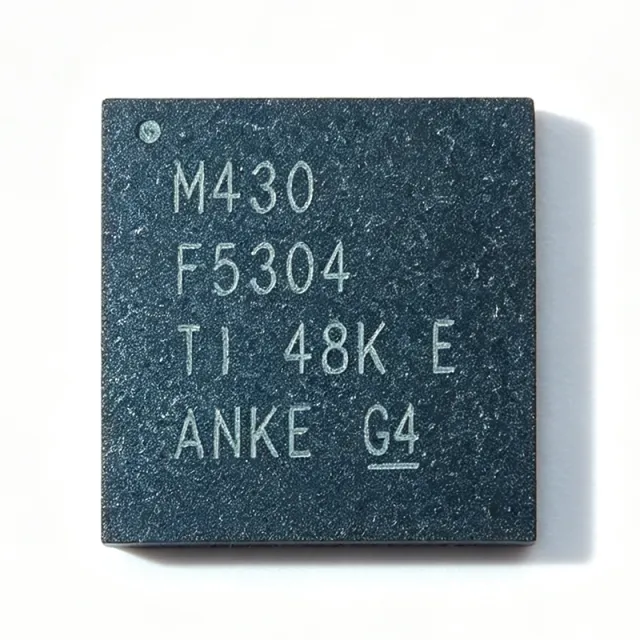
The Texas Instruments MSP430F5304IPTR is a 16-bit ultra-low-power mixed-signal microcontroller based on the MSP430 CPUXV2 core, running at up to 25 MHz with 8KB Flash and 6KB SRAM in a 48-pin LQFP (7x7 mm) package. On-chip peripherals include an integrated 3.3V LDO, four 16-bit timers, a 10-bit ADC, one USCI (UART/SPI/I2C), a hardware multiplier, DMA, an RTC with alarm capabilities, and 31 I/O pins. An ultra-low-power microcontroller (MCU) is a single-chip processor optimized to minimize active and standby current draw, essential for battery-operated and energy-harvesting systems. The MSP430 family sits within the broader hierarchy of 16-bit microcontrollers -> mixed-signal MCUs -> embedded processors, and is widely recognized as an industry benchmark for low-power design. Key features include the flexible clock system (5 selectable low-power modes), a hardware 32x32 multiplier that offloads arithmetic from the CPU, and DMA for peripheral-to-memory transfers without CPU intervention. The integrated LDO simplifies power tree design by generating the core supply from a single external rail, while the RTC with alarm supports timekeeping during standby. The 10-bit ADC provides general-purpose analog acquisition for sensor front ends. The MSP430F5xx architecture pairs the von Neumann CPUXV2 core with a clock system supporting a VLO, REFO, XT1, and DCO sources, allowing designers to trade clock accuracy against current consumption. Interrupt-driven operation with fast wake-up keeps average current in the microamp range in duty-cycled applications. Typical applications include battery-powered metering, portable medical monitoring, industrial sensor nodes, and consumer appliances where the combination of 25 MHz performance, one USCI serial port, and 31 GPIO covers most moderate-complexity control tasks. Design consideration: the family shares the MSP430F5xx/F6xx User's Guide peripheral set, so code migrates freely between family members; verify Flash/SRAM sizing and package pinout before board reuse, as memory-density variants exist in identical footprints.

USD $2,10 Contato