Produtos (20.000+)

PIC18F13K22-E/SO - 8-Bit 48MHz 8KB Flash MCU | Microchip
PIC18F13K22-E/SO

PIC18F13K22-E/SO - 8-Bit 48MHz 8KB Flash MCU | Microchip

The Microchip PIC18F13K22-E/SO is a PIC® XLP™ 18K family 8-bit microcontroller running at 48 MHz with 8 KB (4K x 16) of Flash program memory, housed in a 20-pin SOIC (SO) package. The device is part of the nanoWatt XLP low-power PIC18F1XK22 sub-family and integrates 256 bytes of SRAM, 256 bytes of EEPROM, a 10-bit A/D converter, and 16 I/O pins. An 8-bit microcontroller (MCU) is a small, self-contained computing system on a single integrated circuit that combines an 8-bit CPU core, non-volatile program memory (Flash), volatile data memory (RAM), non-volatile user data (EEPROM), and a rich set of on-chip peripherals such as timers, communication interfaces, and analog-to-digital converters. The PIC18 architecture belongs to the modified Harvard RISC family designed for C-compiler efficiency, and XLP variants extend the operating range into ultra-low-power territory typical of battery applications. PIC microcontrollers sit within the broader hierarchy: 8-bit MCU -> microcontroller -> embedded controller -> semiconductor IC. Key features include an extended operating voltage range of 1.8 V to 5.5 V (per the datasheet's wide VDD spec), four 8-bit timers plus one 16-bit timer, an enhanced 10-bit ADC, and support for I²C, SPI, and EUSART (including RS-485) peripherals. The "-E" temperature grade extends to -40 °C to +125 °C operation, and the SOIC-20 footprint makes the part easy to hand-solder or reflow. Internal oscillator options, including a 16 MHz HFINTOSC with ±1% accuracy, allow BOM-cost reduction. Typical applications include low-power remote sensor nodes, IoT edge devices, USB-less consumer peripherals, motor and lighting control subsystems, and battery-backed industrial instrumentation. Its small footprint, low sleep current, and XLP architecture make it especially suitable when standby power matters more than raw throughput. Designers should note that code for PIC18F14K22 / PIC18F15K22 siblings is generally source-compatible because the 1XK22 family shares peripheral mapping, easing migration across pin counts. This page synthesizes pricing, drop-in equivalents, and field notes beyond the standard datasheet.

Cotação Contato
PIC18F13K22-E/SS - 8-bit 48MHz 8KB Flash XLP MCU | Microchip
PIC18F13K22-E/SS

PIC18F13K22-E/SS - 8-bit 48MHz 8KB Flash XLP MCU | Microchip

The Microchip Technology PIC18F13K22-E/SS is an 8-bit PIC18 nanoWatt XLP flash microcontroller running at up to 48 MHz with 8 KB of program Flash, 256 bytes of RAM and 256 bytes of EEPROM, housed in a 20-pin SSOP package. The E suffix indicates the extended industrial temperature grade (-40C to +125C), making the part suitable for harsh-environment designs where commercial-grade parts cannot survive. The on-chip peripherals include a 10-bit ADC with up to 12 channels, multiple capture/compare/PWM modules, EUSART, MSSP (SPI/I2C), and nanoWatt XLP sleep currents as low as 50 nA typical. A microcontroller (MCU) is a single-chip computer that integrates a CPU core, non-volatile program memory, volatile RAM, and a mix of analog and digital peripherals. The 8-bit PIC18 architecture falls in the hierarchy: microcontroller -> embedded processor -> semiconductor. Within the MCU family, the PIC18 sits between the 8-bit baseline (PIC10/12/16) and the 16-bit dsPIC/PIC24 families, and is targeted at C-compiler-optimized applications where deterministic behaviour, low power, and rich peripherals matter more than raw MHz. Key features include a 49-instruction RISC core with hardware multiplier, 16-bit instruction word, internal oscillator factory-calibrated to within +/-1% over voltage and temperature, two analog comparators with programmable references, and a charge time measurement unit (CTMU) for capacitive touch sensing. The nanoWatt XLP technology and the deep-sleep modes deliver microamp-level average current for battery-powered designs, which is one reason this family is widely used in IoT edge nodes and remote sensor products. In terms of architecture, the part uses a Harvard bus with separate code and data paths, an 8-level hardware stack, and a vectored interrupt controller with two priority levels. The Flash memory supports self-programming under firmware control, which enables in-field bootloader updates via UART, I2C or SPI - a frequent requirement for sealed products that cannot be physically opened for firmware changes. Typical applications include consumer white goods, low-power handheld instruments, sensor hubs for HVAC systems, USB HID devices (using a software USB stack), and small appliances with capacitive touch interfaces. The wide 2.3V-5.5V supply range lets a single design operate from two AA cells or a regulated 3.3V or 5V rail, simplifying the BOM. When designing with this device, place a 100 nF decoupling capacitor within 5 mm of the VDD pin and keep the MCLR pull-up close to the IC. Use the internal oscillator to free the OSC pins for I/O on pin-constrained designs, and leave the unused I/O pins configured as outputs low to minimize current draw. This page synthesizes distributor pricing, drop-in cross-references, and design notes not found in the manufacturer datasheet alone.

Cotação Contato
PIC18F13K22-I/P - 8KB Flash 8-bit nanoWatt XLP MCU | Microchip
PIC18F13K22-I/P

PIC18F13K22-I/P - 8KB Flash 8-bit nanoWatt XLP MCU | Microchip

The Microchip Technology PIC18F13K22-I/P is an 8-bit PIC18F1XK22 family flash microcontroller in a 20-pin PDIP through-hole package, offering up to 64 MHz operation, 8 KB of flash program memory, 256 bytes of RAM, and 256 bytes of data EEPROM. It uses the nanoWatt XLP extreme-low-power technology and is positioned as a 'just right' mid-density MCU between smaller PIC16 parts and larger 28/40-pin PIC18 devices. What is an 8-bit flash microcontroller? An MCU (microcontroller unit) integrates a CPU core, program memory (flash), data memory (RAM), non-volatile data storage (EEPROM), and peripherals (ADC, timers, UART, I/O) on a single die. The PIC18 core is an enhanced 8-bit Harvard RISC architecture with C-compiler-friendly instruction set, 16-bit opcodes, and hardware multiply — well above the older PIC16 baseline. The PIC18F13K22 adds nanoWatt XLP sleep modes (down to single-digit nA typical) that let battery-powered products survive years on a coin cell, while still running code at 16 MIPS from a 64 MHz internal oscillator. Key features include 16 I/O pins, an integrated 10-bit ADC with up to 11 channels, two PWM modules, one Enhanced USART, one MSSP (SPI/I2C), and a wide 1.8 V–5.5 V operating range. The 'I' temperature grade supports -40 °C to +85 °C industrial applications. Internal 16 MHz and 64 MHz oscillators eliminate external crystals on most designs. Typical applications include consumer appliances, low-power IoT sensor nodes, battery-powered handheld instruments, and LED control. The 20-pin PDIP form factor remains the package of choice for through-hole hobby, education, breadboarding, and legacy industrial PCB designs where socketed replacement simplifies field service. The PIC18F13K22-I/P offers familiar MPLAB X IDE, XC8 compiler, and PICkit programmer support.

Cotação Contato
PIC18F13K22-I/SO - 8KB Flash 20-Pin nanoWatt XLP MCU | Microchip
PIC18F13K22-I/SO

PIC18F13K22-I/SO - 8KB Flash 20-Pin nanoWatt XLP MCU | Microchip

The Microchip PIC18F13K22-I/SO is an 8-bit PIC18 microcontroller with 8KB Flash, 256 bytes SRAM, and 256 bytes EEPROM, housed in a 20-pin SOIC (SO) package, part of the nanoWatt XLP family. Key features include a 64MHz internal oscillator (16 MIPS at 3.3V), wide operating voltage from 1.8V to 5.5V, 17 I/O pins, and 10-bit ADC with up to 12 channels. The device integrates nanoWatt eXtreme Low Power technology achieving sub-uA sleep currents, peripherals including EUSART, MSSP (SPI/I2C), PWM and comparators, plus in-circuit debugging via ICD. As an 8-bit C-optimized RISC microcontroller, the PIC18F13K22 belongs to the broader hierarchy: 8-bit MCU -> microcontroller -> embedded controller -> semiconductor. The 14-bit instruction width with 8-bit data path provides an industry-standard architecture supported by MPLAB X IDE, XC8 compiler, and Microchip's extensive peripheral library ecosystem. Typical applications include battery-powered sensor nodes, IoT edge devices, consumer appliances, automotive body electronics, and industrial control modules. The wide voltage range and low sleep current make it ideal for energy harvesting and energy-conscious designs. Design consideration: leverage nanoWatt XLP sleep modes (down to 20 nA typical) by gating peripheral clocks and using the RTCC with a 32 kHz crystal for periodic wake, extending battery life from months to years in many use cases. This page synthesizes distributor pricing, drop-in alternatives in identical 20-pin SOIC footprints, and practical design notes not consolidated in the manufacturer datasheet.

Cotação Contato
PIC18F13K22T-I/SO - 8KB Flash 8-bit MCU | Microchip
PIC18F13K22T-I/SO

PIC18F13K22T-I/SO - 8KB Flash 8-bit MCU | Microchip

The Microchip PIC18F13K22T-I/SO is a nanoWatt XLP 8-bit PIC18 microcontroller delivering 64 MHz CPU performance with 8 KB Flash, 256 bytes SRAM, and 256 bytes EEPROM in a 20-pin SOIC package. According to the Microchip datasheet, it operates from 4.2 V to 5.5 V and is part of the PIC18F1XK22 family designed for high-performance, power-sensitive applications. A microcontroller (MCU) is an integrated circuit that combines a CPU core, program memory, data memory, and programmable peripherals on a single silicon die. The PIC18 family uses an enhanced 8-bit RISC Harvard architecture optimized for C compilers, delivering deterministic instruction execution and code density that makes it ideal for embedded control. The PIC18F13K22T-I/SO sits within the broader hierarchy of microcontroller (MCU) > 8-bit MCU > PIC18 family > nanoWatt XLP family > PIC18F1XK22 sub-family. Key features include 16 I/O pins, 10-bit ADC with multiple channels, enhanced PWM, UART, SPI, I2C peripherals, and nanoWatt XLP technology for ultra-low power operation. The device supports multiple low-power sleep modes that draw microampere-level current, making it suitable for battery-powered applications. The 20-pin SOIC package provides compact through-hole-compatible footprint for industrial and consumer designs. The PIC18F13K22T-I/SO uses a 16-bit instruction word with 8-bit data path architecture, achieving most instructions in a single cycle. The integrated nanoWatt XLP technology includes multiple sleep modes, oscillator switching, and doze mode that allow engineers to tune power consumption against performance for energy harvesting, remote sensing, and portable applications where battery life is critical. Typical applications include industrial sensor interfaces, battery-powered IoT sensor nodes, low-power remote controls, small home appliances, and automotive body modules (when properly qualified). Its small footprint and XLP features make it attractive for space-constrained designs requiring extended battery life. The PIC18 ecosystem also offers MPLAB X IDE and XC8 compiler support, simplifying firmware development. When designing with this device, ensure proper decoupling (100 nF ceramic close to VDD), respect the supply voltage range, and configure unused I/O pins as outputs low to minimize current leakage. The device is identical to the PIC18F13K22-I/SO in specifications - the T suffix indicates tape and reel packaging. This page synthesizes distributor pricing, drop-in alternatives from both Microchip and competitor manufacturers, and practical design notes not found in the standalone datasheet, providing unique information gain for procurement and engineering decision-making.

Cotação Contato
PIC18F13K22T-I/SS - 8KB Flash 8-bit nanoWatt XLP MCU 20-SSOP | Microchip
PIC18F13K22T-I/SS

PIC18F13K22T-I/SS - 8KB Flash 8-bit nanoWatt XLP MCU 20-SSOP | Microchip

The Microchip Technology PIC18F13K22T-I/SS is a member of the PIC18F1XK22 nanoWatt XLP family of 8-bit flash microcontrollers, offering 8KB of program flash, 256 bytes of RAM and 256 bytes of EEPROM in a 20-pin SSOP package. It is built on a C-compiler-optimized PIC18 RISC architecture, executes instructions at up to 16 MIPS, and is rated for clock speeds up to 64 MHz (internal oscillator) across an industrial operating range of -40C to +85C. An 8-bit RISC microcontroller is a single-chip computer integrating a CPU, non-volatile program memory, working RAM, configurable digital I/O, and a rich peripheral set in one package. Microcontrollers form the lowest tier of the embedded computing hierarchy (MCU -> microcontroller -> embedded processor -> semiconductor), enabling deterministic, low-power control in products where a full microprocessor would be excessive. The 'nanoWatt XLP' branding refers to Microchip's proprietary low-power process and IP that drives quiescent current down to the nanoampere region in sleep modes, a critical advantage for battery-powered or energy-harvesting designs. Key specifications for the PIC18F13K22T-I/SS include 16 I/O pins, up to 16 MIPS throughput, six timers, two analog comparators, a 5-bit DAC, a 10-bit ADC, and support for multiple serial interfaces including EUSART, MSSP (I2C/SPI), and mTouch capacitive sensing. The wide 1.8V to 5.5V supply range allows direct operation from single-cell Li-ion, two-cell alkaline, regulated 3.3V rails, or 5V systems, simplifying power-tree design. In system architecture the device pairs a precision 16 MHz internal oscillator with a 4x PLL to reach 64 MHz system clock, eliminating the cost and PCB area of an external crystal in cost-sensitive applications. The XLP sleep modes (down to tens of nA typical) allow years of operation from a single CR2032 cell, while the CIP (Core Independent Peripherals) set such as the hardware CRC, zero-cross detection and configurable logic cells offload common tasks from the CPU. Typical applications include low-power IoT sensor nodes, battery-powered remote controls, small appliance user interfaces, capacitive-touch front panels, USB-pretending serial bridges, and general-purpose 5V industrial control modules. The 20-pin SSOP footprint also makes the part suitable for handheld instrumentation and consumer accessories where board height matters. When designing with this part, budget the SSOP package's thermal resistance (theta_JA approx 100 C/W typical) for worst-case ambient. Always include decoupling of 100 nF plus 10 uF bulk close to VDD, and verify ADC accuracy against source impedance when sampling high-impedance signals. This page combines distributor pricing, drop-in pin-compatible alternatives from the same PIC18 family, and practical low-power design guidance not available in the bare datasheet, giving engineers a single decision-ready reference for the PIC18F13K22T-I/SS.

Cotação Contato
PIC18F13K50-I/MQ - 8-bit USB MCU, 48MHz, 8KB Flash, 20-VQFN | Microchip
PIC18F13K50-I/MQ

PIC18F13K50-I/MQ - 8-bit USB MCU, 48MHz, 8KB Flash, 20-VQFN | Microchip

The Microchip Technology PIC18F13K50-I/MQ is an 8-bit PIC18 microcontroller featuring a full-speed USB 2.0 compliant interface, 48 MHz maximum CPU clock, 8 KB Flash program memory (4K x 16), and a 10-bit ADC, housed in a 20-pin VQFN (5x5 mm) package. It belongs to the PIC XLP 18K family and is targeted at embedded USB applications requiring ultra-low-power operation, with nanoWatt XLP technology for sleep currents below 1 uA in real-time-clock mode. A microcontroller (MCU) is a single-chip computer that integrates a CPU, memory (Flash/RAM), peripherals, and I/O on one die. The 8-bit PIC18 core family uses a modified Harvard architecture with a RISC-style instruction set and 16-bit opcodes, providing deterministic throughput and ease of C-compiler targeting. MCUs like the PIC18F13K50 sit within the embedded computing hierarchy as fixed-function, low-power control processors used wherever a general-purpose CPU and OS are unnecessary - typically between discrete logic and application processors. Within that hierarchy, PIC MCUs bridge simple 8-bit controllers (PIC10/12/16) and 32-bit ARM Cortex-M parts, offering USB, ADC, PWM, and rich peripherals at low cost and low power. Key features of the PIC18F13K50-I/MQ include 16 I/O pins, an internal 31 kHz to 16 MHz HF oscillator with PLL up to 48 MHz, hardware USB 2.0 full-speed transceiver with on-chip pull-up/pull-down resistors, mTouch capacitive touch sensing support, and a 10-bit ADC with up to 11 channels. The device also integrates two 8-bit timers plus one 16-bit timer, two PWM modules with capture/compare, an Enhanced USART, and an I2C/SPI MSSP module. Internal regulator and 5V-tolerant I/O (when operating at 5V) simplify mixed-voltage system design. Typical applications include low-cost USB HID/CDC devices (keyboards, mice, custom peripherals), USB-to-UART bridges, battery-powered data loggers, capacitive touch user interfaces, sensor hubs with USB diagnostics, and consumer electronics where BOM cost and PCB area are constrained. The 20-VQFN (5x5 mm) package makes the part suitable for compact dongles and wearable form factors. When designing with the PIC18F13K50, observe that the /MQ suffix designates the 20-pin VQFN industrial temperature (-40C to +85C) variant. Ensure the VUSB 3.3V internal regulator pin is bypassed with the manufacturer-specified capacitor network, and that the D+/D- USB lines follow Microchip's USB 2.0 routing guidelines (90 ohm differential, common-mode choke placement, and guard traces). For low-power designs, use the nanoWatt XLP sleep modes with RTCC rather than relying on software delays. This page synthesizes real-time distributor pricing, drop-in same-package alternatives drawn from the same PIC18F13K50/14K50 family, and practical USB layout design notes that complement the manufacturer datasheet and datasheet.com summary.

Cotação Contato
PIC18F13K50-I/SO - 8-bit USB MCU, 8KB Flash, 20-SOIC | Microchip
PIC18F13K50-I/SO

PIC18F13K50-I/SO - 8-bit USB MCU, 8KB Flash, 20-SOIC | Microchip

The Microchip Technology PIC18F13K50-I/SO is an 8-bit PIC18 microcontroller featuring a full-speed USB 2.0 compliant device interface, 8KB of Flash program memory, and 512 bytes of RAM, housed in a 20-pin SOIC (SO) package. It operates at up to 48 MHz instruction-clock throughput and supports a wide 1.8V to 5.5V supply range on the F-variant core, with the I-grade parts specified across -40C to +85C. An 8-bit microcontroller (MCU) is a single-chip computer built around an 8-bit data path and a Harvard RISC architecture. Within Microchip's portfolio the PIC18 sits above PIC10/12/16 as the upper-tier 8-bit family, itself a hypernym for the broader microcontroller -> embedded controller -> semiconductor category. PIC18F13K50-I/SO's differentiating feature is integrated USB 2.0 full-speed hardware with on-chip transceivers and pull-up resistors, allowing a board to act as a USB device with minimal external components. Key specifications include a 10-bit ADC with up to 11 channels (suitable for sensor and analog front-end interfaces), nanoWatt XLP technology for low-power sleep currents in the sub-microamp range, an internal 32 kHz to 16 MHz HF oscillator with PLL, and 15 digital I/O pins. The 20-pin SOIC footprint exposes the D+/D- USB pins, two capture/compare/PWM modules, an Enhanced USART, and an SPI/I2C master/slave module. The architecture uses a Harvard RISC pipeline with 16-bit opcodes and an 8-bit data path, plus hardware multiplier for efficient C compilation in MPLAB X. The combination of integrated USB, multiple timers, and configurable oscillator blocks lets one MCU replace external USB bridge chips plus a separate microcontroller in many designs. mTouch capacitive-touch support and a charge time measurement unit (CTMU) simplify proximity and level-sensing tasks. Typical applications include USB HID peripherals (keyboards, mice, custom joysticks), USB-to-UART bridges and CDC virtual COM ports, capacitive-touch sensor interfaces, low-power sensor nodes, and embedded learning platforms. The wide operating voltage and USB peripheral make it a common choice for any product that needs a single-IC USB device. When designing with this part, verify that the 20-SOIC thermal path is adequate for sustained USB enumeration current and choose the correct USB bus-powered vs self-powered enumeration scheme in firmware. The PIC18F13K50 (F) and PIC18LF13K50 (LF) differ mainly in core voltage range; the I/SO suffix here denotes industrial temperature (-40C to +85C) and the SOIC-20 package. This page synthesizes distributor pricing, drop-in alternatives, and practical design notes that go beyond the manufacturer datasheet to help engineers choose and qualify the PIC18F13K50-I/SO for USB-aware embedded designs.

Cotação Contato
PIC18F13K50-I/SS - 8-bit USB MCU 8KB Flash | Microchip
PIC18F13K50-I/SS

PIC18F13K50-I/SS - 8-bit USB MCU 8KB Flash | Microchip

The Microchip Technology PIC18F13K50-I/SS is an 8-bit PIC18 microcontroller featuring a full-speed USB 2.0 compliant interface, 8 KB of Flash program memory, 512 bytes of RAM, and a 10-bit ADC, all integrated in a 20-pin SSOP package. It operates up to 48 MHz and supports an industrial temperature range of -40°C to +85°C, targeting low-cost USB embedded designs. A microcontroller (MCU) is a single-chip computer that integrates a CPU, non-volatile program memory (typically Flash), volatile working memory (RAM), and a set of peripheral interfaces such as timers, ADC, communication ports, and I/O pins. The PIC18F family sits in Microchip's 8-bit enhanced MCU portfolio, designed for deterministic interrupt-driven applications. Within that family, the '13K50' variant uniquely integrates a USB 2.0 full-speed peripheral plus nanoWatt XLP ultra-low-power technology, making it the lowest-pin-count member of the PIC18 USB-capable line. Key features include 15 digital I/O pins, a 10-bit ADC with up to 11 input channels, an internal 31 kHz to 16 MHz configurable oscillator plus a 96 MHz PLL for USB, hardware I²C/SPI/EUSART, mTouch capacitive touch support, and nanoWatt XLP sleep currents under 100 nA typical. The integrated USB transceiver with on-chip 3.3V regulator eliminates external USB PHY components, reducing BOM for HID, CDC, and custom-class USB devices. Architecturally, the device uses an enhanced 8-bit Harvard RISC core with a hardware multiplier and C-friendly compiler support through MPLAB XC8. The peripheral set is fixed-function rather than the configurable 'F1xx' PPS variant, which keeps the silicon small and reduces cost, while a 14-bit instruction word provides uniform instruction timing for predictable interrupt latency. Typical applications include USB HID peripherals (keyboards, mice, custom input devices), USB-to-UART bridges (CDC class), low-cost USB sensors, USB automotive interfaces, hobbyist and educational development boards, and battery-powered touch-sensing devices. The combination of native USB, mTouch, and nanoWatt XLP makes it particularly attractive for powered-from-bus designs that must minimize suspend current to comply with USB 2.0 suspend specifications. When designing, attention must be paid to the VUSB 3.3V regulator pin decoupling and the DP/DNM pull-up configuration. A ferrite bead or direct short between VUSB and the MCU VDD, plus a 220 nF + 47 µF bulk capacitor network, is typically required to meet USB-IF electrical compliance.

Cotação Contato
PIC18F13K50T-I/SO - 8-bit USB MCU 8KB Flash 20-SOIC | Microchip
PIC18F13K50T-I/SO

PIC18F13K50T-I/SO - 8-bit USB MCU 8KB Flash 20-SOIC | Microchip

The Microchip PIC18F13K50T-I/SO is an 8-bit high-performance enhanced flash microcontroller with an integrated full-speed USB 2.0 compliant interface, 8KB of Flash program memory, 512 bytes of SRAM, and a 10-bit ADC, housed in a 20-pin SOIC package. It operates from 4.2V to 5.5V supply, supports up to 40 MHz clock speed, and provides 15 I/O ports for flexible peripheral connectivity. The T-suffix indicates tape-and-reel packaging, while the I-suffix denotes the industrial -40C to +85C operating temperature range. An 8-bit microcontroller (MCU) is a compact programmable computing device built around an 8-bit data path, integrating CPU, RAM, non-volatile program memory, and peripherals on a single silicon die. PIC18F microcontrollers sit in the broader PIC (Peripheral Interface Controller) family, which falls under the MCU -> microcontroller -> embedded processor -> semiconductor taxonomy. The PIC18F line uses an enhanced Harvard architecture with 16-bit opcodes and 8-bit data, balancing code density with deterministic interrupt handling. Key differentiating features of the PIC18F13K50 include a full-speed USB 2.0 peripheral with on-chip transceiver, nanoWatt XLP technology for ultra-low power consumption, an internal oscillator with PLL for flexible clocking, and a 10-bit ADC with up to 9 channels. The integrated USB transceiver eliminates the need for external USB PHY chips, reducing BOM cost and PCB area. The device also includes a charge time measurement unit (CTMU) for capacitive touch sensing. Architecturally, the PIC18F13K50 employs a RISC-based 8-bit core with a 16-bit instruction word, hardware multiply, and a modified Harvard bus. The USB module automatically switches between a 48 MHz clock for USB operation and a lower-power oscillator for normal run mode, optimizing energy consumption. Internal EEPROM emulation is supported in Flash, and the device supports in-circuit serial programming (ICSP) via two pins, enabling in-field firmware updates. Typical applications include USB HID peripherals (keyboards, mice, custom input devices), USB-to-UART bridges, low-cost USB sensor interfaces, embedded learning platforms, and capacitive touch user interfaces. The wide operating voltage and industrial temperature range make it suitable for consumer, industrial, and USB-enabled IoT edge nodes. When designing with the PIC18F13K50, allocate a 100 nF decoupling capacitor close to VDD and consider the USB D+/D- trace impedance of 90 ohms differential. The internal regulator must be bypassed with the recommended capacitor values from the manufacturer datasheet to ensure stable USB operation. This page synthesizes verified distributor pricing, drop-in SOIC alternatives, and practical design notes not found in the standalone Microchip datasheet, helping procurement and firmware engineers make sourcing decisions faster.

Cotação Contato
PIC18F13K50T-I/SS - 8-bit USB MCU, 48MHz, 8KB Flash, 20-SSOP | Microchip
PIC18F13K50T-I/SS

PIC18F13K50T-I/SS - 8-bit USB MCU, 48MHz, 8KB Flash, 20-SSOP | Microchip

The Microchip PIC18F13K50T-I/SS is an 8-bit PIC18 microcontroller with integrated full-speed USB 2.0, 8KB of Flash program memory, 512 bytes of RAM, and 256 bytes of EEPROM, packaged in a 20-pin SSOP. The device runs at up to 48MHz from a 1.8V to 5.5V supply, targeting cost-sensitive embedded USB designs. A microcontroller (MCU) is a single-chip computer that integrates a CPU core, program memory, data memory, and peripheral interfaces such as ADC, timers, and communication blocks. Within the Microchip taxonomy, this part belongs to the PIC18 family (8-bit Harvard-architecture RISC core), then the PIC XLP 18K sub-family (eXtreme Low Power), then the USB-capable line, then the power-management IC hierarchy of embedded computing. The PIC18F13K50T-I/SS combines that MCU role with an on-board USB 2.0 full-speed transceiver that auto-negotiates clock and power on VBUS attach. Key features include a 10-bit ADC with multiple channels, four timers, two comparators, a 256-byte data EEPROM, brown-out reset (BOR), power-on reset (POR), watchdog timer (WDT), PWM modules, and 15 I/O lines. The XLP variant adds nanoWatt sleep modes useful for USB-suspended battery-powered nodes. Architecturally, the part uses a CMOS PIC18 Harvard core with separate program and data buses, plus an internal USB transceiver that frees the board from an external PHY. The 8KB Flash supports self-programming, and the on-chip 3.3V regulator can power internal logic from a 5V VBUS rail when USB is attached. Typical applications include USB HID peripherals (keyboards, mice, custom HID), USB-to-UART bridges, USB sensor dongles, low-cost data loggers, and USB firmware-bootloader targets. Designers use it when board area and BOM cost matter more than compute throughput. When laying out this part, keep the VBUS, D+, D-, and regulated 3V3 traces short and follow USB impedance guidelines. The SSOP exposed thermal pad route is unused; ensure the SSOP footprint accommodates the 0.65mm pitch cleanly. This page synthesizes distributor pricing, drop-in pin-compatible alternatives, and practical PCB/USB design notes that go beyond the manufacturer datasheet.

Cotação Contato
PIC18F14K22-E/ML - 8-bit 48MHz 16KB Flash MCU | Microchip
PIC18F14K22-E/ML

PIC18F14K22-E/ML - 8-bit 48MHz 16KB Flash MCU | Microchip

The Microchip Technology PIC18F14K22-E/ML is an 8-bit PIC18 microcontroller built on the nanoWatt XLP (eXtreme Low Power) architecture, integrating 16KB of Flash program memory and 512 bytes of EEPROM in a compact 20-pin QFN (4x4 mm) package. The device operates at up to 48 MHz CPU clock speed from a 4.2V to 5.5V supply, delivering 16 MIPS of performance, and features 12 channels of 10-bit A/D conversion with on-chip selectable Fixed Voltage Reference plus dual rail-to-rail comparators. A microcontroller (MCU) is a single-chip computer containing a CPU core, program memory (Flash/ROM), data memory (RAM), and integrated peripherals such as timers, communication interfaces, and analog blocks. The PIC18F family is Microchip's high-performance 8-bit architecture optimized for C compiler efficiency; PIC18F1XK22 sub-family variants shrink the PIC18 feature set into 20-pin / 28-pin packages aimed at cost- and power-sensitive embedded designs. Within the broader taxonomy, the PIC18F14K22 sits under microcontroller -> embedded controller -> semiconductor -> integrated circuit, making it a typical building block for sensor nodes, appliance controls, and battery-powered IoT edge devices. Key features include 17 I/O pins with high-current sink/source capability, hardware USART, SPI, and I2C peripherals, two capture/compare/PWM modules, and nanoWatt XLP modes that drop the active current below 100 nA in Sleep. The internal 16 MHz precision oscillator can be combined with the 4x PLL to reach 64 MHz at 3V, eliminating the need for an external crystal in most designs. Integrated peripherals also include an Enhanced Universal Synchronous Asynchronous Receiver Transmitter (EUSART) and an MSSP peripheral supporting both SPI and I2C master/slave operation. The QFN-20 (ML) package provides a thermal resistance of approximately 43 C/W and a 4x4 mm footprint suited to compact PCB layouts. The E suffix in the part number designates the Extended (-40C to +125C) operating temperature range required for industrial and automotive under-hood environments, while the ML suffix identifies the 20-lead QFN (Quad Flat No-lead) package variant. Typical applications include handheld consumer products, low-power wireless sensor nodes, battery-powered instrumentation, LED lighting controllers, HVAC damper actuators, and USB-to-UART bridges. The wide 4.2V-5.5V supply range also makes it compatible with regulated 5V USB rails and 4-cell NiMH battery packs. Design tip: when migrating from the older PIC18F14K22 (industrial -40C to +85C) to the E/ML variant, no code change is required - the only differences are temperature range and package style. Ensure unused I/O pins are configured as outputs to minimize Sleep current below 100 nA. This page synthesizes distributor pricing, drop-in alternatives, and practical design notes not found in the manufacturer datasheet alone, providing a single reference for BOM selection, sourcing, and circuit design validation.

Cotação Contato
PIC18F14K22-E/SO - 8-bit MCU, 16KB Flash, 20-Pin SOIC | Microchip
PIC18F14K22-E/SO

PIC18F14K22-E/SO - 8-bit MCU, 16KB Flash, 20-Pin SOIC | Microchip

The Microchip Technology PIC18F14K22-E/SO is an 8-bit PIC18F1XK22 flash microcontroller delivering 16 KB of on-chip Flash program memory, 512 bytes of SRAM, and 256 bytes of EEPROM, housed in a 20-pin SOIC (SO) package. It runs at up to 40 MHz of CPU clock speed with a 4.2 V to 5.5 V supply range, and integrates nanoWatt XLP extreme-low-power technology for battery-friendly designs. The /E suffix indicates the -40C to +125C extended operating temperature range, making this part suitable for industrial and harsh-environment applications. A microcontroller (MCU) is a single-chip computer containing a CPU core, program and data memory, programmable I/O peripherals, and on-chip support functions like timers, ADC, and communication interfaces. PIC18F devices use a C-compiler-optimized 8-bit RISC architecture and occupy the middle ground of Microchip's PIC lineup - more capable than baseline PIC10/12/16 parts while cheaper and smaller than PIC24/dsPIC33 devices. The PIC18F1XK22 family specifically targets low-pin-count (20 pins) cost-sensitive embedded designs needing nanoWatt XLP energy efficiency. Key features include 16 I/O pins, a 10-bit ADC with up to 12 channels, two comparators, two 8-bit timers plus two 16-bit timers, an enhanced USART, two MSSP (SPI/I2C) modules, and a charge time measurement unit (CTMU) for capacitive touch sensing. The XLP technology delivers typical sleep currents below 50 nA, while the instruction set supports hardware multiply and C-compiler-friendly addressing. These features allow direct use in mains-powered and battery-powered sensor nodes without external glue logic. Typical applications include home-automation controllers, HVAC sensor interfaces, low-cost industrial sensing nodes, capacitive-touch user interfaces, and USB-free serial-comm bridge designs using the on-chip EUSART. The wide 4.2 V to 5.5 V supply range also supports direct connection to regulated 5 V rails without level shifters, simplifying BOM and PCB layout. When designing with this device, place a 0.1 uF decoupling capacitor within 5 mm of VDD and consider ICSP header access for production programming. The MCLR pin must be pulled up through a resistor (typically 10 kOhm) for reliable reset behavior. For battery designs, leverage the XLP sleep modes and the on-chip LDO to maximize idle life.

Cotação Contato
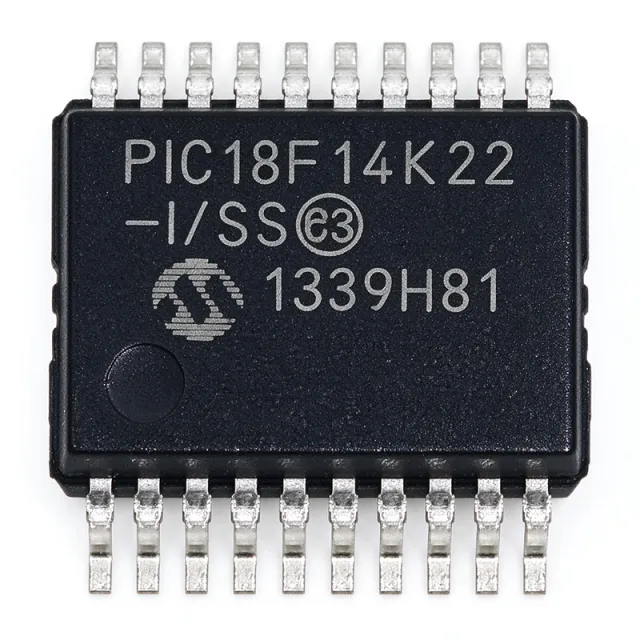
PIC18F14K22-E/SS - 8-bit XLP MCU 16KB Flash 48MHz | Microchip
PIC18F14K22-E/SS

PIC18F14K22-E/SS - 8-bit XLP MCU 16KB Flash 48MHz | Microchip

The Microchip Technology PIC18F14K22-E/SS is an 8-bit nanoWatt XLP flash microcontroller featuring 16KB (8K x 16) of program memory, 512 bytes of RAM, and 256 bytes of data EEPROM, running at up to 48 MHz (16 MIPS) across a 1.8V to 5.5V operating range, packaged in a 20-pin SSOP. It belongs to Microchip's PIC18F1XK22 family and balances low pin count with high computational performance and ultra-low-power operation. What is an 8-bit PIC microcontroller? A PIC (Peripheral Interface Controller) microcontroller is a compact, self-contained computing device built around an 8-bit or 16-bit RISC core, integrated with flash program memory, RAM, EEPROM, timers, ADC, communication peripherals, and I/O on a single chip. PIC18 series parts represent Microchip's high-performance 8-bit tier, featuring a C-compiler-optimized instruction set and an industry-leading peripheral set. The PIC18F14K22 sits within the broader taxonomy: PIC18F1XK22 -> PIC18F family -> PIC microcontroller -> 8-bit MCU -> microcontroller -> embedded computing IC -> semiconductor. Key features include 18 I/O lines, four timers (Timer0/1/2/3), two analog comparators, a 10-bit ADC with up to 11 channels, enhanced PWM modules, MSSP/SPI/I2C and EUSART communication, an internal oscillator, and nanoWatt XLP technology that delivers sleep currents in the tens of nanoamp range. These features make it suitable for battery-powered applications where energy efficiency is critical. Architecturally, the PIC18F14K22 uses an enhanced Harvard architecture with separate program and data buses, an 8-bit ALU with hardware multiply, and 31-level stack support. The integrated voltage regulator supports operation from a single 1.8V to 5.5V supply, eliminating the need for external level shifters. The nanoWatt XLP technology provides multiple low-power modes (Run, Idle, Sleep, and deep sleep variants) that allow current consumption to scale with workload. Typical applications include handheld consumer electronics, remote sensor nodes, LED lighting controllers, low-end motor control, USB-to-UART bridges, home automation peripherals, and battery-powered IoT edge devices. The wide 1.8V-5.5V range also makes it useful in industrial control systems with unregulated supplies. When designing with this MCU, ensure decoupling capacitors are placed close to VDD/VSS pins, follow Microchip's guidance on in-circuit serial programming (ICSP) pin usage, and verify the I/O current budget does not exceed 25 mA per pin or 200 mA total to avoid latch-up and reliability issues. This page synthesizes distributor pricing across DigiKey, Mouser, and LCSC, drop-in same-family alternatives from Microchip, and practical design notes not found in the manufacturer datasheet, giving engineers a single, complete reference for the PIC18F14K22-E/SS.

Cotação Contato
PIC18F14K22-I/ML - 8-bit 64MHz XLP 16KB Flash MCU QFN-20 | Microchip
PIC18F14K22-I/ML

PIC18F14K22-I/ML - 8-bit 64MHz XLP 16KB Flash MCU QFN-20 | Microchip

The Microchip PIC18F14K22-I/ML is an 8-bit PIC microcontroller from the nanoWatt XLP 18K family, featuring 16KB (8K x 16) of Flash program memory, 512 bytes of SRAM, and 256 bytes of EEPROM in a compact 20-pin QFN (4x4) package. Operating up to 64MHz at 3V (16 MIPS), the device integrates a C-compiler-optimized RISC core with an industry-leading peripheral set for a low pin-count MCU. The I/ML suffix denotes the industrial temperature grade (-40C to +85C) and the ML package code (20-pin QFN 4x4mm). A microcontroller (MCU) is a single-chip computer containing a processor core, program memory (Flash), working memory (RAM), non-volatile data memory (EEPROM), and configurable peripherals. In the embedded hierarchy, the PIC18F14K22 belongs to the 8-bit PIC18 family, sits under the broader PIC microcontroller umbrella, and connects upward to the nanoWatt XLP low-power sub-family. The PIC18 architecture is C-compiler optimized and offers an industry-leading peripheral set, making this 20-pin device ideal for cost-sensitive, space-constrained designs. Key features include a 16 MHz precision internal oscillator (with 4X PLL for 64 MHz operation), 12 channels of 10-bit ADC, dual rail-to-rail comparators, an on-chip selectable Fixed Voltage Reference, multiple timer/counter modules (Timer0/Timer1/Timer2), enhanced USART, MSSP (SPI/I2C), and nanoWatt XLP technology for ultra-low sleep currents. The 20-pin QFN (4x4mm) footprint fits tight PCB layouts while still exposing two analog comparators, PWM, and 17 I/O pins. The PIC18F14K22 is designed around Microchip's enhanced Harvard RISC architecture with a modified instruction set and 16-bit wide instructions. nanoWatt XLP technology enables sleep currents below 100 nA typical, allowing battery-powered designs to operate for years on a single cell. Internal RC oscillator and PLL eliminate external crystal cost in many applications. Typical applications include low-power IoT sensor nodes, consumer electronics remote controls, battery-powered HVAC sensors, LED lighting controllers, and small appliance interfaces. The combination of XLP sleep current, 10-bit ADC, and small QFN package suits compact, energy-constrained designs. When designing with this MCU, budget analog and digital supply pins separately (AVDD/AVSS) and place the decoupling capacitor within a few millimeters of the QFN thermal pad. For low-power applications, use the DNT/SLEEP/IDLE modes and the on-chip LFINTOSC to minimize current draw. This page synthesizes distributor pricing, drop-in alternatives, and practical design notes not found in the manufacturer datasheet, enabling engineers to evaluate the PIC18F14K22-I/ML for compact, low-power 8-bit embedded designs.

Cotação Contato
PIC18F14K22-I/SO - 8-Bit 64MHz XLP MCU 16KB Flash 20-SOIC
PIC18F14K22-I/SO

PIC18F14K22-I/SO - 8-Bit 64MHz XLP MCU 16KB Flash 20-SOIC

The Microchip Technology PIC18F14K22-I/SO is an 8-bit PIC18 microcontroller built on the nanoWatt XLP (eXtra Low Power) platform, delivering up to 64 MHz CPU performance with 16 KB Flash, 512 bytes SRAM, and 256 bytes EEPROM in a 20-pin SOIC package. According to DigiKey distributor data, the device integrates an 8K x 16 Flash array organized for Harvard architecture access plus peripherals such as ADC, comparators, PWM, USART, and MSSP (SPI/I2C). The 'I' temperature grade spans -40C to +85C, suitable for industrial and consumer embedded designs. A microcontroller (MCU) is a single-chip computer integrating a CPU core, program memory, data memory, peripherals, and I/O. The 8-bit PIC18 family uses a modified Harvard architecture with a RISC instruction set optimized for C compilers, balancing code density with deterministic interrupt response. XLP technology specifically targets battery-powered applications through nanoWatt sleep modes that cut quiescent current into the sub-microamp range. Within the broader embedded hierarchy, the PIC18 sits below 16-bit PIC24/dsPIC and 32-bit ARM Cortex-M families in computational throughput, but offers lower cost, simpler toolchains, and decades of firmware stability. Key differentiating features include 16 KB self-programmable Flash rated for 100K erase/write cycles, 256 bytes EEPROM rated for 1M cycles, 18 I/O pins with interrupt-on-change, an enhanced 10-bit ADC with up to 12 channels, dual analog comparators, Capture/Compare/PWM modules, and a 31 kHz internal oscillator allowing operation without an external crystal. The MSSP module supports both SPI and I2C master/slave protocols, while the EUSART provides RS-232/485 connectivity. Internally the PIC18F14K22 uses a 16-bit instruction word with an 8-bit data path, allowing single-cycle execution for most instructions at 64 MHz (15.6 ns instruction cycle). The device supports in-circuit serial programming (ICSP) and in-circuit debugging via two-wire ICD. Voltage regulation operates across 1.8 V to 5.5 V VDD with brown-out reset and a configurable low-voltage detect circuit. Typical applications include low-power sensor nodes, battery-powered IoT peripherals, HVAC thermostat controls, small appliance user interfaces, USB-to-UART bridges, and embedded control loops in industrial sensor conditioning. The wide operating voltage and XLP sleep modes make it attractive for energy-harvesting and remote-control designs where quiescent current dominates battery life. When designing with this MCU, allocate a robust decoupling network (100 nF plus 10 uF bulk) within 5 mm of VDD, and connect MCLR through a 10 kohm pull-up with the ICSP connector in series. Unused I/O should be configured as outputs and tied low to minimize current leakage. Migration is straightforward: PIC18F13K22 (8 KB Flash) shares the same peripheral set and SOIC-20 pinout. This page synthesizes distributor stock, drop-in alternatives in the SOIC-20 footprint, parametric comparisons, and PCB design guidance not collected in any single datasheet or catalog entry, helping engineers select and qualify the part faster.

USD $1,52 Contato
PIC18F14K22-I/SS - 8-bit MCU, 16KB Flash, 64MHz, XLP | Microchip
PIC18F14K22-I/SS

PIC18F14K22-I/SS - 8-bit MCU, 16KB Flash, 64MHz, XLP | Microchip

The Microchip Technology PIC18F14K22-I/SS is an 8-bit PIC18 microcontroller featuring 16 KB of Flash program memory, 512 bytes of SRAM, and 256 bytes of EEPROM, operating at up to 64 MHz core clock speed, housed in a 20-pin SSOP package. This device belongs to the PIC18F K2x nanoWatt XLP family, which combines high-performance PIC18 architecture with extreme low-power technology for battery-friendly applications. An 8-bit microcontroller (MCU) is a self-contained computing unit on a single integrated circuit, integrating a CPU, program memory (Flash), data memory (RAM), non-volatile storage (EEPROM), and a rich peripheral set. MCUs form the lowest tier of embedded computing hierarchy: microcontroller -> embedded processor -> SoC -> computing platform, and are the workhorses of IoT, automotive body electronics, industrial control, and consumer appliances. The PIC18 architecture is C-compiler optimized and offers interrupt-driven operation, making firmware development straightforward for both assembly and C toolchains. Key features of the PIC18F14K22-I/SS include 16 KB (8K × 16) Flash, 512 bytes SRAM, 256 bytes EEPROM, 12-channel 10-bit ADC, multiple PWM modules, UART/SPI/I2C peripherals, and nanoWatt XLP technology that delivers sleep currents below 100 nA typical. The wide operating voltage range from 1.8 V to 5.5 V (full-performance above 2.3 V) and industrial temperature range of -40 °C to +85 °C make this device versatile for both battery-powered and mains-powered designs. From an architectural standpoint, the PIC18F14K22 uses an enhanced Harvard architecture with separate program and data buses, a 16-bit instruction word, and a hardware multiplier. The internal 16 MHz oscillator (or 64 MHz via 4× PLL) eliminates the need for external crystal in many applications, reducing BOM cost and PCB area. The XLP technology adds ultra-low-power sleep modes with peripheral activity monitoring, enabling years of operation from a single coin-cell battery. Typical applications for the PIC18F14K22-I/SS include low-power sensor nodes, portable consumer electronics, home automation devices, automotive body controllers, and small industrial control modules. Designers commonly use it where moderate Flash/RAM budgets are sufficient but extreme low-power sleep behavior is essential, such as remote controls, battery-backed thermostats, and wearable peripherals. When designing with this MCU, allocate sufficient decoupling (typically 100 nF near VDD plus 10 µF bulk), respect the in-circuit serial programming (ICSP) pins (PGC/PGD), and review the configuration bits carefully because incorrect oscillator settings can brick the part. The 20-pin SSOP footprint is also available in SOIC (PIC18F14K22-I/SO) and PDIP (PIC18F14K22-I/P), giving PCB layout flexibility for prototyping and production. This page synthesizes verified distributor pricing from DigiKey, Mouser, LCSC, and Octopart; same-brand SSOP-package drop-in variants; and practical design notes that go beyond the manufacturer datasheet, providing a one-stop engineering reference for component selection.

Cotação Contato
PIC18F14K22T-I/ML - 8-bit 64MHz XLP MCU 16KB Flash | Microchip
PIC18F14K22T-I/ML

PIC18F14K22T-I/ML - 8-bit 64MHz XLP MCU 16KB Flash | Microchip

The Microchip PIC18F14K22T-I/ML is an 8-bit PIC18F XLP microcontroller running up to 64 MHz with 16 KB Flash, 512 bytes SRAM and 256 bytes EEPROM, housed in a 20-pin QFN (4x4 mm) package. The 'T' suffix denotes tape-and-reel packaging and the 'I' indicates the -40C to +85C industrial temperature grade. A PIC18F microcontroller is an 8-bit Harvard-architecture MCU from Microchip's enhanced mid-range family, built around the nanoWatt XLP (eXtreme Low Power) technology platform. Within the broader taxonomy, PIC18F sits between the baseline PIC10/12/16 families and the high-performance dsPIC33/PIC32 lines, offering C-compiler-friendly instruction set, hardware multiplier, and self-programmable Flash. Key features include 16 MIPS performance at 64 MHz (with on-chip 4x PLL from a 16 MHz internal oscillator), 17 I/O pins, 12 channels of 10-bit ADC, dual rail-to-rail comparators with programmable reference, two 8-bit and two 16-bit timers, EUSART, MSSP (SPI/I2C), and nanoWatt XLP sleep currents as low as 20 nA. The QFN-20 (4x4 mm) package is pin-compatible with PIC18F13K22 and PIC18F14K22 family variants. Internally, the device combines a RISC core with hardware multiply, a 16-level hardware stack, 31 interrupt sources, and a 10-bit ADC capable of up to 100 ksps. The XLP technology implements multiple power-managed modes (Run, Idle, Sleep) and a dedicated low-power Timer1 oscillator for RTC-style operation. Typical applications include low-power battery sensors, consumer remote controls, motor control for small BLDC fans, automotive body controllers (when qualified part is selected), and industrial sensor nodes. The 20-pin QFN footprint and 5.5V maximum VDD also support 4-20 mA loop instrumentation. Design consideration: ensure the QFN central exposed pad (EP) is soldered to a sufficiently large copper pour (minimum 10 mm^2) to meet thermal dissipation requirements. For AEC-Q100 automotive deployments, prefer the PIC18F14K22T-I/MLVAO variant over the standard industrial grade. This page synthesizes Microchip datasheet specifications, distributor pricing tiers, drop-in pin-compatible alternatives from the PIC18F1XK22 family, and practical design notes not consolidated in any single manufacturer document.

Cotação Contato
PIC18F14K22T-I/SO - 8-bit XLP MCU 16KB Flash 64MHz SOIC-20 | Microchip
PIC18F14K22T-I/SO

PIC18F14K22T-I/SO - 8-bit XLP MCU 16KB Flash 64MHz SOIC-20 | Microchip

The Microchip Technology PIC18F14K22T-I/SO is an 8-bit PIC18 microcontroller in the nanoWatt XLP family, delivering 64 MHz CPU performance with 16 KB Flash, 512 bytes RAM and 256 bytes EEPROM in a 20-pin SOIC (SO) wide-body package. It is the tape-and-reel (-T) variant of the PIC18F14K22-I/SO, electrically identical and qualified for industrial temperature ranges from -40C to +85C, with 17 I/O pins available for application use. The device integrates a 10-bit ADC with up to 12 channels, two PWM modules with capture/compare, two USART (EUSART) interfaces, one MSSP (SPI/I2C) port, and a 16-bit timer plus two 8-bit timers, all driven by the enhanced PIC18 Harvard core. What is an 8-bit microcontroller? An 8-bit MCU is a single-chip processor whose internal datapath, registers and ALU operate on 8-bit words, providing deterministic real-time response, low power consumption and straightforward peripheral integration for embedded control. Within the Microchip portfolio, the PIC18F14K22 belongs to the XLP (eXtreme Low Power) sub-family of the PIC18 high-performance architecture, which targets battery-powered and energy-harvesting designs that demand sub-microamp sleep currents and a C-compiler-friendly instruction set. Key features of the PIC18F14K22 include nanoWatt XLP technology with sleep currents as low as 20 nA typical, four brown-out-reset selectable trip points, an internal 16 MHz oscillator that can be multiplied via PLL to 64 MHz, an on-board 8 MHz HFINTOSC with 2% accuracy, and a wide 1.8 V to 5.5 V operating voltage range that simplifies multi-rail designs. The device also supports self-programmability of its Flash, a hardware RTCC, and an enhanced USART with auto-baud detection. Architecturally, the PIC18F14K22 uses a 16-bit modified Harvard structure with separate program and data buses, a hardware multiplier, and a vectored interrupt controller. The peripheral set is prioritized for low-pin-count applications: enough timers and serial channels for sensor hubs, motor control, or display driving, but with a small footprint that fits 14- and 20-pin SOIC/PDIP layouts without sacrificing analog performance. Typical applications include battery-powered sensor nodes, USB-to-UART bridges using the EUSART, simple motor control with PWM, low-end consumer appliances, HVAC remote controls, and industrial sensor conditioning. The wide voltage range and nanoWatt XLP modes make it well suited for IoT edge devices powered by coin cells or energy harvesters. When designing with the PIC18F14K22T-I/SO, observe the SOIC-20 wide-body land pattern (pin pitch 1.27 mm / 50 mil) and ensure the trace to the MCLR pin includes the recommended pull-up. Decouple VDD with 100 nF plus 10 uF bulk capacitance placed within 5 mm of the supply pins to keep ADC accuracy stable. This page synthesizes distributor pricing, drop-in SOIC-20 alternatives, and practical design notes that complement the official Microchip datasheet.

Cotação Contato
PIC18F14K22T-I/SS - 8-bit 64MHz XLP MCU 16KB Flash 20-SSOP
PIC18F14K22T-I/SS

PIC18F14K22T-I/SS - 8-bit 64MHz XLP MCU 16KB Flash 20-SSOP

The Microchip Technology PIC18F14K22T-I/SS is an 8-bit PIC18 microcontroller with nanoWatt XLP extreme-low-power technology, 16KB of Flash program memory, 512 bytes of SRAM, and 256 bytes of EEPROM, housed in a 20-pin SSOP package. It integrates a 64MHz internal oscillator (16 MIPS CPU performance), 16 I/O pins, a 10-bit A/D converter, and enhanced peripherals optimized for C-compiler efficiency. The 'T' suffix denotes Tape & Reel packaging, the 'I' indicates the -40C to +85C industrial operating range, and '/SS' specifies the 0.209-inch SSOP-20 package. An 8-bit microcontroller (MCU) is a self-contained computer-on-a-chip that combines a CPU core, program memory, data memory, and peripherals on a single die. The PIC18F family belongs to the wider PIC microcontroller hierarchy (PIC -> 8-bit MCU -> embedded controller -> semiconductor). The 'F' prefix denotes Flash-based reprogrammable program memory; 'K' designates the family's enhanced nanoWatt XLP low-power architecture; and the trailing '22' marks the specific peripheral/peripheral-set configuration. This taxonomy (PIC18F1XK22) positions the part as a mid-pin-count general-purpose MCU ideal for battery-powered and space-constrained designs. Key features include 16 MIPS throughput at 64MHz, 12-bit ADC variant options, hardware PWM, EUSART, MSSP (SPI/I2C) peripherals, ultra-low-power sleep currents in the nanoWatt range, and dual oscillator support. The part operates from 1.8V to 5.5V across the full industrial temperature range. Internal self-programmability supports field firmware updates, and the 16-channel 10-bit ADC provides mixed-signal capability for sensor-interface designs. The PIC18F14K22T-I/SS architecture uses a RISC-based Harvard core with separate program and data buses, enabling single-cycle instruction execution except for branch operations. The enhanced 16-level stack, hardware multiplier, and C-friendly instruction set make it attractive for portable instrumentation, sensor nodes, and consumer appliances where deterministic real-time performance and battery life are equally critical. Typical applications include low-power IoT sensor endpoints, battery-backed wireless remote controls, industrial sensor conditioning, USB bridge modules (in the larger family variants), HVAC control panels, and appliance user-interface controllers. The -40C to +85C industrial rating, XLP low-power sleep modes (down to 20nA typical in sleep), and the small SSOP-20 footprint make it well-suited to compact, always-listening devices. When designing with this MCU, allocate at least one full SSOP-20 footprint pattern with adequate copper for the exposed-pad thermal pad when present, and follow Microchip's recommended 0.1uF + 10uF decoupling guidance adjacent to VDD/AVDD/VSS. The MCLR pin should be pulled high through a 10k resistor with the optional 100nF cap for in-circuit serial programming (ICSP). This page consolidates distributor pricing, parametric comparison, and practical design notes not always surfaced in the manufacturer datasheet. Engineers can quickly validate drop-in alternatives, evaluate same-family variants, and confirm lifecycle and compliance status in one view.

Cotação Contato
PIC18F14K50-I/MQ - 8-bit USB MCU, 16KB Flash, 48MHz | Microchip
PIC18F14K50-I/MQ

PIC18F14K50-I/MQ - 8-bit USB MCU, 16KB Flash, 48MHz | Microchip

The Microchip Technology PIC18F14K50-I/MQ is an 8-bit PIC18 microcontroller with a full-speed USB 2.0 compliant interface, 16KB Flash program memory, 768 bytes RAM, and a 48MHz maximum internal clock, housed in a 20-pin VQFN 5x5mm package with exposed pad. It operates from 4.2V to 5.5V (F-version) and features nanoWatt XLP extreme low-power technology for battery-friendly applications. What is a PIC18 microcontroller? The PIC18 family is an 8-bit RISC microcontroller architecture from Microchip Technology that sits within the broader category of microcontrollers (MCU), which are programmable single-chip computers. Microcontrollers belong to the semiconductor hierarchy: MCU -> embedded controller -> integrated circuit. The PIC18 line uses a Harvard architecture with separate program and data buses, enabling single-cycle instruction execution and deterministic timing. Key features of the PIC18F14K50 include a 10-bit ADC with up to 11 channels, 2 comparators, 2 enhanced PWM modules, an EUSART with auto-baud, an MSSP module for SPI/I2C, and 256 bytes of EEPROM data memory. The device provides 18 I/O pins across a 20-pin package and supports ICSP (In-Circuit Serial Programming) for field upgrades. The PIC18F14K50 uses Microchip's nanoWatt XLP technology, achieving sub-microamp sleep currents suitable for battery-powered USB peripherals. Its USB 2.0 full-speed transceiver with on-chip pull-up resistors and internal 3.3V regulator simplifies USB hardware design by eliminating external USB components. The CPU clock can be sourced directly from the USB module, eliminating an external crystal for USB-only applications. Typical applications include low-cost USB HID peripherals (keyboards, mice, custom input devices), USB-to-UART bridges, USB sensor nodes, and embedded industrial data loggers with USB connectivity. The wide 5V operating range and integrated USB PHY make it a strong choice when engineers want USB connectivity without external transceiver ICs. When designing with this part, evaluate whether the 16KB Flash and 768-byte RAM are sufficient for your firmware. The PIC18F13K50 is a pin-compatible lower-memory sibling, and the LF14K50 variant offers extended 1.8V-3.6V operation for ultra-low-power designs. Ensure the exposed pad on the VQFN package is soldered for proper thermal and electrical grounding. This page synthesizes distributor pricing, cross-reference alternatives, and practical design notes for the PIC18F14K50-I/MQ that are not found in the manufacturer datasheet alone.

Cotação Contato
PIC18F14K50-I/SO - 48MHz 8-bit USB MCU, 16KB Flash | Microchip
PIC18F14K50-I/SO

PIC18F14K50-I/SO - 48MHz 8-bit USB MCU, 16KB Flash | Microchip

The Microchip Technology PIC18F14K50-I/SO is an 8-bit PIC18 XLP microcontroller with an integrated USB 2.0 Full-Speed transceiver, 16 KB of Flash program memory, 768 bytes of SRAM, and 256 bytes of EEPROM, operating at up to 48 MHz from a 4.2V to 5.5V supply in a 20-pin SOIC (SO) package. A microcontroller (MCU) is a single-chip computer that integrates a CPU core, program memory (Flash/ROM), data memory (RAM), and peripherals such as timers, ADC, and communication interfaces. The PIC18F14K50 sits in Microchip's PIC18F USB family, positioned between baseline PIC16 and high-pin-count PIC24/dsPIC parts, and is targeted at low-cost embedded USB applications. Its place in the hierarchy is: PIC18 family -> 8-bit microcontroller -> MCU -> semiconductor -> embedded IC. Key features include a Full-Speed USB 2.0 (12 Mbps) device/host/OTG transceiver with on-chip 3.3V regulator, nanoWatt XLP technology for low-power sleep currents, 15 general-purpose I/O pins, a 10-bit ADC with up to 9 channels, two 8-bit timers, one 16-bit timer, an Enhanced USART, an MSSP module for SPI/I2C, and an internal 16 MHz HFINTOSC that can switch automatically to the 48 MHz USB clock when VBUS is detected. The 20-pin SOIC package is the most popular through-hole/SMD PIC18 footprint, ideal for hand-soldered prototypes and space-constrained consumer designs. The PIC18F14K50 architecture is Harvard (separate program and data buses), uses a RISC instruction set with 49 instructions and 16-bit opcodes, and supports self-programming of Flash under firmware control. The 'XLP' (eXtreme Low Power) label indicates <100 nA sleep current with the RTCC running from a 32 kHz crystal, which is critical for USB battery-powered devices such as wireless mice, keyboard dongles, and data loggers. Typical applications include USB HID devices (mice, keyboards, custom input), USB-to-UART bridges, CDC virtual COM ports, USB battery chargers, low-cost USB data acquisition, and any embedded system that previously required an external USB controller chip. The part is pin-compatible with the lower-memory PIC18F13K50 (8 KB Flash) for tiered BOM management. When designing with this device, place the 12 MHz or 48 MHz crystal close to the OSC pins and respect Microchip's USB PCB layout guidelines (90-ohm differential routing on D+/D-, guard traces, ferrite on VBUS). Configure CPUs to clock-switch from HFINTOSC to the 48 MHz USB clock only after the USB PLL locks, otherwise the USB peripheral will not enumerate. This page synthesizes distributor pricing, drop-in alternatives, and practical design notes not found in the manufacturer datasheet alone.

Cotação Contato
PIC18F14K50-I/SS - 8-bit USB MCU, 16KB Flash, 48MHz | Microchip
PIC18F14K50-I/SS

PIC18F14K50-I/SS - 8-bit USB MCU, 16KB Flash, 48MHz | Microchip

The Microchip PIC18F14K50-I/SS is an 8-bit PIC microcontroller with a built-in full-speed USB 2.0 compliant interface, 16KB of Flash program memory, 768 bytes of RAM, and a 10-bit ADC, housed in a 20-pin SSOP package. It operates up to 48MHz, supports supply voltages from 4.2V to 5.5V, and is part of the nanoWatt XLP (eXtreme Low Power) family. A microcontroller (MCU) is a single-chip computer that integrates a CPU core, program memory (Flash/ROM), data memory (RAM), and peripherals such as timers, ADC, communication interfaces, and I/O pins. MCUs sit at the heart of nearly every embedded system, from USB peripherals to IoT sensor nodes, and belong to the broader hierarchy of microprocessors, embedded controllers, and integrated circuits (semiconductors). The PIC18 family is Microchip's 8-bit mainstream line, designed for deterministic interrupt-driven firmware development in C or assembly. Key features of the PIC18F14K50-I/SS include 16 I/O pins, 15 channels of 10-bit ADC, a USB 2.0 full-speed transceiver with on-chip 3.3V regulator, two comparators, one enhanced capture/compare/PWM (ECCP) module, two standard CCP modules, EUSART, and an MSSP (SPI/I2C). The XLP technology provides nanoWatt sleep currents as low as 20 nA in sleep mode, making it suitable for battery-powered USB devices. Architecturally, the PIC18F14K50 uses a 16-bit instruction word with an 8-bit data path, 31-level hardware stack, and deterministic interrupt latency. The internal USB transceiver automatically switches between a 48MHz USB clock and the system clock when VBUS is detected, enabling firmware to remain in low-power state until a host is connected. This is a meaningful design simplification compared to external USB interface ICs (like FTDI or MCP2200) that require additional components and PCB area. Typical applications include low-cost USB HID peripherals (keyboards, mice, custom input devices), USB-to-UART bridges, USB sensors, low-cost data loggers, USB charging controllers, and battery-powered USB dongles. The 20-pin SSOP footprint offers a compact solution for USB device designs where PCB space is constrained. When designing with the PIC18F14K50-I/SS, place a 200-ohm ferrite bead and decoupling capacitors in series with VUSB, and ensure the 3.3V USB regulator output is bypassed with at least 0.1uF and 10uF ceramic capacitors as specified in the Microchip datasheet. Forgetting these components is a common cause of USB enumeration failures in first-time designs. This page synthesizes distributor pricing, drop-in same-family alternatives, and practical design notes not found in the standalone manufacturer datasheet, helping engineers compare candidates and source reliably.

Cotação Contato
PIC18F14K50T-I/SO - 8-bit USB MCU, 16KB Flash, 48MHz, 20-SOIC | Microchip
PIC18F14K50T-I/SO

PIC18F14K50T-I/SO - 8-bit USB MCU, 16KB Flash, 48MHz, 20-SOIC | Microchip

The Microchip Technology PIC18F14K50T-I/SO is an 8-bit PIC18 XLP USB microcontroller delivering 48 MHz CPU performance with 16 KB Flash, 768 bytes RAM and an integrated full-speed USB 2.0 device interface, housed in a 20-pin SOIC package. The part combines a 10-bit ADC, multiple timers, mTouch capacitive touch support and nanoWatt XLP power management in a single low-cost MCU. A microcontroller (MCU) is a programmable system-on-a-chip that integrates a CPU core, non-volatile program memory, working RAM, and a rich set of digital and analog peripherals. PIC microcontrollers, in particular, use a RISC-based Harvard architecture with separate program and data buses, which gives them deterministic instruction timing and very low interrupt latency. The PIC18 family extends this architecture to 16-bit opcodes, higher peripheral integration, and C-friendly programming. Low-cost MCUs with integrated USB have become foundational building blocks for HID, CDC/ACM, and custom-USB devices because they eliminate external PHY and interface glue. Key features of the PIC18F14K50 include 16 KB (8K x 16) self-programmable Flash, 768 bytes RAM, 256 bytes EEPROM, 15 digital I/O, 10-bit ADC with up to 11 channels, enhanced USART, MSSP (SPI/I2C) and a full-speed USB 2.0 peripheral that supports device-only operation with internal pull-ups. The nanoWatt XLP technology provides ultra-low sleep current in the nanoampere range, making the device well suited for battery-powered and energy-harvesting designs. The architecture uses a modified Harvard core with a 16-bit instruction word and a hardware multiply unit, achieving up to 16 MIPS at 48 MHz. The integrated USB peripheral includes an internal 3.3V regulator for the D+/D- transceivers and supports auto clock switching from a high-frequency oscillator to a low-power 31 kHz source when host disconnect is detected - a feature explicitly designed for bus-powered and battery-aware USB applications. Typical applications include low-cost USB HID peripherals, USB-to-UART bridges (CDC class), capacitive touch user interfaces using mTouch, sensor readout front-ends, hobbyist and maker projects (Arduino-compatible toolchains), industrial sensor nodes and any space-constrained design that needs USB connectivity without an external PHY. When designing with this part, place the USB D+/D- traces as a 90 ohm differential pair and add the recommended 0.1 uF decoupling near VDD, plus a bulk capacitor on the internal 3.3V regulator output. For sleep-mode designs, verify the wake-up source and WDT configuration, since nanoWatt XLP currents assume specific oscillator and peripheral states. This page synthesizes distributor pricing, drop-in same-package alternatives, and practical design notes not found in the bare manufacturer datasheet, including parametric comparison with the PIC18F13K50, PIC18F14K22, PIC18LF14K50, and PIC18F14K50-I/SO variants.

Cotação Contato