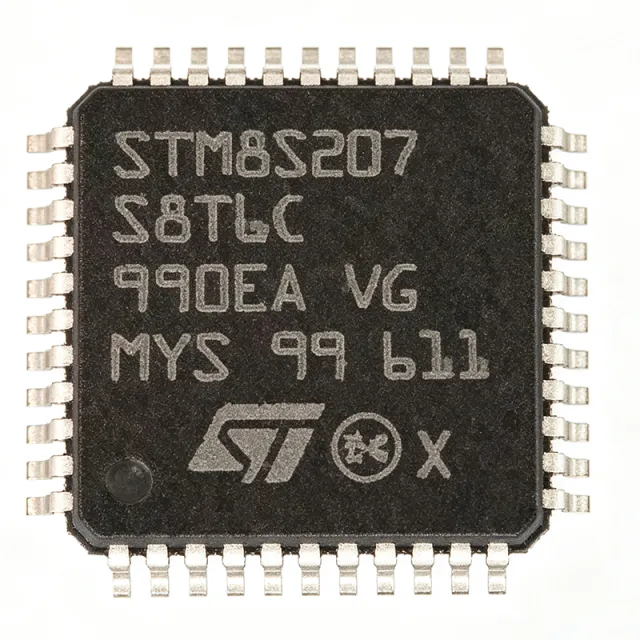
STM8S207K6T6
STM8S207K6T6 - 24MHz 8-bit MCU, 32KB Flash | STMicroelectronics
The STM8S207K6T6 is a performance-line 8-bit microcontroller from STMicroelectronics, featuring a 24 MHz STM8 core with up to 32 Kbytes of Flash program memory. It integrates 2 Kbytes of data EEPROM, a 10-bit ADC, multiple timers, two UARTs, SPI, I²C, and CAN interfaces, all in a 32-pin LQFP package. This MCU is designed for cost-sensitive industrial and consumer applications requiring robust communication and control capabilities.
An 8-bit microcontroller (MCU) is a single-chip computer with an 8-bit data bus, executing instructions on 8-bit words. It integrates a CPU, memory (Flash, RAM, EEPROM), and peripherals (timers, ADC, communication interfaces) on one die. In the system hierarchy, an 8-bit MCU sits below 16-bit and 32-bit MCUs in processing power but offers lower cost, simpler architecture, and lower power consumption, making it ideal for control-oriented tasks like motor control, sensor interfacing, and human-machine interfaces. The STM8S207K6T6 belongs to the STM8S20xxx performance line, which balances performance and peripheral richness for mid-range embedded applications.
Key features include a 24 MHz CPU clock, 32 Kbytes of Flash, 2 Kbytes of RAM, 2 Kbytes of EEPROM, a 10-bit ADC with up to 10 channels, two 16-bit timers, one 8-bit timer, two UARTs, SPI, I²C, and a CAN 2.0B controller. The device operates from 2.95V to 5.5V, making it suitable for 3.3V and 5V systems. It also features a low-power mode with typical current consumption of 5.4 mA at 24 MHz, and a halt mode with 1.5 µA typical current.
The STM8S207K6T6 uses a Harvard architecture with a 3-stage pipeline, achieving up to 20 MIPS at 24 MHz. It includes an embedded debug module (SWIM) for in-circuit debugging and programming, and a single-wire interface for firmware updates. The CAN controller supports CAN 2.0B active mode, enabling robust industrial networking. The device is manufactured using ST's proprietary 130nm process, balancing performance and power efficiency.
Typical applications include industrial control systems, home appliances, automotive body electronics (non-safety), sensor nodes, and communication gateways. The CAN interface makes it particularly suitable for automotive and industrial CAN bus networks, while the multiple UARTs and SPI/I²C support diverse peripheral connectivity.
When designing with this MCU, ensure proper decoupling of the VDD and VDDA pins with 100nF capacitors placed close to the pins. The SWIM pin should be pulled up with a 10kΩ resistor for reliable programming. For CAN applications, an external CAN transceiver (e.g., TJA1050) is required, and the bus termination resistor should be 120Ω at each end of the CAN bus.
USD $1,82
Em estoque