Produtos (18696)

STM32G483RET6 - 170MHz 512KB Cortex-M4 MCU | STMicroelectronics
STM32G483RET6

STM32G483RET6 - 170MHz 512KB Cortex-M4 MCU | STMicroelectronics

STMicroelectronics STM32G483RET6 is a 32-bit Arm Cortex-M4 microcontroller with a 170 MHz maximum clock, 512 KB of Flash memory, and a 64-LQFP 10 x 10 mm package. It combines high-resolution analog capabilities, a math accelerator, and advanced motor-control resources for digital power and industrial embedded systems. A microcontroller is a programmable integrated circuit that executes firmware, reads sensors, controls actuators, and manages communications within an embedded product. The STM32G4 series combines the Arm Cortex-M4 processor core with timers, analog converters, communication peripherals, memory, and security features. It sits within the hierarchy microcontroller, embedded processor, semiconductor, and electronic component. The verified manufacturer-distributor information identifies a 32-bit architecture, 170 MHz operating frequency, and 512 KB (512K x 8) Flash memory. Additional indexed technical material identifies 128 KB SRAM, an FPU, up to 213 DMIPS, a math accelerator, and AES support. The device is positioned for motor-control and digital-power applications where deterministic control, analog measurement, and computational throughput are important. The STM32G483RET6 combines general-purpose embedded processing with high-performance analog and control peripherals. Its 170 MHz Cortex-M4 core can execute control algorithms efficiently, while the math accelerator reduces the computational burden of suitable operations. AES support adds a hardware-oriented option for security-sensitive embedded functions. Exact peripheral assignments, electrical limits, pin functions, and compliance claims must be confirmed against the official manufacturer documentation. Typical uses include digital power converters, motor-control systems, industrial automation equipment, sensor-driven controllers, and compact embedded instruments. The 64-LQFP package exposes a substantial pin count for analog inputs, communication signals, timers, and general-purpose I/O while remaining suitable for conventional leaded PCB assembly. Design decisions should start with the complete pin, clock, power, and peripheral requirements rather than CPU frequency alone. Confirm analog accuracy, timer capabilities, communication peripherals, pin multiplexing, voltage domains, decoupling, and exposed programming/debug options in the manufacturer datasheet before schematic capture. This product record consolidates verified distributor specifications, sourcing information, application guidance, and design cautions. It separates confirmed facts from unavailable details and avoids treating general STM32 family characteristics as guaranteed target-part specifications without verification.

Cotação Contato
STM32G484CET6 - 170MHz 512KB Cortex-M4 MCU | STMicroelectronics
STM32G484CET6

STM32G484CET6 - 170MHz 512KB Cortex-M4 MCU | STMicroelectronics

The STMicroelectronics STM32G484CET6 is a 32-bit Arm Cortex-M4 microcontroller with FPU, a 170 MHz maximum clock, 512 KB of Flash, and 128 KB of SRAM in a 48-LQFP 7 x 7 mm package. According to the manufacturer datasheet, it also provides rich analog resources, math acceleration, a 184 ps 12-channel high-resolution timer, and AES capability. These features place it in the STM32G4 mainstream MCU family, combining general-purpose embedded control with high-resolution timing and precision analog conversion. An Arm Cortex-M4 MCU is a 32-bit RISC microcontroller used to execute embedded firmware, manage peripherals, and implement real-time control. The MCU belongs to the hierarchy microcontroller, embedded processor, processor IC, and semiconductor. STM32G4 devices combine that core with industrial-oriented control peripherals, so the STM32G484CET6 is suited to systems requiring both computational throughput and detailed analog sensing. Verified headline specifications include a 170 MHz operating frequency, 213 DMIPS, 512 KB Flash organized as 512K x 8, 128 KB SRAM, and a 3 V device designation shown in distributor results. The manufacturer identifies a 12-channel high-resolution timer with 184 ps resolution, math acceleration, and AES support. These capabilities are useful for digital power conversion, motor control, precision timing, communications, and compact industrial equipment. The STM32G4 architecture targets demanding control loops while retaining a conventional embedded MCU ecosystem. Its Cortex-M4F core supports floating-point-oriented firmware, while the math accelerator can reduce selected computational overhead. The high-resolution timer improves edge placement and timing measurement, and the analog feature set makes the MCU useful when a design needs both digital control loops and local signal acquisition without adding a separate high-performance analog processor. Typical applications include digital power supplies, motor-control boards, industrial automation modules, sensor-heavy embedded systems, communications equipment, and compact control platforms. The 48-LQFP package exposes enough pins for mixed signal and peripheral connectivity while remaining compatible with automated PCB assembly. Firmware support, peripheral reuse, and migration paths must still be evaluated against the exact requirements of the selected board. When designing a PCB, verify every LQFP pin assignment, power rail, decoupling requirement, and exposed thermal condition against the current STMicroelectronics datasheet. Do not infer pin names from another STM32G4 member because memory size and package variants can differ. Validate oscillator, analog-reference, debug, bootloader, and firmware-update connections before layout release. This product record consolidates verified manufacturer specifications, distributor listings, package data, and selection guidance. It also distinguishes confirmed drop-in alternatives from generic MCU substitutes and identifies unavailable commercial and technical data instead of estimating missing values.

Cotação Contato
STM32G484CEU6 - 170MHz Cortex-M4 MCU | STMicroelectronics
STM32G484CEU6

STM32G484CEU6 - 170MHz Cortex-M4 MCU | STMicroelectronics

The STMicroelectronics STM32G484CEU6 is a 32-bit Arm Cortex-M4 microcontroller with FPU, operating up to 170 MHz, integrating 512 KB of Flash memory, 128 KB of SRAM, and rich mixed-signal peripherals in a 48-UFQFPN package measuring 7 x 7 mm. A microcontroller is a programmable system-on-chip that combines a processor core, nonvolatile program memory, volatile data memory, timers, communication interfaces, and analog peripherals. The STM32G4 family occupies the microcontroller hierarchy beneath embedded processors and combines real-time control with substantial analog integration. Its Cortex-M4F architecture provides floating-point instruction support, while the peripheral mix targets efficient industrial motor-control, power-conversion, sensing, and communications designs. Verified headline features include a 170 MHz operating frequency, up to 213 DMIPS, 512 KB of Flash, 128 KB of SRAM, a math accelerator, high-resolution timers, a 184 ps timer resolution claim, and AES hardware cryptography. The high analog integration makes the MCU useful for designs that require fast control-loop execution alongside ADCs, comparators, DACs, operational amplifiers, and power-management functions. The STM32G484xE architecture combines the Cortex-M4 processor, memory interfaces, high-speed control peripherals, and analog resources in one device. The math accelerator is useful for control algorithms that would otherwise burden the CPU, while AES support can offload cryptographic operations. Exact peripheral counts, voltage limits, ADC performance, GPIO availability, and timer channels require confirmation in the manufacturer datasheet. Typical applications include digital and analog motor control, power-supply control, industrial automation, sensor acquisition, communications gateways, and compact embedded control systems. Its combination of processing speed, local SRAM, Flash capacity, and analog peripherals supports designs that need deterministic control without an external digital signal controller or analog companion device. PCB design should preserve clean analog and digital return paths, place decoupling capacitors close to supply pins, and follow the exposed-pad and thermal-land requirements in the package documentation. Firmware selection must also account for the exact peripheral mix, clock configuration, pin multiplexing, and operating-voltage limits before production release. This page combines verified distributor data, the official manufacturer documentation, package information, and design-oriented guidance to support MCU sourcing and initial engineering evaluation. Pricing is listed as available data permits, while unverified engineering values are explicitly marked for follow-up.

Cotação Contato
STM32G484RET6 - 170MHz Arm Cortex-M4 MCU with FPU | STMicroelectronics
STM32G484RET6

STM32G484RET6 - 170MHz Arm Cortex-M4 MCU with FPU | STMicroelectronics

The STMicroelectronics STM32G484RET6 is a high-performance 32-bit microcontroller based on the Arm Cortex-M4 core with floating-point unit (FPU), operating at up to 170 MHz. It is part of the STM32G4 series, designed for advanced motor control, digital power conversion, and industrial applications. The device features 512 KB of flash memory and 128 KB of SRAM, along with a rich set of analog and digital peripherals. What is a microcontroller? A microcontroller (MCU) is a compact integrated circuit designed to govern a specific operation in an embedded system. It integrates a processor core, memory, and programmable input/output peripherals on a single chip. In the system hierarchy, an MCU sits above a microprocessor (which lacks integrated memory and peripherals) and below a system-on-chip (SoC) that may include more complex subsystems. The STM32G484RET6 is a mid-range MCU in the STM32 family, balancing performance, power efficiency, and peripheral integration. Key features include a 170 MHz Arm Cortex-M4 core with FPU and DSP instructions, 512 KB flash, 128 KB SRAM, and a comprehensive set of peripherals: three 12-bit ADCs (up to 5 Msps), four comparators, three operational amplifiers, a 12-bit DAC, and advanced timers with dead-time generation for motor control. It also includes a CORDIC hardware accelerator and a FMAC (filter math accelerator) for mathematical processing. The device supports multiple communication interfaces: I2C, SPI, UART, CAN FD, and USB. The STM32G484RET6 is built on ST's advanced 90 nm process technology, offering a balance of performance and power consumption. The core is based on the Armv7E-M architecture, which includes hardware divide and single-cycle multiply-accumulate instructions. The FPU enables efficient floating-point arithmetic, essential for control algorithms. The device also features a memory protection unit (MPU) and a nested vectored interrupt controller (NVIC) for real-time responsiveness. Typical applications include field-oriented control (FOC) of brushless DC motors, digital power supplies (buck, boost, and flyback converters), solar inverters, and industrial automation. The high-resolution timers (HRTIM) with 184 ps resolution are ideal for power conversion topologies. The device also supports USB Power Delivery (PD) for charging applications. When designing with this MCU, ensure proper decoupling of the power supply pins with 100 nF capacitors placed close to each VDD pin. The VDDA analog supply should be filtered with a ferrite bead and a 1 uF capacitor to reduce noise. For motor control applications, use the dedicated timer break inputs for safe shutdown.

Cotação Contato
STM32G484VET6 - 170MHz Cortex-M4 MCU, 512KB Flash | STMicroelectronics
STM32G484VET6

STM32G484VET6 - 170MHz Cortex-M4 MCU, 512KB Flash | STMicroelectronics

The STM32G484VET6 is a high-performance 32-bit microcontroller from STMicroelectronics, based on the Arm® Cortex®-M4 core with FPU, operating at up to 170 MHz and delivering 213 DMIPS. It features 512 KB of Flash memory and 128 KB of SRAM, making it suitable for a wide range of real-time control and signal processing applications. The device is housed in a 100-pin LQFP package (14x14 mm), offering a compact footprint for space-constrained designs. A microcontroller (MCU) is a compact integrated circuit designed to govern a specific operation in an embedded system. It contains a processor core, memory, and programmable input/output peripherals. The STM32G4 series is part of the STM32 family, which is a broad portfolio of 32-bit microcontrollers based on Arm Cortex-M cores. These MCUs are widely used in industrial, automotive, and consumer applications due to their performance, low power consumption, and rich peripheral set. Key features of the STM32G484VET6 include a high-resolution timer with 184 ps resolution, a math accelerator for enhanced DSP performance, and an AES hardware encryption engine. The device also integrates a rich analog front-end with multiple 12-bit ADCs, DACs, and comparators, making it ideal for mixed-signal control applications. The 170 MHz clock speed and 213 DMIPS performance enable complex algorithms to run efficiently. The STM32G484VET6 is built on a high-performance Arm Cortex-M4 32-bit RISC core with a floating-point unit (FPU) for single-precision arithmetic. The math accelerator (CORDIC) and FMAC (filter math accelerator) offload intensive computations from the CPU, improving overall system throughput. The device supports a wide operating voltage range and includes multiple power-saving modes to optimize energy consumption. Typical applications include motor control, digital power conversion, industrial automation, and advanced sensing. The high-resolution timer is particularly suited for pulse-width modulation (PWM) generation in power converters and motor drives. The rich analog peripherals enable precise current and voltage sensing, while the math accelerator speeds up control loop calculations. When designing with this MCU, ensure proper decoupling of the power supply pins and a stable clock source. The device supports both internal and external oscillators, and the PLL can be configured to achieve the desired system clock. Careful PCB layout is essential to minimize noise and ensure reliable operation at high frequencies.

Cotação Contato
STM32G491CET6 - 170MHz ARM Cortex-M4F MCU | STMicroelectronics
STM32G491CET6

STM32G491CET6 - 170MHz ARM Cortex-M4F MCU | STMicroelectronics

The STMicroelectronics STM32G491CET6 is a high-performance 32-bit microcontroller based on the ARM Cortex-M4 core with floating-point unit (FPU), operating at up to 170 MHz. It is part of the STM32G4 series, designed for advanced motor control, digital power conversion, and industrial applications. The device is housed in a 48-pin LQFP package (7x7 mm) and offers a rich set of peripherals including advanced timers, high-resolution timers, analog peripherals, and communication interfaces. What is a microcontroller? A microcontroller (MCU) is a compact integrated circuit designed to govern a specific operation in an embedded system. It contains a processor core, memory (Flash and RAM), and programmable input/output peripherals on a single chip. Microcontrollers are the brains of countless electronic devices, from automotive engine control units to home appliances and IoT sensors. In the system hierarchy, a microcontroller sits between a microprocessor (which requires external memory and peripherals) and a system-on-chip (SoC, which integrates more complex functions like graphics or wireless). The STM32G491CET6 is a mid-range MCU that balances performance, power efficiency, and peripheral integration. Key features of the STM32G491CET6 include a 170 MHz ARM Cortex-M4F core with DSP instructions and FPU, 512 KB of Flash memory, 112 KB of SRAM, and a comprehensive set of peripherals. It features a high-resolution timer (HRTIM) capable of generating PWM signals with sub-nanosecond resolution, essential for digital power conversion. The device also includes a 12-bit ADC with hardware oversampling, multiple 12-bit DACs, comparators, and operational amplifiers, making it suitable for analog-intensive applications. Communication interfaces include SPI, I2C, USART, and CAN FD, providing robust connectivity options. From a technical depth perspective, the STM32G491CET6 leverages the ARM Cortex-M4F architecture with a single-precision FPU and DSP instructions, enabling efficient execution of complex algorithms such as FFT and motor control loops. The high-resolution timer (HRTIM) is a standout feature, offering up to 184 picoseconds resolution, which is critical for high-frequency switching power supplies. The device also integrates a CORDIC hardware accelerator for trigonometric functions and a filter math accelerator (FMAC) for digital filtering, offloading the CPU for real-time control tasks. Typical applications include field-oriented control (FOC) of brushless DC motors, digital power supplies (buck, boost, flyback), solar inverters, and industrial automation. The combination of high-speed ADC, comparators, and HRTIM makes it ideal for closed-loop control systems requiring precise timing and fast response. Additionally, its CAN FD interface supports robust communication in automotive and industrial networks. When designing with the STM32G491CET6, ensure proper decoupling of the power supply pins with 100 nF capacitors placed close to each VDD pin. The VDDA analog supply should be filtered with a ferrite bead and a 1 uF capacitor to minimize noise on analog peripherals. For high-resolution timer applications, use a clean clock source and minimize PCB trace inductance in the power stage.

Cotação Contato
STM32G491KEU6 - 170MHz 512KB Flash Cortex-M4 MCU | STMicroelectronics
STM32G491KEU6

STM32G491KEU6 - 170MHz 512KB Flash Cortex-M4 MCU | STMicroelectronics

The STMicroelectronics STM32G491KEU6 is a 32-bit Arm Cortex-M4F microcontroller with a 170 MHz maximum clock, 512 KB of Flash memory, and a 32-pin UFQFPN 5x5 mm package. It belongs to the STM32G4 high-performance microcontroller family and combines an advanced Cortex-M4 core with analog, communications, timing, and motor-control peripherals for compact embedded systems. A microcontroller is a programmable semiconductor device that integrates a processor core, memory, and peripherals on one package. In the hierarchy of electronic components, the STM32G491KEU6 is an embedded microcontroller within the MCU and embedded-processing category. Its Cortex-M4F architecture supports efficient control-oriented software, while the STM32G4 feature set targets power conversion, industrial automation, sensing, communications, and connected equipment. Verified distributor data identifies a 170 MHz operating frequency, 512 KB of Flash organized as 512K x 8, a 32-bit Arm Cortex-M4F core, and a 32-UFQFPN 5x5 mm package. The high clock rate supports responsive control loops and communication handling. Its compact package also reduces board area compared with larger leaded or high-pin-count microcontroller packages, although careful PCB layout and exposed-pad thermal management remain essential. The STM32G491xC/xE device family is based on the high-performance 32-bit Arm Cortex-M4 RISC core, as stated by the manufacturer. The family's combination of processing performance, mixed-signal peripherals, and control-oriented interfaces makes it suitable for motor control, industrial conversion, digital power, metering, and connected embedded products. Firmware should confirm each peripheral, electrical limit, and pin multiplexing option against the manufacturer documentation before design release. Typical uses include servo and motor controllers, digital power converters, industrial sensor nodes, building and energy equipment, communication gateways, and compact consumer or medical-control products. In motor-control systems, the 170 MHz CPU can execute control algorithms while dedicated timers and analog resources support sensing and feedback. In power conversion, its high-performance control capabilities help manage feedback loops, while the small package suits space-constrained assemblies. Designers should verify the exact pin multiplexing, operating-voltage limits, peripheral availability, startup behavior, and thermal requirements in the STM32G491KE datasheet and reference manual. The 5x5 mm UFQFPN footprint also requires a compatible land pattern, adequate solder-mask and paste control, and sufficient thermal-via density beneath the exposed thermal pad. This page combines verified manufacturer and distributor information, procurement data, application guidance, and drop-in replacement analysis. It is intended to help engineers identify the correct STM32G491 variant, plan the PCB layout, compare alternatives, and move from datasheet review to a production-ready embedded design.

Cotação Contato
STM32G491REI6 - 170MHz 512KB Cortex-M4F MCU | STMicroelectronics
STM32G491REI6

STM32G491REI6 - 170MHz 512KB Cortex-M4F MCU | STMicroelectronics

The STMicroelectronics STM32G491REI6 is a 32-bit ARM Cortex-M4F microcontroller operating up to 170 MHz, with 512 KB of Flash memory in a 64-UFBGA 5 mm × 5 mm package. It belongs to the STM32G4 series of high-performance Arm Cortex-M4 microcontrollers and combines embedded Flash, SRAM, analog peripherals, digital interfaces, and advanced motor-control capability in one compact surface-mount device. A microcontroller is a programmable semiconductor that integrates a processor core, memory, and peripherals onto one package. The ARM Cortex-M4F core provides a 32-bit instruction set and floating-point processing, while the STM32G4 family adds mixed-signal and motor-control features suited to industrial, consumer, and embedded applications. In the system hierarchy, STM32G491REI6 is an MCU, a microcontroller, and an embedded processing IC within the broader semiconductor category. Verified source information identifies a maximum core frequency of 170 MHz and 512 KB of programmable Flash. The DigiKey listing describes the part as an ARM Cortex-M4F STM32G4 microcontroller in a 64-UFBGA package measuring 5 mm × 5 mm. Mouser likewise identifies the device as an Arm Cortex-M4+ MCU with 512 KB of Flash memory. These compact dimensions support dense PCB layouts where a larger leaded package would be impractical. The STM32G491RE platform is positioned for applications requiring more performance than general-purpose entry-level MCUs, including digital power conversion, motor control, industrial sensing, communications, and compact control systems. Its high-performance Cortex-M4F architecture can execute control algorithms while supporting simultaneous use of analog and digital peripherals. The exact peripheral configuration, voltage limits, SRAM capacity, and operating-temperature limits must be confirmed in the manufacturer documentation before design release. Typical application areas include motor drives, power-supply control, sensor acquisition, industrial automation, communications equipment, and consumer devices. The 64-UFBGA footprint reduces board area but requires careful escape routing, inspection, and assembly planning because its ball grid and fine pitch complicate rework compared with leaded packages. Designers should budget decoupling, validate power sequencing, and preserve adequate routing clearance around exposed thermal and electrical features. Firmware migration should also account for peripheral and pin differences between STM32 families. This page consolidates distributor availability, official product information, and engineering-selection guidance rather than duplicating only the raw datasheet specifications. The STM32G491REI6 is appropriate when a design specifically needs the STM32G491 platform, 170 MHz Cortex-M4F processing, and 512 KB Flash in a compact 64-UFBGA footprint. Before substituting another MCU, verify package geometry, pin multiplexing, clock configuration, memory map, peripheral coverage, voltage constraints, and qualification requirements rather than relying only on headline frequency.

Cotação Contato
STM32G4A1REI6 - 170MHz 512KB Cortex-M4 MCU | STMicroelectronics
STM32G4A1REI6

STM32G4A1REI6 - 170MHz 512KB Cortex-M4 MCU | STMicroelectronics

The STMicroelectronics STM32G4A1REI6 is a 32-bit Arm Cortex-M4F microcontroller rated up to 170 MHz, with 512 KB of Flash memory and a 64-UFBGA 5 x 5 mm package. According to the distributor listing, it also provides CANbus, I2C, IrDA, IRTIM, LINbus, SAI, SPI, UART/USART, and USB connectivity, making it suitable for connected industrial, motor-control, communications, and embedded-control systems. A microcontroller is a semiconductor device that integrates a processor core, nonvolatile program memory, data memory, peripherals, and communication interfaces on one integrated circuit. The STM32G4 family belongs to the Arm Cortex-M microcontroller hierarchy: STM32G4 device -> 32-bit microcontroller -> embedded processor -> embedded semiconductor. This integration lets a compact control board combine real-time control, data acquisition, communications, and safety monitoring without separate interface devices. The supplied data identifies the processor as Arm Cortex-M4F, the core width as 32 bits, and the maximum frequency as 170 MHz. Its 512 KB Flash store provides 512K x 8 organization for firmware. The listed connectivity is unusually broad for a compact controller, covering CANbus, I2C, SPI, UART/USART, USB, SAI, LINbus, IrDA, and IRTIM. Listed system peripherals include brown-out detection/reset, DMA, I2S, POR, PWM, and WDT. The STM32G4A1REI6 is identified as part of STMicroelectronics' mainstream STM32G4 line and is supplied in a compact 64-UFBGA package. Its combination of a 170 MHz core, 512 KB Flash, and extensive serial interfaces supports responsive control loops and connected embedded products. Exact RAM capacity, voltage range, pin assignments, ADC specifications, timer channels, and electrical limits are not supplied in the verified excerpts and must be confirmed from the complete STMicroelectronics documentation before design release. Typical applications include industrial automation controllers, CAN network nodes, motor and power-system controllers, sensor hubs, communication gateways, USB-enabled embedded equipment, and compact control boards. The STM32G4A1REI6 is particularly appropriate where several communication standards and a high-performance 32-bit core must coexist in a small board area. Design work should begin with the exact 64-UFBGA land pattern and pin multiplexing table. Keep high-speed and sensitive routes controlled, provide clean power and decoupling according to the full datasheet, and verify boot, clock, reset, and peripheral assignments in the selected STM32CubeMX configuration. Do not infer the complete pinout or electrical limits from distributor snippets alone. This page consolidates verified distributor and manufacturer information, package and interface facts, application guidance, sourcing references, and design cautions. It adds engineering context while clearly separating confirmed values from details that still require the complete manufacturer datasheet and product documentation.

Cotação Contato
STM32G4A1RET6 - 170MHz Arm Cortex-M4F MCU | STMicroelectronics
STM32G4A1RET6

STM32G4A1RET6 - 170MHz Arm Cortex-M4F MCU | STMicroelectronics

The STMicroelectronics STM32G4A1RET6 is a high-performance 32-bit microcontroller based on the Arm Cortex-M4 core with floating-point unit (FPU), operating at up to 170 MHz. It is part of the STM32G4 series, designed for advanced motor control, industrial automation, and digital power conversion applications. The device is housed in a 64-pin LQFP package (10x10 mm) and offers a rich set of analog and digital peripherals. A microcontroller (MCU) is a compact integrated circuit designed to govern a specific operation in an embedded system. It contains a processor core, memory, and programmable input/output peripherals on a single chip. The STM32G4A1RET6 belongs to the STM32G4 family, which is optimized for mixed-signal applications requiring high-resolution timers, fast ADCs, and advanced analog features. This MCU sits within the broader hierarchy of embedded processors, bridging general-purpose microcontrollers and digital signal processors (DSPs) with its FPU and DSP instructions. Key features include a 170 MHz Arm Cortex-M4F core with DSP instructions and FPU, 512 KB of flash memory, and 96 KB of SRAM. It integrates a 12-bit ADC with hardware oversampling (up to 16-bit resolution), two 12-bit DACs, three fast comparators, and operational amplifiers. The device also includes advanced motor-control timers, a USB Type-C Power Delivery controller, and a CAN-FD interface. These features enable precise real-time control and efficient signal processing in demanding applications. The STM32G4A1RET6 is built on a high-performance architecture with a nested vectored interrupt controller (NVIC) and a memory protection unit (MPU). It supports a wide supply voltage range of 1.71V to 3.6V and operates over a temperature range of -40°C to +85°C. The device includes multiple low-power modes, including Sleep, Stop, and Standby, to optimize energy consumption. Its advanced analog peripherals are designed to work seamlessly with the digital core, reducing external component count and system cost. Typical applications include field-oriented control (FOC) of brushless DC motors, digital power supplies (e.g., LLC converters), solar inverters, and industrial sensors. The high-resolution timers (up to 184 ps resolution) and fast ADCs make it ideal for power conversion loops requiring high bandwidth. The USB Type-C PD controller simplifies implementation of power delivery in consumer and industrial devices. When designing with this MCU, pay attention to the power supply decoupling: place a 100 nF capacitor close to each VDD pin and a 4.7 uF bulk capacitor. For analog performance, use a separate VDDA supply with a ferrite bead to isolate digital noise. The internal reference voltage (VREFINT) can be used for ADC calibration, but for higher accuracy, an external reference is recommended.

Cotação Contato
STM32H503RBT6 - 250MHz Cortex-M33 MCU 128KB Flash | ST
STM32H503RBT6

STM32H503RBT6 - 250MHz Cortex-M33 MCU 128KB Flash | ST

The STMicroelectronics STM32H503RBT6 is a high-performance 32-bit microcontroller based on the Arm Cortex-M33 core running at 250 MHz, with 128 KB of Flash memory and 32 KB of SRAM, housed in a 64-pin LQFP (10 x 10 mm) surface-mount package. A microcontroller (MCU) is a single-chip computer that integrates a processor core, non-volatile program memory, SRAM, and peripherals such as timers, communication interfaces, and analog blocks on one die. Within the semiconductor hierarchy, the STM32H503RBT6 belongs to the STM32H5 high-performance MCU series, which sits inside the broader STM32 family, the Cortex-M microcontroller category, and the general class of embedded processors used in real-time control systems. Key features include the 250 MHz Cortex-M33 core with a single-precision floating-point unit (FPU), a full set of DSP instructions, and a memory protection unit (MPU) for application security. According to the ST datasheet, the part operates from a 1.8 V, 2.5 V, or 3.3 V supply. The 128 KB on-chip Flash allows embedded firmware to be stored and executed in place, while the 32 KB SRAM supports real-time control loops and communication buffers without external memory. Architecturally, the Cortex-M33 is an Armv8-M mainline profile core: the FPU accelerates single-precision math for sensor fusion and control algorithms, DSP instructions speed up filtering and signal processing, and the MPU enforces memory partitioning between application code and safety-critical regions. ST positions the STM32H503 line as extending the STM32 high-performance portfolio with enhanced performance and power efficiency, targeting compute-intensive real-time control at entry-level price points. Typical applications include industrial motor control and digital power conversion (where the 250 MHz core closes fast control loops), consumer and industrial HMI nodes, and embedded systems needing USB, CAN, or multi-UART connectivity with more CPU and memory headroom than entry-level MCUs. The 64-pin LQFP offers a practical count of GPIOs for such designs. One key design consideration is supply selection: the device supports 1.8 V, 2.5 V, and 3.3 V rails, so confirm the operating voltage range and peripheral-speed derating at the chosen VDD before finalizing the power tree. Decouple each supply pin with 100 nF ceramics per ST hardwareGettingStarted guidance. This page synthesizes distributor pricing context, drop-in alternatives, design notes, and application guidance not found in a single manufacturer datasheet.

Cotação Contato
STM32H523RET6 - 250MHz Cortex-M33 MCU 512KB Flash | STMicroelectronics
STM32H523RET6

STM32H523RET6 - 250MHz Cortex-M33 MCU 512KB Flash | STMicroelectronics

The STMicroelectronics STM32H523RET6 is a high-performance 32-bit microcontroller based on the Arm Cortex-M33 core with TrustZone and FPU, running at up to 250 MHz (375 DMIPS), with 512 Kbytes of flash memory and 272 Kbytes of RAM, housed in a 64-pin LQFP (10 x 10 mm) package. A microcontroller (MCU) is a single-chip computer that integrates a processor core, memory, and peripherals on one die, sitting at the top of the embedded hierarchy: MCU -> embedded processor -> system-on-chip -> semiconductor. The STM32H5 series belongs to STMicroelectronics' high-performance STM32 family, positioned for applications that need both compute throughput and hardware-based security. Key features include the 250 MHz Cortex-M33 core with Arm TrustZone security, an 8-Kbyte instruction cache with ART Accelerator enabling near zero-wait-state flash execution, 512 Kbytes of on-chip flash, and 272 Kbytes of SRAM. The integrated FPU and MPU support real-time operating systems and safety-oriented software architectures. Technically, the STM32H523xx line combines the ART Accelerator with a wide peripheral set typical of the STM32H5 series, including multiple communication interfaces, timers, and analog peripherals, all clocked from a flexible clock tree. According to STMicroelectronics, the family targets 375 DMIPS (Dhrystone 2.1) performance, making it suitable for compute-intensive embedded control while retaining low-power operating modes. Typical applications include industrial automation and motor control, secure IoT edge nodes leveraging TrustZone, and consumer or medical devices requiring fast 32-bit processing. The LQFP64 package suits both hand-assembly prototypes and automated surface-mount production. Design consideration: verify that the 512 Kbyte flash and 272 Kbyte RAM sizing matches your application footprint before layout, since smaller CE/C variants of the STM32H523xx family exist in different packages and memory densities. This page synthesizes distributor pricing, drop-in alternatives, datasheet links, and practical design notes not found on any single manufacturer or distributor page.

Cotação Contato
STM32H563ZIT6 - 250MHz Cortex-M33 2MB Flash MCU | ST
STM32H563ZIT6

STM32H563ZIT6 - 250MHz Cortex-M33 2MB Flash MCU | ST

The STMicroelectronics STM32H563ZIT6 is a high-performance 32-bit microcontroller based on the Arm Cortex-M33 core running at 250 MHz, with 2 Mbytes of Flash memory and 640 Kbytes of RAM, housed in a 144-pin LQFP (20x20 mm) package. A microcontroller (MCU) is a single-chip computer that integrates a processor core, memory, and programmable peripherals on one die. Within the semiconductor hierarchy, it belongs to the embedded processor family: microcontroller -> Arm Cortex-M class MCU -> STM32H5 high-performance series -> STMicroelectronics 32-bit MCU portfolio. MCUs run real-time firmware for control, connectivity, and signal processing tasks in embedded systems. Key features of the STM32H563ZIT6 include Arm TrustZone hardware security with a Cortex-M33 core delivering 375 DMIPS at 250 MHz, an integrated SMPS (switched-mode power supply) that reduces external power dissipation, and rich connectivity: Ethernet MAC, I3C, USB, DCMI camera interface, and multiple SPI/I2C/UART ports. Math accelerators boost DSP and AI workloads at the edge. Technically, the STM32H563 line implements the Armv8-M mainline architecture with TrustZone isolation between secure and non-secure firmware domains, a flexible memory protection unit, and ST math accelerator blocks for filter and trigonometric operations. The 640-Kbyte SRAM is organized to support Ethernet and graphics buffers without external memory in many designs, and the 2-Mbyte dual-bank Flash supports over-the-air firmware updates. Typical applications include industrial gateways and PLCs requiring on-chip Ethernet, networked building automation and smart metering, and embedded systems needing camera input via the DCMI with on-chip ML inference. High GPIO count (up to 114 I/Os) suits dense peripheral integration. Design consideration: enable the internal SMPS buck converter for 3.3V rails above roughly 50 MHz operation to cut core power; verify the LQFP-144 land pattern to IPC dimensions and provide a solid ground plane under the 20x20 mm body for signal integrity. This page synthesizes distributor pricing, drop-in alternatives, and practical design notes not found in the manufacturer datasheet.

Cotação Contato
STM32H723VET6 - 550MHz Cortex-M7 MCU with FPU | STMicroelectronics
STM32H723VET6

STM32H723VET6 - 550MHz Cortex-M7 MCU with FPU | STMicroelectronics

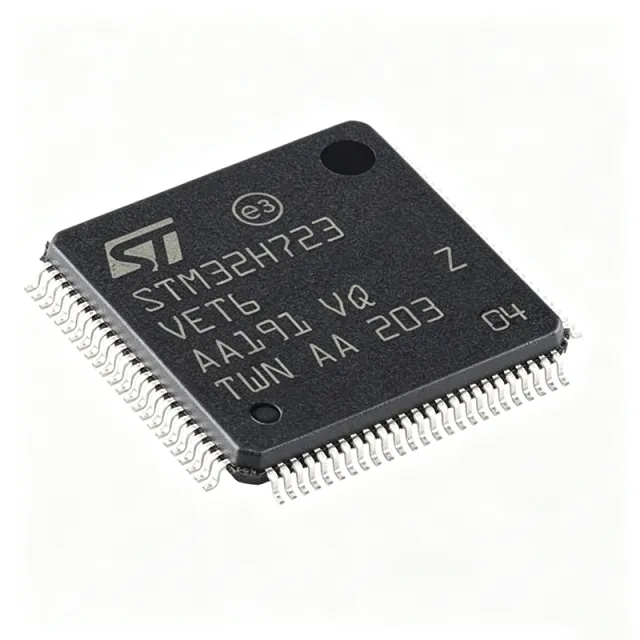
The STM32H723VET6 is a high-performance 32-bit microcontroller from STMicroelectronics, featuring an Arm Cortex-M7 core running at up to 550 MHz. It is part of the STM32H7 series, designed for demanding applications requiring high computational power, advanced connectivity, and rich analog peripherals. The device is housed in a 100-pin LQFP package (LQFP100) with a 14x14 mm body and 0.5 mm pitch, making it suitable for compact PCB designs. What is a microcontroller? A microcontroller (MCU) is a compact integrated circuit designed to govern a specific operation in an embedded system. It integrates a processor core, memory (RAM and flash), and programmable input/output peripherals on a single chip. Microcontrollers are the backbone of embedded systems, ranging from simple household appliances to complex industrial automation. In the system hierarchy, a microcontroller sits between a microprocessor (which requires external memory and peripherals) and a system-on-chip (SoC) that may include more advanced features like graphics or wireless. The STM32H723VET6 belongs to the high-performance MCU category, optimized for real-time control, signal processing, and connectivity. Key features of the STM32H723VET6 include a 550 MHz Arm Cortex-M7 core with double-precision FPU, 1 Mbyte of flash memory, 564 Kbytes of SRAM, and a comprehensive set of peripherals. It supports a wide range of communication interfaces including Ethernet, USB OTG HS/FS, CAN FD, SPI, I2C, UART, and SDMMC. The device also integrates a 16-bit ADC with 3.6 MSPS, a 12-bit DAC, multiple timers, and a cryptographic acceleration unit. These features make it ideal for applications requiring high-speed data processing and secure communication. From a technical depth perspective, the STM32H723VET6 leverages the Arm Cortex-M7 architecture with a 6-stage pipeline and a branch prediction unit, enabling efficient execution of complex algorithms. The inclusion of a double-precision FPU accelerates floating-point operations, which is critical for audio processing, motor control, and industrial analytics. The device also features a memory protection unit (MPU) and a cache controller, enhancing system reliability and performance. The advanced analog peripherals, such as the 16-bit ADC with oversampling, provide high-resolution data acquisition for precision measurement applications. Typical applications for the STM32H723VET6 include industrial control systems, motor drives, power conversion, audio processing, and IoT gateways. Its high clock speed and rich peripheral set make it suitable for real-time control loops and edge computing tasks. The Ethernet and USB interfaces enable seamless connectivity in networked systems, while the CAN FD support is ideal for automotive and industrial communication. When designing with this device, ensure proper decoupling of the power supply pins with 100 nF capacitors placed close to each VDD pin. The VDDA pin should be filtered with a ferrite bead and a 1 uF capacitor to reduce analog noise. Additionally, the VCAP pins require a 2.2 uF capacitor to stabilize the internal voltage regulator. Careful attention to the crystal oscillator layout is essential for reliable clock generation.

Cotação Contato
STM32H723VGH6 - 550MHz Cortex-M7 1MB Flash MCU | ST
STM32H723VGH6

STM32H723VGH6 - 550MHz Cortex-M7 1MB Flash MCU | ST

The STMicroelectronics STM32H723VGH6 is a 32-bit Arm Cortex-M7 microcontroller with a 550 MHz CPU, 1 MB flash memory, 564 KB RAM, and a 100-TFBGA package measuring 8 mm by 8 mm. According to DigiKey, it is an ARM Cortex-M7 STM32H7 microcontroller with 1M x 8 flash, while Mouser identifies the device as a high-performance MCU with DP-FPU support. A microcontroller is a programmable system-on-chip that integrates a processor core, memory, communication interfaces, timers, analog peripherals, and general-purpose input/output. Within the embedded-computing hierarchy, this device belongs to the Arm Cortex-M class, combines high-performance digital control with DSP-oriented processing, and serves as the central controller in industrial, networking, motor-control, and connected embedded products. The headline capabilities include a 550 MHz Cortex-M7 core, 1 MB of flash, 564 KB of RAM, an L1 cache, and an external memory interface. The manufacturer datasheet result also identifies Ethernet, USB, three FDCAN peripherals, graphics, and two 16-bit ADCs. These interfaces support high-bandwidth communications, motor and automation systems, graph-based user interfaces, and precision analog acquisition while preserving deterministic embedded-control capability. The MCU is designed for demanding applications where processing throughput, memory capacity, and peripheral integration matter more than minimum cost or smallest package size. Its 100-TFBGA package provides 100 external connection points, enabling access to the documented GPIO, communication, analog, timer, power, debug, and memory resources. Package layout, voltage domains, peripheral availability, and pin multiplexing must be checked against the manufacturer datasheet before schematic or PCB release. Typical uses include industrial motor controllers, networked industrial equipment, Ethernet-connected machines, USB-enabled embedded systems, FDCAN-based vehicle or automation nodes, and graphics-capable human-machine interfaces. The 550 MHz Cortex-M7 performance can reduce reliance on external compute for signal processing and control, while integrated connectivity can reduce board-level component count when the selected firmware and driver stack support those peripherals. A critical design consideration is that the H723 ordering code, package suffix, pin multiplexing, and hardware revision must match the PCB footprint and bill of materials exactly. Review power sequencing, decoupling, external-memory routing, high-speed signal integrity, thermal conditions, and debug programming requirements in the manufacturer datasheet. LCSC listed the device in stock at $12.0658, but current quantity-tier pricing beyond that single reference requires confirmation. This product synthesis combines the verified manufacturer datasheet reference with distributor specifications, sourcing information, and engineering-oriented design guidance. It does not treat generic STM32H7 claims as verified unless they appear in the supplied data, and it directs engineers to the official PDF for complete pin-level and electrical details.

Cotação Contato
STM32H723VGT6 - 550MHz ARM Cortex-M7 MCU | STMicroelectronics
STM32H723VGT6

STM32H723VGT6 - 550MHz ARM Cortex-M7 MCU | STMicroelectronics

The STMicroelectronics STM32H723VGT6 is a high-performance 32-bit microcontroller based on the ARM Cortex-M7 core, operating at up to 550 MHz. It is part of the STM32H7 series, designed for demanding applications requiring high processing power, advanced connectivity, and rich analog peripherals. The device is housed in a 100-pin LQFP package (LQFP100) and offers 1 Mbyte of Flash memory and 564 Kbytes of SRAM, making it suitable for complex real-time control and signal processing tasks. What is a microcontroller? A microcontroller (MCU) is a compact integrated circuit designed to govern a specific operation in an embedded system. It integrates a processor core, memory (Flash and SRAM), and programmable input/output peripherals on a single chip. Microcontrollers are the brains of countless electronic devices, from automotive engine control units to industrial robots and consumer electronics. The STM32H723VGT6 belongs to the high-performance segment of the microcontroller family, positioned above mid-range MCUs like the STM32F4 series, and is optimized for applications that require intensive computation, such as digital signal processing, motor control, and artificial intelligence at the edge. Key features of the STM32H723VGT6 include a 550 MHz Cortex-M7 core with double-precision floating-point unit (FPU), a Chrom-ART Accelerator for 2D graphics, and a comprehensive set of communication interfaces including Ethernet, USB OTG HS, CAN FD, and multiple UARTs/SPIs/I2Cs. The device also integrates a 16-bit ADC with up to 5 MSPS, a 12-bit DAC, and advanced timers for precise PWM generation. With its high clock speed and rich peripheral set, the STM32H723VGT6 delivers exceptional performance for real-time applications. From a technical architecture perspective, the STM32H723VGT6 features a Harvard architecture with separate instruction and data buses, enabling simultaneous fetch and data access. The Cortex-M7 core includes a 6-stage pipeline, branch prediction, and a memory protection unit (MPU) for enhanced reliability. The device supports external memory interfaces (FMC) for SDRAM, NOR, and NAND Flash, and includes a hardware cryptographic accelerator for AES, DES, and RSA, ensuring secure data communication. The integrated power management allows operation from 1.62V to 3.6V, with multiple low-power modes to optimize energy consumption. Typical applications for the STM32H723VGT6 include industrial automation, motor control, power conversion, medical devices, and high-end consumer electronics. Its high-speed ADC and timers make it ideal for digital power supplies and motor drives, while the Ethernet and USB interfaces enable connectivity in IoT gateways and industrial networking. The device's graphics acceleration supports human-machine interfaces (HMI) with smooth rendering. When designing with the STM32H723VGT6, ensure proper decoupling of the power supply pins with 100nF capacitors placed close to each VDD pin, and a 4.7uF bulk capacitor. The VDDA pin requires a dedicated analog supply with a ferrite bead to reduce noise. For high-speed interfaces like Ethernet and USB, follow the layout guidelines in the datasheet to maintain signal integrity. The device supports in-circuit programming via SWD or JTAG, and the STM32CubeIDE toolchain simplifies development.

Cotação Contato
STM32H723ZGI6 - 550MHz Cortex-M7 1MB Flash MCU | STMicroelectronics
STM32H723ZGI6

STM32H723ZGI6 - 550MHz Cortex-M7 1MB Flash MCU | STMicroelectronics

The STMicroelectronics STM32H723ZGI6 is a 32-bit Arm Cortex-M7 microcontroller operating up to 550 MHz, with 1 MB of flash memory and 564 KB of RAM, in a 144-UFBGA 7 x 7 mm package. It combines high-performance DSP and control processing with Ethernet, USB, three FDCAN peripherals, graphics, and two 16-bit ADCs, making it suitable for industrial control, connected equipment, communications, and embedded automation. What is a Cortex-M7 microcontroller? A Cortex-M7 microcontroller is a 32-bit Arm-based embedded processor used in the hierarchy microcontroller -> embedded processor -> semiconductor. It executes control software, manages digital interfaces, samples analog signals, and controls connected peripherals. The STM32H7 family extends this role with high clock frequency, cache, substantial memory, and integrated communication and analog peripherals. Key features include a 550 MHz CPU, 1 MB flash, 564 KB RAM, L1 cache, an external memory interface, and up to 35 communication peripherals and analog interfaces. The STM32H723ZGI6 also provides Ethernet, USB, three FDCAN channels, graphics, and two 16-bit ADCs. These resources reduce the need for external interface and conversion components in systems that need real-time control alongside data processing. The device is designed for applications where processing throughput, deterministic control, and communication capability are important. Its high-performance Cortex-M7 core supports demanding control loops, while the integrated peripherals address industrial networking, motor-control communication, data acquisition, and human-machine-interface workloads. The 144-UFBGA package also enables compact designs but requires careful PCB layout and thermal management. Typical uses include industrial automation, IoT gateways, motor and power-control systems, communications infrastructure, instrumentation, and networked industrial equipment. The Ethernet, USB, CAN, graphics, and ADC resources make it useful where a design must combine control, connectivity, and signal acquisition. When designing around the STM32H723ZGI6, verify the complete pin assignment, power requirements, decoupling, external-memory connections, and thermal layout against the manufacturer datasheet. A 144-UFBGA package is not a low-risk prototype footprint; use the manufacturer’s recommended land pattern and validate signal integrity and power integrity. This page consolidates the verified distributor and manufacturer information for the STM32H723ZGI6, highlights the engineering role of its Cortex-M7 architecture, and separates documented features from information that still requires datasheet confirmation.

Cotação Contato
STM32H723ZGT6 - 550MHz Cortex-M7 MCU, 1MB Flash | ST
STM32H723ZGT6

STM32H723ZGT6 - 550MHz Cortex-M7 MCU, 1MB Flash | ST

The STMicroelectronics STM32H723ZGT6 is a high-performance 32-bit Arm Cortex-M7 microcontroller running at up to 550 MHz, with 1 MB of Flash memory and 564 KB of RAM, housed in a 144-pin LQFP (20x20 mm) surface-mount package. A microcontroller (MCU) is a single-chip computer that integrates a processor core, memory, and peripherals on one die, forming the top of the embedded processing hierarchy that also spans DSPs and application processors. The STM32H7 family sits at the high-performance end of the STM32 portfolio, targeting real-time control and signal-processing workloads that previously required a separate DSP. Key features include the Cortex-M7 core with double-precision FPU and L1 cache, an external memory interface, and 35 communication peripherals and analog interfaces. Integrated Ethernet, USB, and 3x FDCAN controllers make the device well suited for connected industrial nodes, while 2x 16-bit ADCs with 12-bit resolution handle multi-channel analog acquisition. Architecturally, the STM32H723 combines the DSP and double-precision floating-point capabilities of the Cortex-M7 with ST ART Accelerator prefetch logic, enabling execution from internal Flash at full core speed. The 564 KB RAM is organized in multiple blocks (including DTCM/ITCM) to sustain deterministic real-time behavior at 550 MHz. Typical applications include drone flight controllers (ArduPilot/PX4 autopilots such as Cube Orange+/Purple class hardware), industrial automation and motor control, and connected IoT gateways using the integrated Ethernet and FDCAN interfaces. When designing with the STM32H723ZGT6, budget the 550 MHz core supply rail (VOS0 operation) carefully and verify that peripheral subsets required by your firmware are present in this family member; pin-compatible H7 siblings differ in memory size and clock ceiling. This page synthesizes distributor pricing, drop-in alternatives, and practical design notes not found in the manufacturer datasheet.

Cotação Contato
STM32H725AEG6 - 550MHz Cortex-M7 MCU with 1MB Flash | STMicroelectronics
STM32H725AEG6

STM32H725AEG6 - 550MHz Cortex-M7 MCU with 1MB Flash | STMicroelectronics

The STMicroelectronics STM32H725AEG6 is a high-performance 32-bit microcontroller based on the Arm Cortex-M7 core, operating at up to 550 MHz. It integrates 1 MB of flash memory and 564 KB of SRAM, along with a rich set of peripherals including a TFT-LCD controller, cryptographic acceleration, and high-speed connectivity interfaces. The device is housed in a 144-pin UFBGA package (UFBGA144) with a 10x10 mm footprint, offering a compact solution for advanced embedded applications. A microcontroller (MCU) is a compact integrated circuit designed to govern a specific operation in an embedded system. It contains a processor core, memory, and programmable input/output peripherals on a single chip. MCUs are the brains of countless electronic devices, from automotive engine control units to IoT sensors and industrial automation systems. The STM32H7 series represents the high-performance tier of STMicroelectronics' STM32 family, positioned above the mainstream F4 series and the low-power L4 series, targeting applications that demand maximum processing power and advanced features. Key features of the STM32H725AEG6 include a 550 MHz Arm Cortex-M7 core with double-precision FPU, 1 MB of dual-bank flash memory, 564 KB of SRAM, and a Chrom-ART Accelerator for graphics. It also features a TFT-LCD controller supporting up to XGA resolution, a camera interface, and a cryptographic processor with hardware acceleration for AES, DES, and 3DES. The device supports a wide range of communication interfaces including Ethernet, USB OTG HS/FS, CAN FD, and multiple USART/SPI/I2C ports, making it suitable for complex connectivity requirements. From a technical architecture perspective, the STM32H725AEG6 leverages a 7-stage pipeline with branch prediction and a memory protection unit (MPU) for enhanced real-time performance. The dual-bank flash allows read-while-write operations, enabling firmware updates without halting the system. The device also includes a power management unit with multiple low-power modes, including Sleep, Stop, and Standby, to optimize energy consumption in battery-powered applications. Typical applications include industrial control systems, motor drives, smart home gateways, audio processing, and high-end consumer electronics. The combination of high clock speed, large memory, and rich peripherals makes it ideal for applications requiring real-time processing and complex user interfaces. When designing with this MCU, careful attention must be paid to power supply decoupling and PCB layout to ensure stable operation at 550 MHz. The use of multiple supply pins (VDD, VDDA, VDDUSB) requires proper filtering to minimize noise and maintain signal integrity.

Cotação Contato
STM32H725REV6 - 550MHz Cortex-M7 MCU, 512KB Flash | STMicroelectronics
STM32H725REV6

STM32H725REV6 - 550MHz Cortex-M7 MCU, 512KB Flash | STMicroelectronics

The STMicroelectronics STM32H725REV6 is a high-performance 32-bit ARM Cortex-M7 microcontroller with double-precision FPU, 512 KB of embedded Flash, 564 KB of total SRAM, and a 550 MHz maximum CPU clock, housed in a 68-pin VFQFPN (8x8 mm) package. The device integrates a 32 KB instruction cache and a 32 KB data cache that enable 0-wait-state execution from flash and external memories, plus an external memory interface (FMC), an integrated SMPS step-down converter for core supply, and a subset of high-speed peripherals including Ethernet MAC, USB OTG, and multiple UART/SPI/I2C ports. An ARM Cortex-M7 microcontroller is the highest-performance member of the Cortex-M family, featuring a six-stage superscalar pipeline, hardware single- and double-precision floating-point unit, SIMD DSP instructions, and tightly-coupled instruction/data caches. Within the broader system hierarchy, the Cortex-M7 sits above Cortex-M4/M3 in DSP and signal-processing capability and below Cortex-A application cores in raw integer performance, making it ideal for embedded systems that require deterministic real-time control combined with high-throughput DSP — for example, motor control, audio codecs, and motor drives. The STM32H7 family from STMicroelectronics is the first commercial Cortex-M7 implementation and pairs the core with a Chrom-ART graphics accelerator, a hardware JPEG codec, and advanced analog peripherals. Key features of the STM32H725REV6 include 550 MHz CPU clock (with MPU and DSP instructions), 2x 16-bit ADCs (up to 36 MSPS each), 2x 12-bit DACs, 2x comparators, 2x op-amps, a low-power RTC, and support for cryptographic/hash acceleration on selected derivatives. The integrated SMPS reduces external component count by generating the internal 1.2V core voltage from a single 3.3V rail, and the wide operating voltage range of 1.62V to 3.6V simplifies battery-backed designs. The 68-pin VFQFPN package exposes a subset of the H7 peripheral set, balancing I/O count with PCB-friendly 8x8 mm footprint. Typical applications include high-performance motor control (FOC for PMSM/BLDC drives), industrial automation controllers, audio processing and digital audio bridges, edge AI / TinyML inference nodes (paired with CMSIS-NN), HMI and graphical touch panels, and Ethernet-connected IoT gateways. The 564 KB SRAM enables moderate on-chip frame buffers and full-frame audio streaming without external memory, while the 550 MHz Cortex-M7 with FPU delivers ~1027 CoreMark and ~277 DMIPS per MHz performance. When designing with this part, allocate decoupling capacitors per the reference manual (100 nF near every VDD pin plus 4.7 µF bulk), and verify the SMPS inductor selection against the datasheet's recommended LC network. The package exposes a subset of H7 peripherals; if your design needs a larger I/O count or the full peripheral set, the 100-pin and 144-pin STM32H725 siblings share the same silicon and firmware. This page synthesizes verified distributor pricing, AEC-Q100/automotive variants, drop-in alternative candidates and practical design notes that are not consolidated on the manufacturer datasheet, giving an engineer a single reference for part selection, BOM risk management, and schematic-to-layout bring-up.

Cotação Contato
STM32H725VGT6 - 550MHz Cortex-M7 MCU with 1MB Flash | STMicroelectronics
STM32H725VGT6

STM32H725VGT6 - 550MHz Cortex-M7 MCU with 1MB Flash | STMicroelectronics

The STMicroelectronics STM32H725VGT6 is a high-performance 32-bit microcontroller based on the Arm Cortex-M7 core, operating at up to 550 MHz. It integrates 1 Mbyte of flash memory and 564 Kbytes of SRAM, along with a rich set of peripherals including a Chrom-ART Accelerator, a JPEG codec, and advanced security features. The device is housed in a 100-pin LQFP package (LQFP100) with a 14x14 mm body and 0.5 mm pitch, making it suitable for space-constrained industrial and consumer applications. What is a microcontroller? A microcontroller (MCU) is a compact integrated circuit designed to govern a specific operation in an embedded system. It contains a processor core, memory (flash and SRAM), and programmable input/output peripherals on a single chip. Microcontrollers are the brain of countless electronic devices, from automotive engine control units to smart home sensors. In the system hierarchy, the STM32H725VGT6 sits at the application processor level, providing the computational power and connectivity for complex tasks such as real-time control, digital signal processing, and human-machine interfaces. Key features of the STM32H725VGT6 include a 550 MHz Cortex-M7 core with double-precision FPU, a Chrom-ART Accelerator for 2D graphics, a hardware JPEG codec, and a comprehensive set of communication interfaces: 6x SPI, 4x I2C, 4x USART, 2x UART, 2x FDCAN, 2x SDMMC, 1x USB OTG FS/HS, 1x Ethernet MAC, and 1x camera interface. It also features a 16-bit ADC with 3.6 MSPS, a 12-bit DAC, and multiple timers including a high-resolution timer. Security is enhanced with a true random number generator (TRNG), a cryptographic accelerator (AES, DES, 3DES, SHA-1, SHA-256), and a secure boot option. The STM32H725VGT6 is built on a high-performance architecture with an L1 cache (32 Kbytes I-cache and 32 Kbytes D-cache) and a memory protection unit (MPU) for enhanced real-time performance. The device supports a wide supply voltage range of 1.62V to 3.6V and operates over a temperature range of -40°C to +85°C (T suffix). It is available in both commercial and industrial temperature grades, with the '6' suffix indicating the -40°C to +85°C range. Typical applications include industrial control systems, motor drives, power conversion, medical devices, audio processing, and IoT gateways. The combination of high clock speed, rich peripherals, and security features makes it ideal for applications requiring both computational power and connectivity. When designing with this device, ensure proper decoupling of the power supply pins with 100 nF capacitors placed close to each VDD pin, and a 4.7 uF bulk capacitor. The VDDA pin must be connected to a clean analog supply, and the VCAP pins require external capacitors as specified in the datasheet. For high-speed interfaces like USB and Ethernet, follow the layout guidelines in the STM32H7 reference manual (RM0433) to ensure signal integrity.

Cotação Contato
STM32H725ZGT6 - 550MHz Cortex-M7 MCU, 1MB Flash | STMicroelectronics
STM32H725ZGT6

STM32H725ZGT6 - 550MHz Cortex-M7 MCU, 1MB Flash | STMicroelectronics

The STMicroelectronics STM32H725ZGT6 is a high-performance 32-bit microcontroller built around the Arm Cortex-M7 core running at up to 550 MHz, integrating 1 Mbyte of Flash and 564 Kbytes of SRAM in a 144-pin LQFP package (LQFP144, 20x20 mm). The device targets demanding real-time applications including industrial control, motor drives, audio processing, and high-end consumer electronics. A double-precision FPU, L1 cache (16 KB I-cache / 16 KB D-cache), and a multi-layer AXI bus matrix deliver high compute throughput with deterministic memory access. A microcontroller (MCU) is a single-chip computer integrating a processor core, program memory, data memory, and programmable peripherals. The STM32H725ZGT6 belongs to the STM32H7 series within the broader STM32 family of 32-bit Arm Cortex-M microcontrollers. This hierarchy places it as a high-tier MCU within the STM32 ecosystem, sitting above Cortex-M4/M0+ variants in compute performance while sharing the same ST ecosystem (CubeMX, HAL/LL libraries, STM32CubeIDE). Key features include the 550 MHz Cortex-M7 with double-precision FPU, 1 MB dual-bank Flash with ECC, 564 KB total SRAM (including TCM and backup SRAM), 16-bit ADC up to 3.6 MSPS, 12-bit DAC, advanced motor-control timers with high-resolution PWM, USB 2.0 OTG HS/FS, two CAN FD controllers, Ethernet MAC, multiple SPI/I²C/UART/USART instances, SDMMC, and hardware cryptographic accelerators (AES, SHA, RSA, ECC). An integrated SMPS step-down regulator reduces core-power dissipation. Architecturally, the device couples an L1 cache to TCM (Tightly Coupled Memory) for deterministic code execution and uses a multi-layer AHB/AXI matrix to allow simultaneous peripheral DMA and CPU access. The Chrom-ART Accelerator offloads 2D graphics, and the JPEG codec accelerator handles image compression. The on-chip SMPS drives the internal core logic from VBAT or VDD, simplifying power-tree design and improving efficiency versus an external LDO. Typical applications include industrial PLCs and HMIs, motor-control drives (PMSM, BLDC, stepper), high-end audio equipment, IoT gateways, smart appliances, and medical instrumentation. The 144-pin LQFP exposes up to 112 GPIO for extensive system integration, while the Ethernet and CAN FD interfaces enable connected industrial nodes. A subset of peripherals is provided versus the STM32H735/H730, suiting designs that do not need the full H730 feature set. When designing with this part, supply VBAT from a backup source if RTC retention is required, and ensure adequate decoupling on every VDD/VDDA/VDD_USB pin. For high-MIPS operation, an external SMPS (such as ST's ST1PS02) is recommended to limit internal dissipation. Boot configuration (BOOT0, nSWBOOT0) must be set according to the desired boot source. This page synthesizes distributor pricing, drop-in alternatives, and practical design notes not found in the manufacturer datasheet.

Cotação Contato
STM32H730IBK6Q - 550MHz Cortex-M7 MCU, 128KB Flash | STMicroelectronics
STM32H730IBK6Q

STM32H730IBK6Q - 550MHz Cortex-M7 MCU, 128KB Flash | STMicroelectronics

The STMicroelectronics STM32H730IBK6Q is a high-performance ARM Cortex-M7 microcontroller operating at 550 MHz with 128 KB of Flash and 564 KB of RAM, housed in a 176+25-pin UFBGA (10x10) package. Built on the STM32H7 platform, it integrates a double-precision FPU, L1 cache, and a hardware crypto/hash accelerator. A microcontroller (MCU) is a single-chip computer that combines a CPU core, memory, and programmable peripherals. Within the broader semiconductor taxonomy, the STM32H730IBK6Q sits at the level of a 32-bit RISC MCU (Cortex-M7 -> ARM Cortex family -> 32-bit MCU -> microcontroller -> semiconductor). It belongs to the high-performance tier of the STM32 family and is designed for applications that demand both DSP capability and real-time control. Key features include 550 MHz CPU clock, 16 KB I-cache / 16 KB D-cache, 4 KB backup SRAM, an external memory interface (FMC), and an integrated SMPS step-down converter for core supply. The device also provides Ethernet, USB OTG, 3x FDCAN, two 16-bit ADCs, and a graphics subset (Chrom-ART, JPEG codec). The crypto/hash accelerator accelerates AES, SHA, and RSA, allowing secure firmware updates and authenticated communication. The STM32H730IBK6Q uses a 40 nm CMOS process and a multi-power-domain architecture that allows the SMPS to supply the core directly, reducing external component count. The 564 KB of SRAM is split across DTCM, AXI SRAM, and backup SRAM domains, allowing concurrent DMA and CPU access without contention. Compared to STM32F7 series, the Cortex-M7 core at 550 MHz and 6-stage pipeline provide roughly twice the CoreMark performance. Typical applications include industrial motor control, factory automation, audio processing with DSP, USB-based peripherals, secure IoT gateways, and human-machine interface (HMI) panels with graphics. The combination of crypto, Ethernet, and FDCAN makes the device suitable for networked industrial controllers and connected medical instruments. The 176-pin UFBGA also supports external SRAM/PSRAM/NOR/NAND via the FMC for applications requiring large buffers. When designing with this MCU, ensure the SMPS inductor and output capacitors are placed close to the VCAP pins and that the high-speed USB and Ethernet differential pairs are routed with 90-ohm impedance. The crypto accelerator must be clocked from the HSI or HSE source before being used; otherwise the peripheral stays in reset. This page synthesizes distributor pricing, package-aware drop-in alternatives, and practical layout notes that go beyond the manufacturer datasheet summary.

Cotação Contato
STM32H730IBT6 - 550MHz Cortex-M7 MCU with 1MB Flash | STMicroelectronics
STM32H730IBT6

STM32H730IBT6 - 550MHz Cortex-M7 MCU with 1MB Flash | STMicroelectronics

The STMicroelectronics STM32H730IBT6 is a high-performance ARM Cortex-M7 based microcontroller operating at up to 550 MHz, delivering 3224 CoreMark points. It integrates 1 MB of flash memory and 564 KB of SRAM in a 176-pin LQFP package, making it suitable for demanding embedded applications requiring real-time processing and advanced connectivity. A microcontroller (MCU) is a compact integrated circuit designed to govern a specific operation in an embedded system. It contains a processor core, memory, and programmable input/output peripherals. The STM32H730IBT6 belongs to the STM32H7 series, which is part of the broader STM32 family of 32-bit ARM Cortex-M microcontrollers. This hierarchy places it within the embedded processing domain, where it serves as the central control unit for applications ranging from industrial automation to consumer electronics. Key features include a 550 MHz Cortex-M7 core with double-precision FPU, a Chrom-ART Accelerator for 2D graphics, and a hardware cryptographic accelerator supporting AES, DES, and HASH algorithms. The device also offers a comprehensive set of communication interfaces including Ethernet, USB OTG HS, multiple SPI, I2C, UART, and CAN FD. Its advanced timer peripherals and 16-bit ADC with oversampling enable precise motor control and high-resolution sensing. The STM32H730IBT6 is built on a high-performance architecture with an L1 cache, a 32-bit multi-AHB bus matrix, and a power-efficient design that includes multiple low-power modes. The Chrom-ART Accelerator offloads graphics rendering from the CPU, while the cryptographic accelerator ensures secure data transfer without burdening the core. This combination of raw processing power and dedicated hardware accelerators makes it ideal for real-time control and edge computing. Typical applications include industrial motor control, robotics, high-end audio processing, and smart home gateways. Its rich peripheral set and high-speed interfaces allow it to handle complex tasks such as real-time audio effects, predictive maintenance, and secure IoT connectivity. The device's 550 MHz clock speed ensures rapid response in time-critical control loops. When designing with this MCU, careful attention must be paid to power supply decoupling and PCB layout to maintain signal integrity at high frequencies. The device supports a wide supply voltage range of 1.62V to 3.6V, and its multiple power domains require proper sequencing. Additionally, the extensive peripheral set demands a well-structured firmware architecture to fully utilize its capabilities.

Cotação Contato