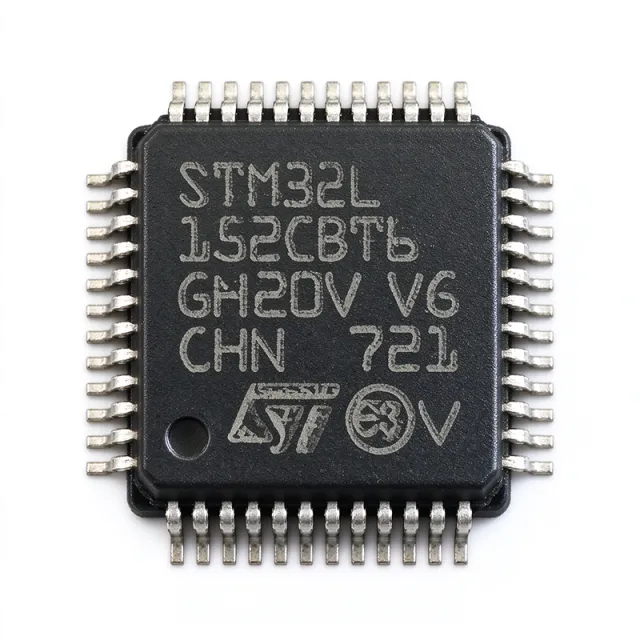
STM8L152C4U6
STM8L152C4U6 - 16MHz, 16KB Low-Power MCU | STMicroelectronics
STMicroelectronics STM8L152C4U6 is an ultra-low-power 8-bit microcontroller rated at 16MHz, with 16KB of embedded Flash memory and a 48-pin UFQFPN package measuring 7 x 7mm. It belongs to the STM8L151x4/6 and STM8L152x4/6 medium-density device group, combining an 8-bit architecture with LCD, RTC, communication, analog, and timing resources for compact embedded systems. The device is positioned for applications that require low-power operation, broad peripheral integration, and a space-efficient surface-mount footprint.
An ultra-low-power microcontroller is an embedded processing device designed to maintain useful operation while minimizing energy consumption during active and sleep states. The STM8L family sits within the hierarchy of low-power 8-bit microcontrollers, embedded controllers, and general-purpose semiconductors. This positioning makes the STM8L152C4U6 suitable for metering, sensing, access-control, industrial control, consumer accessories, and connected low-power equipment in which battery life, display support, and mixed analog/digital functions matter.
The manufacturer identifies the STM8L152C4U6 as an 8-bit MCU with 16KB Flash, 16MHz operation, and a 48-UFQFPN package. Its documented feature set includes an RTC, 1KB data EEPROM, LCD support, timers, USART, I2C, SPI, ADC, DAC, and comparators. These resources can reduce external component count by consolidating communications, display control, data acquisition, and low-level timing into one device. The 16KB Flash configuration is suitable for compact control firmware that does not require the storage capacity of the larger members in the same family.
The STM8L architecture integrates an 8-bit CPU, memory, and multiple peripheral blocks on a single die. Its communication peripherals support serial links to sensors, transceivers, displays, and other embedded controllers, while the ADC, DAC, and comparators extend the device beyond basic digital logic control. The RTC provides timekeeping for data logging and scheduled operations, and the LCD interface is particularly useful in segmented-display products. Pin-count and exact peripheral availability should be checked against the manufacturer pin description before assigning board functions.
Typical uses include low-energy sensor nodes, compact industrial controllers, portable measurement equipment, LCD-driven utility meters, access terminals, and battery-assisted appliances. In a sensor-node design, the MCU can gather analog measurements, filter them digitally, timestamp them through the RTC, and transmit results through I2C, SPI, or USART. In a display-oriented product, the LCD interface can reduce parallel-display driver requirements while the timers and comparators support background measurement or threshold functions.
PCB planning should reserve the 48-pin UFQFPN land pattern, confirm exposed-pad requirements, and follow the manufacturer recommendations for decoupling and signal routing. Place input and output capacitors close to their associated supply pins, provide a stable clock implementation, and keep analog and communication routes away from noisy switching nodes. Firmware and peripheral allocation should be checked against the target device's 16KB Flash limit before enabling multiple complex functions.
This product page consolidates the manufacturer's core device identification, family positioning, package information, peripheral capabilities, pinout caveat, drop-in family comparisons, and practical PCB guidance into one engineering-focused reference. It also distinguishes confirmed device facts from parameters that require confirmation in the manufacturer datasheet, helping engineers evaluate the STM8L152C4U6 before schematic capture and PCB layout.
Cotação
Contato