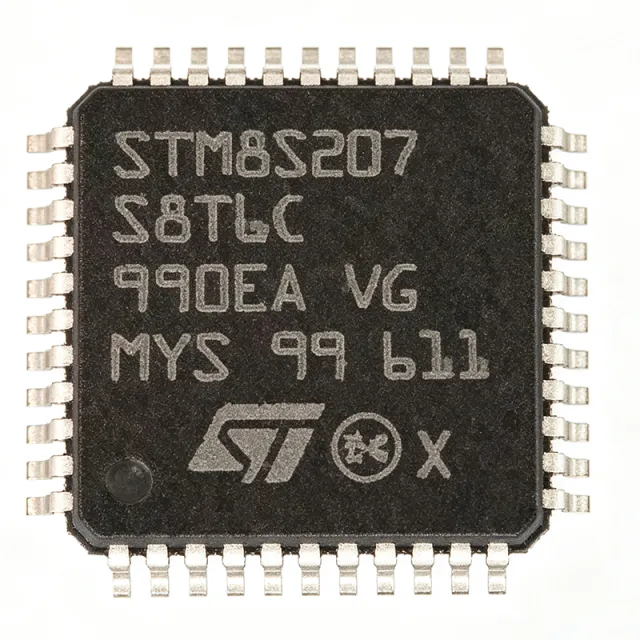
STM8S903K3U6
STM8S903K3U6 - 16MHz 8-Bit MCU with 8KB Flash | ST
The STMicroelectronics STM8S903K3U6 is an 8-bit STM8S microcontroller with a 16 MHz clock, 8 KB of Flash program memory, 1 KB of RAM, 640 bytes of true EEPROM, and a 10-bit ADC in a 32-pin UFQFPN package measuring 5 x 5 mm. It operates from 2.95 V to 5.5 V and provides 16 I/O ports, two timers, UART, SPI, and I2C interfaces for compact embedded-control designs.
An 8-bit microcontroller is a compact embedded-processing component designed around a simple central processing unit, program memory, working memory, and integrated peripherals. The STM8S family belongs to the broader hierarchy of microcontrollers, embedded processors, and semiconductors. Its combination of integrated Flash, true EEPROM, analog conversion, and serial interfaces makes it useful for cost-sensitive appliance control, industrial sensing, compact instrumentation, and low-to-moderate-speed communication equipment.
Key features include 8 KB of Flash program memory, 1 KB of RAM, and 640 bytes of integrated true data EEPROM. The device supports a 16 MHz maximum clock and includes a 10-bit analog-to-digital converter, two timers, one UART, SPI, and I2C. Its operating voltage of 2.95 V to 5.5 V supports both 3.3 V and 5 V systems, while a temperature range of -40°C to +85°C covers common industrial and commercial environments.
The STM8S903K3/F3 access-line architecture emphasizes performance, robustness, and reduced system cost. Flash permits in-system program storage, true EEPROM retains calibration or configuration data without external memory, and the ADC provides an economical path for analog measurement. The 32-pin UFQFPN package also offers fine-pitch external connectivity for sensors, actuators, displays, and communication transceivers, although its 0.5 mm pitch requires careful PCB assembly and inspection.
Typical applications include sensor nodes, appliance controllers, compact industrial interfaces, low-speed data loggers, and embedded modules requiring UART, SPI, or I2C connectivity. Designers can connect analog inputs to the 10-bit ADC, use the timers for periodic measurement or output generation, and retain operating parameters in EEPROM. A UART bridge or level translator can extend the device into RS-232 or RS-485 systems.
The primary design consideration is PCB implementation. A 32-pin UFQFPN package requires a land pattern capable of 0.5 mm pitch routing, adequate solder paste coverage, and careful control of thermal and electrical conditions. Firmware should also verify the device-specific reset behavior, clock configuration, peripheral mapping, and ADC calibration sequence against the manufacturer documentation before production.
This page consolidates verified manufacturer specifications, distributor availability, procurement information, interface guidance, and same-footprint replacement analysis. It is intended to provide engineering context beyond a basic distributor listing while clearly identifying data that requires confirmation from the manufacturer datasheet.
Cotação
Contato