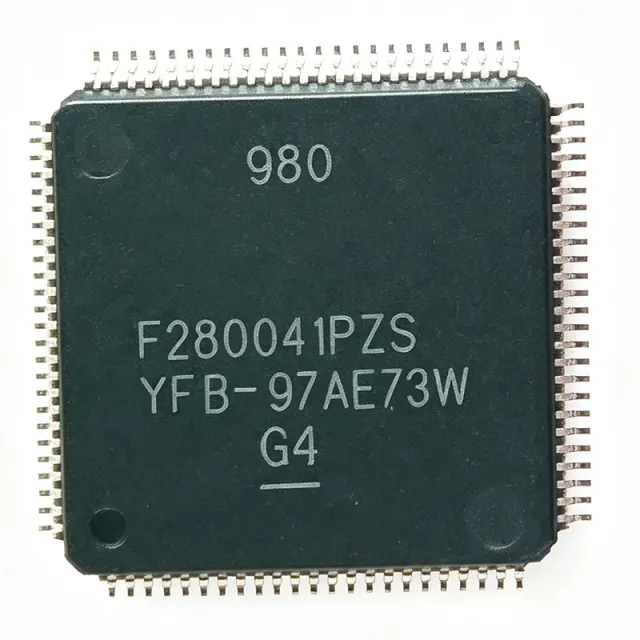
TMS320F206PZ
TMS320F206PZ - Digital Signal Processor | Texas Instruments
The Texas Instruments TMS320F206PZ is a TMS320C20x-generation digital signal processor fabricated with high-performance static CMOS technology and optimized for low-power operation. It is packaged in a 100-pin LQFP measuring 14 mm by 14 mm and combines a specialized signal-processing instruction set, Harvard-style architecture, on-chip peripherals, and on-chip memory. The device is intended for embedded systems that require deterministic real-time signal processing, including digital audio, industrial control, communications, and instrumentation.
A digital signal processor, or DSP, is a specialized microprocessor architecture optimized for arithmetic operations on continuously changing signals. Unlike a general-purpose processor, a DSP emphasizes predictable execution of filtering, Fourier-analysis, convolution, and waveform-shaping algorithms. In the broader semiconductor hierarchy, the TMS320F206PZ is a digital signal processor within the embedded processor and microcontroller family, combining controller integration with dedicated real-time computational hardware.
The supplied manufacturer information identifies the processor as a member of the TMS320C2xLP core CPU and the TMS320C20x generation. Its static CMOS implementation combines the architectural benefits of a dedicated DSP with low-power characteristics. On-chip memory and peripherals reduce the need for external components in compact embedded systems, while the source-code compatibility stated for the TMS320C25 generation can simplify migration of suitable legacy signal-processing software.
A principal advantage is the device's integration of a specialized instruction set with real-time processing resources. The TMS320C20x architecture is designed around the computational demands of digital filtering and other mathematically intensive tasks rather than general desktop-style software execution. This makes it appropriate when predictable processing throughput, compact integration, and legacy software continuity are more important than broad ecosystem size or a conventional microcontroller pin count.
Typical uses include audio and communications signal conditioning, industrial motor and process control, data acquisition, spectrum analysis, and embedded instrumentation. In these systems, the processor can execute filtering and control algorithms while its integrated peripherals manage data movement and external interfaces. The 100-pin LQFP package is comparatively substantial for a low-power embedded device, but it provides enough physical connection capacity for a larger legacy DSP system with multiple peripheral and bus signals.
Designers should verify the complete electrical, timing, memory, and pin-assignment information from the manufacturer datasheet before schematic capture or PCB layout. In particular, legacy DSP designs require careful attention to clocking, memory-interface timing, analog-interface requirements, decoupling, and signal-conditioning components. Because the verified source set does not provide numerical clock, memory-capacity, I/O, voltage-range, or thermal limits, those values must be confirmed rather than inferred.
This page organizes the verified distributor and manufacturer information, highlights the role of the TMS320F206PZ in embedded signal-processing systems, and separates documented facts from parameters that still require datasheet confirmation. It also provides application guidance and sourcing links, while explicitly identifying the absence of verified drop-in alternatives and exact current pricing rather than presenting unsupported substitutions.
Cotação
Contato