Интерфейсные ИС
Подкатегории
Товары (1568)

ISO1I811TXUMA1 - Isolated 8Ch Digital Input Power Driver | Infineon
The Infineon ISO1I811TXUMA1 is an industrial interface IC with galvanic isolation that integrates an 8-channel digital input power driver with SPI communication, housed in a 48-pin TFSOP (Tape & Reel, PG-TFSOP-48) package with 0.240 inch (6.10 mm) body width. The device provides 500 VAC isolation, 25 kV/us minimum common-mode transient immunity (CMTI), and operates across an extended industrial temperature range up to 135 C, making it well suited for harsh PLC and DCS environments. An isolated digital input (DI) IC is a specialized interface device that bridges low-voltage logic (typically 3.3 V or 5 V microcontrollers) to high-voltage industrial field I/O (24 V DC IEC 61131-2 type-1/3 sensors), while providing galvanic isolation to protect the host controller from voltage transients, ground loops, and field-side faults. In the broader taxonomy, the ISO1I811T sits within the signal conditioning and isolation IC family, which is a sub-class of power management and interface ICs. It is functionally distinct from generic digital isolators (such as TI ISO77xx or ADI ADuM14xx) because it integrates the input conditioning current limiters, reverse-polarity protection, and threshold comparators in one isolated module. Key features include eight parallel input channels with individually programmable thresholds, integrated galvanic isolation rated at 500 VAC, 25 kV/us CMTI, an SPI interface for status read-back and configuration, and a wide supply range of approximately 5 V to 5.5 V. According to the Infineon product page, the part is qualified for industrial ambient temperatures up to 135 C and is optimized for EMI robustness in electrically noisy cabinet environments. Architecturally, the device uses Infineon's coreless transformer isolation technology combined with on-chip input current-limiters and IEC 61131-2 compliant switching thresholds. The SPI peripheral allows the host to poll each input's state, detect wire-break, and configure filter timing, reducing the FPGA/CPU GPIO count traditionally required for parallel isolated DI. Typical applications include PLC digital input modules, distributed I/O in DCS systems, industrial sensor interfaces, building automation I/O cards, and isolated front-ends for safety controllers. The TFSOP-48 surface-mount package simplifies PCB assembly and supports high-density input modules. When designing with this device, ensure that the field-side ground, host-side ground, and any cable shield are routed per the datasheet's creepage/clearance guidelines to preserve the 500 VAC isolation rating. The integrated thermal pad on the TFSOP package must be soldered to a sufficient copper pour to keep junction temperature below 135 C under worst-case input current. This page synthesizes distributor pricing, drop-in alternatives, application guidance, and design considerations not found on the manufacturer datasheet cover page.

ISO6760DWR - 6-Channel 50Mbps Digital Isolator | Texas Instruments
The Texas Instruments ISO6760DWR is a six-channel, all-forward-direction digital isolator with a 50 Mbps maximum data rate, reinforced 5000 Vrms isolation, and 1.8 V logic support, packaged in a 16-pin SOIC (DW). It is designed for high-speed digital communication across equipment, power, and ground barriers where noise immunity and galvanic isolation are required. The device provides six isolated output channels and no reverse input channels, making it appropriate for transmitting commands or data from one voltage domain to another without a direct conductive path. A digital isolator transfers logic signals across an insulation barrier while maintaining electrical separation between the input and output grounds. Galvanic isolation helps prevent ground loops, common-mode currents, and high-voltage fault energy from propagating between systems. In the broader hierarchy, digital isolators belong to interface ICs and signal-conditioning semiconductors, complementing optocouplers, transformers, and other isolation technologies. The ISO6760 family is designed for applications requiring both high data throughput and robust electromagnetic compatibility. Key electrical characteristics include six channels, 50 Mbps operation, 5000 Vrms isolation, and common-mode transient immunity identified in distributor data as 100 kV/µs. The wide operating temperature range is -40 °C to +125 °C, supporting industrial and automotive-adjacent equipment environments. Logic-side operation includes compatibility with 1.8 V systems, which is useful when interfacing modern low-voltage processors, sensors, and transceivers. The ISO6760DWR uses Texas Instruments’ reinforced digital-isolation technology to maintain signal integrity across the barrier while minimizing propagation delay and distortion. Its 16-SOIC package is compatible with standard surface-mount assembly and provides a practical isolation solution for control, communication, and protection interfaces. The exact channel direction and timing values should be confirmed against the manufacturer datasheet for the production design. Typical applications include isolated SPI or serial command links, CAN or RS-485 transceiver interfaces, power-converter control signals, industrial automation equipment, test and measurement systems, and high-voltage battery-management systems. Isolation helps keep low-voltage logic physically separated from noisy power stages while allowing communication at up to 50 Mbps. For PCB implementation, place the isolation device close to the barrier and route input and output returns to their respective ground domains. Keep decoupling capacitors near the supply pins and control creepage and clearance according to the system insulation requirements. Verify voltage levels, timing, isolation rating, and channel direction before final release.
ISO6760FDWR - 6-Ch 50Mbps Digital Isolator | Texas Instruments
Texas Instruments ISO6760FDWR is a 6-channel (6/0 direction) general-purpose digital isolator rated for 5000 Vrms isolation and 50 Mbps data rate, supplied in a 16-pin SOIC (DW) wide-body package. The device supports 1.8 V logic on side 1 (1.71 V to 1.89 V) and 2.25 V to 5.5 V on side 2, enabling direct interface with MCUs, FPGAs, and 5 V transceivers without level shifters. CMTI is specified at ±150 kV/us typical, and the silicon dioxide isolation barrier provides up to 10 kV surge capability. A digital isolator is a semiconductor IC that transfers logic signals across a galvanically isolated barrier using an embedded high-voltage capacitor or transformer. Digital isolators sit within the isolation IC category, which itself is a subset of interface ICs in the broader signal-conditioning and power-management hierarchy. Reinforced 5000 Vrms parts such as the ISO6760FDWR replace older optocoupler-based designs where speed, aging, and CTR degradation were limiting factors. Key features include: 50 Mbps signaling across all six channels, 5000 Vrms RMS working isolation per UL 1577, up to 10 kV surge rating, ±150 kV/us CMTI for robust operation in switching-power and motor-drive environments, low 1.5 mA per-channel quiescent current at 1 Mbps, and 1.71 V to 5.5 V supply range. The wide-body 16-DW package provides the 10.0 mm creepage/clearance demanded by IEC 60747-17 reinforced-reach designations. The architecture uses TI's capacitive SiO2 isolation barrier with on-off keying (OOK) signaling. An internal 1-LF reference on the side-rail and a differential refresh capacitor in the data path minimize component leakage and improve common-mode transient immunity. The result is a wide DL (load-dump) decoupling by -differential receiver that rejects fast dv/dt events above 100 kV/us, making it suitable for IGBT gate-driver signal isolation, where CM noise from the high-voltage bus would otherwise couple into logic ground. Typical applications include: isolated RS-232/RS-485/CAN/SPI interfaces, industrial fieldbus isolation, isolated gate drivers for IGBT/MOSFET half-bridges, medical equipment signal isolation, and PLC digital I/O modules. Its 1.8 V logic compatibility makes it ideal for bridging low-voltage SoCs to legacy 5 V industrial transceivers. Design consideration: place 0.1 uF and 1 uF bypass capacitors as close as possible to each VCC pin (VCC1 at pin 1, VCC2 at pin 16) to meet the datasheet's 1 ns rise-time decoupling requirement. The exposed thermal pad (pin 8) must be soldered to a grounded copper pour to meet the rated isolation; floating it reduces surge-withstand by 3 to 4 kV. This page synthesizes distributor stock and pricing, drop-in same-package and cross-brand equivalents, and practical PCB layout notes not collated in the manufacturer datasheet — saved engineering hours for industrial-isolation designers.

ISO6762FDWR - 6-Channel Digital Isolator 50Mbps | TI
The ISO6762FDWR is a general-purpose, six-channel digital isolator from Texas Instruments, featuring a 4/2 channel configuration (four forward, two reverse) and supporting data rates up to 50 Mbps. It provides reinforced isolation with a withstand voltage of 5000 Vrms and a common-mode transient immunity (CMTI) of 50 kV/µs, ensuring robust performance in noisy industrial environments. The device operates over a wide supply voltage range of 1.8V to 5.5V on both sides, making it compatible with low-voltage logic and legacy 5V systems. Housed in a 16-pin SOIC (DW) package with 7.50mm width, it is designed for surface-mount assembly and is qualified for operation from -40°C to 125°C. Digital isolators are components that provide galvanic isolation between two circuit domains while allowing digital signals to pass across the isolation barrier. They are essential in applications where ground potential differences, noise, or safety requirements demand separation, such as in industrial automation, motor drives, and medical equipment. The ISO6762FDWR uses capacitive isolation technology, which offers high-speed data transfer with low power consumption and excellent EMC performance, as highlighted in the datasheet. Key features of the ISO6762FDWR include its 50 Mbps data rate, which supports high-speed protocols like SPI and RS-485, and its 1.8V logic support, enabling direct interface with low-voltage microcontrollers. The device also features an enable pin for output control, fail-safe outputs that default to a known state when inputs are unpowered, and a wide temperature range. Its reinforced isolation rating ensures reliable operation in safety-critical applications. The ISO6762FDWR is built on TI's capacitive isolation technology, which uses high-voltage capacitors to couple signals across the barrier. This architecture provides low propagation delay and high CMTI, making it suitable for applications where fast transients are present. The device also includes integrated noise filtering to enhance signal integrity. Typical applications include isolating SPI, RS-232, RS-485, and CAN buses in industrial control systems, motor drives, and power converters. Its high data rate and robust isolation make it ideal for communication interfaces in factory automation and building automation. When designing with the ISO6762FDWR, ensure proper PCB layout with adequate clearance and creepage distances under the isolator to maintain the rated isolation voltage. Also, place decoupling capacitors close to the VCC pins to minimize noise.
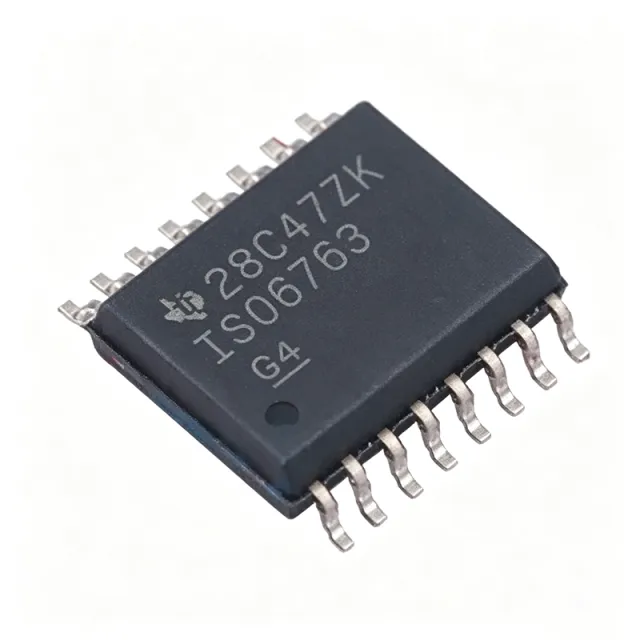
ISO6763DWR - 6-Ch 50Mbps 5000Vrms Digital Isolator | TI
The Texas Instruments ISO6763DWR is a general-purpose six-channel (3/3) reinforced digital isolator with a 50 Mbps data rate, 5000 VRMS isolation rating, and 1.8 V logic support, housed in a 16-pin SOIC (DW, 7.50 mm width) package rated from -40C to +125C. A digital isolator is a semiconductor device that transfers digital signals across an isolation barrier without any galvanic connection, replacing optocouplers in the signal-isolation hierarchy of industrial interface and power-management systems. Reinforced digital isolators use a capacitive or transformer-based barrier certified to withstand thousands of volts, enabling safe communication between controllers and high-voltage circuitry in compliance with reinforced-insulation system requirements. The ISO6763DWR's key features include a 50 Mbps maximum data rate for high-throughput SPI, RS-485, CAN, and RS-232 links; a robust isolation barrier with up to 5000 VRMS isolation rating, 1500 VRMS working voltage, up to 10 kV surge capability, and high CMTI (50 kV/us minimum per distributor listings, up to 150 kV/us typical per the ISO676x datasheet); and a wide dual-supply range of 1.71 V to 1.89 V on one side and 2.25 V to 5.5 V on the other, allowing direct interfacing with 1.8 V logic. The device uses TI's proven capacitive isolation construction with an SiO2 dielectric barrier, delivering long barrier lifetime at 1500 VRMS working voltage and robust EMC performance against common-mode transients. The symmetrical 3-forward/3-reverse channel configuration supports bidirectional buses such as full-duplex RS-485 and isolated SPI with independent read-back. Typical applications include isolated CAN, RS-232, and RS-485 industrial fieldbus nodes, isolated SPI communication in battery management and motor-drive systems, and isolation of PLC I/O modules in factory automation. Designers should bypass both VCC pins with 0.1 uF and 1 uF ceramic capacitors placed as close to the package as possible, and verify that the logic-side supply domain matches the 1.71 V to 1.89 V narrow range of the low-voltage side. This page adds distributor pricing tiers, drop-in alternatives, and engineering design notes beyond what the manufacturer datasheet provides.
ISO6763FDWR - 6-Ch 5kVrms Digital Isolator 50Mbps | TI
The Texas Instruments ISO6763FDWR is a general-purpose six-channel reinforced digital isolator delivering 50 Mbps signaling rate and 5000 Vrms isolation per UL 1577, housed in a 16-pin SOIC (DW, 7.50 mm width) package. It provides a 3/3 channel configuration (three forward, three reverse channels) with 50 kV/us common-mode transient immunity and support for 1.8V, 2.5V, 3.3V, and 5V CMOS/LVCMOS logic on both sides. A digital isolator is a semiconductor device that transfers digital signals across an isolation barrier using high-frequency carrier-based or edge-based encoding, replacing optocouplers with faster, more reliable, and more power-efficient capacitive isolation. Digital isolators sit within the signal isolation hierarchy of industrial interface components, alongside isolated transceivers and isolated gate drivers, and are fundamental to galvanic isolation in power management and communication systems. Key features of the ISO6763FDWR include the 50 Mbps maximum data rate, a high 50 kV/us CMTI that maintains signal integrity in electrically noisy environments such as motor drives, and reinforced isolation rated to 5000 Vrms per UL 1577 with additional VDE, TUV, CSA, and CQC certifications. The device offers high electromagnetic immunity and low emissions at low power consumption, per the TI ISO676x family datasheet. Architecturally, the ISO676x family uses TI capacitive isolation technology with on-chip transformers formed from SiO2, providing a robust insulation barrier that is resistant to magnetic field interference and field aging, unlike optocoupler LED-based approaches. The F suffix grade of the ISO6763 carries the default default characteristic; the six channels are split symmetrically 3/3, allowing bidirectional signal transfer in a single package without extra components. Typical applications include isolated RS-485 and RS-232 communication links, isolated SPI buses in industrial programmable logic controllers, CAN isolation in factory automation, and battery management systems where multi-bit status signals must cross a safety barrier. When designing with this device, ensure both VCC1 and VCC2 supplies are decoupled with 0.1 uF ceramic capacitors placed close to the pins, and verify that the default output states match the system fail-safe requirements. This page synthesizes distributor pricing, drop-in family alternatives, and practical design notes not found in the manufacturer datasheet.
ISO6763FQDWRQ1 - 6-Ch 50Mbps Digital Isolator 5kVrms | TI
The Texas Instruments ISO6763FQDWRQ1 is an automotive-grade, six-channel (3/3 configuration) reinforced digital isolator delivering up to 50 Mbps data rate, 5000 Vrms galvanic isolation per UL 1577, and 100 kV/us common-mode transient immunity, housed in a 16-pin wide-body SOIC (DW) package rated from -40C to +125C. A digital isolator is a semiconductor device that transfers digital signals across an isolation barrier while blocking high voltages, ground loops, and common-mode transients. Within the power and signal-chain hierarchy, it sits between level translators and optocouplers: unlike optocouplers, capacitive or inductive digital isolators provide far higher data rates, tighter channel-to-channel matching, longer lifetime, and lower power consumption, making them the modern choice for galvanic isolation in industrial and automotive systems. Key features include support for 1.8 V, 2.5 V, 3.3 V, and 5 V logic on either side of the barrier, robust EMC performance with 100 kV/us CMTI for harsh motor-drive environments, and a symmetric 3/3 channel arrangement that suits bidirectional buses such as SPI and general-purpose parallel signaling. The automotive Q1 qualification and AEC-Q100-grade temperature range address under-hood and traction-battery requirements. Architecturally, the ISO676x family uses TI's silicon-dioxide isolation barrier with on-chip RF oscillators and data coding to transmit across the capacitive barrier with deterministic propagation delay and high immunity to external fields. The wide-body 16-pin SOIC (DW) package is a pin-to-pin upgrade to older TI generations, easing drop-in redesigns, and its 8 mm creepage/clearage supports reinforced isolation ratings per UL 1577. Typical applications include isolated SPI communication in battery management systems, industrial PLC digital I/O isolation, motor-drive gate-drive supervisory links, and isolated interfaces between microcontrollers and field-side sensors. When designing, keep total data rate within 50 Mbps and verify the supply range on each side independently, since the two sides support different logic levels by design. This page synthesizes distributor pricing, drop-in alternatives, and practical design notes not found in the manufacturer datasheet.

ISO7041FDBQR - 4-Channel 2 Mbps Low-Power Digital Isolator | TI
The Texas Instruments ISO7041FDBQR is an ultra-low-power four-channel digital isolator with a 3/1 channel-direction configuration, data rates up to 2 Mbps, 3,000 Vrms reinforced isolation, and a 16-pin SSOP (DBQ) package. It is designed to isolate CMOS or LVCMOS digital signals across high-potential-difference barriers while consuming 116 uA per channel. A digital isolator transfers logic signals between electrically separated domains by placing a reinforced insulation barrier between input and output buffers. Unlike a transformer or relay interface, the ISO7041 uses capacitive silicon-dioxide isolation and edge-based modulation, allowing low power, compact integration, and no external magnetic components. The 3/1 configuration supports three forward channels and one reverse channel, making it suitable for isolated command, feedback, control, and bidirectional communication links. Key verified features include 2.25 V to 5.5 V operation, 2 Mbps maximum data speed, 3000 Vrms isolation, fail-safe output behavior, and common-mode transient immunity listed at 50 kV/us by DigiKey and 100 kV/us by LCSC/JLCPCB. The manufacturer identifies the ISO7041 family for ultra-low-power isolation and ATEX-certified applications, while the ISO7041FDBQR ordering variant uses the 16-pin SSOP DBQ package. The capacitive isolation barrier and integrated digital interfaces are suited to industrial automation, isolated communications, power-conversion control, battery-powered equipment, and test and measurement systems. The low 116 uA/channel supply current is particularly valuable when the isolated side must operate continuously with limited energy budget. Designers should still verify propagation delay, pulse-width distortion, input logic levels, channel direction, and isolation-system safety requirements for the exact operating conditions. The main PCB consideration is keeping the input-side and output-side copper, ground, and external components physically separated according to the manufacturer isolation layout guidance. Decoupling capacitors should be placed close to the relevant supply pins, while the isolation barrier must remain free of unintended copper bridges, coating residue, or low-voltage test points. For a production design, review the complete TI datasheet, package drawings, creepage and clearance requirements, and the relevant certification documentation rather than relying only on distributor summaries. This page combines verified manufacturer and distributor data, application context, package information, design notes, and replacement guidance. Those engineering details help distinguish a genuine isolated interface solution from a generic low-voltage logic IC and support faster sourcing and design decisions for compact, reinforced-isolation systems.

ISO722MD - 150 Mbps Digital Isolator | Texas Instruments
The Texas Instruments ISO722MD is a single-channel high-speed digital isolator supporting signaling rates from 0 Mbps to 150 Mbps, with 2500 Vrms galvanic isolation and 25 kV/µs common-mode transient immunity. It is packaged in an 8-pin SOIC (D) package and operates from 3.3 V and 5 V supplies. The device includes a digital isolator enable function and is designed for high-speed control, communication, and interface isolation. A digital isolator is a semiconductor interface device that transfers a digital signal across an electrically isolated barrier while preventing direct conductive current between the two sides. ISO72x devices use silicon-dioxide insulation to provide galvanic isolation up to 4000 V, as described in the family documentation. This isolation helps protect low-voltage circuitry from high-voltage transients, ground-potential differences, and noise-coupled environments when used with an appropriate isolated power supply. Key features include a maximum signaling rate of 150 Mbps, low propagation delay, low pulse-width distortion, and typical transient immunity of 50 kV/µs according to the family datasheet information. The ISO722MD supports operation across the -40°C to +125°C temperature range and is identified by Texas Instruments as a drop-in replacement for most opto and magnetic isolators. Its failsafe output behavior is important when the isolated link loses input-drive validity. The ISO722MD is suited to industrial control, test and measurement, communications, and power-conversion systems where a high-speed control or data signal must cross an isolation boundary. The enable input allows the output to be controlled during power-up or fault conditions. The 8-SOIC package supports conventional surface-mount assembly, while the isolation rating and transient immunity help simplify compliance-oriented system design. Designers should confirm supply sequencing, input and output logic levels, decoupling, and the isolation-capacitor requirements against the manufacturer datasheet. For systems requiring reinforced isolation, working voltage, creepage, clearance, and applicable safety standards must be evaluated for the complete PCB layout. The ISO722M family documentation also notes that transient protection and propagation delay differ among vendors, so compatibility should not be inferred from package appearance alone.
ISO7241MDW - 4-Ch 3/1 150Mbps Digital Isolator | TI
The ISO7241MDW is a quad-channel digital isolator from Texas Instruments, featuring a 3/1 channel configuration (three forward and one reverse) with a signaling rate of 150 Mbps. It is housed in a 16-pin SOIC (DW) package with a wide body (7.50 mm width). The device provides galvanic isolation up to 2500 Vrms and a common-mode transient immunity (CMTI) of 25 kV/µs, making it suitable for industrial and automotive applications where robust isolation is required. Digital isolators are components that transfer digital signals across an isolation barrier while preventing DC current flow and rejecting common-mode noise. They are essential in systems where safety, noise immunity, or ground potential differences exist between circuit domains. The ISO7241MDW uses a silicon-dioxide (SiO2) isolation barrier, which offers high reliability and long-term stability. It is part of the ISO7240x/ISO7241x/ISO7242x family of quad-channel isolators, which provide various channel configurations and output-enable functions. Key features of the ISO7241MDW include a low channel-to-channel output skew of 1 ns maximum, low pulse-width distortion (PWD) of 2 ns maximum, and low jitter content of 1 ns typical at 150 Mbps. The device operates over a wide supply voltage range of 3.0 V to 5.5 V on both sides, and it is specified for the industrial temperature range of -40°C to +125°C. The output-enable function allows the outputs to be placed in a high-impedance state, facilitating bus-oriented applications. The ISO7241MDW is designed for high-speed signal isolation in applications such as industrial fieldbus communication, motor control, power inverters, and isolated SPI/UART interfaces. Its high CMTI ensures reliable operation in noisy environments, and the 2500 Vrms isolation rating meets basic insulation requirements for many industrial standards. The device is RoHS compliant and lead-free, supporting environmentally conscious designs. When designing with the ISO7241MDW, it is important to provide adequate decoupling capacitors on both supply pins and to ensure proper PCB layout to maintain signal integrity and isolation performance. The device does not require external components for the isolation barrier, simplifying the design. For applications requiring higher isolation or different channel configurations, other members of the ISO724x family can be considered.
ISO7721BDWR - 2Ch Reinforced Digital Isolator | TI
The ISO7721BDWR is a high-speed, robust EMC, reinforced dual-channel digital isolator from Texas Instruments. It provides 5000 Vrms isolation per UL 1577, with a data rate of 100 Mbps and common-mode transient immunity (CMTI) of 85 kV/µs. The device is available in a 16-pin SOIC (DW) package with 7.50 mm width, operating over a temperature range of -55°C to +125°C. It is designed for applications requiring reliable signal isolation in industrial, automotive, and communication systems. Digital isolators are components that transmit digital signals across an isolation barrier, providing galvanic isolation to protect circuits and users from high voltages, ground loops, and noise. They are essential in systems where safety and signal integrity are critical, such as in motor drives, power supplies, and medical equipment. The ISO7721BDWR belongs to the ISO772x family, which includes reinforced and basic insulation variants, offering flexibility for different isolation requirements. Key features of the ISO7721BDWR include its reinforced insulation rating, 100 Mbps data rate, and 85 kV/µs CMTI, which ensures reliable operation in noisy environments. The device supports CAN, RS232, and RS485 protocols, making it versatile for industrial communication. It also features low power consumption and a wide supply voltage range, enhancing its suitability for power-sensitive designs. Technically, the ISO7721BDWR uses TI's capacitive isolation technology, which provides robust performance against magnetic interference and ensures long-term reliability. The device has a channel configuration of 1/1 (one forward, one reverse), allowing bidirectional communication. It also includes an enable pin for power management and failsafe outputs for safety-critical applications. Typical applications include industrial fieldbus communication, isolated SPI/UART interfaces, motor control, and power converters. The high CMTI and reinforced isolation make it ideal for harsh environments where voltage transients are common. When designing with the ISO7721BDWR, ensure proper PCB layout with adequate creepage and clearance distances to maintain the isolation rating. Place decoupling capacitors close to the power pins and follow the recommended layout guidelines in the datasheet to achieve optimal EMC performance.
ISO7721DW - 2Ch Reinforced Digital Isolator 100Mbps | TI
The ISO7721DW is a high-performance, dual-channel digital isolator from Texas Instruments, designed to provide robust signal isolation in industrial and automotive applications. It delivers 5000 Vrms isolation per UL 1577, with a data rate of 100 Mbps and a common-mode transient immunity (CMTI) of 85 kV/µs. The device is available in a 16-pin SOIC (DW) package with a wide body width of 7.50 mm, ensuring adequate creepage and clearance for reinforced insulation. Digital isolators are essential components that transfer digital signals across an isolation barrier, preventing dangerous voltages or ground loops from affecting sensitive circuitry. They replace optocouplers in many designs, offering higher speed, better reliability, and lower power consumption. The ISO7721DW belongs to the ISO772x family, which includes devices with reinforced insulation ratings certified by VDE, CSA, TUV, and CQC, in addition to UL 1577. Key features of the ISO7721DW include a dual-channel configuration with one forward and one reverse channel (1/1), a wide supply voltage range of 2.25 V to 5.5 V, and a default output state that is high when the input is unpowered. The device supports both 3.3 V and 5 V logic levels, making it versatile for mixed-voltage systems. Its robust EMC performance ensures reliable operation in noisy industrial environments. The ISO7721DW uses TI's capacitive isolation technology, which provides superior immunity to magnetic interference compared to traditional optocouplers. The isolation barrier is rated for 5000 Vrms, with a working voltage of 800 Vrms (reinforced) or 566 Vrms (basic), depending on the certification. The device also features a fail-safe output that defaults to a known state if the input side loses power, enhancing system safety. Typical applications include industrial fieldbus communication (e.g., PROFIBUS, Modbus), motor drives, power inverters, and isolated SPI/UART interfaces. The high CMTI of 85 kV/µs makes it suitable for applications with fast-switching power stages, such as SiC and GaN inverters, where transient noise can corrupt signals. When designing with the ISO7721DW, ensure proper PCB layout with adequate isolation spacing and place decoupling capacitors close to the VCC pins. The device supports a wide temperature range of -55°C to +125°C, making it suitable for harsh environments.
ISO7721FQDWRQ1 - Automotive Reinforced 2-Ch Digital Isolator | TI
The ISO7721FQDWRQ1 is an automotive-grade, reinforced dual-channel digital isolator from Texas Instruments, designed for high-speed signal isolation in harsh automotive and industrial environments. It provides 5000 Vrms isolation voltage, supports data rates up to 100 Mbps, and features a high common-mode transient immunity (CMTI) of 85 kV/µs. The device is offered in a 16-pin SOIC (DWR) package with 7.50 mm width, suitable for surface-mount assembly. Digital isolators are components that transmit digital signals across an isolation barrier, providing galvanic isolation to protect circuits and users from high voltages, ground loops, and noise. They are essential in systems where safety and signal integrity are critical, such as in electric vehicles, industrial motor drives, and medical equipment. The ISO7721FQDWRQ1 belongs to the ISO772x-Q1 family, which is part of TI's broad portfolio of isolation products. Key features include a reinforced isolation rating per VDE 0884-10 and UL 1577, a default output state of low (suffix F) when input power is lost, and a wide supply voltage range of 2.25 V to 5.5 V. The device also offers a 1/1 channel configuration (one forward, one reverse), making it ideal for bidirectional isolation. Its robust EMC performance ensures reliable operation in noisy environments. The ISO7721FQDWRQ1 uses TI's capacitive isolation technology, which provides low power consumption and high-speed operation. The device is AEC-Q100 qualified for automotive applications, ensuring reliability under extreme temperature and vibration conditions. It also features an enable pin for output control and a fail-safe mechanism that sets outputs to a known state during power loss. Typical applications include isolated SPI, UART, and CAN interfaces in automotive battery management systems, on-board chargers, and industrial fieldbus communication. The high CMTI and reinforced isolation make it suitable for motor drive inverters and power converters where fast switching transients are present. When designing with this device, ensure proper PCB layout with adequate creepage and clearance distances to maintain isolation ratings. Place decoupling capacitors close to the VCC pins and follow the recommended layout guidelines in the datasheet to achieve optimal EMC performance.
ISO7721QDWRQ1 - Automotive 2-Ch Digital Isolator 100Mbps | TI
The Texas Instruments ISO7721QDWRQ1 is an automotive, reinforced 2-channel digital isolator with a 1 forward / 1 reverse (1/1) channel direction, 5000 Vrms isolation voltage, and 100 Mbps data rate, housed in a 16-pin SOIC (DW) wide-body package with 85 kV/us minimum common-mode transient immunity (CMTI). It is qualified to AEC-Q100 Grade 1 for automotive applications. A digital isolator is an integrated circuit that transfers logic signals across a galvanically-isolated barrier using on-chip capacitive or transformer coupling, while blocking high-voltage DC and transient events. In the broader semiconductor taxonomy, digital isolators belong to the interface ICs family, sit alongside gate drivers and ADCs, and serve the power management and signal-chain isolation hierarchy. By replacing optocouplers, they deliver higher speed, tighter channel-to-channel matching, lower power, and superior EMC robustness. Key features include 5000 Vrms isolation per UL 1577 (DW package), 100 Mbps signaling across two channels, 85 kV/us minimum CMTI for noisy motor and inverter environments, and 1.5 ns typical propagation delay. The wide-body SOIC (DW) package provides 8 mm of creepage/clearance suitable for reinforced insulation at 400 Vrms or 600 Vrms systems per IEC 60747-17. Integrated thermal shutdown, default output states, and ±5 kV ESD ratings (HBM) further harden the device against automotive transients. The ISO7721QDWRQ1 uses TI's silicon-dioxide (SiO2) capacitive isolation barrier combined with on-chip encoding that rejects common-mode transients, with the wide-body SOIC body delivering reinforced insulation rating for industrial and automotive high-voltage links. Its low 1.5 ns typical propagation delay and 100 Mbps throughput make it suitable for SPI, CAN, RS-485, and high-speed GPIO isolation where timing margins are tight. Typical applications include traction inverter gate-drive signal isolation, on-board charger (OBC) communication, BMS high-voltage isolation, solar inverter control interfaces, and industrial PLC I/O modules. The 1/1 channel direction makes it well suited for bidirectional half-duplex interfaces. When designing with this device, supply both VCC1 (logic side) and VCC2 (isolated side) with proper decoupling (1 uF + 0.1 uF) close to each supply pin, and respect the 8 mm wide-body creepage when routing PCB high-voltage traces to preserve reinforced insulation ratings. This page synthesizes distributor pricing, AEC-Q100 cross-reference alternatives, and practical EMC design notes that supplement the manufacturer datasheet for automotive digital-isolator selection.
ISO7740FQDBQQ1 - Automotive Quad-Channel Digital Isolator | Texas Instruments
The Texas Instruments ISO7740FQDBQQ1 is an automotive-grade, reinforced quad-channel digital isolator with 4 forward / 0 reverse channels, supporting 100 Mbps data rate and 85 kV/µs common-mode transient immunity (CMTI) in a 16-pin SSOP (DBQ) package. It provides 3000 Vrms isolation per UL 1577 in the DBQ package and operates across a -40 °C to +125 °C automotive temperature range. The Q1 suffix denotes AEC-Q100 qualification for automotive applications, making this part suitable for EV traction inverters, battery management systems, on-board chargers, and industrial PLC I/O isolation. A digital isolator is a semiconductor device that transfers logic signals between two galvanically isolated domains using high-voltage capacitive or magnetic isolation barriers. Compared to optocouplers, digital isolators integrate the encoder/decoder and the isolation barrier on a single CMOS die, delivering 10x faster data rates, 5x lower power consumption, tighter channel-to-channel matching, and CMTI performance that prevents data corruption from fast dV/dt events on the isolated ground reference. Digital isolators serve as a foundational building block in any mixed-domain system where a high-voltage domain (e.g., 800 V battery) must safely communicate with a low-voltage controller (e.g., 3.3 V MCU), satisfying UL 1577, IEC 60747-17 (VDE 0884-11), CSA, CQC, and TUV reinforced insulation requirements. Key features include low propagation delay (10.7 ns typical), low pulse-width distortion (<3 ns), 1.5 mA per-channel quiescent current at 100 Mbps, and ±150 kV/µs typical CMTI. The device supports 2.25 V to 5.5 V supplies on either side, allowing level translation between 3.3 V MCUs and 5 V transceivers without external level shifters. Default output high (F suffix) and low options are both available; this variant uses F (default-high) outputs. Architecturally, the ISO7740-Q1 uses TI's proprietary SiO2 capacitive isolation barrier with on-chip differential signaling and refresh, eliminating optocoupler-style LED aging and CTR degradation. The DBQ package is a 16-pin SSOP with 3.90 mm body width, providing 8 mm creepage/clearance - sufficient for 3000 Vrms reinforced isolation per UL 1577. The reinforced isolation makes it suitable for equipment that requires double protection against electric shock. Typical applications include isolated SPI between a traction MCU and gate driver, isolated UART between BMS AFE and main MCU, isolated CAN transceivers in EV powertrains, and industrial 24V digital input modules. The Q1 AEC-Q100 qualification covers Grade 1 (-40 °C to +125 °C) operation, making the part drop-in compatible with non-automotive ISO7740FDBQR systems when automotive qualification is desired. When designing with this part, place 0.1 µF VCC bypass capacitors within 2 mm of each supply pin, use 4-layer PCB with keep-out under the isolation barrier, and verify creepage/clearance per IEC 60664-1 for the end equipment's working voltage. The default-high F variant requires no external pull-up on output if the receiver downstream is reset-tolerant. This page synthesizes distributor pricing, drop-in alternatives in the same 16-SSOP footprint, and practical PCB/EMI design notes not aggregated on a single manufacturer or distributor page.
ISO7741DBQR - 100Mbps 4-Ch Digital Isolator SSOP-16 | TI
The Texas Instruments ISO7741DBQR is a reinforced quad-channel digital isolator with a 3 forward / 1 reverse channel configuration, 3000 Vrms isolation rating per UL 1577, and a maximum signaling data rate of 100 Mbps, housed in a 16-pin SSOP (DBQ) package. Its 85 kV/µs minimum common-mode transient immunity (CMTI) and 10.7 ns typical / 16 ns maximum propagation delay make it suitable for high-speed SPI, RS-485, RS-232, GPIO, and I2S signal isolation in industrial environments. What is a digital isolator? A digital isolator is a semiconductor device that transfers logic-level signals across a galvanic isolation barrier using capacitive or magnetic coupling instead of optocouplers, enabling robust high-speed data transfer while protecting low-voltage circuitry from high-voltage transients. Within the broader product taxonomy, digital isolators sit inside Interface ICs -> Isolation ICs -> Signal Conditioning -> Power Management & Interface. The ISO774x family adopts TI's silicon-dioxide (SiO2) capacitive coupling, which provides stronger CMTI and longer service life than LED-based optocouplers. Key features include reinforced insulation per VDE / CSA / TUV / CQC, an operating temperature range of -55°C to +125°C, low power consumption of approximately 1.5 mA per channel at 10 Mbps, and a default-low output state that drives a known logic level if input power is lost. The device is rated MSL-2 (260°C, 1 year) and is RoHS/REACH compliant, supporting lead-free assembly on standard SMT lines. The ISO7741DBQR uses a differential capacitive coupling architecture with on-chip encoding/decoding, achieving 100 Mbps NRZ signaling while maintaining < 4 mW per channel. Each channel incorporates a refresh generator that continuously updates the output state, ensuring valid logic levels are preserved even after long periods without input transitions. Typical applications include industrial fieldbus isolation (RS-485, CAN, Profibus), motor-drive gate-driver signal isolation, solar inverter communication links, isolated SPI between a microcontroller and an ADC, and medical equipment patient-isolation barriers. The wide temperature range and reinforced insulation rating also support factory automation, programmable logic controllers (PLC), and battery management systems. When designing with this device, ensure that decoupling capacitors are placed within 2 mm of the VCC1 and VCC2 pins and that the isolation barrier creepage/clearance on the PCB meets the end-equipment standard (e.g., 8 mm for reinforced 250 Vrms). Avoid routing any signal or plane under the device body between pins 1-8 and pins 9-16 to preserve the isolation barrier. This page synthesizes distributor pricing, drop-in pin-compatible alternatives (TI ISO7740/ISO7742 plus cross-brand ADuM141E, Si8641, MAX14431 equivalents), and practical design notes that are not found in the manufacturer datasheet alone.
ISO7741DWR - 4-Ch 3/1 100Mbps 5kVrms Digital Isolator | Texas Instruments
The Texas Instruments ISO7741DWR is a reinforced quad-channel digital isolator with a 3 forward / 1 reverse (3/1) channel direction, providing up to 100 Mbps data rate, 5000 Vrms isolation (DW package), and 85 kV/µs common-mode transient immunity (CMTI) in a 16-pin SOIC (DW) wide-body package with 0.295 inch (7.50 mm) width. A digital isolator is a semiconductor device that transfers data across a galvanic isolation barrier using capacitive, inductive (transformer), or optical coupling while blocking DC and low-frequency voltages. The ISO7741 belongs to the digital isolator family within the broader interface IC and signal-isolation hierarchy, and is widely used to protect low-voltage logic domains from high-voltage transients in industrial systems, motor drives, and renewable-energy converters. Its reinforced insulation rating supports safety-critical designs that must meet UL 1577, VDE, CSA, TUV, and CQC requirements. Key features of the ISO7741DWR include integrated enable pins on side-2 outputs (EN2) and selectable default-high/low outputs (ISO7741F variant), robust EMC performance verified through IEC 61000-4-2 ESD and IEC 61000-4-6 RF-immunity tests, low 1.5 ns typical propagation delay, low power consumption with 1.6 mA per channel typical supply current at 1 Mbps, and wide -55 °C to +125 °C operating temperature. The wide-body SOIC-16 (DW) footprint provides sufficient creepage and clearance to meet 5000 Vrms reinforced isolation ratings. Internally, the ISO7741 uses TI's silicon-oxide (SiO2) capacitive isolation barrier with on-chip encoding and decoding that delivers high immunity to RF fields and fast transients. The differential signalling across the isolation barrier rejects common-mode noise and supports DC correctness even across long cable runs and noisy industrial environments. Typical applications include isolated SPI/UART interfaces in factory automation, gate-driver signal isolation for IGBT/MOSFET power stages, isolated data acquisition front ends, isolated USB and RS-485 links, solar inverter communications, and EV battery management system (BMS) communications. Designers pair it with companion gate drivers, isolated DC/DC converters, and reinforced isolated RS-485 transceivers to complete a robust isolated signal chain. When designing with the ISO7741DWR, observe the 5000 Vrms isolation voltage rating and follow UL 1577 / VDE 0884 creepage requirements. Decouple both VCC1 and VCC2 supplies with 0.1 µF and 1 µF ceramic capacitors placed close to the device pins, and ensure that the high-voltage side maintain safe spacing of the wide-body SOIC land pattern to meet regulatory clearance. This page synthesizes distributor stock, drop-in alternatives including same-brand reinforced and basic variants, cross-brand Si8641/ADuM141x equivalents, and practical design notes not found in the bare manufacturer datasheet.
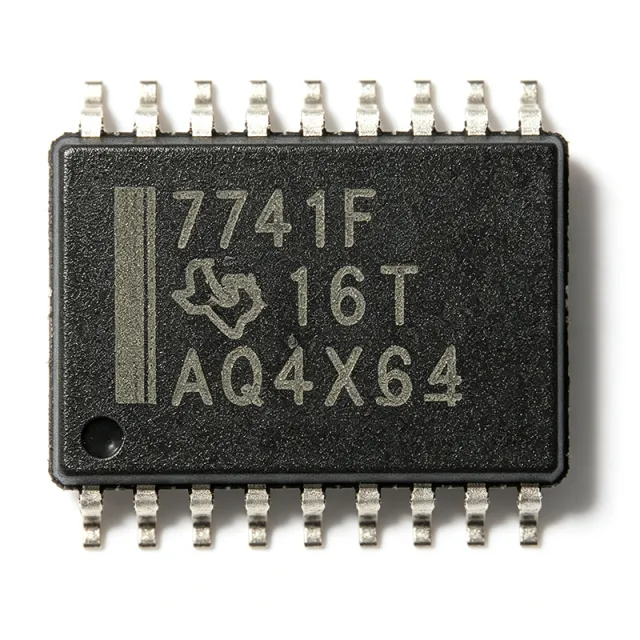
ISO7741FDBQR - 4-Ch 100Mbps Digital Isolator | Texas Instruments
The Texas Instruments ISO7741FDBQR is a high-performance, reinforced quad-channel digital isolator designed for robust signal isolation in industrial and automotive systems. It provides four isolation channels in a 3 forward / 1 reverse configuration, supports data rates up to 100 Mbps, and achieves a common-mode transient immunity (CMTI) of 85 kV/us. Housed in a compact 16-pin SSOP (DBQ) package, the device delivers 3000 Vrms reinforced isolation per UL 1577 and operates from -55C to +125C. A digital isolator is an integrated circuit that transfers digital signals across an isolation barrier without a direct electrical connection, preventing ground loops and protecting low-voltage circuitry from high-voltage transients. In the system hierarchy, digital isolators are interface ICs used in isolated communication and sensor networks. The ISO774x family leverages Texas Instruments robust-EMC technology to maintain signal integrity in electrically noisy environments such as motor drives and inverters. Key features include 3000 Vrms reinforced isolation, 100 Mbps data rate, 85 kV/us CMTI, default-low output state (F suffix) for fail-safe power-up, and a 3/1 channel configuration. The device is certified to UL 1577, VDE, CSA, TUV, and CQC, making it suitable for safety-critical applications. It operates over a -55C to +125C temperature range and is available in tape and reel packaging for high-volume production. The ISO7741FDBQR uses an integrated isolation barrier with silicon dioxide (SiO2) insulation to transfer digital data across the barrier. The F suffix sets outputs low when the input supply is unpowered, ensuring a known state for attached microcontrollers and actuators. With 100 Mbps throughput, it supports high-speed SPI, UART, and GPIO isolation while maintaining low propagation delay (16 ns max) and high reliability. The robust-EMC design reduces the impact of radiated and conducted interference, simplifying qualification in CE-marked industrial products. Typical applications include industrial automation PLCs, motor drives, solar inverters, medical equipment, automotive battery management systems, and isolated SPI/UART communication buses. In each, the ISO7741FDBQR provides reliable signal transfer while protecting control electronics from high-voltage spikes and ground potential differences. Designers should ensure that supply decoupling capacitors are placed close to the device pins and that PCB layout respects creepage and clearance distances required for the isolation voltage. For default-high outputs, choose the non-F variant (ISO7741DBQR).

ISO7741FQDBQRQ1 - 100Mbps 3/1 Quad Digital Isolator | TI
The Texas Instruments ISO7741FQDBQRQ1 is an automotive-grade, AEC-Q100 qualified, reinforced four-channel digital isolator in a 16-pin SSOP (DBQ) package, delivering three forward and one reverse direction channel at up to 100 Mbps data rate. It provides 3000 VRMS galvanic isolation per UL 1577, 85 kV/us common-mode transient immunity (CMTI), and 2.25 V to 5.5 V supply on both sides enabling 1.8 V-to-5 V logic translation. A digital isolator is a semiconductor device that transfers digital signals across an isolation barrier while blocking high voltages, isolating ground loops, and protecting low-voltage circuitry from hazardous potentials. Within the power-management and signal-chain hierarchy, digital isolators sit alongside optocouplers and isolation amplifiers as galvanic isolation solutions, with the ISO774x-Q1 family using a capacitive SiO2 isolation technology that outperforms optocouplers in speed, power consumption, and reliability. Key features include the robust-EMC F-grade option with reinforced insulation, default output states for fail-safe behavior, low propagation delay, low power consumption, and wide temperature range of -40C to +125C ambient for automotive under-hood environments. The DBQ package supports 3000 VRMS isolation while the larger DW package supports 5000 VRMS in the broader family. Technically, the ISO774x-Q1 uses an on-chip transformer built from SiO2 capacitive barriers, with a high-frequency carrier modulating input data across the barrier and a differential receiver on the secondary side. This architecture delivers fast edge rates, low channel-to-channel skew, and exceptional immunity to external fields. The F-grade designation indicates enhanced EMC robustness with system-level IEC 61000-4-2 and IEC 61000-4-4 compliance. Typical applications include isolated CAN and RS-485 bus interfaces in automotive networks, gate-drive signal isolation for traction inverters and onboard chargers, battery-management-system (BMS) communications, isolated SPI/GPIO links in industrial PLCs, and isolated UART links between MCUs and transceivers. Design tip: decouple both VCC pins with 0.1 uF ceramic capacitors placed within 2 mm of the pins, respect the 16-SSOP creepage/clearance limits of the DBQ package, and avoid placing high-voltage planes directly beneath the device to maintain rated isolation. This page synthesizes distributor pricing, AEC-Q100-qualified drop-in alternatives, and practical design notes not found in the manufacturer datasheet alone.
ISO7741FQDWWQ1 - Automotive 4-Ch Digital Isolator | TI | 5700Vrms
The Texas Instruments ISO7741FQDWWQ1 is an automotive-grade (AEC-Q100 qualified) reinforced 4-channel digital isolator with 3 forward / 1 reverse channel directionality, delivering 100 Mbps signaling at 5700 Vrms isolation (DWW package) in a 16-pin extra-wide-body SOIC (0.551", 14.00 mm) package. The device provides best-in-class CMTI of 85 kV/us minimum and supports 2.25 V to 5.5 V supply voltage on each side, enabling direct level translation between low-voltage MCUs and higher-voltage peripherals. Reinforced insulation ratings comply with UL 1577, VDE, CSA, TUV, and CQC standards for high-voltage system safety. A digital isolator transfers logic signals across a galvanic isolation barrier using capacitive or magnetic coupling rather than optical or transformer coupling. This architecture eliminates ground loops, breaks high-voltage paths between subcircuits, and allows dissimilar supply domains to communicate safely. Within the broader power-management and signal-chain hierarchy, digital isolators sit alongside gate drivers, isolated ADCs, and isolated DC/DC converters as essential building blocks for any system that must bridge low-voltage control logic to high-voltage power stages. The ISO77xx family is TI's flagship reinforced-isolation platform. Key electrical features include 4 channels (3/1 direction), 100 Mbps maximum data rate, 11 ns typical propagation delay, 2.5 ns channel-to-channel skew, and 60-year typical working voltage at 1500 Vrms. The device supports 2.25 V to 5.5 V supplies on both VCC1 and VCC2 sides, draws 4.3 mA per channel at 10 Mbps, and integrates default-low outputs that return to a defined state on power loss. Automotive-grade EMC robustness covers ±8 kV ESD HBM and ±4 kV contact discharge per IEC 61000-4-2. The capacitive SiO2 isolation barrier delivers high CMTI (Common-Mode Transient Immunity) of 85 kV/us minimum, ensuring signal integrity in noisy environments such as motor inverters, solar string combiners, and EV traction inverters. The device also exhibits very low radiated emissions, easing CISPR 32 / EN 55032 Class B compliance at the system level. Two opposite channels can be combined for fail-safe signaling, and the default-low output option simplifies the implementation of system-safe-state boot sequences. Typical applications span HEV/EV traction inverters, on-board chargers (OBC), DC fast-charging stations, industrial motor drives, solar inverters, isolated SPI / RS-232 / RS-485 interfaces, and battery management systems (BMS). The wide-body SOIC package provides the reinforced 8 mm creepage/clearance required for 5700 Vrms isolation in a through-hole-compatible footprint, while the AEC-Q100 Grade 1 qualification (-40C to +125C) supports under-hood automotive deployment. When designing with the ISO7741FQDWWQ1, place 0.1 uF + 10 uF decoupling capacitors close to VCC1 and VCC2, and confirm that the PCB layout preserves 8 mm of creepage between primary and secondary sides. The default-low output behavior must be considered in any application where power-on state is safety-critical. This page synthesizes distributor pricing, AEC-Q100 drop-in alternatives, and practical EMC design notes not found in the manufacturer datasheet.
ISO7741FQDWWRQ1 - Automotive 4-Ch Digital Isolator | TI
The Texas Instruments ISO7741FQDWWRQ1 is an automotive-grade, reinforced quad-channel digital isolator with three forward and one reverse-direction channels, packaged in a 16-pin extra-wide-body SOIC (DWW) with 5700 Vrms isolation rating per UL 1577 and 85 kV/µs typical CMTI. It supports up to 100 Mbps data rate across each channel, making it suitable for high-speed SPI, CAN, RS-485, and I2C isolation in automotive and industrial systems. The DWW package provides wide creepage and clearance suitable for reinforced insulation at mains or bus voltages up to 1500 Vrms working voltage. A digital isolator is a semiconductor device that transfers logic signals between two galvanically isolated voltage domains using an on-chip SiO2 capacitive or RF coupler, replacing bulky optocouplers with a smaller, faster, lower-power solution. In the broader taxonomy, the ISO7741FQDWWRQ1 belongs to the digital isolator category, which sits within interface ICs in the signal chain between mixed-signal controllers and external transceivers. Reinforced isolation means the part survives 5000 Vrms (DW) or 5700 Vrms (DWW) for 60 seconds per UL 1577, which is a stricter safety requirement than basic isolation. Key features include ±8 kV HBM ESD on all pins per AEC-Q100, robust EMC with low emissions, glitch-free power-up/power-down sequencing, and a wide -40°C to +125°C operating range. The device operates from 2.25 V to 5.5 V on both sides, eliminating the need for external level shifters when bridging 3.3 V MCUs to 5 V transceivers. Default output is high on channels without input transition to provide a known safe state at startup. Typical applications include isolated SPI between an ECU microcontroller and a traction inverter gate driver, isolated CAN-FD bus interfaces in 12 V/48 V mild-hybrid systems, and reinforced isolation for industrial motor drives with human-accessible I/O. The AEC-Q100 qualification supports direct deployment in body electronics, battery management, and onboard charger subsystems. When designing with this device, place 0.1 µF decoupling capacitors on both VCC1 and VCC2 as close to the IC pins as possible, and avoid routing signal traces beneath the package to preserve creepage. The default-high outputs can be inverted to default-low for fail-safe bus bias by selecting the ISO7741F-Q1 variant with the inverted default.
ISO7741QDWWRQ1 - 4-Ch Digital Isolator, 100Mbps | Texas Instruments
The Texas Instruments ISO7741QDWWRQ1 is an automotive-qualified, reinforced 4-channel digital isolator with 3 forward and 1 reverse channel, delivering up to 100 Mbps signaling in a 16-pin extra-wide-body SOIC (DWW) package. It supports 5700 Vrms isolation and 85 kV/us minimum common-mode transient immunity (CMTI), making it suitable for noise-heavy industrial and automotive environments. A digital isolator is a semiconductor device that transfers data across an electrical isolation barrier using capacitive or magnetic coupling rather than optical or transformer means. Digital isolators sit in the signal chain isolation category, above optocouplers in switching speed and below transformer-based isolators in cost, and they belong to the broader interface ICs family of power management and inter-chip communication building blocks. By replacing legacy optocouplers they enable smaller, faster, more reliable signal isolation. Key features include a 2.25 V to 5.5 V supply range per side, default output-high option on the F variant, low power consumption of about 1.7 mA per channel at 1 Mbps, and an industrial-leading CMTI rating that protects data integrity when switching high dV/dt transients occur across the barrier. The extra-wide-body SOIC (DWW) footprint maintains 8 mm of creepage and clearance for reinforced insulation per IEC 61010-1 and related safety norms. The ISO7741QDWWRQ1 uses TI's capacitive isolation technology with an ON/OFF keying (OOK) modulation scheme and an internal differential link that rejects common-mode noise. Each channel has its own enable control, supporting fault-tolerant multi-channel designs. The device is AEC-Q100 Grade 1 qualified with an operating temperature range of -40C to +125C. Typical applications include EV battery management system (BMS) communications, traction inverter gate-driver signal isolation, industrial fieldbus isolation (CAN, RS-485, SPI), and isolated power-supply feedback. The reinforced insulation rating supports line-side to low-side isolation in photovoltaic inverters and motor drives. When designing with this device, place 0.1 uF decoupling capacitors as close as possible to the VCC1 and VCC2 pins. Avoid routing high-speed traces directly beneath the isolator to preserve barrier integrity, and verify that creepage and clearance meet end-equipment IEC requirements. This page synthesizes distributor pricing, drop-in alternatives from TI's ISO77xx family and competitor isolators, and practical design notes not found in the manufacturer datasheet alone.
ISO7742DBQR - Quad-Channel Digital Isolator, 100Mbps, 3kVrms | Texas Instruments
The Texas Instruments ISO7742DBQR is a quad-channel digital isolator with 2 forward and 2 reverse-direction channels (2/2 configuration), 100 Mbps data rate, and 3 kVrms isolation rating housed in a 16-pin SSOP (DBQ) wide-body package. It features 85 kV/µs common-mode transient immunity (CMTI) and reinforced insulation per UL 1577, making it suitable for industrial systems with fast switching transients on the ground reference. What is a digital isolator? A digital isolator is a semiconductor device that transfers logic-level signals between two voltage domains while providing galvanic isolation (typically several kVrms) between them. Digital isolators replace legacy optocouplers in modern designs because they offer higher data rates, lower power consumption, tighter pulse-width distortion, and superior CMTI. Within the broader hierarchy, the ISO7742DBQR is a digital isolator -> signal isolator -> interface IC -> integrated circuit. Key features include: 100 Mbps signaling with a maximum pulse-width distortion of 2.5 ns, 4.5 ns typical propagation delay, 100 µA/channel typical quiescent current at 1 Mbps, and a wide 2.25V to 5.5V supply range on both sides (VCC1 and VCC2 independent). Robust EMC performance includes IEC 61000-4-2 ESD contact discharge ratings and IEC 61000-4-4 EFT immunity, while the integrated fail-safe default-high output eliminates need for external pull-up logic. The ISO7742DBQR uses TI's proprietary silicon-dioxide (SiO2) capacitive isolation barrier combined with an on-chip RF carrier for signal transfer across the isolation barrier. This architecture avoids LED-aging issues inherent to optocouplers and delivers deterministic timing that simplifies timing-budget analysis in SPI, UART, RS-485, GPIO, and I2C signal isolation. The 85 kV/µs CMTI prevents data corruption in motor-drive, solar-inverter, and industrial-servo applications where large dV/dt transients are common. Typical applications include isolated SPI interfaces for motor drives and solar inverters, isolated RS-485/RS-232 transceivers, factory-automation I/O modules, isolated GPIO in PLCs, and digital control signal isolation in medical and renewable-energy equipment. When designing with the ISO7742DBQR, place 0.1 µF bypass capacitors as close as possible to both VCC pins and follow high-voltage PCB layout rules (4 mm minimum creepage, isolation cuts in inner layers) to preserve the rated isolation voltage. This page synthesizes distributor pricing, drop-in alternatives, and practical layout guidance not aggregated in the manufacturer datasheet.
ISO7760FDBQR - 6-Ch 100Mbps Digital Isolator, 3kV | TI
The Texas Instruments ISO7760FDBQR is a high-speed, reinforced six-channel digital isolator with 6 forward and 0 reverse channels (6/0), delivering 100 Mbps data rate and 3000 Vrms isolation rating per UL 1577. It comes in a 16-pin SSOP (DBQ) package with 85 kV/µs typical CMTI and a wide 2.25 V to 5.5 V supply range on both sides. What is a digital isolator? A digital isolator is a semiconductor device that transmits binary signals across an electrical isolation barrier using capacitive or inductive coupling rather than optocouplers. Digital isolators sit within the interface IC category (digital isolator -> isolator -> interface IC -> integrated circuit) and are essential for breaking ground loops, protecting low-voltage logic from high-voltage transients, and meeting safety standards such as UL 1577, IEC 60747-17, and reinforced insulation requirements. Compared with optocouplers, CMOS-based digital isolators offer higher speed, lower power, better CMTI, and tighter channel-to-channel matching. Key features of the ISO7760FDBQR include robust EMC performance, up to 5000 Vrms isolation on the SOIC-DW variant, 12.8 kV surge capability, >30-year projected lifetime at rated working voltage, ±100 kV/µs typical common-mode transient immunity, and level translation across 2.25 V to 5.5 V on either side. Default output is high when input is open, which simplifies fail-safe system design. The device integrates a SiO2-based isolation barrier supporting reinforced insulation per VDE 0884-11 / IEC 60747-17. The architecture uses TI's proprietary CMOS capacitive coupling with on-off keying (OOK) modulation and a differential receiver, which provides excellent immunity to common-mode noise and stable propagation delay (~10.7 ns typical) across temperature. Integrated fail-safe logic and under-voltage lockout on both rails prevent bus chatter during power-up and power-down sequencing. Typical applications include industrial fieldbus isolation (RS-485, CAN, SPI), motor-drive gate-driver signal isolation, solar inverter power-stage communication, medical equipment patient-isolation interfaces, and battery management systems (BMS) where reinforced isolation is mandated by safety standards. The wide supply range simplifies level shifting between 3.3 V MCUs and 5 V transceivers without external level translators. When designing with the ISO7760FDBQR, place 0.1 µF bypass capacitors close to each VCC pin on both sides of the barrier. The exposed pad (DBQ package) should be soldered to a copper pour to reduce thermal resistance and improve surge performance. This page synthesizes distributor pricing, drop-in same-package alternatives, and EMC layout guidance not found on a single supplier page.