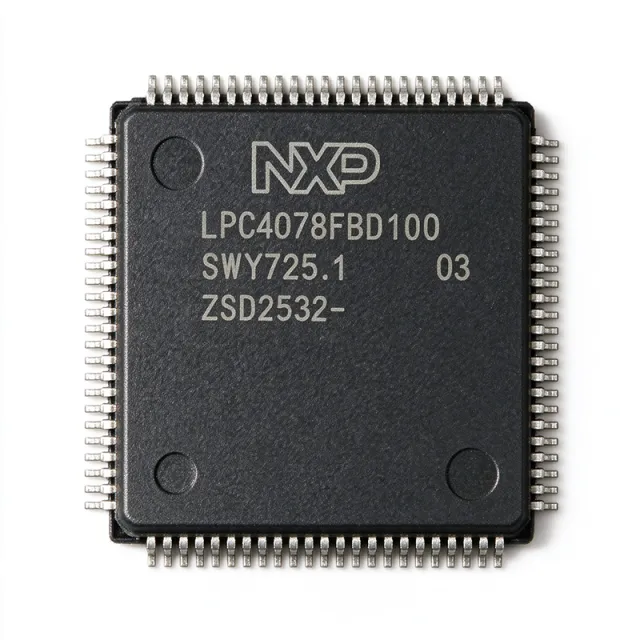
LPC2368FET100
LPC2368FET100 - ARM7 72MHz MCU, 512KB Flash, Ethernet, USB | NXP
The NXP LPC2368FET100 is a 16/32-bit ARM7TDMI-S microcontroller running at up to 72 MHz, integrating 512 kB of on-chip flash, 58 kB SRAM, 100-pin TFBGA (9x9) package, Ethernet MAC, USB 2.0 Device/Host/OTG, two CAN channels, four UARTs, three SSP/SPI ports, three I2C buses, I2S, an SD/MMC interface, an 8-channel 10-bit ADC, a 10-bit DAC, two PWM blocks, four general-purpose timers, an RTC, and a 10-bit ADC. According to the NXP LPC2368FET100 product page, the device is positioned for embedded applications requiring high peripheral integration and low active-power consumption with the rich connectivity needed for industrial gateways and networked appliances.
An ARM7 microcontroller is a member of the 16/32-bit RISC microcontroller family based on the ARM7TDMI-S core, sitting within the broader taxonomy of microcontrollers -> microprocessors -> embedded processors -> semiconductors. Compared with 8-bit 8051 or AVR devices, ARM7 cores offer substantially higher code density (Thumb mode), better interrupt handling, and rich on-chip peripherals for Ethernet and USB connectivity. Compared with later Cortex-M3 cores, ARM7TDMI-S lacks the deterministic interrupt latency and unified memory map of the Cortex-M series, but its mature toolchain (Keil, IAR, GCC) and large code base make it useful for legacy designs and field-deployed products.
Key features of the LPC2368FET100 include 72 MHz core clock, 512 kB flash for application code, 58 kB SRAM for data buffering, 100-pin TFBGA package (9x9 mm), Ethernet MAC for 10/100 Mbps networking, USB 2.0 full-speed Device/Host/OTG for USB connectivity, two CAN 2.0B channels for industrial networking, 8-channel 10-bit ADC, and 10-bit DAC for analog signal generation. Integrated peripherals reduce external component count and BOM cost while simplifying PCB layout.
The LPC2368FET100 is well suited for industrial gateways, building automation controllers, point-of-sale terminals, networked sensors, and USB peripherals. According to the NXP product page, the high peripheral count (Ethernet, USB, CAN, SD/MMC, multiple UARTs) eliminates the need for many external ICs, reducing both cost and board area. The 72 MHz ARM7 core delivers sufficient throughput for TCP/IP stacks and industrial communication protocols.
When designing with this device, ensure decoupling on all power pins and follow NXP AN10414 layout guidelines for TFBGA-100 routing. The integrated PHY is not included - an external Ethernet PHY such as the DP83848 is required for Ethernet applications. The USB DP/DM traces must be 90 ohm differential, length-matched, and routed without stubs.
Запрос цены
Контакты