Mga Interface IC
Subkategorya
Mga Produkto (2,200+)

ADG849YKSZ-REEL7 - 0.5Ω SPDT CMOS Switch, 1.8-5.5V | Analog Devices
The Analog Devices ADG849YKSZ-REEL7 is a monolithic CMOS single-pole double-throw (SPDT) analog switch housed in a 6-pin SC-70 (KS) package. It operates from a 1.8 V to 5.5 V single supply, features an ultra-low on-resistance of 0.5 Ω typical / 0.8 Ω maximum at 5 V, and delivers rail-to-rail signal switching with 0.13 Ω typical RON flatness for minimal distortion. The device is rated for 400 mA continuous current and 600 mA peak current at 5 V, with a typical power consumption below 0.01 µW. An analog switch (or CMOS switch) is a solid-state device that routes analog or digital signals between two or more paths using MOSFET pass transistors controlled by a logic-level input. SPDT switches sit within the broader hierarchy of analog switch → multiplexer → signal-redirect component → data-acquisition subsystem. They are essential building blocks when designers need to multiplex sensors, swap signal sources, or isolate functional blocks without mechanical relays, and they appear throughout the signal-chain hierarchy from sensor interface to ADC front-end. Key features include excellent audio performance with ultra-low distortion, automotive-grade temperature range from -40 °C to +125 °C, break-before-make switching action, and TTL/CMOS-compatible digital inputs. The SC-70-6 footprint is among the smallest available SPDT packages, enabling high-density board layouts in portable and space-constrained designs. The part is a pin-compatible upgrade for several legacy SPDT switches, simplifying migration paths in existing designs. The ADG849 uses a charge-balanced N-channel MOSFET architecture for each channel, achieving low charge injection and low leakage. Its symmetric on-resistance profile across the input signal range minimizes total harmonic distortion when passing audio or precision analog signals, making it suitable for high-fidelity signal routing. Typical applications include portable audio signal routing, USB 2.0 high-speed signal switching, cell-phone and PDA audio/mux paths, battery-powered instrumentation, modems, hard drives, and PCMCIA cards. The 1.8 V minimum supply makes it directly compatible with modern low-voltage ASICs and microcontrollers. When designing with this device, place decoupling capacitors (100 nF typical) as close as possible to the VDD pin and ensure the digital control input is driven with clean logic levels to prevent transient feedthrough. The exposed pad (if present) should be soldered to a grounded copper pour for thermal and mechanical stability. This page synthesizes distributor pricing, drop-in pin-compatible alternatives, and practical PCB-layout guidance that is not available on standalone distributor listings, giving the engineer a single, citable reference for component selection.
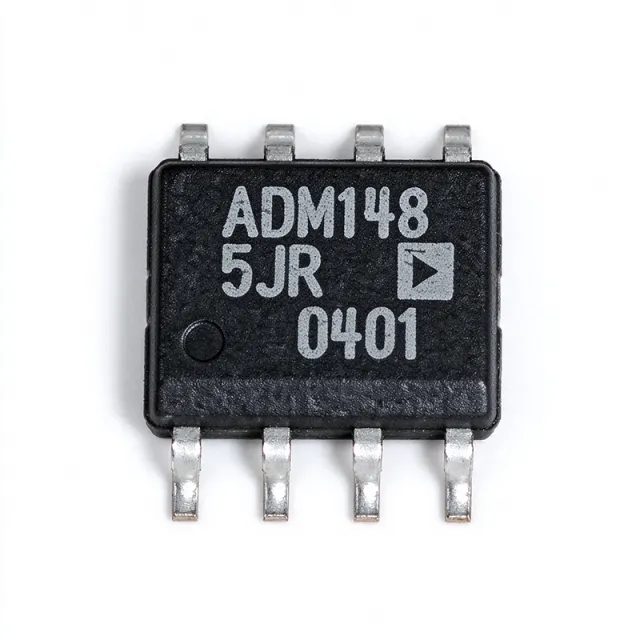
ADM1485ARZ - 30 Mbps 5V RS-485/RS-422 Half-Duplex Transceiver | ADI
The Analog Devices ADM1485ARZ is a 5 V, high-speed (30 Mbps), low-power, half-duplex differential line transceiver that complies with both EIA RS-485 and EIA RS-422 standards. Housed in an 8-pin SOIC_N package, it integrates one driver and one receiver (1/1) on a single die, making it suitable for bidirectional data communication on multipoint bus transmission lines. What is an RS-485/RS-422 transceiver? It is a physical-layer interface IC that converts a single-ended TTL/CMOS logic signal from a UART, MCU, or FPGA into a differential signal suitable for transmission over twisted-pair cable, and vice versa. RS-485 supports multipoint, half-duplex or full-duplex buses with up to 32 unit loads and common-mode voltages up to ±12 V, while RS-422 is its point-to-point/point-to-multipoint predecessor with similar differential signaling. Transceivers sit at the bottom of the OSI physical layer, bridging digital logic to industrial bus standards such as Profibus, Modbus, DMX512, and BACnet. Key specifications include a maximum data rate of 30 Mbps (with low driver skew for minimal EMI), a single 5 V supply (4.75 V to 5.25 V), ±12 V bus common-mode range, 70 mV receiver hysteresis, BiCMOS construction for low power, and on-chip thermal shutdown plus short-circuit protection. The differential driver outputs are well balanced to ensure distortion-free transmission, and minimal propagation delay supports high-speed industrial links without timing margin loss. Architecturally, the ADM1485ARZ uses BiCMOS process technology that combines the low power consumption of CMOS with the high drive capability of bipolar transistors. The result is a robust transceiver that draws minimal quiescent current while still swinging RS-485 levels into 60 ohm loads (two 120 ohm terminations in parallel). Internal fail-safe biasing on the receiver inputs guarantees a defined logic-high output when the bus is idle or open. Typical applications include industrial fieldbus networks (Profibus, Modbus), building automation (BACnet, DMX512 lighting), point-of-sale and banking terminals, motor drive feedback links, and any half-duplex multidrop RS-485 wiring run. The wide common-mode range makes the part tolerant of ground-potential differences between nodes in factory environments. When designing with the ADM1485ARZ, place the IC close to the bus connector and use a 100 ohm differential termination at each end of the cable. For multi-node buses, fail-safe biasing resistors (typically a pull-up on B and pull-down on A) may be needed if the part is operated without termination. The half-duplex design requires firmware control of the DE and RE pins, which can be tied together when only one direction is active at a time. This page synthesizes distributor pricing, drop-in alternatives, and practical design notes not found in the manufacturer datasheet.

ADM202EAN - Dual RS-232 Driver/Receiver, 5V, 16-PDIP | Analog Devices
The Analog Devices ADM202EAN is a dual, integrated RS-232 line driver and receiver interface IC operating from a single 5 V supply in a 16-pin PDIP package. It supports data rates up to 230 kbit/s and uses charge-pump capacitors as small as 0.1 µF to generate approximately ±10 V RS-232 output levels. An RS-232 transceiver is an interface IC that converts logic-level signals from a controller or terminal into bipolar RS-232 voltages and converts received RS-232 levels back into CMOS-compatible logic. Within the signal-chain hierarchy, the ADM202EAN belongs to the RS-232 interface transceiver category and connects UART-based digital systems to unipolar, single-ended communications ports using differential bipolar signaling. Key features include compliance with the TIA/EIA-232-E and V.28 specifications, 230 kbit/s operation, and electromagnetic-immunity provisions covering the EU 89/336/EEC EMC Directive. ESD protection is specified at 8 kV contact discharge, 15 kV air-gap discharge, and 15 kV human-body-model levels. Fast transient burst immunity is referenced to IEC 61000-4-4, while low EMI emissions are referenced to EN 55022. The ADM202E family provides a pin-compatible upgrade path for existing ADM202, ADM232L, MAX202E, and MAX232E sockets. Its charge-pump architecture eliminates the need for a separate external 5 V-to-±10 V converter, reducing board area and component count. The 230 kbit/s capability is appropriate for industrial equipment, data-acquisition systems, point-of-sale terminals, and legacy serial-control interfaces. For layout, the charge-pump capacitors must be placed close to their associated pins, and the interface ground must connect to the equipment chassis through the strategy specified by the application EMC standard. Cable routing and enclosure grounding often determine real-world ESD and EFT performance more than the IC rating alone. This page combines manufacturer specifications, verified distributor availability information, drop-in socket-compatibility candidates, and practical interface-design guidance to support component selection and PCB implementation.
ADM202JN - Dual 120kbps RS-232 Transceiver | Analog Devices
The Analog Devices ADM202JN is a dual-channel RS-232 line driver and receiver IC with two drivers, two receivers, a 120 kB/s transmission rate, and a 16-PDIP package. It operates from a single 5 V supply and uses an on-chip charge pump with 0.1 µF capacitors to generate ±10 V RS-232 output levels. The device is designed for legacy and industrial point-to-point serial interfaces requiring TIA/EIA-232-E and V.28-compatible signaling. An RS-232 transceiver is an interface IC that converts low-voltage digital logic levels into differential bipolar line voltages for transmission and converts received line voltages back into logic-compatible signals. The ADM202 belongs to the RS-232 transceiver class, which includes line drivers, line receivers, level-shifting circuitry, and charge-pump voltage generation. It is intended to bridge a host controller or UART with an external RS-232 connector while operating from a single 5 V rail. Key features include two RS-232 drivers, two RS-232 receivers, a 120 kB/s data rate, 0.1 µF charge-pump capacitors, and integrated on-board DC-DC conversion. The supplied data identifies the output levels as ±10 V and states that the device meets or exceeds TIA/EIA-232-E and V.28 specifications. The 16-PDIP package is a through-hole package suitable for conventional PCB sockets and legacy communication equipment. The ADM202 architecture combines digital input/output compatibility with analog line-driver and receiver functions. Its charge-pump converter avoids a separate negative supply for RS-232 transmission while reducing the external capacitor requirement to 0.1 µF. The receiver side translates the bipolar RS-232 signal into a logic-level output suitable for a UART or microprocessor. Exact propagation-delay, input-threshold, output-current, and absolute-maximum values are not supplied in the verified excerpts and are marked for data collection rather than inferred. Typical uses include industrial serial adapters, data-acquisition equipment, service interfaces, test systems, embedded control consoles, and legacy peripheral connections. The part is most appropriate where the system already uses a true RS-232 physical interface and requires a compact two-channel transceiver rather than a modern differential bus such as RS-485. The ±10 V output capability helps provide the voltage swing expected by RS-232 receivers while the single 5 V supply simplifies system power design. Designers should verify the external charge-pump capacitor connection, pin orientation, logic-level compatibility, receiver hysteresis, and cable-side protection against the manufacturer datasheet. Do not treat RS-232 as a long-distance differential communication standard; cable length, grounding, connector pin assignment, and EMI conditions still determine practical reliability. The supplied data also indicates that the ADM202JN is an obsolete-style 16-DIP product, so sourcing and lifecycle confirmation should be checked before new production commitments. This product page combines the verified Analog Devices function description, distributor package identification, and public cross-reference leads with engineering-focused selection, application, and sourcing guidance. It distinguishes verified facts from missing parameters and does not invent pricing, pin names, or electrical values that were not present in the supplied data.

ADM203JN - 120 kB/s 5 V RS-232 Transceiver | Analog Devices
The Analog Devices ADM203JN is a high-speed, single-supply CMOS RS-232 driver/receiver with a 120 kB/s transmission rate, two drivers, and two receivers in a 20-pin through-hole DIP package. It operates from a 5 V supply, requires no external charge-pump capacitors, and includes onboard DC-DC conversion that produces approximately 9 V for RS-232-level output. An RS-232 transceiver is an interface IC that translates between single-ended CMOS logic levels and differential, bipolar RS-232 voltage levels. It belongs to the interface-IC hierarchy, where transceivers combine line drivers and receivers for serial data links. The ADM203JN is designed for equipment that needs bidirectional or multi-channel RS-232 connectivity while minimizing external charge-pump components. Verified source data identifies key features as 120 kB/s transmission, a single 5 V power supply, compliance with EIA-232-E and V.28 specifications, two drivers, two receivers, onboard DC-DC converters, and no external capacitors for the ADM203 version. These characteristics make it suitable for industrial control, test equipment, point-of-sale terminals, and computer peripherals using RS-232 links. The device's integrated charge-pump approach simplifies board layout compared with older RS-232 implementations that require external pump capacitors. Its high drive current is described in the verified material as supporting extended cable lengths, while the 120 kB/s rate supports faster serial data transfer than many conventional RS-232 designs. Typical circuit use places the IC between a host UART and an external RS-232 connector. Logic-side inputs and outputs use CMOS-compatible levels, while driver outputs handle the higher RS-232 voltage swings generated by the internal converter. Board layout should keep connector and interface traces short where possible, provide adequate bypassing, and follow the manufacturer's datasheet for decoupling and signal routing. This page combines verified ADM203JN specifications, sourcing information, interface-category guidance, and design notes. It also distinguishes confirmed facts from unavailable electrical details, avoiding unsupported claims about parameters that are not present in the supplied sources.
ADM203JNZ - Dual 5V RS-232 Transceiver | Analog Devices
The Analog Devices ADM203JNZ is a dual RS-232 line driver and receiver operating from a single +5 V supply in a 20-pin PDIP-N package. It provides two transmit channels and two receive channels, uses 0.1 µF charge-pump capacitors, supports data rates up to 120 kB/s, and is designed to meet or exceed the EIA-232-E and V.28 specifications. The device is intended for bidirectional serial-interface designs requiring a compact, integrated RS-232 solution. An RS-232 transceiver is an interface IC that converts logic-level TTL signals into differential, bipolar RS-232 line levels and converts incoming RS-232 signals back into logic-compatible levels. It belongs to the transceiver class within interface ICs and connects UART-based digital systems to serial ports, industrial equipment, data acquisition systems, and communications equipment. The ADM203JNZ combines drivers and receivers in one package while deriving the required positive and negative RS-232 voltage levels from a 5 V supply. The principal features include dual RS-232 driver/receiver operation, a single +5 V supply, operation up to 120 kB/s, and fast driver slew rates. According to the manufacturer datasheet information identified in the verified search results, the high-drive-current implementation can also support extended cable lengths. The EIA-232-E and V.28 compliance statements provide useful context for systems designed around standardized RS-232 electrical behavior, while the integrated receiver and driver circuitry reduces the number of discrete interface components required. The ADM203 series uses CMOS-compatible driver and receiver circuitry with external 0.1 µF charge-pump capacitors, eliminating the need for a separate bipolar supply. This architecture allows compact single-supply equipment while retaining the voltage translation required by RS-232. Designers must still account for the charge-pump capacitor tolerance, startup behavior, connector ground, cable routing, and the large voltage swings present at the physical interface. Typical uses include serial-port adapters, industrial controllers, test and measurement instruments, point-of-sale terminals, data loggers, and embedded systems that expose a legacy RS-232 port. It is particularly appropriate when a board requires two RS-232 channels and the system uses a 5 V supply. A UART or other communications controller provides the parallel logic data, while the ADM203JNZ handles the physical-layer conversion. Place the two 0.1 µF charge-pump capacitors close to their designated pins, maintain the datasheet-recommended loop area, and connect the interface reference ground to the circuit ground according to the layout guidance. Confirm signal polarity, receiver enable behavior, and cable length during design review. The 120 kB/s rating should not be interpreted as permission to use unshielded cabling at every installation distance because RS-232 cable performance remains system-dependent. This product record combines the verified manufacturer-derived features, distributor availability references, packaging information, and drop-in comparison candidates in one engineering-focused view. It also distinguishes documented electrical attributes from unavailable pricing, lifecycle, environmental, and detailed pinout data rather than estimating missing values.

ADM206AN - 4/3 RS-232 200 kbps Transceiver | Analog Devices
The Analog Devices ADM206AN is a +5 V powered CMOS RS-232 transceiver with four drivers, three receivers, a shutdown pin, and an enable pin, operating at up to 200 kbps in a 24-pin PDIP package. According to the Analog Devices product page, the device uses only 0.1 µF charge-pump capacitors and is intended for systems that cannot provide ±12 V rails. An RS-232 transceiver is an interface IC that converts logic-level digital signals into RS-232-compatible line levels and converts received line levels back into logic-level signals. The ADM206 family belongs to the broader line-driver/receiver and interface-IC hierarchy, where EIA-232-E and V.28 links connect embedded systems, computers, industrial controllers, and communications equipment. Its single +5 V supply and integrated charge-pump support simplify systems that require RS-232 functionality without external negative-voltage generation. The ADM206 provides four transmit channels and three receive channels. The receiver design is intended for dependable operation across RS-232 signal levels, while the driver outputs use the device's CMOS charge-pump approach to produce the required bipolar line voltage. The device also includes shutdown control and an enable function, allowing power management or interface isolation in multi-channel systems. Its 200 kbps capability is suitable for moderate-speed serial links rather than high-speed differential interconnects. The ADM206AN is the through-hole PDIP-24 ordering variant. The provided manufacturer and distributor data identify a 24-pin PDIP package, while a surface-mount ADM206ARZ variant is a different package and is not a drop-in replacement for a PDIP footprint. Engineers should therefore preserve the package outline and verify the exact pin functions in the manufacturer datasheet before substitution. Typical uses include RS-232 ports in embedded control equipment, test systems, industrial instrumentation, computer peripherals, and service interfaces. For new designs, the shutdown and enable pins can support power sequencing or reduce consumption when the interface is idle. The principal trade-off is that a +5 V RS-232 solution still uses external charge-pump capacitors and occupies a relatively large through-hole package compared with newer compact interface transceivers. Use the manufacturer's ADM206 datasheet and product page to confirm pinout, capacitor values, receiver thresholds, timing, and absolute maximum ratings. Do not infer values from a distributor listing alone. This page distinguishes verified product identity and application context from electrical parameters that require confirmation in the full datasheet.

ADM206AR - 4/3 +5V RS-232 Transceiver | Analog Devices
The Analog Devices ADM206AR is a +5 V powered CMOS RS-232 transceiver with four drivers, three receivers, a shutdown pin, and an enable pin in a 24-SOIC package. Its specified 200 kbps data rate, 0.1 µF charge-pump capacitor requirement, 9 V output swing, and 30 V receiver input levels make it suitable for compact single-supply serial interfaces where ±12 V is unavailable. What is an RS-232 transceiver? An RS-232 transceiver combines line drivers and receivers that translate between digital logic levels and bipolar serial-interface signals. The driver channels transmit data, while receiver channels interpret incoming RS-232 levels. In the broader hierarchy, it is an interface transceiver, a communications IC, and a semiconductor designed for point-to-point serial data links. The ADM206AR is especially useful when a system has only a +5 V supply but requires the voltage levels and noise immunity associated with RS-232. Its four-driver and three-receiver arrangement can serve several channels where space is constrained. The manufacturer describes the device as a 200 kbps RS-232 transceiver with an integrated shutdown function and enable control. Operationally, the device uses charge-pump circuitry to generate the bipolar signal levels required by RS-232 from the single positive supply. The verified product description identifies 0.1 µF capacitors for charge-pump operation and reports a 9 V output swing with a +5 V supply. The receivers accept input voltages identified in the source data as extending to 30 V, which helps when the interface cable introduces larger transients or sees voltage offsets. Typical applications include serial adapters, embedded instrumentation, industrial control links, test equipment, and legacy computer peripherals. Because the ADM206AR includes both shutdown and enable pins, it can support systems that need controlled power states or channel management. The 24-SOIC package also remains convenient for through-hole and mixed-signal PCB assembly. When laying out the circuit, place the charge-pump capacitor and interface protection components according to the manufacturer’s recommended layout and keep the RS-232 connector-side traces physically separated from sensitive logic where practical. Confirm the exact receiver enable, shutdown, and channel pin assignments against the official ADM206 datasheet before final PCB release. This page combines verified manufacturer and distributor information, package-aware replacement guidance, interface design considerations, and application-oriented selection context. It is intended to help engineers evaluate the ADM206AR against alternatives without assuming that every RS-232 IC is pin-compatible.
ADM207AN - 5V RS-232 Interface, 120 kbps | Analog Devices
Analog Devices ADM207AN is a five-driver, three-receiver CMOS RS-232 interface transceiver with a 5 V supply, 120 kB/s data rate, and on-board DC-to-DC converters. It is packaged in a 24-pin PDIP and supports EIA-232-E and V.28 links where approximately ±12 V is unavailable. The verified family data also identifies ±9 V output swing, low 15 mW power, and receiver inputs rated to ±30 V. An RS-232 transceiver is an interface IC that translates between complementary TTL/CMOS logic and bipolar, single-ended RS-232 signals. It belongs to the communication-interface hierarchy: RS-232 interface IC → line driver and receiver → interface IC → semiconductor. Drivers amplify logic signals for a cable, while receivers detect cable voltage levels and present them to a host controller. On-board converters eliminate the need for a separate negative supply rail. Key features include support for external charge-pump capacitors from 0.1 µF to 10 µF, a maximum data rate of 120 kB/s, and pin compatibility with the MAX206 through MAX211 and MAX213 families. Latch-up-free operation is stated in the available manufacturer-family data. The ±30 V receiver input capability provides additional tolerance to transients encountered on external cabling, although system-level protection and grounding still require engineering review. The ADM207AN uses five driver channels and three receiver channels, allowing multiple serial functions or unused-line handling in one circuit. Its 5 V CMOS architecture simplifies interfacing with 5 V logic but requires checking input thresholds, output levels, and timing against the connected microcontroller or UART. The integrated converters generate the bipolar voltage required by RS-232 drivers without a separate negative supply. Typical uses include industrial serial consoles, instrumentation links, data acquisition equipment, service ports, and legacy peripheral connectivity. A microcontroller UART connects to the logic-side pins, while the RS-232 pins connect through the board’s DB9 or other physical connector. Designers should verify cable length, grounding, data direction, and connector pin assignment before production. A key design consideration is to place charge-pump capacitors close to their marked pins and provide a suitable return path for RS-232 current. Do not substitute negative logic or change connector wiring without reviewing the UART protocol. Verify propagation delay and slew-rate limits against the required baud rate, especially when long cables or slow edge rates are involved. This page consolidates verified family specifications, distributor identity, package details, application guidance, and availability checks into one engineering-focused reference. Pricing and lifecycle statements remain qualified because verified quantity pricing, manufacturer lifecycle status, and complete pin mapping were not supplied.
ADM207AR - 5/3 RS-232 Transceiver, 200 kb/s | Analog Devices
The Analog Devices ADM207AR is a +5 V powered CMOS RS-232 transceiver with five drivers, three receivers, 200 kb/s data rate, and a 24-pin SOIC package. It uses 0.1 µF charge-pump capacitors and is designed for EIA-232-E and V.28 interfaces when ±12 V supplies are unavailable. An RS-232 transceiver is an interface IC that combines line drivers, receivers, and charge-pump voltage-boost circuitry. It translates logic-level UART signals between a host and a noisy, differential-distance serial link. The ADM207AR belongs to the RS-232 transceiver class within interface ICs and supports the asymmetric voltage levels required by legacy serial communications. The verified feature data identifies five transmitters, three receivers, a +5 V supply, 0.1 µF capacitors, 120 kb/s in one secondary source and 200 kb/s in the Analog Devices product listing. It also reports a 9 V output swing from a +5 V supply, 15 mW low power, low-power shutdown, 30 V receiver input levels, latch-up protection, and plug-in compatibility with MAX205 through MAX213. Exact operating limits not present in the supplied data are marked for verification rather than guessed. The charge-pump topology generates the bipolar voltage needed by RS-232 drivers from a single +5 V rail. This reduces system power-supply complexity, but external capacitor selection, layout, and signal-return continuity remain critical. Five driver channels permit multi-drop or multi-port RS-232 links, while three receiver channels provide simultaneous receive monitoring or handshake support. Typical applications include industrial control equipment, data acquisition systems, instrumentation, barcode or serial adapters, legacy peripheral ports, and embedded controller links. The device is appropriate when the system already uses RS-232 logic levels and must interoperate with existing equipment rather than modern differential buses such as RS-485. For a new PCB, verify the complete 24-pin pinout, capacitor values, driver and receiver loading, and maximum cable length against the current manufacturer datasheet. Keep charge-pump traces short, place capacitors close to their associated pins, and provide a continuous ground return between communicating systems. This page combines the supplied manufacturer and distributor findings with practical interface-selection guidance. It explicitly separates verified facts from unavailable parameters, so procurement and design decisions can be checked against the authoritative ADM207 datasheet before release to production.
ADM207ARZ - 5/3 RS-232 Transceiver, 200 kbps | Analog Devices
The Analog Devices ADM207ARZ is a 5 V powered CMOS RS-232 transceiver with five drivers, three receivers, a 200 kbps data rate, and onboard charge-pump voltage conversion in a 24-pin wide SOIC package. It requires 0.1 µF charge-pump capacitors and operates from a single 4.5 V to 5.5 V supply, producing the bipolar voltage swings required by EIA-232-E and V.28 interfaces. The ADM207 family is intended for communications systems where conventional ±12 V RS-232 supplies are unavailable. An RS-232 transceiver is an interface IC that converts logic-level digital signals into RS-232 line levels and converts received line levels back into digital logic. This device belongs to the line-driver and receiver category, which forms part of the broader interface IC and semiconductor hierarchy. Unlike a standalone RS-232 driver or receiver, the ADM207ARZ combines both functions and its regulated charge-pump circuitry on one integrated circuit. The ADM207ARZ provides five transmit channels and three receive channels, allowing three bidirectional ports plus two transmit-only outputs. Its maximum signaling rate of 200 kbps supports common asynchronous serial data links while requiring only a 0.1 µF external capacitor for its on-chip voltage converters. The 5 V supply architecture simplifies system design because designers do not need a separate ±12 V source. Technically, the integrated DC-to-DC converters generate positive and negative RS-232 voltage levels from the single low-voltage supply. The receivers provide noise immunity for the ±3 V logic used by many microcontrollers and programmable controllers. Although the ADM207 lacks the low-power shutdown feature associated with some related ADM2xx devices, it remains suitable for multiport industrial, instrumentation, test-equipment, and embedded-control interfaces where several RS-232 channels are required. Typical applications include data acquisition systems, industrial controllers, laboratory instruments, point-of-sale equipment, barcode scanners, and embedded serial-port interfaces. A system designer can connect its logic-side transmitter inputs and receiver outputs directly to a suitable microcontroller UART, while the RS-232-side pins connect through the external charge-pump capacitors and protection network. The wide SOIC package is easy to assemble and available in production packaging. When laying out the board, place the 0.1 µF charge-pump capacitors close to their specified pins and route the high-voltage RS-232 outputs away from sensitive logic. Decoupling and external protection must follow the manufacturer application guidance because long cables expose the interface to electrostatic discharge and surge events. The supply must remain within the verified 4.5 V to 5.5 V range. This page consolidates verified manufacturer and distributor information, package-specific sourcing details, application guidance, and a transparent assessment of available drop-in alternatives. It also separates documented capabilities from unavailable electrical details instead of estimating missing specifications.
ADM208AN - 4/4 RS-232 Transceiver, 5V, 24-PDIP | Analog Devices
The Analog Devices ADM208AN is a +5 V powered CMOS RS-232 transceiver with four drivers and four receivers, a 120 kbit/s data rate, and a 24-pin PDIP package. It is designed for EIA-232-E and V.28 communications interfaces where ±12 V supplies are unavailable. The verified product information identifies a 0.1 µF charge-pump requirement, 9 V output swing from a +5 V supply, 30 V receiver input levels, and low-power operation. An RS-232 transceiver is an interface IC that combines differential line drivers and receivers for point-to-point serial communication. In the broader electronics hierarchy, it belongs to interface ICs and communications transceivers rather than power-management or logic devices. The ADM2xx family translates between low-voltage digital logic levels and the voltage levels used by RS-232 links, while internal charge-pump circuitry generates the required negative transceiver voltage. Key features include four drivers, four receivers, 120 kbit/s operation from a single +5 V supply, and 9 V output swing. The receiver supports 30 V input levels according to the supplied manufacturer-related snippets. The device is intended for RS-232 links that must tolerate the electrical environment of the EIA-232-E or V.28 standards while avoiding external ±12 V rails. Low-power shutdown and receiver behavior vary by family member, so the exact ADM208AN functions must be verified against its datasheet during design-in. The ADM208AN uses CMOS drivers and receivers to interface a host UART, microcomputer, or data-acquisition system with an RS-232 cable. Its 120 kbit/s rate is suitable for conventional serial equipment, configuration links, instrumentation, and industrial control links that do not require higher data rates. The 24-pin PDIP package favors through-hole assembly and legacy industrial equipment rather than compact surface-mount designs. A primary design consideration is ensuring that the external charge-pump capacitors, supply decoupling, grounding, and cable-side protection meet the requirements in the manufacturer datasheet. Because RS-232 is a single-ended, unbalanced interface, cable routing and grounding can affect noise immunity. Do not infer an ESD rating, temperature range, or package dimensions that are not stated in the verified data. This page consolidates verified manufacturer and distributor information, comparison-ready attributes, and practical RS-232 integration guidance. It distinguishes published facts from parameters requiring verification and is intended to support engineering selection before purchasing the ADM208AN.
ADM208AR - 200 kbps 4/4 RS-232 Transceiver | Analog Devices
The Analog Devices ADM208AR is a +5 V CMOS RS-232 transceiver with four drivers, four receivers, a 200 kbps data rate, and a 24-pin SOIC package. It is designed for single-supply EIA-232-E and V.28 communications interfaces where a 12 V supply is unavailable. The verified manufacturer page identifies the device as a 0.1 µF, +5 V, 4-driver and 4-receiver RS-232 transceiver. An RS-232 transceiver is an interface IC that converts logic-level signals between a host or controller and a cable-based RS-232 link. The driver channels translate CMOS levels into RS-232-compatible bipolar signals, while the receiver channels convert those signals back into CMOS logic. As a result, the ADM208AR belongs to the RS-232 interface IC, communications transceiver, line-driver/receiver, and power-management interface hierarchy. Key verified features include four drivers and four receivers, operation from a single +5 V supply, 0.1 µF charge-pump capacitors, and a data rate listed by the official product page as 200 kbps. The manufacturer describes the ADM2xx family as robust RS-232 and V.28 interface devices intended for communications systems that do not have a 12 V rail. Additional detailed electrical, environmental, and package values require confirmation in the manufacturer datasheet. The ADM208AR is useful for industrial control links, equipment-to-console connections, embedded serial ports, point-of-sale equipment, and test systems requiring more than two RS-232 channels. Its four-channel arrangement reduces the need for multiple interface packages when several point-to-point RS-232 links share the same +5 V system supply. The 24-SOIC package is also suitable for conventional surface-mount PCB assembly. Designers should verify every unused driver output and receiver input, preserve the required charge-pump capacitor arrangement, and treat the RS-232 cable interface as a physically isolated communication environment rather than a high-speed differential link. The verified snippets identify the device as a plug-in upgrade family relative to MAX205-211 and MAX213 parts, but each replacement must still be checked against the exact pinout, supply requirements, and timing ratings. For a new layout, use the exact package drawing and pin table from the Analog Devices datasheet before routing. Confirm the external capacitor values, supply decoupling, logic levels, receiver thresholds, and maximum cable-side voltage levels against the latest manufacturer documentation. Pricing and availability should be checked as of 2026-10-22 because distributor commercial terms can change independently of the component's electrical design. This page synthesizes the verified ADM208AR product description, distributor package information, and practical RS-232 design considerations. It does not infer unreported electrical limits or invent replacement specifications; unavailable values are explicitly marked for engineering verification.

ADM208ARS - 4/4 RS-232 200kbps IC | Analog Devices
Analog Devices ADM208ARS is a +5 V powered CMOS RS-232 interface IC containing four drivers and four receivers in an SSOP package. It supports data rates up to 200 kbps and uses 0.1 µF external charge-pump capacitors. According to the Analog Devices ADM208 product page and data sheet, the ADM208 family is in production and provides a 9 V output swing from a +5 V supply. An RS-232 transceiver is an interface IC that converts logic-level digital signals into RS-232 line levels and converts received RS-232 signals back into CMOS-compatible logic. Within the signal-chain hierarchy, the ADM208ARS is a multi-channel line transceiver, placing it between low-voltage digital controllers and external RS-232 equipment such as computers, peripherals, modems, printers, and instruments. The four-driver, four-receiver arrangement provides eight independently usable RS-232 channels in one package. Key operating characteristics include a maximum data rate of 200 kbps, low power consumption of 15 mW as stated in the verified feature summary, and external charge-pump capacitors of 0.1 µF. The ADM208 family also provides 9 V output swing with a +5 V supply and receiver input levels rated to 30 V. The +5 V single-supply architecture simplifies power planning in systems that already operate from 5 V. Internally generated charge-pump voltage raises the driver output above the normal supply rail, allowing the device to meet RS-232 output voltage requirements without a separate negative supply. The ADM208 data sheet also identifies the family as a plug-in upgrade for MAX205, MAX211, and MAX213 devices, providing a useful basis for compatibility assessment when evaluating board revisions. Typical applications include multi-channel data acquisition, industrial instrumentation, printer and modem interfaces, computer peripherals, and embedded serial-port systems. Four transmitter and four receiver channels also allow one controller to communicate with several RS-232 devices or support bidirectional links on fewer physical lines. The principal design consideration is ensuring adequate charge-pump capacitor selection and placement. The verified data identifies 0.1 µF capacitors, so designers should follow the manufacturer’s recommended capacitor type, voltage rating, and PCB layout to obtain the specified 200 kbps operation and dependable line-driver behavior.
ADM209AR - 120kbps +5V RS-232 Transceiver | Analog Devices
The Analog Devices ADM209AR is a high-speed, +5 V powered CMOS RS-232 driver/receiver transceiver with a 120 kbps data rate, 0.1 µF charge-pump capacitors, and a 24-SOIC package. The device provides two RS-232 drivers and two receivers, supports shutdown operation, and is specified for a maximum receiver input range of 30 V. Its CMOS implementation is intended for low-power, high-speed serial-interface designs. An RS-232 transceiver is an interface integrated circuit that combines differential line drivers and receivers with charge-pump circuitry to generate the positive and negative voltage swings required by the RS-232 standard. It belongs to the broader class of interface ICs, connecting a host, peripheral, instrument, or industrial controller to a physical communication port. The ADM209AR is therefore positioned between low-voltage digital logic and an external RS-232 cable. Key features include operation from a +5 V supply, support for 120 kbps data rates, use of only 0.1 µF capacitors, 9 V output swing with a +5 V supply, low power consumption of 15 mW, and active receiver behavior during shutdown for the ADM213 family context identified in the retrieved data. The device also includes latch-up protection and is described as a plug-in upgrade for MAX205, MAX211, and MAX213 devices. The ADM209AR uses charge-pump-generated rails to provide RS-232-compatible output levels from a single positive supply. This architecture simplifies external power design compared with a dual-supply implementation, while the 30 V receiver input rating helps the interface withstand harsher cable-side transients. The 24-SOIC package provides a conventional surface-mount footprint and room for the required external capacitors. Typical applications include RS-232 ports in industrial equipment, test and measurement instruments, computer peripherals, embedded systems, and communications equipment. The 120 kbps rate is suitable for legacy serial links that require higher throughput than slow modem-style interfaces but do not demand modern high-speed differential signaling. When laying out the ADM209AR, place the charge-pump capacitors and RS-232 line-side protection or termination components close to the IC and connector. Verify that the external capacitor polarity, supply decoupling, cable length, and logic levels satisfy the system requirements. Do not substitute a receiver-only or driver-only IC unless the surrounding circuit is redesigned. This product data synthesizes the retrieved manufacturer and distributor information, available pricing, package details, application guidance, and replacement constraints into an engineering-oriented component reference.
ADM209ARS - 200kbps 5V RS-232 Transceiver | Analog Devices
The Analog Devices ADM209ARS is a +5 V CMOS RS-232 interface transceiver with 3 drivers, 5 receivers, 200 kbps data rate, and a 24-lead SOIC package. It uses 0.1 µF charge-pump capacitors, provides 9 V output swing from a 5 V supply, accepts receiver inputs up to 30 V, and includes an enable control for low-power shutdown. The manufacturer identifies the ADM209 family as obsolete, so new production availability should be confirmed before committing a design. A CMOS RS-232 transceiver is an interface IC that translates logic-level signals between a host or controller and RS-232-compatible equipment. In the hierarchy of electronic components, it belongs to interface ICs, within the broader semiconductor category. The driver channels convert TTL/CMOS logic into RS-232 levels, while the receiver channels convert RS-232 inputs back into logic levels. This allows equipment operating at different logic and voltage domains to communicate over a wired serial interface. The ADM209ARS provides five receiver channels and three driver channels, making it useful where a design has more incoming data paths than outgoing data paths. Its 200 kbps maximum data rate supports moderate-speed serial links, while the 0.1 µF charge-pump capacitor requirement reduces external capacitance compared with earlier RS-232 implementations. The 30 V receiver input rating provides additional tolerance for exposed or industrial serial connections, although the complete interface still requires suitable protection in harsh environments. Internally, the device combines CMOS drivers and receivers with on-board charge-pump circuitry. The charge pump generates the RS-232 voltage levels required by the drivers, while the enable pin supports shutdown operation that can reduce system power consumption. Because the part is specified for a single +5 V supply, the ADM209ARS simplifies system power architecture compared with dual-supply RS-232 transceivers. Its 24-lead SOIC package supports conventional surface-mount assembly and is the relevant footprint constraint when evaluating replacements. Typical uses include industrial serial controllers, test equipment, point-of-sale systems, data-acquisition equipment, and embedded systems that need multiple RS-232 receive paths. A 3-transmitter design can connect several peripherals while five receiver inputs can monitor commands, status signals, or acknowledgments. In cable-based installations, designers should also consider ground reference, electrostatic discharge, surge, and isolation requirements that are outside the IC itself. For replacement work, verify the complete 24-pin signal map, supply voltage, channel counts, charge-pump capacitor values, enable polarity, and receiver thresholds rather than relying only on the RS-232 protocol label. The page distinguishes documented cross-reference candidates from a manufacturer-confirmed universal replacement and marks unavailable technical and commercial fields where the retrieved sources do not provide verified values. This page consolidates the retrieved Analog Devices product information, distributor availability, RS-232 application context, package constraints, and cross-reference guidance. It adds design-oriented selection criteria that are useful beyond the basic manufacturer description while clearly separating verified facts from information that still requires engineering confirmation.

ADM211AR - 4/5 RS-232 Transceiver, 120 kbps | Analog Devices
The Analog Devices ADM211AR is a 4-driver, 5-receiver RS-232 transceiver designed for EIA-232-E and V.28 communications from a single 5 V supply. It supports data rates up to 120 kbps, uses 0.1 µF charge-pump capacitors, and provides approximately ±9 V output swing in a 28-pin SOIC package. The integrated dc-to-dc converters eliminate the need for a separate ±12 V supply. An RS-232 transceiver is an interface IC that converts between digital logic levels and the bipolar voltage levels used by RS-232 links. It belongs to the broader line-driver/receiver and interface-IC hierarchy, where differential or single-ended digital signals must cross systems with different voltage references. The ADM211AR combines four transmit channels and five receive channels for multi-port equipment, industrial controllers, and legacy peripheral connections. Key features include four drivers, five receivers, operation from a 4.5 V to 5.5 V supply, and a data rate of 120 kB/s. The on-board dc-to-dc converters support approximately ±9 V output swing from a 5 V supply, while the low-power mode is specified at 15 mW. The receiver section provides 30 V input-level handling according to the supplied search data, making the device useful where protected or long RS-232 lines are encountered. The ADM211AR is designed for EIA-232-E and V.28 interfaces when ±12 V is unavailable. Its 28-SOIC package provides a conventional surface-mount footprint and allows the four transmitters and five receivers to be consolidated instead of using separate interface devices. The exact pin assignments, absolute maximum ratings, propagation timing, and detailed electrical limits must be confirmed in the manufacturer datasheet before layout or production use. Typical applications include RS-232 port expansion, industrial data acquisition, test equipment, instrumentation, and embedded serial interfaces. In a multi-port design, the four drivers can support outgoing connections while five receivers provide additional inbound channels. The shared supply architecture also simplifies system design where a single 5 V rail is available. A key design consideration is maintaining the correct charge-pump capacitor values and checking the RS-232 line polarity and signal levels during bring-up. Decoupling should follow the manufacturer application guidance, and unused channels should be configured according to the datasheet rather than left floating. The device is a digital interface IC, so SOA is not applicable. This product page consolidates verified manufacturer and distributor information, application guidance, sourcing context, and engineering design notes. It distinguishes verified facts from parameters that still require the complete manufacturer datasheet, helping engineers evaluate the ADM211AR without relying on unverified substitutions.
ADM213AR - 4/5 5V RS-232 Transceiver, 200kbps | Analog Devices
The Analog Devices ADM213AR is a production +5 V CMOS RS-232 transceiver with four drivers, five receivers, shutdown and enable pins, and two receivers remaining active during shutdown. It supports data rates to 200 kbps, operates from a 4.5 V to 5.5 V supply, and uses a 28-pin SOIC package. Its integrated DC-to-DC converters produce approximately ±9 V output swing from a single 5 V supply. An RS-232 transceiver is an interface IC that converts logic-level TTL or CMOS signals into RS-232-compatible differential voltage levels, while converting received RS-232 levels back into logic-level signals. The ADM213AR belongs to the line-driver/receiver and interface-IC hierarchy used for EIA-232-E and V.28 communications where ±12 V is unavailable. Integrating charge-pump converters eliminates the need for a separate negative supply in many point-to-point interfaces. Key features include four RS-232 drivers, five receivers, two receivers active in shutdown, 0.1 µF charge-pump capacitors, 120 kbps data-rate support in the cited feature data, and approximately ±9 V output swing with a 5 V supply. The reported low-power figure is 15 mW. The 28-SOIC package is suitable for conventional through-hole PCB assembly, and the device is identified as a plug-in upgrade for MAX205, MAX211, and MAX213 families. The device uses a single positive supply, making it useful for systems that cannot easily provide negative RS-232 rails. Its receiver inputs are specified for ±30 V input levels, while latch-up protection is listed as a feature. The shutdown function can reduce system power when the interface is inactive, although two receivers remain operational for selected monitoring or wake-up signals. Typical applications include industrial RS-232 links, instrumentation, point-of-sale equipment, data acquisition systems, embedded serial ports, and legacy computer peripherals. When using the device, verify the exact pinout, shutdown polarity, receiver enable behavior, charge-pump capacitor values, and RS-232 signal polarity against the manufacturer datasheet before final PCB release. This page combines the supplied manufacturer and distributor information, sourcing links, interface context, and engineering cautions. Pricing and cross-reference claims are limited to the retrieved data; unverified values are marked as data needed rather than guessed.

ADM222AN - 200 kbps Dual RS-232 Transceiver | Analog Devices
The Analog Devices ADM222AN is a high-speed, 5 V CMOS RS-232 transceiver with 2 drivers, 2 receivers, a 200 kbps data rate, and an 18-pin PDIP package. Its key interface ratings are 200 kbps, 5 V supply operation, and 2/2 transmit-receive channels, while the charge-pump subsystem develops bipolar RS-232 levels with only 0.1 µF external capacitors. According to the Analog Devices product page, the on-board DC-DC converters provide a 9 V output swing with the 5 V supply, and the receivers accept input voltages to 30 V. An RS-232 transceiver is an interface IC that combines line drivers and line receivers so digital logic can communicate across a noisy, ground-offset-prone serial link. Its hierarchy is RS-232 transceiver → serial interface transceiver → line-driver/receiver IC → interface semiconductor. The ADM222 belongs to the high-speed CMOS RS-232 family alongside ADM232A and ADM242, combining logic-level interfacing with the voltage conversion required by RS-232. The ADM222 provides 2 drivers and 2 receivers, enabling two simplex links or one full-duplex RS-232 port. Its 200 kbps transmission rate is substantially faster than conventional low-speed RS-232 links. A 5 V-only power architecture simplifies system supply design, while the external 0.1 µF charge-pump capacitors support generation of bipolar signal levels. The stated 9 V output swing provides the required positive and negative line-drive voltage. The receiver input rating extends to 30 V, providing useful transient and voltage-range margin when connected to external RS-232 equipment. The device also includes a shutdown pin, allowing the transceiver to reduce activity when the interface is not required. Exact propagation-delay, input-threshold, output-current, supply-current, and temperature values are not present in the supplied search data and therefore require confirmation from the manufacturer datasheet. Typical uses include industrial serial-control links, test equipment, instrumentation, data-acquisition systems, and legacy peripheral connections. In each case, the two receiver/driver channels can support bidirectional communication when TX and RX signals are crossed appropriately. The 200 kbps rate can also shorten transfer time compared with slower RS-232 implementations, provided the connected equipment, cable, and protocol support that throughput. For implementation, place the 0.1 µF charge-pump capacitors close to their designated pins and route RS-232 traces away from sensitive analog and clock signals. Confirm every unused input and output state, especially when placing the part between systems with different logic voltage levels. Do not infer an unqualified alternative from functional similarity; a true drop-in replacement must match the 18-pin footprint and pin functions. This page combines verified Analog Devices product information, distributor identification, sourcing links, and design-oriented RS-232 considerations. It distinguishes documented values from unavailable specifications and does not treat general functional equivalents as guaranteed pin-to-pin replacements.

ADM222AR - 200 kbps Dual RS-232 Transceiver | Analog Devices
The Analog Devices ADM222AR is a 5 V CMOS RS-232 transceiver with two drivers, two receivers, a 200 kbps transmission rate, and shutdown control in an 18-SOIC package. It generates bipolar RS-232 levels from a single 5 V supply using 0.1 µF charge-pump capacitors. Key verified features include 9 V output swing, 30 V receiver input capability, EIA-232-E and V.28 compliance, and an on-board DC-DC converter. An RS-232 transceiver is the interface category that connects a CMOS or TTL-based digital system to the bipolar signal domain used by serial equipment. The RS-232 driver converts logic-level signals into positive and negative voltage levels, while the receiver converts those bipolar levels back into logic-compatible signals. The ADM222 belongs to the broader interface IC hierarchy and combines line drivers, line receivers, and charge-pump circuitry in one package. The ADM222AR provides two transmit channels and two receive channels, allowing bidirectional RS-232 links between two systems. Its 200 kbps data rate supports faster serial communication than many conventional RS-232 transceivers. The 0.1 µF charge-pump capacitors reduce external capacitance requirements, while the shutdown pin can reduce supply current to 0.1 µA according to the manufacturer product information. Its 5 V supply architecture simplifies integration with digital logic. The on-board DC-DC converter develops the positive and negative voltage levels needed for RS-232 transmission, while the 9 V output swing and 30 V receiver input range provide useful line-level margin. The device is identified as a 2/2 full RS-232 transceiver and is available in the 18-SOIC surface-mount package denoted by the DigiKey listing. Typical uses include RS-232 test equipment, instrumentation, industrial serial links, data acquisition systems, and legacy peripheral connections. Designers should verify the exact package pinout and line-level timing requirements in the Analog Devices datasheet before layout. Charge-pump capacitor placement and supply decoupling remain important because they influence output voltage generation and signal integrity. This page consolidates verified Analog Devices product information, distributor package details, technical feature data, and practical RS-232 design guidance. It also distinguishes the ADM222AR from functional alternatives by emphasizing the verified 18-SOIC package, 200 kbps rate, 5 V operation, and shutdown function.
ADM222ARZ - 2/2 RS-232 Transceiver 200kbps | Analog Devices
The ADM222ARZ is a high-speed, 5 V, 0.1 µF CMOS RS-232 transceiver from Analog Devices, featuring two drivers and two receivers in an 18-pin SOIC-W package. It operates from a single 5 V supply and uses an on-chip charge pump with small 0.1 µF external capacitors to generate RS-232 bipolar levels, achieving data rates up to 200 kbps. The device includes a shutdown (SHDN) pin that reduces supply current to 0.1 µA, making it ideal for power-sensitive portable applications. RS-232 transceivers are interface ICs that convert logic-level signals to RS-232 voltage levels for serial communication. They are part of the interface IC family, which also includes RS-485, CAN, and USB transceivers. The ADM222ARZ specifically provides the electrical signaling and protection required for legacy serial ports, enabling communication between microcontrollers and peripherals such as modems, GPS modules, and industrial equipment. Key features include a 200 kbps data rate, 0.1 µF charge pump capacitors, and a shutdown mode with 0.1 µA supply current. The device is fully compliant with EIA-232E standards and features a wide operating temperature range of -40°C to +85°C. The 18-pin SOIC-W package is suitable for space-constrained designs while providing adequate thermal performance. Technically, the ADM222ARZ uses a CMOS charge pump architecture to generate ±10 V RS-232 levels from a single 5 V supply. The internal charge pump requires only four external 0.1 µF capacitors, reducing board space and cost compared to older designs requiring larger capacitors. The receiver inputs tolerate up to ±30 V, providing robust protection against voltage spikes on the serial line. Typical applications include industrial automation, point-of-sale terminals, medical devices, and any system requiring reliable RS-232 communication. The shutdown feature is particularly useful in battery-powered devices where power conservation is critical. When designing with the ADM222ARZ, ensure that the charge pump capacitors are placed close to the V+ and V- pins to minimize noise and maintain proper voltage generation. The shutdown pin can be driven by a microcontroller GPIO to enter low-power mode when the serial port is idle.

ADM223ARS - 120kB/s 5V RS-232 Interface | Analog Devices
The Analog Devices ADM223ARS is a +5 V powered CMOS RS-232 driver and receiver interface IC featuring four transmitters, five receivers, a 120 kB/s data rate, and a 28-pin SSOP package. Its integrated on-board DC-DC converters produce approximately 9 V output swing from a single 5 V supply, while small 1 F capacitors support a compact implementation. An RS-232 interface is a transceiver category that converts logic-level signals into RS-232-compatible levels and converts received RS-232 signals back into CMOS logic. The ADM223ARS belongs to the interface IC hierarchy, which includes RS-232 transceivers, line drivers, line receivers, and multi-channel interface controllers. These devices connect conventional microcontroller, processor, and instrumentation logic to cable-based serial ports using differential bipolar voltage signaling. Key features include operation from a single +5 V supply, compliance with the stated EIA-232-E and V.28 specifications, a maximum data rate of 120 kB/s, approximately 9 V transmitter output swing, and support for small 1 F charge-pump capacitors. A low-power shutdown function reduces consumption when the interface is not needed, while the receiver channels remain active during shutdown. The receivers also provide a stated 30 V input capability. The integrated DC-DC conversion architecture removes the need for a separate external 5 V-to-approximately 9 V supply rail. This simplifies board design and reduces the number of power-supply connections around the transceiver. Because charge-pump capacitors and high-voltage driver outputs are involved, placement and return-current management remain important even though the device operates internally from only 5 V. Typical applications include RS-232 ports in industrial control equipment, data-acquisition systems, instrumentation, embedded control systems, and legacy serial-port interfaces. The combination of five receiver channels and four driver channels is useful when a system needs additional receive-only status or handshake signals beyond the four conductors required for bidirectional communication. A critical design consideration is that the S suffix denotes the 28-pin SSOP package used by this ordering code, so board layout and pin count must be checked before substitution. Cable protection, ground continuity, and isolation should also be evaluated because RS-232 is a physical-layer standard rather than a guarantee of surge immunity. This page consolidates verified manufacturer and distributor information, interface specifications, sourcing data, and replacement constraints into an engineer-oriented resource. It also separates verified drop-in replacements from broader functional equivalents to avoid implying PCB compatibility that the available cross-reference evidence does not establish.
ADM230LJN - +5V CMOS RS-232 Driver/Receiver, 120 kbps, PDIP-20 | Analog Devices
The Analog Devices ADM230LJN is a +5 V powered CMOS RS-232 line driver and receiver (transceiver) rated for data rates up to 120 kbps, packaged in a 20-pin plastic PDIP through-hole housing specified for 0 °C to +70 °C ambient operation. It is designed for EIA-232-E and V.28 serial interfaces where ±12 V supplies are not available. An RS-232 transceiver is an interface IC that combines a line driver and a line receiver, converting between TTL/CMOS logic levels and the differential bipolar signalling of the RS-232 standard. In the signal chain it belongs to the transceiver class, which sits between parallel logic ICs and a multi-driver, single-ended, physically long cable. A transceiver IC is a subtype of interface IC, which is itself part of the broader semiconductor and signal-conditioning hierarchy. Key features of the ADM230LJN include single +5 V operation, CMOS logic compatibility with 5 V microcontrollers, 120 kbps signalling rate, and a plastic PDIP-20 package that allows through-hole assembly and socketed prototyping. Because the part runs from a single +5 V rail, no separate negative voltage supply or external charge-pump components are required for standard RS-232 levels. The 0 °C to +70 °C rating places it firmly in commercial-temperature grade designs. The +5 V single-supply architecture is the key technical differentiator versus classic RS-232 transceivers that expect a dual ±12 V or ±5 V rail. This simplifies power tree design in industrial controllers, POS terminals, and instrumentation where only regulated +5 V is available, and it lowers overall board current compared with older bipolar driver-receiver combinations. Typical applications include PC serial port interfacing, industrial data acquisition and control panels, point-of-sale and retail peripherals, industrial instrumentation, and general-purpose RS-232 links between a host UART and an external modem or instrument. When designing with the ADM230LJN, keep the RS-232 cable run short, place the transceiver close to the connector, and route the differential receiver pair as a tightly coupled pair with a solid ground reference, because unbalanced RS-232 signalling is susceptible to ground-offset noise. This page consolidates verified distributor and manufacturer data, drop-in replacement options in the same PDIP-20 footprint, and practical interface-design notes that are not found in a single manufacturer datasheet.

ADM231LAN - 2/2 5V RS-232 Transceiver | Analog Devices
Analog Devices ADM231LAN is an obsolete low-power, +5 V CMOS RS-232 transceiver containing two line drivers and two line receivers in a 14-lead plastic dual in-line package. It supports EIA-232-E and V.28 communications interfaces where conventional ±12 V supplies are unavailable. According to the Analog Devices ADM231L family datasheet, the integrated charge-pump circuitry permits operation from a single +5 V supply while maintaining approximately ±5 V driver signal levels. The transceiver is intended for low-power serial-interface designs that require multiple RS-232 channels without external level-shifting components. An RS-232 transceiver is an interface IC that combines a transmitter and receiver with the voltage conversion required at a serial port boundary. The transmitter converts logic-level signals into RS-232-compatible levels, while the receiver converts incoming RS-232 levels back into CMOS-compatible signals. Within the broader semiconductor hierarchy, an RS-232 transceiver belongs to the interface IC family, alongside UARTs, level translators, isolated communication interfaces, and other data-communication components. The ADM231LAN combines two channels in each direction in one package. The principal feature is its two-driver, two-receiver arrangement. Its +5 V CMOS architecture avoids the need for a separate bipolar ±12 V power supply, reducing board complexity in systems where the host or controller already operates from +5 V. The manufacturer's Rev. C datasheet states that the family supports EIA-232-E and V.28 interfaces. It also identifies high slew rates and operation at data rates up to 100 kbps under worst-case loading conditions, making the device suitable for moderate-speed point-to-point serial links. The internal architecture uses charge-pump voltage generation to produce the bipolar signal levels required by RS-232 from one low-voltage supply. Each driver must still handle the voltage and current behavior of an RS-232 connection, including the possibility of a shorted or misconnected cable. The receiver provides the thresholding required to interpret bipolar RS-232 levels as valid logic states. Although the device eliminates external negative-supply generation, its communication performance still depends on correct supply bypassing, controlled-impedance interconnects, and appropriately terminated connector-side networks. Typical uses include industrial control links, point-of-sale equipment, data-acquisition systems, embedded serial ports, and legacy computer interfaces that cannot accept modern ±12 V RS-232 levels directly. It can also serve as a bridge between a +5 V CMOS controller and an RS-232 host, provided that the system observes the family's specified data-rate, supply, temperature, and package constraints. The ADM231LAN's lifecycle status is obsolete, so new production designs should verify current replacement availability before committing a PCB layout to it. The primary design consideration is package migration. The 14-lead plastic dual in-line package is relatively large and not as assembly-efficient as modern leadless or surface-mount interface packages. The 100 kbps capability is suitable for many control and instrumentation links but is not appropriate for higher-bandwidth protocols. Because the part is obsolete, engineers should evaluate listed drop-in candidates by pinout, driver and receiver count, supply voltage, data rate, and transceiver shutdown behavior rather than selecting a substitute solely by the RS-232 label. This product page combines verified manufacturer and distributor information with lifecycle context, application guidance, technical comparisons, and practical replacement-selection criteria. It distinguishes documented facts from unavailable parameters, highlights the ADM231LAN's +5 V two-driver/two-receiver architecture, and identifies the package and supply constraints that most affect drop-in replacement decisions.