مصنوعات (39,000+)

STM32G031F6P6 - 64MHz Cortex-M0+ MCU, 32KB Flash | ST
STM32G031F6P6

STM32G031F6P6 - 64MHz Cortex-M0+ MCU, 32KB Flash | ST

The STMicroelectronics STM32G031F6P6 is a mainstream 32-bit Arm Cortex-M0+ microcontroller operating up to 64 MHz, with 32 KB of Flash memory, 8 KB of RAM, and a 20-pin TSSOP package. The device supports a 1.7 V to 3.6 V operating-voltage range and combines two USART interfaces with timers and an ADC for compact embedded-control designs. A microcontroller is an integrated semiconductor that executes firmware, reads inputs, controls outputs, and manages system timing. The STM32G031F6P6 belongs to the STM32G0 mainstream MCU family and uses the Arm Cortex-M0+ processor, a 32-bit RISC architecture designed for efficient control-oriented workloads. Its combination of modest memory, fast execution, and multiple communication peripherals makes it suitable for cost-sensitive embedded products. Verified distributor information identifies the device as a 64 MHz STM32G0 MCU with 32 KB Flash, 8 KB RAM, two USARTs, timers, an ADC, and communication interfaces. The 20-TSSOP package provides 20 pins and is supplied in tube packaging according to the Arrow listing. The verified operating-temperature range is -40 °C to +85 °C, and RoHS compliance is reported by FindMyChip. The Cortex-M0+ core provides a practical balance between processing capability and resource consumption for embedded control. With two USARTs, designers can support serial consoles, sensors, modules, or industrial peripherals while retaining timers for periodic control tasks. The ADC enables analog measurements, and the communication interfaces expand the range of connected equipment supported by a single controller. Typical uses include industrial control modules, compact sensor nodes, building-automation controllers, small motor-control products, and low-cost consumer devices. The 20-pin TSSOP package is useful when a small, readily available through-hole-compatible package is preferred, although the exact pin functions and exposed electrical requirements must be checked against the STMicroelectronics datasheet before layout. When designing around the STM32G031F6P6, confirm supply-voltage tolerances, peripheral pin multiplexing, clock configuration, decoupling, programming method, and exposed-pin requirements. The verified data does not provide detailed pin names or pricing tiers for every quantity, so those values should be checked against the manufacturer datasheet and current distributor quotations before release.

RFQ رابطہ
STM32G031F8P3 - 64MHz Cortex-M0+ 64KB MCU | STMicroelectronics
STM32G031F8P3

STM32G031F8P3 - 64MHz Cortex-M0+ 64KB MCU | STMicroelectronics

The STMicroelectronics STM32G031F8P3 is a 32-bit Arm Cortex-M0+ microcontroller operating at up to 64 MHz, with 64 KB of Flash memory and 8 KB of SRAM in a 20-pin TSSOP package. It belongs to the STM32G0 mainstream microcontroller family and is designed for cost-sensitive embedded control applications requiring compact packaging, efficient processing, and a broad set of mixed-signal peripherals. A microcontroller is a programmable semiconductor that integrates a CPU core, memory, and peripherals such as timers, communication interfaces, analog converters, and GPIO into one package. The STM32G0 product hierarchy places this device among Arm Cortex-M0+ embedded processors, where the reduced instruction set, low power behavior, and compact package support cost-sensitive control systems, sensors, consumer accessories, industrial equipment, and connected products. The STM32G031F8P3 combines a 64 MHz Cortex-M0+ core with 64 KB of Flash and 8 KB of SRAM. Its 32-bit architecture provides efficient execution of control routines, communication handlers, and peripheral servicing while requiring a relatively small embedded code footprint. Hardware Flash protection and a securable area are listed among the memory features, helping isolate critical firmware and supporting product-security designs. Operating-temperature options listed for the STM32G031F8 family include -40°C to 85°C, -40°C to 105°C, and -40°C to 125°C. The device integrates a 12-bit Analog-to-Digital Converter, high-resolution timers, communication interfaces, and GPIO into a 20-TSSOP footprint. These resources support designs that need to measure analog inputs, generate precise timing signals, operate control loops, and communicate with sensors or external controllers. Its 64 MHz maximum clock frequency provides additional timing margin for multitasking, protocol handling, and real-time control without requiring a higher-performance Cortex-M core. Typical applications include compact motor controllers, building and industrial automation modules, low-cost sensor nodes, appliance control boards, battery-powered instruments, and USB Type-C accessories. The small 20-pin TSSOP package simplifies board assembly, while the combination of SRAM, Flash, analog conversion, timers, and serial interfaces supports consolidation of multiple discrete functions into a single embedded controller. Designers should select decoupling capacitors from the manufacturer reference schematic, verify every alternate-function pin against the device datasheet, and confirm the programming and debug interface arrangement before layout release. Because the 20-pin package exposes a limited number of GPIO and power pins, pin multiplexing should be planned early enough to prevent conflicts among communications, timers, analog inputs, and debug functions. This product page combines manufacturer specifications, package information, replacement guidance, and practical design considerations to help engineers evaluate the STM32G031F8P3 for embedded-control designs.

RFQ رابطہ
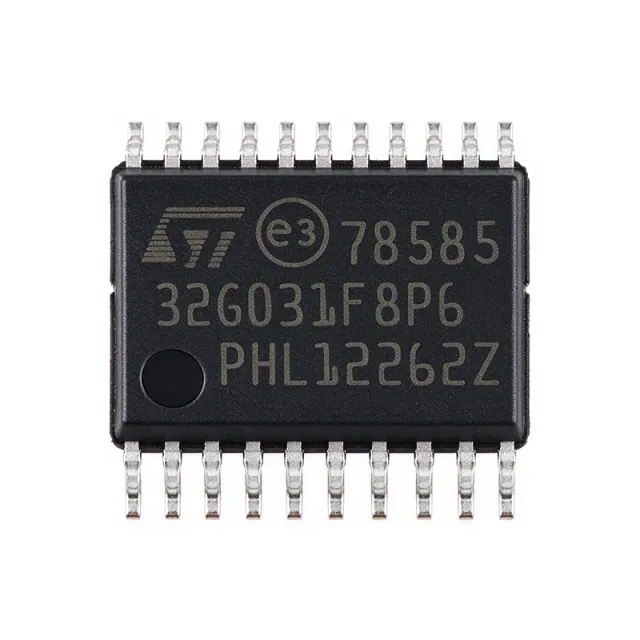
STM32G031F8P6 - 64MHz Cortex-M0+ MCU, 64KB Flash | STMicroelectronics
STM32G031F8P6

STM32G031F8P6 - 64MHz Cortex-M0+ MCU, 64KB Flash | STMicroelectronics

The STMicroelectronics STM32G031F8P6 is a mainstream Arm Cortex-M0+ 32-bit microcontroller operating at up to 64 MHz with 64 KB Flash and 8 KB SRAM in a 20-pin TSSOP package. It belongs to the STM32G0 family, ST's cost-optimized successor to the STM32F0 line, targeting LIN-connected control nodes, low-end motor control, and compact sensor-hub designs. An MCU (microcontroller) is a single-chip computer that integrates a CPU core, program memory (Flash), data memory (SRAM), and programmable peripherals into one package. The Cortex-M0+ is Arm's smallest and most energy-efficient 32-bit core, sitting in the hierarchy: Cortex-M0+ -> Arm Cortex-M -> 32-bit RISC processor -> MCU -> semiconductor. The STM32G0 family further integrates a 5V-tolerant I/O architecture and a 12-bit ADC, simplifying designs that must interface with 5V legacy sensors. Key features of the STM32G031F8P6 include 64 MHz maximum CPU frequency, 64 KB of embedded Flash with ECC, 8 KB SRAM, a 12-bit 2.5 MSPS ADC, two USART interfaces supporting LIN and IrDA, a 16-bit advanced-control timer, multiple general-purpose 16-bit timers, an I2C, an SPI, and a USB 2.0 Full-speed device controller (Type-C power-delivery capable on related parts). The 20-pin TSSOP package exposes 18 GPIO with 5V tolerance, making it suitable for mixed-voltage designs. The architecture uses a single AHB/APB bus matrix with a Cortex-M0+ core featuring single-cycle I/O access, an MPU for memory protection, and a built-in vectored interrupt controller (NVIC). The on-chip 12-bit ADC achieves 2.5 MSPS with hardware oversampling, and the comparators and op-amps available in larger variants are omitted here to fit the 20-pin footprint. Typical applications include LIN slave nodes in automotive body electronics, low-end motor-control loops (BLDC and stepper), consumer appliances (washing machines, induction cooktops), small home appliances, smart sensors, USB Type-C cable markers, and low-cost IoT end nodes. The USB FS device controller enables low-cost cable-mark and HID designs. When designing with this MCU, ensure the VDDA pin is properly decoupled (100 nF + 1 uF) and that NRST has a 10 kohm pull-up and 100 nF cap if not driven externally. The 20-pin TSSOP package has limited GPIO (18) - plan pin allocation carefully for multi-peripheral designs and consider the LQFP-32 variant if more I/O is required.

USD $1.07 اسٹاک میں
STM32G031G4U6 - 64MHz Cortex-M0+ MCU | STMicroelectronics
STM32G031G4U6

STM32G031G4U6 - 64MHz Cortex-M0+ MCU | STMicroelectronics

STMicroelectronics STM32G031G4U6 is an Arm Cortex-M0+ 32-bit RISC microcontroller operating at up to 64 MHz, with 16 KB of Flash memory and 8 KB of SRAM in a 28-pin UFQFPN package measuring 4 x 4 mm. A microcontroller is a programmable semiconductor that integrates a processor core, memory, and peripherals into a single device. The STM32G0 family belongs to the embedded-processing hierarchy that includes 32-bit RISC cores, microcontrollers, embedded systems, and semiconductor components. Its combination of compact packaging, serial communication interfaces, analog conversion resources, and timers makes it suitable for cost-sensitive embedded control designs. The STM32G031G4U6 provides 16 KB of Flash for program storage, 8 KB of SRAM for working data, and a maximum CPU frequency of 64 MHz. It supports two USART peripherals, an ADC, timers, and communication interfaces. Its stated operating voltage range is 1.7 V to 3.6 V, allowing operation from low-voltage 3.3 V systems when appropriate regulator headroom is maintained. The 28-UFQFPN package occupies only 4 x 4 mm, making the device appropriate for compact control boards, sensor nodes, and embedded products where board area is limited. Its Arm Cortex-M0+ architecture supports efficient 32-bit processing while retaining a simple embedded-control design profile. Exact peripheral counts, timer resources, pin assignments, and conversion performance should be confirmed in the manufacturer pin description and electrical characteristics tables before design release. Typical applications include low-power sensor interfaces, small industrial control modules, building accessory controllers, compact motor-control supervisory systems, and communication-equipped IoT endpoints. Two USART channels are particularly useful when a product needs concurrent serial links for a host controller, local module, diagnostics, or an external radio. The principal design consideration is careful 1.7 V to 3.6 V power-supply planning. Decoupling must follow the manufacturer reference layout, unused inputs must be configured correctly, and firmware should validate actual clock, ADC, and communications behavior on production hardware rather than relying solely on nominal family-level specifications. This page combines the official product positioning with package, memory, voltage, interface, and temperature information, then adds application guidance, parameter comparisons, and practical implementation notes for faster engineering evaluation.

RFQ رابطہ
STM32G031G6U6 - 64MHz Cortex-M0+ MCU | STMicroelectronics
STM32G031G6U6

STM32G031G6U6 - 64MHz Cortex-M0+ MCU | STMicroelectronics

The STMicroelectronics STM32G031G6U6 is a 32-bit Arm Cortex-M0+ RISC microcontroller, operating up to 64 MHz with 32 KB of Flash memory, 8 KB of SRAM, and a 28-pin UFQFPN package measuring 4 x 4 mm. It targets compact, cost-sensitive embedded control designs that require modern instruction efficiency and broad peripheral integration without a larger microcontroller package. A microcontroller is a complete embedded-processing component containing a CPU core, program memory, data memory, peripherals, clocking, debug facilities, and input/output interfaces. The STM32G0 family belongs to the embedded MCU and 32-bit RISC processor hierarchy. Its Cortex-M0+ core provides a compact software ecosystem, while the STM32G031G6U6 combines 64 MHz processing with 32 KB Flash and 8 KB RAM for control, communication, sensing, and user-interface tasks. The verified device data identifies an Arm Cortex-M0+ core, 32-bit architecture, 64 MHz maximum frequency, 32 KB Flash, 8 KB SRAM, and a 28-UFQFPN 4 x 4 mm package. Mouser additionally identifies two USART peripherals. STMicroelectronics positions the STM32G031x4/x6/x8 mainstream range for general embedded applications, allowing developers to use a small MCU for compact industrial, consumer, sensor, and communication products. The UFQFPN package supports dense PCB integration while keeping the footprint within 4 x 4 mm. Because the provided data does not include the complete pin names, electrical limits, timing characteristics, or environmental ratings, those values must be confirmed against the official STMicroelectronics product documentation before schematic capture, PCB release, or production qualification. Typical design roles include low-cost sensor controllers, compact sensor hubs, small motor-control supervisory circuits, industrial modules, communication equipment, and embedded control panels. The 64 MHz CPU and 32 KB Flash provide useful performance and code space for lightweight protocol handling and control loops, while 8 KB RAM should be checked against the selected application’s stack and buffer requirements. The principal design check is software and peripheral fit rather than package size alone. Validate the required USART count, pin multiplexing, clock tree, ADC resources, timers, communication peripherals, memory usage, and low-power behavior against the official datasheet. Keep power decoupling close to the device and confirm exposed-pad or thermal-layout requirements from the package drawing before manufacturing. This product record combines the verified manufacturer and distributor identity, pricing source, core and memory specifications, package information, and application-oriented engineering guidance. It also records unavailable parameters explicitly rather than guessing, helping engineers distinguish verified facts from data that must be completed during design-in.

RFQ رابطہ
STM32G031G8U6 - 64KB Flash ARM Cortex-M0+ MCU | STMicroelectronics
STM32G031G8U6

STM32G031G8U6 - 64KB Flash ARM Cortex-M0+ MCU | STMicroelectronics

The STM32G031G8U6 is a 32-bit ARM Cortex-M0+ microcontroller from STMicroelectronics, featuring 64KB of Flash memory and 8KB of SRAM in a compact 28-pin UFQFPN-28 package. Operating at a core frequency of up to 64 MHz, this device is designed for cost-sensitive and power-efficient embedded applications, offering a rich set of peripherals including multiple timers, communication interfaces (I2C, SPI, USART), and a 12-bit ADC with hardware oversampling. What is an ARM Cortex-M0+ microcontroller? It is a 32-bit processor core designed for low-power and high-efficiency embedded control. The Cortex-M0+ is the smallest and most energy-efficient ARM processor, making it ideal for IoT devices, consumer electronics, and industrial sensors. In the hierarchy of microcontrollers, the Cortex-M0+ sits below the Cortex-M3 and Cortex-M4, offering lower performance but significantly reduced power consumption and cost. This makes it a popular choice for battery-powered and space-constrained applications. Key features of the STM32G031G8U6 include a 12-bit ADC with up to 2.5 MSPS, a 12-bit DAC, an operational amplifier, and a low-power RTC. It supports a wide supply voltage range of 1.7V to 3.6V, making it suitable for single-cell battery operation. The device also includes a flexible clock control, with an internal 16 MHz RC oscillator and an external crystal oscillator option. The UFQFPN-28 package measures 4x4 mm, offering a compact footprint for space-limited designs. From a technical depth perspective, the STM32G031G8U6 is built on a 90nm process technology, enabling low dynamic and static power consumption. It features multiple low-power modes, including Sleep, Stop, and Standby, with typical current consumption as low as 0.4 uA in Standby mode. The device also includes a memory protection unit (MPU) and a single-cycle hardware multiplier, enhancing both safety and performance for real-time control tasks. Typical applications include sensor hubs, smart home devices, portable medical monitors, and industrial automation controllers. Its rich analog peripherals make it particularly well-suited for signal conditioning and data acquisition systems. The device's low power consumption and wide operating temperature range (-40C to +85C) ensure reliable operation in harsh environments. When designing with this MCU, ensure proper decoupling of the VDD pins with 100nF capacitors placed close to the device. The VDDA pin should be connected to a clean analog supply, and the VREF+ pin can be tied to VDDA for full-scale ADC reference. For low-power applications, utilize the Stop mode with wake-up from external interrupts to minimize average current consumption.

RFQ رابطہ
STM32G031J4M6 - 64MHz Cortex-M0+ 16KB MCU | STMicroelectronics
STM32G031J4M6

STM32G031J4M6 - 64MHz Cortex-M0+ 16KB MCU | STMicroelectronics

The STMicroelectronics STM32G031J4M6 is an Arm Cortex-M0+ 32-bit RISC microcontroller operating at up to 64 MHz, with 16 KB of Flash memory and 8 KB of RAM in an 8-pin SO package. The device belongs to the STM32G0 mainstream microcontroller family and combines a compact embedded-control architecture with two USART interfaces, timers, an ADC, and communication interfaces. A microcontroller is a semiconductor device that integrates a processor core, program memory, data memory, and peripherals into one integrated circuit. The STM32G0 series occupies the low-end portion of the STM32 product portfolio: microcontroller, embedded system, embedded controller, semiconductor. Its Arm Cortex-M0+ core provides a 32-bit instruction set with compact software-oriented control, while the STM32G031J4M6 is designed for applications that require modest memory, fast control, and multiple serial interfaces without a larger package. Key features include a maximum 64 MHz CPU frequency, 16 KB of Flash memory, 8 KB of SRAM, and two USART peripherals. The listed interface resources also include timers, an ADC, and communication interfaces. The operating voltage range is 1.7 V to 3.6 V, allowing the device to operate from common low-voltage rails used in compact embedded products. The 8-SO package also reduces PCB space requirements compared with larger STM32G0 packages. The Cortex-M0+ architecture provides a straightforward migration path for engineers already using Arm-based embedded systems. Peripheral integration is suitable for sensor reading, digital control, communications, and compact automation designs. Two USART channels can connect the MCU to external sensors, transceivers, display controllers, or service interfaces, while the ADC supports analog measurements and the timers support periodic or event-driven control functions. Typical applications include industrial control modules, IoT sensor nodes, compact motor-control or metering systems, embedded automation controllers, and low-power board designs. Engineers should confirm peripheral assignments, clock configuration, and package pin multiplexing against the manufacturer pinout and reference manual before finalizing the PCB layout. The main design trade-off is the combination of limited 16 KB Flash and 8 KB RAM with a compact 8-pin package. This is suitable for focused control tasks but less appropriate for complex user interfaces, large protocol stacks, or graphics-intensive workloads. Adequate decoupling, stable supply routing, and correct assignment of the multiplexed 8-pin interface remain essential. This product page combines the manufacturer family information, distributor part details, interface specifications, replacement analysis, and practical design guidance to support component selection, PCB planning, and sourcing decisions.

RFQ رابطہ
STM32G031J6M6 - 64MHz Cortex-M0+ MCU | STMicroelectronics
STM32G031J6M6

STM32G031J6M6 - 64MHz Cortex-M0+ MCU | STMicroelectronics

The STMicroelectronics STM32G031J6M6 is a 32-bit Arm Cortex-M0+ microcontroller operating up to 64 MHz, with 32 KB of embedded Flash memory, 8 KB of SRAM, two USART peripherals, timers, ADC, and communication interfaces in an 8-pin SOIC package. The operating supply range is 1.7 V to 3.6 V, making it suitable for compact embedded systems powered from low-voltage rails. A microcontroller is a programmable system-on-chip that integrates a processor core, nonvolatile program memory, volatile data memory, and peripherals into one package. In the STM32 hierarchy, the STM32G031 belongs to the STM32G0 mainstream family of 32-bit RISC microcontrollers. Its Arm Cortex-M0+ core combines a compact architecture with deterministic embedded-control capabilities while supporting a 64 MHz operating frequency. The STM32G031J6M6 combines 32 KB of Flash for firmware and 8 KB of SRAM for working data. Two USART interfaces support serial communication, while the listed timers, ADC, and other communication interfaces reduce the need for external peripheral components. The low-voltage 1.7 V to 3.6 V operating range supports designs requiring low supply voltage, although each external circuit and connected peripheral must remain compatible with that range. The STM32G031J6M6 uses an 8-pin SOIC package, providing a compact surface-mount format for embedded-control boards. STMicroelectronics states that the STM32G031x4, x6, and x8 devices use the Arm Cortex-M0+ core and can operate at up to 64 MHz. Its internal VCORE supply supports digital peripherals, SRAM, and Flash through an embedded linear voltage regulator; packages without a VREF+ pin internally connect VREF+ to VDD. Typical uses include small motor-control modules, serial data acquisition units, compact sensor controllers, communication equipment, and low-power industrial or consumer automation nodes. The ADC supports analog measurements, the timers support periodic and timing functions, and the USART interfaces permit connection to sensors, displays, data modules, or host processors when their electrical protocols are compatible. Designers should verify the exact SOIC-8 pin assignment and exposed functional options against the manufacturer datasheet before layout. Decoupling, grounding, signal routing, and the treatment of VREF+ depend on the selected pinout. Software migration and procurement decisions should also distinguish memory variants, package variants, and temperature-grade suffixes rather than treating every STM32G0 device as interchangeable. This page consolidates the verified manufacturer specifications, distributor availability references, and cross-reference evidence for the STM32G031J6M6. It also separates confirmed same-package alternatives from candidates that require package or pinout verification, helping engineers make an informed drop-in decision without treating merely similar microcontrollers as exact replacements.

RFQ رابطہ
STM32G031K4T6 - 64MHz Cortex-M0+ MCU | STMicroelectronics
STM32G031K4T6

STM32G031K4T6 - 64MHz Cortex-M0+ MCU | STMicroelectronics

The STMicroelectronics STM32G031K4T6 is a 32-bit Arm Cortex-M0+ microcontroller with a 64 MHz CPU, 16 KB of Flash memory, and 8 KB of SRAM in a 32-pin LQFP package. It operates from 1.7 V to 3.6 V and integrates communication interfaces, timers, and an ADC for compact embedded-control designs. A general-purpose microcontroller is a programmable semiconductor that combines a processor core, nonvolatile program memory, volatile data memory, and peripherals in one integrated circuit. The STM32G031K4T6 belongs to the STM32G0 microcontroller family and sits within the hierarchy of embedded processor, microcontroller, and semiconductor. Its Arm Cortex-M0+ architecture supports efficient event-driven control while keeping the external hardware count low. The device's principal features include a 64 MHz CPU, 16 KB Flash, 8 KB SRAM, two USART interfaces, an analog-to-digital converter, timers, and communication interfaces. The 16 KB Flash supports a modest embedded application, while 8 KB of SRAM provides working space for control logic, communication buffers, and stack operations. A 1.7 V minimum operating voltage allows use in low-voltage systems, although the complete design must remain within the 1.7 V to 3.6 V operating range. The STM32G0 series combines an Arm Cortex-M0+ core with integrated analog and communications resources in a compact package. Two USARTs permit simultaneous serial-device connections, while the ADC allows the MCU to measure analog inputs without a separate converter. General-purpose timers support periodic timing, input capture, output compare, and basic motor-control or signal-generation functions. Firmware can use these peripherals to create responsive embedded systems with fewer external components. Typical applications include compact sensor nodes, industrial condition-monitoring equipment, small motor controllers, digital control panels, serial data concentrators, and low-power IoT devices. The 32-pin LQFP package remains inspectable after soldering and is practical for prototypes, small production runs, and designs that favor through-hole access over the smallest possible land pattern. When laying out the PCB, place decoupling capacitors close to the power pins and route oscillator, reset, and communications signals away from noisy switching nodes. Confirm pin multiplexing in the device pinout and pin-description table before assigning alternate functions. Firmware and peripheral configuration should follow the STM32G0 reference manual and device programming guidance rather than assuming that compatibility with an older STM32 series extends to every peripheral register. This product page combines manufacturer and distributor identification, verified memory and operating information, practical application guidance, same-package alternatives, and engineering-focused design notes. Those details help engineers distinguish a true package-compatible substitution from a merely similar microcontroller before committing a PCB revision or production BOM.

RFQ رابطہ
STM32G031K4U6 - 64MHz Cortex-M0+ MCU | STMicroelectronics
STM32G031K4U6

STM32G031K4U6 - 64MHz Cortex-M0+ MCU | STMicroelectronics

The STMicroelectronics STM32G031K4U6 is an ARM Cortex-M0+ 32-bit microcontroller operating at up to 64 MHz, with 16 KB of Flash memory, 8 KB of RAM, and a 32-pin UFQFPN 5 x 5 mm package. It is designed for compact mixed-signal and timer-driven control applications that require ADC, timer, PWM, USART, and general-purpose serial-interface resources in a compact surface-mount footprint. A microcontroller is a programmable system-on-chip that integrates a processor core, memory, and peripherals into one package. The STM32G0 series belongs to the broader embedded-processing hierarchy of Arm Cortex microcontrollers, embedded MCUs, and semiconductor devices. This combination makes the STM32G031K4U6 suitable for small control systems that must execute firmware, acquire analog measurements, generate precise timing signals, and exchange data with external controllers. The device provides 64 MHz processing performance, 16 KB of programmable Flash, 8 KB of SRAM, and an operating voltage range of 1.7 V to 3.6 V. Its listed peripherals include two USARTs, an ADC, timers, PWM capability, and communication interfaces. Two USART channels allow simultaneous serial connections to sensors, human-interface equipment, debug adapters, or another controller, while the ADC supports measurements required in analog control loops. The STM32G031K4U6 combines a 32-bit Arm Cortex-M0+ core with mixed-signal acquisition and timer-driven output functions. This architecture is appropriate for controls where deterministic timing, compact PCB area, and low-voltage operation are more important than a large memory capacity. Its 30 I/O positions provide connections for digital inputs, outputs, and mixed peripheral assignments, although the exact pin multiplexing must be checked against the manufacturer pin-definition data before PCB routing. Typical uses include motor and actuator control, temperature-sensing instruments, compact motor-drive modules, industrial monitoring nodes, and low-voltage embedded control boards. The ADC can supervise a sensor or power system, while timers and PWM channels can drive displays, indicators, relays, or small motors. Two USARTs are useful for a wired host interface combined with logging or external-sensor traffic. PCB design should preserve the low-voltage operating range of 1.7 V to 3.6 V and account for every power, ground, decoupling, programming, and reset connection in the manufacturer pinout. Place local bypass capacitance next to the supply pins, route sensitive analog inputs away from fast-switching nodes, and confirm signal levels before assigning communication interfaces. Firmware, bootloader, and peripheral configuration should also be reviewed for the selected temperature grade and package variant. This product page consolidates the verified electrical, memory, package, interface, and lifecycle information with practical application guidance, selection criteria, and qualified replacement comparisons. It is designed to help engineers evaluate the STM32G031K4U6 quickly while preserving the package, voltage, memory, and peripheral constraints that govern a safe PCB-level substitution.

RFQ رابطہ
STM32G031K6T6 - 64MHz Cortex-M0+ MCU | STMicroelectronics
STM32G031K6T6

STM32G031K6T6 - 64MHz Cortex-M0+ MCU | STMicroelectronics

STMicroelectronics STM32G031K6T6 is a 32-bit Arm Cortex-M0+ microcontroller rated for up to 64 MHz, with 32 KB of embedded Flash memory, 8 KB of SRAM, and a 32-pin LQFP package measuring 7 x 7 mm. The STM32G0 series provides a compact microcontroller platform for cost-sensitive embedded control applications that require efficient processing, mixed-signal peripherals, and flexible low-power operation. A microcontroller is a semiconductor device that integrates a processor core, programmable memory, data memory, and peripherals on one package. In the STM32G0 product hierarchy, this device belongs to the Arm Cortex-M0+ class of 32-bit RISC microcontrollers and operates within the broader embedded-microcontroller and semiconductor categories. Its combination of 64 MHz processing performance and 32 KB Flash makes it suitable for compact control logic, sensor nodes, communication modules, and cost-sensitive consumer or industrial equipment. Verified product information identifies 32 KB of Flash, 8 KB of SRAM, two USART peripherals, and a maximum CPU frequency of 64 MHz. The STM32G031K6T6 is available in a 32-pin LQFP package, and distributor listings identify both 2.5 V and 3.3 V operating configurations. The supported supply range is listed as 1.7 V to 3.6 V. Two serial interfaces allow simultaneous debugging or external communications where system architecture and peripheral assignments permit. The Arm Cortex-M0+ core provides 32-bit processing while retaining the simple instruction set and low implementation complexity associated with Cortex-M devices. Its operating frequency of up to 64 MHz supports responsive control loops, protocol handling, and supervisory tasks without requiring a larger high-performance microcontroller package. The 8 KB SRAM provides working memory for real-time applications, while the 32 KB embedded Flash stores firmware, configuration data, and constant application data. Typical applications include industrial control modules, building automation endpoints, compact sensor nodes, consumer appliances, battery-powered accessories, and communications equipment. The MCU is especially useful when a board area of 7 x 7 mm is desirable but a high-end Cortex-M processor, large external memory interface, or complex graphics subsystem is unnecessary. Its USART resources can also support host-to-device links, programming interfaces, or field-bus transceiver connections. Designers should verify the complete pin assignment, peripheral multiplexing, clock configuration, and decoupling requirements against the official STM32G031K6 datasheet before layout release. A 1.7 V to 3.6 V supply must remain within the rated range, and firmware should be validated for startup, brownout behavior, and low-power transitions. Migration to a part with more Flash or RAM can also affect boot space, linker placement, and application layout. This page consolidates verified manufacturer and distributor information, honest drop-in replacement findings, package-level selection guidance, and practical design considerations. It distinguishes documented STM32G031 family options from unverified cross-brand substitutes so engineers can make a compatibility decision without assuming that equal package size alone guarantees a valid replacement.

RFQ رابطہ
STM32G031K6U6 - 64MHz Cortex-M0+ 32KB MCU | STMicroelectronics
STM32G031K6U6

STM32G031K6U6 - 64MHz Cortex-M0+ 32KB MCU | STMicroelectronics

STMicroelectronics STM32G031K6U6 is an Arm Cortex-M0+ 32-bit microcontroller operating up to 64 MHz, with 32 KB Flash memory, 8 KB RAM, and a 32-pin UFQFPN 5 x 5 mm package. Its operating supply range is 1.7 V to 3.6 V, while the integrated peripheral set includes two USARTs, timers, an ADC, and communication interfaces. A microcontroller is a programmable semiconductor that combines a CPU core, memory, and peripherals in one integrated circuit. The STM32G0 family sits within the broader embedded-controller and power-management hierarchy. The Cortex-M0+ core uses a compact 32-bit RISC architecture intended for cost-sensitive embedded products, while the STM32G031K6U6 adds enough Flash and SRAM for control logic, serial communications, and modest real-time processing. The device operates at up to 64 MHz and includes 32 KB of Flash and 8 KB of RAM. Two USART interfaces support serial links to sensors, modules, human-interface equipment, and debug or programming accessories. The available timer and ADC resources make it suitable for converting analog measurements into digital control data, generating timing signals, and operating actuators. Its 32-pin UFQFPN package supports compact surface-mount designs. The STM32G031K6U6 uses an Arm Cortex-M0+ processor with 32-bit RISC characteristics and operates from a 1.7 V to 3.6 V supply. This combination provides useful processing performance without requiring a larger package or a more complex MCU architecture. The 8 KB SRAM is sufficient for control buffers and stack-intensive embedded routines, while the 32 KB Flash supports firmware, configuration data, and a boot program. Typical applications include compact industrial controllers, sensor-hub boards, serial data concentrators, LED-control systems, and small motor-control products. Two USARTs allow simultaneous connections to local modules or external instrumentation, while the ADC and timers support analog monitoring and deterministic timing tasks. The 5 x 5 mm package also helps reduce board area in densely populated embedded products. Designers should verify the exact pin multiplexing, debug interface, clock configuration, and peripheral electrical limits against the official STM32G031K6 datasheet before layout. Decoupling, exposed-pad implementation, boot configuration, and programming access are critical in a compact QFN design. Firmware migration should also be checked because equivalent-looking MCU order codes can differ in Flash size, temperature grade, or peripheral configuration. This page consolidates verified distributor pricing, manufacturer specifications, package details, drop-in family alternatives, and practical replacement guidance. It distinguishes confirmed STM32G031K6U6 data from parameters that still require confirmation from the manufacturer datasheet, helping engineers select, compare, and source the MCU with fewer procurement and design errors.

RFQ رابطہ
STM32G031K8T3 - 64MHz Cortex-M0+ 64KB MCU | STMicroelectronics
STM32G031K8T3

STM32G031K8T3 - 64MHz Cortex-M0+ 64KB MCU | STMicroelectronics

The STMicroelectronics STM32G031K8T3 is a 32-bit Arm Cortex-M0+ microcontroller operating up to 64 MHz, with 64 KB of Flash memory, 8 KB of SRAM, and a 32-pin LQFP package measuring 7 mm by 7 mm. It is designed for compact embedded systems that require efficient control, communications, timing, and low-power peripheral support in a small surface-mount footprint. A microcontroller is a programmable integrated circuit containing a processor core, memory, and peripherals such as GPIO, timers, communication interfaces, and analog conversion blocks. The STM32G0 family is positioned as a mainstream embedded platform for cost-sensitive industrial, consumer, and instrumentation products. Its Cortex-M0+ architecture provides a 32-bit instruction set while maintaining an efficient design for control-oriented workloads. The STM32G031K8T3 combines a maximum operating frequency of 64 MHz with 64 KB of Flash for firmware storage and 8 KB of SRAM for working memory. The manufacturer describes the STM32G031x4, x6, and x8 devices as mainstream microcontrollers based on the Arm Cortex-M0+ core. The package configuration provides a practical option for designs requiring a moderate pin count and a conventional LQFP assembly process. Typical embedded applications include compact sensor controllers, small motor-control boards, industrial monitoring modules, consumer appliances, and low-cost communication equipment. The device is appropriate when the application needs more processing capability than a simple 8-bit controller but does not require the memory capacity or peripheral complexity of a higher-end Cortex-M processor. For PCB design, use the manufacturer pinout description when assigning the 32 LQFP connections and provide the required power, decoupling, ground, and programming interfaces according to the datasheet. Confirm the exact voltage limits, clock configuration, peripheral availability, and package pin definitions for STM32G031K8 variants before releasing a board layout. This page consolidates the manufacturer product information, package details, practical application guidance, and design considerations for engineers evaluating the STM32G031K8T3 as a compact 64 MHz Cortex-M0+ MCU.

RFQ رابطہ
STM32G031K8T6 - 64MHz Cortex-M0+ 64KB MCU | STMicroelectronics
STM32G031K8T6

STM32G031K8T6 - 64MHz Cortex-M0+ 64KB MCU | STMicroelectronics

STMicroelectronics STM32G031K8T6 is a 32-bit Arm Cortex-M0+ microcontroller operating at up to 64 MHz, with 64 KB of embedded flash memory and 8 KB of SRAM. The device is supplied in a 32-pin LQFP package measuring 7 mm by 7 mm, making it suitable for compact embedded control boards, sensor nodes, industrial modules, and connected accessories. According to the STMicroelectronics STM32G031K8 product page, the STM32G031x4/x6/x8 mainstream family is built around a high-performance 32-bit Cortex-M0+ RISC core. A microcontroller is a semiconductor that integrates a processor core, program memory, data memory, and peripheral interfaces into one package. In the product hierarchy, a microcontroller is an integrated circuit and semiconductor device; within an embedded system, it executes firmware, reads inputs, controls outputs, and connects the application to sensors, communications equipment, and actuators. The Cortex-M0+ architecture therefore provides the computational foundation rather than acting merely as a fixed-function interface controller. The STM32G031K8T6 combines a 64 MHz operating frequency with 64 KB of flash and 8 KB of SRAM. Its 32-bit instruction set supports efficient control workloads while its relatively small memory footprint suits compact systems. The 32-LQFP 7 mm by 7 mm package provides a conventional leaded footprint that can simplify assembly and prototype inspection compared with a very small fine-pitch package. The available verified listings also describe the part as an active embedded microcontroller. The exact peripheral mix, voltage range, temperature ratings, timers, communication interfaces, analog features, and programming details are not present in the supplied verified excerpts. Those values are therefore not inferred or fabricated here. This page concentrates on confirmed identity and capacity information: Cortex-M0+ core, 32-bit architecture, 64 MHz maximum frequency, 64 KB flash, 8 KB RAM, and 32-LQFP 7 mm by 7 mm packaging. The MCU is appropriate for small embedded controllers whose firmware fits within 64 KB and whose working data fits within 8 KB. Potential roles include building controls, compact industrial interfaces, low-cost sensor nodes, accessory controllers, and compact consumer devices. Final peripheral suitability should be confirmed against the complete manufacturer datasheet and the pin configuration for the 32-pin package before schematic or PCB release. The primary design consideration is package and pinout verification. A shared package name alone does not guarantee that every peripheral signal is assigned identically between MCU variants. Engineers should compare power pins, ground pins, debug signals, boot configuration pins, and every used peripheral signal against the manufacturer package diagram. The 32-LQFP footprint also requires adequate copper and assembly clearance around its leaded package. This page combines verified manufacturer identity, distributor specifications, source links, package facts, and careful replacement guidance. It also distinguishes documented drop-in candidates from related devices that require pinout, firmware, and peripheral-level verification, providing practical context beyond a distributor title or basic catalog listing.

RFQ رابطہ
STM32G031K8T7 - 64MHz Cortex-M0+ MCU | STMicroelectronics
STM32G031K8T7

STM32G031K8T7 - 64MHz Cortex-M0+ MCU | STMicroelectronics

The STMicroelectronics STM32G031K8T7 is a 32-bit Arm Cortex-M0+ microcontroller operating up to 64 MHz, with 64 KB of flash memory, 8 KB of RAM, and 30 general-purpose I/O pins in a 32-LQFP package. It combines a compact embedded processing core with mixed-signal and timer-oriented peripherals for cost-sensitive industrial, consumer, and control applications. A microcontroller is a programmable semiconductor that integrates a CPU core, nonvolatile program memory, volatile data memory, and peripherals into one device. The STM32G0 family belongs to the hierarchy of embedded MCU, 32-bit RISC processor, and programmable semiconductor. Its Cortex-M0+ architecture supports efficient event-driven control while providing a broad peripheral set without requiring a separate processor, memory, and interface devices. The principal specifications of the STM32G031K8T7 include a 64 MHz maximum operating frequency, 64 KB of flash program memory, 8 KB of SRAM, and 30 I/O pins. The device also supports I2C, IrDA, LINbus, SPI, UART/USART, and I2S communication, along with DMA, PWM, watchdog, brown-out detection, and power-on-reset functions. These resources make it suitable for mixed-signal products that need timer-driven control and several serial interfaces on a compact board. The Cortex-M0+ core provides a 32-bit instruction set with a compact instruction footprint, helping designers balance performance, memory use, and power consumption. Direct-memory-access support allows transfers to occur without placing every data movement on the CPU. PWM and general-purpose timer resources suit motor, lighting, and actuator control, while I2C, SPI, UART/USART, and I2S interfaces cover sensors, displays, converters, and digital audio links. Typical uses include sensor-hub and IoT control boards, compact motor controllers, LED lighting controllers, industrial monitoring equipment, digital-audio interfaces, and low-cost embedded consumer products. In each case, the 64 MHz processing rate supports responsive control loops, while the 32-LQFP package provides 32 physical pins for power, ground, clocking, communications, and general-purpose signals. PCB planning should begin with the package pinout and the STM32G0 reference manual. Confirm the supported supply range, clock configuration, boot options, and every peripheral pin before schematic capture. Place decoupling capacitors close to the supply pins, route sensitive analog and clock connections away from fast-switching nodes, and program unused pins in accordance with the manufacturer guidance rather than treating their state as inherently safe. This product record combines the STMicroelectronics device specifications with cross-reference guidance for same-family alternatives, practical application positioning, and design-focused selection criteria. It is intended to accelerate engineering review while keeping package, memory, interface, and replacement decisions traceable to the manufacturer and component records.

RFQ رابطہ
STM32G031K8U6 - 64MHz Cortex-M0+ 64KB MCU | STMicroelectronics
STM32G031K8U6

STM32G031K8U6 - 64MHz Cortex-M0+ 64KB MCU | STMicroelectronics

STMicroelectronics STM32G031K8U6 is an Arm Cortex-M0+ 32-bit STM32G0 series microcontroller operating up to 64 MHz, with 64 KB of Flash memory and 8 KB of SRAM, in a 32-pin UFQFPN package measuring 5 x 5 mm. It targets compact embedded-control designs requiring efficient processing, serial connectivity, timers, and analog peripherals without the resource demand of a larger microcontroller. A microcontroller is a programmable integrated circuit containing a processor core, memory, and peripherals on one device. STM32G0 belongs to the embedded processor and microcontroller hierarchy, where the Arm Cortex-M0+ core executes compact control firmware, Flash retains program code, SRAM supports working data, and integrated peripherals reduce the component count required for sensing, communication, timing, and actuator control. The verified product information identifies a 64 MHz Arm Cortex-M0+ core, 64 KB Flash organized as 64K x 8 bits, 8 KB SRAM, and a 32-pin UFQFPN package. The listed interface set includes two USART peripherals. Related family documentation also identifies I2C, SPI, IrDA, and LIN connectivity, DMA, brown-out detection and reset, PWM, a watchdog timer, and hardware SRAM parity checking, subject to the exact device variant and pin availability. STM32G031K8U6 is positioned for cost-sensitive embedded systems where a 64 MHz core provides useful performance headroom while retaining 64 KB of nonvolatile program storage. Its compact 5 x 5 mm land pattern supports space-constrained boards, and the mixture of serial interfaces, timing peripherals, and analog functions makes it suitable for sensor hubs, building controls, appliance controllers, and compact automation modules. Typical designs place the MCU beside sensors and power-conversion circuitry, using its serial interfaces for external converters, displays, or network modules. Firmware must be built and programmed through a supported Arm/ST development environment. Before hardware release, engineers should verify the exact pin multiplexing, peripheral limits, clock tree, and electrical constraints against the official STM32G031K8 documentation. The principal design consideration is not simply matching the 5 x 5 mm footprint but confirming device-level compatibility. Firmware, package pinout, supply voltage, peripheral configuration, and all used I/O assignments must align with the replacement. This page distinguishes verified STM32G0 family options from parts with different package, memory, or peripheral configurations. This page combines exact distributor and manufacturer identifiers, verified memory and core specifications, package information, commercial availability references, and application-focused engineering guidance. It also documents the shortage of independently verified, pin-compatible drop-in replacements rather than presenting electrically similar MCUs as drop-in substitutes.

RFQ رابطہ
STM32G031K8U7 - 64MHz Cortex-M0+ MCU | STMicroelectronics
STM32G031K8U7

STM32G031K8U7 - 64MHz Cortex-M0+ MCU | STMicroelectronics

The STMicroelectronics STM32G031K8U7 is a 32-bit ARM Cortex-M0+ microcontroller operating at up to 64 MHz, with 64 KB of embedded Flash memory, 8 KB of SRAM, and a 32-pin UFQFPN package measuring 5 x 5 mm. It belongs to the STM32G0 mainstream microcontroller family and combines a compact package with general-purpose embedded processing and analog peripherals. A microcontroller is a programmable semiconductor that integrates a processor core, memory, peripherals, and communication interfaces on one integrated circuit. Within the product hierarchy, the STM32G031K8U7 is an ARM Cortex-M0+ microcontroller, an embedded processor, and a compact system-on-chip for control-oriented products. Its 32-bit architecture supports efficient instruction execution while its small package and memory configuration suit cost-sensitive, space-constrained designs. The principal device characteristics are a maximum 64 MHz core frequency, 64 KB of Flash, and 8 KB of SRAM. The STM32G031K8 family supports operating-temperature options from -40°C to 85°C, 105°C, or 125°C, depending on the selected ordering variant. Its compact 5 x 5 mm UFQFPN package also supports surface-mount manufacturing and reduces PCB area compared with larger leaded packages. The Cortex-M0+ core provides a practical balance of processing capability, efficiency, and implementation complexity. Flash memory retains firmware when the device is unpowered, while SRAM supports working data and stack operations. The family is designed for applications requiring compact control logic and efficient embedded processing without the memory scale of a higher-end Cortex-M application processor. Typical applications include compact sensor controllers, building and industrial automation modules, battery-powered monitoring equipment, appliance controls, and low-cost USB-enabled accessories. The small package is especially useful when the PCB area around the MCU is constrained but manufacturing still requires a conventional surface-mount assembly process. Designers should confirm the complete pin assignment, exposed-pad connection, decoupling requirements, and peripheral availability against the STM32G031K8 datasheet before layout release. The UFQFPN thermal pad must be connected according to the device's recommended land pattern and thermal strategy, while unused GPIO and supply pins should follow the stated input and termination requirements. This page combines the verified STM32G031K8U7 device identity, manufacturer documentation, pin and package information, practical application guidance, and a parameter-by-parameter comparison with close same-family alternatives. It is intended to accelerate engineering selection while keeping PCB compatibility and firmware constraints visible.

RFQ رابطہ
STM32G041C6T6 - 64MHz Cortex-M0+ MCU | STMicroelectronics
STM32G041C6T6

STM32G041C6T6 - 64MHz Cortex-M0+ MCU | STMicroelectronics

The STMicroelectronics STM32G041C6T6 is a 32-bit ARM Cortex-M0+ microcontroller rated at up to 64 MHz, with 32 KB of internal Flash memory and a 48-LQFP package measuring 7 mm by 7 mm. It belongs to the STM32G0 mainstream microcontroller family, combining a compact general-purpose MCU architecture with mixed-signal acquisition capability for compact embedded products. A microcontroller is a programmable semiconductor that integrates a processor core, memory, peripherals, and communication interfaces into one device. The STM32G0 family sits within the hierarchy of embedded microcontroller, 32-bit processor, ARM Cortex-M processor, and general-purpose semiconductor. This positioning makes the STM32G041C6T6 suitable for cost-sensitive control systems that require more processing capability than an 8-bit MCU while retaining a conventional surface-mount footprint. The device runs at up to 64 MHz and provides 32 KB of Flash for program storage. Its 48-LQFP package provides 48 accessible pins in a 7 mm by 7 mm surface-mount outline, supporting integration with external sensors, communication transceivers, memory, regulators, and discrete interface circuitry. The STM32G041C6T6 is identified specifically as a mixed-signal sensor-acquisition MCU, making signal conditioning and embedded measurement central to its application profile. The Arm Cortex-M0+ core uses a reduced instruction set optimized for efficient embedded control while providing the software ecosystem associated with ARM Cortex-M devices. Peripheral configuration, clocking, interrupt handling, and low-power behavior are managed through the STM32G0 device architecture. Firmware can be developed using the STM32 embedded software environment and configured through supported graphical or C-language development workflows. Typical applications include compact industrial sensors, digital measurement instruments, low-cost control boards, connected sensor nodes, and embedded condition-monitoring systems. The MCU is particularly appropriate when an acquisition task, control loop, and communication function must share one compact device. Designers should account for the exact peripheral mix, RAM capacity, electrical limits, and clock configuration when assigning production firmware. For a new PCB, follow the STMicroelectronics STM32G041C6T6 datasheet for the complete pin-description table, exposed-pad requirements, decoupling recommendations, clock limits, and programming connections. Confirm the required trace, reset, boot, and interface assignments against the final schematic before layout release. This product page combines the manufacturer's key device facts, application-specific engineering context, drop-in family options, and practical design guidance to support faster component selection, schematic review, and sourcing decisions.

RFQ رابطہ
STM32G041C8T6 - 64MHz Cortex-M0+ 64KB MCU | STMicroelectronics
STM32G041C8T6

STM32G041C8T6 - 64MHz Cortex-M0+ 64KB MCU | STMicroelectronics

The STMicroelectronics STM32G041C8T6 is an Arm Cortex-M0+ 32-bit microcontroller operating up to 64 MHz, with 64 KB of Flash memory and 8 KB of RAM, housed in a 48-LQFP 7 x 7 mm package. It belongs to the STM32G0 mainstream MCU family and targets compact embedded-control, analog, communications, and security-assisted designs. The verified distributor listing also identifies 2 USART interfaces and a 1.7 V to 3.6 V supply range. A microcontroller is a programmable semiconductor that integrates a processor core, nonvolatile program memory, volatile data memory, peripherals, and communication interfaces on one integrated circuit. In the device hierarchy, an MCU is a semiconductor and embedded-control IC; the STM32G0 family combines general-purpose processing with analog and digital peripherals for compact control boards, sensors, actuators, and communication equipment. The STM32G041C8T6 combines a 64 MHz Cortex-M0+ core with 64 KB Flash and 8 KB RAM. Its 1.7 V to 3.6 V operating supply supports low-voltage embedded systems, while the listed 2 USARTs provide serial connectivity for debugging, module integration, or peripheral communication. The family description specifically associates STM32G041x6/x8 devices with mainstream embedded applications, making this part appropriate for compact control logic where performance and integration matter. The STM32G0 architecture uses a 32-bit RISC core designed for efficient embedded execution. Flash retains programmed firmware after power removal, while RAM supports working data and execution state. This division allows the MCU to operate as a self-contained controller without requiring external program memory. Exact peripheral inventories, pin multiplexing, clock limits under each voltage range, and performance figures beyond the verified values are not inferred here. Typical applications include low-voltage sensor nodes, compact motor-control peripherals, industrial control modules, communication bridges, and embedded instruments. Two USARTs can support a host interface and an external module, while the 64 KB Flash capacity provides room for application firmware and boot logic. The 48-LQFP package is appropriate for through-hole assembly and manual prototyping where a fine-pitch BGA would be inconvenient. Designers should use the manufacturer datasheet for the exact 48-pin map, alternate-function assignments, decoupling requirements, clock configuration, and programming procedure. Because the package is relatively large and exposed to handling and soldering challenges, verify PCB footprint, pin orientation, and assembly capability before committing to a board. Firmware migration should also be reviewed rather than assuming software compatibility from the family name alone. This page consolidates verified manufacturer and distributor facts, separates verified values from missing parameters, and emphasizes procurement, application, and design context. It does not invent unprovided electrical details, pricing tiers, pin assignments, lifecycle claims, or drop-in alternatives; those items remain explicitly qualified for engineering validation.

RFQ رابطہ
STM32G041C8U6 - 64MHz Cortex-M0+ MCU | STMicroelectronics
STM32G041C8U6

STM32G041C8U6 - 64MHz Cortex-M0+ MCU | STMicroelectronics

STMicroelectronics STM32G041C8U6 is a 32-bit Arm Cortex-M0+ microcontroller rated for operation up to 64 MHz, with 64 KB of Flash memory, 8 KB of RAM, and a 48-pin UFQFPN package. It belongs to the STM32G0 family of compact, energy-efficient embedded microcontrollers for cost-sensitive control and sensing applications. A microcontroller integrates a processor core, program memory, data memory, peripherals, and I/O into one device. The Cortex-M0+ architecture provides a compact instruction set suited to real-time control, while the STM32G0 family extends into the broader hierarchy of embedded processor, microcontroller, semiconductor, and embedded systems products. This combination makes the STM32G041C8U6 appropriate for compact control boards, industrial sensing nodes, and connected equipment. The device operates at up to 64 MHz and includes 64 KB of Flash program memory alongside 8 KB of SRAM. Its 48-pin UFQFPN package provides a surface-mount implementation with an exposed pad for PCB-level thermal management. The part is identified as a mainstream STM32G0 device, positioning it for applications that need modern Cortex-M0+ performance without moving to a higher-cost microcontroller family. According to the manufacturer datasheet, the STM32G041x6/x8 devices use an Arm Cortex-M0+ 32-bit RISC core. The exact peripheral mix, voltage limits, conversion performance, and absolute maximum ratings must be taken from the package-specific datasheet and pinout tables before a design is released. The manufacturer also documents package-dependent handling of VREF+, including its internal connection to VDD when the package does not provide a dedicated VREF+ pin. Typical uses include compact motor-control controllers, industrial sensor interfaces, digital monitoring equipment, and low-cost IoT control nodes. Its small surface-mount package supports automated assembly, while the Cortex-M0+ ecosystem provides access to STM32 development tools, embedded software libraries, and familiar firmware-development workflows. PCB design should treat the exposed pad as a thermal and electrical structure rather than an unused area. Follow the manufacturer’s recommended land pattern, connect the ground network properly, and verify decoupling, debug-port, clock, and boot configuration requirements against the package pinout. Confirm peripheral assignments and startup behavior in the device reference manual. This product page combines the exact orderable MPN, manufacturer specifications, package information, verified source links, comparison data, and practical integration guidance. It also distinguishes confirmed device facts from parameters that require selection from the complete datasheet, helping engineers move from component identification to a production-ready embedded design.

RFQ رابطہ
STM32G041F6P6 - 64MHz Cortex-M0+ MCU | STMicroelectronics
STM32G041F6P6

STM32G041F6P6 - 64MHz Cortex-M0+ MCU | STMicroelectronics

The STMicroelectronics STM32G041F6P6 is a 32-bit Arm Cortex-M0+ microcontroller operating up to 64 MHz, with 32 KB of Flash memory, 8 KB of RAM, and a 20-pin TSSOP package. It supports a 1.7 V to 3.6 V operating voltage range and includes two USART peripherals, timers, an ADC, communication interfaces, and AES-256 hardware encryption. The STM32G041F6P6 is positioned for compact, cost-sensitive embedded systems where a small package and low-voltage operation are important. A microcontroller is a programmable semiconductor that integrates a CPU core, memory, peripherals, and communication interfaces on one device. The STM32G041F6P6 belongs to the STM32G0 mainstream family and uses the Arm Cortex-M0+ architecture, a 32-bit RISC core designed for energy-efficient control applications. Its role in the broader hierarchy is embedded controller → microcontroller → Arm Cortex-M0+ MCU, where the integrated peripherals reduce the need for external components in control, sensing, and communications products. Key features include a maximum 64 MHz operating frequency, 32 KB of Flash memory, and 8 KB of RAM. Two USART peripherals support serial communication, while the integrated ADC supports analog measurement functions. AES-256 hardware encryption provides a dedicated cryptographic capability without requiring a general-purpose software implementation. The 1.7 V to 3.6 V supply range allows operation from common low-voltage rails, and the TSSOP-20 package supports compact, surface-mount PCB layouts. The Arm Cortex-M0+ core provides a straightforward exception-based architecture and efficient instruction execution for embedded workloads. Flash memory retains programmed firmware, while RAM supports stack, variables, and working data. The combination of two USARTs, an ADC, timers, and communication interfaces permits one MCU to consolidate several common peripheral functions, reducing board area and simplifying firmware design in small industrial, consumer, and communications equipment. Typical applications include compact sensor controllers, serial data concentrators, industrial monitoring nodes, battery-powered instruments, and small communication modules. The STM32G041F6P6 is particularly appropriate when the design needs two serial channels, analog measurement, encrypted data handling, and a 64 MHz control loop without requiring a larger microcontroller package. Its low-voltage supply range also fits systems powered by regulated 3.3 V rails or compatible low-energy power sources. Designers should verify the complete pin assignment, exposed electrical limits, clock configuration, and peripheral allocation against the manufacturer datasheet before layout release. Decoupling, programming access, reset behavior, and analog-input conditioning remain essential integration details. Because the supplied data does not include a verified pin table, no pin names are inferred in this record, and a footprint-only substitution should not be assumed to be functionally identical. This page combines verified manufacturer and distributor information, explicit data gaps, application-oriented design guidance, and same-brand drop-in candidates for engineering review. It distinguishes confirmed STM32G041F6P6 attributes from alternatives that require datasheet-level pin, memory, peripheral, and firmware validation before production use.

RFQ رابطہ
STM32G041F8P6 - 64MHz ARM Cortex-M0+ MCU | STMicroelectronics
STM32G041F8P6

STM32G041F8P6 - 64MHz ARM Cortex-M0+ MCU | STMicroelectronics

The STM32G041F8P6 is a 32-bit ARM Cortex-M0+ microcontroller from STMicroelectronics, operating at up to 64 MHz with 32 KB of flash memory and 8 KB of SRAM. It is housed in a 20-pin TSSOP package, offering a compact solution for cost-sensitive and space-constrained applications. The device integrates a rich set of peripherals including a 12-bit ADC, multiple timers, I2C, SPI, USART, and a low-power RTC, making it suitable for a wide range of embedded control tasks. What is a microcontroller? A microcontroller (MCU) is a compact integrated circuit designed to govern a specific operation in an embedded system. It contains a processor core, memory (flash and SRAM), and programmable input/output peripherals on a single chip. Microcontrollers are the backbone of modern electronics, found in everything from automotive engine control units to consumer appliances and IoT devices. The STM32G0 series sits within the broader STM32 family, which is a leading ARM Cortex-M based MCU portfolio, and is positioned as an entry-level, high-efficiency option for applications requiring low power and high integration. Key features of the STM32G041F8P6 include a 64 MHz ARM Cortex-M0+ core with memory protection unit (MPU), 32 KB flash, 8 KB SRAM, and a comprehensive set of peripherals. It supports a supply voltage range of 1.7V to 3.6V, with an operating temperature range of -40°C to +85°C. The device includes a 12-bit ADC with up to 19 channels, a 12-bit DAC, multiple 16-bit timers, and a low-power UART. It also features a hardware random number generator (RNG) and a cyclic redundancy check (CRC) unit, enhancing security and data integrity for industrial and IoT applications. Technically, the STM32G041F8P6 is built on a 90nm process technology, offering a balance between performance and power consumption. It supports multiple low-power modes, including Sleep, Stop, and Standby, with a typical standby current of 0.3 µA, making it ideal for battery-powered devices. The device also includes a high-speed internal oscillator (HSI) that can be calibrated to achieve ±1% accuracy, reducing the need for external crystals in many applications. Typical applications include industrial sensors, smart home devices, portable medical monitors, and motor control systems. Its rich analog peripherals and low-power capabilities make it particularly well-suited for sensor interfacing and data acquisition. The compact TSSOP-20 package allows for minimal PCB footprint, enabling high-density designs. When designing with this MCU, ensure proper decoupling of the VDD pins with 100nF capacitors placed close to the device. For applications requiring precise timing, use the external crystal oscillator (HSE) or calibrate the internal HSI. The device supports in-circuit programming and debugging via SWD, simplifying firmware development.

RFQ رابطہ
STM32G041G6U6 - 64MHz Cortex-M0+ MCU | STMicroelectronics
STM32G041G6U6

STM32G041G6U6 - 64MHz Cortex-M0+ MCU | STMicroelectronics

The STMicroelectronics STM32G041G6U6 is a 32-bit Arm Cortex-M0+ microcontroller operating up to 64 MHz, with 32 KB of Flash program memory, 8 KB of RAM, and 28 I/O pins in a 28-pin UFQFPN package. It operates from 1.7 V to 3.6 V and combines a compact embedded-control footprint with two USART interfaces, timers, an ADC, communication interfaces, AES-256 encryption, and a random-number generator. A microcontroller is a programmable integrated circuit that combines a processor core, memory, peripherals, and communication interfaces on one package. The STM32G0 family belongs to the broader Arm Cortex-M microcontroller hierarchy, where Cortex-M0+ provides an efficient 32-bit architecture for cost-sensitive embedded control. The STM32G041G6U6 is positioned for compact motor-control, sensing, consumer-equipment, and general-purpose automation designs that require more capability than a basic 8-bit controller without adopting a larger application processor. The 64 MHz Cortex-M0+ core supports deterministic control tasks while the 32 KB Flash and 8 KB RAM provide room for firmware and working data. Two USARTs allow connection to sensors, human-interface devices, external transceivers, or service interfaces. The integrated analog and timing resources support signal acquisition, pulse-width modulation, motor control, and periodic system functions. AES-256 and the random-number generator add hardware-oriented resources for products that need basic data protection or randomized security operations. The STM32G041x6/x8 device family is built around STMicroelectronics' STM32G0 architecture and provides a practical combination of processing speed, memory, serial connectivity, analog conversion, and security functions. The 1.7 V minimum operating voltage supports low-voltage embedded systems, while the 3.6 V maximum rating keeps the device compatible with common 3.3 V system rails. The 28-pin UFQFPN format also allows a smaller assembled footprint than many leaded or larger multi-row microcontroller packages. Typical uses include compact motor controllers, digital potentiometer and sensor systems, household appliances, communication modules, LED-control boards, and industrial control products. Two serial interfaces make it especially useful where a design must bridge a local sensor or actuator network while the Cortex-M0+ core performs control processing. Its combination of timers, ADC capability, and security resources also suits compact control nodes that need more than basic digital I/O. The primary design consideration is footprint-aware firmware and board planning. Confirm the exposed-pad connection, pin multiplexing, decoupling requirements, clock setup, and peripheral assignments against the manufacturer datasheet and reference manual. Use the same 4 x 4 mm package only when the candidate device has matching voltage, memory, peripheral, pin, and exposed-pad requirements. MCU interchangeability depends on more than a shared package because bootloader behavior, peripheral mapping, clock limits, and software support can differ. This product record combines manufacturer-device specifications, package information, interface details, application guidance, and an engineering-focused comparison framework. It also distinguishes documented device capabilities from unknown assembly details, helping designers evaluate the STM32G041G6U6 without treating a package match as proof of complete software and hardware equivalence.

RFQ رابطہ
STM32G041G8U6 - 64MHz Cortex-M0+ MCU | STMicroelectronics
STM32G041G8U6

STM32G041G8U6 - 64MHz Cortex-M0+ MCU | STMicroelectronics

STMicroelectronics STM32G041G8U6 is a 32-bit Arm Cortex-M0+ microcontroller with a 64 MHz operating frequency, 64 KB of Flash memory, and 8 KB of SRAM in a 28-pin UFQFPN package measuring 4 x 4 mm. It belongs to the STM32G0 family of low-power embedded microcontrollers and targets compact consumer, industrial, sensor, and control applications. A microcontroller is a programmable semiconductor that integrates a CPU core, memory, peripheral interfaces, and power-management circuitry on one package. In the product hierarchy, the STM32G041G8U6 is an MCU, an embedded controller, and a member of the STM32G0 family of 32-bit Arm Cortex-M0+ devices. This integration reduces the component count required for small control systems while supporting digital communication, timing, analog input, and general-purpose I/O. The device combines a 64 MHz Arm Cortex-M0+ processor with 64 KB of Flash and 8 KB of SRAM. Its operating voltage range is 1.7 V to 3.6 V, supporting low-voltage embedded systems. The compact 28-pin UFQFPN package is suitable for space-constrained products, while the manufacturer’s STM32 ecosystem provides a consistent development path for firmware, peripherals, and board-level evaluation. The STM32G0 architecture emphasizes efficient processing in an entry-level 32-bit MCU platform. Flash memory provides nonvolatile program storage, while the 8 KB SRAM provides working memory for stack operations, variables, and interrupt servicing. The 64 MHz clock rate gives designers more scheduling headroom than slower general-purpose 8-bit controllers without moving to a more complex high-performance MCU class. Typical uses include low-power sensor nodes, compact motor and relay controllers, building automation endpoints, household appliances, instrumentation, and small industrial control boards. The small footprint is particularly useful when the design must fit into a compact sensor enclosure or densely populated control PCB while retaining a 32-bit software ecosystem. Designers should use the manufacturer’s pin and package documentation to assign all 28 pins, preserve the exposed-pad land pattern, and select decoupling capacitors for the device-specific power requirements. Firmware migration and PCB reuse should be evaluated against the complete electrical, pinout, peripheral, and lifecycle documentation rather than processor frequency alone. This product page combines the manufacturer specifications, package information, sourcing guidance, and engineering-focused design considerations into a concise selection reference for teams evaluating the STM32G041G8U6 for compact embedded systems.

RFQ رابطہ