مصنوعات (39,000+)

AT90CAN32-16MU - 16MHz AVR CAN MCU | Microchip Technology
AT90CAN32-16MU

AT90CAN32-16MU - 16MHz AVR CAN MCU | Microchip Technology

The Microchip Technology AT90CAN32-16MU is an 8-bit AVR RISC microcontroller with a 16 MHz clock, 32 KB of flash program memory, and an integrated CAN controller in a 64-QFN (9 x 9 mm) package. It is designed for compact embedded systems that require CAN communication alongside UART, I2C, SPI, timers, and general-purpose I/O. The device operates from a 4.5 V to 5.5 V supply and provides 53 general-purpose I/O lines. A microcontroller is a programmable semiconductor that integrates a processor core, memory, communication peripherals, and I/O into one package. The AT90CAN32 belongs to the AVR family of 8-bit RISC microcontrollers and sits within the broader embedded-control hierarchy of microcontroller ICs. Its enhanced RISC architecture supports efficient instruction execution, while dedicated CAN hardware reduces the processing burden associated with communicating over a robust vehicle or industrial network. The AT90CAN32 family combines CAN controller support with read-while-write flash operation, EEPROM, and SRAM. The -16MU configuration is specified for 16 MHz operation and includes 32 KB of flash. Its communication peripherals allow one controller to coordinate CAN traffic with serial, synchronous, and serial peripheral interfaces. Brown-out detection, reset, pulse-width modulation, and watchdog functions support dependable control-system behavior. The 53 I/O lines provide substantial connectivity for sensors, actuators, status indicators, and external interface circuits. This controller is particularly suitable for industrial automation, building controls, automotive subsystems, embedded data acquisition, motor-control interfaces, and CAN-connected sensors. Its 64-QFN package supports compact board layouts, but the exposed thermal-pad and exposed-pad requirements should be followed exactly. The small pitch also makes careful PCB trace planning essential for reliable assembly and testability. When designing around the AT90CAN32-16MU, confirm the external clock, CAN transceiver, termination, decoupling, programming interface, and reset circuitry against the manufacturer datasheet. A CAN bus requires a physical transceiver such as the SN65HVD37D, and correct termination at both ends of the network is necessary for reliable operation. Firmware should also include CAN error handling, bus-off recovery, and watchdog service routines. This product page combines the manufacturer specifications, documented package characteristics, practical interface guidance, and verified drop-in substitution information. It is intended to help engineers determine whether the 16 MHz AVR CAN controller matches the required memory, interface, package, and environmental constraints before committing a board design to production.

RFQ رابطہ
AT90CAN64-15AT - 64KB AVR CAN Microcontroller | Microchip
AT90CAN64-15AT

AT90CAN64-15AT - 64KB AVR CAN Microcontroller | Microchip

The Microchip Technology AT90CAN64-15AT is an 8-bit AVR RISC microcontroller with 64KB of ISP flash memory, 4KB SRAM, 2KB EEPROM, 53 general-purpose I/O lines, and an integrated CAN controller in a 64-lead TQFP package. It is specified for 4.5V to 5.5V operation and an automotive-oriented part configuration, making it suitable for vehicle network nodes, body controllers, dashboard electronics, and industrial CAN gateways. An 8-bit microcontroller is a programmable integrated circuit built around a compact processor core, embedded memory, and dedicated peripheral blocks. The AT90CAN64 belongs to the AVR 90CAN family, combining Microchip's AVR RISC architecture with a CAN protocol controller. This hierarchy places the device between a general-purpose MCU and a dedicated CAN transceiver: the MCU processes frames and controls logic, while an external CAN transceiver converts the digital CAN TXD and RXD signals to a physical bus. Key features include 64KB of flash for read-while-write operation, 2KB of EEPROM for nonvolatile parameters, and 4KB of SRAM for working data. The 53 I/O lines provide substantial connectivity for sensors, switches, actuators, indicators, and status inputs. A 64-lead TQFP package also exposes the complete peripheral set while remaining compatible with automated board assembly and multilayer PCB layouts. The device uses 32 general-purpose working registers and supports 16-bit instruction word execution, balancing throughput with low-power operation. Its integrated CAN controller supports standard CAN communication tasks, including frame handling and status monitoring, while timers, serial interfaces, and other MCU peripherals support periodic control, sensor acquisition, diagnostics, and external communication. Typical uses include automotive body and comfort modules, CAN-based diagnostic equipment, elevator and industrial machinery controllers, building automation interfaces, and embedded telemetry nodes. The 5V supply range and 64-pin footprint make AT90CAN64-15AT especially suitable for established 5V CAN-control designs that require more memory and I/O capacity than entry-level 8-bit MCUs. When laying out the PCB, place the MCU decoupling capacitors and oscillator components close to their associated pins, and route the CAN RXD and TXD connections away from noisy switching nodes. Confirm the transceiver logic levels, termination placement, and firmware clock configuration before production release. These steps reduce signal-integrity risk in multi-node CAN networks.

RFQ رابطہ
AT90CAN64-15AZ - 64KB 15MHz CAN AVR MCU | Microchip
AT90CAN64-15AZ

AT90CAN64-15AZ - 64KB 15MHz CAN AVR MCU | Microchip

The Microchip AT90CAN64-15AZ is an 8-bit AVR RISC microcontroller with 64KB of ISP flash memory, a 15 MHz maximum clock, an integrated CAN controller, and a 64-pin TQFP package. It combines embedded flash, EEPROM, SRAM, general-purpose I/O, and serial peripherals in one device for compact CAN-connected control systems. An 8-bit AVR microcontroller is a reduced-instruction-computer device whose registers, arithmetic unit, and instruction set are optimized for efficient embedded control. The AVR architecture executes many instructions in a single clock cycle, while the AT90CAN64 family adds a CAN 2.0A/2.0B controller for communication between embedded nodes. This places the device within the hierarchy of semiconductor, microcontroller, embedded processor, and CAN-capable embedded controller. Key device attributes include 64KB of ISP flash memory with read-while-write capability, 2KB of EEPROM, 4KB of SRAM, and an integrated CAN controller. The -15 speed designation corresponds to a 15 MHz operating frequency. The 64-pin TQFP package provides a conventional surface-mount footprint with gull-wing leads, while the integrated CAN controller reduces the need for a separate protocol controller in connected industrial, automotive, or equipment-control designs. The AT90CAN64 family uses the AVR enhanced RISC architecture and provides general-purpose registers, timer resources, serial interfaces, and programmable I/O for embedded-control tasks. Its CAN controller supports CAN 2.0A and CAN 2.0B message formats, allowing the MCU to participate in standardized controller-area-network communication while local firmware handles acquisition, actuation, diagnostics, and system supervision. Typical uses include industrial machine controllers, automotive body and accessory modules, CAN-based sensor gateways, industrial communication adapters, and compact embedded control boards. These applications benefit from the combination of local flash execution, EEPROM for persistent configuration, SRAM for working data, and integrated CAN handling. A separate CAN transceiver is still required to connect the MCU's logic-level CAN pins to a physical CAN bus. Design around the 4.5 V to 5.5 V supply range, provide all specified decoupling and clock circuitry, and use the manufacturer pin-description table when assigning PCB tracks. Because the CAN interface operates through a bus transceiver, its pin voltage ratings, termination strategy, isolation requirements, and grounding scheme must be handled separately from the MCU supply design. This product page combines the manufacturer's device information with practical package, power, communication, and selection guidance. It also distinguishes speed and temperature-grade alternatives while keeping every proposed replacement tied to the same 64-pin TQFP footprint.

RFQ رابطہ
AT90CAN64-15MZ 15MHz 128KB Flash CAN MCU 64-QFN
AT90CAN64-15MZ

AT90CAN64-15MZ 15MHz 128KB Flash CAN MCU 64-QFN

The Microchip Technology AT90CAN64-15MZ is an 8-bit AVR RISC-based microcontroller with 128 KB of ISP flash memory, read-while-write capability, 2 KB EEPROM, 4 KB SRAM, 53 general-purpose I/O lines, and a CAN controller in a 64-QFN package. It operates from 4.5 V to 5.5 V and is rated for a 16 MHz clock speed according to the product listing. An 8-bit AVR microcontroller is a compact embedded-processing device that combines a RISC processor core, program memory, data memory, peripherals, and I/O in one integrated circuit. The AT90CAN64 family belongs to the AVR embedded-controller hierarchy and is designed for control systems that need deterministic peripheral handling together with embedded serial communication. Key features include 128 KB of ISP flash, 2 KB of EEPROM, 4 KB of SRAM, 53 general-purpose I/O lines, 32 general-purpose working registers, 133 powerful instructions, and a CAN controller identified as compliant with CAN V2.0A and V2.0B. The 15 MHz grade provides the device's stated clock-speed class, while the broad I/O count supports external sensors, actuators, communication transceivers, and human-interface circuitry. The MCU architecture supports single-clock-cycle execution for many instructions and provides a close relationship between the AVR processor, the CAN peripheral, and embedded serial programming. This combination makes the device useful in industrial control, automotive communication modules, building equipment, instrumentation, and other CAN-connected embedded products where an 8-bit controller is sufficient. Typical designs use the CAN controller with an external CAN transceiver, connect programming signals through ISP, and route the 53 I/O lines to application-specific interfaces. The 4.5 V to 5.5 V operating range is compatible with conventional 5 V embedded systems, although designers should confirm all timing, peripheral, and communication requirements against the manufacturer datasheet before production release. A key design consideration is to preserve clean supply and ground distribution around the 64-QFN device. Place decoupling capacitance close to the supply pins, route high-current and switching nodes away from sensitive inputs, and validate CAN bus termination, transceiver standby behavior, and firmware timing in the complete system rather than relying only on the MCU block diagram. This page combines manufacturer specifications, application guidance, verified comparison options, and practical design considerations to help engineers evaluate the AT90CAN64-15MZ for embedded CAN systems.

RFQ رابطہ
AT90CAN64-16AU - 8-Bit AVR CAN MCU, 16MHz, 64KB Flash | Microchip Technology
AT90CAN64-16AU

AT90CAN64-16AU - 8-Bit AVR CAN MCU, 16MHz, 64KB Flash | Microchip Technology

The Microchip Technology AT90CAN64-16AU is an 8-bit AVR enhanced RISC microcontroller with 64 KB of in-system-programmable flash memory, 4 KB EEPROM, 4 KB SRAM, 53 general-purpose I/O lines and an integrated CAN 2.0A/2.0B controller, clocked at up to 16 MHz from a single 4.5 V to 5.5 V supply and packaged in a 64-pin TQFP. An 8-bit microcontroller is a compact processing core, memory set and peripheral block built on a single CMOS die, positioned below 32-bit processors in raw arithmetic power but far above them in simplicity, deterministic interrupt latency and low power consumption. The CAN (Controller Area Network) protocol is a multi-master, message-based bus standard originally developed for vehicle networks; it allows many nodes to share two wires using arbitration by identifier, so a CAN-equipped MCU can talk to sensors, actuators and gateways without a separate bus controller chip. Key features of the AT90CAN64-16AU include 16 MHz maximum clock speed with most instructions executed in a single clock cycle, an on-chip CAN controller compliant with both CAN 2.0A and CAN 2.0B, four flexible timer/counters with compare and PWM modes, two USARTs, an SPI interface, a real-time counter and a 10-bit ADC with 8 multiplexed channels. Read-while-write capable flash allows firmware to be updated in circuit through the ISP interface. Internally, the device follows the AVR enhanced RISC architecture with 32 general-purpose working registers and an instruction set of 133 powerful instructions, most executing in one cycle. The result is throughput approaching 1 MIPS per MHz, which lets a design keep a CAN node responsive while handling protocol stacks and diagnostics. Separate 64 KB flash, 4 KB EEPROM and 4 KB SRAM regions allow calibration and configuration data to be stored independently of application code. Typical applications include industrial CAN-to-serial and CAN-to-Ethernet gateways, automotive body and comfort modules, elevator and building automation controllers, instrumentation clusters, battery management and charger controllers, and motor drive supervisory logic where a deterministic field bus is required and a 32-bit processor would be over-specified. When designing around this device, budget the 4.5 V to 5.5 V supply window carefully and remember that the CAN transceiver is external: the MCU drives TXD and receives RXD, while bus protection, galvanic isolation and termination are handled by a separate CAN transceiver such as the SN65HVD37D. Confirm the pin-multiplexing of the 53 I/O lines in the pin-description table of the manufacturer datasheet before assigning board functions. This page consolidates the manufacturer specifications, package and pin resources, drop-in replacement options from the same AT90CAN32/64/128 family, and practical design notes on CAN bus layout, decoupling and firmware strategy into a single engineering reference.

RFQ رابطہ
AT90CAN64-16MU - 16MHz AVR CAN 64KB MCU | Microchip
AT90CAN64-16MU

AT90CAN64-16MU - 16MHz AVR CAN 64KB MCU | Microchip

The Microchip Technology AT90CAN64-16MU is an 8-bit AVR RISC microcontroller with a 16 MHz clock, 64 KB of internal flash memory, and an integrated CAN controller in a 64-QFN 9 x 9 mm package. It is designed for industrial embedded systems that require deterministic CAN communication, substantial program memory, and a compact surface-mount footprint. The device provides 53 general-purpose I/O lines and follows the AT90CAN32/64/128 family's hardware-compatible architecture. A microcontroller is a programmable semiconductor that integrates a processor core, memory, peripherals, and I/O in one device. The AT90CAN64 belongs to the 8-bit microcontroller hierarchy, combining an AVR enhanced RISC core with embedded flash, EEPROM, SRAM, timers, serial interfaces, and a CAN controller. This integration allows a single controller to handle application logic and bus communication without requiring a separate communications processor. The AT90CAN64-16MU operates from a 4.5 V to 5.5 V supply at up to 16 MHz and provides 64 KB of ISP flash memory with read-while-write capability, 2 KB of EEPROM, and 4 KB of SRAM. Its 53 general-purpose I/O lines support digital sensing, actuators, status indicators, and external bus interfacing. The integrated CAN controller is compliant with CAN V2.0A and CAN V2.0B, providing a practical foundation for CAN-based industrial, transportation, and embedded control networks. Execution performance comes from the AVR enhanced RISC architecture, whose instructions commonly execute in a single clock cycle. The resulting throughput approaches 1 MIPS per MHz, helping designers optimize processing speed against power consumption. The exact target variant is identified as an industrial-temperature 16 MHz device with 64 KB of flash in a 64-QFN package. Typical uses include CAN gateway controllers, industrial sensor nodes, motor and actuator controllers, instrumentation, automotive body electronics, and communication bridges. Its combination of 53 I/O lines and 64 KB flash allows protocol handling and local control logic to coexist on one device, reducing component count and board area. For PCB design, follow the Microchip AT90CAN32/64/128 datasheet for the 64-QFN land pattern, exposed-pad connection, power pins, clock requirements, and decoupling guidance. Pay particular attention to CAN transceiver interface timing, termination placement, grounding, and firmware initialization because the MCU does not include the physical CAN transceiver. This page combines the exact AT90CAN64-16MU ordering information, family-level architecture, drop-in family alternatives, application guidance, and design considerations to help engineers evaluate the device before releasing a PCB or production BOM.

RFQ رابطہ
AT90CAN64-16MUR - 16MHz AVR CAN 64KB MCU | Microchip (Tape & Reel)
AT90CAN64-16MUR

AT90CAN64-16MUR - 16MHz AVR CAN 64KB MCU | Microchip (Tape & Reel)

The Microchip Technology AT90CAN64-16MUR is an 8-bit AVR RISC microcontroller with a 16 MHz clock, 64 KB of internal flash memory, and an integrated CAN controller in a 64-QFN 9 x 9 mm package. It is designed for industrial embedded systems that require deterministic CAN communication, substantial program memory, and a compact surface-mount footprint. The device provides 53 general-purpose I/O lines and follows the AT90CAN32/64/128 family's hardware-compatible architecture. A microcontroller is a programmable semiconductor that integrates a processor core, memory, peripherals, and I/O in one device. The AT90CAN64 belongs to the 8-bit microcontroller hierarchy, combining an AVR enhanced RISC core with embedded flash, EEPROM, SRAM, timers, serial interfaces, and a CAN controller. This integration allows a single controller to handle application logic and bus communication without requiring a separate communications processor. The AT90CAN64-16MUR operates from a 4.5 V to 5.5 V supply at up to 16 MHz and provides 64 KB of ISP flash memory with read-while-write capability, 2 KB of EEPROM, and 4 KB of SRAM. Its 53 general-purpose I/O lines support digital sensing, actuators, status indicators, and external bus interfacing. The integrated CAN controller is compliant with CAN V2.0A and CAN V2.0B, providing a practical foundation for CAN-based industrial, transportation, and embedded control networks. Execution performance comes from the AVR enhanced RISC architecture, whose instructions commonly execute in a single clock cycle. The resulting throughput approaches 1 MIPS per MHz, helping designers optimize processing speed against power consumption. The exact target variant is identified as an industrial-temperature 16 MHz device with 64 KB of flash in a 64-QFN package. Typical uses include CAN gateway controllers, industrial sensor nodes, motor and actuator controllers, instrumentation, automotive body electronics, and communication bridges. Its combination of 53 I/O lines and 64 KB flash allows protocol handling and local control logic to coexist on one device, reducing component count and board area. For PCB design, follow the Microchip AT90CAN32/64/128 datasheet for the 64-QFN land pattern, exposed-pad connection, power pins, clock requirements, and decoupling guidance. Pay particular attention to CAN transceiver interface timing, termination placement, grounding, and firmware initialization because the MCU does not include the physical CAN transceiver. This page combines the exact AT90CAN64-16MUR ordering information, family-level architecture, drop-in family alternatives, application guidance, and design considerations to help engineers evaluate the device before releasing a PCB or production BOM.

RFQ رابطہ
AT90CAN64-ESAZ - 16MHz AVR CAN MCU | Microchip Technology
AT90CAN64-ESAZ

AT90CAN64-ESAZ - 16MHz AVR CAN MCU | Microchip Technology

Microchip Technology AT90CAN64-ESAZ is an 8-bit AVR RISC microcontroller with a CAN controller, 64KB of In-System Programmable Flash, 4KB SRAM, 2KB EEPROM, and 53 general-purpose I/O lines, supplied in a 64-pin TQFP package. It operates from 2.7V to 5.5V and is based on the low-power CMOS AVR enhanced RISC architecture. The integrated CAN controller makes this device suitable for industrial, automotive, and embedded systems that exchange data over a robust two-wire CAN network. An 8-bit AVR microcontroller is a compact embedded-control platform that executes instructions from nonvolatile Flash while using SRAM for working data and EEPROM for parameters that must survive power loss. Within the product hierarchy, the AT90CAN64 belongs to the AVR family of RISC microcontrollers and combines general-purpose embedded processing with a dedicated CAN protocol controller. Its 32 general-purpose working registers support an efficient register-based programming model. Key features include 64KB of read-while-write ISP Flash, 4KB of SRAM, 2KB of EEPROM, 53 general-purpose I/O lines, and a maximum clock frequency of 16MHz. Four flexible timer/counter blocks provide compare and PWM functions, while two USARTs and a byte-oriented Two-wire Serial interface support multiple serial communication channels. These peripherals reduce the need for external interface ICs in CAN-connected control nodes. The AT90CAN64 architecture provides 133 powerful instructions, with most instructions executing in a single clock cycle. Read-while-write Flash allows the application to remain operational while nonvolatile code or data is updated through the ISP interface. A separate CAN controller handles message objects, filtering, and bus protocol processing, while the AVR core manages application logic and general-purpose I/O. Typical uses include CAN-based industrial control modules, vehicle or transportation subsystems, building automation equipment, sensor gateways, motor controllers, and diagnostic interfaces. The combination of 53 I/O lines and two USARTs is particularly useful for nodes that must monitor several discrete inputs while communicating over both CAN and RS-232 or RS-485 equipment. Designers should verify the exact pin functions, clock source, reset requirements, and transceiver interface against the manufacturer datasheet. A CAN bus still requires an external CAN transceiver; the AT90CAN64 provides the digital controller but not the physical bus driver. Decoupling, grounding, and PCB layout should preserve CAN signal integrity and minimize noise coupling into sensitive measurements. This product page consolidates verified manufacturer specifications, distributor availability, same-family drop-in candidates, and practical selection guidance. It also distinguishes documented electrical and memory characteristics from parameters that still require confirmation for a production design.

RFQ رابطہ
AT90CAN64-ESMZ - 64KB AVR CAN MCU | Microchip Technology
AT90CAN64-ESMZ

AT90CAN64-ESMZ - 64KB AVR CAN MCU | Microchip Technology

The Microchip Technology AT90CAN64-ESMZ is an 8-bit AVR RISC microcontroller with 64KB of in-system programmable flash, 2KB of EEPROM, 4KB of SRAM, and an integrated CAN controller in a 64-QFN package. It operates from a 2.7V to 5.5V supply and provides 53 general-purpose I/O lines plus 32 general-purpose working registers. An 8-bit microcontroller is a programmable semiconductor that executes instructions from embedded flash memory and uses peripherals to control electronic systems. The AVR enhanced RISC architecture combines a compact instruction set with low-power CMOS operation. In the wider product hierarchy, the AT90CAN64 is an 8-bit microcontroller, an embedded processing IC, and a member of Microchip's AVR 90CAN family. Its integrated CAN controller makes it suitable for distributed industrial, automotive, and control systems that require robust communication between nodes. The AT90CAN64-ESMZ combines 64KB of ISP flash with read-while-write capability, allowing firmware to remain available while embedded code is updated. Its 2KB EEPROM supports nonvolatile configuration and calibration data, while 4KB of SRAM provides working memory for protocol stacks and real-time control. The device also offers two USARTs, a byte-oriented two-wire serial interface, four flexible timer/counter blocks, and a real-time counter according to the AT90CAN32/64/128 family datasheet. The 53 general-purpose I/O lines make the device useful in designs that need both control signals and communications in one package. The CAN controller handles frame-based network communication, while the USARTs support independent serial links to sensors, programmers, or other controllers. The 2.7V to 5.5V operating range accommodates both 3.3V and 5V equipment while supporting designs that need a transition between the two voltage domains. Typical uses include CAN-connected industrial controls, automotive body and subsystem controllers, building automation nodes, motor-control equipment, instrument panels, and embedded data loggers. A network node can place the AT90CAN64-ESMZ beside a CAN transceiver, use its timers for periodic control tasks, and retain configuration in EEPROM. This integration reduces the need for separate memory, serial-interface, and real-time timer components in a compact control board. Designers should preserve the required input, output, programming, reset, and clock circuitry from the manufacturer datasheet and confirm the exact exposed-pad and thermal-layout requirements before release. Firmware should include CAN termination, fault handling, watchdog discipline, and brownout behavior appropriate to the installed CAN network. Software compatibility must be validated because a footprint-compatible component does not automatically guarantee identical peripheral behavior. This product record combines verified manufacturer specifications, distributor availability, price information, same-family alternatives, and practical CAN-system design guidance. It also distinguishes package and temperature-grade differences that are essential when evaluating a true drop-in replacement rather than merely a functionally similar microcontroller.

RFQ رابطہ
AT90USB1286-AU 16MHz 128KB USB AVR MCU | Microchip Technology
AT90USB1286-AU

AT90USB1286-AU 16MHz 128KB USB AVR MCU | Microchip Technology

The Microchip Technology AT90USB1286-AU is an 8-bit AVR RISC microcontroller with a 16 MHz clock, 128 KB of ISP flash memory, and an integrated USB 2.0 device controller in a 64-pin TQFP package. It provides 48 general-purpose I/O lines, 8 KB of SRAM, and 4 KB of EEPROM for firmware, working data, and configuration storage. An AVR microcontroller is an 8-bit reduced-instruction-set computing platform designed for embedded control. The AT90USB1286 combines the AVR core with USB connectivity, serial interfaces, timers, and general-purpose I/O, placing it within the hierarchy of 8-bit MCU, embedded microcontroller, and embedded processing semiconductor. Its integrated USB controller allows a compact peripheral design without requiring a separate USB interface IC. Key features include read-while-write flash, USB low-speed and full-speed operation, a USART, a byte-oriented two-wire serial interface, four flexible timer/counter blocks with compare and PWM modes, 32 general-purpose working registers, and a real-time counter. The USB controller supports full-speed operation up to 12 Mbit/s and low-speed operation up to 1.5 Mbit/s, making the device suitable for USB-connected human-interface, control, and data-acquisition equipment. The enhanced AVR architecture executes instructions in a single clock cycle, supporting efficient time-driven control and event processing. Read-while-write flash allows the firmware to update data while the program continues operating from flash. Digital communication resources support USB connectivity alongside conventional serial expansion, while the timer blocks provide timing, capture, compare, and PWM functions for motor, lighting, and signal-generation circuits. Typical applications include USB keyboards and mice, industrial human-interface panels, USB data-acquisition equipment, embedded control modules, instrumentation, and custom USB peripheral adapters. The 48 I/O lines offer substantial interface capacity for sensors, displays, relays, and digital controls, while the 128 KB memory footprint accommodates protocol stacks, bootloaders, and application firmware. PCB design should preserve access to the programming and debug interfaces while keeping sensitive USB and clock routing compact. Confirm the required operating voltage, decoupling requirements, crystal configuration, and USB transceiver connection against the manufacturer datasheet before releasing the layout. This page combines the core MCU capabilities, package details, application guidance, replacement assessment, and engineering design considerations needed to evaluate the AT90USB1286-AU for a new embedded USB design.

RFQ رابطہ
AT90USB1286-MU - 16MHz 128KB USB AVR MCU | Microchip
AT90USB1286-MU

AT90USB1286-MU - 16MHz 128KB USB AVR MCU | Microchip

The Microchip Technology AT90USB1286-MU is an 8-bit AVR RISC-based microcontroller operating at up to 16 MHz, with 128 KB of flash memory and a 64-QFN (9 x 9 mm) package. It integrates USB 2.0 low-speed and full-speed device connectivity, 48 general-purpose I/O lines, 8 KB of SRAM, 4 KB of EEPROM, and an 8-channel 10-bit ADC. The part operates from a 2.7 V to 5.5 V supply. An AVR microcontroller is a compact embedded-control processor based on the reduced instruction set computer architecture. The AT90USB1286 family combines general-purpose digital control, USB communications, serial interfaces, timers, and analog conversion in one device. It belongs to the hierarchy of 8-bit microcontroller, RISC microcontroller, embedded processor, and semiconductor. USB integration allows the same device to manage peripheral control while presenting a standard interface to a host computer. The principal features include 128 KB of ISP flash with read-while-write capability, 4 KB of EEPROM, 8 KB of SRAM, and 48 general-purpose I/O lines. Four flexible timer/counter blocks provide compare and PWM functions, while USART and byte-oriented 2-wire serial interfaces support external sensors and peripherals. An 8-channel, 10-bit ADC provides analog measurement, and the integrated USB controller supports USB 2.0 full-speed operation up to 12 Mbit/s and low-speed operation up to 1.5 Mbit/s. The enhanced RISC architecture supports throughput approaching 1 MIPS per MHz, giving the AT90USB1286-MU up to 16 MIPS at 16 MHz. On-chip USB functionality removes the need for a separate USB interface controller in host-managed peripherals. Read-while-write flash supports firmware updates, while EEPROM preserves calibration, configuration, or user data independently of the main program memory. The MCU also includes real-time counter, USART, JTAG debugging, and timer resources for connected embedded products. Typical applications include USB-connected human-interface devices, keyboard controllers, test and measurement equipment, data-acquisition systems, USB-to-serial adapters, industrial control modules, and compact consumer peripherals. The 48 I/O lines provide flexibility for sensors, indicators, communication buses, and control signals, while the internal ADC reduces the component count for analog front ends that do not require more than 10-bit resolution. When designing around the AT90USB1286-MU, verify USB signal routing, supply decoupling, and exposed-pad thermal design against the manufacturer datasheet. Provide a compliant USB connection and ensure the firmware budget fits the 128 KB flash and 8 KB SRAM limits. Confirm the operating voltage and industrial-temperature requirements for the assembled product before releasing the PCB design. This page organizes the core memory, USB, analog, timing, and package characteristics while adding practical application guidance, direct engineering comparisons, and design considerations that help engineers evaluate the AT90USB1286-MU before schematic capture and PCB layout.

RFQ رابطہ
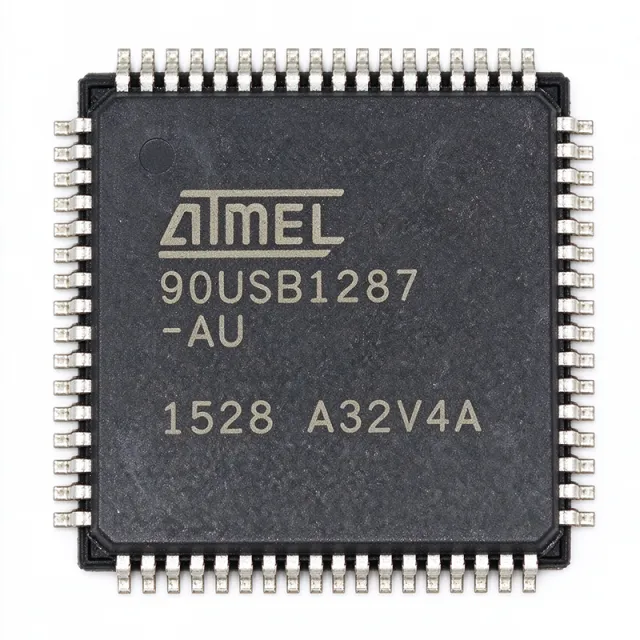
AT90USB1287-AU - 16MHz 128KB USB AVR MCU | Microchip
AT90USB1287-AU

AT90USB1287-AU - 16MHz 128KB USB AVR MCU | Microchip

Microchip Technology AT90USB1287-AU is an 8-bit AVR RISC microcontroller with a 16 MHz clock, 128 KB of ISP flash memory, 4 KB of EEPROM, 8 KB of SRAM, and integrated USB 2.0 low-speed and full-speed On-The-Go support in a 64-TQFP 14 x 14 mm package. It combines 48 general-purpose I/O lines, 32 working registers, four timer/counter blocks with PWM, USART, two-wire serial interface, an eight-channel 10-bit ADC, and a real-time counter. The architecture supports throughput approaching 16 MIPS at 16 MHz, while the read-while-write ISP flash allows applications to be updated through the device’s programming interface without interrupting operation in the same manner as a conventional flash-memory restriction. An AVR microcontroller is an 8-bit RISC semiconductor that combines a processor core, program memory, data memory, and peripherals on one integrated circuit. The AT90USB1287 belongs to the 90USB hierarchy of Microchip AVR devices designed for USB-connected embedded control. Unlike a discrete USB interface solution, its integrated USB controller, general-purpose I/O, serial interfaces, timers, and ADC allow a compact design to manage data exchange, analog measurement, timing, and control functions using one microcontroller. The principal feature of the AT90USB1287-AU is native USB 2.0 connectivity operating at low speed and full speed. According to the Microchip product-page data, the device also supports USB On-The-Go operation, while the 48 GPIO pins provide extensive connectivity for sensors, indicators, controls, and external interface devices. Four flexible timer/counter blocks with compare modes and PWM support precise periodic generation, while the real-time counter, USART, byte-oriented two-wire serial interface, and eight-channel 10-bit ADC broaden its embedded-control capabilities. The 128 KB flash and 8 KB SRAM provide substantially more code and working-memory capacity than smaller AVR USB controllers. Read-while-write ISP flash supports firmware maintenance in systems where code execution can continue from another program-memory region during a suitable update operation. The AVR enhanced RISC core executes instructions in a single clock cycle for many common operations, giving the device a stated throughput approaching 1 MIPS per MHz, or approximately 16 MIPS at its 16 MHz operating frequency. Typical uses include USB human-interface interface controllers, USB-to-serial equipment, bootloaders and firmware update systems, USB-connected instrumentation, industrial control panels, data acquisition modules, and embedded accessories. Its integrated ADC makes it appropriate for monitoring eight analog channels, while its timer/counter PWM resources can drive indicators, motor-control signaling, or other periodic outputs. The integrated USB controller is especially useful when a design requires a compact interface without a separate USB transceiver or host controller. Designers should budget 64 package pins, confirm the exact pin assignments and alternate functions in the manufacturer datasheet, and provide the required USB transceiver, crystal or clock components, bypass capacitors, and programming access. USB bus routing should follow the applicable layout guidance, and analog inputs require suitable filtering and grounding. The 2.7 V to 5.5 V operating range supports both 3.3 V and 5 V systems, but peripheral and USB requirements must be evaluated together before selecting the system supply voltage. This product record consolidates verified manufacturer, distributor, and cross-reference information into a selection-focused comparison with same-package alternatives, commercial data, and practical design guidance. It distinguishes documented capabilities from unavailable details instead of estimating missing electrical, timing, compliance, or lifecycle information.

USD $13.62 اسٹاک میں
AT90USB1287-MU - 128KB USB AVR MCU | Microchip Technology
AT90USB1287-MU

AT90USB1287-MU - 128KB USB AVR MCU | Microchip Technology

The Microchip Technology AT90USB1287-MU is an 8-bit AVR RISC-based USB microcontroller with 128KB of ISP flash memory, 4KB of EEPROM, 8KB of SRAM, and 48 general-purpose I/O lines in a 64-QFN 9 x 9 mm package. It operates at up to 16MHz and integrates low-speed and full-speed USB 2.0 connectivity. A microcontroller is a programmable semiconductor that combines a processor core, nonvolatile program memory, data memory, peripherals, and input/output interfaces on one integrated circuit. The AT90USB1287 belongs to the AVR 8-bit microcontroller family and combines the enhanced RISC architecture with a dedicated USB controller. This makes it suitable for systems that require local control logic, data acquisition, human-interface connectivity, or USB device communication without adding a separate USB interface controller. Key features include 128KB of read-while-write ISP flash memory, 4KB of EEPROM, 8KB of SRAM, 32 general-purpose working registers, and 48 general-purpose I/O lines. Four flexible timer/counter blocks provide compare modes and PWM outputs, while USART and byte-oriented 2-wire serial interfaces support external peripherals and board-level communication. The integrated USB controller supports USB 2.0 low-speed and full-speed operation. The AVR enhanced RISC architecture is designed for efficient embedded control, with most instructions executing in a single clock cycle. At a maximum clock frequency of 16MHz, the AT90USB1287 combines substantial nonvolatile memory with a broad peripheral set. Its 48 I/O lines allow the device to connect sensors, actuators, indicators, and communication transceivers while retaining USB as the primary host interface. Typical applications include USB-connected human-interface devices, industrial data-acquisition equipment, USB-to-serial or USB-to-control adapters, instrumentation, bootloader-capable embedded products, and compact USB peripherals. Its combination of EEPROM, SRAM, timers, serial interfaces, and USB makes it especially useful where firmware configuration, peripheral control, and direct USB connectivity must coexist in one package. When laying out the PCB, follow the manufacturer pin-description table for the 64-QFN footprint and its exposed thermal-pad connection. Place USB signal routing away from noisy analog or switching paths, provide compliant USB impedance and power-path layouts, and decouple each supply rail close to its associated pins. Firmware should also use the device-specific boot and clock configuration procedures from the manufacturer documentation. This page combines the exact orderable MPN, memory and peripheral specifications, package information, application guidance, and qualified same-family drop-in alternatives. It also organizes PCB, firmware, and replacement-selection considerations that help engineers evaluate the AT90USB1287-MU before integrating it into a new USB-enabled embedded design.

RFQ رابطہ
AT90USB646-AU - 16MHz 64KB USB AVR MCU | Microchip
AT90USB646-AU

AT90USB646-AU - 16MHz 64KB USB AVR MCU | Microchip

The Microchip Technology AT90USB646-AU is an 8-bit AVR RISC microcontroller with a 16 MHz clock, 64 KB of ISP flash memory, 2 KB of EEPROM, 4 KB of SRAM, and USB 2.0 low-speed and full-speed device support in a 64-pin TQFP package. It provides 48 general-purpose I/O lines, 32 general-purpose working registers, four flexible timer/counters with compare modes and PWM, a USART, and a byte-oriented two-wire serial interface. A microcontroller is a compact programmable controller that integrates a processor core, memory, and peripherals on one semiconductor device. The AT90USB646 belongs to the hierarchy of 8-bit MCU -> AVR RISC microcontroller -> embedded controller -> semiconductor. Its built-in USB controller allows a board to enumerate as a USB peripheral and exchange data with a host without a separate USB interface IC, while the AVR core supports typical embedded control, communication, and human-interface-device workloads. Key features include read-while-write ISP flash, 64 KB of program memory, 2 KB of EEPROM, 4 KB of SRAM, and a USB 2.0 controller supporting low-speed and full-speed operation. The four timer/counter blocks provide compare and PWM functions, while the USART and two-wire serial interface add communication options beyond USB. The 48 I/O lines provide substantial external connectivity for buttons, indicators, sensors, and peripheral control signals. The AT90USB646-AU combines an 8-bit AVR enhanced RISC processor with dedicated USB and communications peripherals in one device. Its 64 KB flash allocation supports embedded USB firmware, boot code, and application logic in a single controller. Read-while-write operation can improve firmware-update flexibility by allowing supported memory operations during programming, subject to the detailed restrictions in the manufacturer datasheet. The device also includes an 8-channel, 10-bit ADC according to the available product information. Typical uses include USB-connected human-interface devices, HID peripherals, USB-to-serial bridges, bootloaders, data-acquisition controllers, and embedded systems that need both USB connectivity and general-purpose I/O. Its integrated USB controller reduces board complexity in devices that communicate directly with a USB host. The 16 MHz operating clock supports deterministic embedded control, and the timer/counter PWM resources can drive indicator LEDs, motor-control signals, or periodic tasks. The primary design consideration is package and firmware compatibility. The -AU ordering uses a 64-pin TQFP package, so board layout, exposed-pad handling, and pin assignment must follow the manufacturer package drawing rather than a generic 64-pin footprint. USB routing also requires careful placement of the transceiver connection, protection components, and grounding. Firmware should be validated against the USB enumeration, suspend, resume, and bus-power requirements specified by Microchip. This page consolidates the verified distributor listing, manufacturer product information, and cross-reference results into an engineering-focused view of memory, connectivity, package, and replacement options. It also distinguishes true same-footprint choices from functional equivalents that require PCB or firmware changes.

RFQ رابطہ
AT90USB646-AUR - 16MHz 64KB USB AVR MCU | Microchip (Tape & Reel)
AT90USB646-AUR

AT90USB646-AUR - 16MHz 64KB USB AVR MCU | Microchip (Tape & Reel)

The Microchip Technology AT90USB646-AUR is an 8-bit AVR RISC microcontroller with a 16 MHz clock, 64 KB of ISP flash memory, 2 KB of EEPROM, 4 KB of SRAM, and USB 2.0 low-speed and full-speed device support in a 64-pin TQFP package. It provides 48 general-purpose I/O lines, 32 general-purpose working registers, four flexible timer/counters with compare modes and PWM, a USART, and a byte-oriented two-wire serial interface. A microcontroller is a compact programmable controller that integrates a processor core, memory, and peripherals on one semiconductor device. The AT90USB646 belongs to the hierarchy of 8-bit MCU -> AVR RISC microcontroller -> embedded controller -> semiconductor. Its built-in USB controller allows a board to enumerate as a USB peripheral and exchange data with a host without a separate USB interface IC, while the AVR core supports typical embedded control, communication, and human-interface-device workloads. Key features include read-while-write ISP flash, 64 KB of program memory, 2 KB of EEPROM, 4 KB of SRAM, and a USB 2.0 controller supporting low-speed and full-speed operation. The four timer/counter blocks provide compare and PWM functions, while the USART and two-wire serial interface add communication options beyond USB. The 48 I/O lines provide substantial external connectivity for buttons, indicators, sensors, and peripheral control signals. The AT90USB646-AUR combines an 8-bit AVR enhanced RISC processor with dedicated USB and communications peripherals in one device. Its 64 KB flash allocation supports embedded USB firmware, boot code, and application logic in a single controller. Read-while-write operation can improve firmware-update flexibility by allowing supported memory operations during programming, subject to the detailed restrictions in the manufacturer datasheet. The device also includes an 8-channel, 10-bit ADC according to the available product information. Typical uses include USB-connected human-interface devices, HID peripherals, USB-to-serial bridges, bootloaders, data-acquisition controllers, and embedded systems that need both USB connectivity and general-purpose I/O. Its integrated USB controller reduces board complexity in devices that communicate directly with a USB host. The 16 MHz operating clock supports deterministic embedded control, and the timer/counter PWM resources can drive indicator LEDs, motor-control signals, or periodic tasks. The primary design consideration is package and firmware compatibility. The -AU ordering uses a 64-pin TQFP package, so board layout, exposed-pad handling, and pin assignment must follow the manufacturer package drawing rather than a generic 64-pin footprint. USB routing also requires careful placement of the transceiver connection, protection components, and grounding. Firmware should be validated against the USB enumeration, suspend, resume, and bus-power requirements specified by Microchip. This page consolidates the verified distributor listing, manufacturer product information, and cross-reference results into an engineering-focused view of memory, connectivity, package, and replacement options. It also distinguishes true same-footprint choices from functional equivalents that require PCB or firmware changes.

RFQ رابطہ
AT90USB646-MU - 16MHz USB AVR MCU 64-QFN | Microchip
AT90USB646-MU

AT90USB646-MU - 16MHz USB AVR MCU 64-QFN | Microchip

The Microchip Technology AT90USB646-MU is an 8-bit AVR RISC microcontroller with a 16 MHz clock, 64 KB of ISP flash memory, 2 KB EEPROM, 4 KB SRAM, and integrated USB 2.0 low-speed and full-speed device support, all housed in a 64-QFN 9 x 9 mm package. The device combines 48 general-purpose I/O lines, 32 working registers, four timer/counter resources with compare and PWM modes, a USART, and a byte-oriented two-wire serial interface. A microcontroller is a programmable semiconductor that integrates a processor core, nonvolatile program memory, data memory, and peripherals into one compact device. The AVR family belongs to the embedded-controller hierarchy: general-purpose MCU, embedded controller, processor, and semiconductor. AT90USB646-MU targets systems that need local control logic combined directly with USB connectivity, avoiding a separate USB interface controller when the firmware and host software support the AVR platform. Verified product information identifies read-while-write ISP flash, 2 KB EEPROM, 4 KB SRAM, 48 I/O lines, 32 general-purpose working registers, a real-time counter, four flexible timer/counters, PWM, USART, and a byte-oriented two-wire serial interface. Its integrated USB controller supports low-speed and full-speed USB 2.0 operation. These resources make the MCU suitable for compact USB-connected control, data-acquisition, human-interface, bootloader, and embedded peripheral products. The 16 MHz operating frequency provides the timing basis for the AVR core, while the 64 KB flash region stores firmware and 4 KB SRAM supports runtime data. Compared with a larger AVR controller, the AT90USB646 remains resource-focused, yet its 48 I/O lines and USB integration offer substantial peripheral connectivity. Designers must also account for the exposed-pad package, USB signal routing, decoupling, clock stability, and programming requirements. Typical implementations include USB HID controllers, DFU-capable embedded products, USB-to-serial equipment, data loggers, keyboard and control-panel firmware, and small industrial or instrumentation modules. It is particularly useful when a compact, single-chip design needs both deterministic embedded processing and USB device connectivity. PCB implementation requires a 64-QFN land pattern, adequate thermal copper, and short USB differential routing. The supplied data does not provide detailed operating-voltage limits, pin names, or thermal limits, so those values must be checked against the official manufacturer documentation before release to production. This page consolidates the verified manufacturer and distributor information, clarifies the controller's core resources, and identifies practical selection considerations. Pricing and stock are intentionally not inferred because exact commercial values were not supplied; compare authorized distributor quotations and the official product page before procurement.

RFQ رابطہ
AT90USB646-MUR - 16MHz USB AVR MCU 64-QFN | Microchip (Tape & Reel)
AT90USB646-MUR

AT90USB646-MUR - 16MHz USB AVR MCU 64-QFN | Microchip (Tape & Reel)

The Microchip Technology AT90USB646-MUR is an 8-bit AVR RISC microcontroller with a 16 MHz clock, 64 KB of ISP flash memory, 2 KB EEPROM, 4 KB SRAM, and integrated USB 2.0 low-speed and full-speed device support, all housed in a 64-QFN 9 x 9 mm package. The device combines 48 general-purpose I/O lines, 32 working registers, four timer/counter resources with compare and PWM modes, a USART, and a byte-oriented two-wire serial interface. A microcontroller is a programmable semiconductor that integrates a processor core, nonvolatile program memory, data memory, and peripherals into one compact device. The AVR family belongs to the embedded-controller hierarchy: general-purpose MCU, embedded controller, processor, and semiconductor. AT90USB646-MUR targets systems that need local control logic combined directly with USB connectivity, avoiding a separate USB interface controller when the firmware and host software support the AVR platform. Verified product information identifies read-while-write ISP flash, 2 KB EEPROM, 4 KB SRAM, 48 I/O lines, 32 general-purpose working registers, a real-time counter, four flexible timer/counters, PWM, USART, and a byte-oriented two-wire serial interface. Its integrated USB controller supports low-speed and full-speed USB 2.0 operation. These resources make the MCU suitable for compact USB-connected control, data-acquisition, human-interface, bootloader, and embedded peripheral products. The 16 MHz operating frequency provides the timing basis for the AVR core, while the 64 KB flash region stores firmware and 4 KB SRAM supports runtime data. Compared with a larger AVR controller, the AT90USB646 remains resource-focused, yet its 48 I/O lines and USB integration offer substantial peripheral connectivity. Designers must also account for the exposed-pad package, USB signal routing, decoupling, clock stability, and programming requirements. Typical implementations include USB HID controllers, DFU-capable embedded products, USB-to-serial equipment, data loggers, keyboard and control-panel firmware, and small industrial or instrumentation modules. It is particularly useful when a compact, single-chip design needs both deterministic embedded processing and USB device connectivity. PCB implementation requires a 64-QFN land pattern, adequate thermal copper, and short USB differential routing. The supplied data does not provide detailed operating-voltage limits, pin names, or thermal limits, so those values must be checked against the official manufacturer documentation before release to production. This page consolidates the verified manufacturer and distributor information, clarifies the controller's core resources, and identifies practical selection considerations. Pricing and stock are intentionally not inferred because exact commercial values were not supplied; compare authorized distributor quotations and the official product page before procurement.

RFQ رابطہ
AT90USB647-AU - 16MHz AVR USB Microcontroller | Microchip
AT90USB647-AU

AT90USB647-AU - 16MHz AVR USB Microcontroller | Microchip

The Microchip AT90USB647-AU is an 8-bit AVR RISC microcontroller with a 16 MHz clock, 64 KB of flash memory, 4 KB of SRAM, and 2 KB of EEPROM in a 64-TQFP package. It integrates USB 2.0 low-speed and full-speed On-The-Go connectivity, 48 general-purpose I/O lines, 32 working registers, USART, a byte-oriented 2-wire serial interface, timers with PWM support, and a real-time counter. A microcontroller is a programmable semiconductor that integrates a CPU core, memory, and peripherals into one device. The AT90USB647 belongs to the AVR 8-bit microcontroller family and is designed for embedded USB control, human-interface devices, data acquisition, and industrial peripheral applications. Its USB On-The-Go support can simplify device-to-device connectivity while reducing the need for separate USB interface hardware. The verified product information identifies 64 KB of ISP flash memory with read-while-write capability, 2 KB of EEPROM, 4 KB of SRAM, and 48 general-purpose I/O lines. The 16 MHz operating frequency supports responsive control-loop and USB firmware execution, while the 3.3 V and 5 V supply description identifies compatibility with common embedded system rails. The part is available in a 64-pin TQFP package and tray packaging according to the supplied distributor data. The AT90USB647-AU architecture is based on Microchip’s enhanced AVR RISC core and includes four flexible timer/counters with compare modes and PWM, USART, byte-oriented 2-wire serial interface, USB 2.0 low-speed/full-speed On-The-Go, and a real-time counter. These peripherals allow firmware to manage USB data, serial communications, timing events, motor or LED control, and sensor acquisition without requiring several discrete support devices. Typical applications include USB keyboards and mice, HID-class human-interface equipment, USB-to-serial adapters, data loggers, embedded instrumentation, and USB-connected industrial control modules. The large memory footprint is useful for bootloader code, protocol stacks, configuration data, and application firmware, while the broad I/O count supports multiple external peripherals on a single board. When designing around the AT90USB647-AU, confirm the USB connector, transceiver integration, power-supply sequencing, clock implementation, and decoupling requirements against the manufacturer datasheet. Use the specified 64-TQFP footprint and verify all 64 pin assignments before layout. USB signal routing and cable or connector behavior also require board-level validation. This page combines the verified Microchip product description, distributor specifications, package data, source links, and application guidance to support engineering selection and sourcing of the AT90USB647-AU.

RFQ رابطہ
AT90USB647-AUR - 16MHz 64KB USB AVR MCU | Microchip
AT90USB647-AUR

AT90USB647-AUR - 16MHz 64KB USB AVR MCU | Microchip

The Microchip Technology AT90USB647-AUR is an 8-bit AVR RISC microcontroller with USB 2.0 device support, 64KB of ISP flash memory, 2KB EEPROM, 4KB SRAM, and 48 general-purpose I/O lines. It operates at up to 16MHz and is packaged in a 64-pin TQFP (14x14 mm) tape-and-reel option. Its integrated USB controller supports low-speed and full-speed operation, while the AVR core provides a compact platform for USB-connected control, data acquisition, human-interface, and embedded peripheral designs. A microcontroller is an integrated computing device containing a processor core, nonvolatile program memory, working memory, and dedicated peripherals. The AT90USB647 belongs to the hierarchy of AVR 8-bit RISC microcontrollers, embedded microcontrollers, and general-purpose semiconductor integrated circuits. Its USB connectivity, moderate memory capacity, and 48 I/O pins make it suitable for systems that need local control without the cost or complexity of a higher-bit-width processor. Key device features include 64KB of flash with read-while-write capability, 2KB EEPROM, 4KB SRAM, 48 I/O lines, 32 general-purpose working registers, and four flexible timer/counter blocks with compare and PWM modes. The device also includes USART, byte-oriented two-wire serial interface, and USB 2.0 low-speed and full-speed On-The-Go support. These resources consolidate several control and communication tasks into one device. The AT90USB647-AUR combines a 16MHz AVR architecture with dedicated USB connectivity, allowing firmware to enumerate as a USB peripheral while using timers for timing, PWM for actuator control, and serial interfaces for sensors or external modules. Its 48 I/O lines provide substantial board-level connectivity for indicators, buttons, relays, displays, and data-capture circuits. The 2KB EEPROM supports nonvolatile parameter storage, while the 4KB SRAM provides working memory for protocol handling and control state. Typical applications include USB bootloaders, USB-to-serial bridges, industrial control modules, USB-connected instrumentation, human-interface devices, and embedded accessory controllers. The manufacturer product page also identifies MPLAB Snap and ICSP connectivity, supporting programming and debugging workflows. The 64-pin TQFP footprint offers a conventional leaded surface-mount package for prototype and production assemblies where a higher pin-count analog or mixed-signal interface is useful. When designing around this MCU, confirm the USB operating mode, clocking arrangement, power requirements, and every exposed-pin function against the manufacturer datasheet before layout. Route USB D+ and D- as a controlled-impedance differential pair, keep the interface away from noisy switching nodes, and provide the decoupling and crystal or clock circuitry recommended by the application reference design. Firmware should also use the USB descriptors and device identifiers appropriate to the finished product. This page consolidates verified manufacturer and distributor specifications, practical USB design guidance, same-family comparisons, and sourcing information. It adds engineering context around memory, connectivity, programming, and package reuse without replacing the complete manufacturer datasheet for production design release.

RFQ رابطہ
AT90USB647-MU 16MHz 64KB USB MCU | Microchip Technology
AT90USB647-MU

AT90USB647-MU 16MHz 64KB USB MCU | Microchip Technology

The Microchip Technology AT90USB647-MU is an 8-bit AVR RISC microcontroller with USB 2.0 device support, 64KB of ISP flash memory, 2KB of EEPROM, 4KB of SRAM, and 48 general-purpose I/O lines. It operates at up to 16MHz and is supplied in a 64-pin VFQFN package with an exposed pad. The device combines an AVR microcontroller, USB connectivity, serial interfaces, timers, and modular peripherals in one integrated package. A microcontroller is a programmable semiconductor that executes firmware, coordinates digital peripherals, and provides the central control logic for embedded products. The AT90USB series belongs to the AVR family of low-power 8-bit RISC devices. In a USB-enabled product, the controller can manage host-to-device data transfer, firmware updates, configuration handling, and application-specific control functions without requiring a separate USB interface controller. The verified feature set includes 64KB of flash with read-while-write capability, 2KB of EEPROM, 4KB of SRAM, and 32 general-purpose working registers. The device provides USB 2.0 low-speed and full-speed On-The-Go support, a USART, a byte-oriented 2-wire serial interface, a real-time counter, and four flexible timer/counters with compare modes and PWM. These resources support USB peripherals, human-interface devices, data acquisition, industrial control, communication bridges, and embedded USB test equipment. The 64-pin package leaves substantial I/O capacity for USB data, programming, debugging, serial communication, timers, and application signals. The exposed pad is intended for thermal management, but actual power dissipation and layout requirements depend on clock rate, I/O activity, supply voltage, ambient temperature, and PCB construction. The supplied data confirms industrial-temperature ordering information through the AT90USB647-MU listing, while detailed operating-temperature limits should be confirmed in the manufacturer datasheet. Typical designs place the microcontroller beside USB protection, clock circuitry, decoupling capacitors, programming access, and application-specific sensors or transceivers. Designers should preserve the exposed-pad land pattern, route USB differential signals with controlled impedance, keep high-current paths compact, and validate firmware compatibility before production release. AT90USB647-MU is a tray-packaged ordering option; the exact exposed-pad dimensions and complete pin map are not fully included in the supplied source snippets. This product page combines the verified Microchip feature summary, distributor package information, and application-oriented design guidance. Pricing and lead time vary by supplier, so procurement should be confirmed against current distributor listings as of 2026-10-23. The data also identifies AT90USB647-MUR as a closely related reel-packaging designation, but packaging form alone is not treated here as a separate drop-in alternative.

RFQ رابطہ
AT90USB647-MUR 16MHz 64KB USB MCU | Microchip Technology (Tape & Reel)
AT90USB647-MUR

AT90USB647-MUR 16MHz 64KB USB MCU | Microchip Technology (Tape & Reel)

The Microchip Technology AT90USB647-MUR is an 8-bit AVR RISC microcontroller with USB 2.0 device support, 64KB of ISP flash memory, 2KB of EEPROM, 4KB of SRAM, and 48 general-purpose I/O lines. It operates at up to 16MHz and is supplied in a 64-pin VFQFN package with an exposed pad. The device combines an AVR microcontroller, USB connectivity, serial interfaces, timers, and modular peripherals in one integrated package. A microcontroller is a programmable semiconductor that executes firmware, coordinates digital peripherals, and provides the central control logic for embedded products. The AT90USB series belongs to the AVR family of low-power 8-bit RISC devices. In a USB-enabled product, the controller can manage host-to-device data transfer, firmware updates, configuration handling, and application-specific control functions without requiring a separate USB interface controller. The verified feature set includes 64KB of flash with read-while-write capability, 2KB of EEPROM, 4KB of SRAM, and 32 general-purpose working registers. The device provides USB 2.0 low-speed and full-speed On-The-Go support, a USART, a byte-oriented 2-wire serial interface, a real-time counter, and four flexible timer/counters with compare modes and PWM. These resources support USB peripherals, human-interface devices, data acquisition, industrial control, communication bridges, and embedded USB test equipment. The 64-pin package leaves substantial I/O capacity for USB data, programming, debugging, serial communication, timers, and application signals. The exposed pad is intended for thermal management, but actual power dissipation and layout requirements depend on clock rate, I/O activity, supply voltage, ambient temperature, and PCB construction. The supplied data confirms industrial-temperature ordering information through the AT90USB647-MUR listing, while detailed operating-temperature limits should be confirmed in the manufacturer datasheet. Typical designs place the microcontroller beside USB protection, clock circuitry, decoupling capacitors, programming access, and application-specific sensors or transceivers. Designers should preserve the exposed-pad land pattern, route USB differential signals with controlled impedance, keep high-current paths compact, and validate firmware compatibility before production release. AT90USB647-MUR is a tray-packaged ordering option; the exact exposed-pad dimensions and complete pin map are not fully included in the supplied source snippets. This product page combines the verified Microchip feature summary, distributor package information, and application-oriented design guidance. Pricing and lead time vary by supplier, so procurement should be confirmed against current distributor listings as of 2026-10-23. The data also identifies AT90USB647-MURR as a closely related reel-packaging designation, but packaging form alone is not treated here as a separate drop-in alternative.

RFQ رابطہ
AT90USB82-16MU - 16MHz USB AVR MCU | Microchip
AT90USB82-16MU

AT90USB82-16MU - 16MHz USB AVR MCU | Microchip

The Microchip Technology AT90USB82-16MU is an 8-bit AVR RISC microcontroller with a 16 MHz clock, 8 KB of self-programming ISP flash memory, 512 bytes of SRAM, 512 bytes of EEPROM, and USB connectivity in a 32-pin VQFN package measuring 5 mm by 5 mm. The -16MU suffix identifies the 16 MHz grade, while the M suffix denotes the surface-mount package configuration. An 8-bit microcontroller is a compact embedded-processing device that executes instructions from a program memory and interacts with external hardware through general-purpose I/O pins. The AT90USB82 belongs to the AVR family and the broader AT90USB product group, combining a RISC architecture, USB device connectivity, and read-while-write flash in a single device. This combination makes it suitable for USB-connected peripheral, human-interface, and firmware-update applications. According to the Microchip product page, the device provides 22 general-purpose I/O lines, 32 general-purpose working registers, and two flexible timer/counter blocks with compare and PWM capabilities. It supports 135 instructions, with most instructions completing within a single clock cycle, and can execute up to 16 million instructions per second at 16 MHz. Its operating voltage range of 2.7 V to 5.5 V supports both 3.3 V and 5 V system designs. Program development is supported through 8 KB of ISP flash with read-while-write capability, 512 bytes of EEPROM for nonvolatile data, 512 bytes of SRAM, and an on-chip DebugWire interface. USB firmware can use the device's DFU bootloader capability, while the AVR architecture and DebugWire interface support in-circuit debugging. Detailed peripheral pin assignments are not included in the supplied source data. Typical uses include low-speed USB adapters, keyboard and mouse controllers, HID peripherals, industrial interface modules, and USB-connected embedded accessories. The 5 V by 5 mm VQFN package minimizes board area, but its exposed-pad construction requires careful PCB thermal design and a suitable copper landing area. When designing the layout, place the USB transceiver and its supporting components near the package, maintain the required impedance-controlled USB traces, and provide stable decoupling at each supply pin. Because this is a fine-pitch VQFN, verify pad dimensions, paste stencil apertures, solder mask clearance, and the exposed-pad paste pattern against the manufacturer footprint before releasing artwork. This page consolidates distributor availability, verified device specifications, package information, and practical engineering guidance. It also identifies the scarcity of confirmed pin-to-pin replacements, helping designers distinguish true drop-in alternatives from related AVR devices that require schematic, firmware, or PCB changes.

RFQ رابطہ
AT91FR4042-CI - ARM7 75MHz MCU 512KB Flash 121-BGA | Microchip
AT91FR4042-CI

AT91FR4042-CI - ARM7 75MHz MCU 512KB Flash 121-BGA | Microchip

The Microchip Technology AT91FR4042-CI is an ARM7TDMI-based 16/32-bit RISC microcontroller integrating 512 KB of on-chip Flash and 256 KB of on-chip SRAM in a 121-ball BGA (10x10 mm) package. It operates at up to 75 MHz and targets embedded applications that need an external bus interface alongside high-density on-chip memory. An ARM7TDMI microcontroller is a 32-bit RISC processor core licensed by Arm Ltd., combining a 32-bit data path with the 16-bit Thumb instruction set to balance performance and code density. Devices in this family are widely used as general-purpose embedded controllers because they pair deterministic interrupt handling with mature tool support (GCC, IAR, Keil). The AT91 sub-line from Microchip/Atmel extends the core with peripheral blocks such as USARTs, timers, and an external bus interface, placing it in the broader category of embedded microcontrollers -> microprocessors -> semiconductors. Key features of the AT91FR4042-CI include 512 KB (4 Mbits) of reprogrammable program storage, 256 KB (2 Mbits) of SRAM, an external bus interface for off-chip memory or peripherals, two USARTs, a 3-channel timer/counter, a watchdog timer, embedded ICE (in-circuit emulation) debug, and advanced power-saving modes. The combination of large on-chip memory and an external bus removes the need for external SRAM or Flash in many designs, reducing board complexity and BOM cost. The device is fabricated on a low-power CMOS process and runs from a 1.8 V core supply, with separate I/O domain rails. Its MIPS/Watt figure is competitive for the era and the architecture remains popular for legacy industrial and POS designs that need deterministic real-time performance. The embedded ICE block provides non-intrusive debug and Flash programming without external hardware beyond a standard JTAG probe. Typical applications include industrial control, point-of-sale terminals, secure access controllers, HMI panels, and other embedded designs that require 32-bit performance with rich on-chip memory. The 121-BGA package makes it suitable for compact, high-density boards. When designing with the AT91FR4042-CI, ensure the core supply is decoupled with low-ESR ceramic capacitors placed as close as possible to the power balls. The external bus interface requires careful impedance-controlled routing to avoid signal integrity issues at higher bus speeds. This page synthesizes distributor stock, replacement alternatives, and practical design notes not found in the standalone manufacturer datasheet.

RFQ رابطہ
AT91RM3400-AU - 66MHz ARM7TDMI 256KB ROM MCU | Microchip
AT91RM3400-AU

AT91RM3400-AU - 66MHz ARM7TDMI 256KB ROM MCU | Microchip

The Microchip Technology AT91RM3400-AU is a 16/32-bit ARM7TDMI microcontroller operating at 66 MHz, with 256 KB of ROM and 96 KB of RAM in a 100-pin LQFP package measuring 14 x 14 mm. The device belongs to the AT91SAM family and integrates interfaces including I2C, SPI, SSC, UART/USART, USB, and a multimedia memory card interface. An ARM microcontroller is a programmable system-on-chip built around a licensed processor core, embedded memory, and dedicated peripheral controllers. The ARM7TDMI core combines a 32-bit ARM architecture with Thumb instruction support, allowing compact code to execute in the 16-bit Thumb state while retaining 32-bit processing capability. The AT91RM3400 therefore sits within the hierarchy of embedded microcontroller, embedded processor, and programmable logic device. Three headline characteristics define this part: a 66 MHz ARM7TDMI operating frequency, 256 KB of program ROM, and a broad set of communication peripherals. Its 96 KB SRAM provides working memory for protocol stacks, buffers, and real-time control tasks. The integrated I2C, SPI, SSC, UART/USART, USB, and MMC interfaces reduce external component count and allow the controller to serve as the central communications hub for an embedded board. The part uses the ARM7TDMI architecture with Thumb-2 instruction support for code-density benefits. Its on-chip peripheral set covers serial data exchange, storage-device access, and system monitoring through a watchdog timer. This combination is suited to legacy industrial controllers, communication gateways, data acquisition equipment, and embedded accessories where established ARM7 software support and a mature peripheral set are more valuable than a newer high-performance core. Typical applications include USB-connected control panels, industrial serial bridges, local data concentrators, multimedia card data stores, and compact instrumentation. The 100-LQFP package provides enough pin count for parallel and serial external interfaces while remaining compatible with standard PCB assembly methods. Board designers should route USB differential pairs carefully, provide clean clock and reset networks, and decouple each supply rail close to its supply pins. Design trade-offs center on the 66 MHz ARM7TDMI performance level and the 256 KB ROM footprint. For new designs, confirm that application code, bootloader space, and update requirements fit the available memory before committing the board layout. If substantially greater code space, faster performance, or lower power consumption is required, evaluate a newer microcontroller family and plan a software migration rather than treating a different device as a pin-compatible substitute. This page consolidates core specifications, verified source listings, interface guidance, application fit, and drop-in replacement analysis to support faster component selection and board planning.

RFQ رابطہ