Sản phẩm (20.000+)

MSP430F5529IPN - 25MHz 128KB Flash USB MCU | Texas Instruments (Tape & Reel)
MSP430F5529IPN

MSP430F5529IPN - 25MHz 128KB Flash USB MCU | Texas Instruments (Tape & Reel)

The Texas Instruments MSP430F5529IPN is a 16-bit ultra-low-power microcontroller featuring the MSP430 CPUXV2 core running at up to 25 MHz. It integrates 128KB of Flash memory, 8KB of SRAM, a 12-bit ADC, comparator, DMA, UART/SPI/I2C, USB 2.0, and a hardware multiplier, all in an 80-pin LQFP (PN) package measuring 12x12 mm. This device is part of the MSP430F55xx family, designed for extended battery life in portable and industrial applications. A microcontroller (MCU) is a compact integrated circuit containing a processor core, memory, and programmable input/output peripherals on a single chip. The MSP430 family is renowned for its ultra-low-power operation, featuring multiple low-power modes that reduce current consumption to microamps, making it ideal for battery-powered devices. The MSP430F5529IPN sits within the MSP430F5xx series, which adds USB connectivity and enhanced analog peripherals while maintaining the low-power heritage of the MSP430 architecture. Key features include 25 MHz CPU speed, 128KB Flash, 8KB SRAM, a 12-bit ADC with up to 16 external channels, a comparator, DMA controller, two USCI modules supporting UART/SPI/I2C, a full-speed USB 2.0 interface with integrated PHY, and a 32-bit hardware multiplier. The device operates from 1.8V to 3.6V and supports a wide temperature range of -40C to +85C. The LQFP-80 package provides 63 I/O pins, enabling complex system integration. The MSP430F5529IPN employs the MSP430 CPUXV2 architecture with a von-Neumann memory layout, offering efficient code density and low power consumption. The integrated USB module supports device, host, and OTG modes, simplifying connectivity in embedded systems. The hardware multiplier accelerates DSP-like operations, while the DMA controller offloads data transfers from the CPU, improving overall system throughput. Typical applications include portable medical devices, smart meters, industrial sensor nodes, USB-based data acquisition systems, and battery-powered IoT endpoints. The combination of low power, USB, and rich analog peripherals makes it a versatile choice for designs requiring extended battery life and connectivity. When designing with this MCU, pay attention to the power supply decoupling and the USB PHY layout to ensure signal integrity. The device supports multiple low-power modes, so configure the clock system and peripherals appropriately to maximize battery life.

RFQ Liên hệ
MSP430F5529IPNR - 25MHz 128KB Flash USB MCU | Texas Instruments
MSP430F5529IPNR

MSP430F5529IPNR - 25MHz 128KB Flash USB MCU | Texas Instruments

The Texas Instruments MSP430F5529IPNR is a 16-bit ultra-low-power microcontroller featuring the MSP430 CPUXV2 core running at up to 25 MHz. It integrates 128KB of Flash memory, 8KB of SRAM, a 12-bit ADC, comparator, DMA, UART/SPI/I2C, USB 2.0, and a hardware multiplier, all in an 80-pin LQFP (PN) package measuring 12x12 mm. This device is part of the MSP430F55xx family, designed for extended battery life in portable and industrial applications. A microcontroller (MCU) is a compact integrated circuit containing a processor core, memory, and programmable input/output peripherals on a single chip. The MSP430 family is renowned for its ultra-low-power operation, featuring multiple low-power modes that reduce current consumption to microamps, making it ideal for battery-powered devices. The MSP430F5529IPNR sits within the MSP430F5xx series, which adds USB connectivity and enhanced analog peripherals while maintaining the low-power heritage of the MSP430 architecture. Key features include 25 MHz CPU speed, 128KB Flash, 8KB SRAM, a 12-bit ADC with up to 16 external channels, a comparator, DMA controller, two USCI modules supporting UART/SPI/I2C, a full-speed USB 2.0 interface with integrated PHY, and a 32-bit hardware multiplier. The device operates from 1.8V to 3.6V and supports a wide temperature range of -40C to +85C. The LQFP-80 package provides 63 I/O pins, enabling complex system integration. The MSP430F5529IPNR employs the MSP430 CPUXV2 architecture with a von-Neumann memory layout, offering efficient code density and low power consumption. The integrated USB module supports device, host, and OTG modes, simplifying connectivity in embedded systems. The hardware multiplier accelerates DSP-like operations, while the DMA controller offloads data transfers from the CPU, improving overall system throughput. Typical applications include portable medical devices, smart meters, industrial sensor nodes, USB-based data acquisition systems, and battery-powered IoT endpoints. The combination of low power, USB, and rich analog peripherals makes it a versatile choice for designs requiring extended battery life and connectivity. When designing with this MCU, pay attention to the power supply decoupling and the USB PHY layout to ensure signal integrity. The device supports multiple low-power modes, so configure the clock system and peripherals appropriately to maximize battery life.

RFQ Liên hệ
MSP430F5638IPZ - 20MHz 256KB Flash MCU | Texas Instruments
MSP430F5638IPZ

MSP430F5638IPZ - 20MHz 256KB Flash MCU | Texas Instruments

The Texas Instruments MSP430F5638IPZ is a 20 MHz mixed-signal microcontroller with 256 KB of Flash memory, 16 KB of SRAM, a 12-bit ADC, a 12-bit DAC, USB, DMA, and an on-chip comparator, supplied in a 100-pin LQFP package. It combines a 16-bit RISC CPU with low-power operating modes for portable measurement, industrial control, and USB-connected data-acquisition systems. An ultra-low-power microcontroller is a semiconductor designed to complete control and measurement tasks while minimizing energy consumption. The MSP430 family combines a 16-bit RISC core, 16-bit registers, constant generators, and hardware peripherals in a single mixed-signal device. Its architecture supports portable instruments that must alternate between active processing and low-power standby operation while retaining measurements, control state, and communications. Three headline characteristics distinguish this part. The 20 MHz CPU provides higher processing throughput than slower MSP430 devices, while 256 KB of Flash provides room for application code, boot routines, and firmware updates. The analog signal chain combines a 12-bit ADC and 12-bit DAC, allowing a single device to acquire sensor inputs and generate analog outputs without requiring separate converters. The integrated feature set also includes USB, DMA, and a comparator. USB supports direct connectivity to a host or peripheral system, DMA reduces CPU involvement during data transfers, and the comparator supports threshold detection and basic analog supervision. Texas Instruments identifies the MSP430F5638 family as an ultra-low-power MCU intended for portable measurement applications where low-power modes can extend battery life. Typical implementations include USB-connected sensors, precision data loggers, industrial monitoring nodes, handheld analyzers, and low-power embedded measurement instruments. The 12-bit ADC handles analog sensor conditioning, the DAC supports excitation or output signals, and USB reduces the need for a separate protocol converter when the application uses a standard USB interface. PCB design should preserve the analog signal path and USB signal integrity. Place the ADC and DAC support components close to their associated pins, provide clean reference and supply connections, and route USB differential pairs as a short, symmetric pair on a continuous reference plane. Confirm the exact pin assignments, exposed thermal-pad requirements, and decoupling recommendations in the manufacturer datasheet before layout release. This page combines the manufacturer's device features with a practical drop-in alternative assessment, package-level comparison, and engineering design notes. It highlights where the MSP430F5638IPZ fits in mixed-signal designs and where pin-compatible MCU options can support memory upgrades, production sourcing, or footprint consolidation.

RFQ Liên hệ
MSP430F6638CY - 20MHz 16-Bit Mixed-Signal MCU | Texas Instruments
MSP430F6638CY

MSP430F6638CY - 20MHz 16-Bit Mixed-Signal MCU | Texas Instruments

The Texas Instruments MSP430F6638CY is a 20 MHz, 16-bit mixed-signal microcontroller with 256KB of Flash memory, 16KB of SRAM, a 12-bit ADC, a 12-bit DAC, a comparator, DMA, USB connectivity, and support for a 160-segment LCD. The device is identified as a die-sale product, so the MSP430F6638CY ordering code is not associated with a standard finished package in the manufacturer product information shown here. A mixed-signal microcontroller combines a digital processor with analog conversion and other peripheral functions on one integrated circuit. The MSP430F6638 belongs to the MSP430F6xx family, whose 16-bit RISC CPUXV2 architecture uses a reduced instruction set designed for efficient embedded control. USB, serial interfaces, DMA, and high-resolution analog peripherals make this device suitable for industrial instrumentation, data acquisition, communications, and control systems where integration can reduce external component count. The MSP430F6638 operates with a 20 MHz maximum clock and provides 256KB of program Flash plus 16KB of SRAM. Its analog resources include a 12-bit ADC and 12-bit DAC, while the integrated comparator supports thresholding and signal monitoring. Additional peripherals include DMA, brown-out detection and reset, power-on reset, PWM, a watchdog timer, and a 160-segment LCD driver. These features support real-time acquisition, local control loops, human-machine interfaces, and firmware-managed peripheral movement. The device provides I2C, IrDA, LINbus, SCI, SPI, UART/USART, and USB connectivity. USB can support a direct host or device-oriented peripheral role, while the serial interfaces allow connection to sensors, transceivers, displays, and external converters. The 74 I/O positions indicated for the MSP430F6638 family provide a broad hardware interface for a platform assembled from bare die or a qualified module. Because MSP430F6638CY is offered as die sale rather than a conventional packaged ordering option, assembly into a finished electronic assembly requires die attach, wire bonding, electrical verification, and a package or substrate designed for the device. The die-sale designation also means that exposed-pad, lead, pinout, and standard package drawings cannot be assigned safely without the bonding map or assembly documentation. For new production designs, engineers should use the MSP430F6638 family documentation, confirm the available memory and peripheral configuration, and plan the analog input conditioning around the ADC resolution. USB signal routing requires controlled impedance and careful placement of protection and bypass components, while firmware should verify reset behavior and watchdog behavior during startup. This product summary consolidates the manufacturer specifications, ordering information, interface capabilities, die-sale constraints, and application guidance needed to evaluate the MSP430F6638CY before beginning an embedded mixed-signal design.

RFQ Liên hệ
MSP430F6723IPZ - 25 MHz Metering MCU | Texas Instruments
MSP430F6723IPZ

MSP430F6723IPZ - 25 MHz Metering MCU | Texas Instruments

The Texas Instruments MSP430F6723IPZ is a 16-bit ultra-low-power mixed-signal microcontroller designed for single-phase metering, with a 25 MHz maximum CPU speed, 64 KB of Flash memory, 4 KB of RAM, and two sigma-delta ADCs. It is housed in a 100-pin LQFP (PZ) package rated for -40 °C to 85 °C. A mixed-signal microcontroller combines a digital processor with analog front-end and energy-measurement peripherals on one device. The MSP430F6xx family belongs to the broader embedded MCU category and provides programmable real-time control for energy meters, utility data concentrators, industrial monitoring systems, and portable measurement equipment. Its integration reduces component count while keeping sensing, computation, display control, and communication functions within one low-power device. Key features include 72 configurable I/O pins, two 16-bit sigma-delta ADCs, LCD drive capability, and an internal real-time clock. The device operates from a 3.6 V low-supply range and is specified at 265 µA/MHz in active mode with all system clocks operating at 8 MHz and 3.0 V. These characteristics support metering designs that must continuously acquire analog energy signals while controlling a segment or matrix LCD. The MSP430 architecture uses a 16-bit RISC core with 16-bit registers and constant generators, supporting efficient metering algorithms and compact firmware. Multiple low-power operating modes help reduce energy consumption when the meter is idle, while the real-time clock allows time-of-use measurement and load-profile timing without an external clock component. Typical applications include single-phase electricity meters, smart grid endpoint equipment, industrial energy monitors, and low-cost data loggers with LCD displays. The two sigma-delta channels are particularly relevant to current and voltage sensing, where oversampled conversion and digital filtering improve signal resolution before calculations are performed by the CPU. When laying out a meter board, reserve isolated analog routing for the sigma-delta inputs and keep LCD segment, crystal, and high-current drive connections away from the measurement front end. Confirm the complete pin-assignment table in the manufacturer datasheet before routing, especially for the exposed ground and supply pins in the 100-pin LQFP footprint. This page organizes the device specifications, verified alternatives, metering application guidance, and PCB-level design considerations to support faster component selection and board bring-up.

RFQ Liên hệ
MSP430F6733IPZ - 16-Bit Metering MCU with 3 ADCs | Texas Instruments
MSP430F6733IPZ

MSP430F6733IPZ - 16-Bit Metering MCU with 3 ADCs | Texas Instruments

Texas Instruments MSP430F6733IPZ is a 16-bit mixed-signal microcontroller and single-phase metering SoC featuring three sigma-delta ADCs, a 25 MHz MSP430 CPU, 64 KB of Flash memory, and 4 KB of RAM in a 100-pin LQFP package. It integrates an LCD driver, real-time clock, DMA controller, hardware multiplier, four 16-bit timers, and four enhanced universal serial communication interfaces. A mixed-signal microcontroller combines a digital control processor with analog measurement resources on one device. The MSP430 belongs to the low-power MCU hierarchy, combining a 16-bit RISC CPU, mixed-signal peripherals, and energy-conscious design in a single integrated circuit. This integration is especially useful in electricity meters, industrial sensing systems, and equipment that must acquire precision analog measurements while controlling communications and displays. The MSP430F6733IPZ provides three high-performance 24-bit sigma-delta ADCs and one 10-bit ADC. Its four enhanced universal serial communication interfaces comprise three eUSCI_A modules and one eUSCI_B module, supporting serial communication and external-interface requirements. Four 16-bit timers, DMA, a hardware multiplier, an RTC with alarm capabilities, and an integrated-contrast LCD driver reduce the need for external components in metering designs. The device uses a 16-bit MSP430 RISC core operating at up to 25 MHz and includes 64 KB of Flash plus 4 KB of RAM. Its mixed-signal architecture separates precision measurement from general-purpose digital processing, while sigma-delta conversion is appropriate for slowly changing sensor signals in energy-metering and industrial applications. The integrated RTC supports time-based measurement, scheduling, and alarm functions. Typical uses include single-phase electricity meters, smart-grid terminal equipment, industrial process monitors, energy-management terminals, and LCD-based instrumentation. The three sigma-delta channels enable concurrent or sequential analog acquisition, while the LCD driver supports local meter-display designs. Serial interfaces provide a path to communications peripherals, and DMA can move sampled data with limited CPU intervention. PCB design should account for analog and digital return paths around the metering inputs, decoupling requirements for each supply rail, exposed thermal and ground-pin assignments, and the 14 mm by 14 mm LQFP footprint. Use the pin-description and layout guidance in the manufacturer datasheet when assigning tracks and planning analog isolation. This page consolidates the MSP430F6733IPZ metering architecture, package details, application guidance, parameter comparisons, and practical replacement considerations into a focused engineering reference.

RFQ Liên hệ
MSP430F6734AIPNR - 16-bit 96KB Flash Metering SoC | Texas Instruments
MSP430F6734AIPNR

MSP430F6734AIPNR - 16-bit 96KB Flash Metering SoC | Texas Instruments

The Texas Instruments MSP430F6734AIPNR is a single-phase metering system-on-chip (SoC) built around the 16-bit MSP430 CPUXV2 core running at up to 25 MHz, integrating 96 KB Flash and 4 KB RAM in an 80-pin LQFP (PN) package measuring 12 x 12 mm. It is purpose-engineered for metrology and energy-meter front-ends, combining three independent 24-bit sigma-delta analog-to-digital converters, an on-chip real-time clock, hardware LCD driver, and the ultra-low-power MSP430 architecture to deliver years of battery life on a single lithium cell. Background: A metering SoC is a class of mixed-signal microcontroller optimized for accurate measurement of line-voltage and line-current waveforms in single- or poly-phase electricity meters. Within the broader power-management IC hierarchy, the metering SoC sits alongside analog front-ends (AFEs), metrology coprocessors, and standard MCUs, but uniquely combines the metering-specific sigma-delta data path, reference, and LCD segment drive into a single low-power die. This integration eliminates the need for a dedicated metrology AFE companion chip and reduces BOM count. Key differentiating features include the three 24-bit sigma-delta ADCs with built-in programmable gain amplifiers, dedicated tamper-detection input pins for anti-tamper designs, hardware RTC with calendar function, integrated segmented LCD driver supporting up to 320 segments, and the MSP430 CPUXV2 core offering multiple low-power modes (LPM3, LPM4) with sub-microamp standby current. The 96 KB Flash supports full application firmware plus IEC 62053-22 calibration tables. Technical depth: The three sigma-delta ADCs are paired with on-chip voltage reference and gain stages, enabling simultaneous sampling of phase voltage, phase current, and neutral current with effective number of bits (ENOB) suitable for Class 0.2 or Class 0.5 meters per IEC 62053. The 25 MHz CPUXV2 core provides ample headroom for FFT-based harmonic analysis up to the 63rd harmonic while remaining in active mode only during measurement windows. Typical applications include single-phase residential electricity meters, smart energy monitoring sockets, energy-harvesting IoT sensors, prepayment meters, and battery-backed tamper-detecting metering nodes. The integrated LCD driver eliminates a separate driver chip and reduces cost in display-equipped designs. Compared with a discrete MCU + AFE solution, the SoC approach reduces PCB area by approximately 40% and BOM cost. Design consideration: When laying out the PCB, keep the analog sigma-delta traces short and symmetric to avoid degrading effective resolution, place the 32.768 kHz crystal within 5 mm of the XIN/XOUT pins, and provide a solid ground plane under the device to minimize noise coupling into the metrology inputs. This page synthesizes distributor pricing, drop-in alternative MPNs, and design guidance not consolidated in the manufacturer datasheet, supporting rapid component selection and second-sourcing decisions.

RFQ Liên hệ
MSP430F6736AIPN - 25MHz Metering SoC MCU 128KB Flash | TI
MSP430F6736AIPN

MSP430F6736AIPN - 25MHz Metering SoC MCU 128KB Flash | TI

The Texas Instruments MSP430F6736AIPN is a 16-bit ultra-low-power microcontroller SoC designed for single-phase electricity metering, integrating three independent 24-bit Sigma-Delta ADCs, an LCD driver, real-time clock (RTC), 128KB of Flash, and 8KB of RAM in an 80-pin LQFP (PN) package. It runs the MSP430 CPUXV2 core at up to 25 MHz and operates from 2.5V or 3.3V supplies across -40C to +85C, with rich connectivity including I2C, IrDA, LINbus, SCI, SPI, and UART/USART. A metering SoC (System-on-Chip) is a microcontroller that integrates application-specific analog front-end peripherals - in this case, three precision Sigma-Delta analog-to-digital converters - directly onto the same silicon as the CPU, memory, and display drivers. This topology eliminates the need for an external ADC chip in single-phase energy-meter products, reducing BOM cost and PCB area. The MSP430F6736AIPN sits inside TI's MSP430F6xx metering family, which extends from the broader MSP430 ultra-low-power MCU lineage into the power-measurement domain. Synonyms commonly used in the trade include 'metering MCU', 'energy-meter SoC', and 'e-meter microcontroller'. Key differentiating features of the MSP430F6736AIPN include its 128KB of in-system programmable Flash (sufficient for storing calibration tables, metrology algorithms, and display fonts), an integrated segmented-LCD driver that eliminates external LCD bias-generation hardware, the three 24-bit Sigma-Delta ADCs which simultaneously sample voltage and current channels for class-0.2 or class-0.5 energy accuracy, and ultra-low-power modes that allow the entire meter to draw under 4 mA active while continuously metering. Technically, the device combines a 16-bit RISC MSP430 CPUXV2 core with hardware multiplier, an embedded RTC with calendar, brown-out reset, supply-voltage supervisor, watchdog timer, and multiple timer/capture modules. The three SD24 ADCs achieve effective resolution suitable for IEC 62053-22 class-0.2 meters, and the integrated LCD driver supports up to 320 segments in 8-mux mode. The 80-pin LQFP package exposes all analog and digital pins, with the PN suffix identifying a 12x12 mm body. Typical applications include single-phase residential electricity meters, smart-plug energy monitors, in-home display panels, sub-metering for solar inverters, and industrial power-monitoring controllers. The combination of three SD ADCs and an LCD driver makes the part a true single-chip solution for IEC-compliant class meters. When designing with this device, place the crystal and the SD24 RC components as close to the respective pins as the layout allows, route the analog and digital grounds as separate nets joined at a single point near the IC, and follow TI's 'Single-Phase Metering with the MSP430F6736A' reference design for ADC gain calibration. This page consolidates distributor pricing, drop-in package-matched alternatives, application notes, and design guidance that go beyond a single datasheet table, giving engineers a faster path from datasheet to working single-phase meter prototype.

RFQ Liên hệ
MSP430F6736AIPNR - 128KB Flash 16-Bit Metering SoC | TI
MSP430F6736AIPNR

MSP430F6736AIPNR - 128KB Flash 16-Bit Metering SoC | TI

The Texas Instruments MSP430F6736AIPNR is a 16-bit RISC ultra-low-power single-phase metering system-on-chip (SoC) with three independent 24-bit sigma-delta ADCs, an integrated LCD driver, real-time clock, 128 KB Flash and 8 KB RAM, packaged in an 80-pin LQFP (PN) at 12x12 mm. The CPU core runs at up to 25 MHz and the device supports 1.8V-3.6V supply with active-mode current typically in the 200-400 uA/MHz range, suitable for line-powered and battery-aware smart-meter designs. A single-phase metering SoC is a microcontroller with on-chip analog front-end and LCD driver, purpose-built to perform metrology calculations (RMS voltage, RMS current, active/reactive power, energy) for one residential or commercial phase. The MSP430 family belongs to the broader hierarchy: metering MCU -> mixed-signal microcontroller -> 16-bit microcontroller -> ultra-low-power MCU -> embedded processor. Sigma-delta ADCs offer 24-bit resolution at low sample rates, ideal for current transformers and shunt-based sensing where high dynamic range and noise rejection matter more than bandwidth. Key features include three 24-bit sigma-delta ADCs with differential inputs and programmable gain, hardware AES-256 accelerator on most F67xxA derivatives, integrated LCD driver supporting up to 320 segments, on-chip RTC with calendar, brown-out reset, supply voltage supervisor, and a multi-channel 10-bit SAR ADC on shared pins. Communication interfaces include up to four USCI modules supporting UART/SPI/I2C, IrDA encoder/decoder, and JTAG/SBW for in-system programming and debugging. The MSP430F6736AIPNR uses TI's MSP430 CPUXV2 16-bit RISC core with a 16-bit register file, hardware multiplier, and four-byte fetch. Code execution from Flash at 25 MHz delivers 1.46 DMIPS/MHz (Whetstone equivalent). The architecture trades absolute throughput for energy efficiency: each peripheral can be individually clock-gated, and the CPU enters one of five low-power modes (LPM0-LPM4) with standby currents below 1 uA. Typical applications include single-phase electricity meters (Class 0.2/0.5/1.0 accuracy), smart energy monitoring plugs, solar PV string monitors, appliance line-monitoring controllers, and any battery-aware IoT sensor requiring an integrated LCD. Pin compatibility with the F6736A family allows easy migration to higher-memory or lower-cost variants. When designing with this device, place the three sigma-delta ADC inputs in a quiet ground island and route the analog LDO output to dedicated AVDD pins. The device ships in tape and reel (T&R) and is lead-free / RoHS compliant.

RFQ Liên hệ
MSP430F6736AIPZ - 25MHz MCU, 128KB Flash, 3 SD ADC | TI
MSP430F6736AIPZ

MSP430F6736AIPZ - 25MHz MCU, 128KB Flash, 3 SD ADC | TI

The Texas Instruments MSP430F6736AIPZ is a 16-bit ultra-low-power MSP430 mixed-signal microcontroller engineered for single-phase energy metering, featuring 128KB Flash, 8KB RAM, three independent 24-bit sigma-delta analog-to-digital converters, an integrated LCD driver, and a real-time clock in a 100-pin LQFP (14x14 mm) package. The CPU runs at up to 25 MHz from the MSP430 CPUXV2 core, and the device operates from 1.8V to 3.6V across an industrial -40C to +85C temperature range. According to the manufacturer datasheet, three sigma-delta ADCs were pre-tuned for voltage and current sensing channels typical of class-0.2 metering accuracy. An MSP430 microcontroller is a 16-bit RISC mixed-signal processor from Texas Instruments designed for ultra-low-power embedded applications. The MSP430 family integrates an orthogonal RISC architecture with configurable on-chip peripherals including ADCs, timers, communication interfaces, and LCD drivers. MSP430 devices dominate battery-powered metering, sensor nodes, and portable instrumentation due to sub-microamp standby currents and integrated analog front-ends that would otherwise require external components. Key features of the MSP430F6736AIPZ include hardware multiplier, 32-bit hardware multiplier, DMA controller, multiple low-power modes down to RAM retention, three 24-bit sigma-delta ADCs with programmable gain, integrated LCD driver supporting up to 320 segments, and a real-time clock module. The 100-pin LQFP package exposes extensive GPIO and multiple serial interfaces (UART, SPI, I2C) alongside the metering-specific peripherals, eliminating external ADC chips in single-phase meter designs. The MSP430F6736AIPZ uses a von Neumann 16-bit architecture with a 16-register file, allowing any register to act as an accumulator or address pointer. Three independent sigma-delta ADCs sample voltage and current waveforms simultaneously at programmable data rates, with built-in reference and PGA eliminating most external analog conditioning. The 128KB Flash supports in-field firmware updates, and 8KB RAM is sufficient for metering algorithm storage plus display buffers. Typical applications include single-phase electricity meters, smart plug energy monitors, power-quality analyzers, and utility AMI endpoints. The integrated LCD driver simplifies display integration for meter front panels. Industrial sensor transmitters and battery-powered data loggers also benefit from the ultra-low-power sleep modes and RTC wake functionality. Designers should plan PCB layout with separate analog and digital ground planes, keeping the sigma-delta ADC traces short and isolated from switching nodes. Use low-ESR ceramic bypass capacitors within 5mm of each supply pin. The integrated peripherals reduce BOM cost versus discrete ADC-plus-MCU architectures, but firmware should still use the hardware CRC and watchdog for IEC 62053-22 compliance. This page synthesizes distributor pricing, drop-in alternatives, and practical design notes not found in the manufacturer datasheet alone.

RFQ Liên hệ
MSP430F6779AIPZ - 25MHz Polyphase Metering SoC, 512KB Flash | TI
MSP430F6779AIPZ

MSP430F6779AIPZ - 25MHz Polyphase Metering SoC, 512KB Flash | TI

The Texas Instruments MSP430F6779AIPZ is a polyphase metering system-on-chip (SoC) based on the MSP430 CPUXV2 16-bit RISC core, integrating seven independent 24-bit sigma-delta analog-to-digital converters (SD24), 512KB of Flash, 32KB of SRAM, an LCD driver, hardware AES, and a real-time clock in a 100-pin LQFP (PZ) package. The MSP430 family is a line of ultra-low-power 16-bit mixed-signal microcontrollers from Texas Instruments built around the MSP430X CPUXV2 core. A metering SoC is a specialized microcontroller that integrates precision analog front-ends (sigma-delta ADCs), energy-measurement firmware support, and communication peripherals into one device - placing analog acquisition, computational logic, and display driving on the same silicon to reduce bill-of-materials cost and to provide calibrated metrology accuracy for billing-grade electricity meters. Key specifications include seven independent 24-bit SD24 sigma-delta ADCs (each with its own input multiplexer and reference buffer), 512KB in-system programmable Flash, 32KB SRAM, a built-in LCD driver capable of up to 320 segments, a hardware AES-128/256 accelerator, a real-time clock (RTC) with calendar mode, and a maximum CPU clock of 25 MHz. The device operates from 1.8 V to 3.6 V, supports five low-power modes drawing as little as 0.1 uA in RTC-only retention, and exposes multiple serial interfaces (UART, SPI, I2C) for communication with metrology front-ends or smart-metering PLC modems. Architecturally, the MSP430F6779AIPZ combines the MSP430X CPUXV2 core with a 32-bit hardware multiplier, a three-channel DMA controller, and the seven SD24 ADCs clocked by a dedicated auxiliary clock domain. The integrated LCD controller supports 4-mux/8-mux displays with charge-pump generation, eliminating the need for an external display driver and reducing overall BOM cost in single-phase and polyphase meter designs. Typical applications include three-phase electricity meters, single-phase smart meters, grid-monitoring equipment, solar inverter monitoring, industrial energy sub-meters, building-automation power meters, and any IEC 62053-22 / IEC 62053-23 class-0.2S or class-0.5S metrology design that requires multiple current and voltage channels with accurate active and reactive energy measurement. Designers should plan for a stable low-noise analog supply (AVCC/AVSS) and a separate digital supply (DVCC/DVSS) with ferrite-isolation between them, since the sigma-delta ADCs are highly sensitive to digital switching noise. Use TI's MSP430 Energia Meter Library and MSP-IQMATHLIB DSP library to accelerate the development of class-0.2S calibration routines. This page synthesizes distributor pricing, drop-in alternatives within the MSP430F67xxA family, and practical hardware design notes not found in the manufacturer datasheet alone.

RFQ Liên hệ
MSP430FR2111IRLLR - 16MHz FRAM MCU, 4KB FRAM, 24-VQFN | TI
MSP430FR2111IRLLR

MSP430FR2111IRLLR - 16MHz FRAM MCU, 4KB FRAM, 24-VQFN | TI

The Texas Instruments MSP430FR2111IRLLR is a 16-bit ultra-low-power MSP430™ FRAM microcontroller running at 16 MHz with 4 KB of unified FRAM and 1 KB of SRAM, packaged in a 24-pin VQFN (RLL) measuring 3 mm × 3 mm. The device integrates a 10-bit ADC with up to 8 input channels, an analog comparator, multiple timers, and a UART/SPI serial interface, providing a compact mixed-signal platform for cost- and energy-constrained embedded designs. An FRAM-based microcontroller (Ferroelectric Random Access Memory MCU) is a class of ultra-low-power MCU that uses ferroelectric memory as unified program and data storage instead of the conventional Flash/EEPROM split. Compared with Flash, FRAM offers faster write speeds, lower energy per write, higher endurance (essentially unlimited write cycles), and a unified address space, which simplifies firmware data logging and over-the-air updates. FRAM MCUs sit within the broader hierarchy of microcontrollers -> 16-bit MCUs -> low-power MCUs -> mixed-signal MCUs -> MSP430 family -> MSP430FR2x value-line sensing portfolio. Key features include 4 KB FRAM, 1 KB SRAM, 12 GPIO pins, an integrated 10-bit 8-channel ADC, an on-chip comparator, eUSCI_A UART/SPI and eUSCI_B I2C, and multiple low-power modes consuming as little as ~1 µA in real-time clock retention mode. The wide supply range of 2.0 V to 3.6 V and an operating temperature range of -40 °C to +85 °C support battery-powered industrial and consumer applications. Architecturally, the device is built around the MSP430 CPU16 core with a 16-bit RISC architecture optimized for low active and standby current. The unified FRAM memory map simplifies software design by allowing the same memory region to be used for both code and data, eliminating the typical Flash/RAM partition restrictions. Typical applications include battery-powered sensor nodes, smoke detectors, building automation, IoT edge nodes, capacitive-touch human-machine interfaces, and small motor control loops. The combination of analog peripherals and ultra-low-power modes enables long-life products powered by coin-cell or 2xAA batteries. When designing with this part, ensure the FRAM memory access patterns avoid long wait states by limiting sustained bytewise writes only where necessary, and verify the power-rail decoupling network (1 µF + 100 nF) is placed close to the VDD pin. This page synthesizes distributor pricing, drop-in alternatives, and practical design notes not found in the manufacturer datasheet.

RFQ Liên hệ
MSP430FR2355TPTR - 32KB FRAM 24MHz MCU w/ Analog | TI
MSP430FR2355TPTR

MSP430FR2355TPTR - 32KB FRAM 24MHz MCU w/ Analog | TI

The Texas Instruments MSP430FR2355TPTR is a 16-bit ultra-low-power MSP430 FRAM microcontroller running at 24 MHz, with 32 KB of embedded FRAM, 4 KB of SRAM, and an integrated analog front end including four op-amps/PGAs, two 12-bit DACs, and a 12-bit ADC. The device is housed in a 48-pin LQFP (PT) package measuring 7 mm × 7 mm and operates across an industrial temperature range of -40 °C to +105 °C. It belongs to the MSP430™ value line FRAM family, targeting cost-sensitive sensing and measurement applications. An MSP430 FRAM microcontroller is a member of the broader 16-bit ultra-low-power MCU category that combines ferroelectric RAM (FRAM) non-volatile memory with the MSP430 CPU16 core. FRAM technology unifies program and data storage into a single low-power memory, replacing traditional Flash + EEPROM partitioning. Within the power-management hierarchy, the MSP430 sits above discrete 8-bit MCUs in capability yet well below 32-bit Cortex-M devices in cost and complexity, offering a sweet spot for battery-powered edge sensing. Key features of the MSP430FR2355TPTR include four configurable op-amp/PGA channels supporting transimpedance and instrumentation topologies, two 12-bit DACs with output buffer options, a 12-bit SAR ADC with up to 12 channels, multiple timers including a 16-bit timer with seven capture/compare registers, two eUSCI_A (UART/SPI) and two eUSCI_B (SPI/I2C) serial interfaces, a real-time clock, and a 10-bit DAC reference. The integrated analog blocks remove the need for external signal-conditioning ICs in many sensor-interface designs. Architecturally, the device leverages TI's MSP430 CPU16 core with a 3-stage pipeline and 16-bit RISC instruction set. FRAM delivers 100× lower write energy than Flash, supports byte-level writes at full CPU speed (no erase cycles), and offers 100× higher endurance (≥ 10^14 cycles) compared to conventional Flash. The integrated smart analog combo (SAC) lets each op-amp operate in general-purpose, PGA, transimpedance, or unity-gain-buffer mode without external resistors, reducing BOM and PCB area. Typical applications include battery-powered IoT sensor nodes, analog signal conditioning for temperature/RTD/photodiode front ends, portable medical and fitness monitors, smart-meter data acquisition, and industrial 4–20 mA loop transmitters. The combination of high-integrity FRAM storage and on-chip analog is especially attractive for data loggers that must retain calibration history across power cycles. When designing, note that the LQFP-48 (PT) package shares pinout with other MSP430FR2xx family members, allowing upward migration (e.g., to MSP430FR2355 with more memory) and downward scaling without PCB redesign. Provide a clean analog supply (AVCC) decoupling network with 1 µF + 100 nF ceramic capacitors close to pins, and follow TI SLAA704 layout guidance for SAC routing. This page synthesizes real-time distributor pricing, drop-in compatible alternatives in the same LQFP-48 footprint, and practical design notes that complement the manufacturer datasheet.

RFQ Liên hệ
MSP430FR2422IPW16 - 16MHz FRAM MCU, 7.5KB FRAM | Texas Instruments
MSP430FR2422IPW16

MSP430FR2422IPW16 - 16MHz FRAM MCU, 7.5KB FRAM | Texas Instruments

The Texas Instruments MSP430FR2422IPW16 is a 16-bit ultra-low-power MSP430™ FRAM microcontroller running at 16 MHz with 7.5 KB of unified FRAM memory, 2 KB SRAM, and an 8-channel 10-bit ADC, housed in a 16-pin TSSOP (PW) package. It is part of TI's MSP430™ value line portfolio, the lowest cost family of MCUs for cost-sensitive sensing and measurement applications, and combines a precision analog front-end, multiple serial interfaces (UART/SPI/I2C), and a 16-bit timer subsystem on a single die. An FRAM microcontroller is a type of embedded MCU that uses Ferroelectric RAM instead of flash as the non-volatile program and data store. FRAM technology delivers near-unlimited write endurance (10^15 cycles vs. flash's 10^5), single-cycle write access, and ~50% lower active power than flash-based MCUs. Within the broader semiconductor taxonomy, FRAM MCUs sit under: microcontroller -> embedded MCU -> ultra-low-power MCU -> FRAM MCU, and are commonly chosen for battery-powered IoT endpoints where frequent data logging or wireless firmware updates would otherwise wear out flash memory. Key features of the MSP430FR2422 include 7.5 KB of unified FRAM (usable as both program and data memory), 2 KB SRAM, an 8-channel 10-bit SAR ADC with internal reference, two enhanced universal serial communication interfaces supporting UART/SPI/I2C, a 16-bit Timer_A with capture/compare, and five low-power modes (LPM3.5 typically draws <1 µA with RTC). The integrated 10-bit ADC and 1.5 KB of additional FRAM over the sibling MSP430FR2422 family gives designers headroom for data logging without external EEPROM. The architecture centers on a 16-bit RISC MSP430 CPU16 core with 16 registers, hardware multiplier, and a unified memory map that lets FRAM be partitioned arbitrarily between code and data. The chip also features a wide 1.8 V-3.6 V supply range, brownout reset, and a low-power boron-doped polysilicon process. Performance analysis shows the device achieves 16 MIPS at 16 MHz while consuming ~700 µA/MHz active and ~0.5 µA in LPM3.5 retention. Typical applications include battery-powered IoT sensor nodes, water/gas metering, electronic shelf labels, HVAC thermostats, wearable health monitors, and any portable sensing application requiring 10-bit analog measurement and years of battery life. Its tiny 16-TSSOP footprint makes it suitable for space-constrained PCB designs. When designing with the MSP430FR2422IPW16, ensure decoupling is placed close to DVCC/AVCC pins (1 µF + 100 nF) and that unused ADC channels are tied to ground to minimize leakage. For long-term retention in LPM4.5, hold RESET low to enter ship mode and reduce quiescent current to <100 nA. This page synthesizes distributor pricing, drop-in alternatives, and practical design notes not found in the manufacturer datasheet alone.

RFQ Liên hệ
MSP430FR2433IRGER - 16MHz FRAM MCU | TI
MSP430FR2433IRGER

MSP430FR2433IRGER - 16MHz FRAM MCU | TI

The Texas Instruments MSP430FR2433IRGER is a 16 MHz ultra-low-power 16-bit microcontroller based on the MSP430 CPU16 core, featuring 15.5KB FRAM, 4KB SRAM, a 10-bit ADC, UART/SPI/I2C, and timers, housed in a 24-pin VQFN (RGE) 4x4 mm package. A microcontroller (MCU) is a compact integrated circuit designed to govern a specific operation in an embedded system, containing a processor core, memory, and programmable input/output peripherals. Within the taxonomy, an MCU is an embedded processor and a type of integrated circuit. The MSP430 family is a 16-bit ultra-low-power microcontroller line known for extended battery life and is part of Texas Instruments' Value Line sensing portfolio. Key features of the MSP430FR2433IRGER include a 16 MHz CPU frequency, 15.5KB of ferroelectric RAM (FRAM), 4KB of SRAM, a 10-bit analog-to-digital converter (ADC), and serial interfaces including UART, SPI, and I2C. It operates from 1.8V to 3.6V and is specified for -40°C to +85°C. FRAM provides non-volatile storage with high write endurance and fast write speeds, making it suitable for data logging and battery-powered sensing. The CPU16 core uses a von-Neumann architecture with a unified memory space, a hardware multiplier, and low-power modes LPM0-LPM4. These modes allow the device to wake quickly from deep sleep while consuming minimal current, which is critical for portable and energy-harvesting designs. The integrated 10-bit ADC with internal reference simplifies direct connection of analog sensors without external converter ICs. Typical applications include industrial sensors, medical and health monitoring devices, smart meters, portable instrumentation, and IoT sensor nodes. The combination of low power, non-volatile FRAM, and the compact VQFN-24 package makes the MSP430FR2433IRGER especially suited for space-constrained designs that must retain data during power loss. When designing with this MCU, tie the exposed thermal pad on the bottom of the VQFN package to the PCB ground plane for optimal thermal and electrical performance. Place 100 nF and 10 µF decoupling capacitors close to the supply pins. For lowest power consumption, use the low-power modes and disable unused peripherals in firmware. This page synthesizes distributor pricing, drop-in alternatives, and practical design notes not found in the manufacturer datasheet, providing a convenient engineering reference for the MSP430FR2433IRGER.

RFQ Liên hệ
MSP430FR2476TPT - 16MHz MCU 64KB FRAM 48-LQFP | Texas Instruments
MSP430FR2476TPT

MSP430FR2476TPT - 16MHz MCU 64KB FRAM 48-LQFP | Texas Instruments

The Texas Instruments MSP430FR2476TPT is a 16-bit RISC mixed-signal microcontroller in the MSP430FRxx value-line portfolio, integrating 64KB of FRAM, 8KB of SRAM, and a 12-bit ADC in a 48-pin LQFP (TPT) package. The CPU16 core runs up to 16 MHz and is paired with ultra-low-power peripherals for sensing and measurement applications. Wide supply voltage range from 3.6V down to 1.8V (minimum supply voltage is restricted by SVS levels) supports battery and energy-harvesting designs. What is an MSP430 FRAM MCU? An MSP430 FRAM microcontroller is a 16-bit ultra-low-power MCU that uses Ferroelectric Random Access Memory (FRAM) instead of flash for non-volatile code and data storage. FRAM combines the speed of SRAM with the non-volatility of flash, enabling faster writes (100x faster than flash), higher endurance (10^15 write cycles vs 10^5 for flash), and unified memory for code/data, which simplifies firmware design and enables in-field data logging at high rates. FRAM MCUs sit in the broader taxonomy: microcontroller -> embedded MCU -> 16-bit MCU -> ultra-low-power MCU -> MSP430 family -> FRAM value line. Key features of the MSP430FR2476TPT include: 16 MHz CPU16 core, 64.5KB (64K x 8) FRAM program/data memory, 8KB SRAM, an integrated 12-bit SAR ADC with multiple channels, an analog comparator, hardware UART/SPI/I2C, multiple 16-bit timers, and an intelligent digital peripherals interface. The device ships in a 48-pin LQFP (7x7 mm) package suitable for low-cost PCB designs. The architecture centers on a 16-bit RISC core optimized for low active current and ultra-low standby current, enabling years of operation on a single coin cell. FRAM enables byte-addressable non-volatile storage with near-instant write times, allowing data logging and wireless firmware updates without the erase-then-write cycle penalty of flash. The 12-bit ADC supports internal voltage reference and temperature sensor channels for direct sensor interfacing. Typical applications for the MSP430FR2476TPT include battery-powered sensor nodes, IoT end nodes, low-cost data loggers, energy-harvesting devices, smoke/CO detectors, smart thermostats, fitness wearables, and home automation peripherals. The combination of low cost, ultra-low power, and integrated analog peripherals makes it well suited for always-on sensing applications where energy budget is measured in microwatts. When designing with the MSP430FR2476TPT, follow the MSP430 hardware user's guide for SVS threshold settings, decoupling capacitor placement, and JTAG/SBW programming connections. Use the MSP-TS430PZ48 target board for development and the free MSP430Ware/Code Composer Studio toolchain for code development. Pay attention to the SVS minimum supply voltage restriction to avoid brown-out at low VCC. This page synthesizes distributor pricing, drop-in same-family alternatives, and practical design notes not consolidated in the manufacturer datasheet. The MSP430FR2476TPT is a member of the wider MSP430FR247x family and shares the same 48-LQFP (TPT) footprint across the TPT and TPTR tape-and-reel variants.

RFQ Liên hệ
MSP430FR5989IPMR - 128KB FRAM 16MHz Rotary Sensing MCU | TI
MSP430FR5989IPMR

MSP430FR5989IPMR - 128KB FRAM 16MHz Rotary Sensing MCU | TI

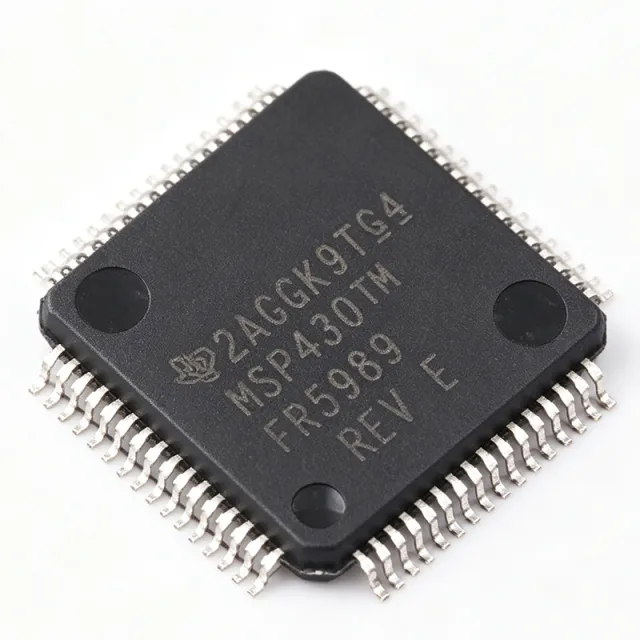
The Texas Instruments MSP430FR5989IPMR is a 16-bit ultra-low-power microcontroller based on the MSP430 CPUXV2 RISC core running at up to 16MHz, with 128KB embedded FRAM, 2KB SRAM, and an extended Scan Interface 2 for rotary sensing, housed in a 64-pin LQFP (PM) 10x10mm package. A microcontroller (MCU) is a compact integrated circuit that combines a processor core, program memory, data memory, and programmable peripherals on a single die to govern a specific embedded function. Within the MCU hierarchy, this device belongs to the MSP430 FRAM family of ultra-low-power (ULP) microcontrollers under the broader MSP430 platform and power-management IC taxonomy. Its FRAM (ferroelectric RAM) memory unites SRAM-like speed, flexibility, and endurance with flash-like non-volatility at much lower write energy, eliminating the erase-before-write cycles of conventional flash. Key features include the extended Scan Interface 2 that offloads high-resolution rotary and linear position sensing from the CPU, a hardware AES accelerator for secure metering data, a real-time clock with calendar mode, a 12-bit ADC, comparator, DMA controller, a 32-bit hardware multiplier, and multiple 16-bit timers. Power performance is exceptional: active mode draws approximately 100 uA/MHz and standby (LPM3 with VLO) about 0.4 uA, enabling decade-class battery life in field instruments. Architecturally, the CPUXV2 core executes a 16-bit RISC instruction set over a von Neumann bus at 16MHz. FRAM is byte-writable in-system, allowing fast data logging without external EEPROM, while the AES accelerator encrypts measurements for smart-grid and flow-metering security. The operating supply range is 1.8V to 3.6V with -40C to +85C temperature tolerance for harsh deployments. Typical applications include gas, water, and heat flow meters, rotary and linear position sensing systems, smart-grid endpoints, industrial process control, and secure wireless sensor nodes. Scan Interface 2 directly supports rotary encoders while the CPU sleeps, minimizing average current. Design tip: decouple each VCC pin with 100nF close to the pin plus 10uF bulk capacitance, keep the supply above the SVS threshold for reliable FRAM writes, and use JTAG or two-wire Spy-Bi-Wire for debugging. This page synthesizes distributor pricing, drop-in alternatives, and practical design notes not found in the manufacturer datasheet.

USD $6,30 Liên hệ
MSP430FR5994 - 16MHz 256KB FRAM MCU with LEA | TI
MSP430FR5994

MSP430FR5994 - 16MHz 256KB FRAM MCU with LEA | TI

The Texas Instruments MSP430FR5994 is a 16-bit ultra-low-power microcontroller operating at up to 16 MHz, with 256KB of non-volatile FRAM memory, 8KB of SRAM, a Low-Energy Accelerator (LEA) coprocessor for DSP-style math, and a 64-pin LQFP (10x10 mm) package option. A microcontroller (MCU) is a single-chip embedded computer combining a processor core, memory, and peripherals. The MSP430FR5994 belongs to the 16-bit MCU class, within the broader family of microcontrollers and embedded processors, and sits in TI's MSP430 FRAM platform - a product line that replaces flash memory with ferroelectric RAM for faster, lower-power, and far more durable writes in a unified non-volatile memory architecture. Key differentiating features include the LEA (Low-Energy Accelerator), which TI states delivers up to 40x the DSP performance of Arm Cortex-M0+ class cores for functions such as FFT, FIR filtering, and matrix multiplication, without requiring DSP expertise. The 256KB FRAM supports memory writes at very low energy compared to flash, and the device integrates a 12-bit ADC, comparator, DMA, AES accelerator, and UART/SPI/I2C serial interfaces, plus multiple 16-bit timers. Architecturally, the MSP430FR5994 uses the MSP430 CPUXV2 16-bit RISC core, a hallmark of the lowest-power MCU technology platform on the market. The unified FRAM memory allows code and data to coexist in non-volatile storage, enabling in-application software updates and rapid data logging. Typical applications include battery-powered metering, portable medical and sensor-monitoring equipment, industrial sensing nodes, and edge signal-processing tasks where LEA-accelerated FFT and FIR computation offloads the main CPU. A key design consideration: FRAM writes consume far less energy than flash programming, but designers should still manage the unified memory map carefully when partitioning persistent data segments. This page synthesizes distributor availability data, same-family drop-in alternatives, and practical design notes not found in the manufacturer datasheet.

RFQ Liên hệ
MSP430FR59941IPM - 16MHz 256KB FRAM MCU | TI
MSP430FR59941IPM

MSP430FR59941IPM - 16MHz 256KB FRAM MCU | TI

The Texas Instruments MSP430FR59941IPM is a 16-bit MSP430FR FRAM microcontroller running at up to 16 MHz with 256KB non-volatile FRAM, 8KB SRAM, and a Low-Energy Accelerator (LEA) DSP coprocessor, housed in a 64-pin LQFP (PM) package measuring 10x10 mm and rated from -40C to +85C. A FRAM (Ferroelectric RAM) microcontroller is a class of mixed-signal MCU that replaces conventional flash program memory with ferroelectric memory, a technology that combines the non-volatility of flash with the write speed and endurance of SRAM. Within the power-management hierarchy of embedded systems, the MCU sits at the center of the signal chain, controlling sensors, interfaces, and power modes; FRAM MCUs occupy the low-power embedded processing tier, below application processors and above simple 8-bit controllers. Key differentiating features include 256KB of FRAM unified memory with unlimited write endurance in practice and uniform 128-byte write granularity, the LEA hardware accelerator that offloads vector math such as FFTs and FIR filters from the CPU at a fraction of the energy, a hardware AES256 cryptographic accelerator, and a 12-bit SAR ADC. The peripheral set also includes comparators, DMA, four eUSCI serial interfaces (UART/SPI/I2C), and 68 I/O lines made available through TI's port mapping architecture. Architecturally, the device uses the MSP430 CPUXV2 RISC core with 16-bit instructions, a flexible clock system (VLO, REFO, DCO, and external LFXT/HFXT sources), and multiple low-power modes (LPM0-LPM4.5) that let the MCU spend most of its life in sub-microamp sleep states. The FRAM write mechanism requires no erase cycle, so data logging writes are roughly 100x faster and far lower energy than flash-based writes. Typical applications include battery-powered metering and data logging, portable medical monitoring, sensor-fusion nodes performing DSP pre-processing via LEA, and secure connected endpoints using the AES256 engine. Designers should note that FRAM read timing is fast but the maximum system frequency of 16 MHz requires wait-state management for FRAM access above 8 MHz, and the LQFP-64 PM package needs a solid DVSS/DVCC decoupling network per TI's layout guidance. This page synthesizes distributor pricing, same-family drop-in alternatives, pinout guidance, and practical design notes not consolidated in the manufacturer datasheet.

RFQ Liên hệ
MSP430FR59941IZVWR - 16MHz 256KB FRAM MCU 87-NFBGA | Texas Instruments
MSP430FR59941IZVWR

MSP430FR59941IZVWR - 16MHz 256KB FRAM MCU 87-NFBGA | Texas Instruments

The Texas Instruments MSP430FR59941IZVWR is a 16-bit MSP430FR59xx FRAM microcontroller running at 16 MHz with 256KB of FRAM nonvolatile memory, 8KB of SRAM, and a hardware Low-Energy Accelerator (LEA) for digital signal processing, housed in an 87-pin NFBGA (ZVW) 6x6 mm ball grid array package. It integrates a 12-bit ADC, comparator, DMA controller, AES cryptographic accelerator, and up to 68 general-purpose I/O lines with eUSCI serial communication modules. A FRAM (ferroelectric random access memory) microcontroller is a class of MCU in which program flash is replaced by ferroelectric memory, a technology that combines the nonvolatility of flash with the write speed, endurance, and ultra-low write energy of RAM. Within the power management hierarchy of embedded systems, FRAM MCUs occupy the extreme low-power end, enabling energy harvesting and battery designs that conventional flash MCUs cannot match. Key features include the LEA vector math accelerator, which offloads FFT, FIR, and matrix operations from the CPU at a fraction of the energy, and the AES256 accelerator for secure IoT deployments. FRAM writes at full 16 MHz speed with 10^15 cycle endurance, eliminating flash erase-before-write delays and enabling in-system data logging. Operating voltage spans 1.8V to 3.6V with active-mode currents in the microampere-per-MHz class and multiple low-power modes (LPM3.5/4.5) for battery designs. The CPUXV2 16-bit RISC core executes MSP430 instructions with a modernized pipeline. Peripherals include four eUSCI modules supporting UART, SPI, and I2C, a 12-channel DMA, a real-time clock, and a flexible clock system with DCO, LFXT, and HFXT sources. Typical applications include battery-powered metering, portable medical monitoring, energy harvesting sensor nodes, and secure IoT edge devices requiring cryptographic key storage and long battery life. Design consideration: the 87-NFBGA (0.8 mm ball pitch, 6x6 mm) demands careful PCB stack-up; escape routing typically requires a dedicated inner signal layer, and X-ray inspection is recommended for assembly. This page adds distributor pricing, drop-in alternative analysis, and layout guidance not found in the TI datasheet.

RFQ Liên hệ
MSP430FR59941REV - 16MHz 256KB FRAM MCU with LEA | TI
MSP430FR59941REV

MSP430FR59941REV - 16MHz 256KB FRAM MCU with LEA | TI

The Texas Instruments MSP430FR59941REV is a 16-bit MSP430FR microcontroller (MCU) built on the MSP430 CPUXV2 core, running at up to 16 MHz with 256KB of non-volatile FRAM, 8KB of SRAM, and an integrated Low-Energy Accelerator (LEA) for digital signal processing. The device integrates AES hardware acceleration, a 12-bit ADC, comparators, DMA, 68 general-purpose I/O pins, and multiple eUSCI serial interfaces. FRAM (ferroelectric random access memory) is a non-volatile memory technology that combines the speed and low power of SRAM with the endurance and retention of Flash. In the power-management hierarchy, the MSP430FR59941 sits within the MSP430FR599x mixed-signal MCU family, part of TI's ultra-low-power MSP430 portfolio for embedded control and sensing applications. Key differentiating features include the LEA coprocessor, which TI states delivers 40x the signal-processing performance of Arm Cortex-M0+ MCUs for FFT, FIR, and matrix multiplication, without requiring DSP expertise. The 256KB FRAM enables large data logging with unlimited write endurance in practice, while the 12-bit ADC and AES accelerator support secure, precision sensing. Architecturally, the CPUXV2 16-bit RISC core pairs with the LEA vector engine, and FRAM is accessed at full speed, removing the erase-before-write penalties of Flash MCUs. Multiple low-power modes allow active currents in the microamp-per-MHz class, a hallmark of the MSP430 line. Typical applications include smart metering and energy monitoring, industrial sensor front ends with FFT-based analytics, secure IoT sensor nodes using the AES engine, and portable medical devices. Design consideration: FRAM requires no external programming voltage and survives power loss mid-write, but designers should verify the package and pinout details of the REV suffix ordering code directly against the MSP430FR599x datasheet before layout. This page synthesizes verified distributor listings, same-family drop-in alternatives, and practical design notes beyond what a single datasheet page provides.

RFQ Liên hệ
MSP430FR5994IPMR - 16MHz 256KB FRAM MCU | Texas Instruments
MSP430FR5994IPMR

MSP430FR5994IPMR - 16MHz 256KB FRAM MCU | Texas Instruments

The Texas Instruments MSP430FR5994IPMR is a 16-bit ultra-low-power microcontroller based on the MSP430 CPUXV2 RISC core running at up to 16 MHz, integrating 256KB of FRAM non-volatile memory, 8KB of SRAM, a Low-Energy Accelerator (LEA) DSP engine, an AES256 accelerator, a 12-bit ADC, comparators, DMA, and UART/SPI/I2C serial interfaces in a 64-pin LQFP (10x10 mm, PM suffix) package. A microcontroller (MCU) is a single-chip embedded processor that combines a CPU core, memory, and peripherals on one die, sitting at the device level of the embedded-systems hierarchy (MCU -> embedded processor -> semiconductor). The MSP430FR599x family belongs to the MSP430 FRAM series, which replaces flash with ferroelectric RAM: FRAM offers fast, low-power writes, unified program and data memory, and very high write endurance, making it one of the lowest-power MCU memory technologies available. Key differentiators include the Low-Energy Accelerator (LEA), a hardware signal-processing engine that TI states delivers up to 40x the performance of Arm Cortex-M0+ MCUs on functions such as FFT, FIR filtering, and matrix multiplication, without requiring DSP expertise. The integrated AES256 accelerator secures IoT connectivity, and multiple low-power modes (LPM) extend battery life in always-on sensing applications. Architecturally, the 16-bit CPUXV2 core offloads vector math to LEA via the DMA controller, keeping the CPU in sleep while signal processing proceeds. FRAM is byte-writable with no sector-erase penalty, which simplifies data logging and over-the-air firmware updates. Typical applications include battery-powered sensor nodes, building automation and electronic metering, portable medical devices, and edge signal-conditioning nodes that need FFT/FIR processing at minimal energy cost. Design tip: partition FRAM deliberately - the unified memory allows constants in information segments, but code/data segmentation and write-endurance budgeting should follow TI's FRAM guidance in the MSP430FR599x, MSP430FR596x Mixed-Signal Microcontrollers datasheet (Rev. D). This page adds value beyond the datasheet by synthesizing drop-in alternatives (MSP430FR5989IPMR, MSP430FR59941IPM and related family parts), pricing context as of 2026-09-03, and practical design notes in one place.

RFQ Liên hệ
MSP430FR5994IPNR - 16MHz 256KB FRAM MCU | Texas Instruments
MSP430FR5994IPNR

MSP430FR5994IPNR - 16MHz 256KB FRAM MCU | Texas Instruments

The Texas Instruments MSP430FR5994IPNR is a 16-bit ultra-low-power FRAM microcontroller running at 16 MHz with 256KB of FRAM nonvolatile memory, 8KB of SRAM, and an integrated Low-Energy Accelerator (LEA) for signal processing, housed in an 80-pin LQFP (12x12 mm) package. FRAM (ferroelectric random access memory) is a nonvolatile memory technology that combines the speed and low power of SRAM-like writes with the data retention of flash. In a microcontroller system hierarchy, the MSP430FR5994 sits within the broader family of mixed-signal MCUs, occupying the memory-and-signal-processing tier of the MSP430FR599x series, which targets battery-powered and energy-harvesting applications that require both large nonvolatile memory and mathematical computation. Key differentiating features include the LEA (Low-Energy Accelerator), a vector math coprocessor that offloads FFT, FIR, and matrix operations from the CPU while the core remains in a low-power state; hardware AES cryptography for secure data handling; a 12-bit ADC and analog comparator for sensing front ends; and direct memory access (DMA) for peripheral-to-memory transfers without CPU intervention. FRAM offers 100x faster writes than flash with inherently low write energy and virtually unlimited write endurance. Architecturally, the MSP430 CPUXV2 16-bit RISC core is paired with multiple low-power modes, enabling active currents in the microamp-per-MHz class while retaining RAM and peripheral state. The unified FRAM memory allows flexible partitioning between code and data, and the MPU (memory protection unit) can segment FRAM into protected regions for bootloader and data-logging designs. Typical applications include portable medical and health monitoring devices, building and factory sensor nodes, energy metering front ends, and battery-powered signal processing where the LEA accelerates FFT-based vibration or acoustic analysis. A key design consideration is the FRAM write protection scheme: configure the MPU segments early in development to prevent accidental data corruption, and respect the maximum operating frequency versus supply voltage relationship documented in the manufacturer datasheet. This page synthesizes distributor pricing, same-family drop-in alternatives, and practical design notes not found in the manufacturer datasheet.

RFQ Liên hệ
MSP430FR5994IRGZR - 16MHz 256KB FRAM MCU | TI | Low Power
MSP430FR5994IRGZR

MSP430FR5994IRGZR - 16MHz 256KB FRAM MCU | TI | Low Power

The Texas Instruments MSP430FR5994IRGZR is a 16-bit RISC microcontroller based on the MSP430 CPUXV2 core running at 16 MHz, featuring 256KB of unified FRAM memory, 8KB of SRAM, and a Low-Energy Accelerator (LEA) for signal processing, housed in a 48-pin VQFN (7x7 mm) package. A microcontroller (MCU) is a single integrated circuit that combines a processor core, memory, and programmable peripherals into one chip, forming the lowest layer of the embedded-systems hierarchy: semiconductor -> microcontroller -> embedded system. The MSP430FR5994 belongs to the MSP430 FRAM family of ultra-low-power mixed-signal microcontrollers, where ferroelectric RAM replaces flash to combine non-volatility with fast, low-energy writes. Key differentiating features include FRAM unified memory with 256KB capacity that writes up to 100x faster than flash with far lower energy per byte, the LEA coprocessor delivering up to 40x the DSP performance of Arm Cortex-M0+ cores for FFT, FIR, and matrix operations without requiring DSP expertise, hardware AES encryption, a 12-bit ADC, analog comparators, DMA, and UART/SPI/I2C serial interfaces plus multiple timers. Technically, the FRAM architecture eliminates the erase-before-write penalty of flash, enabling true infinite-endurance data logging and instant software updates. The CPUXV2 16-bit RISC core emphasizes low active power, making the family suitable for battery-powered sensing where every microamp matters. The LEA offloads vector math from the CPU, cutting both execution time and energy per operation in edge signal-processing workloads. Typical applications include portable medical monitoring, industrial sensor nodes, battery-powered metering, and edge signal-conditioning systems that perform FFT or filtering on-chip. The combination of large non-volatile memory and a math accelerator fits data-logging and vibration-sensing designs particularly well. Design consideration: FRAM memory write operations are fast, but code must account for wait states at higher frequencies; use TI's driver library and the MSP430FR599x family datasheet for timing details. This page synthesizes distributor availability, family drop-in alternatives, and practical design guidance not found in a single manufacturer datasheet.

RFQ Liên hệ