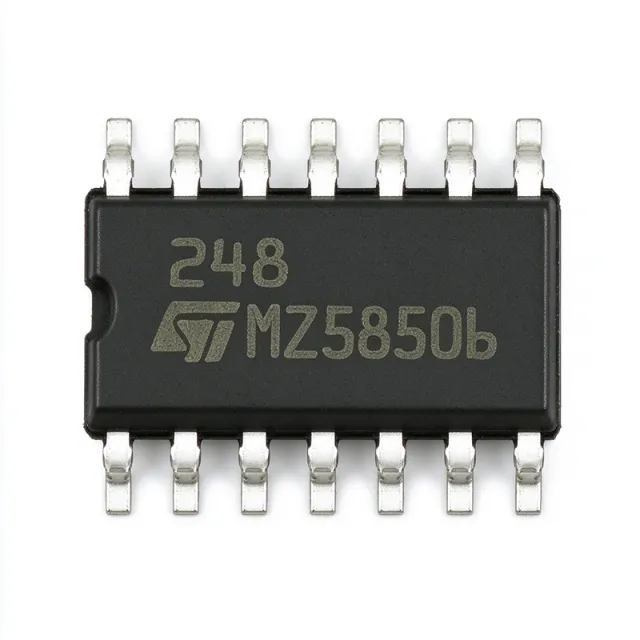
LM239AN
LM239AN - Quad Differential Comparator | STMicroelectronics
The STMicroelectronics LM239AN is a low-power quad differential voltage comparator containing four independent comparator channels in a 14-pin through-hole DIP package. The device supports single-supply operation, has a typical input bias current of 25 nA, and belongs to the LM139/LM239 family designed for level detection, low-level sensing, memory, consumer, automotive, and industrial applications.
A voltage comparator is an analog semiconductor that compares two input voltages and produces a logic-level output indicating which input is higher. The LM239AN belongs to the hierarchy differential comparator, comparator, analog integrated circuit, and semiconductor. Its four independent channels make it suitable for threshold detection, window monitoring, alarm generation, sensor conditioning, and general digital-interface control. The open-collector outputs can also be used to drive wired logic buses when an appropriate pull-up arrangement is provided.
Key characteristics include four independent differential comparators, single-supply operation, a 25 nA typical input bias current, an offset voltage specification as low as 2.0 mV maximum for the LM139 series, and open-collector outputs compatible with CMOS, DTL, ECL, MOS, and TTL according to distributor product information. The 14-DIP package provides through-hole assembly compatibility and ample spacing for inspection and hand soldering.
The LM239AN architecture supports independent comparison channels within one package, reducing component count in multi-threshold systems. Because the comparators are independent, their input and output nodes are not internally tied together. Designers must observe the common-mode input range and supply-voltage limits from the manufacturer datasheet, especially when comparing signals that can approach either supply rail. Open-collector outputs require suitable pull-up resistors when a valid high output is required.
Typical applications include industrial control systems, automotive sensing interfaces, battery-powered equipment, memory threshold detection, consumer electronics, and precision logic interfaces. Four channels can implement separate overvoltage, undervoltage, temperature, and light-level decisions, while open-collector outputs support alarm aggregation or level translation. Low input bias current is particularly useful when the comparator is driven by high-impedance sensors.
When laying out a circuit, keep sensitive input traces away from switching nodes and connect each comparator's supply and ground pins with short, low-impedance paths. Confirm input polarity, common-mode limits, output pull-up values, and input-overvoltage conditions against the manufacturer datasheet before releasing a production design. A single supply is convenient, but dual-supply operation may also be possible within specified limits.
This product guide combines device specifications, pin assignments, practical application guidance, and drop-in replacement information to accelerate engineering review. It also highlights the electrical and qualification checks required when substituting another quad comparator on an existing 14-DIP PCB.
詢價
聯絡我們