產品(19,000+)

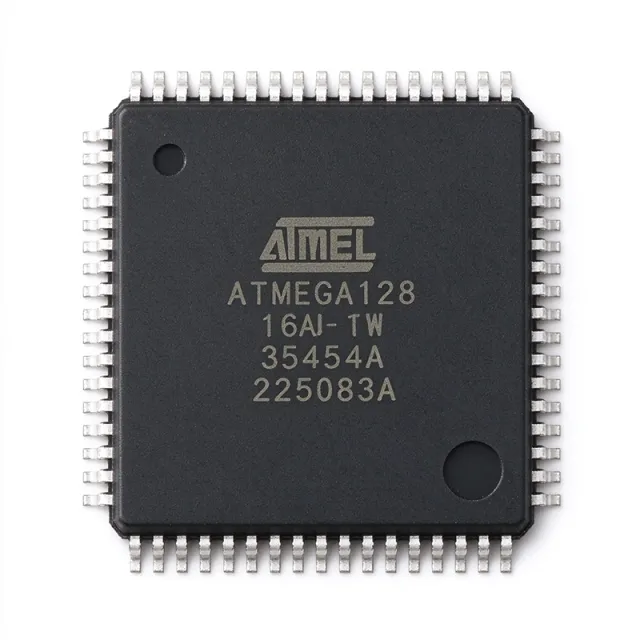
ATMEGA128-16ANR - 8-Bit AVR MCU 128KB 16MHz TQFP-64 | Microchip (Tape & Reel)
ATMEGA128-16ANR

ATMEGA128-16ANR - 8-Bit AVR MCU 128KB 16MHz TQFP-64 | Microchip (Tape & Reel)

The Microchip Technology ATMEGA128-16ANR is an 8-bit AVR RISC microcontroller delivering up to 16 MIPS throughput at 16 MHz, with 128 KB of In-System Programmable FLASH, 4 KB SRAM, and 4 KB EEPROM, housed in a 64-pin TQFP (14x14 mm) package. It operates from 4.5V to 5.5V and supports on-chip JTAG debugging. An 8-bit AVR microcontroller is a single-chip processor built on the AVR enhanced RISC architecture, in which most of the 131 instructions execute in a single clock cycle. Within the system hierarchy, the microcontroller sits between simple logic ICs and application processors, integrating CPU, program memory, data memory, timers, and communication peripherals into one device for embedded control tasks. Key features include 53 general-purpose I/O lines, 32 general-purpose working registers, four flexible timers/counters with compare modes and PWM, and an 8-channel 10-bit A/D converter. Dual USARTs, a byte-oriented Two-Wire Interface (I2C-compatible), and a hardware SPI port provide multi-protocol connectivity for sensors, displays, and industrial networks. Technically, the fully static core sustains performance from DC to 16 MHz, while the Read-While-Write FLASH allows code updates during operation. An RTC with separate oscillator, JTAG boundary-scan, and an ATmega103 compatibility mode (via the M103C fuse) simplify legacy design migration. This version is rated at 16 MHz at 4.5-5.5V with a -40C to +85C industrial temperature rating. Typical applications include industrial automation control panels, HVAC and building-management systems, battery-monitoring instrumentation, and motor-control nodes using the PWM channels. Design consideration: for lowest power consumption in idle and power-down modes, configure unused I/O pins as inputs with internal pull-ups and use the power-reduction registers to clock-gate unused peripherals. This page synthesizes distributor pricing, drop-in alternatives, and practical design notes not found in the manufacturer datasheet.

詢價 聯絡我們
ATMEGA128-16AU - 8-Bit AVR MCU, 128KB Flash, 16MHz | Microchip
ATMEGA128-16AU

ATMEGA128-16AU - 8-Bit AVR MCU, 128KB Flash, 16MHz | Microchip

The Microchip Technology ATMEGA128-16AU is a high-performance, low-power 8-bit AVR RISC microcontroller with 128KB of In-System Programmable Flash, 4KB SRAM, 4KB EEPROM, an 8-channel 10-bit ADC, and a JTAG interface for on-chip debugging, delivered in a 64-pin TQFP (14x14 mm) package operating at up to 16 MHz. An 8-bit AVR microcontroller is a single-chip processor built on the AVR enhanced RISC architecture, in which most instructions execute in a single clock cycle. Within the power-management and embedded-control hierarchy, it functions as the central computing element of a system, replacing discrete logic and analog control circuitry while offering flash-based field reprogrammability. Key features include 128KB self-programmable Flash with a boot section for in-application programming, 4KB internal SRAM, 4KB EEPROM for non-volatile parameter storage, and throughput approaching 16 MIPS at 16 MHz, allowing designers to optimize power consumption versus processing speed. Technically, the ATmega128 combines an 8-channel 10-bit A/D converter with an external-memory interface (up to 64KB external data space via PORTA/PORTC multiplexed addressing), two 8-bit and two 16-bit timers with PWM outputs, two USARTs, SPI, and a Two-Wire Interface, plus a JTAG boundary-scan and debug port. The AVR Harvard architecture with 32 general-purpose registers enables efficient C-compiled code execution. Typical applications include industrial control and automation nodes, general embedded systems, data loggers, and legacy ATmega103 upgrades, since the ATmega128 is 100% pin compatible with ATmega103 and can replace it on existing PCBs. A key design consideration is supply voltage: the 16 MHz -16AU speed grade requires 4.5V to 5.5V operation; the ATmega128L variant is needed for 2.7V-5.5V low-voltage designs. Provide decoupling capacitors on all VCC/AVCC pins and use the internal RC or external crystal clock option accordingly. This page synthesizes distributor pricing, verified drop-in alternatives, and practical design notes not found in the manufacturer datasheet.

詢價 聯絡我們
ATMEGA128-16AUR - 8-Bit AVR MCU, 128KB Flash, 16MHz | Microchip (Tape & Reel)
ATMEGA128-16AUR

ATMEGA128-16AUR - 8-Bit AVR MCU, 128KB Flash, 16MHz | Microchip (Tape & Reel)

The Microchip Technology ATMEGA128-16AUR is a high-performance, low-power 8-bit AVR RISC microcontroller with 128KB of In-System Programmable Flash, 4KB SRAM, 4KB EEPROM, an 8-channel 10-bit ADC, and a JTAG interface for on-chip debugging, delivered in a 64-pin TQFP (14x14 mm) package operating at up to 16 MHz. An 8-bit AVR microcontroller is a single-chip processor built on the AVR enhanced RISC architecture, in which most instructions execute in a single clock cycle. Within the power-management and embedded-control hierarchy, it functions as the central computing element of a system, replacing discrete logic and analog control circuitry while offering flash-based field reprogrammability. Key features include 128KB self-programmable Flash with a boot section for in-application programming, 4KB internal SRAM, 4KB EEPROM for non-volatile parameter storage, and throughput approaching 16 MIPS at 16 MHz, allowing designers to optimize power consumption versus processing speed. Technically, the ATmega128 combines an 8-channel 10-bit A/D converter with an external-memory interface (up to 64KB external data space via PORTA/PORTC multiplexed addressing), two 8-bit and two 16-bit timers with PWM outputs, two USARTs, SPI, and a Two-Wire Interface, plus a JTAG boundary-scan and debug port. The AVR Harvard architecture with 32 general-purpose registers enables efficient C-compiled code execution. Typical applications include industrial control and automation nodes, general embedded systems, data loggers, and legacy ATmega103 upgrades, since the ATmega128 is 100% pin compatible with ATmega103 and can replace it on existing PCBs. A key design consideration is supply voltage: the 16 MHz -16AU speed grade requires 4.5V to 5.5V operation; the ATmega128L variant is needed for 2.7V-5.5V low-voltage designs. Provide decoupling capacitors on all VCC/AVCC pins and use the internal RC or external crystal clock option accordingly. This page synthesizes distributor pricing, verified drop-in alternatives, and practical design notes not found in the manufacturer datasheet.

USD $9.02 有庫存
ATMEGA128-16MC - 8-Bit AVR MCU 16MHz 128KB Flash | Microchip
ATMEGA128-16MC

ATMEGA128-16MC - 8-Bit AVR MCU 16MHz 128KB Flash | Microchip

The Microchip Technology (Atmel) ATMEGA128-16MC is a high-performance, low-power 8-bit AVR RISC microcontroller executing up to 16 MIPS at 16 MHz, with 128 KB of In-System Programmable Flash, 4 KB SRAM, 4 KB EEPROM, an 8-channel 10-bit ADC, and a JTAG interface for on-chip debugging, housed in a 64-pad QFN (MLF, 9x9 mm) no-lead package. An 8-bit AVR microcontroller is a Harvard-architecture RISC processor in the broader hierarchy of MCUs (microcontroller -> embedded processor -> system-on-chip building block). The AVR family is known for executing most of its powerful instruction set in a single clock cycle, giving high code efficiency and deterministic timing for embedded control systems. Key features include 133 powerful instructions (most single-cycle), 32 x 8-bit general-purpose working registers, 53 programmable I/O lines, and a self-programming Flash architecture enabling field firmware updates. The 8-channel 10-bit ADC supports direct analog sensor interfacing, while dual USARTs, SPI, and TWI (I2C-compatible) cover common embedded communication needs. Technically, the ATmega128 pairs an advanced RISC core with a rich peripheral set: two 8-bit timers, two 16-bit timers with PWM capability, a watchdog timer, an on-chip analog comparator, and internal/external interrupt sources. The JTAG boundary-scan and on-chip-debug capability shortens development cycles on dense, no-lead packages that are otherwise hard to probe. According to the ATmega128 datasheet, the device is 100% pin compatible with the ATmega103 and can replace it on existing PCBs. Typical applications include industrial automation and control panels, building and HVAC controllers, instrumentation with analog sensor inputs, and legacy ATmega103 board upgrades. The commercial temperature grade (0C to +70C) suits indoor industrial and consumer products. Design consideration: at 16 MHz operation the ATMEGA128-16MC requires a 4.5 V to 5.5 V supply; for 3 V systems choose the ATmega128L speed-voltage grade or drop the clock below the low-voltage frequency limit. This page synthesizes distributor sourcing data, same-family drop-in alternatives, and practical design notes not found in the manufacturer datasheet.

詢價 聯絡我們
ATMEGA128-16MI - 8-Bit AVR MCU 128KB Flash 16MHz | Microchip
ATMEGA128-16MI

ATMEGA128-16MI - 8-Bit AVR MCU 128KB Flash 16MHz | Microchip

The Microchip Technology (Atmel) ATMEGA128-16MI is an 8-bit AVR RISC microcontroller executing up to 16 MIPS at 16 MHz, with 128 KB of In-System Programmable Flash (64K x 16), 4 KB of EEPROM, 4 KB of internal SRAM, and a 64-pin VFQFN package with exposed pad. An 8-bit AVR microcontroller is a Harvard-architecture MCU in which program memory and data memory use separate buses, allowing most instructions to execute in a single clock cycle. Within the power-management hierarchy, the ATmega128 sits at the top of the classic ATmega family, acting as the system brain that orchestrates peripherals, sensors, and communication interfaces in embedded systems. Key features include the AVR enhanced RISC core with 133 powerful instructions, 128 KB self-programmable Flash with a 2-wire (I2C/TWI) or SPI programming interface, two 8-bit and two 16-bit timers/counters, and rich connectivity: two UARTs, SPI, TWI (I2C), and an 8-channel 10-bit ADC. The 16 MHz speed grade (-16 suffix) supports industrial automation, metering, and motor-control workloads that smaller ATmega parts cannot handle. Technically, the ATmega128 implements JTAG (IEEE 1149.1 compliant) for on-chip debugging and boundary scan, six sleep modes including power-down and power-save for battery designs, and an internal RC oscillator option alongside an external crystal input. Byte-writable EEPROM retains calibration data through power cycles, and the bootloader section permits field firmware updates over UART or SPI. Typical applications include industrial control panels, HVAC and building automation, battery-powered data loggers, and legacy embedded products upgraded from smaller ATmega devices. The 64-QFN exposed-pad package suits space-constrained boards needing 53 general-purpose I/O lines. A key design consideration: the MLF/QFN pad requires a solid ground pour with thermal vias; the -MI temperature range and QFN footprint must be confirmed against the TQFP (AU/AI) variants during layout migration. This page synthesizes distributor pricing, drop-in alternatives, and practical design notes not found in the manufacturer datasheet.

詢價 聯絡我們
ATMEGA128-16MJ - 8-bit AVR MCU 16MHz 128KB Flash | Microchip
ATMEGA128-16MJ

ATMEGA128-16MJ - 8-bit AVR MCU 16MHz 128KB Flash | Microchip

The Microchip Technology (Atmel) ATMEGA128-16MJ is an 8-bit AVR enhanced RISC microcontroller delivering up to 16 MIPS at 16 MHz, with 128 KB self-programming Flash, 4 KB EEPROM, 4 KB SRAM, and a 64-pin VFQFN package with exposed pad. A microcontroller is a single-chip computer that integrates a processor core, nonvolatile program memory, SRAM, and peripherals on one die. The ATmega128 sits in the 8-bit general-purpose MCU hierarchy, within the AVR family that traces from tiny ATtiny parts up through megaAVR and 32-bit AVR/ARM devices, serving embedded systems, industrial control, and consumer products. Key features include the AVR RISC core executing most instructions in a single clock cycle for near 1 MIPS per MHz throughput, dual UART/USART serial ports, SPI and TWI (I2C) interfaces, an external bus interface (EBI/EMI) for memory-mapped expansion, an 8-channel 10-bit ADC, JTAG for on-chip debugging and boundary scan, and hardware PWM outputs from multiple timers. Architecturally, the ATmega128 uses a Harvard structure with separate program and data buses, 133 instructions, and 32 general-purpose registers directly connected to the ALU. Self-programming Flash with a boot-loader section enables field firmware updates over UART or SPI without external programmers. Typical applications include industrial automation controllers, embedded communication gateways using the dual USART and EBI, and motor or lighting control leveraging PWM and 10-bit ADC feedback loops. Design consideration: the 16 MHz speed grade targets the 4.5 V to 5.5 V supply range; systems running at 3.3 V should select the ATmega128L variants to remain within datasheet frequency-voltage limits. This page synthesizes distributor availability, drop-in alternatives, pinout, and practical design notes not found in the manufacturer datasheet.

詢價 聯絡我們
ATMEGA128-16MN - 8-Bit AVR MCU 128KB 16MHz 64-QFN | Microchip
ATMEGA128-16MN

ATMEGA128-16MN - 8-Bit AVR MCU 128KB 16MHz 64-QFN | Microchip

The Microchip Technology ATMEGA128-16MN is a high-performance, low-power 8-bit AVR RISC microcontroller delivering 16 MIPS throughput at 16 MHz, with 128 KB (64K x 16) in-system programmable FLASH, 4 KB SRAM, and 4 KB EEPROM, housed in a 64-pin QFN/MLF (9x9 mm) package operating from a 4.5V to 5.5V supply. A microcontroller is a single-chip computer that integrates a processor core, program memory, data memory, and peripherals such as timers, communication interfaces, and analog-to-digital converters. Within the embedded hierarchy, the ATmega128 belongs to the 8-bit AVR ATmega family, positioned under the broader categories of microcontroller units (MCUs), embedded processors, and integrated circuits. It executes most of its 131 powerful instructions in a single clock cycle, providing fully static operation. Key features include an 8-channel 10-bit ADC for direct analog sensor interfacing, a JTAG interface for on-chip debugging and boundary-scan, two hardware USARTs for serial communication, plus SPI and TWI (I2C) buses. The four flexible timers (two 8-bit, two 16-bit with PWM) support motor control, lighting, and waveform generation. In-system programmable FLASH allows firmware updates without removing the device from the board. Architecturally, the AVR uses an advanced Harvard structure with separate program and data buses and 32 general-purpose working registers directly connected to the ALU, achieving one-cycle instruction execution. The optional external memory interface can expand addressing for larger applications. Typical applications include industrial automation and control panels, building and HVAC controllers, embedded instrumentation, and motor control systems that require 5V noise immunity, generous 128 KB code space, and field-updatable firmware. A key design consideration is power dissipation: at 5V/16 MHz the device draws more current than its 8 MHz low-voltage siblings, so active clock management (idle, power-down modes) should be used in battery-sensitive designs. The QFN pad geometry requires an exposed-land PCB footprint. This page synthesizes distributor pricing, drop-in alternatives, cross-reference findings, and practical design notes not found in the manufacturer datasheet. Price data is as of 2026-09-15.

詢價 聯絡我們
ATMEGA128-16MNR - 8-Bit AVR MCU 128KB 16MHz QFN-64 | Microchip
ATMEGA128-16MNR

ATMEGA128-16MNR - 8-Bit AVR MCU 128KB 16MHz QFN-64 | Microchip

The Microchip Technology ATMEGA128-16MNR is a high-performance, low-power 8-bit AVR RISC microcontroller featuring 128 KB of in-system programmable Flash, 4 KB SRAM, 4 KB EEPROM, an 8-channel 10-bit ADC, and a 16 MHz maximum clock frequency, housed in a 64-pin QFN/MLF (9x9 mm) package with exposed pad and green/RoHS-compliant plating. An 8-bit AVR microcontroller is a Harvard-architecture RISC processor that executes most instructions in a single clock cycle, placing this device in the broader hierarchy of microcontroller unit (MCU) -> embedded processor -> integrated circuit. The ATmega128 family has long served as a workhorse for 5V industrial embedded designs, bridging the gap between small ATmega328-class devices and larger ATmega1280/2560 parts. Key features include 131 powerful instructions with mostly single-cycle execution, delivering up to 16 MIPS throughput at 16 MHz; two 8-bit and two 16-bit timers with PWM and input capture; dual programmable USARTs; an SPI interface; a two-wire (I2C-compatible) interface; and an 8-channel 10-bit ADC. A JTAG interface with on-chip debugging (OCD) and boundary-scan capability is built in, and an on-chip boot loader section supports self-programming Flash firmware updates. Technically, the device combines the AVR advanced RISC architecture with 32 general-purpose working registers, fully static operation, and an XMEM interface that addresses up to 64 KB of external memory via ports PA/PC. The 64-QFN exposed-pad package improves thermal and ground performance over the TQFP option while saving board area. Typical applications include industrial control and automation, motor control and power management nodes, building/HVAC controllers, and legacy 5V systems requiring drop-in AVR upgrades. The 16 MHz -16 grade at 4.5-5.5V suits environments needing robust noise margins. Design consideration: for full-speed operation at 16 MHz, use the 4.5V to 5.5V supply range; below that voltage the maximum safe clock derates per the datasheet frequency-versus-voltage curve. This page synthesizes distributor pricing, drop-in alternatives, pinout, and practical design notes not found in a single manufacturer datasheet.

詢價 聯絡我們
ATMEGA128-16MU - 8-Bit AVR MCU 16MHz 128KB Flash | Microchip
ATMEGA128-16MU

ATMEGA128-16MU - 8-Bit AVR MCU 16MHz 128KB Flash | Microchip

The Microchip Technology ATMEGA128-16MU (originally Atmel) is a high-performance, low-power 8-bit AVR RISC microcontroller with 128 KB In-System Programmable Flash, 16 MHz maximum clock frequency, and 53 general-purpose I/O lines, housed in a 64-pin QFN (9x9 mm, MLF) surface-mount package. An 8-bit AVR microcontroller is a Harvard-architecture RISC processor that executes most instructions in a single clock cycle, placing it in the broader hierarchy of microcontrollers (MCU) -> embedded processors -> integrated circuits. MCUs integrate CPU, memory, and peripherals on one die, making them the workhorse of embedded control systems. Key features of the ATMEGA128-16MU include 128 KB (64K x 16) Flash with Read-While-Write capability, 4 KB EEPROM, 4 KB SRAM, and an 8-channel 10-bit ADC. Its single-cycle RISC core delivers up to 16 MIPS at 16 MHz, providing deterministic execution for real-time control. The technical architecture includes four flexible Timer/Counters with compare modes and PWM, two USARTs, a byte-oriented Two-Wire Interface (I2C-compatible TWI), a SPI serial interface, a Real Time Counter with separate oscillator, and a JTAG (IEEE 1149.1-compliant) interface for on-chip debug and boundary scan. The device is 100% pin compatible with the ATmega103 and can replace it on existing PCBs. Typical applications include industrial control systems, consumer electronics, building automation, and instrumentation where the 128 KB Flash accommodates larger firmware images than smaller ATmega parts. Design consideration: select the M-version (MLF/QFN) when board height and thermal pad grounding matter, and remember the 10-bit ADC requires a clean AVCC supply and stable AREF reference for full accuracy. This page synthesizes distributor data, drop-in alternatives, and practical design notes not found in a single manufacturer datasheet.

詢價 聯絡我們
ATMEGA128-16MUR - 8-bit AVR MCU 128KB 16MHz | Microchip
ATMEGA128-16MUR

ATMEGA128-16MUR - 8-bit AVR MCU 128KB 16MHz | Microchip

The Microchip Technology ATMEGA128-16MUR is a high-performance, low-power 8-bit AVR RISC microcontroller with 128 KB of In-System Programmable Flash, 4 KB SRAM, 4 KB EEPROM, and a 16 MHz maximum clock frequency, housed in a 64-pin QFN (9x9 mm, MLF) package with exposed pad and rated for a 4.5 V to 5.5 V supply. An 8-bit AVR microcontroller is a Harvard-architecture RISC processor that executes most instructions in a single clock cycle, making it a core embedded processing element within the broader power management and control hierarchy of industrial, consumer, and automotive electronics. The AVR family from Microchip is one of the most widely deployed MCU architectures in embedded systems. Key features include 131 powerful instructions with mostly single-cycle execution delivering up to 16 MIPS throughput at 16 MHz, an 8-channel 10-bit ADC for analog sensing, a JTAG interface for on-chip debugging and boundary scan, two 8-bit and two 16-bit timers with PWM capability, and dual programmable serial USARTs plus SPI and TWI (I2C) interfaces. Six sleep modes allow aggressive power optimization in battery-conscious designs. Architecturally, the ATmega128 offers full static operation, 64 KB optional external memory space, and a byte-oriented two-wire serial interface. The 128 KB flash supports 10,000 write/erase cycles, the EEPROM supports 100,000 cycles, and ISP (In-System Programming) via SPI or boot-loader programming via USART simplifies field updates. JTAG provides hardware breakpoint and single-observability debugging. Typical applications include industrial automation control, sensor data acquisition using the 10-bit ADC, embedded motor and actuator control with hardware PWM, and legacy ATmega103 designs, since the ATmega128 is 100% pin compatible with the ATmega103 and provides an ATmega103 compatibility mode. A key design consideration is supply voltage: the -16MUR speed grade requires 4.5 V to 5.5 V for 16 MHz operation; for 3 V designs, use the 8 MHz ATmega128V variants instead. Decouple the multiple VCC/GND pin pairs with 0.1 uF ceramics. This page synthesizes distributor pricing, drop-in alternatives, full 64-pin pinout, and practical design notes not consolidated in the manufacturer datasheet.

詢價 聯絡我們
ATMEGA1280-16AU - 16MHz 128KB AVR MCU | Microchip Technology
ATMEGA1280-16AU

ATMEGA1280-16AU - 16MHz 128KB AVR MCU | Microchip Technology

The Microchip Technology ATMEGA1280-16AU is an 8-bit AVR RISC microcontroller with a 16 MHz maximum clock, 128 KB of in-system programmable flash memory, 8 KB SRAM, 4 KB EEPROM, and 86 general-purpose I/O lines in a 100-pin TQFP package measuring 14 x 14 mm. It provides four USARTs, a 16-channel 10-bit ADC, six flexible timer/counters, a two-wire serial interface, and JTAG support. An 8-bit microcontroller such as the ATMEGA1280-16AU combines a processor core, nonvolatile program memory, volatile data memory, and programmable peripherals in one integrated circuit. Within the semiconductor hierarchy, it is an MCU, a microcontroller, and an embedded-control IC. Its AVR architecture executes compact instruction sets directly from flash while retaining deterministic timing suitable for motor, communications, measurement, and general industrial-control systems. The 128 KB flash capacity supports larger firmware than smaller 8-bit AVR devices, while the 16 MHz operating limit provides useful processing headroom for protocol handling and real-time control. Four hardware USARTs allow simultaneous serial communication, and the 10-bit ADC supports 16 analog input channels. The 86 I/O lines also permit multiple digital interfaces, indicators, sensors, and actuator outputs in a single controller. The device uses an advanced RISC architecture with 133 or 135 powerful instructions depending on the documented family revision, with most instructions executing in a single clock cycle. It includes 32 general-purpose working registers and dedicated timer/counter resources supporting compare modes and PWM. These features allow time-critical tasks to be scheduled without relying entirely on software delays. Typical uses include Arduino Mega-class embedded platforms, industrial automation modules, data acquisition units, serial gateways, instrumentation, and motor-control boards. Four USARTs are particularly useful for multi-channel logging or communications, while the ADC and numerous I/O pins support sensor acquisition and discrete control functions. Designers should preserve the 16 MHz clock and power-decoupling requirements in the manufacturer datasheet, and should assign pin multiplexing carefully because the 86 I/O lines include alternate peripheral functions. Firmware must also account for the ATmega1280's larger memory map and peripheral configuration requirements rather than assuming compatibility with smaller AVR devices. This page combines manufacturer specifications, distributor availability, source-linked technical facts, and engineering-focused selection guidance. It also distinguishes confirmed package compatibility from broader functional equivalence, helping engineers identify when a true footprint-compatible replacement is documented and when a different AVR family requires PCB, firmware, or validation changes.

詢價 聯絡我們
ATMEGA1280-16AUR - 16MHz 128KB AVR MCU | Microchip
ATMEGA1280-16AUR

ATMEGA1280-16AUR - 16MHz 128KB AVR MCU | Microchip

Microchip Technology ATMEGA1280-16AUR is an 8-bit AVR RISC microcontroller with a 16 MHz maximum clock, 128 KB of in-system programmable Flash memory, 8 KB SRAM, and 4 KB EEPROM in a 100-pin TQFP package measuring 14 x 14 mm. It supports a 2.7 V to 5.5 V supply range and provides 86 general-purpose I/O lines, combining substantial embedded storage with broad peripheral connectivity. An AVR microcontroller is a single-chip embedded controller that executes compact instructions from internal Flash memory while integrating memory, I/O, timers, communication interfaces, and analog conversion functions. Within the product hierarchy, the ATMEGA1280 belongs to the 8-bit AVR family of RISC-based microcontrollers, positioned for industrial and embedded systems that need more I/O and memory than smaller entry-level MCUs provide. The key features include 128 KB ISP Flash, 8 KB SRAM, 4 KB EEPROM, 86 general-purpose I/O lines, 32 general-purpose working registers, and 53 I/O ports. The device also provides six flexible timer/counters, real-time counter capability, programmable timer PWM, a 10-bit ADC, and multiple serial interfaces for connected embedded systems. Its communication resources include two USARTs, SPI, and a byte-oriented 2-wire serial interface. The ADC supports 16 channels and 10-bit resolution, while an on-chip analog comparator and watchdog timer broaden the functions available for control, monitoring, and communications-oriented designs. These integrated peripherals reduce the need for external logic in suitable applications. Typical applications include industrial automation controllers, data-acquisition systems, communication hubs, instrumentation, and embedded control platforms with substantial external connectivity. The 86 I/O lines are particularly useful when a design needs multiple digital interfaces, while 128 KB Flash provides room for a larger embedded firmware image than many compact 8-bit MCUs. Designers should preserve the required decoupling capacitors and keep sensitive analog and communication routes away from fast-switching nodes. Firmware replacement must also account for boot-loader behavior, fuse settings, and the distinct peripheral organization of related megaAVR devices rather than assuming every 100-pin AVR has identical pin multiplexing. This page consolidates verified manufacturer and distributor information, same-package drop-in candidates, pricing context, and practical selection guidance. It also distinguishes verified electrical facts from fields that still require confirmation from the complete manufacturer datasheet before a board-level design is released.

詢價 聯絡我們
ATMEGA1280-16CU - 8-bit AVR MCU 128KB Flash 16MHz CBGA-100 | Microchip
ATMEGA1280-16CU

ATMEGA1280-16CU - 8-bit AVR MCU 128KB Flash 16MHz CBGA-100 | Microchip

The Microchip Technology ATMEGA1280-16CU is a high-performance, low-power 8-bit AVR RISC microcontroller with 128KB of In-System Programmable Flash, 8KB SRAM, 4KB EEPROM, and a 16 MHz maximum clock rate, housed in a 100-ball CBGA (9x9 mm) package. It operates from a 2.7V to 5.5V supply and provides 86 general-purpose I/O lines. An 8-bit AVR microcontroller is a Harvard-architecture RISC processor that executes most instructions in a single clock cycle. Within the power management and embedded-control hierarchy, microcontrollers such as the ATmega1280 integrate processor core, program memory, data memory, timers, serial interfaces, and analog peripherals on a single die, replacing multi-chip MCU solutions and reducing board area and BOM cost. Key features include the advanced AVR RISC core with 133 powerful instructions (most single-cycle), 32 general-purpose working registers, up to 16 MIPS throughput at 16 MHz, and hardware multiplier. The 128KB self-programmable Flash supports field firmware updates, while 4KB EEPROM retains calibration and configuration data through power cycles. Technical depth: the ATmega1280 family shares its die and peripherals with ATmega640/1281/2560/2561, offering four flexible 16-bit timer/counters, two 8-bit timers, an 8/16-channel 10-bit ADC, four USARTs, master/slave SPI, a byte-oriented 2-wire serial interface (TWI/I2C-compatible), a programmable watchdog timer with separate on-chip oscillator, an on-chip analog comparator, and an output compare modulator. In-System Programming and In-Circuit debugging are implemented via the SPI pins and reset line. Typical applications include Arduino Mega-class prototyping boards, industrial automation controllers, motor and LED control panels, data loggers, and instrumentation front ends that need abundant I/O and multiple hardware serial ports. Design consideration: the CBGA (ball grid array) package demands precise PCB land-pattern design, controlled reflow profiling, and cannot be hand-soldered; X-ray or optical inspection is recommended for production. The -16CU speed grade requires a stable 4.5V-5.5V supply at the full 16 MHz clock. This page synthesizes distributor pricing, drop-in family alternatives, and practical design guidance not found in the manufacturer datasheet alone.

詢價 聯絡我們
ATMEGA1280-16CUR - 8-Bit AVR MCU 16MHz 128KB CBGA | Microchip
ATMEGA1280-16CUR

ATMEGA1280-16CUR - 8-Bit AVR MCU 16MHz 128KB CBGA | Microchip

The Microchip ATMEGA1280-16CUR is a high-performance, low-power 8-bit AVR RISC microcontroller operating at 16 MHz with 128 KB ISP FLASH memory, 8 KB SRAM, and 4 KB EEPROM, housed in a 100-ball CBGA (9x9 mm) package. A microcontroller unit (MCU) integrates a processor core, memory, and programmable peripherals on a single die, sitting at the top of the embedded control hierarchy: semiconductor -> integrated circuit -> microcontroller -> 8-bit AVR family. The AVR architecture uses Harvard addressing with most of its 133 instructions executing in a single clock cycle, delivering roughly 1 MIPS per MHz. Key features include 86 general-purpose I/O lines, six flexible timer/counters with compare modes and PWM, four programmable USARTs, a 16-channel 10-bit ADC, master/slave SPI, a byte-oriented 2-wire (I2C-compatible) serial interface, programmable watchdog timer with separate on-chip oscillator, on-chip analog comparator, and interrupt and wake-up on pin change. The 32 general-purpose working registers are directly connected to the ALU, enabling efficient C-compiled code execution. The 100-ball CBGA package provides high I/O density in a 9x9 mm footprint suited to dense industrial control boards. The AVR core executes out of 128 KB of in-system-programmable FLASH, self-programmable through the SPI interface or via boot-loader firmware, and the 4 KB EEPROM retains calibration and configuration data through power cycles. Typical applications include industrial automation controllers, Arduino Mega-class prototyping platforms, motor control, building automation, and instrumentation requiring multiple UART channels and many GPIO. Design consideration: at 16 MHz the device requires a 4.5V to 5.5V supply; below 8 MHz it can run down to 2.7V, so confirm the supply domain before locking the clock source. This page synthesizes distributor pricing, drop-in family alternatives, and practical design notes not found in the manufacturer datasheet.

詢價 聯絡我們
ATMEGA1280V-8AU - 8MHz 128KB Flash AVR MCU | Microchip
ATMEGA1280V-8AU

ATMEGA1280V-8AU - 8MHz 128KB Flash AVR MCU | Microchip

The Microchip Technology ATMEGA1280V-8AU is a high-performance, low-power 8-bit AVR RISC microcontroller featuring 128KB ISP Flash memory, 8KB SRAM, 4KB EEPROM, an 8MHz maximum clock speed, and 86 general purpose I/O lines, housed in a 100-pin TQFP (14x14 mm) surface-mount package. It operates from a 2.7V to 5.5V supply, covering the 3.3V and 5V logic domains. An 8-bit microcontroller is a complete computing system on a single chip that integrates a CPU, program memory, data memory, and a rich set of peripherals. Within the power-management and embedded-control hierarchy, MCUs like the ATmega1280 family sit at the top of the 8-bit AVR lineup, succeeding the ATmega128 by quadrupling Flash and expanding I/O and peripheral count. They are the successors in the AVR architecture lineage originally developed by Atmel, now manufactured and supported by Microchip Technology. Key differentiating features include the advanced RISC architecture with 133 powerful instructions, most executing in a single clock cycle, plus 32 general purpose working registers. The device provides six flexible timer/counters with compare modes and PWM, four USARTs for multi-channel serial communication, a byte-oriented 2-wire interface (I2C/TWI), an SPI interface, a 10-bit ADC, a real-time counter, and programmable Watchdog Timer with internal oscillator. In-System Programmable (ISP) Flash enables firmware updates without removing the part from the board. Architecturally, the AVR Harvard structure separates program and data buses, allowing single-cycle instruction fetch and execution. The pipelined fetch/decode stage sustains throughput close to 1 MIPS per MHz, so at 8MHz the ATMEGA1280V-8AU delivers roughly 8 MIPS while remaining in the low-power V-class voltage envelope. Typical applications include 3D printer and CNC controller boards, industrial automation nodes, dataloggers, and multi-serial-port gateway modules, where its four USARTs and 86 GPIO lines eliminate external port expanders. A key design consideration: the V suffix denotes the low-voltage grade, so full-speed 8MHz operation is guaranteed across the 2.7V to 5.5V range - do not substitute a 16MHz speed-grade part without revisiting supply voltage and brown-out detector thresholds. This page synthesizes distributor pricing, drop-in family alternatives, and practical design notes not found in the manufacturer datasheet, adding unique comparison value beyond raw specification listings.

詢價 聯絡我們
ATMEGA1280V-8AUR - 8MHz 128KB Flash AVR MCU | Microchip (Tape & Reel)
ATMEGA1280V-8AUR

ATMEGA1280V-8AUR - 8MHz 128KB Flash AVR MCU | Microchip (Tape & Reel)

The Microchip Technology ATMEGA1280V-8AUR is a high-performance, low-power 8-bit AVR RISC microcontroller featuring 128KB ISP Flash memory, 8KB SRAM, 4KB EEPROM, an 8MHz maximum clock speed, and 86 general purpose I/O lines, housed in a 100-pin TQFP (14x14 mm) surface-mount package. It operates from a 2.7V to 5.5V supply, covering the 3.3V and 5V logic domains. An 8-bit microcontroller is a complete computing system on a single chip that integrates a CPU, program memory, data memory, and a rich set of peripherals. Within the power-management and embedded-control hierarchy, MCUs like the ATmega1280 family sit at the top of the 8-bit AVR lineup, succeeding the ATmega128 by quadrupling Flash and expanding I/O and peripheral count. They are the successors in the AVR architecture lineage originally developed by Atmel, now manufactured and supported by Microchip Technology. Key differentiating features include the advanced RISC architecture with 133 powerful instructions, most executing in a single clock cycle, plus 32 general purpose working registers. The device provides six flexible timer/counters with compare modes and PWM, four USARTs for multi-channel serial communication, a byte-oriented 2-wire interface (I2C/TWI), an SPI interface, a 10-bit ADC, a real-time counter, and programmable Watchdog Timer with internal oscillator. In-System Programmable (ISP) Flash enables firmware updates without removing the part from the board. Architecturally, the AVR Harvard structure separates program and data buses, allowing single-cycle instruction fetch and execution. The pipelined fetch/decode stage sustains throughput close to 1 MIPS per MHz, so at 8MHz the ATMEGA1280V-8AUR delivers roughly 8 MIPS while remaining in the low-power V-class voltage envelope. Typical applications include 3D printer and CNC controller boards, industrial automation nodes, dataloggers, and multi-serial-port gateway modules, where its four USARTs and 86 GPIO lines eliminate external port expanders. A key design consideration: the V suffix denotes the low-voltage grade, so full-speed 8MHz operation is guaranteed across the 2.7V to 5.5V range - do not substitute a 16MHz speed-grade part without revisiting supply voltage and brown-out detector thresholds. This page synthesizes distributor pricing, drop-in family alternatives, and practical design notes not found in the manufacturer datasheet, adding unique comparison value beyond raw specification listings.

詢價 聯絡我們
ATMEGA1280V-8CU - 8-bit AVR MCU 128KB Flash 8MHz CBGA-100 | Microchip
ATMEGA1280V-8CU

ATMEGA1280V-8CU - 8-bit AVR MCU 128KB Flash 8MHz CBGA-100 | Microchip

The Microchip Technology ATMEGA1280V-8CU is an 8-bit AVR RISC microcontroller IC with 128 KB in-system programmable Flash, 8 KB SRAM, 4 KB EEPROM, and a maximum clock speed of 8 MHz, housed in a 100-ball CBGA (9x9 mm) package. The low-voltage "V" grade operates from a 2.7 V to 5.5 V supply, making it well suited to battery-powered and industrial embedded designs where wide rail tolerance is mandatory. An 8-bit AVR microcontroller is a Harvard-architecture processor that executes most instructions in a single clock cycle, giving it deterministic timing for real-time control. Within the power-management hierarchy of embedded systems, the MCU sits at the heart of the control chain: it reads sensors through its ADC, executes firmware from Flash, and drives actuators through general-purpose I/O. The ATmega family (ATmega640/1280/2560) is the enlarged pin-compatible branch of the popular ATmega line, sharing the same core and toolchain as the smaller ATmega48/88/168/328 devices used on Arduino-class boards. Key features include 86 general-purpose I/O lines, four USARTs, a master/slave SPI interface, a byte-oriented 2-wire serial interface (TWI/I2C), an 8/16-channel 10-bit ADC, six flexible timers with output-compare modulator, a programmable watchdog timer with separate on-chip oscillator, an on-chip analog comparator, and interrupt and wake-up on pin change. The advanced RISC core executes 133/135 powerful instructions, most in a single clock cycle. Technically, the device pairs its AVR core with 32 general-purpose working registers, a real-time counter, JTAG boundary-scan and on-chip debug support, and in-system self-programmable Flash that allows field firmware updates. The CBGA ball-grid array improves board-level routing density versus QFP alternatives while offering shorter interconnects for signal integrity at 8 MHz operation. Typical applications include industrial automation controllers, battery-powered instrumentation, building control and HVAC panels, and multi-channel sensor hubs that exploit the wide peripheral set and low supply range. A key design consideration: the 8 MHz speed limit is bonded to the supply voltage; firmware ported from faster 16 MHz ATmega parts must be re-timed, and the CBGA package requires BGA-capable PCB assembly, so consider the TQFP siblings if in-house assembly lacks BGA reflow capability. This page synthesizes distributor pricing, drop-in family alternatives, and practical design notes not found in the manufacturer datasheet.

詢價 聯絡我們
ATMEGA1280V-8CUR - 8MHz AVR MCU 128KB Flash CBGA-100 | Microchip
ATMEGA1280V-8CUR

ATMEGA1280V-8CUR - 8MHz AVR MCU 128KB Flash CBGA-100 | Microchip

The Microchip Technology ATMEGA1280V-8CUR is an 8-bit AVR ATmega microcontroller with 128 KB ISP flash memory (64K x 16), 8 KB SRAM, 4 KB EEPROM, and a maximum clock speed of 8 MHz, housed in a 100-ball CBGA (9x9 mm) package. The R suffix indicates tape-and-reel packaging and the V suffix indicates the low-voltage grade. An 8-bit microcontroller (MCU) is an integrated circuit that combines a processor core, memory, and peripherals on a single die, sitting at the top of the embedded-control hierarchy (MCU -> microcontroller -> integrated circuit -> semiconductor). The AVR architecture executes most of its 133 powerful instructions in a single clock cycle, with 32 general-purpose working registers directly connected to the ALU, achieving throughputs close to 1 MIPS per MHz. Key features include in-system programmable (ISP) flash, four flexible timer/counters with output-compare modulator, four programmable serial USARTs, master/slave SPI, byte-oriented 2-wire (I2C) interface, an EBI/EMI external bus interface, a programmable watchdog timer with separate on-chip oscillator, on-chip analog comparator, and interrupt and wake-up on pin change. An 8/16-channel, 10-bit ADC supports analog sensing with up to 86 general-purpose I/O lines. Architecturally, the ATMEGA1280V belongs to the ATmega640/1280/2560 family, sharing a common die and peripheral set with different flash sizes. The AVR Harvard architecture separates program and data buses for deterministic single-cycle execution, and the JTAG/on-chip debug capability simplifies firmware development. Typical applications include industrial automation controllers, battery-powered portable instruments (the low-voltage V grade supports energy-sensitive designs), building control, and sensor hubs that need many UARTs or abundant GPIO. Design consideration: at 8 MHz maximum frequency, this V-grade part trades speed for low-voltage operation; verify the supply-voltage-versus-frequency safe operating region before selecting a 5V rail. This page synthesizes distributor pricing, drop-in alternatives, and practical design notes not found in the manufacturer datasheet.

詢價 聯絡我們
ATMEGA1281-16AU - 8-Bit AVR MCU 128KB Flash 16MHz | Microchip
ATMEGA1281-16AU

ATMEGA1281-16AU - 8-Bit AVR MCU 128KB Flash 16MHz | Microchip

The Microchip Technology ATMEGA1281-16AU is a high-performance, low-power 8-bit AVR RISC microcontroller with 128 KB ISP flash memory, 8 KB SRAM, 4 KB EEPROM, 54 general purpose I/O lines and 16 MHz maximum clock speed, housed in a 64-pin TQFP (14x14 mm) package. It operates from a 2.7 V to 5.5 V supply across an industrial -40C to +85C temperature range. A microcontroller (MCU) is a single-chip computer that integrates a processor core, program memory, data memory and peripherals such as timers, USARTs and ADCs. MCUs form the bottom layer of the embedded systems hierarchy, sitting below system-on-chip and application processor families, and the AVR ATmega family is one of the most widely deployed 8-bit MCU architectures, famous as the basis of the Arduino platform. Key features include the AVR advanced RISC architecture with 133 powerful instructions, most executing in a single clock cycle, delivering up to 16 MIPS throughput at 16 MHz. The ATmega1281 provides two flexible USARTs, a 10-bit ADC with 8 channels, six timer/counters, an SPI interface, a two-wire serial (I2C-compatible) interface, a real-time counter with separate oscillator, and debugWIRE on-chip debugging. Architecturally, the device uses a Harvard structure with separate program and data buses, single-cycle execution, 32 general purpose working registers directly connected to the ALU, and an internal RC oscillator option that eliminates external crystals in tolerant designs. Self-programming flash with boot loader support enables field firmware updates. Typical applications include industrial automation and robotics controllers, sensor hubs and data loggers, motor control and HVAC systems, and hobby/embedded prototyping where 128 KB of flash and rich peripherals are needed. Design consideration: the 16 MHz grade requires a 4.5 V to 5.5 V supply for full-speed operation; at reduced supply voltages, lower the maximum clock frequency per the datasheet frequency-versus-voltage curve. This page synthesizes distributor pricing, drop-in alternatives, and practical design notes not found in the manufacturer datasheet.

詢價 聯絡我們
ATMEGA1281-16AUR - 8-Bit AVR MCU 128KB Flash 16MHz | Microchip (Tape & Reel)
ATMEGA1281-16AUR

ATMEGA1281-16AUR - 8-Bit AVR MCU 128KB Flash 16MHz | Microchip (Tape & Reel)

The Microchip Technology ATMEGA1281-16AUR is a high-performance, low-power 8-bit AVR RISC microcontroller with 128 KB ISP flash memory, 8 KB SRAM, 4 KB EEPROM, 54 general purpose I/O lines and 16 MHz maximum clock speed, housed in a 64-pin TQFP (14x14 mm) package. It operates from a 2.7 V to 5.5 V supply across an industrial -40C to +85C temperature range. A microcontroller (MCU) is a single-chip computer that integrates a processor core, program memory, data memory and peripherals such as timers, USARTs and ADCs. MCUs form the bottom layer of the embedded systems hierarchy, sitting below system-on-chip and application processor families, and the AVR ATmega family is one of the most widely deployed 8-bit MCU architectures, famous as the basis of the Arduino platform. Key features include the AVR advanced RISC architecture with 133 powerful instructions, most executing in a single clock cycle, delivering up to 16 MIPS throughput at 16 MHz. The ATmega1281 provides two flexible USARTs, a 10-bit ADC with 8 channels, six timer/counters, an SPI interface, a two-wire serial (I2C-compatible) interface, a real-time counter with separate oscillator, and debugWIRE on-chip debugging. Architecturally, the device uses a Harvard structure with separate program and data buses, single-cycle execution, 32 general purpose working registers directly connected to the ALU, and an internal RC oscillator option that eliminates external crystals in tolerant designs. Self-programming flash with boot loader support enables field firmware updates. Typical applications include industrial automation and robotics controllers, sensor hubs and data loggers, motor control and HVAC systems, and hobby/embedded prototyping where 128 KB of flash and rich peripherals are needed. Design consideration: the 16 MHz grade requires a 4.5 V to 5.5 V supply for full-speed operation; at reduced supply voltages, lower the maximum clock frequency per the datasheet frequency-versus-voltage curve. This page synthesizes distributor pricing, drop-in alternatives, and practical design notes not found in the manufacturer datasheet.

詢價 聯絡我們
ATMEGA1281-16MU - 8-Bit AVR MCU 16MHz 128KB Flash | Microchip (Tape & Reel)
ATMEGA1281-16MU

ATMEGA1281-16MU - 8-Bit AVR MCU 16MHz 128KB Flash | Microchip (Tape & Reel)

The Microchip Technology ATMEGA1281-16MU is a high-performance, low-power 8-bit AVR RISC microcontroller executing up to 16 MIPS at 16 MHz, integrating 128 KB ISP flash memory, 8 KB SRAM, and 4 KB EEPROM in a 64-QFN (9x9 mm) surface-mount package with exposed pad. A microcontroller (MCU) is a single integrated circuit that combines a processor core, program memory, data memory, and peripheral functions such as timers, serial interfaces, and analog-to-digital converters. The ATmega1281 belongs to the AVR family of 8-bit MCUs, which sits within the broader hierarchy of embedded processors used in industrial, automotive-adjacent, and consumer control systems. Key features include an advanced RISC architecture with 135 powerful instructions, most executed in a single clock cycle; 54 general-purpose I/O lines; and a rich peripheral set comprising six flexible timer/counters with compare modes and PWM, four USARTs, a byte-oriented 2-wire serial interface (TWI/I2C), and a 16-channel 10-bit ADC. The device operates from a 2.7 V to 5.5 V supply, supporting both 3.3 V and 5 V designs at industrial temperature ranges. Architecturally, the AVR core uses 32 general-purpose working registers directly connected to the ALU, allowing one-cycle instruction execution and high code efficiency for C and assembly development. In-system programmable flash enables field firmware updates through SPI, while lock bits and an on-chip debug capability support secure deployment. Typical applications include industrial automation and control nodes, building automation and HVAC controllers, sensor acquisition systems using the 16-channel ADC, and motor control or instrumentation products that need multiple UART channels and PWM outputs. When designing with the ATMEGA1281-16MU, decouple the supply with 100 nF ceramic capacitors close to each VCC/GND pair, and connect the exposed pad to a solid ground plane for thermal and signal-integrity benefits. This page synthesizes distributor pricing, drop-in alternatives, and practical design notes not found in the manufacturer datasheet.

詢價 聯絡我們
ATMEGA1281-16MUR - 8-Bit AVR MCU 16MHz 128KB Flash | Microchip
ATMEGA1281-16MUR

ATMEGA1281-16MUR - 8-Bit AVR MCU 16MHz 128KB Flash | Microchip

The Microchip Technology ATMEGA1281-16MUR is a high-performance, low-power 8-bit AVR RISC microcontroller executing up to 16 MIPS at 16 MHz, integrating 128 KB ISP flash memory, 8 KB SRAM, and 4 KB EEPROM in a 64-QFN (9x9 mm) surface-mount package with exposed pad. A microcontroller (MCU) is a single integrated circuit that combines a processor core, program memory, data memory, and peripheral functions such as timers, serial interfaces, and analog-to-digital converters. The ATmega1281 belongs to the AVR family of 8-bit MCUs, which sits within the broader hierarchy of embedded processors used in industrial, automotive-adjacent, and consumer control systems. Key features include an advanced RISC architecture with 135 powerful instructions, most executed in a single clock cycle; 54 general-purpose I/O lines; and a rich peripheral set comprising six flexible timer/counters with compare modes and PWM, four USARTs, a byte-oriented 2-wire serial interface (TWI/I2C), and a 16-channel 10-bit ADC. The device operates from a 2.7 V to 5.5 V supply, supporting both 3.3 V and 5 V designs at industrial temperature ranges. Architecturally, the AVR core uses 32 general-purpose working registers directly connected to the ALU, allowing one-cycle instruction execution and high code efficiency for C and assembly development. In-system programmable flash enables field firmware updates through SPI, while lock bits and an on-chip debug capability support secure deployment. Typical applications include industrial automation and control nodes, building automation and HVAC controllers, sensor acquisition systems using the 16-channel ADC, and motor control or instrumentation products that need multiple UART channels and PWM outputs. When designing with the ATMEGA1281-16MUR, decouple the supply with 100 nF ceramic capacitors close to each VCC/GND pair, and connect the exposed pad to a solid ground plane for thermal and signal-integrity benefits. This page synthesizes distributor pricing, drop-in alternatives, and practical design notes not found in the manufacturer datasheet.

詢價 聯絡我們
ATMEGA1281V-8AU - 8-bit AVR MCU 128KB 8MHz TQFP-64 | Microchip (Tape & Reel)
ATMEGA1281V-8AU

ATMEGA1281V-8AU - 8-bit AVR MCU 128KB 8MHz TQFP-64 | Microchip (Tape & Reel)

The Microchip Technology ATMEGA1281V-8AU is a high-performance, low-power 8-bit AVR RISC microcontroller with 128KB of In-System Programmable Flash, 8KB SRAM, 4KB EEPROM, and a maximum clock speed of 8MHz, housed in a 64-pin TQFP (14x14 mm) surface-mount package and rated for operation at 1.8V to 5.5V over the -40C to +85C industrial temperature range. An 8-bit AVR microcontroller is a Harvard-architecture single-chip computer that executes code directly from embedded Flash while storing variables in on-chip SRAM. Within the power-management hierarchy it serves as a complete embedded processing IC, combining CPU, memory, timers, serial interfaces, and analog-to-digital conversion in one device, eliminating external logic in cost-sensitive designs. Key features include 133 powerful RISC instructions with mostly single-cycle execution, 32 general purpose working registers directly connected to the ALU, 54 general purpose I/O lines, four flexible timer/counters with compare and PWM modes, and multiple serial communication peripherals. The AVR core achieves throughputs of up to one MIPS per MHz, allowing the 8MHz ATMEGA1281V-8AU to deliver roughly 8 MIPS while consuming minimal power, which is why the V-graded 1.8V supply option is attractive for battery-operated systems. Technically, the device integrates 128KB ISP Flash organized as 64K x 16, supporting in-system programming via SPI as well as boot-loader self-programming, with an optional boot code section protected by lock bits. The 8KB internal SRAM supports an external memory interface for expansion, and 4KB EEPROM provides non-volatile parameter retention through hundreds of thousands of write cycles. Typical applications include industrial control panels, sensor acquisition nodes, metering products, and low-voltage battery-powered instrumentation, where the wide 1.8V to 5.5V supply range removes the need for a dedicated regulator in 2-cell or 3-cell battery systems. For design, the V-grade part is limited to 8MHz; the 16MHz-capable ATMEGA1281-16AUR should be chosen only when a 4.5V to 5.5V supply is guaranteed. This page synthesizes distributor pricing, drop-in ATmega-family alternatives, and practical design notes not found in the manufacturer datasheet, as of 2026-09-15.

詢價 聯絡我們
ATMEGA1281V-8AUR - 8-bit AVR MCU 128KB 8MHz TQFP-64 | Microchip
ATMEGA1281V-8AUR

ATMEGA1281V-8AUR - 8-bit AVR MCU 128KB 8MHz TQFP-64 | Microchip

The Microchip Technology ATMEGA1281V-8AUR is a high-performance, low-power 8-bit AVR RISC microcontroller with 128KB of In-System Programmable Flash, 8KB SRAM, 4KB EEPROM, and a maximum clock speed of 8MHz, housed in a 64-pin TQFP (14x14 mm) surface-mount package and rated for operation at 1.8V to 5.5V over the -40C to +85C industrial temperature range. An 8-bit AVR microcontroller is a Harvard-architecture single-chip computer that executes code directly from embedded Flash while storing variables in on-chip SRAM. Within the power-management hierarchy it serves as a complete embedded processing IC, combining CPU, memory, timers, serial interfaces, and analog-to-digital conversion in one device, eliminating external logic in cost-sensitive designs. Key features include 133 powerful RISC instructions with mostly single-cycle execution, 32 general purpose working registers directly connected to the ALU, 54 general purpose I/O lines, four flexible timer/counters with compare and PWM modes, and multiple serial communication peripherals. The AVR core achieves throughputs of up to one MIPS per MHz, allowing the 8MHz ATMEGA1281V-8AUR to deliver roughly 8 MIPS while consuming minimal power, which is why the V-graded 1.8V supply option is attractive for battery-operated systems. Technically, the device integrates 128KB ISP Flash organized as 64K x 16, supporting in-system programming via SPI as well as boot-loader self-programming, with an optional boot code section protected by lock bits. The 8KB internal SRAM supports an external memory interface for expansion, and 4KB EEPROM provides non-volatile parameter retention through hundreds of thousands of write cycles. Typical applications include industrial control panels, sensor acquisition nodes, metering products, and low-voltage battery-powered instrumentation, where the wide 1.8V to 5.5V supply range removes the need for a dedicated regulator in 2-cell or 3-cell battery systems. For design, the V-grade part is limited to 8MHz; the 16MHz-capable ATMEGA1281-16AUR should be chosen only when a 4.5V to 5.5V supply is guaranteed. This page synthesizes distributor pricing, drop-in ATmega-family alternatives, and practical design notes not found in the manufacturer datasheet, as of 2026-09-15.

詢價 聯絡我們