产品(32770)

STM8S103F2P3 - 16MHz 8-Bit MCU, 4KB Flash | STMicroelectronics
STM8S103F2P3

STM8S103F2P3 - 16MHz 8-Bit MCU, 4KB Flash | STMicroelectronics

The STMicroelectronics STM8S103F2P3 is an 8-bit STM8S access-line microcontroller operating at up to 16 MHz, with 4 KB of Flash program memory and integrated data EEPROM, housed in a 20-pin TSSOP package. The verified distributor listings identify a 2.95 V to 5.5 V supply range, 16 I/O ports, a 10-bit ADC, three timers, UART, SPI, and I2C. Its small package and low-voltage operation make it suitable for compact embedded controls, sensor nodes, and simple industrial products. What is an 8-bit microcontroller? An 8-bit MCU is a programmable integrated circuit that executes instructions using an 8-bit data bus. In the embedded-control hierarchy, the STM8S103F2P3 belongs to the STM8S MCU family, which combines a CPU core, Flash program memory, data EEPROM, peripherals, and GPIO in one low-power device. It is intended for applications that need deterministic control and multiple serial interfaces without the resource demand of a higher-bit MCU. The STM8S103F2P3 is listed by STMicroelectronics as part of the STM8S103F2/x3 access line. The verified specifications show 4 KB of Flash for the STM8S103F2P3 ordering code, while the related STM8S103F2 family also includes variants with larger memory. The device provides a 16 MHz clock, a 10-bit ADC, three timers, UART, SPI, and I2C, making it a broad platform for embedded sensing, communications, and actuator-control designs. The 20-pin TSSOP package helps reduce PCB area compared with larger leaded packages. With 16 I/O ports, the device can connect digital inputs, outputs, and serial peripherals while leaving the remaining pins for power, clock, reset, and programming functions. The 2.95 V to 5.5 V operating range supports common embedded supply systems, although the final design should verify every electrical limit against the manufacturer datasheet. Typical applications include small sensor nodes, digital control boards, temperature or analog-signal monitoring, simple communication bridges, LED and relay-control systems, and compact access-line embedded products. The UART, SPI, and I2C peripherals allow the MCU to interface with sensors, transceivers, memories, displays, and actuators without requiring a separate interface controller. For a new design, verify the exact pinout, alternate-function assignments, clock configuration, and reset behavior before layout. The verified web data does not provide a complete pin-by-pin mapping, pricing, lead time, or all electrical timing values, so those fields are marked as unavailable rather than inferred.

询价 联系我们
STM8S103F3M6 - 16MHz 8KB 8-Bit MCU | STMicroelectronics
STM8S103F3M6

STM8S103F3M6 - 16MHz 8KB 8-Bit MCU | STMicroelectronics

The STMicroelectronics STM8S103F3M6 is an 8-bit STM8S access-line microcontroller operating up to 16 MHz, with 8 KB of Flash program memory and a 20-pin SOIC package. The verified product information identifies a 2.95 V to 5.5 V supply range, 16 I/O ports, integrated true data EEPROM, and an 8 KB Flash organization of 8K × 8. Its lifecycle status is active. A microcontroller is a programmable semiconductor device that integrates a processor core, memory, and peripherals into one compact component. In the device hierarchy, the STM8S103F3 belongs to the STM8S 8-bit MCU family, a cost-conscious platform for embedded control. The STM8S103F3M6 is intended for products that need deterministic low-complexity control, local sensing, actuator output, and communication without adopting a higher-cost 32-bit MCU. The principal verified features include a 16 MHz clock, 8 KB Flash memory, true EEPROM, 16 I/O ports, and operation across a 2.95 V to 5.5 V supply range. The true data EEPROM is useful when persistent parameters must be retained outside the program Flash. Sixteen I/O ports give a compact design multiple digital connection points, while the 20-pin SOIC package supports conventional surface-mount assembly. The access-line positioning emphasizes general embedded utility rather than automotive qualification or extreme-performance processing. The STM8S architecture is suited to small control loops, keypad interfaces, indicator logic, sensor conditioning, and communication modules. Because only Flash memory and clock speed were explicitly quantified in the supplied verified results, detailed RAM, peripheral, timer, and electrical limits should be confirmed in the manufacturer documentation before design release. Firmware migration also requires reviewing the applicable STM8S103F3 device datasheet, reference manual, startup files, linker configuration, and toolchain settings. Typical applications include building controls, compact industrial interfaces, appliance controllers, instrumentation, and low-power sensor nodes. At 16 MHz, the MCU can service multiple time-sensitive I/O tasks while keeping the design centered on an economical 8-bit processor. Its 8 KB Flash capacity also makes it most appropriate for applications with modest code requirements and simple update behavior. Designers should confirm every peripheral assignment, alternate-function mapping, pin type, and electrical limit from the official STM8S103F3M6 documentation before PCB release. Decoupling, clock stability, programming access, and exposed-pin assignments must follow the manufacturer recommendations. This page combines verified distributor and manufacturer information with procurement context and engineering guidance rather than filling missing technical details with assumptions. The information below synthesizes official product positioning, distributor listings, verified pricing evidence, and application-specific design considerations. Missing RAM, timer, peripheral, and package details are intentionally marked for verification, preventing unsupported claims from entering a new design.

询价 联系我们
STM8S103F3P6 - 8-bit 16MHz MCU, 8KB Flash, 20-TSSOP | STMicroelectronics
STM8S103F3P6

STM8S103F3P6 - 8-bit 16MHz MCU, 8KB Flash, 20-TSSOP | STMicroelectronics

The STMicroelectronics STM8S103F3P6 is an access-line 8-bit microcontroller from the STM8S family, featuring a 16 MHz STM8 core, 8 KB of Flash program memory, and an integrated true data EEPROM, housed in a 20-pin TSSOP package. The device delivers 1 Kbyte of SRAM, a 10-bit ADC, three 16-bit timers, plus UART, SPI, and I²C communication interfaces, with 16 programmable I/O pins for general-purpose use. Operating from a 2.95 V to 5.5 V supply, the STM8S103F3P6 provides a balance of small footprint, low power, and rich peripherals for cost-sensitive embedded designs. An 8-bit microcontroller (MCU) is a single-chip computer that integrates a CPU, memory, and peripheral interfaces. The STM8 core uses an advanced Harvard architecture with a 16-bit instruction word and 32-bit program counter extension for efficient code density. The "Access line" designation indicates this part targets cost-optimized designs with sufficient peripherals for general control tasks. This positions the STM8S103F3P6 within the broader taxonomy: MCU -> 8-bit microcontroller -> STM8 family -> STM8S access line -> STMicroelectronics 8-bit portfolio. Key features include 8 KB Flash with in-application programming (I2AP) capability, 640-byte true data EEPROM rated for 300 k write/erase cycles, a 10-bit ADC with up to 5 channels, and a 4-channel 16-bit PWM/timer structure supporting capture, compare, and one-pulse modes. The integrated SWIM debug interface and on-chip watchdog with window option simplify development and field reliability. The 20-pin TSSOP package offers a compact 6.5 mm × 4.4 mm footprint suitable for space-constrained PCBs. Typical applications include low-cost consumer appliances, sensor interface nodes, LED lighting controllers, battery chargers, simple motor drivers, and replacement of legacy 8051 or PIC16 designs. The wide 2.95-5.5 V supply range also supports 3.3 V and 5 V industrial systems without level shifters. Designers should note that the STM8S103F3P6 (industrial grade, -40 °C to 85 °C) and the STM8S003F3P6 differ in feature set; the '103 part includes a beeper and AWU peripherals absent on the '003. For higher memory needs, the STM8S105 series provides 32 KB Flash in larger packages. This page synthesizes distributor pricing, drop-in alternatives, and design notes not found in the manufacturer datasheet alone.

询价 联系我们
STM8S103K3U6 - 16MHz 8-Bit MCU with 8KB Flash | STMicroelectronics
STM8S103K3U6

STM8S103K3U6 - 16MHz 8-Bit MCU with 8KB Flash | STMicroelectronics

The STMicroelectronics STM8S103K3U6 is an access-line 8-bit STM8S microcontroller operating up to 16 MHz, with 8 KB of Flash program memory and 16 I/O ports, packaged in a 32-pin UFQFPN. It operates from 2.95 V to 5.5 V and integrates a 10-bit ADC, three timers, UART, SPI, and I²C. This combination makes it suitable for compact embedded control, sensor acquisition, communication, and low-cost automation systems where an 8-bit architecture, peripheral integration, and a small surface-mount footprint are useful. What is an 8-bit microcontroller? An 8-bit microcontroller is a compact embedded-processing device whose central processing unit, registers, data paths, and instruction handling are organized around eight-bit values. Within the broader semiconductor hierarchy, the STM8S103K3U6 is an MCU, then an embedded controller, then a general-purpose semiconductor used in control and communication products. The STM8S family combines program memory, RAM, data EEPROM, timers, serial interfaces, and analog conversion on one device. The part provides 8 Kbytes of Flash program memory, 1 Kbyte of RAM as identified in the retrieved comparison data, and 640 bytes of true data EEPROM with 300 kcycles endurance. Its 16 MHz clock supports responsive control loops, while the 10-bit ADC enables measurements from analog sensors. The integrated UART, SPI, and I²C interfaces support external transceivers, memory, sensors, displays, and other digital peripherals without requiring separate interface controllers. The STM8S103K3U6 is identified in the verified listing as a 32-pin UFQFPN device with an exposed pad and a 5 x 5 mm package description. The exposed pad and compact land pattern are important layout considerations because they influence thermal spreading, soldering, and assembly requirements. The device uses surface-mount construction, and the supplied search data identifies an operating supply range of 2.95 V to 5.5 V, allowing operation from either regulated 3.3 V or 5 V systems. Typical applications include low-cost sensor nodes, small motor or actuator controllers, communication modules, industrial control panels, instrument interfaces, and compact consumer products. The ADC and serial interfaces make it practical for designs that acquire analog values and transmit or store measurements. Firmware selection must match the STM8S device family, and board-level validation should include power sequencing, peripheral pin multiplexing, clock configuration, ADC calibration behavior, and exposed-pad thermal design. For a new design, choose the STM8S103K3U6 when 8 KB of Flash, 1 KB of RAM, a 16 MHz maximum clock, and integrated mixed-signal and serial peripherals are sufficient. It is not automatically interchangeable with a different STM8 device merely because the family name is similar; verify package pinout, memory size, voltage limits, peripheral assignments, and firmware support. This page combines verified distributor and manufacturer information with sourcing guidance, design cautions, and structured technical context.

询价 联系我们
STM8S105C6T6 - 8-bit MCU, 16MHz, 32KB Flash | STMicroelectronics
STM8S105C6T6

STM8S105C6T6 - 8-bit MCU, 16MHz, 32KB Flash | STMicroelectronics

The STM8S105C6T6 is an 8-bit microcontroller from STMicroelectronics' STM8S access line, featuring a 16 MHz advanced STM8 core with Harvard architecture and a 3-stage pipeline. It offers 32 KB of Flash program memory, 2 KB of RAM, and 1 KB of true data EEPROM, making it a cost-effective solution for a wide range of embedded control applications. The device is housed in a 48-pin LQFP package (7x7 mm) and operates over a supply voltage range of 2.95V to 5.5V, with an operating temperature range of -40°C to +85°C. An 8-bit microcontroller (MCU) is a single-chip computer with an 8-bit data bus, integrating a processor core, memory, and programmable input/output peripherals. The STM8S105C6T6 belongs to the STM8S family, which is part of the broader STM8 microcontroller series, positioned below the 32-bit STM32 family in STMicroelectronics' product hierarchy. It is designed for applications requiring moderate processing power, low power consumption, and rich peripheral integration, such as industrial control, home appliances, and automotive body electronics. Key features include a 10-bit analog-to-digital converter (ADC) with up to 10 channels, multiple 16-bit timers, and a full set of communication interfaces: UART, SPI, and I2C. The device also integrates a true data EEPROM with up to 300,000 write/erase cycles, enabling data storage without external memory. The STM8 core operates at up to 16 MHz, delivering 16 MIPS throughput, and supports a wide range of clock sources including internal RC oscillators and external crystals. The STM8S105C6T6 is built on a high-density Flash technology, providing robust program memory endurance and fast programming. The architecture includes a nested interrupt controller with 28 interrupt vectors, enhancing real-time responsiveness. The device also features a low-power mode with typical current consumption of 5 µA in Halt mode, making it suitable for battery-powered applications. Typical applications include industrial automation, home appliances (e.g., washing machines, air conditioners), power tools, and automotive body control modules. The rich peripheral set and 5V-tolerant I/Os allow direct interfacing with sensors, relays, and displays without level shifting. The LQFP-48 package provides 38 I/O pins, offering ample connectivity for control and communication. When designing with this MCU, ensure proper decoupling of the VDD and VDDA pins with 100 nF capacitors placed close to the device. The NRST pin should be connected to a 100 nF capacitor to ground for reliable reset. For applications requiring precise timing, use an external crystal oscillator with load capacitors as specified in the datasheet.

询价 联系我们
STM8S105K4B6 8-Bit 16MHz MCU 16KB Flash | STMicroelectronics
STM8S105K4B6

STM8S105K4B6 8-Bit 16MHz MCU 16KB Flash | STMicroelectronics

The STMicroelectronics STM8S105K4B6 is an 8-bit STM8S series microcontroller operating at 16 MHz, with 16 KB of Flash program memory and 2 KB of RAM, housed in a 32-pin SDIP package. It belongs to the STM8S105x4/6 access-line family, which combines integrated data EEPROM, a 10-bit ADC, timers, UART, SPI, and I2C in an 8-bit embedded-control device. What is an 8-bit microcontroller? An 8-bit MCU is a compact embedded processor whose internal bus and arithmetic operations are organized around eight-bit data. STM8 devices sit within the broader semiconductor and microcontroller hierarchy and are commonly used for cost-sensitive control, sensing, communications, and actuator-control systems. The STM8S105K4B6 provides enough Flash and RAM for compact embedded applications without requiring a higher-complexity processor. Key features include an 8-bit architecture, 16 MHz maximum clocking, 16 KB Flash, 2 KB RAM, and 25 I/O according to the verified distributor specifications. The device also includes a 10-bit ADC, UART, SPI, I2C, timers, and integrated true data EEPROM. These peripherals enable local sensing, serial communication, and motor or relay control while keeping the design compact. The STM8S105K4B6 is identified as part of the STM8S105x4/6 access line, with the manufacturer describing the family as offering 16 to 32 KB Flash and integrated true data EEPROM. The verified product-page result specifically associates this MPN with a 32-SDIP package, 0.400 inch, 10.16 mm. Exact operating voltage, temperature limits, ADC accuracy details, timer ratings, and electrical timing values are not included in the supplied verified data and must be checked against the manufacturer datasheet. Typical applications include small industrial controllers, sensor nodes, serial-interface equipment, LED-control boards, compact instrumentation, and embedded systems using UART, SPI, or I2C. The 16 MHz clock speed supports responsive control-loop execution, while the 10-bit ADC is useful for analog monitoring. A designer should confirm memory-map compatibility, peripheral availability, startup behavior, and electrical limits before replacing another STM8 device in an existing design. For implementation, begin with the manufacturer datasheet and reference manual for exact pin assignments, register definitions, clock settings, and peripheral constraints. Use the official STMicroelectronics product page as the primary lifecycle and family reference. This page synthesizes verified distributor specifications, procurement information, application context, and replacement guidance without inventing unavailable electrical details.

询价 联系我们
STM8S105K4T6 - 8-bit MCU, 16KB Flash, 16MHz | STMicroelectronics
STM8S105K4T6

STM8S105K4T6 - 8-bit MCU, 16KB Flash, 16MHz | STMicroelectronics

The STM8S105K4T6 is an 8-bit microcontroller from STMicroelectronics' STM8S access line, featuring a 16 MHz STM8 core, 16 KB of Flash program memory, and 1 KB of true data EEPROM. It comes in a 32-pin LQFP package, offering a compact footprint for space-constrained embedded applications. The device operates over a supply voltage range of 2.95V to 5.5V, making it suitable for both 3.3V and 5V systems. An 8-bit microcontroller (MCU) is a single-chip computer containing a processor core, memory, and programmable input/output peripherals. The STM8S105K4T6 belongs to the STM8S family, which is designed for cost-sensitive industrial and consumer applications. As a medium-density device per reference manual RM0016, it balances performance and peripheral integration, providing a 10-bit ADC, multiple timers, and standard communication interfaces like UART, SPI, and I2C. Key features include a 16 MHz CPU clock delivering up to 16 MIPS, 16 KB Flash with read-while-write capability, 1 KB EEPROM with up to 300k write/erase cycles, and a 10-bit ADC with up to 7 channels. The device integrates a 16-bit advanced control timer, two 16-bit general-purpose timers, and a basic timer, plus UART, SPI, and I2C interfaces for connectivity with sensors, displays, and other peripherals. The STM8S105K4T6 uses a Harvard-architecture STM8 core with a 3-stage pipeline. An embedded SWIM debug module enables in-circuit debugging and programming, reducing development time. The clock system offers internal and external oscillator options, including a low-power crystal oscillator and a PLL for clock multiplication. Typical applications include industrial control, home appliances, sensor interfaces, and motor control. Its wide operating voltage range and industrial temperature grade (-40C to +85C) make it suitable for harsh environments. The integrated EEPROM eliminates external storage in many designs, reducing BOM cost. When designing with this MCU, ensure proper decoupling of power supply pins and consider the thermal characteristics of the LQFP-32 package. Reserve the SWIM interface for programming and debugging. For low-power designs, use Active-halt and Halt modes to minimize current consumption.

询价 联系我们
STM8S105K6B6 - 8-Bit 16MHz 32KB MCU | STMicroelectronics
STM8S105K6B6

STM8S105K6B6 - 8-Bit 16MHz 32KB MCU | STMicroelectronics

The STMicroelectronics STM8S105K6B6 is an 8-bit STM8S series microcontroller operating up to 16 MHz, with 32 KB of Flash program memory and a 32-pin SDIP package. The device also provides integrated EEPROM, 25 I/O pins, mixed-signal acquisition, timers, and serial connectivity. It is positioned for compact embedded control, sensing, communications, and motor-control systems requiring an 8-bit MCU with integrated memory and peripherals. A microcontroller is a programmable semiconductor that integrates a processor core, memory, input/output ports, timers, and communication peripherals on one device. The STM8S105K6B6 belongs to the STM8S access-line family: an 8-bit MCU platform intended for compact control systems where deterministic peripheral access, low component count, and simple embedded software development are important. Its 32 KB Flash provides room for application firmware, while integrated data EEPROM supports parameter storage and calibration data. The verified specifications identify a 16 MHz operating frequency, 32 KB Flash organized as 32K × 8, 2K × 8 RAM, 25 I/O pins, and a 10-bit ADC. The verified sources also identify UART, SPI, I2C, timers, and mixed-signal acquisition capabilities. These peripherals allow the MCU to connect sensors, communicate with external controllers, generate timing signals, and perform basic analog measurements without requiring several discrete support devices. The STM8S105K6B6 is packaged in a 32-SDIP through-hole format with a stated 0.400-inch, 10.16 mm package dimension. Through-hole construction can simplify prototype assembly, inspection, and manual rework compared with fine-pitch surface-mount packages. The device is suitable for applications such as compact motor controllers, industrial sensing modules, communication interfaces, and embedded automation products, provided the firmware and board design are verified against the manufacturer datasheet. Designers should verify supply voltage, clock configuration, peripheral pin multiplexing, ADC accuracy, reset behavior, and programming requirements against the manufacturer datasheet before release. The 8-bit architecture and 32 KB Flash footprint are appropriate for focused control tasks, but software memory planning is essential when combining multiple communication protocols and control functions. Verify exact electrical limits and package details before using the device as a drop-in replacement for another MCU. This page consolidates verified distributor specifications, official manufacturer information, pricing context, sourcing links, and engineering guidance. It does not infer unprovided electrical limits, pin names, lifecycle claims, or alternative-device compatibility. For production use, confirm the current manufacturer datasheet, package drawing, programming toolchain, and distributor inventory.

询价 联系我们
STM8S105S6T6 - 8-bit MCU, 32KB Flash, 16MHz | STMicroelectronics
STM8S105S6T6

STM8S105S6T6 - 8-bit MCU, 32KB Flash, 16MHz | STMicroelectronics

The STM8S105S6T6 is an 8-bit microcontroller from STMicroelectronics' STM8S access line, featuring a high-performance STM8 core running at up to 16 MHz. It integrates 32 Kbytes of Flash program memory, 2 Kbytes of RAM, and true data EEPROM, making it suitable for a wide range of embedded control applications. The device operates from a 3.3V or 5V supply and is available in a 44-pin LQFP package. An 8-bit microcontroller is a single-chip computer with an 8-bit data bus, designed for cost-sensitive control applications. It typically integrates a CPU, memory (Flash, RAM, EEPROM), and peripherals such as timers, UART, SPI, and ADC on a single die. In the system hierarchy, an 8-bit MCU sits below 16-bit and 32-bit MCUs in processing power but offers lower cost, lower power consumption, and simpler development, making it ideal for applications like home appliances, industrial control, and consumer electronics. Key features of the STM8S105S6T6 include a 10-bit ADC with up to 10 channels, multiple 16-bit timers, a UART, SPI, and I2C interfaces, and an integrated EEPROM for data storage. The STM8 core is CISC-based with a pipeline architecture, achieving 16 MIPS at 16 MHz. The device supports a wide operating voltage range of 2.95V to 5.5V, ensuring compatibility with both 3.3V and 5V systems. The STM8S105S6T6 is part of the STM8S105xx medium-density family, which offers from 16 to 32 Kbytes of Flash. It is pin-compatible with other STM8S105 devices, allowing easy migration between memory sizes. The integrated EEPROM eliminates the need for external EEPROM chips, reducing BOM cost and board space. The device also features robust ESD protection and a wide operating temperature range of -40°C to +85°C. Typical applications include home appliances (washing machines, air conditioners), industrial control (motor control, sensors), and consumer electronics (remote controls, power tools). The rich peripheral set and low cost make it a popular choice for high-volume applications. The 44-pin LQFP package provides a good balance between I/O count and board space. When designing with this MCU, ensure proper decoupling of the power supply with 100nF and 10uF capacitors close to the VDD pins. The STM8S105S6T6 supports in-circuit programming and debugging via SWIM, simplifying firmware development. For low-power applications, use the HALT and WAIT modes to reduce current consumption.

询价 联系我们
STM8S207C8T3 - 24MHz 8-Bit MCU with 64KB Flash | ST
STM8S207C8T3

STM8S207C8T3 - 24MHz 8-Bit MCU with 64KB Flash | ST

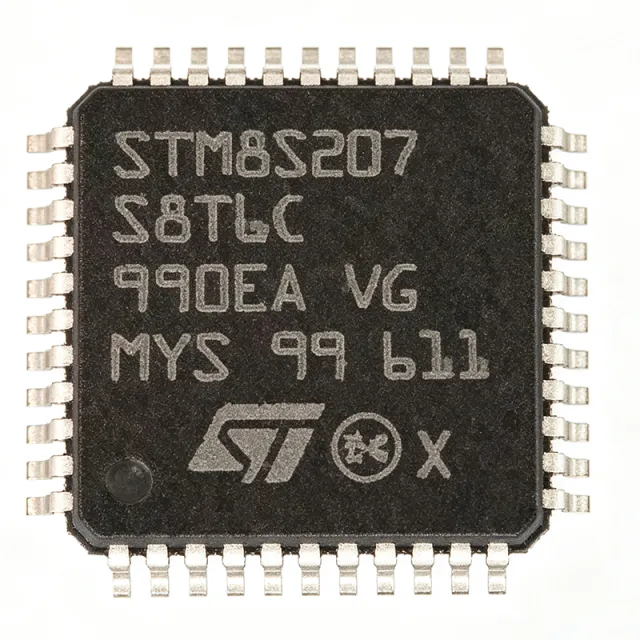
The STMicroelectronics STM8S207C8T3 is an 8-bit STM8 performance-line microcontroller with a 24 MHz clock, 64 KB of Flash program memory, and a 48-LQFP 7 x 7 mm package. The supplied distributor data identifies an 8-bit architecture and confirms 64 KB Flash; Mouser additionally lists 4 KB RAM. Designed as a compact embedded-control MCU, it combines mixed-signal measurement, communications, timing, and general-purpose I/O capabilities for cost-sensitive industrial and consumer equipment. An STM8S microcontroller belongs to the 8-bit MCU hierarchy: microprocessor core, embedded controller, and programmable digital control component. Unlike a discrete logic controller, an MCU integrates firmware memory, data memory, peripherals, and I/O in one package. This integration lets a design acquire sensor inputs, execute control logic, drive outputs, and exchange data with other assemblies without requiring several separate logic devices. Confirmed features include 24 MHz operation, 64 KB Flash, 4 KB RAM, 38 I/O ports, and a 3 V to 5.5 V supply range. The STM8S207 family description also identifies a 10-bit ADC, timers, two UARTs, SPI, I2C, and CAN. These interfaces support analog measurement, actuator control, serial peripherals, industrial networking, and service communications. The exact pin assignments and complete electrical limits require confirmation against the manufacturer documentation. At a maximum 24 MHz clock, the 8-bit MCU provides useful processing throughput without an external memory interface. Its 64 KB Flash supports embedded application code, while 4 KB RAM handles working data and stack operations. The 48-LQFP package exposes substantially more I/O than smaller packages, making the device suitable for connectorized control boards that need numerous digital, analog, and communications signals. Typical uses include industrial control modules, motor and relay-control boards, sensor acquisition units, CAN-connected equipment, communication bridges, and compact consumer appliances. A design can place the MCU beside sensors and power stages, then use its ADC and serial interfaces to acquire measurements while timers and GPIO control the system. Firmware and external circuitry still require validation for timing, analog accuracy, and EMC requirements. The principal layout consideration is careful decoupling and signal grouping around the 48-LQFP device. Keep the MCU supply path compact, place stable bypass capacitance at its supply pins, reserve adjacent routing for sensitive analog inputs, and separate high-current switching returns. Before layout approval, verify every ball-and-pad-style LQFP pin assignment against the official pinout and confirm oscillator, debug, reset, and communications routing requirements. This page consolidates verified distributor specifications, sourcing information, family capabilities, and practical selection considerations. It distinguishes confirmed STM8S207C8T3 values from unavailable details rather than estimating electrical limits, package pricing tiers, pin functions, or lifecycle compliance claims.

询价 联系我们
STM8S207C8T6 - 24MHz 8-bit MCU, 64KB Flash | STMicroelectronics
STM8S207C8T6

STM8S207C8T6 - 24MHz 8-bit MCU, 64KB Flash | STMicroelectronics

The STM8S207C8T6 is a performance-line 8-bit microcontroller from STMicroelectronics, built around a high-performance STM8 core running at up to 24 MHz. It integrates 64 KB of Flash program memory, 4 KB of RAM, and 2 KB of EEPROM, along with a rich peripheral set including a 10-bit ADC, multiple timers, two UARTs, SPI, I2C, and CAN. Housed in a 48-pin LQFP package, this MCU is designed for cost-sensitive industrial and consumer applications requiring robust performance and a wide operating voltage range of 2.95V to 5.5V. An 8-bit microcontroller (MCU) is a single-chip computer with an 8-bit data bus that integrates a processor core, memory (Flash, RAM, EEPROM), and programmable peripherals (timers, ADC, communication interfaces) on one die. In the system hierarchy, an 8-bit MCU sits below 16-bit and 32-bit MCUs in processing power but offers lower cost, simpler architecture, and lower power consumption, making it ideal for control-oriented tasks. The STM8S207C8T6 belongs to the STM8 family from STMicroelectronics, positioned between the low-cost STM8S value line and the 32-bit ARM-based STM32 MCUs. Key features include a 24 MHz CPU clock (20 MIPS), 64 KB Flash with read-while-write capability, 2 KB of true EEPROM rated for up to 300k write/erase cycles, and a 10-bit ADC with up to 10 multiplexed channels. Communication interfaces cover two UARTs, one SPI, one I2C, and a CAN 2.0B controller. Operation from 2.95V to 5.5V supports both 3.3V and 5V systems, with low-power modes reducing consumption below the 5.4 mA typical running current at 24 MHz. Technically, the STM8 core is a CISC architecture with a 3-stage pipeline and a single-wire debug interface (SWIM) supporting ICP and IAP programming. The LQFP-48 package provides 38 I/O pins, most with multiple alternate functions for flexible board design. Typical applications include industrial control systems, home appliances, motor control, sensor interfaces, and CAN-networked nodes in automotive and industrial systems, where the rich timer set supports PWM generation. Design tip: decouple VDD/VDDA with 100nF capacitors placed close to the device, add a pull-up on SWIM, and use an external transceiver (e.g., TJA1050) with 120-ohm bus termination for CAN.

询价 联系我们
STM8S207K6T6 - 24MHz 8-bit MCU, 32KB Flash | STMicroelectronics
STM8S207K6T6

STM8S207K6T6 - 24MHz 8-bit MCU, 32KB Flash | STMicroelectronics

The STM8S207K6T6 is a performance-line 8-bit microcontroller from STMicroelectronics, featuring a 24 MHz STM8 core with up to 32 Kbytes of Flash program memory. It integrates 2 Kbytes of data EEPROM, a 10-bit ADC, multiple timers, two UARTs, SPI, I²C, and CAN interfaces, all in a 32-pin LQFP package. This MCU is designed for cost-sensitive industrial and consumer applications requiring robust communication and control capabilities. An 8-bit microcontroller (MCU) is a single-chip computer with an 8-bit data bus, executing instructions on 8-bit words. It integrates a CPU, memory (Flash, RAM, EEPROM), and peripherals (timers, ADC, communication interfaces) on one die. In the system hierarchy, an 8-bit MCU sits below 16-bit and 32-bit MCUs in processing power but offers lower cost, simpler architecture, and lower power consumption, making it ideal for control-oriented tasks like motor control, sensor interfacing, and human-machine interfaces. The STM8S207K6T6 belongs to the STM8S20xxx performance line, which balances performance and peripheral richness for mid-range embedded applications. Key features include a 24 MHz CPU clock, 32 Kbytes of Flash, 2 Kbytes of RAM, 2 Kbytes of EEPROM, a 10-bit ADC with up to 10 channels, two 16-bit timers, one 8-bit timer, two UARTs, SPI, I²C, and a CAN 2.0B controller. The device operates from 2.95V to 5.5V, making it suitable for 3.3V and 5V systems. It also features a low-power mode with typical current consumption of 5.4 mA at 24 MHz, and a halt mode with 1.5 µA typical current. The STM8S207K6T6 uses a Harvard architecture with a 3-stage pipeline, achieving up to 20 MIPS at 24 MHz. It includes an embedded debug module (SWIM) for in-circuit debugging and programming, and a single-wire interface for firmware updates. The CAN controller supports CAN 2.0B active mode, enabling robust industrial networking. The device is manufactured using ST's proprietary 130nm process, balancing performance and power efficiency. Typical applications include industrial control systems, home appliances, automotive body electronics (non-safety), sensor nodes, and communication gateways. The CAN interface makes it particularly suitable for automotive and industrial CAN bus networks, while the multiple UARTs and SPI/I²C support diverse peripheral connectivity. When designing with this MCU, ensure proper decoupling of the VDD and VDDA pins with 100nF capacitors placed close to the pins. The SWIM pin should be pulled up with a 10kΩ resistor for reliable programming. For CAN applications, an external CAN transceiver (e.g., TJA1050) is required, and the bus termination resistor should be 120Ω at each end of the CAN bus.

询价 联系我们
STM8S207R6T6 - 24MHz 8-Bit MCU 32KB Flash LQFP-64 | STMicroelectronics
STM8S207R6T6

STM8S207R6T6 - 24MHz 8-Bit MCU 32KB Flash LQFP-64 | STMicroelectronics

The STMicroelectronics STM8S207R6T6 is a performance-line 8-bit STM8S microcontroller built around a CISC Harvard architecture core running at 24 MHz (20 MIPS) with 32 KB of on-chip Flash program memory and up to 2 KB of SRAM plus an integrated EEPROM data area. It integrates a 10-bit ADC, two 16-bit timers plus one 8-bit timer, two UARTs, SPI, I2C, and CAN, all in a 64-pin LQFP (T6 suffix) package operating from 2.95 V to 5.5 V. The device is positioned in the STM8S20xxx family which scales from 32 KB to 128 KB Flash and is intended for cost-sensitive motor-control, appliance, and industrial-control applications. An 8-bit microcontroller (MCU) is a single-chip computer that integrates a CPU, non-volatile program memory, working RAM, and peripherals onto one silicon die. The STM8 family uses a CISC 8-bit core with a 16-bit instruction word, giving higher code density than legacy 8051 cores while retaining the predictable interrupt latency and deterministic timing that embedded control designers prefer. The STM8S207 series specifically belongs to the STM8S "performance line," sitting above the access-line STM8S103 and below the value-line STM8S105, and is paired with ST's Cosmic, IAR, and Raisonance toolchains plus the free STVD development environment. Key features of the STM8S207R6T6 include a 20 MIPS peak instruction throughput at 24 MHz, integrated CAN 2.0B interface, a 1 Mbyte linear address space, a single-wire SWIM debug interface, and an embedded bootloader stored in ROM for in-application Flash programming. The device offers 38 GPIOs with 5 V tolerance on most pins and supports up to 16 external interrupts. Watchdog, auto-wakeup, and a 4-level low-power run/wait/slow/halt scheme allow the device to drop quiescent current below 5 uA in Halt with full RAM retention. Architecturally, the STM8S core pairs a 32-bit program address bus with a 24-bit data address bus and supports up to 16 Mbytes of linear addressing for data, while code is read from a separate Flash bus. This Harvard split removes fetch-decode stalls that plague older 8-bit Von Neumann designs and is the reason the family reaches 20 MIPS at 24 MHz without wait states. A 32 KB Flash variant such as the STM8S207R6 sits at the low-memory end of the family, sharing the same peripheral set as the larger 64 KB (R8) and 128 KB (RB) siblings. Typical applications include BLDC/PMSM motor control in appliances, HVAC fan and pump control, smart metering, lighting ballast control, industrial sensor hubs, and CAN-connected remote I/O nodes. The integrated CAN controller, combined with 32 KB Flash, makes the part a good fit for distributed industrial nodes that need deterministic on-chip comms without an external transceiver MCU. When designing with the STM8S207R6T6, pay attention to the 5 V I/O tolerance (most pins are true 5 V tolerant, but a few high-current pins are FT-compat only) and to the SWIM pin shared with NRST; the debug probe needs a tri-state buffer on the SWIM line for in-circuit debugging without disabling reset. The internal 16 MHz HSI RC is accurate to about 1 percent after user trimming, but designs that need CAN bit-time accuracy must select the external HSE crystal option. This page synthesizes distributor pricing, drop-in LQFP-64 alternatives, and practical hardware design notes not found in the manufacturer datasheet alone.

询价 联系我们
STM8S207S8T6 - 24MHz 8-bit MCU, 64KB Flash | STMicroelectronics
STM8S207S8T6

STM8S207S8T6 - 24MHz 8-bit MCU, 64KB Flash | STMicroelectronics

The STM8S207S8T6 is a performance-line 8-bit microcontroller from STMicroelectronics, operating at up to 24 MHz with 64 Kbytes of Flash program memory. It is part of the STM8S20xxx family, which offers from 32 to 128 Kbytes of Flash, and is housed in a 44-pin LQFP package. The device integrates a rich set of peripherals including a 10-bit ADC, multiple timers, two UARTs, SPI, I2C, and CAN, making it suitable for a wide range of industrial and consumer applications. An 8-bit microcontroller (MCU) is a single-chip computer with an 8-bit data bus, executing instructions on 8-bit words. It typically integrates a CPU core, memory (Flash, RAM, EEPROM), and programmable peripherals on a single die. In the system hierarchy, an 8-bit MCU sits below 16-bit and 32-bit counterparts in processing power but offers lower cost, simpler architecture, and adequate performance for control-oriented tasks. The STM8S207S8T6 belongs to the STM8S performance line, which is designed for applications requiring higher clock speeds and richer connectivity than the value line, while maintaining the ease of use and robustness of the STM8 core. Key features of the STM8S207S8T6 include a 24 MHz CPU clock, 64 KB of Flash memory, 2 KB of data EEPROM, and a 10-bit ADC with up to 16 multiplexed channels. It also provides two UARTs, one SPI, one I2C, and a CAN 2.0B interface, enabling flexible communication in industrial networks. The device operates from a 3.3V or 5V supply, with a wide operating temperature range of -40°C to +85°C, and is available in a 44-pin LQFP package with a 10x10 mm body and 0.8 mm pitch. Technically, the STM8S207S8T6 is built on a high-performance 8-bit core with a three-stage pipeline, achieving up to 20 MIPS at 24 MHz. It includes a nested interrupt controller, a clock controller with multiple sources (internal RC, external crystal, or PLL), and a comprehensive set of timers including a 16-bit advanced control timer, two 16-bit general-purpose timers, and an 8-bit basic timer. The device also features a CAN controller with 3 mailboxes, supporting both standard and extended identifiers, which is critical for automotive and industrial networking. Typical applications include industrial control systems, home appliances, power tools, and automotive body electronics. The CAN interface makes it particularly suitable for automotive networks, while the rich timer set and ADC support motor control and sensor interfacing. The 5V tolerance simplifies direct connection to legacy sensors and actuators without level shifting. When designing with this MCU, ensure proper decoupling of the VDD and VDDA pins with 100 nF capacitors placed close to the device. The internal RC oscillator can be used for cost-sensitive designs, but for precise timing, an external crystal is recommended. The STM8S207S8T6 supports in-circuit programming and debugging via the SWIM interface, which requires a single-wire connection and simplifies firmware updates.

询价 联系我们
STM8S207SBT6C - 24MHz 8-bit MCU 128KB Flash LQFP-44 | STMicroelectronics
STM8S207SBT6C

STM8S207SBT6C - 24MHz 8-bit MCU 128KB Flash LQFP-44 | STMicroelectronics

The STMicroelectronics STM8S207SBT6C is a 24 MHz 8-bit STM8S microcontroller with 128 KB program Flash and integrated EEPROM, housed in a 44-pin LQFP package. As a member of the STM8S performance line, this part delivers up to 24 MIPS CPU throughput, integrates a 10-bit ADC, multiple 16-bit timers, two UARTs, SPI, I2C and CAN peripherals, and is rated for 3.0 V to 5.5 V single-supply operation. An 8-bit MCU (microcontroller unit) is a self-contained computing IC that integrates a CPU core, non-volatile program memory (Flash), read/write data memory (RAM/EEPROM), and configurable peripherals (ADC, timers, communication interfaces) on a single die. Within the broader semiconductor taxonomy, an MCU is a sub-category of microcontroller -> embedded processor -> semiconductor device. The STM8S family uses a Harvard-architecture CISC core designed for deterministic real-time control, balancing low power, high code density, and 5 V tolerance that simplifies interfacing to legacy analog and industrial peripherals. The STM8S207SBT6C's key specifications include 38 general-purpose I/O lines, a 10-bit successive-approximation ADC with up to 16 channels, a 1 KB true-EEPROM data area plus 6 KB user RAM, two UARTs (including LIN master capability), one SPI peripheral, one CAN 2.0B interface, and a beCAN controller. Integrated reset circuitry, internal 16 MHz RC oscillator, and window watchdog reduce external component count. The part supports up to 30 kV ESD HBM and operates across -40 °C to +85 °C. Architecturally the STM8S uses a modified Harvard layout, 32-bit program counter with 24-bit linear addressing, and a single-cycle 8x8 multiplier, providing efficient C code generation. The 5 V-tolerant GPIO eliminates level shifters when interfacing to legacy 5 V sensors and drivers, while the integrated CAN controller removes the need for an external transceiver controller. A flexible clock tree with internal 16 MHz HSI reduces external crystal cost for cost-sensitive designs. Typical applications include industrial sensor conditioning nodes, building automation controllers, smart metering peripherals, automotive body and chassis subsystems, low-end motor control boards, and white-goods user-interface modules. Designers choose this STM8S207 variant when 128 KB Flash headroom is needed for communication stacks (CANopen, Modbus) while staying inside the 5 V-tolerant 8-bit ecosystem. A critical design consideration is power budgeting: at 24 MHz the core draws roughly 10 mA plus peripheral contributions, so a clean 3.3 V or 5 V LDO rail is recommended. Decouple VDD/VSS pairs with 100 nF X7R ceramic capacitors placed within 3 mm of each pin pair, and reserve a 4.7 uF bulk capacitor on the main rail. The CAN bus requires a 120 ohm termination offset on each end and a common-mode choke for industrial EMC compliance. This page synthesizes distributor pricing, drop-in alternatives, and practical design notes not consolidated on the manufacturer datasheet or individual supplier listings.

询价 联系我们
STM8S208C8T6 - 8-Bit 24MHz MCU, 64KB Flash | STMicroelectronics
STM8S208C8T6

STM8S208C8T6 - 8-Bit 24MHz MCU, 64KB Flash | STMicroelectronics

The STM8S208C8T6 is a high-performance 8-bit microcontroller from STMicroelectronics, part of the STM8S Performance line. It operates at a maximum frequency of 24 MHz and features 64 KB of Flash memory, 2 KB of EEPROM, and 4 KB of RAM. The device is housed in a 48-pin LQFP package (7x7 mm) and supports a supply voltage range of 2.95V to 5.5V, making it suitable for a wide range of industrial and consumer applications. An 8-bit microcontroller (MCU) is a single-chip computer with an 8-bit central processing unit (CPU), memory, and peripherals. It is a type of embedded processor used to control electronic systems. In the hierarchy of computing devices, an 8-bit MCU is a subset of microcontrollers, which are a subset of embedded systems, which are a subset of electronic systems. The STM8S208C8T6 is a CISC (Complex Instruction Set Computer) architecture MCU, offering a rich instruction set and efficient code density. Key features of the STM8S208C8T6 include a 10-bit analog-to-digital converter (ADC) with up to 16 channels, multiple timers (including a 16-bit advanced control timer, a 16-bit general-purpose timer, and a basic timer), and a comprehensive set of communication interfaces: two UARTs, one SPI, one I2C, and one CAN interface. The device also includes an integrated EEPROM for data storage, a watchdog timer, and a low-power mode for energy-efficient operation. The STM8S208C8T6 is built on a high-performance 8-bit core with a three-stage pipeline, achieving up to 20 MIPS at 24 MHz. It features a flexible clock control with an internal RC oscillator, an external crystal oscillator, and a phase-locked loop (PLL) for frequency multiplication. The device supports in-circuit programming and debugging via the SWIM (Single Wire Interface Module) interface, simplifying firmware development and field updates. Typical applications include industrial control systems, home automation, consumer electronics, automotive body electronics, and power management. The CAN interface makes it particularly suitable for automotive and industrial networking applications where robust communication is required. The wide operating voltage range and low-power modes enable battery-powered and energy-harvesting designs. When designing with the STM8S208C8T6, ensure proper decoupling of the power supply pins with 100nF capacitors placed close to the VDD and VSS pins. The SWIM interface should be reserved for programming and debugging. For CAN applications, an external CAN transceiver (e.g., TJA1050) is required. The device is RoHS compliant and available in tray packaging.

询价 联系我们
STM8S208R8T6 - 8-Bit 24MHz 64KB Flash MCU | STMicroelectronics
STM8S208R8T6

STM8S208R8T6 - 8-Bit 24MHz 64KB Flash MCU | STMicroelectronics

The STM8S208R8T6 is a high-performance 8-bit microcontroller from STMicroelectronics' STM8S series, featuring a 24 MHz CPU core, 64KB of Flash program memory, and 6KB of RAM. It is housed in a 64-pin LQFP package (10x10 mm) and operates from a 3.3V or 5V supply, making it suitable for a wide range of industrial and consumer applications. An 8-bit microcontroller (MCU) is a single-chip computer with an 8-bit data bus, integrating a CPU, memory, and peripherals. The STM8S series is a family of 8-bit MCUs from STMicroelectronics, positioned between low-end 8-bit devices and 32-bit ARM-based MCUs. It offers a cost-effective solution for applications requiring moderate processing power, rich peripherals, and low power consumption. The STM8S208R8T6 belongs to the performance line, which provides higher clock speeds and more memory compared to access line devices. Key features include a 24 MHz maximum CPU frequency with 0 wait states, 64KB of Flash memory, 6KB of RAM, and 2KB of EEPROM. It integrates a 10-bit ADC with up to 16 channels, multiple 16-bit timers, two UARTs, SPI, I2C, and a CAN interface. The device also includes a watchdog timer, brown-out reset, and low-power modes, enhancing reliability and energy efficiency. The STM8S208R8T6 is built on ST's advanced 8-bit core architecture, which delivers up to 20 MIPS at 24 MHz. It features a Harvard architecture with separate instruction and data buses, allowing simultaneous instruction fetch and data access. The integrated EEPROM enables non-volatile data storage without external components, and the CAN interface supports robust communication in automotive and industrial networks. Typical applications include industrial control systems, home appliances, automotive body electronics, and communication modules. The CAN interface makes it ideal for automotive networks, while the rich timer and ADC peripherals suit motor control and sensor interfacing. The wide operating voltage range (2.95V to 5.5V) ensures compatibility with both 3.3V and 5V logic systems. When designing with this MCU, ensure proper decoupling of the power supply and a stable clock source. The device supports multiple clock sources, including an internal RC oscillator and external crystal. For low-power applications, utilize the halt and active-halt modes to reduce current consumption. The CAN interface requires an external transceiver, such as the TJA1050, for physical layer connectivity.

询价 联系我们
STM8S208RBT6 - 8-Bit 24MHz 128KB Flash MCU | STMicroelectronics
STM8S208RBT6

STM8S208RBT6 - 8-Bit 24MHz 128KB Flash MCU | STMicroelectronics

STMicroelectronics STM8S208RBT6 is an 8-bit STM8S performance-line microcontroller operating at 24MHz with 128KB of Flash program memory and up to 20MIPS throughput. It is supplied in a 64-pin LQFP package and supports 3.3V and 5V operation according to the verified product listings. Integrated peripherals include a 10-bit ADC, timers, two UARTs, SPI, I2C, and CAN. An STM8S microcontroller belongs to the 8-bit embedded-control segment of the semiconductor hierarchy. These devices combine a compact CISC core, embedded nonvolatile memory, analog conversion, serial communication, and timing peripherals in one package. They are used where deterministic control, low system complexity, and economical embedded intelligence are more important than the processing power and memory bandwidth of a 32-bit Cortex-M MCU. The STM8S208RBT6 combines 128KB Flash with a 24MHz clock, delivering 20MIPS as identified by Mouser. Its integrated 10-bit ADC supports measurements without a separate converter, while two UARTs, SPI, I2C, and CAN provide several paths for sensors, displays, industrial networks, and external controllers. This interface density makes the device suitable for compact industrial controllers, motor-control helpers, communication gateways, and embedded measurement products. As an STM8S20xxx performance-line part, the device belongs to a family offered from 32KB through 128KB Flash. The selected 128KB configuration provides more program space than lower-density variants while preserving the familiar STM8S peripheral and software environment. This supports protocol stacks, application logic, logging, and parameter handling in a single embedded controller. Typical applications include CAN-connected industrial nodes, sensor acquisition and control, motor or actuator supervision, and compact communication equipment. The CAN interface is valuable when the design must participate in a bus network, while the ADC and multiple serial interfaces support local sensing. Designers should still verify timing, peripheral availability, pin multiplexing, and memory requirements in the manufacturer documentation before finalizing firmware. The principal design consideration is that software compatibility does not guarantee an unconditional drop-in replacement. Firmware startup code, interrupt vectors, peripheral configuration, clock settings, and PCB pad assignments must all be checked. For new designs, the 128KB Flash capacity and broad mixed-signal connectivity can reduce external components, but the 64-pin LQFP footprint requires adequate board area and careful routing of analog and communication signals. This product page combines verified manufacturer, distributor, and cross-reference information with practical design guidance. It helps engineers assess the STM8S208RBT6, compare documented same-family options, understand its peripherals, and plan sourcing and PCB integration without presenting unsupported electrical values.

询价 联系我们
STM8S903F3M6 - 16MHz 8KB 8-Bit MCU | STMicroelectronics
STM8S903F3M6

STM8S903F3M6 - 16MHz 8KB 8-Bit MCU | STMicroelectronics

The STMicroelectronics STM8S903F3M6 is an 8-bit STM8S-series microcontroller operating at 16 MHz, with 8 KB of Flash memory, 16 I/O ports, and a 20-SOIC package. According to the verified distributor data, it is available in a 20-SO package and is identified as an active, RoHS-compliant device with a 2.95 V to 5.5 V supply-voltage range. What is an 8-bit microcontroller? An MCU is a semiconductor device that combines a processor core, program memory, data memory, and peripherals on one integrated circuit. The STM8S903F3M6 belongs to the 8-bit MCU -> embedded microcontroller -> semiconductor hierarchy and is intended for compact control, measurement, and communication systems where a dedicated processor, memory, and serial interfaces are required. Verified specifications identify 8 KB of Flash memory, 1 KB of RAM, 640 bytes of EEPROM, a 10-bit ADC, two timers, UART, SPI, and I²C. These peripherals make the device suitable for sensor acquisition, actuator control, industrial instrumentation, and low-cost embedded products. The 16 MHz clock provides the processing headroom needed for basic control loops and serial data handling, although the verified data does not specify the complete peripheral timing or ADC accuracy. The STM8S903F3M6 uses a 20-SOIC package, also described as a 0.295-inch, 7.50 mm-width SOP package in the verified distributor data. The SOIC outline is a surface-mount package with gull-wing leads, making it suitable for conventional PCB assembly and prototype-to-production transfer. The package pinout and exposed thermal-pad details are not included in the supplied verified data, so the pinout is reported as null rather than inferred. Typical applications include compact industrial controllers, low-power sensor nodes, simple motor or relay-control boards, data-acquisition modules, UART-to-digital bridges, and small SPI or I²C peripheral boards. The STM8 family can be paired with external sensors and communication transceivers, while the integrated ADC supports analog measurement. Final firmware support should be confirmed with the applicable STMicroelectronics development tools and device documentation. For PCB design, preserve the manufacturer's recommended decoupling and grounding layout, and verify all peripheral pins, reset behavior, clock requirements, and package dimensions against the official datasheet before production. This page combines verified distributor specifications, package data, sourcing information, and engineering-oriented application guidance without treating unverified details as guaranteed specifications.

询价 联系我们
STM8S903K3T6 - 8-bit MCU, 8KB Flash, 16MHz | STMicroelectronics
STM8S903K3T6

STM8S903K3T6 - 8-bit MCU, 8KB Flash, 16MHz | STMicroelectronics

The STM8S903K3T6 is an 8-bit microcontroller from STMicroelectronics' STM8S access line, featuring 8 Kbytes of Flash program memory, 1 Kbyte of RAM, and 640 bytes of true data EEPROM. It operates at a clock speed of 16 MHz and is supplied in a 32-pin LQFP package, offering a compact solution for a wide range of embedded control applications. An 8-bit microcontroller (MCU) is a single-chip computer with an 8-bit central processing unit (CPU), memory, and programmable input/output peripherals. It is the foundational building block in the hierarchy of embedded systems, sitting below 16-bit and 32-bit MCUs in processing power but offering lower cost, lower power consumption, and simpler programming. The STM8S903K3T6 belongs to the STM8S family, which is designed for general-purpose industrial and consumer applications, bridging the gap between simple 8-bit controllers and more complex 32-bit processors. Key features of the STM8S903K3T6 include a 10-bit analog-to-digital converter (ADC) with up to 7 multiplexed channels, two 16-bit timers, a UART for serial communication, an SPI interface, and an I2C interface. The device also integrates a true data EEPROM with read-while-write capability, enabling non-volatile data storage without external components. The supply voltage range of 2.95V to 5.5V allows operation from standard 3.3V and 5V power rails, making it versatile for mixed-voltage systems. The STM8S903K3T6 is built on ST's advanced 8-bit core architecture, which delivers up to 16 MIPS at 16 MHz, providing efficient execution of control algorithms. The integrated EEPROM and robust clock management, including an internal RC oscillator and optional external crystal, simplify system design by reducing external component count. The device also features low-power modes, including Active-Halt and Halt modes, to minimize energy consumption in battery-powered applications. Typical applications include industrial control systems, home automation, consumer electronics, and automotive body electronics. The combination of analog and digital peripherals, along with the wide operating voltage range, makes it suitable for sensor interfacing, motor control, and communication bridging tasks. The 32-pin LQFP package provides a good balance between I/O count and board space, supporting compact PCB layouts. When designing with the STM8S903K3T6, ensure proper decoupling of the VDD and VDDA pins with 100nF capacitors placed close to the device. The internal RC oscillator is accurate to ±1% over temperature, but for applications requiring precise timing, an external crystal can be connected to the OSC_IN and OSC_OUT pins. The device's EEPROM endurance is rated for 100,000 write/erase cycles, making it suitable for frequent data logging applications.

询价 联系我们
STMP3770XXBJEA2N - i.MX233/235 Audio/Video Decoder SoC | NXP
STMP3770XXBJEA2N

STMP3770XXBJEA2N - i.MX233/235 Audio/Video Decoder SoC | NXP

The NXP (formerly Freescale Semiconductor) STMP3770XXBJEA2N is a fifth-generation audio/video decoder SoC from the STMP3700 series, designed for portable media players, digital photo frames, and consumer multimedia appliances. It integrates an ARM926EJ-S CPU core with vector floating-point unit (VFP), hardware video decoding for H.264/MPEG-4/H.263/WMV9/VC-1 at D1 (720x480) resolution, and dedicated audio processing for MP3, WMA, AAC, Ogg Vorbis, and FLAC. The device is offered in a compact BGA package and is qualified for consumer-grade temperature operation. This particular MPN (XXBJEA2N) is a customer-specific suffix variant; full datasheets are available only to qualified customers under NXP NDA due to the device's use in commercial media-player products. What is an audio/video decoder SoC? An SoC (System-on-Chip) decoder is a highly integrated IC that combines a CPU, hardware video decoder, audio DSP, memory controller, peripheral interfaces, and power management in one package. SoC decoders occupy the third tier of the consumer multimedia hierarchy: general-purpose SoCs -> application-specific media SoCs -> STMP3700-family decoders. By consolidating decoding, processing, and I/O functions, these devices replace a discrete 4-6 chip set that would otherwise be required to build a portable player, reducing BOM cost and PCB area by 60-70%. Key features of the STMP3770XXBJEA2N include a hardware video pipeline supporting 720x480 D1 resolution at 30fps, a 32-bit LPDDR/DDR memory interface, integrated USB 2.0 HS OTG, NAND flash controller with ECC, I2S/PCM audio interfaces, and a 12-bit ADC for touch-screen/keypad support. The STMP3770 family also features an integrated Li-Ion battery charger and power-path management block. Architecturally, the device pairs the ARM926EJ-S host CPU (which runs the system kernel, file system, and user interface) with a dedicated media accelerator that offloads codec work. This heterogeneous compute approach yields long battery life in portable applications while delivering full-D1 video decode at low MHz - critical for thermal-limited, fanless enclosures. Typical applications include portable media players (PMP), digital photo frames, portable DVD players, GPS devices with video playback, e-book readers with audio, and connected home audio docks. Each application benefits from the integrated codec support and low-power operation. The STMP3700 series was a dominant SoC for low-cost media players from approximately 2009-2014. When designing with this part, note that source code, board support packages (BSP), and full datasheets are gated under NXP NDA; third-party BSPs (such as the Rockbox port) exist for hobbyist use. Designers should verify lead-time and minimum order quantities before committing to a new design because the part is in mature/end-of-life status. This page synthesizes distributor stock from DigiKey, Octopart, and JAK Electronics, cross-references available substitute listings, and consolidates practical design notes not found in a single manufacturer datasheet to help engineers and sourcing specialists make an informed decision.

询价 联系我们
STPA001 - 4 x 50W Class AB Audio Amplifier | STMicroelectronics
STPA001

STPA001 - 4 x 50W Class AB Audio Amplifier | STMicroelectronics

The STMicroelectronics STPA001 is a 4-channel Class AB audio power amplifier built with Multipower BCD technology and MOSFET output stages for high-power car-radio systems. It supports operation down to 6 V, includes a fully complementary P-channel/N-channel output structure for rail-to-rail output swing, and is identified as a quad bridge power amplifier rated up to 50 W per channel under the manufacturer’s stated test conditions. The device is supplied in a 25-Flexiwatt vertical package. A Class AB audio amplifier is a linear power-amplifier category that uses conduction overlap between push-pull output devices to reduce crossover distortion compared with Class B designs. An audio power amplifier converts a low-level audio signal into a current- and voltage-capable drive signal for loudspeakers. STPA001 occupies the power-amplifier IC, audio amplifier, and automotive infotainment electronics hierarchy rather than a small-signal or signal-conditioning amplifier role. Key features include MOSFET output power stages, high output-current capability, low Hi-Fi-class distortion, low output noise, excellent 2 Ω driving capability, standby support, and disturbance immunity. The manufacturer describes operation down to 6 V as suitable for automotive start-stop battery profiles. Its bridge configuration is intended for car-radio speaker loads, where differential speaker drive can increase usable output voltage into the load compared with a single-ended output. The P-channel/N-channel complementary output architecture is significant because it provides rail-to-rail output-voltage swing while reducing saturation losses. That behavior helps maximize the useful output signal available to the speaker and supports the amplifier’s high-power automotive use case. The IC is intended for audio systems where low distortion and controlled output noise are more important than the efficiency of a switching audio stage. Typical applications include automotive head units, car-radio power stages, four-channel speaker systems, audio sub-system amplification, and other vehicle infotainment platforms. The 6 V minimum operating capability makes it relevant to modern vehicle electrical environments, particularly where battery voltage can fall during engine stop or cranking events. The bridge outputs must be paired with the appropriate speaker wiring arrangement shown in the manufacturer’s application information. The main design consideration is power dissipation and heat spreading in the 25-Flexiwatt package. Actual thermal performance depends on supply voltage, speaker impedance, output power, channel loading, PCB copper, and ambient temperature. A replacement must match the package footprint, pinout, bridge-output topology, voltage range, channel count, and thermal conditions; simply matching nominal wattage is not sufficient for a safe drop-in substitution. This page consolidates the verified STPA001 product description, manufacturer datasheet, distributor listing information, and application guidance. It also distinguishes documented facts from parameters that were not supplied, avoiding invented ratings or unsupported replacement claims.

询价 联系我们
STPA001A - 4 x 50W Quad Bridge Audio Amplifier | STMicroelectronics
STPA001A

STPA001A - 4 x 50W Quad Bridge Audio Amplifier | STMicroelectronics

The STMicroelectronics STPA001A is a four-channel Class AB MOSFET bridge power amplifier rated for 4 x 50 W output and supplied from 6 V to 18 V. It is packaged in the vertically formed 27-Flexiwatt power package for high-power car-radio and automotive audio systems. The device uses Multipower BCD technology, a fully complementary P-channel/N-channel MOSFET output stage, standby and mute inputs, clip detection, and offset detection. An audio power amplifier is an integrated circuit that drives loudspeakers rather than only providing a low-power line signal. This STPA001A belongs to the class-AB power-amplifier hierarchy, combining MOSFET output stages with audio signal processing and protection functions. Its bridge topology allows differential speaker drive, while the Class AB biasing supports lower crossover distortion than a typical switching amplifier at the cost of higher standing dissipation. Key verified features include output capability of 50 W per channel into 4 ohms at 14 V and 72 W per channel into 2 ohms at 14 V, low-voltage operation from 6 V to 18 V, excellent two-ohm drive capability, low output noise, and high disturbance immunity. The standby and mute controls support system-level power management, while clip and offset detection support diagnostic or protection functions. The MOSFET output stage is designed for rail-to-rail output swing and high output current. STMicroelectronics describes the device as a class-AB audio power amplifier intended for high-power car radio applications. The datasheet also identifies its 27-Flexiwatt vertical package, which is a thermally relevant power-dissipation package and must be mounted with suitable copper and thermal design. Typical uses include automotive head-unit amplifier stages, car-radio speaker drives, four-channel cabin audio systems, and other bridge-tied audio loads where a low-voltage battery supply is available. The four-channel architecture allows independent regulation of four speaker outputs when configured with the required passive network and load arrangement. Designers should confirm the exact load impedance, supply voltage, thermal pad implementation, output-filter network, and pin-level application circuit in the STMicroelectronics datasheet before layout. Because power dissipation rises with voltage difference and output current, the PCB copper area and thermal path are critical. This page combines verified manufacturer and distributor information with engineering guidance for amplifier selection, thermal implementation, and application planning.

询价 联系我们
STPA001AH - Quad 4x50W Class AB Audio Amplifier | STMicroelectronics
STPA001AH

STPA001AH - Quad 4x50W Class AB Audio Amplifier | STMicroelectronics

The STMicroelectronics STPA001AH is a four-channel Class AB audio power amplifier rated at 4 x 50 W and supplied in a 27-Flexiwatt horizontal power package. Its quad bridge-tied-load configuration is designed for high-power car-radio audio systems. The verified distributor data identifies low-voltage operation, standby and mute inputs, clip detection, offset detection, and MOSFET output technology, but several detailed electrical limits are not available in the supplied sources. A Class AB audio amplifier is an audio amplifier that uses conduction overlap between its output transistors to reduce crossover distortion compared with a pure Class A amplifier. In the broader electronics hierarchy, an audio amplifier belongs to amplifier ICs, analog signal-chain ICs, and semiconductor components. The bridge-tied-load arrangement uses each output stage differentially, allowing speaker current flow in both directions without a conventional DC-blocking output capacitor. Key verified features include four output channels, Class AB operation, up to 50 W per channel as stated by distributor listings, a 27-pin horizontal Flexiwatt package, standby and mute control, clip detection, and offset detection. The standby function can place the amplifier into a low-power state, while mute supports controlled audio attenuation. Clip and offset detection give the surrounding controller useful status signals for protecting the output stage or diagnosing abnormal operation. The STPA001 family uses MOSFET technology for its audio output stage and targets automotive head units, where four speakers or multiple powered speaker channels are common. Compared with an external discrete amplifier made from many transistors and resistors, the integrated quad amplifier reduces board area and assembly effort. Its principal engineering trade-off is substantial heat: actual channel power depends on supply voltage, speaker impedance, distortion limit, thermal conditions, and PCB copper, none of which is fully specified in the supplied data. Typical applications include car-radio head units, automotive infotainment systems, four-speaker cabin audio, powered multimedia enclosures, and low-voltage high-power audio racks when the thermal and supply conditions match the complete manufacturer specification. Each speaker output must connect to a bridge-tied load; grounding either speaker terminal to chassis ground is not an equivalent wiring method. Before layout, obtain the manufacturer datasheet and verify the exact pinout, supply limits, speaker impedance, output-power conditions, thermal resistance, protection limits, exposed-tab connection, and decoupling requirements. Keep the power ground and output-current paths compact, use the prescribed input and bypass capacitors, and thermally couple the horizontal Flexiwatt tab to the PCB copper according to the manufacturer layout guidance. This page consolidates verified distributor descriptions, sourcing information, application context, and design cautions. Parameters not present in the supplied sources remain explicitly marked for verification rather than being inferred from generic Flexiwatt or Class AB amplifier data.

询价 联系我们