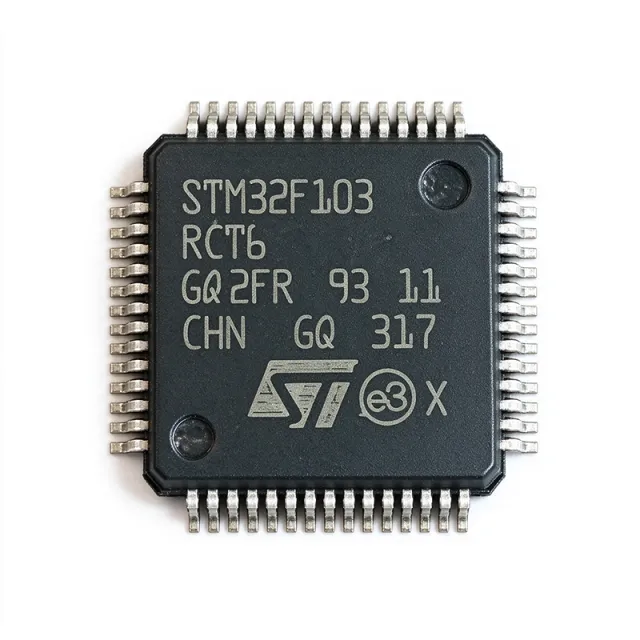
STM32F103RCY6CTR
STM32F103RCY6CTR - 256KB Cortex-M3 MCU | STMicroelectronics
STMicroelectronics STM32F103RCY6CTR is a 32-bit ARM Cortex-M3 microcontroller with 256 KB of Flash memory in a 64-UFBGA/WLCSP package. The high-density STM32F103 device combines USB, CAN, 11 timers, 3 ADCs, and 13 communication interfaces for compact embedded-control, industrial automation, metering, motor-control, and connected-device designs. Its 64-lead wafer-level chip-scale package supports space-constrained boards requiring substantial peripheral integration without a large leaded footprint.
An ARM Cortex-M3 microcontroller is a 32-bit embedded processor that combines a CPU core, memory, interrupt control, and peripherals on one integrated circuit. It belongs to the microcontroller hierarchy and executes firmware directly from embedded Flash. Compared with a general-purpose processor, the STM32F103 architecture is designed for real-time control, low-power operation, deterministic peripheral access, and compact industrial or commercial products.
The STM32F103RCY6CTR provides 256 KB of Flash for program storage, 3 ADC channels, and a peripheral set covering USB, CAN, timers, and multiple serial communication interfaces. USB and CAN support respectively removable data exchange and robust controller-area-network communications. The 11 timers support periodic timing, input capture, output compare, encoder-related measurement, and motor-control sequencing, while the 3 ADC channels provide analog-to-digital conversion for sensing and feedback applications.
The STM32F103 series is positioned by STMicroelectronics as its mainstream value line of high-density ARM-based microcontrollers. Its combination of Cortex-M3 processing, extensive timers, analog conversion, and communication peripherals allows a single device to consolidate functions that might otherwise require several discrete components. Software design should still account for the exact peripheral assignments and alternate-function settings listed in the manufacturer pin and reference documents.
Typical applications include industrial control boards, IoT gateways, USB-connected instruments, CAN-based monitoring equipment, electronic meters, compact motor controllers, and low-power embedded products. The 64-UFBGA/WLCSP format is especially useful for space-sensitive products, but its fine pitch requires careful PCB layout, solder-paste control, X-ray inspection, and assembly-process qualification.
Designers should review the package drawing, land pattern, exposed-pad or thermal requirements, and recommended PCB stack-up before layout. Firmware and peripheral configurations should be validated against the STM32F103 reference manual, especially for alternate-function pins, clock configuration, USB suspend behavior, and CAN timing. Because this package has a fine ball-grid pitch, assembly yield is as important as electrical performance.
This product page consolidates the identified electrical characteristics, package information, sourcing guidance, alternative-device caveats, and practical implementation considerations into one engineering-focused resource. It also distinguishes true pin-compatible substitution from broader MCU equivalence, helping teams evaluate second sourcing without overlooking memory, firmware, timing, qualification, or PCB-change risks.
询价
联系我们