产品(39,000+)

LM339DTBR2 - 4-Channel Open-Collector Comparator | onsemi
LM339DTBR2

LM339DTBR2 - 4-Channel Open-Collector Comparator | onsemi

onsemi LM339DTBR2 is a four-channel general-purpose differential comparator with CMOS inputs, open-collector outputs, and TTL-compatible output levels. It operates from a single supply over a 2 V to 36 V range and is packaged in a 14-pin TSSOP for surface-mount assembly. The four independent channels support threshold detection, level sensing, and open-drain bus signaling in industrial and embedded systems. A comparator is an analog semiconductor that compares one voltage with another and changes its output state when the differential input crosses a selected threshold. The LM339 family belongs to the comparator hierarchy within integrated circuits, where each independent channel can monitor an input voltage against a reference or another signal. Open-collector outputs provide wired-AND behavior when several channels pull up a common bus. The device provides four comparison channels, a wide 2 V to 36 V single-supply operating range, and CMOS input characteristics combined with TTL-compatible outputs. The open-collector architecture allows the output pull-up voltage and current to be selected externally. This makes the LM339 adaptable to transistor-driven relays, open-drain buses, and systems that require multiple low- or high-side signaling nodes. Each channel includes independent inverting and non-inverting inputs, allowing threshold inversion without changing the surrounding circuit. Open-collector outputs remain in a high-impedance state when the comparator does not actively pull the node low, so external pull-up resistors establish the inactive voltage. This architecture is useful when several comparator channels share a bus or when the output must interface with a supply domain different from the comparator supply. Typical uses include industrial sensor thresholding, battery and power-supply monitoring, window-comparator functions, control-system interlocks, and general-purpose logic interfaces. The 14-TSSOP package reduces board area compared with a through-hole DIP implementation, while the four-channel integration reduces the number of discrete comparator packages required for multi-signal designs. When designing with the LM339DTBR2, use the manufacturer pin-description table to assign every input, output, supply, and ground connection. Place pull-up resistors close to the open-collector outputs, keep input and return paths short, and ensure that the selected pull-up voltage and sink current remain within the applicable electrical limits. This page combines device specifications, verified replacement information, comparison guidance, and practical design notes for faster component selection.

询价 联系我们
LM339EDR2G - Quad Comparator, 3-36V | onsemi
LM339EDR2G

LM339EDR2G - Quad Comparator, 3-36V | onsemi

The onsemi LM339EDR2G is a four-channel general-purpose comparator designed for single-supply operation from 3.0 V to 36 V or split-supply operation from ±1.5 V to ±18 V. Each channel provides low-power voltage comparison with a typical input bias current of 25 nA, typical input offset current of ±5.0 nA, and a typical low output saturation voltage of 130 mV at 4.0 mA. The device is packaged in a 14-pin SOIC. A voltage comparator is an analog integrated circuit that compares two input voltages and produces a logic-level output indicating their relative polarity. Within the broader semiconductor hierarchy, a comparator belongs to the linear IC and signal-conditioning family, alongside amplifiers, voltage references, and interface devices. Quad comparators consolidate four independent comparison channels into one package, reducing board area in industrial controls, consumer equipment, and automotive electronics. The LM339EDR2G offers low input bias current, low input offset current, and input common-mode voltage range extending to ground. These characteristics suit level detection and low-level sensing, where the comparator must detect small voltage changes without drawing excessive input current. Its output is TTL and CMOS compatible, allowing the device to interface with both older logic families and modern low-voltage digital circuits. ESD clamps on the inputs improve reliability in applications where electrostatic discharge may occur. Operation from a single supply simplifies designs that do not have a negative rail, while split-supply operation permits sensing around ground. Each open-collector output can sink current from a load or pull-up network, allowing the output transition speed and level to be controlled externally. The LM339 is not intended as a high-speed comparator; its role is general-purpose thresholding, signal conditioning, and simple decision logic rather than waveform timing at high frequencies. Typical uses include consumer and automotive level detection, industrial sensor interfaces, memory threshold detection, power-supply monitoring, and control systems. The low input currents are particularly useful with high-impedance sensors, while the wide single-supply range supports multiple industrial and automotive rails. An external pull-up is required for the open-collector outputs when a valid logic-high level is needed. PCB layout should keep sensitive input traces away from output and pull-up return paths, while placing the device close to the sensed node when trace resistance could affect the comparison threshold. Verify input and output absolute maximum ratings, common-mode range, pull-up values, and propagation delay for the intended supply voltage before releasing a production design. This product page combines the manufacturer electrical characteristics, package information, sourcing details, drop-in assessment, and practical PCB guidance into a focused engineering reference. It is intended to help designers select the LM339EDR2G, understand its operating limits, compare relevant alternatives, and implement the four comparator channels correctly in level-detection and sensing circuits.

询价 联系我们
LM339F-E2 - 4-Channel 3-32V Comparator | ROHM Semiconductor
LM339F-E2

LM339F-E2 - 4-Channel 3-32V Comparator | ROHM Semiconductor

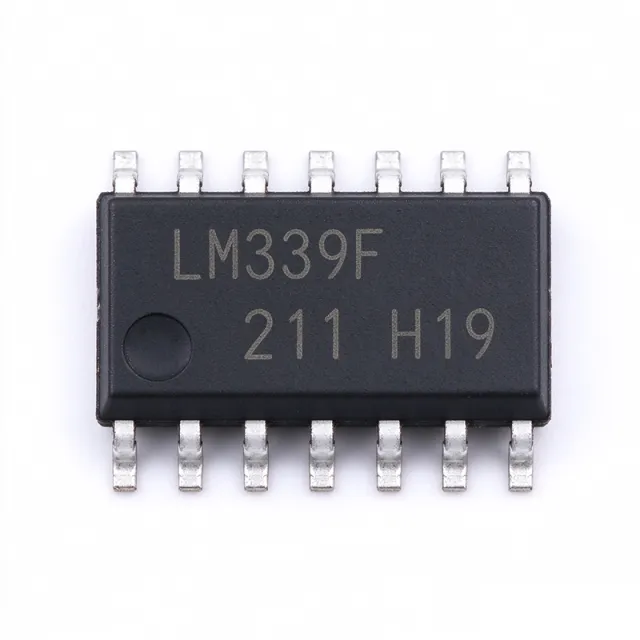
ROHM Semiconductor LM339F-E2 is a four-channel differential comparator IC designed for ground-sense signal detection and general-purpose voltage comparison. It operates from a 3 V to 32 V supply, provides four open-collector outputs, and is packaged in a 14-pin SOP package. The device is intended for industrial, control, and instrumentation systems where multiple independent threshold decisions are required. A comparator is a voltage-regulating semiconductor that evaluates two input voltages and produces a digital output indicating their relationship. The LM339 family belongs to the comparator hierarchy, alongside linear ICs such as amplifiers, while differing from op amps because its output is designed for logic-level signaling rather than linear amplification. The LM339F-E2 combines four ground-sense comparators in one package, reducing component count and simplifying routing in multi-channel sensing systems. The key operating characteristics are the 3 V to 32 V supply range, four-channel configuration, ground-sense input arrangement, and open-collector outputs. The open-collector architecture allows each output to be pulled up to a suitable external voltage and permits multiple outputs to share a wired bus when the design requires wired-AND behavior. External pull-up resistors are required because the output transistors do not actively drive the output high. The SOP14 package supports conventional surface-mount assembly and provides separate access to four comparator channels. Applications include process-control thresholds, industrial sensor interfaces, battery and power-system monitoring, overvoltage detection, signal translation, and four-channel digital sensing. Because the output stage is open collector, output rise time and logic-level compatibility depend on the pull-up resistor, load capacitance, and intended system voltage. Designers should verify input common-mode range, output pull-up voltage, input offset behavior, and response timing against the manufacturer datasheet for each operating condition. A pull-up resistor should be placed close to each output to limit trace capacitance and switching noise. Where multiple open-collector outputs are connected together, every output must remain electrically compatible with the shared bus and appropriate current limiting must be included. This page organizes the manufacturer product information, lifecycle status, verified source links, cross-reference candidates, application guidance, and design notes into a practical engineering reference. It also distinguishes documented electrical characteristics from parameters that require confirmation before schematic release or production qualification.

USD $0.33 有现货
LM339FV-E2 - Quad Open-Collector Comparator | ROHM
LM339FV-E2

LM339FV-E2 - Quad Open-Collector Comparator | ROHM

The ROHM Semiconductor LM339FV-E2 is a four-channel general-purpose comparator with an open-collector output, a 3 V to 32 V operating supply range, and a low 1 us response time. It is supplied in a 14-pin SSOP-B surface-mount package with tape-and-reel packing. The device is intended for ground-sense and general voltage-comparison applications where four independent comparison channels are useful. A comparator is an analog integrated circuit that evaluates two input voltages and produces a logic-level indication of their relationship. The LM339 belongs to the broader comparator and analog interface hierarchy, where it bridges precision input sensing and digital control logic. Its open-collector outputs can support wired logic, level translation, and relay-driving functions when paired with suitable external pull-up circuitry. Four comparison channels provide a practical advantage over dual comparators where board area is constrained. The 3 V to 32 V supply range allows operation from low-voltage analog systems through conventional industrial control rails. A 1 us response time supports fast threshold decisions, while low supply current and a 250 nA input-output bias-current specification help limit loading on high-impedance sensing networks. Each comparator channel compares a non-inverting and an inverting input and uses an open-collector output structure. The open-collector transistor can pull the output toward ground but cannot actively drive it high, so a pull-up resistor is normally required. This architecture provides flexibility for interfacing with 3.3 V, 5 V, or other logic rails while also permitting multiple open-collector outputs to share a common bus when the system design permits wired-AND behavior. Typical uses include industrial threshold detection, power-supply sequencing, sensor signal conditioning, battery monitoring, window comparison, and general control logic. The quad-channel organization is particularly useful in monitoring systems that must evaluate several temperature, voltage, current, or sensor thresholds independently. Tape-and-reel packaging supports automated surface-mount assembly, although the narrow SSOP-B package still warrants careful inspection and soldering practices. Designers should account for the open-collector output when calculating pull-up resistor values and checking the sink-current capability of every attached node. Input common-mode limits, output saturation behavior, supply decoupling, and channel-to-channel timing should be reviewed against the manufacturer datasheet. For new designs, the manufacturer classifies LM339FV-E2 as not recommended for new designs, so a currently supported comparator should be considered when a lifecycle-compliant component is required. This product page combines the exact ROHM ordering information with engineering-focused comparisons, application guidance, design cautions, and sourcing instructions. It distinguishes the LM339FV-E2 from dual-channel comparator alternatives while keeping the focus on verified package, supply-voltage, output-type, timing, and lifecycle characteristics.

询价 联系我们
LM339J - Quad Open-Collector Comparator | Texas Instruments
LM339J

LM339J - Quad Open-Collector Comparator | Texas Instruments

The Texas Instruments LM339J is a general-purpose quad differential comparator with four independent comparison channels, open-collector outputs, and a 14-CDIP package. The device operates from single or dual supplies, with the verified dual-supply range extending from ±1 V minimum to ±18 V maximum, and its listed typical dual-supply configurations include ±3 V, ±5 V, ±9 V, ±12 V, and ±15 V. Its maximum power dissipation is listed as 1190 mW. These characteristics place the LM339J within the comparator IC hierarchy: comparator, differential comparator, analog IC, and semiconductor. A comparator is an analog signal-conditioning IC that compares two input voltages and changes its output state according to their relationship. Unlike a logic gate, a comparator is intended for decision-making near analog operating points. The LM339J combines four comparator channels in one 14-pin through-hole package, making it useful where multiple threshold decisions are required but board area and component count must remain controlled. The open-collector output is the central feature of the LM339J. Each output can source current when the comparator output is high and must be pulled up with an external resistor to the appropriate logic supply. This architecture permits wired logic, interface to TTL, MOS, or CMOS circuitry, and light-driven or relay-driving arrangements. Open-collector outputs can also be paralleled when the application requires a common output node. The verified product information identifies the LM339J as a standard, general-purpose comparator and describes it as a low-power, low-offset device. The exact input-offset voltage, input-bias current, response time, and channel-to-channel behavior for the original LM339J were not included in the supplied source data, so those values should be confirmed in the manufacturer datasheet before precision timing or sensing designs are released. The newer LM339B family has different stated specifications and should not be assumed identical to the original LM339J. Typical uses include industrial control and monitoring, automatic test equipment, power-supply sequencing, battery threshold detection, motor or actuator control, sensor conditioning, and general-purpose digital interface circuits. The 14-CDIP package is especially useful for legacy industrial equipment, educational systems, through-hole prototypes, and assemblies where a socketed or leaded comparator is preferred over a surface-mount package. Designers should verify input common-mode limits, differential input limits, output pull-up voltage, output sink current, supply current, and input behavior around ground before implementation. A pull-up resistor must always connect each open-collector output to a suitable positive supply. Because the open-collector transistor can pull the node low but cannot actively drive it high, supply sequencing and unused-input states require deliberate design. This page combines verified distributor pricing, package information, technical search results, and engineer-focused design guidance. It also distinguishes the original LM339J from newer LM339B variants and clearly identifies where package, electrical, or lifecycle information still requires manufacturer-document confirmation.

询价 联系我们
LM339M - Quad Open-Collector Comparator | Texas Instruments
LM339M

LM339M - Quad Open-Collector Comparator | Texas Instruments

The Texas Instruments LM339M is a low-power, low-offset-voltage quad comparator containing four independent voltage comparators in a 14-pin SOIC package. It supports single or dual supplies, operates from 2 V to 36 V, accepts input voltages up to ±18 V relative to the supply arrangement, and provides open-collector outputs. The verified data identifies a response time of 1.3 µs, typical supply current drain of 800 µA, and typical input bias current of 25 nA. A comparator is an analog integrated circuit that compares two input voltages and produces a digital logic state indicating which input is higher. The LM339 belongs to the broader hierarchy of analog comparator ICs, voltage-detection devices, and general-purpose signal-conditioning components. Its four independent channels allow one package to implement multiple threshold, overvoltage, undervoltage, window, or sorting decisions while sharing a common supply architecture. Key features include four open-collector outputs, low supply current, low input bias current, low-offset operation, and an input common-mode range that includes ground on single-supply systems. Open-collector outputs require an external pull-up resistor and can support wired logic, connector interfaces, level translation, or multiple devices sharing a bus when the electrical conditions are appropriate. Unlike a push-pull output, this architecture provides useful flexibility at the cost of requiring an external pull-up and having a slower rising edge. The LM339M can operate from 2 V to 36 V, while the verified distributor listing identifies SOIC-14 packaging and a 0 °C to 70 °C temperature grade for the listed Texas Instruments LM339M variant. The four comparators share supply pins but have independent noninverting and inverting inputs. Pin assignment and input polarity must be verified against the manufacturer datasheet before layout, especially because the M suffix identifies the package configuration rather than a different comparator function. Typical applications include DC overvoltage and undervoltage detection, battery threshold monitoring, industrial control interfaces, sensor conditioning, open-collector alarm signaling, and four-channel comparator banks in embedded systems. A pull-up resistor on each output is normally required. Inputs must remain within the device’s common-mode limits, and supply bypass should follow the manufacturer’s recommended layout practice to reduce susceptibility to switching noise and lead instability. This page consolidates the verified LM339M specifications, source links, packaging information, and application-oriented design guidance. It deliberately separates confirmed values from unspecified electrical details; parameters not present in the supplied data are not inferred here.

询价 联系我们
LM339MX - Quad Open-Collector Comparator | Texas Instruments
LM339MX

LM339MX - Quad Open-Collector Comparator | Texas Instruments

The Texas Instruments LM339MX is a general-purpose quad voltage comparator containing four independent comparator channels in a 14-pin SOIC package. Each channel supports single or dual power-supply operation across a total range of approximately 36 V, or approximately ±18 V, and uses an open-collector output. Verified distributor data identifies a response time of 1.3 µs, output compatibility with TTL, CMOS, MOS, DTL, and ECL logic, and an operating temperature range of 0 °C to 70 °C. A voltage comparator is an analog signal-conditioning integrated circuit that compares two input voltages and changes its output state when the non-inverting input exceeds the inverting input. The comparator category belongs to the wider hierarchy of analog IC, signal-conditioning IC, logic-interface IC, and semiconductor. The LM339MX is therefore positioned between precision analog conversion and digital logic systems, converting a small voltage difference into a logic-level transition that can drive digital control, protection, or monitoring circuitry. The four independent channels make the LM339MX suitable for multi-threshold monitoring without requiring four separate packages. Its open-collector outputs permit wired-AND behavior when multiple channels or external devices pull the same output node low. Each channel also supports a pull-up arrangement rather than driving the output rail directly, allowing interface compatibility with different logic families. The approximately 1.3 µs response time makes the device suitable for general-purpose control loops rather than high-speed edge-detection applications. The 14-pin SOIC footprint supports compact through-hole-style PCB assembly and is pin-compatible with common LM339-family and general-purpose quad-comparator implementations. Because the outputs are open collector, a pull-up resistor is normally required when driving CMOS or TTL inputs. The four channels share supply and ground pins, so decoupling should be placed close to the package power pins and the ground return should follow a low-impedance path. Typical uses include overvoltage and undervoltage monitoring, power-supply sequencing, battery threshold detection, window comparators, motor-control interfaces, and industrial control systems. Compared with faster rail-to-rail comparators, the LM339MX emphasizes wide supply operation, multiple logic-output compatibility, and a straightforward open-collector interface rather than low-power or nanopower operation. For new designs, verify the exact input common-mode range, output-current limits, and switching behavior against the selected manufacturer datasheet because these values were not included in the retrieved source snippets. This page combines verified distributor specifications, package details, drop-in alternatives, and application guidance to support engineering selection.

询价 联系我们
LM339MX/NOPB - 4-Comparator, 1.3 us | Texas Instruments
LM339MX/NOPB

LM339MX/NOPB - 4-Comparator, 1.3 us | Texas Instruments

Texas Instruments LM339MX/NOPB is a four-channel, general-purpose voltage comparator with open-collector outputs, a 1.3 us response time, and a 14-pin SOIC package. Each channel provides independent comparison functions, while the device supports single-supply or dual-supply operation across a 2 V to 36 V total supply range. The open-collector outputs are compatible with CMOS, MOS, TTL, DTL, and ECL logic, allowing wired-AND operation and flexible pull-up implementation. A voltage comparator is an analog integrated circuit that compares two input voltages and produces a digital logic state indicating which input is higher. The LM339 belongs to the comparator hierarchy, where a comparator IC converts an analog decision into a logic-level output. It is used when a system needs threshold detection, overvoltage protection, window comparison, sensor conditioning, or a simple control decision without requiring the gain and feedback behavior of an operational amplifier. The four internal comparators offer input offset voltage as low as 2 mV maximum for all four channels, a 1.3 us response time, and typical supply current of 800 uA. Open-collector outputs require an external pull-up resistor when driving a logic input. This architecture can provide level translation, wired-AND bus behavior, and collective open-drain signaling, although pull-up selection, output rise time, and bus capacitance must be considered during design. According to the Texas Instruments LM339 product information, the B version is a drop-in replacement for LM239, LM339, and LM2901, while the A and V versions have different characteristics. The device family supports a common-mode input voltage range that includes ground and a differential input range equal to the maximum-rated supply voltage. Output compatibility with TTL, MOS, and CMOS makes the comparator suitable for mixed-voltage systems, although logic thresholds and supply conditions should be checked against the selected interface. Typical uses include DC overvoltage and undervoltage detection, battery monitoring, sensor threshold switching, temperature-control loops, window comparators, and industrial control interfaces. The 14-pin SOIC package supports surface-mount assembly and provides separate input, output, and ground connections for each comparator. The open-collector architecture is particularly useful when several detectors must share a wired signal or when the output must interface with a logic voltage different from the comparator supply. Design with adequate input common-mode range, correct supply polarity, and an appropriate pull-up network. Do not permit comparator inputs to exceed the device rating, and account for output saturation, pull-up resistance, bus loading, and propagation delay in timing-sensitive control paths. The 0 °C to 70 °C temperature range identifies this ordering code for commercial-temperature operation. This product page combines the manufacturer specifications, package and pin information, sourcing guidance, drop-in replacement analysis, comparison parameters, and practical interface guidance. It is designed to help engineers determine whether the LM339MX/NOPB fits a new design or can replace an existing four-channel comparator without changing the PCB footprint.

询价 联系我们
LM339N - Quad Open-Collector Comparator | Texas Instruments
LM339N

LM339N - Quad Open-Collector Comparator | Texas Instruments

The Texas Instruments LM339N is a low-power, low-offset quad differential comparator containing four independent comparator channels in a 14-pin PDIP package. The verified source identifies the device as a general-purpose comparator with open-collector outputs, a 2 V to 36 V supply range, and approximately 1.3 microsecond response time. Each channel can compare two input voltages, while its open-collector output requires an external pull-up resistor for a usable logic-high level. A quad comparator is an analog comparator integrated circuit used to determine whether an input voltage is higher or lower than a reference voltage. The comparator function belongs to the broader analog and mixed-signal semiconductor hierarchy: comparator -> differential comparator -> analog IC -> semiconductor. LM339N provides four channels in one package, reducing component count when a system needs several independent threshold, sorting, overvoltage, or sensing decisions. The main verified characteristics are four independent comparator sections, open-collector outputs, a 14-pin PDIP package, and a wide operating supply range of 2 V to 36 V. The manufacturer describes the LM339-N family as a low-power, low-offset voltage quad comparator. Because the outputs are open collector, the output stage can sink current but does not actively drive a high voltage; an external resistor connects the output node to the desired positive supply. This arrangement supports wired logic, relay or lamp drive, and level translation when the pull-up voltage is selected appropriately. The open-collector architecture also provides a useful benefit in multi-comparator systems: several outputs can be connected to a common pull-up node when the application intentionally requires wired-AND behavior. The design must account for the voltage and current limits of every connected output and for the sink-current capability of each comparator. The external pull-up resistor also affects rise time, so a lower resistance can improve speed while increasing current and power dissipation. Typical uses include DC threshold detection, battery and supply monitoring, window comparison, industrial control logic, sensor conditioning, overvoltage indication, and general-purpose analog decision circuits. The four channels can be used for independent comparisons or arranged as a multi-level voltage detector. Because input and output details beyond the verified source were not supplied, exact input common-mode limits, output sink-current limits, input offset, response-time conditions, and temperature ranges should be confirmed in the manufacturer datasheet before production release. The LM339N is primarily a through-hole general-purpose comparator rather than a high-speed logic device. Its strength is simple wide-supply operation with four channels and open-collector outputs. A PCB design should route comparator inputs away from switching nodes, provide a stable reference, use a defined ground return, and choose pull-up resistors according to the required logic voltage, rise time, and current budget. This page combines verified distributor and manufacturer information with application-oriented design guidance while avoiding unsupported numeric claims.

询价 联系我们
LM339N/PB - Quad Open-Collector Comparator | Texas Instruments (Lead-Free (Pb-Free))
LM339N/PB

LM339N/PB - Quad Open-Collector Comparator | Texas Instruments (Lead-Free (Pb-Free))

The Texas Instruments LM339N/PB is a low-power, low-offset quad differential comparator containing four independent comparator channels in a 14-pin PDIP package. The verified source identifies the device as a general-purpose comparator with open-collector outputs, a 2 V to 36 V supply range, and approximately 1.3 microsecond response time. Each channel can compare two input voltages, while its open-collector output requires an external pull-up resistor for a usable logic-high level. A quad comparator is an analog comparator integrated circuit used to determine whether an input voltage is higher or lower than a reference voltage. The comparator function belongs to the broader analog and mixed-signal semiconductor hierarchy: comparator -> differential comparator -> analog IC -> semiconductor. LM339N/PB provides four channels in one package, reducing component count when a system needs several independent threshold, sorting, overvoltage, or sensing decisions. The main verified characteristics are four independent comparator sections, open-collector outputs, a 14-pin PDIP package, and a wide operating supply range of 2 V to 36 V. The manufacturer describes the LM339-N family as a low-power, low-offset voltage quad comparator. Because the outputs are open collector, the output stage can sink current but does not actively drive a high voltage; an external resistor connects the output node to the desired positive supply. This arrangement supports wired logic, relay or lamp drive, and level translation when the pull-up voltage is selected appropriately. The open-collector architecture also provides a useful benefit in multi-comparator systems: several outputs can be connected to a common pull-up node when the application intentionally requires wired-AND behavior. The design must account for the voltage and current limits of every connected output and for the sink-current capability of each comparator. The external pull-up resistor also affects rise time, so a lower resistance can improve speed while increasing current and power dissipation. Typical uses include DC threshold detection, battery and supply monitoring, window comparison, industrial control logic, sensor conditioning, overvoltage indication, and general-purpose analog decision circuits. The four channels can be used for independent comparisons or arranged as a multi-level voltage detector. Because input and output details beyond the verified source were not supplied, exact input common-mode limits, output sink-current limits, input offset, response-time conditions, and temperature ranges should be confirmed in the manufacturer datasheet before production release. The LM339N/PB is primarily a through-hole general-purpose comparator rather than a high-speed logic device. Its strength is simple wide-supply operation with four channels and open-collector outputs. A PCB design should route comparator inputs away from switching nodes, provide a stable reference, use a defined ground return, and choose pull-up resistors according to the required logic voltage, rise time, and current budget. This page combines verified distributor and manufacturer information with application-oriented design guidance while avoiding unsupported numeric claims.

询价 联系我们
LM339NE3 - 36V Quad Open-Collector Comparator | Texas Instruments
LM339NE3

LM339NE3 - 36V Quad Open-Collector Comparator | Texas Instruments

The Texas Instruments LM339NE3 is a four-element differential comparator IC with a 2 V to 36 V single-supply operating range, open-collector outputs, and a 14-pin PDIP package. Each comparator provides low input offset voltage of 0.37 mV, input bias current of 3.5 nA, supply current of 200 µA per comparator, and response time of 1 µs. These characteristics make the LM339NE3 suitable for general-purpose threshold detection and analog signal comparison. A comparator is an analog interface IC that compares two input voltages and produces a logic-level indication of their relationship. The LM339 belongs to the broader comparator hierarchy and operates as a general-purpose signal-conditioning component between sensor, reference, and digital-control stages. Its common-mode input range includes ground, allowing the device to monitor signals referenced to a negative rail in dual-supply systems. Four independent comparators are integrated into one package, reducing component count on boards that require multiple threshold or window-detection functions. The open-collector output architecture can sink logic-level current while normally leaving the output transistor off, which supports wired-AND behavior when several outputs share a pull-up resistor. The output stage is compatible with TTL, MOS, and CMOS logic according to the manufacturer product information. The low 200 µA supply current per comparator supports low-power monitoring systems, while the 1 µs response time provides useful speed for supply sequencing, overvoltage detection, and fast control loops. Input offset voltage determines how close the two inputs must be before the output changes state, while input bias current affects the impedance presented to the sensing circuit. The common-mode range and differential input limits must both be checked in high-voltage systems. Typical uses include battery monitoring, power-supply sequencing, overvoltage and undervoltage detection, window comparators, sensor thresholding, relay-control logic, and industrial control systems. The open-collector outputs are particularly useful when multiple detector channels must indicate one combined fault condition. A suitable pull-up resistor is required for normal digital-logic operation because the outputs do not actively drive a high voltage. For reliable PCB design, keep input traces away from switching-power nodes, place the pull-up resistor close to the open-collector output, and decouple the supply connection locally. Designers should verify input and output limits under worst-case supply, temperature, and common-mode conditions. The DIP package is suitable for through-hole assembly, prototyping, and applications that favor easy inspection or manual replacement. This product page combines the manufacturer electrical characteristics, package information, application guidance, drop-in alternatives, and practical design notes to support component selection, PCB implementation, and lifecycle-aware purchasing decisions.

询价 联系我们
LM339NE4 - Quad 36V Comparator | Texas Instruments | DIP
LM339NE4

LM339NE4 - Quad 36V Comparator | Texas Instruments | DIP

Texas Instruments LM339NE4 is a quad differential analog comparator with four independent comparison channels, 300 ns nominal response time, and operation from 2 V to 36 V in a 14-pin PDIP package. Its open-collector outputs are compatible with TTL, MOS, and CMOS logic, making the device suitable for general-purpose threshold detection and control systems. An analog comparator is a semiconductor that compares two input voltages and changes its output state when the difference crosses a selected threshold. The LM339 belongs to the comparator hierarchy, where a general-purpose comparator can be used for voltage monitoring, sensing, level translation, and open-loop control. Placing four comparison functions in one integrated circuit reduces component count and simplifies design in equipment with several independent analog thresholds. The LM339NE4 offers low input offset voltage of 0.37 mV, low input bias current of 3.5 nA, and low supply current of 200 µA per comparator. According to the Texas Instruments datasheet, the device supports input and output logic interfacing with TTL, MOS, and CMOS systems. These characteristics are important when the comparator must detect small input-voltage changes without introducing excessive bias or loading on the signal source. The open-collector architecture provides flexibility in output pull-up selection and permits wired logic connections when suitable pull-up resistors are installed. However, the output must not be left without an appropriate pull-up because the open-collector transistor remains off when it is not actively sinking current. Rise time therefore depends on the pull-up resistance, total bus capacitance, and the number of attached loads. Typical uses include industrial control and monitoring, overvoltage and undervoltage detection, sensor-interface thresholds, battery monitoring, panel and instrument threshold circuits, and general digital control. The four channels may monitor several rails or signals independently, while common power and ground connections simplify the implementation of multi-channel systems. Designers should verify the differential input range, common-mode input range, supply voltage, output pull-up network, and channel-to-channel behavior against the manufacturer datasheet. The broad voltage capability is useful for industrial systems, but the comparator must still be checked for the exact input conditions and output timing required by the application. This page consolidates electrical characteristics, sourcing guidance, drop-in replacement options, pin information, comparison parameters, and practical PCB design notes into one engineering-focused reference for evaluating the LM339NE4.

询价 联系我们
LM339NG - 3-36V Quad Open-Collector Comparator | onsemi
LM339NG

LM339NG - 3-36V Quad Open-Collector Comparator | onsemi

The onsemi LM339NG is a four-channel general-purpose analog comparator with a 3 V to 36 V single-supply operating range, open-collector CMOS/TTL-compatible outputs, and a 14-pin PDIP package. Each channel compares two input voltages, making the device suitable for level detection, low-level sensing, memory applications, threshold control, and industrial interface circuits. The LM339NG supports single or split supply operation. An analog comparator is an integrated circuit that determines whether an input voltage is above or below a reference voltage. In the broader electronics hierarchy, a comparator belongs to the analog IC and signal-conditioning category, where it converts a continuously varying voltage relationship into a logic-level decision. Unlike an operational amplifier, a comparator is optimized for fast switching between output states rather than linear amplification. The four independent LM339NG channels combine a wide supply-voltage range with low input bias current. Verified sources report a typical input bias current of 25 nA, a typical input offset current of ±5 nA, and an input offset voltage of 1.3 mV. The distributor descriptions identify the outputs as open collector, allowing the output stage to sink current rather than actively sourcing it. This architecture requires an external pull-up resistor when the comparator must produce a valid high level. With a response time of approximately 1.3 microseconds, the LM339NG is suitable for general-purpose detection rather than very high-speed signal comparison. Its 14-pin PDIP construction supports through-hole assembly and is useful in industrial control equipment, automotive electronic modules, consumer appliances, memory-control circuits, and laboratory interface boards. The package is also readily inspected or replaced during maintenance. A key design consideration is the open-collector output. Each output requires a pull-up resistor to the appropriate logic supply, and the pull-up voltage must not exceed the applicable device limits. Input common-mode range, output saturation, input protection, and supply-current behavior should be checked against the manufacturer datasheet before operation near the supply extremes. This page consolidates verified distributor information, source-linked specifications, practical application guidance, and cautious drop-in alternatives. It also distinguishes confirmed LM339NG characteristics from attributes that still require full datasheet or application-specific verification before production use.

询价 联系我们
LM339NSRG4 - Quad Open-Collector Comparator | Texas Instruments
LM339NSRG4

LM339NSRG4 - Quad Open-Collector Comparator | Texas Instruments

Texas Instruments LM339NSRG4 is a quad differential voltage comparator containing four independent comparator sections, a maximum offset voltage of 9 mV, and a response time of 1300 ns in a 14-pin SOIC package. It supports single-supply or dual-supply operation and is designed for general-purpose signal comparison applications. Each channel can compare a differential input pair against a common reference, while the open-collector outputs allow wired logic, pull-up resistors, and flexible system-level voltage interfacing. A voltage comparator is an analog interface IC that evaluates two input voltages and changes its output state when the difference between them crosses a defined threshold. The LM339 belongs to the broader comparator and signal-conditioning hierarchy, where its four channels can implement threshold detection, zero-crossing detection, window comparison, saturation sensing, and basic control decisions. Its multi-channel architecture also allows one package to monitor several independent conditions without requiring four separate comparator devices. Key characteristics include operation from a single supply or from dual supplies, a tested supply rating of 30 V for LM339 versions and up to 32 V for non-V devices, low supply-current drain that is independent of supply voltage, and a typical supply-current drain of 0.8 mA. The open-collector output architecture requires an external pull-up, providing flexibility in output voltage and bus-level compatibility. The four channels share supply pins but otherwise retain independent input and output connections. The LM339 architecture is suited to low-cost analog decision circuits because its inputs respond to a wide common-mode range while the open-collector outputs remain electrically flexible. Because bipolar comparators can draw input bias current, source impedance should be limited where offset errors matter. Open-collector outputs can also expose the output node to more than one driver, so wired-AND logic requires careful pull-up selection and a review of output sink-current limits before several comparators share a node. Typical uses include industrial sensor interfaces, overvoltage and undervoltage monitors, temperature-threshold circuits, motor-control interfaces, power-supply supervision, and general industrial control systems. It is particularly useful when several independent comparisons must be performed within a limited board area and a 14-pin surface-mount footprint is preferred over through-hole DIP packaging. When designing around the LM339NSRG4, include a pull-up resistor on every open-collector output, keep input common-mode voltage within the device operating limits, and account for input bias current when using high-impedance sensors. Place bypass capacitance close to the supply pins and route sensitive comparison inputs away from switching nodes and high-current return paths. This page organizes the LM339NSRG4’s key electrical characteristics, application guidance, pin-level information, and carefully qualified replacement options. It is intended to help engineers confirm footprint compatibility, assess threshold accuracy and response time, and plan the external components required by an open-collector comparator design.

询价 联系我们
LM339PT - 4-Channel Open-Collector Comparator | STMicroelectronics
LM339PT

LM339PT - 4-Channel Open-Collector Comparator | STMicroelectronics

The STMicroelectronics LM339PT is a low-power quad voltage comparator containing four independent comparison channels in a 14-pin TSSOP package. Each channel supports single-supply or split-supply operation and uses an open-collector output, allowing the outputs to be wired together for wired-AND behavior. The verified product data identifies a 1 V to 16 V supply range, a maximum input offset voltage of 2 mV for the A-grade device family, and compatibility with CMOS, DTL, ECL, MOS, open-collector, and TTL logic. A voltage comparator is an analog integrated circuit that compares two input voltages and changes its output state according to their relationship. The LM339 belongs to the comparator hierarchy within analog and mixed-signal semiconductors. Its four independent channels can perform threshold detection, overvoltage monitoring, window comparison, zero-crossing detection, and general-purpose signal conditioning. Unlike a digital logic gate, the comparator evaluates continuously varying analog voltages at its inputs. The main feature of the LM339PT is its combination of four independent open-collector comparators in one compact TSSOP-14 package. Its low-power design is suitable for battery-powered equipment, while the broad supply-voltage range supports industrial control and instrumentation systems. The open-collector architecture requires an external pull-up resistor and can interface with CMOS or TTL logic. The verified distributor description also reports a propagation delay of 1.3 µs, making the device suitable for moderate-speed threshold and protection functions rather than ultra-high-speed applications. Each comparator channel has two input pins, an output, and access to the device ground and supply pins. The outputs are open-collector rather than push-pull, so an output can sink current while remaining high-impedance when inactive. Pull-up resistors are therefore required on every used output. Connecting outputs together requires compatible pull-up arrangements and careful review of the maximum sink-current and voltage limits. The device does not provide a latch function, so applications requiring state retention normally add external feedback or latch circuitry. Typical uses include DC overvoltage detection, power-supply sequencing, sensor threshold switching, battery monitoring, industrial control interfaces, and logic-level conversion. Split-supply operation allows the comparator to evaluate signals around ground, while single-supply operation is useful when all measured signals remain above the common-mode limits. Because the outputs are open collector, the device can also connect to buses such as SMBus or I2C where wired-AND behavior is required, provided the electrical and timing requirements of the specific bus are satisfied. Designers should account for input common-mode range, output pull-up resistance, supply decoupling, and the behavior of the open-collector output at temperature extremes. Place the device close to the protected signal and provide a stable ground reference. Avoid relying on an output to source current, and select a pull-up voltage compatible with both the comparator output ratings and the driven logic family. The TSSOP-14 package supports compact PCB layouts, but pin-1 orientation must be checked carefully because closely spaced leads can complicate hand rework. This product page consolidates verified distributor availability and pricing, package information, same-package cross-references, and practical design guidance. It also distinguishes drop-in replacements from devices that differ in package or temperature grade, helping engineers make a replacement decision without assuming that every similarly named LM339 variant is electrically and mechanically interchangeable.

询价 联系我们
LM339PW - 4-Channel 36V Open-Collector Comparator | Texas Instruments
LM339PW

LM339PW - 4-Channel 36V Open-Collector Comparator | Texas Instruments

The Texas Instruments LM339PW is a four-channel general-purpose differential comparator operating from a 2 V to 36 V single supply, with an open-collector output and a 14-pin TSSOP package. Each independent comparator compares two analog inputs and produces a logic-level indication of their relationship. The family supports a supply range of 2 V to 36 V, a 300 ns response time, and operation where the common-mode input voltage range includes ground. A differential comparator is an analog-to-digital decision component that compares two voltage inputs and changes its output when one input crosses the other. A quad comparator such as the LM339PW integrates four independent channels, making it part of the comparator IC hierarchy and the broader interface IC and semiconductor categories. Its open-collector outputs require an external pull-up resistor, allowing the output voltage, rise time, and interface standard to be selected by the system designer. The verified LM339 family information highlights a maximum rating of up to 38 V, an HBM ESD rating of 2 kV, a low input offset of 0.37 mV, a low input bias current of 3.5 nA, and a typical supply current of 200 µA per comparator. A response time of 1 µs is also listed for the family. These characteristics make the device useful for level detection, threshold comparison, open-collector bus signaling, and industrial control functions where input signals can approach ground. Each of the four channels is independent, so the device can perform unrelated comparisons without coupling the logic states of different channels. The open-collector architecture can sink output current while the external pull-up establishes the high state, which is useful for wired logic, relay-driver interfaces, and legacy TTL, MOS, or CMOS-compatible systems. Because output rise time depends on the pull-up resistance and total node capacitance, timing analysis must include the external network rather than relying only on the comparator response time. Typical applications include industrial sensor-threshold monitoring, battery and power-supply protection, overvoltage detection, window comparators, and four-channel level translation. The ground-referenced common-mode capability is particularly useful for detecting the presence or absence of a signal from a 12 V or 24 V industrial sensor. A pull-up can also connect the open-collector outputs to an appropriate supply, allowing multiple comparators to form a wired signal function where the application and device specifications permit it. When designing the PCB, place the pull-up resistor close to the open-collector output and route the node away from high-current switching paths. Decoupling capacitors should connect the supply and ground pins with a short return path. Because the package has no exposed thermal pad and the device can operate across a wide voltage range, engineers should verify the maximum differential input voltage, output current, and dissipation conditions against the manufacturer datasheet. This page consolidates verified distributor and manufacturer information with package guidance, application analysis, commercial questions, and drop-in replacement details. It is intended to support faster component selection while clearly identifying specification fields, pricing, and pin-level details that still require confirmation from the appropriate manufacturer documentation.

询价 联系我们
LM339PWG4 - Quad Open-Collector Comparator | Texas Instruments
LM339PWG4

LM339PWG4 - Quad Open-Collector Comparator | Texas Instruments

The Texas Instruments LM339PWG4 is a quad differential comparator containing four independent voltage-comparison channels, an open-collector output architecture, and a 14-pin TSSOP package. Each comparator supports single-supply or dual-supply operation, with a maximum supply-voltage rating of 38 V, low input offset voltage of 0.37 mV, low input bias current of 3.5 nA, and typical supply-current consumption of 200 uA per comparator. The LM339 family provides common-mode input operation that includes ground and outputs compatible with TTL, MOS, and CMOS logic. A differential comparator is an analog integrated circuit that compares two input voltages and produces a binary result indicating which input is higher. The LM339 belongs to the comparator hierarchy within analog and mixed-signal semiconductors. Four independent channels allow one package to perform several threshold, level, window, or sensing functions. Its open-collector outputs require an external pull-up resistor, allowing the output voltage to be raised to a logic supply selected by the system designer. Key features include four independent comparator channels, a wide 36 V operating supply range indicated by the manufacturer’s related part listing, and a 38 V maximum rating. The device offers a typical total supply-current drain of 0.8 mA, a low input offset of 0.37 mV, and an input bias current of 3.5 nA. Its open-collector architecture is useful for wired-AND buses, relay-driver interfaces, and systems that need a pull-up voltage different from the comparator supply. The LM339 architecture is suited to general-purpose precision comparison rather than high-speed waveform discrimination. The manufacturer identifies LM339B, LM2901B, LM339, LM239, and LM139 as related quad differential comparators and states that the B-version is a drop-in replacement for the earlier A- and V-version families. Open-collector outputs can sink logic current but cannot actively drive a high voltage without a pull-up network. Typical applications include sensor-threshold conditioning, battery and power-supply monitoring, industrial control interfaces, window comparators, LED status signaling, and open-collector alarm or relay-control signaling. The four-channel organization can also reduce package count when a board needs independent comparisons for multiple sensors or rails. In circuits sharing an input source, each channel can compare that source against a different threshold. Designers should treat the output as a sinking device rather than a push-pull logic driver. Place the pull-up resistor close to the relevant output, account for rise time when driving capacitive loads, and use the pin-description table in the Texas Instruments datasheet when assigning PCB tracks. Input common-mode range, output pull-up voltage, and total supply dissipation must be checked against the intended application. This product page combines the manufacturer’s device characteristics with engineering-focused comparisons, application guidance, pin-related cautions, and a strict same-package replacement analysis. It is designed to help engineers determine whether the 14-pin TSSOP LM339PWG4 fits a precision comparator design without assuming that a superficially similar part is electrically or mechanically interchangeable.

询价 联系我们
LM339PWR - 4-Channel 36V Open-Collector Comparator | Texas Instruments (Tape & Reel)
LM339PWR

LM339PWR - 4-Channel 36V Open-Collector Comparator | Texas Instruments (Tape & Reel)

The Texas Instruments LM339PWR is a four-channel general-purpose differential comparator operating from a 2 V to 36 V single supply, with an open-collector output and a 14-pin TSSOP package. Each independent comparator compares two analog inputs and produces a logic-level indication of their relationship. The family supports a supply range of 2 V to 36 V, a 300 ns response time, and operation where the common-mode input voltage range includes ground. A differential comparator is an analog-to-digital decision component that compares two voltage inputs and changes its output when one input crosses the other. A quad comparator such as the LM339PWR integrates four independent channels, making it part of the comparator IC hierarchy and the broader interface IC and semiconductor categories. Its open-collector outputs require an external pull-up resistor, allowing the output voltage, rise time, and interface standard to be selected by the system designer. The verified LM339 family information highlights a maximum rating of up to 38 V, an HBM ESD rating of 2 kV, a low input offset of 0.37 mV, a low input bias current of 3.5 nA, and a typical supply current of 200 µA per comparator. A response time of 1 µs is also listed for the family. These characteristics make the device useful for level detection, threshold comparison, open-collector bus signaling, and industrial control functions where input signals can approach ground. Each of the four channels is independent, so the device can perform unrelated comparisons without coupling the logic states of different channels. The open-collector architecture can sink output current while the external pull-up establishes the high state, which is useful for wired logic, relay-driver interfaces, and legacy TTL, MOS, or CMOS-compatible systems. Because output rise time depends on the pull-up resistance and total node capacitance, timing analysis must include the external network rather than relying only on the comparator response time. Typical applications include industrial sensor-threshold monitoring, battery and power-supply protection, overvoltage detection, window comparators, and four-channel level translation. The ground-referenced common-mode capability is particularly useful for detecting the presence or absence of a signal from a 12 V or 24 V industrial sensor. A pull-up can also connect the open-collector outputs to an appropriate supply, allowing multiple comparators to form a wired signal function where the application and device specifications permit it. When designing the PCB, place the pull-up resistor close to the open-collector output and route the node away from high-current switching paths. Decoupling capacitors should connect the supply and ground pins with a short return path. Because the package has no exposed thermal pad and the device can operate across a wide voltage range, engineers should verify the maximum differential input voltage, output current, and dissipation conditions against the manufacturer datasheet. This page consolidates verified distributor and manufacturer information with package guidance, application analysis, commercial questions, and drop-in replacement details. It is intended to support faster component selection while clearly identifying specification fields, pricing, and pin-level details that still require confirmation from the appropriate manufacturer documentation.

询价 联系我们
LM339PWRE4 - Quad 36V Differential Comparator | Texas Instruments
LM339PWRE4

LM339PWRE4 - Quad 36V Differential Comparator | Texas Instruments

Texas Instruments LM339PWRE4 is a quad differential comparator with an open-collector output, operating from a single 2 V to 36 V supply or from dual supplies, and packaged in a 14-pin TSSOP. Each of the four channels provides independent comparison of two input voltages, making the device suitable for threshold detection, level translation, and analog signal conditioning. A comparator is a differential analog input device that changes its output state when one input becomes higher than the other. The LM339 belongs to the comparator hierarchy within analog integrated circuits and combines four sensing channels in one package. Its open-collector outputs require an external pull-up resistor, allowing the output voltage, rise time, and interface level to be selected by the surrounding circuit. The LM339 family is designed for single-supply or dual-supply operation. The manufacturer identifies a differential input range equal to the maximum-rated supply voltage of plus or minus 38 V, while the common-mode input range includes ground. These characteristics allow the device to monitor signals referenced to a negative rail or systems powered from widely separated supply rails. According to the Texas Instruments product page, the outputs are compatible with TTL, MOS, and CMOS logic. The family also uses low supply current that remains largely independent of supply voltage, making it practical for battery-powered monitoring circuits where every microampere contributes to operating time. The comparison function is particularly useful when a system requires a digital indication of an analog threshold without converting the entire measurement chain to a digital signal. Typical uses include overvoltage and undervoltage detection, sensor threshold switching, window comparators, relay or solenoid drivers, and battery monitoring. Four independent channels can reduce component count in a multi-rail supervisor, while the open-collector architecture permits wired logic, pulled-up alarm outputs, and interfacing to multiple destinations. When laying out a circuit, place input and pull-up components close to the device and keep sensitive comparison nodes away from switching-current paths. Check the input common-mode range, output pull-up voltage, supply sequencing, and channel response time before using the comparator with slow-moving or noisy signals. This product page combines manufacturer specifications, package and lifecycle information, sourcing guidance, and practical comparator-design guidance to support faster component selection, PCB implementation, and replacement planning.

询价 联系我们
LM339PWRG3 - Quad 36V Comparator | Texas Instruments
LM339PWRG3

LM339PWRG3 - Quad 36V Comparator | Texas Instruments

Texas Instruments LM339PWRG3 is a quad differential comparator integrated circuit containing four independent voltage comparators. It operates from a single supply of up to 36 V or from dual supplies whose total span is 2 V to 36 V, and it is housed in a 14-pin TSSOP package. Each channel supports an open-collector output compatible with TTL, MOS, and CMOS logic. The device is intended for general-purpose threshold detection, signal conditioning, and industrial control applications. A comparator is an analog integrated circuit that compares two input voltages and changes its output state when one input crosses the other. The LM339 family belongs to the comparator hierarchy within analog ICs and broader semiconductor signal-processing devices. Its four independent channels allow a single package to implement multiple sensing, protection, or level-conversion functions without requiring four separate single-comparator packages. The LM339 family is designed for wide supply-voltage operation and common-mode input ranges that include ground. According to the Texas Instruments product page, the B-version is a drop-in replacement for LM239, LM339, and LM2901 devices, while the differential input range can equal the maximum-rated supply voltage of 38 V. Open-collector outputs allow wired-AND operation and require an external pull-up resistor. The outputs are designed to drive TTL, MOS, and CMOS-compatible logic. The verified specifications identify a maximum input offset of 0.37 mV, an input bias current of 3.5 nA, and a supply current of 200 uA per comparator. A faster response is also listed as a family improvement. These characteristics make the LM339 useful when a system must compare low-level sensor signals against adjustable references while tolerating substantial supply variation. The open-collector architecture is especially useful where multiple channels must share a pull-up or where a wired fault-detection signal is required. Typical uses include industrial control systems, battery-powered monitoring equipment, sensor threshold circuits, window or level comparators, overvoltage detection, and general digital interface conditioning. The wide operating range is valuable in industrial systems, while the low 200 uA per-comparator supply current supports low-power monitoring designs. Each internal comparator is electrically independent, allowing unused channels to be configured according to the manufacturer datasheet. Layout should preserve a low-impedance ground reference and keep input and feedback traces short because comparison accuracy can be affected by input offset, bias current, and parasitic coupling. Open-collector outputs require suitable pull-up resistors and adequate logic-level current margin. Review the manufacturer pin-description table before assigning tracks because input, output, supply, and ground functions are distributed across the 14-pin TSSOP. This page combines the LM339 family specifications with practical interpretation of supply range, input behavior, output compatibility, package construction, application fit, and replacement considerations. It helps engineers compare the device against closely related TI parts while keeping PCB footprint, logic interface, and analog performance requirements in view.

询价 联系我们
LM339PWRG4 - Quad Differential Comparator | Texas Instruments
LM339PWRG4

LM339PWRG4 - Quad Differential Comparator | Texas Instruments

Texas Instruments LM339PWRG4 is a general-purpose quad differential comparator containing four independent comparator channels in a 14-pin TSSOP package. It accepts single-supply or dual-supply operation, uses open-collector outputs, and supports input voltages extending to ground on the negative side. The device is suited to applications that compare two analog signals and require a logic-compatible, low-saturation output rather than a rail-to-rail push-pull output. A differential comparator is an analog integrated circuit that evaluates the relationship between two input voltages and produces a binary result. When the voltage applied to the non-inverting input exceeds the voltage applied to the inverting input, the corresponding output changes state according to the device's output circuit. The LM339 belongs to the comparator hierarchy within interface ICs and combines four channels in one package, reducing component count in multi-threshold, window-detection, and control systems. The principal advantages of the LM339PWRG4 are its four-channel integration, low supply-current drain, low input-bias current, and open-collector outputs. According to the manufacturer datasheet, the supply-current drain is typically 0.8 mA and is independent of supply voltage. Each output can sink useful logic current while remaining compatible with TTL, MOS, and CMOS systems. A pull-up resistor is required when the output is used as a wired logic node. The comparator's architecture supports single or dual supplies, with a wide operating-voltage range and a maximum-rated supply of 30 V for non-V devices. The common-mode input range includes ground, allowing the device to monitor signals near 0 V. The differential input-voltage range can equal the maximum-rated supply voltage. These characteristics are useful in power-supply control, battery monitoring, industrial sensing, and analog signal conditioning where input levels may exceed conventional logic supply ranges. Typical uses include overvoltage and undervoltage monitoring, current-limit detection, sensor threshold comparison, open-collector alarm signaling, and multi-level battery supervision. Because each of the four channels can compare a separate signal pair, systems can implement several protection functions while sharing the same device. Input and output behavior must be checked against the operating supply, source impedance, pull-up network, and required switching speed. The primary design consideration is the open-collector output. Add a suitable pull-up resistor to the positive supply or another valid logic rail, and confirm that its maximum current and switching speed suit the connected logic family. Avoid floating outputs, account for input offset and common-mode limits, and design signal paths so that nearby switching nodes do not disturb a comparison threshold. The 14-TSSOP package also requires a thermal pad-free layout with adequate solder-joint fillets and board-edge clearance. This page consolidates manufacturer specifications, pin-package details, sourcing guidance, comparison parameters, and practical application notes for engineers evaluating the LM339PWRG4. It also distinguishes direct replacements from options that require electrical or package verification, helping prevent a superficially similar part from causing unexpected logic-level or output-stage incompatibilities.

询价 联系我们
LM339QT - Low-Power Quad Open-Collector Comparator | STMicroelectronics
LM339QT

LM339QT - Low-Power Quad Open-Collector Comparator | STMicroelectronics

The STMicroelectronics LM339QT is a low-power, general-purpose quad voltage comparator containing four independent comparator channels with open-collector outputs in a 16-QFN package measuring 3 x 3 mm. It operates from a single positive supply, supports input voltages ranging from 0 V to VCC − 1.5 V, and provides a typical supply current of 1.1 mA for the complete four-channel device. A voltage comparator is a semiconductor device that compares two input voltages and produces a logic-level output indicating which input is higher. The LM339QT belongs to the comparator hierarchy within analog and mixed-signal integrated circuits. Its four open-collector channels can be used independently, allowing several threshold, sensing, window-detection, or protection functions to be implemented in one compact package. Open-collector outputs also provide flexibility for wired logic, level shifting, and interface designs when an external pull-up is used. Key characteristics include low power consumption, an input offset voltage specified as low as 2 mV maximum for the related LM339A, LM239A, and LM139A precision versions, and input bias current listed as 25 nA in the product listing. The device is compatible with CMOS, DTL, ECL, MOS, open-collector, and TTL logic environments. Each channel provides substantial flexibility in voltage comparison because the inputs can operate across the supply range while the output stage operates from the positive supply. The open-collector output architecture is a central technical feature. Unlike a totem-pole output, an open-collector transistor can pull the output low but cannot actively drive it high. Designers therefore add a pull-up resistor to establish the high state. Multiple comparator outputs can share a pull-up when the application requires wired-AND behavior. Output speed is not its principal strength; instead, the LM339QT emphasizes low power, wide input common-mode capability, flexible logic interfacing, and four independent channels in one small package. Typical uses include monitoring multiple power rails, detecting overvoltage or undervoltage conditions, comparing sensor outputs with adjustable references, implementing window comparators, generating system-reset signals, and translating between different logic voltage domains. The compact 16-QFN footprint is useful in space-constrained industrial, consumer, and embedded-control designs where four comparison functions are required without allocating separate components. The primary design consideration is the open-collector output. Select an external pull-up resistor to suit the required speed, current, and logic level, and place it close enough to the relevant output to limit rise time and susceptibility to noise. Input filtering may also be necessary when the comparator handles slow or high-impedance signals. Verify absolute maximum voltage, common-mode limits, output-current limits, and timing requirements in the manufacturer datasheet for the final operating environment. This product page combines the exact LM339QT package and headline electrical characteristics with practical interface guidance, sourcing guidance, and a focused comparison of technically relevant alternatives. It is intended to help engineers identify whether the four-channel, low-power, open-collector architecture matches the required voltage sensing and logic interface before committing to a PCB layout.

询价 联系我们
LM339SNG - Quad Single-Supply Comparator, 14-Pin PDIP
LM339SNG

LM339SNG - Quad Single-Supply Comparator, 14-Pin PDIP

onsemi LM339SNG is a quad voltage comparator integrated circuit with four independent comparison channels, a single-supply architecture, and a 14-pin PDIP package. The LM339SNG is identified as a comparator device covering an 18 V to 36 V operating range, making it suitable for industrial control, instrumentation, power-monitoring, sensor-interface, and threshold-detection circuits. Its four-channel arrangement allows one packaged device to implement several independent switching decisions while reducing component count and simplifying PCB layout. A comparator is an analog integrated circuit that evaluates two input voltages and produces a logic-level output indicating which input is higher. In the broader electronics hierarchy, LM339SNG belongs to the comparator family within analog and mixed-signal semiconductors. Its single-supply operation is useful when the system has one main supply rail, while its open-collector-style output class is commonly used to drive pull-ups, relay drivers, alarm inputs, and digital control logic. The LM339SNG provides four comparator channels in one package. The 14-pin PDIP arrangement gives adequate spacing for through-hole assembly, inspection, and prototype rework, although it occupies more board area than surface-mount equivalents. The device is particularly useful when a design requires multiple analog threshold decisions and the board maker prefers a readily available through-hole package. A single IC can reduce the number of separate packages and simplify routing between sensing and control sections. Typical applications include sensing relay and solenoid drivers, overvoltage and undervoltage detection, window comparators, battery monitoring, level detection, industrial control interfaces, and general-purpose logic threshold circuits. Because comparator outputs are intended to indicate the relative state of two analog inputs, designers should pay attention to input common-mode range, output pull-up requirements, propagation delay, input offset, and supply voltage limits when establishing system behavior. These operating details should be confirmed against the manufacturer datasheet before final qualification. For implementation, place the device close to the signals being compared and keep sensitive analog traces away from fast-switching nodes. Use suitable bypass capacitance near the supply pins, provide the required pull-up network for the outputs, and verify that every signal remains within the device's supported common-mode and supply limits. The 14-pin PDIP package is particularly appropriate for through-hole industrial, educational, and control-board assemblies where mechanical robustness is more important than minimum board area. This product page combines the verified LM339SNG identity and package information with practical guidance on comparator behavior, PCB implementation, application fit, and drop-in alternatives. It is intended to help engineers confirm whether the single-supply quad comparator is appropriate for a new design before committing to a board layout or production build.

询价 联系我们
LM358AD - Dual Low Power Op-Amp, 1.1MHz, SOIC-8 | STMicroelectronics
LM358AD

LM358AD - Dual Low Power Op-Amp, 1.1MHz, SOIC-8 | STMicroelectronics

The STMicroelectronics LM358AD is a low-power dual operational amplifier consisting of two independent, high-gain, internally frequency-compensated op-amps designed to operate from a single power supply across a wide voltage range. Housed in an 8-pin SOIC package, the LM358AD delivers a unity-gain bandwidth of approximately 1.1 MHz, a slew rate of 0.6 V/µs, and supports supply voltages from 3V to 30V single-supply or ±1.5V to ±16V dual-supply. The device is widely used in cost-sensitive analog front-ends where single-supply operation and low quiescent current are essential design constraints. An operational amplifier (op-amp) is a high-gain, DC-coupled electronic voltage amplifier with differential inputs and a single-ended output. Within the broader power management and signal conditioning hierarchy, the LM358AD belongs to the general-purpose op-amp category, sitting between precision instrumentation amplifiers (high accuracy, low noise) and high-speed amplifiers (wide bandwidth, fast slew). Op-amps form the building blocks of analog signal chains: filters, comparators, integrators, transducers, sensor signal conditioners, and active rectifiers. The LM358 family specifically targets single-supply 5V/12V/24V systems that cannot tolerate the negative rail required by legacy op-amps like the LM741. Key features include: 1.1 MHz gain-bandwidth product, 0.6 V/µs slew rate, input common-mode range that includes ground (enabling true single-supply sensing near 0V), low input bias current, internal frequency compensation (no external capacitor required), and ESD protection on the inputs. The output stage can swing to within a few hundred millivolts of the negative rail, although it does not reach the positive rail — meaning the part is not rail-to-rail but is sufficient for most single-supply transducer interfaces. Technically, the LM358AD uses a bipolar junction transistor (BJT) input stage rather than JFET or CMOS, which trades higher input bias current (~45 nA typical) for extremely low input offset voltage drift and predictable behavior across temperature. The two amplifiers share only the power pins; their inputs and outputs are fully independent, allowing asymmetric configurations such as one channel as a comparator and the other as a gain stage. Typical applications include battery-powered sensor signal conditioning, transducer amplifiers, DC gain blocks, active filters, integrators, comparators with hysteresis, and 4–20 mA current loop transmitters. Industrial designs frequently use the LM358AD in 24V PLC analog input modules, while consumer designs use it for white-goods sensor interfaces and IoT battery nodes. When designing with this device, remember that the output cannot swing to the positive rail — typically VOH stops around VCC−1.5V at 10 mA load. Place a 100 nF bypass capacitor close to VCC and ground, and use a feedback resistor of at least 10 kΩ to limit output stage loading. This page synthesizes distributor pricing, drop-in alternatives, and practical design notes not found in the manufacturer datasheet.

询价 联系我们