产品(39,000+)

PCM1800E - 20-Bit 48 kSPS Stereo ADC | Texas Instruments
PCM1800E

PCM1800E - 20-Bit 48 kSPS Stereo ADC | Texas Instruments

The Texas Instruments PCM1800E is a 20-bit stereo analog-to-digital converter (ADC) with single-ended analog inputs, a maximum sampling rate of 48 kSPS, a 4.5 V to 5.5 V supply range, and a 24-pin SSOP package. It converts two analog input channels into digital data and is intended for cost-sensitive consumer audio equipment. According to the Texas Instruments PCM1800 product page, the converter uses a delta-sigma modulator, 64-times oversampling, a digital decimation filter, and a serial interface supporting master and slave modes. An ADC is a mixed-signal semiconductor that converts continuously varying analog voltages into numerical values suitable for digital processing. The PCM1800 belongs to the delta-sigma ADC family and the broader data-converter and signal-processing IC hierarchy. Its single-ended inputs simplify source connections when the signal source can be referenced adequately against the converter's analog ground. Digital audio equipment commonly uses this architecture to support CD-compatible 44.1 kSPS and 48 kSPS playback or recording rates. Key features of the PCM1800E include dual 20-bit monolithic conversion, single-ended voltage inputs, 64-times oversampling, and four supported data formats. The decimation filter has a stated passband ripple of ±0.05 dB and stopband attenuation of -65 dB. The reported signal-to-noise ratio is 95 dB, making the device relevant to audio preamplifiers, consumer receivers, digital mixers, and other systems requiring stereo audio capture at 48 kSPS. The delta-sigma architecture converts the analog signal through oversampling and digital filtering before producing the final serial output. PCM1800 documentation identifies both master and slave operating modes, allowing the converter either to generate the serial clock or synchronize it with an external audio processor. Four data formats provide design flexibility when connecting the ADC to codecs, digital audio processors, microcontrollers, or programmable logic. The serial interface and decimation filter therefore form the boundary between the analog audio inputs and the digital signal path. Typical PCM1800E applications include stereo consumer audio capture, digital recording equipment, audio mixer inputs, consumer media systems, and digital signal processing front ends. In a typical signal chain, a stereo source is buffered, level-shifted into the ADC input range, sampled by the delta-sigma modulator, decimated, and transferred to a digital audio processor through the serial interface. The 48 kSPS rate supports professional audio-standard sampling rates but does not itself provide the analog front-end gain, anti-alias filtering, clock generation, or output audio processing required by a complete system. A key design consideration is preserving signal integrity at the single-ended analog inputs and the digital serial interface. Input routing should minimize noise pickup, keep the analog and digital return paths controlled, and account for the converter's input voltage range. Clock and data traces require suitable timing margins, while bypass capacitors should be placed close to the supply pins. The SSOP-24 package is suitable for compact designs, but its lead pitch and exposed analog, digital, and supply connections demand careful layout and assembly. This page consolidates the verified PCM1800 family specifications, source links, application guidance, and replacement-status analysis into one engineering-focused reference. It also separates published facts from unavailable details so designers can identify what must still be confirmed in the manufacturer datasheet before schematic release, PCB layout, or production qualification.

询价 联系我们
PCM1801U - 16-Bit Stereo Audio ADC | Texas Instruments
PCM1801U

PCM1801U - 16-Bit Stereo Audio ADC | Texas Instruments

The Texas Instruments PCM1801U is a 16-bit, stereo, single-ended audio analog-to-digital converter with a 48 kSPS conversion rate, 64-times oversampling, and a serial interface, housed in a 14-pin SOIC package. It is designed for cost-sensitive consumer audio equipment where a compact stereo converter with typical 93 dB SNR and -88 dB THD+N performance is required. An audio ADC is a mixed-signal semiconductor that converts left- and right-channel analog voltages into digital sample data for processing, storage, or transmission. The PCM1801 belongs to the ADC and DAC hierarchy, uses a delta-sigma modulator and digital decimation filter, and supports slave-mode operation with two serial data formats. This architecture provides a practical bridge between analog audio sources and digital audio systems. Key features include dual 16-bit monolithic conversion channels, single-ended analog voltage inputs, 64-times oversampling, a 48 kSPS maximum sampling rate, and a serial output interface. The decimation filter has a specified passband ripple of ±0.05 dB and stopband attenuation of -65 dB. Typical signal-chain performance includes THD+N of -88 dB, SNR of 93 dB, and dynamic range of 93 dB. Internally, the PCM1801 uses a delta-sigma modulator followed by a digital decimation filter to reduce aliasing and shape quantization noise. Its serial interface supports slave operation and two data formats, giving the system designer flexibility in clocking and data framing. The single-ended inputs simplify source interfacing, although input filtering, grounding, and source impedance remain critical to achieving the stated audio performance. Typical uses include consumer digital audio equipment, stereo recording products, USB audio interfaces, set-top boxes, and other compact audio systems requiring two analog inputs and a serial digital interface. The 48 kSPS rate aligns with standard CD-rate audio, while the 14-pin SOIC package simplifies assembly in cost-sensitive designs. When laying out the circuit, place input and decoupling capacitors close to their associated pins, maintain a low-impedance ground return for the analog section, and route serial clock and data traces away from sensitive analog inputs. Verify the external interface voltage levels and serial timing before connecting the converter to a host processor. This product page consolidates verified manufacturer and distributor information, price context, package details, application guidance, and substitution limitations. It distinguishes documented specifications from missing data and avoids presenting electrically different converters as guaranteed drop-in replacements.

询价 联系我们
PCM1802DB - 24-Bit 96 kHz Stereo Audio ADC | Texas Instruments
PCM1802DB

PCM1802DB - 24-Bit 96 kHz Stereo Audio ADC | Texas Instruments

Texas Instruments PCM1802DB is a high-performance stereo audio analog-to-digital converter with single-ended analog inputs, 24-bit resolution, and a maximum sampling rate of 96 kHz. It is packaged in a 20-SSOP package and is designed for digital audio capture systems requiring separate analog and digital supply rails. An audio ADC converts left and right analog audio signals into digital sample data for transmission, recording, processing, or playback. The PCM1802DB uses a delta-sigma modulator with 64-times or 128-times oversampling, followed by a digital decimation filter and a high-pass filter that removes the DC component from the input signal. This architecture is part of the broader analog-to-digital converter, data-converter, signal-processing, and semiconductor hierarchy. The device provides two single-ended analog input channels, a 24-bit conversion resolution, and a serial digital interface. Its analog supply operating range is 2.7 V to 3.6 V, while the digital supply range begins at 4.5 V according to the manufacturer product information. The 96 kHz sampling rate supports professional and consumer audio acquisition, including line-level stereo capture and digital audio recording. The PCM1802DB is intended for audio interfaces, USB audio bridges, digital mixers, sound-card designs, broadcast equipment, and other systems that convert analog stereo audio into digital data. Its single-ended inputs simplify source connections compared with differential-input converters, although circuit design must still address analog signal conditioning, filtering, grounding, and digital-interface compatibility. The 20-SSOP package requires careful PCB layout around the analog and digital sections. The manufacturer datasheet should be used as the authority for decoupling values, clock requirements, supported master and slave operating modes, pin assignments, and digital timing. This page combines the manufacturer product information with practical application guidance, engineering comparisons, and sourcing-oriented details.

询价 联系我们
PCM1803DB - 24-Bit 96-kHz Stereo ADC | Texas Instruments
PCM1803DB

PCM1803DB - 24-Bit 96-kHz Stereo ADC | Texas Instruments

The Texas Instruments PCM1803DB is a 24-bit, 96-kHz stereo delta-sigma analog-to-digital converter with single-ended analog voltage inputs, housed in a 20-pin SSOP package. It accepts 3 Vp-p input signals, uses 64-times or 128-times oversampling, and supports both master and slave operating modes. The converter is designed for cost-sensitive consumer audio systems operating from a 5 V analog supply and a 3.3 V digital supply. An audio ADC is an integrated circuit that converts left- and right-channel analog audio voltages into digital data for processing, storage, transmission, or playback. PCM1803DB belongs to the ADC/DAC class of data-conversion ICs and uses a delta-sigma modulator followed by a digital decimation filter. An integrated high-pass filter removes the DC component of the input signal, while master and slave mode support allows the converter to operate within different system clocking arrangements. The principal features are 24-bit resolution, a maximum sampling rate of 96 kHz, stereo single-ended input, and selectable 64-times or 128-times oversampling. Its serial interface supports audio-system integration, and the single-ended input architecture is useful when the source has a relatively simple single-ended output stage. The converter is fabricated using a CMOS process and is offered in a compact 20-pin SSOP package suited to cost-sensitive consumer audio equipment. PCM1803DB is positioned between basic codec functions and more complex audio-conversion solutions. The delta-sigma architecture moves much of the signal-shaping and filtering work into the digital domain, while the decimation and high-pass filters reduce unwanted DC content and aliasing components before the final digital data is presented. System designers still need to provide correct analog and digital supplies, suitable input conditioning, a supported serial clock configuration, and decoupling close to the device pins. Typical uses include consumer stereo audio equipment, digital recording systems, multimedia appliances, and compact audio interfaces requiring two single-ended analog channels. Its 96-kHz conversion rate supports high-resolution digital-audio workflows, while the 5 V analog and 3.3 V digital supply arrangement can simplify mixed analog and digital system design. Its 24-bit output resolution also provides more numerical headroom than lower-resolution converters when downstream gain staging is carefully controlled. For a robust implementation, treat the analog input network as a precision signal path and verify the clock, format, and master or slave configuration against the manufacturer datasheet. Place bypass capacitors close to the supply pins, keep digital return currents away from sensitive analog input routing, and confirm that the external interface device supports the converter's serial output protocol and timing. This page consolidates the PCM1803DB's key conversion specifications, sourcing information, application guidance, and same-family drop-in considerations. It also highlights practical checks involving supply domains, clocking, filtering, PCB layout, and input conditioning that engineers should complete before releasing a new audio design.

询价 联系我们
PCM1804DB - 24-Bit 192kHz Stereo ADC | Texas Instruments
PCM1804DB

PCM1804DB - 24-Bit 192kHz Stereo ADC | Texas Instruments

The Texas Instruments PCM1804DB is a 24-bit, 192 kHz stereo audio analog-to-digital converter with fully differential analog inputs and an I2S-compatible digital interface, housed in a 28-pin SSOP package. Typical performance includes 112 dB dynamic range, 111 dB signal-to-noise ratio, and -102 dB total harmonic distortion plus noise. These headline specifications place it firmly in the professional and high-grade consumer audio conversion class. A delta-sigma audio ADC is a semiconductor that converts left- and right-channel analog voltages into high-resolution digital samples. It belongs to the ADC and DAC hierarchy, where an ADC performs the analog-to-digital conversion stage needed by digital audio equipment. The PCM1804 combines a precision delta-sigma modulator, a linear-phase antialias digital filter, and a high-pass filter that removes DC offset from the input signal. Key features include support for 24-bit resolution, a maximum sampling rate of 192 kHz, fully differential stereo inputs, and PCM audio operation. The converter can also produce DSD-format data because its delta-sigma modulator operates from the same signal chain. The antialias filter limits out-of-band energy before the digitized signal reaches the audio processor, while the high-pass filter helps prevent DC offset from consuming digital headroom. The PCM1804 uses an advanced CMOS process and integrates both converter channels in one package. Its 28-pin SSOP arrangement supports analog input, digital data, clock, control, and power connections. Linear-phase digital filtering is particularly useful in music-production equipment because it provides predictable passband behavior and helps reduce aliasing without introducing a steep magnitude distortion across the audio band. Typical applications include professional audio interfaces, digital mixing consoles, multichannel audio recorders, studio monitors, broadcast equipment, and high-end consumer audio. Fully differential inputs are useful when the source can drive balanced analog signals, while the 192 kHz capability supports high-resolution recording workflows. The digital output can feed a suitable audio processor, DAC, or transport through the appropriate clock and data interface. PCB design should keep the analog input and digital return paths separated, provide clean reference and supply connections, and follow the manufacturer’s recommended decoupling and layout arrangement. Because audio converters can resolve small signal details, thermal design and grounding are as important as nominal resolution. Confirm clock polarity, master-versus-slave operation, and format settings in the datasheet before finalizing the digital interface. This product record combines the Texas Instruments device specifications, application guidance, verified package information, and drop-in comparison details in one engineering-focused reference. It also highlights practical design considerations for clocking, filtering, signal integrity, and PCB implementation that are not apparent from the MPN alone.

询价 联系我们
PCM1807PW - 24-Bit, 96kHz Stereo ADC | Texas Instruments
PCM1807PW

PCM1807PW - 24-Bit, 96kHz Stereo ADC | Texas Instruments

The Texas Instruments PCM1807PW is a 24-bit, 96kHz stereo delta-sigma analog-to-digital converter with single-ended analog inputs, 64-times oversampling, and a 14-pin TSSOP package. It accepts two analog channels and supports both master and slave operating modes for flexible audio-clock synchronization. An audio ADC is a signal-conversion IC that converts continuous analog voltage waveforms into digital audio samples. The PCM1807 sits within the ADC-DAC interface category, combining a delta-sigma modulator, digital decimation filter, and DC-blocking high-pass filter. This integrated filtering allows a stereo analog source to connect directly to a digital audio system while limiting out-of-band noise and removing DC offset from the input signal. The principal specifications are 24-bit resolution, a maximum sampling rate of 96kHz, and two single-ended analog inputs. The analog input range is 3 Vp-p, while the converter uses 64-times oversampling and includes a digital decimation filter. These features make the device appropriate for consumer audio equipment, digital recording systems, sound-card designs, and embedded audio products requiring stereo PCM output. The PCM1807 uses a delta-sigma modulation architecture to encode each analog input as a high-frequency bit stream. A digital decimation filter then reduces that stream to the required audio sample rate, while the high-pass filter removes the DC component of the input. Master and slave modes give the system designer control over whether the converter uses an externally supplied master clock and serial clock or operates according to its own clock relationships. Typical applications include stereo audio capture, USB or microcontroller-based sound-card front ends, consumer playback equipment, and measurement products that accept line-level single-ended signals. The 96kHz sampling capability supports high-resolution digital audio workflows, while the 24-bit conversion format preserves fine amplitude detail for subsequent mixing, recording, or signal processing. PCB implementation should preserve short, separated analog and digital return paths and place input filtering components close to the corresponding pins. The analog input network must also be designed for the converter's single-ended 3 Vp-p input range. Designers should use the manufacturer datasheet pin-description and typical-application diagrams when assigning tracks, grounding, and power-supply connections. This page organizes the converter's verified electrical characteristics, package details, commercial information, application guidance, and verified replacement information into an engineering-focused resource. It also identifies the documented same-footprint option while avoiding unsupported cross-brand substitutions.

询价 联系我们
PCM1808PW - 24-Bit 96-kHz Stereo Audio ADC | TI (Tape & Reel)
PCM1808PW

PCM1808PW - 24-Bit 96-kHz Stereo Audio ADC | TI (Tape & Reel)

The Texas Instruments PCM1808PW is a 24-bit, 96-kHz stereo audio ADC with single-ended analog inputs, 99-dB SNR, and 64-times delta-sigma oversampling, housed in a 14-pin TSSOP package. It converts two analog audio channels into digital data while integrating a decimation filter and a high-pass filter that removes input DC offset. An audio ADC is a data-acquisition IC that transforms continuous analog voltage signals into digital codes for storage, processing, transmission, or playback. The PCM1808 belongs to the broader delta-sigma ADC family, within ADCs, data converters, and signal-chain semiconductors. Its stereo architecture supports two single-ended inputs rather than balanced differential channels, making it suitable for compact consumer and embedded audio equipment. Key verified features include 24-bit resolution, a maximum sampling rate of 96 kHz, 99-dB signal-to-noise ratio, 64-times oversampling, and an integrated digital decimation filter. The manufacturer describes support for both master and slave operating modes. These features allow the converter to capture audio-band signals while reducing analog front-end requirements and limiting out-of-band energy before digital processing. The PCM1808 uses a delta-sigma modulator architecture, with the decimation filter and high-pass filter implemented on-chip. The 99-dB SNR specification indicates a favorable noise floor for high-resolution audio capture, while the 24-bit word length preserves fine amplitude detail. The supplied distributor record identifies the device as a serial, single-ended-input, stereo audio ADC in a 14-TSSOP package. Typical applications include digital audio recording, multimedia input stages, USB or embedded audio interfaces, consumer audio equipment, and systems requiring stereo analog-to-digital conversion. In a signal chain, an analog preamplifier drives the PCM1808 inputs, and the resulting digital stream is routed to a processor, codec interface, or storage subsystem. The converter is especially appropriate where two single-ended channels and a compact surface-mount package are preferred. Designers should verify the complete electrical interface, pin names, clocking requirements, and supported operating conditions against the official PCM1808 datasheet before layout. The TSSOP footprint requires careful analog trace routing and decoupling. Because the verified source provides no exact pinout table or detailed application-specific companion parts, those values are intentionally not invented here. This page consolidates verified manufacturer and distributor information while clearly separating unavailable parameters.

询价 联系我们
PCM1808PWR - 24-Bit 96-kHz Stereo Audio ADC | TI
PCM1808PWR

PCM1808PWR - 24-Bit 96-kHz Stereo Audio ADC | TI

The Texas Instruments PCM1808PWR is a 24-bit, 96-kHz stereo audio ADC with single-ended analog inputs, 99-dB SNR, and 64-times delta-sigma oversampling, housed in a 14-pin TSSOP package. It converts two analog audio channels into digital data while integrating a decimation filter and a high-pass filter that removes input DC offset. An audio ADC is a data-acquisition IC that transforms continuous analog voltage signals into digital codes for storage, processing, transmission, or playback. The PCM1808 belongs to the broader delta-sigma ADC family, within ADCs, data converters, and signal-chain semiconductors. Its stereo architecture supports two single-ended inputs rather than balanced differential channels, making it suitable for compact consumer and embedded audio equipment. Key verified features include 24-bit resolution, a maximum sampling rate of 96 kHz, 99-dB signal-to-noise ratio, 64-times oversampling, and an integrated digital decimation filter. The manufacturer describes support for both master and slave operating modes. These features allow the converter to capture audio-band signals while reducing analog front-end requirements and limiting out-of-band energy before digital processing. The PCM1808 uses a delta-sigma modulator architecture, with the decimation filter and high-pass filter implemented on-chip. The 99-dB SNR specification indicates a favorable noise floor for high-resolution audio capture, while the 24-bit word length preserves fine amplitude detail. The supplied distributor record identifies the device as a serial, single-ended-input, stereo audio ADC in a 14-TSSOP package. Typical applications include digital audio recording, multimedia input stages, USB or embedded audio interfaces, consumer audio equipment, and systems requiring stereo analog-to-digital conversion. In a signal chain, an analog preamplifier drives the PCM1808 inputs, and the resulting digital stream is routed to a processor, codec interface, or storage subsystem. The converter is especially appropriate where two single-ended channels and a compact surface-mount package are preferred. Designers should verify the complete electrical interface, pin names, clocking requirements, and supported operating conditions against the official PCM1808 datasheet before layout. The TSSOP footprint requires careful analog trace routing and decoupling. Because the verified source provides no exact pinout table or detailed application-specific companion parts, those values are intentionally not invented here. This page consolidates verified manufacturer and distributor information while clearly separating unavailable parameters.

询价 联系我们
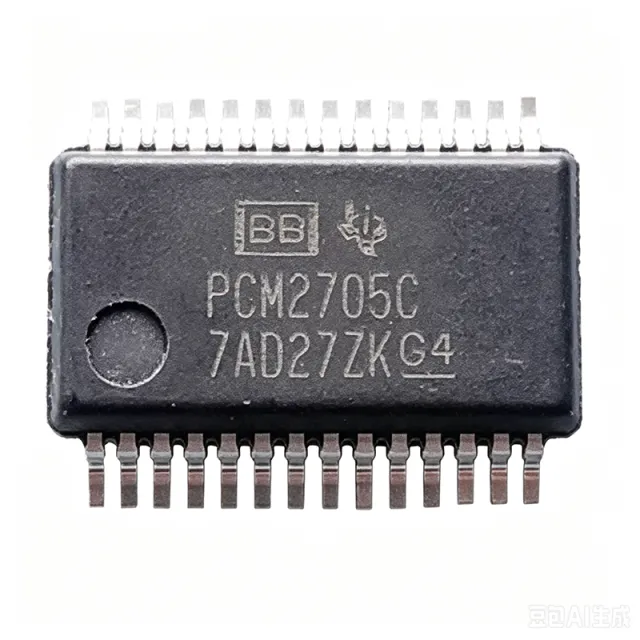
PCM2705C - 98dB SNR Stereo USB DAC with S/PDIF | Texas Instruments
PCM2705C

PCM2705C - 98dB SNR Stereo USB DAC with S/PDIF | Texas Instruments

The Texas Instruments PCM2705C is a single-chip stereo audio digital-to-analog converter (DAC) with an integrated USB 2.0 full-speed protocol controller and S/PDIF output. It delivers 98dB SNR and supports both bus-powered and self-powered operation with software control. The device is fully compliant with USB 2.0 specifications and USB Audio Class, requiring no dedicated device driver. It comes in a 28-pin SSOP package, making it ideal for compact audio applications. A USB audio DAC is a digital-to-analog converter that receives digital audio data from a USB host and converts it to analog audio signals. It integrates the USB interface, protocol controller, and DAC core into a single chip, simplifying system design. The PCM2705C sits in the hierarchy of audio converters, specifically as a USB audio interface IC, which is a subset of audio data converters within the broader category of mixed-signal ICs. Key features include a 98dB SNR stereo DAC, S/PDIF output, and support for both bus-powered and self-powered modes. The device also features partially programmable USB descriptors, allowing customization of vendor ID and product ID via an external SPI host. The integrated USB transceiver eliminates the need for external PHY, reducing BOM cost and board space. Technically, the PCM2705C uses adaptive isochronous transfer for audio data, ensuring synchronized playback. The S/PDIF output supports digital audio transmission to external decoders or amplifiers. The device operates from a 3.3V supply and includes an internal PLL for clock generation, minimizing external components. The SSOP-28 package provides a compact footprint suitable for portable and space-constrained designs. Typical applications include USB sound cards, docking stations, gaming headsets, and portable audio interfaces. The device's plug-and-play capability makes it ideal for consumer audio products where driver installation is undesirable. Its low power consumption and small size also suit battery-powered devices. When designing with the PCM2705C, ensure proper decoupling of the 3.3V supply and careful layout of the USB differential pair to maintain signal integrity. The SPI interface for descriptor programming should be configured during initial setup, and the PSEL and HOST pins must be set correctly for the desired operating mode.

USD $3.82 联系我们
PCM3000E - 18-Bit Stereo Audio Codec | Texas Instruments
PCM3000E

PCM3000E - 18-Bit Stereo Audio Codec | Texas Instruments

The Texas Instruments PCM3000E is an 18-bit stereo audio codec with integrated analog-to-digital and digital-to-analog converters, 64-times oversampling, and a 28-pin SSOP package. It accepts single-ended analog voltage inputs and produces single-ended analog voltage outputs, combining stereo recording and playback functions in one low-cost CMOS device. An audio codec is a mixed-signal interface IC that converts between digital audio data and analog voltage signals. In the signal-chain hierarchy, the PCM3000E sits between an audio signal source or microphone front end and a digital audio processor, microphone preamplifier, and analog output amplifier. Its ADC path digitizes stereo analog inputs, while its DAC path reconstructs stereo audio from serial digital data. The integrated converters make it useful in cost-sensitive consumer equipment requiring more functionality than a basic interface controller. Key features include 18-bit ADC and DAC resolution, stereo operation, single-ended analog inputs and outputs, and 64-times ADC oversampling. The DAC section uses an 8-times oversampling digital interpolation filter. A serial interface provides a straightforward connection to digital audio processors, while the integrated codec architecture reduces the number of separate converters required in a stereo audio subsystem. The PCM3000E uses delta-sigma modulation for both conversion paths. Delta-sigma ADCs oversample the analog input and use digital decimation filtering, while the DAC path combines digital interpolation filtering with a single-bit delta-sigma conversion stage. This architecture supports compact, cost-sensitive stereo audio designs and is suited to consumer applications where good performance is required without the complexity of a high-resolution multibit converter. Typical uses include consumer digital audio equipment, portable audio products, stereo cassette and CD-style playback systems, and other sound-processing products. It can also support multichannel designs when multiple codec channels are combined. For digital signal processing, the codec can work with serial audio processors, microcontrollers, or DSPs capable of handling the required master clock, serial data, and control signals. Designers should follow the pin-description table in the manufacturer datasheet when assigning signal paths and decoupling. The analog supply, digital supply, clock, serial interface, and analog-output circuitry require careful partitioning to prevent switching activity and digital coupling from degrading audio performance. The 28-pin SSOP package is compact but has a relatively narrow lead pitch, so PCB assembly and inspection require suitable fine-pitch capability. This page organizes the PCM3000E specifications, pin and package information, product comparisons, engineering guidance, and available drop-in alternatives for faster design review. It also identifies lifecycle and sourcing considerations that should be checked before committing to a new production design.

询价 联系我们
PCM3002E - Low-Power Stereo Audio Codec | Texas Instruments
PCM3002E

PCM3002E - Low-Power Stereo Audio Codec | Texas Instruments

The Texas Instruments PCM3002E is a low-power stereo audio codec with 16/20-bit resolution, two analog inputs, two analog outputs, and a 24-pin SSOP package. It combines delta-sigma ADCs and DACs with a 20-bit serial audio interface and software-controlled line output, making it suitable for cost-sensitive consumer audio equipment. A stereo audio codec is a mixed-signal semiconductor that converts two analog audio channels into digital data and converts digital audio data back into two analog output channels. In the signal-chain hierarchy, PCM3002E belongs to the audio codec category, combines analog-to-digital converters and digital-to-analog converters, and ultimately supports digital signal processing and audio playback systems. The converter architecture uses delta-sigma modulation with 64-times oversampling. According to the Texas Instruments product information, the ADCs include a digital decimation filter, while the DACs use an 8-times oversampling digital interpolation filter. The 16/20-bit interface supports digital audio formats identified in the family documentation as I2S, L, right-justified I2S, and L/R formats, allowing the device to interface with common audio processors and digital audio buses. The PCM3002 and PCM3003 family is manufactured using an advanced CMOS process and is positioned for cost-sensitive consumer applications where audio performance and low power consumption are important. The 24-pin SSOP package provides a compact surface-mount implementation for consumer audio boards, and the software-controlled line output provides an additional output-control option for system integration. Typical applications include consumer stereo audio systems, portable media equipment, compact digital amplifiers, USB or portable audio accessories, television audio subsystems, and embedded audio interfaces. In each case, the device consolidates two ADCs, two DACs, filtering, and the digital serial interface into one package, reducing the number of separate converter components required on the printed circuit board. When designing a PCB around the PCM3002E, use the manufacturer pin-description table and layout guidance to assign every signal, supply, ground, and reference connection. Decoupling should follow the datasheet recommendations, analog and digital return paths should be routed carefully, and unused inputs should be configured according to the application circuit rather than left electrically unterminated by assumption. This product page combines the device architecture, package information, practical application guidance, sourcing options, and verified equivalent references to support faster component selection and board-level design. It also highlights where an exact replacement is available and when a proposed substitute requires additional engineering verification.

询价 联系我们
PCM3003E - Low-Power Stereo Audio Codec | Texas Instruments
PCM3003E

PCM3003E - Low-Power Stereo Audio Codec | Texas Instruments

Texas Instruments PCM3003E is a low-power stereo audio codec with 16-bit or 20-bit resolution, single-ended analog inputs and outputs, and a 24-pin SSOP package. The device operates from a 2.7 V to 3.6 V analog supply and supports an industrial temperature range of -25 °C to +85 °C. An audio codec is an integrated interface that converts between analog audio signals and digital PCM data. The PCM3003E combines stereo analog-to-digital and digital-to-analog conversion functions in one IC, making it suitable for compact consumer audio equipment where component count, power consumption, and board area are important. Its digital audio interface and analog signal path support equipment such as consumer audio systems, portable products, and compact multimedia devices. The PCM3003E offers selectable 16-bit or 20-bit operation, providing flexibility for designs that balance conversion resolution against system data rate and storage requirements. Its line output includes hardware control, allowing the output stage to be managed according to the product architecture. A single-ended analog interface can simplify PCB routing, although grounding and signal-return design remain important for low-noise performance. The codec is manufactured using an advanced CMOS process and is intended for cost-sensitive consumer applications that require good audio performance without a high-complexity audio interface. The 24-pin SSOP package supports conventional surface-mount assembly and is compatible with automated production processes. System designers should follow the manufacturer pin-description table and recommended application circuit when assigning PCB tracks. Typical PCM3003E applications include stereo audio playback and capture, consumer media equipment, compact sound systems, and embedded audio products. The 2.7 V to 3.6 V operating range supports low-voltage digital platforms, while the -25 °C to +85 °C temperature range covers industrial environments. External decoupling, controlled analog grounding, and careful clock routing should be treated as core parts of the analog design. This product page combines manufacturer specifications, packaging information, application guidance, and engineering comparisons. It also distinguishes the PCM3003E from identified family variants and highlights the design checks that matter when integrating a low-power stereo codec into a mixed-signal PCB.

询价 联系我们
PCM3006T - 16-Bit Stereo Audio Codec | Texas Instruments
PCM3006T

PCM3006T - 16-Bit Stereo Audio Codec | Texas Instruments

Texas Instruments PCM3006T is a low-cost, single-chip stereo audio codec with 16-bit resolution, single-ended analog inputs and outputs, and a 24-SSOP package. The codec combines analog-to-digital and digital-to-analog conversion functions on one device, reducing the component count in stereo audio equipment. Its delta-sigma conversion architecture uses 64-times oversampling, while the ADC path includes a digital decimation filter for converting the oversampled stream into the required audio-rate data. An audio codec is a mixed-signal interface IC that bridges an analog audio system and a digital audio processor. In this product hierarchy, the PCM3006T is a stereo audio codec, which combines an ADC, DAC, analog input and output circuitry, and digital audio data interfaces. It is used where a system needs bidirectional conversion between analog audio signals and a serial digital audio bus rather than a complete USB audio interface or loudspeaker amplifier. The principal functional attributes of the PCM3006T include 16-bit stereo conversion, single-ended analog input and output, 64-times delta-sigma oversampling, and a digital decimation filter in the ADC path. These features make it suitable for compact stereo audio products in which an existing digital audio engine must interface directly with analog microphones, line-level circuitry, speakers, or other analog audio stages. The integrated codec architecture also helps reduce board area compared with separate ADC and DAC devices. The 24-SSOP package is intended for surface-mount assembly and provides a compact implementation for audio equipment. Because the codec performs both conversion directions, board layout should keep the analog input, analog output, digital interface, and supply connections arranged to minimize coupling between sensitive audio nodes and high-speed digital signals. External analog filtering, grounding, and supply-decoupling decisions remain part of the complete signal-chain design rather than being determined solely by the codec specifications. Typical applications include stereo sound-card analog sections, portable audio products, digital mixing consoles, audio-recording interfaces, speaker and headphone subsystems, and embedded equipment that already has a separate USB or digital audio controller. The PCM3006T is particularly appropriate where single-ended analog connections are acceptable and a 16-bit stereo serial interface is sufficient. It does not itself perform USB connectivity or drive a loudspeaker directly, so those functions require suitable companion circuitry. Designers should verify the complete pin configuration, supported digital audio format, sampling-rate range, analog signal limits, and power requirements in the manufacturer datasheet before layout release. The single-ended interface simplifies some analog routing, but it may reduce headroom or flexibility compared with a codec that offers balanced inputs and outputs. Appropriate passive networks, stable references, clean supplies, and controlled return paths remain essential for low distortion and acceptable channel matching. This product summary combines the verified 16-bit stereo codec identity, single-ended analog I/O, 64-times oversampling, digital decimation, and 24-SSOP packaging information with practical selection guidance, comparison notes, sourcing workflow, and design-focused considerations.

询价 联系我们
PCM3060PW - 24-Bit Stereo Audio Codec | Texas Instruments
PCM3060PW

PCM3060PW - 24-Bit Stereo Audio Codec | Texas Instruments

Texas Instruments PCM3060PW is a single-chip 24-bit stereo audio codec with two single-ended analog inputs, two differential analog outputs, 16–96 kHz sampling rates, and 16/24-bit digital audio words, housed in a 28-pin TSSOP package. It combines a stereo ADC using a 64-times delta-sigma modulator with a stereo DAC using a 64- or 128-times delta-sigma modulator. An audio codec converts between analog audio and digital audio data. The PCM3060 integrates both conversion functions, control registers, digital attenuation, soft mute, de-emphasis, and serial host communication on one device. Its interface supports 3-wire SPI-compatible or 2-wire I²C-compatible control, while its audio interface handles the digital conversion data. This integrated architecture suits sound-processing equipment requiring stereo capture and playback without separate ADC and DAC packages. The codec supports 16/24-bit digital audio words at sampling rates from 16 kHz through 96 kHz. Differential analog outputs help reduce common-mode noise and support balanced output routing, while the two single-ended ADC inputs simplify source capture. Programmable digital attenuation, soft mute, and de-emphasis provide useful control functions for consumer audio, television, set-top-box, and audiovisual equipment. The PCM3060 is fabricated using an advanced CMOS process and integrates delta-sigma conversion, digital filtering, and interface control into a 28-pin TSSOP package. This mixed-signal design supports 24-bit resolution while keeping the external component count lower than a discrete converter solution. The control interface provides access to operating functions from a host processor. Typical uses include DVD-RW equipment, digital televisions, set-top boxes, and other audiovisual systems. The same architecture also fits industrial sound modules, stereo recording interfaces, digital mixing equipment, and playback products requiring both microphone-line input capability and line-level differential output. PCB implementation should preserve short analog traces, provide a quiet analog ground connection, and place input and output bypass capacitors close to their associated pins. The digital interface and analog signal paths should be routed to limit coupling between switching signals and sensitive conversion circuitry. Confirm the pin-description table in the manufacturer datasheet before assigning every trace and decoupling connection. This product page combines the manufacturer’s codec specifications, package information, application guidance, pricing workflow, and verified drop-in substitution analysis. It also provides practical comparison points and design notes intended to accelerate component selection, PCB implementation, and second-source qualification for stereo audio designs.

询价 联系我们
PCM3500E - 16-Bit Mono Voice Codec | Texas Instruments
PCM3500E

PCM3500E - 16-Bit Mono Voice Codec | Texas Instruments

Texas Instruments PCM3500E is a low-voltage, low-power, 16-bit mono SoundPlus voice and modem codec in a 24-SSOP package. It operates from a 2.7 V to 3.6 V supply and integrates the functions required for modem analog front ends and speech-processing systems. The codec combines a mono single-to-differential converter, a fully differential fifth-order delta-sigma modulator, decimation filtering, a digital high-pass filter, and a serial interface circuit. A voice codec is a mixed-signal integrated circuit that converts an analog voice signal into a digital bitstream and reconstructs a digital audio stream into an analog signal. In the product hierarchy, PCM3500E is a SoundPlus voice codec, a specialized audio codec, and therefore part of the broader amplifier, interface, and power-management ecosystem. Its mono architecture is appropriate for one speech channel, modem equipment, and portable voice terminals where power consumption and board area are important. The 16-bit resolution provides the primary signal representation for the voice path, while the delta-sigma modulator and decimation filter implement the conversion from analog voice information to a serial digital stream. The integrated power-down function supports systems that need to reduce consumption when the codec is not active. The 2.7 V to 3.6 V operating range aligns with low-voltage digital systems and portable equipment supplied from 3.3 V rails. The PCM3500E is designed for modem analog front-end and speech-processing applications. Its mono single-to-differential input stage is intended to provide a differential signal to the internal modulator, helping the converter operate with its intended signal structure. The serial interface provides the digital connection between the codec and a host processor, digital signal processor, or communications controller. Engineers should pay close attention to the 24-SSOP footprint, analog input routing, reference requirements, bypass capacitors, serial-interface timing, and the 2.7 V to 3.6 V supply limits. Because the device is designed around a voice-band signal chain, microphone and line-level inputs require appropriate gain and impedance conditioning before reaching the converter. This page combines the manufacturer product description with practical application guidance, pin and packaging information, selection criteria, and a comparison framework for engineers evaluating codec upgrades or replacements. It emphasizes the PCM3500E's 16-bit mono architecture, low-voltage operation, integrated power-down capability, and suitability for compact voice and modem equipment.

询价 联系我们
PCM3501E - 16-Bit Mono Voice/Modem Codec | Texas Instruments
PCM3501E

PCM3501E - 16-Bit Mono Voice/Modem Codec | Texas Instruments

The Texas Instruments PCM3501E is a low-voltage, low-power, 16-bit mono SoundPlus voice and modem codec in a 24-pin SSOP (DB) package. The device is designed for voice-band signal conversion, with support for operation rates up to 56 kbps and sampling frequencies up to 26 kHz. Its analog performance includes a typical dynamic range of 88 dB when measured at 8 kHz sampling with a 1 kHz input frequency. The PCM3501E is a single-channel codec intended for embedded voice, modem, telephony, communications, and audio acquisition systems. A voice codec is a mixed-signal semiconductor that converts between analog audio or voice signals and a digital serial interface. The PCM3501E belongs to the broader codec and audio interface hierarchy, which includes analog-to-digital converters, digital-to-analog converters, voice processors, and communication interface ICs. Its 16-bit resolution supports voice-band digital representation, while the mono architecture reduces system complexity compared with stereo codecs. Differential input and output capability is specifically identified for modem analog front-end designs. The principal device characteristics are its 16-bit delta-sigma ADC and DAC sections, differential input and output support, operation to 56 kbps, and maximum sampling frequency of 26 kHz. The 88 dB typical dynamic range provides the stated signal-performance target for voice-band applications. The low-voltage and low-power positioning makes the codec suitable for compact embedded equipment where the system must convert voice signals without introducing unnecessary circuit complexity. The PCM3501E is appropriate for modem analog front ends, telephone interfaces, voice recording systems, industrial communication terminals, and other mono voice-processing equipment. Its serial digital interface allows the analog front end to connect to a host processor or communications controller. Designers should select the digital interface mode and clocking arrangement according to the manufacturer datasheet, and should confirm the system sampling rate and serial framing before committing the PCB layout. A key design consideration is the distinction between the codec signal path and the surrounding analog implementation. Input and output filtering, microphone or line-source conditioning, clocking, digital interface routing, and supply decoupling all affect final voice quality. Use the manufacturer application circuit and pin-description table when assigning tracks, grounding the analog return path, and placing bypass capacitors. This product page consolidates the manufacturer device identity, package information, verified technical characteristics, practical application guidance, and design considerations. It also identifies the limitation that the cross-reference results do not establish five distinct pin-compatible drop-in replacements, avoiding unsupported substitution claims.

询价 联系我们
PCM4202IDBREP - 24-Bit 216kHz Stereo Audio ADC, 28-SSOP | Texas Instruments
PCM4202IDBREP

PCM4202IDBREP - 24-Bit 216kHz Stereo Audio ADC, 28-SSOP | Texas Instruments

The Texas Instruments PCM4202IDBREP is a high-performance, 24-bit, 216 kHz sampling, stereo audio analog-to-digital converter (ADC) housed in a 28-pin SSOP (DB) package. As an Enhanced Product (EP) variant, it is rated for industrial temperature operation from -40C to +85C, and the device supports 24-bit linear PCM output data at sampling frequencies up to 216 kHz through a standard I2S, left-justified, or right-justified interface. The PCM4202IDBREP delivers dynamic performance of 118 dB SNR and 105 dB THD+N (typical), making it suitable for professional and broadcast audio recording. A stereo audio ADC is a high-resolution converter that digitizes two channels of analog audio into a bitstream suitable for storage, mixing, or further DSP processing. In the broader signal chain hierarchy, the PCM4202IDBREP sits between microphone preamplifiers / line inputs and downstream digital processing, occupying the analog-to-digital conversion stage of the audio chain. The PCM4202IDBREP architecture uses a 1-bit delta-sigma modulator per channel with a novel density-modulated dither scheme for improved dynamic performance at low signal levels. Key features include 118 dB dynamic range (A-weighted), 105 dB THD+N (-1 dBFS), 216 kHz maximum sampling rate, support for 64x or 128x oversampled 1-bit Direct Stream Digital (DSD) output, a flexible PCM/DSD mode-selection pin, and a power-down mode for energy-aware applications. The device operates from a 3.3 V or 5 V analog supply and a 3.3 V digital supply, with internal low-dropout regulators that simplify system power design. Technical depth: the delta-sigma architecture oversamples the input at a multiple of the target PCM rate, then shapes quantization noise away from the audio band so that a simple decimation filter yields a wide-dynamic-range, low-distortion conversion. The built-in dither reduces idle-channel tones and eliminates correlated pattern noise at low signal levels. Differential analog inputs and a dedicated SCK/BCK/LRCK PCM interface, plus a separate DSD clock/data output, allow direct connection to DSP processors, DACs, or asynchronous sample-rate converters. Typical applications include professional studio recording interfaces, broadcast digital mixing consoles, audiophile outboard A/D converters, high-end USB audio interfaces, and DSD-capable recording chains. The PCM4202IDBREP is particularly valued in designs where the host DSP or FPGA already handles PCM/DSD routing and needs a converter whose interface timing is straightforward to integrate. Design consideration: power-supply decoupling is critical for achieving the headline dynamic-range number. Place a 10 uF bulk capacitor plus 0.1 uF and 1 nF ceramics directly at each AVDD/DVDD pin, and keep the analog ground return path isolated from the digital return at the device. For best performance, configure MCLK at the appropriate multiple of the target sampling rate and verify that BCK, LRCK, and SCK meet the timing windows specified in the manufacturer datasheet. This page synthesizes distributor pricing, drop-in alternatives, and practical design notes not found in the manufacturer datasheet, including verified cross-reference data from the TI cross-reference search and major franchised distributors.

询价 联系我们
PCM5100PW - 2VRMS Stereo DAC | Texas Instruments
PCM5100PW

PCM5100PW - 2VRMS Stereo DAC | Texas Instruments

Texas Instruments PCM5100PW is a stereo digital-to-analog converter with a 100 dB dynamic range, 2 VRMS output, and an integrated audio PLL. The device accepts 16-bit, 24-bit, and 32-bit PCM data at sampling rates up to 384 kHz and is packaged in a 20-pin TSSOP. Its 2 VRMS DirectPath output architecture is intended for compact, high-performance consumer audio equipment. An audio DAC is a signal-conversion integrated circuit that translates digital audio samples into an analog voltage suitable for amplification or line-level output. Within the broader semiconductor hierarchy, the PCM5100PW is a DAC, an audio data converter, and a mixed-signal integrated circuit. It sits between a digital audio source, such as a USB interface or application processor, and an analog headphone, line, or power-amplifier stage. Key features include a 100 dB stereo DAC dynamic range, 2 VRMS output capability, selectable digital-filter latency, and an integrated audio PLL. The PCM5100PW also uses DirectPath technology, requires no DC-blocking output capacitors, and includes an internal negative charge pump. These features support a compact analog output network while preserving the digital PCM input architecture. The 32-bit PCM interface accepts 16-bit, 24-bit, or 32-bit word lengths at up to 384 kHz sampling rate. Its integrated PLL provides a convenient internal clock for the stereo DAC section. According to the Texas Instruments PCM5100 family datasheet, the device also supports internal pop-free operation, which helps reduce startup transients in audio equipment. Typical applications include digital active speakers, compact stereo audio systems, USB audio adapters, Bluetooth audio receivers, game-console accessories, and portable consumer-audio products. The 3.0 V to 3.6 V supply range and 20-pin TSSOP package make the device suitable for designs where a small PCB footprint and integrated digital-to-analog conversion are priorities. When laying out the PCB, place the digital interface and analog output paths in their respective functional regions, keep the analog output route short, and follow the manufacturer’s recommended decoupling and grounding arrangement. Confirm the output configuration, digital-filter latency, clocking method, and analog load requirements before finalizing the board design. This product overview combines the manufacturer’s key device characteristics with application guidance, package information, and drop-in replacement considerations. It also distinguishes the PCM5100PW from related PCM510x devices so engineers can select the appropriate variant without relying on packaging-only ordering differences.

询价 联系我们
PCM5101PW - 106dB Stereo DAC, 2Vrms | Texas Instruments
PCM5101PW

PCM5101PW - 106dB Stereo DAC, 2Vrms | Texas Instruments

Texas Instruments PCM5101PW is a 106 dB stereo digital-to-analog converter with 2 Vrms output, an integrated audio PLL, and support for 16-, 24-, and 32-bit PCM data at sampling rates up to 384 kHz. The device is packaged in a 20-pin TSSOP (PW) package and operates from a 3.3 V supply according to the manufacturer product listing. An audio DAC is a signal-conversion integrated circuit that reconstructs a continuous analog output from digital audio samples. The PCM5101 belongs to the DAC hierarchy within audio interface and data-converter ICs. Its integrated digital filtering, low-noise architecture, and DirectPath-style output stage are intended to simplify the analog output stage while preserving low out-of-band noise. The PCM5101 supports 16-, 24-, and 32-bit PCM data and a maximum sample rate of 384 kHz. It offers selectable digital-filter latency, allowing system designers to balance responsiveness against out-of-band noise reduction. The manufacturer describes the device as a 106 dB stereo DAC with 2 Vrms output and an integrated audio PLL, which supports clock generation for digital-to-analog conversion from a serial PCM interface. The 2 Vrms output level can drive line-level audio paths without requiring an external output-voltage amplifier when the downstream load and impedance are appropriate. Its internal negative charge pump supports pop-free operation without external DC-blocking capacitors. The integrated PLL also reduces dependence on a separate audio clock source when the host interface supplies a suitable reference clock. Typical uses include digital audio players, USB and network audio equipment, home-theater audio paths, active speakers, soundbars, and embedded multimedia systems. The converter can also serve as the output stage of a mixed-signal audio product where a digital audio stream must become a line-level analog signal. Care is needed to preserve output quality through correct grounding, filtering, and routing. For layout, place input, output, and decoupling connections directly adjacent to their associated pins, and maintain a quiet analog return path that is not shared with high-current digital return currents. Verify the external clock topology, digital interface levels, and output load against the manufacturer datasheet. The 20-pin TSSOP package also makes thermal checking and assembly planning important during PCB layout. This product overview combines the exact ordering information, converter capabilities, package details, lifecycle status, and design trade-offs needed to evaluate PCM5101PW. It also organizes drop-in family alternatives, application guidance, comparison parameters, and practical implementation notes so engineers can move from part selection to board-level implementation with fewer manual cross-checks.

询价 联系我们
PCM5102APWR - 2VRMS 112dB Stereo DAC w/ PLL | TI
PCM5102APWR

PCM5102APWR - 2VRMS 112dB Stereo DAC w/ PLL | TI

The Texas Instruments PCM5102APWR is a 32-bit stereo audio DAC with integrated PLL and DirectPath ground-centered 2.1 VRMS line-level output, housed in a 20-pin TSSOP (PW) package rated -25C to +85C. It delivers 112 dB dynamic range, 100 dB THD+N, and supports PCM sample rates from 8 kHz to 384 kHz in I2S, left-justified, right-justified, and DSP-compatible formats. A stereo DAC (Digital-to-Analog Converter) is a mixed-signal IC that reconstructs an analog audio waveform from a digital bitstream. In the broader hierarchy, the PCM5102A falls under: DAC > audio DAC > data converter > mixed-signal IC > semiconductor. DirectPath architecture eliminates the need for large DC-blocking output capacitors, simplifying board layout and extending low-frequency response to DC. Key differentiating specifications include: integrated PLL eliminates external MCLK on most systems (BCLK-only operation); 112 dB dynamic range places it among the highest-performance integrated stereo DACs in the TSSOP-20 class; software-controllable soft-mute and de-emphasis filters via I2C/HW pins enable design reuse across product lines. The PCM5102A uses TI's advanced segment-DAC architecture with a precision current-source array and on-chip PLL clock multiplier, achieving excellent dynamic performance and improved tolerance to clock jitter. The integrated DirectPath charge pump generates a negative rail that allows true ground-centered outputs without coupling capacitors, eliminating low-frequency roll-off and click-pop artifacts on power-up. Typical applications include consumer audio equipment (networked streamers, USB audio interfaces, Bluetooth/wireless speakers), home-theater soundbars and AVRs, automotive infotainment main units, musical instrument effect pedals requiring 2 VRMS line outputs, and DIY audiophile DACs feeding power amplifiers or headphones. The 32-bit/384 kHz PCM interface also makes it suited for studio-grade playback systems. When designing with PCM5102APWR, consider that VCC must be 3.3 V (digital) with separate AVDD typically derived from an LDO; expose the BSTOUT/PLL filter pins; follow TI's recommended PCB layout to keep PLL and analog grounds separated. This page synthesizes distributor pricing, drop-in alternatives (PCM5100A, PCM5101A, PCM5102A-Q1), and PCB layout notes not bundled in the manufacturer datasheet.

询价 联系我们
PCM5102PW - 112dB Stereo DAC, 2VRMS, TSSOP-20 | TI
PCM5102PW

PCM5102PW - 112dB Stereo DAC, 2VRMS, TSSOP-20 | TI

The Texas Instruments PCM5102PW is a stereo digital-to-analog converter with 112 dB dynamic range, 2 VRMS DirectPath output, and a 32-bit PCM interface supporting operation up to 384 kHz. The device is supplied in a 20-pin TSSOP package for surface-mount audio and digital signal-processing systems. Its architecture supports 16-bit, 24-bit, and 32-bit word lengths, providing compatibility with common high-resolution audio sources while maintaining a serial PCM data interface. An audio DAC is a digital-to-analog converter, a semiconductor in the broader signal-conversion and audio-processing hierarchy. It accepts encoded digital audio samples and reconstructs an analog output waveform for headphone amplifiers, line-level inputs, powered speakers, or other downstream analog stages. The PCM5102 integrates an audio PLL, allowing the digital interface and internal clocking to be coordinated for multiple standard sample rates. The principal performance characteristics are 112 dB dynamic range, 2 VRMS output capability, operation up to 384 kHz, and support for 16-, 24-, and 32-bit PCM data. The manufacturer describes the output stage as 2 VRMS DirectPath, which removes the requirement for conventional DC-blocking output capacitors in the intended application topology. A selectable digital-filter latency function provides another configuration option for systems that must balance conversion performance with timing requirements. The PCM5102 family also incorporates an internal negative charge pump and supports pop-free output behavior. These features address common implementation concerns in audio conversion systems: reducing low-frequency output offset, controlling startup transients, and simplifying the analog output network. The 3 V to 3.6 V supply range supports integration with low-voltage digital audio equipment, although the exact internal voltage rails and operating limits must be taken from the manufacturer datasheet. Typical uses include hi-fi audio playback, USB and network-audio interface outputs, digital mixing consoles, headphone-driver stages, portable media equipment, and embedded audio systems. The integrated audio PLL is particularly useful when the converter must derive a usable clock from an incoming PCM stream. Its 384 kHz capability accommodates high-resolution source formats and studio-oriented playback equipment. When laying out a design, treat the analog output path as a precision signal path and place the device close to the appropriate output-network components. Confirm the manufacturer-recommended decoupling, exposed-pad or thermal-land requirements, and analog grounding arrangement for the selected TSSOP footprint before finalizing the PCB. The PCM5102PW is packaged for a 20-pin TSSOP, so software and hardware teams should verify the exact lead assignment in the pin-description table before routing signals. This product page consolidates the confirmed PCM5102PW electrical, package, interface, and sourcing details with practical design guidance, same-family drop-in candidates, and application-oriented explanations. It adds engineering context beyond a basic catalog listing while keeping unavailable pin-level, lifecycle, and compliance conclusions separate from confirmed manufacturer information.

询价 联系我们
PCM5121PW - 106dB Stereo Audio DAC | Texas Instruments
PCM5121PW

PCM5121PW - 106dB Stereo Audio DAC | Texas Instruments

Texas Instruments PCM5121PW is a stereo audio digital-to-analog converter with a 2 V RMS DirectPath output, 106 dB dynamic performance, a 32-bit PCM interface, and fixed audio processing. The device accepts 16-bit, 24-bit, and 32-bit audio data, supports sampling rates up to 384 kHz, and is offered in a 28-pin TSSOP package. Its architecture is designed for applications requiring a low-noise differential-to-single-ended audio output stage with direct DC-coupled or AC-coupled load support. An audio DAC is a mixed-signal semiconductor that converts PCM-formatted digital audio samples into an analog voltage suitable for amplification, loudspeaker drive, recording, or measurement. The DAC belongs to the broader digital-to-analog converter and data-converter hierarchy, which supports signal-chain, audio, communication, and instrumentation systems. In a typical playback chain, a digital audio source supplies PCM data, the DAC reconstructs the analog waveform, and a subsequent amplifier drives headphones, powered speakers, or another analog processing stage. The PCM5121PW combines a 2 V RMS output capability with 106 dB dynamic performance. Its PCM interface accepts 16-bit, 24-bit, and 32-bit data at rates up to 384 kHz, supporting high-resolution digital audio sources. Fixed audio processing is integrated into the device, while DirectPath output architecture is intended to simplify analog output design. The OUTL and OUTR outputs provide separate left and right channels and support dc-coupled loads when their resistance conforms to the manufacturer specification; AC-coupled loads are also supported. The PCM512x family uses TI segment-DAC architecture and is designed to achieve strong dynamic performance and improved tolerance to clock jitter. The family documentation also describes low out-of-band noise, offering up to 20 dB lower out-of-band noise than existing DAC technology. Together with the 106 dB performance rating and 384 kHz capability, these characteristics make the device relevant to premium digital audio, USB and network audio equipment, digital recording systems, and high-fidelity consumer products. Typical applications include USB audio interfaces, network-audio streamers, digital mixing consoles, hi-fi headphone amplifiers, powered-speaker front ends, surround-sound processors, and professional audio converters. In each case, the PCM5121PW converts the incoming PCM stream into left and right analog outputs while retaining support for high-resolution source material. System designers should pair the converter with a suitable output network, power supply, clock architecture, and analog amplifier while observing the load and bypass requirements in the manufacturer datasheet. A critical design consideration is the relationship between output load, output configuration, and clock quality. AC or DC coupling must be selected according to the downstream amplifier input, and the supported load resistance must be checked before external analog circuitry is added. Power and ground routing should be planned around the DAC’s mixed-signal and high-speed digital sections, while clock jitter can affect achievable conversion performance even when the nominal interface rate is correct. This product page combines the manufacturer’s key PCM5121 specifications with practical interface, analog-output, and replacement guidance. It also identifies verified drop-in candidates, separates known performance characteristics from unconfirmed parameters, and provides engineering-focused selection criteria for audio-system development.

询价 联系我们
PCM5122PW - 112dB Stereo Audio DAC | Texas Instruments
PCM5122PW

PCM5122PW - 112dB Stereo Audio DAC | Texas Instruments

Texas Instruments PCM5122PW is a 2 V RMS DirectPath stereo audio digital-to-analog converter with 112 dB dynamic range, a 32-bit PCM interface, and fixed audio processing in a 28-pin TSSOP package. The converter supports audio sampling rates up to 384 kHz and operates from a 3 V to 3.6 V supply. A stereo audio DAC is a digital-to-analog converter that turns PCM audio samples into left and right analog voltage signals. Its position in the signal chain is between a digital audio source, such as a USB audio interface, Bluetooth receiver, or audio processor, and the output amplifier that ultimately drives headphones or powered speakers. The PCM5122 belongs to the audio DAC hierarchy within signal-conversion and interface ICs. The PCM5122PW combines a 2 V RMS DirectPath output architecture with 112 dB dynamic range and fixed audio processing. Its stereo output stage is designed for high-fidelity audio rather than low-power telephone signaling. The 32-bit PCM interface accommodates high-resolution digital audio, while operation up to 384 kHz supports professional and high-resolution playback formats. I2C and SPI control capabilities allow the host to configure device functions. The 28-pin TSSOP package provides a compact surface-mount implementation for multichannel audio products. Operation from 3 V to 3.6 V suits systems built around modern low-voltage digital audio processors. The -25 °C to +85 °C temperature range covers industrial and extended-temperature environments, although the complete system still requires appropriate analog and digital supply design. Typical uses include high-end active speakers, digital audio appliances, network-audio players, soundbars, USB audio equipment, and premium headphone interfaces. The fixed processing functions can simplify implementation where standardized signal conditioning is preferable to a fully configurable codec. For multi-channel systems, multiple converter channels can be synchronized through the digital audio architecture. The most important design tradeoff is output loading. DirectPath output stages can have different voltage, current, and stability requirements from ordinary line-output amplifiers, so the output network, grounding, and power-supply arrangement must follow the manufacturer recommendations. Confirm the selected output configuration and load range before finalizing the analog board layout. This page combines the manufacturer’s device characteristics with drop-in replacement guidance, parameter comparisons, application guidance, and practical PCB and signal-integrity notes so engineers can evaluate PCM5122PW against alternatives before committing a board design.

询价 联系我们
PCM5122PWR - 112dB Stereo Audio DAC | Texas Instruments (Tape & Reel)
PCM5122PWR

PCM5122PWR - 112dB Stereo Audio DAC | Texas Instruments (Tape & Reel)

Texas Instruments PCM5122PWR is a 2 V RMS DirectPath stereo audio digital-to-analog converter with 112 dB dynamic range, a 32-bit PCM interface, and fixed audio processing in a 28-pin TSSOP package. The converter supports audio sampling rates up to 384 kHz and operates from a 3 V to 3.6 V supply. A stereo audio DAC is a digital-to-analog converter that turns PCM audio samples into left and right analog voltage signals. Its position in the signal chain is between a digital audio source, such as a USB audio interface, Bluetooth receiver, or audio processor, and the output amplifier that ultimately drives headphones or powered speakers. The PCM5122 belongs to the audio DAC hierarchy within signal-conversion and interface ICs. The PCM5122PWR combines a 2 V RMS DirectPath output architecture with 112 dB dynamic range and fixed audio processing. Its stereo output stage is designed for high-fidelity audio rather than low-power telephone signaling. The 32-bit PCM interface accommodates high-resolution digital audio, while operation up to 384 kHz supports professional and high-resolution playback formats. I2C and SPI control capabilities allow the host to configure device functions. The 28-pin TSSOP package provides a compact surface-mount implementation for multichannel audio products. Operation from 3 V to 3.6 V suits systems built around modern low-voltage digital audio processors. The -25 °C to +85 °C temperature range covers industrial and extended-temperature environments, although the complete system still requires appropriate analog and digital supply design. Typical uses include high-end active speakers, digital audio appliances, network-audio players, soundbars, USB audio equipment, and premium headphone interfaces. The fixed processing functions can simplify implementation where standardized signal conditioning is preferable to a fully configurable codec. For multi-channel systems, multiple converter channels can be synchronized through the digital audio architecture. The most important design tradeoff is output loading. DirectPath output stages can have different voltage, current, and stability requirements from ordinary line-output amplifiers, so the output network, grounding, and power-supply arrangement must follow the manufacturer recommendations. Confirm the selected output configuration and load range before finalizing the analog board layout. This page combines the manufacturer’s device characteristics with drop-in replacement guidance, parameter comparisons, application guidance, and practical PCB and signal-integrity notes so engineers can evaluate PCM5122PWR against alternatives before committing a board design.

询价 联系我们