المنتجات (39,000+)

STM32F030F4P6 - 48MHz Cortex-M0 16KB MCU | STMicroelectronics
STM32F030F4P6

STM32F030F4P6 - 48MHz Cortex-M0 16KB MCU | STMicroelectronics

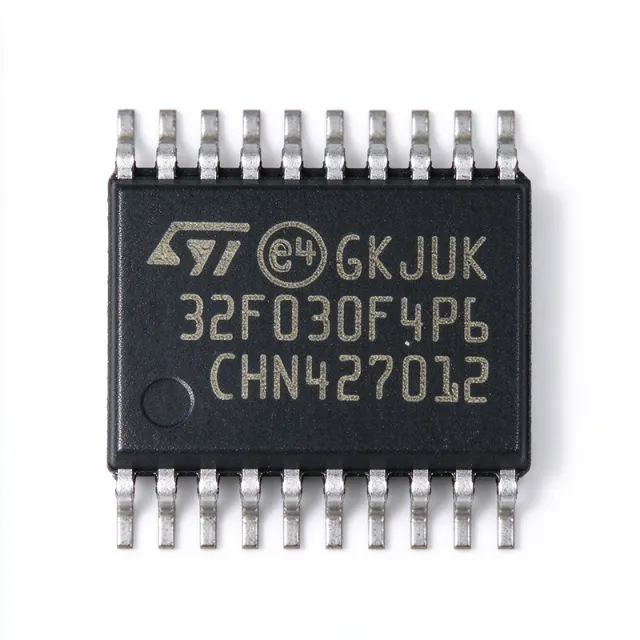
The STMicroelectronics STM32F030F4P6 is a value-line 32-bit Arm Cortex-M0 RISC microcontroller operating up to 48 MHz, with 16 KB Flash, 4 KB SRAM, and a 20-pin TSSOP package. Its 2.4 V to 3.6 V operating range and compact pin count suit embedded control, industrial automation, IoT, metering, and motor-control designs requiring low-cost embedded processing. A microcontroller is a semiconductor device that integrates a processor core, memory, and peripherals into one embedded-control platform. In the hierarchy, the STM32F030F4P6 is an Arm Cortex-M0 microcontroller, an embedded processor, and a member of the STM32F0 family. The STM32F0 series combines a compact general-purpose architecture with timers, communication interfaces, and analog conversion functions for small control systems. The verified data identifies a high-performance 32-bit RISC core operating at 48 MHz, 16 KB Flash organized as 16K x 8, and 4 KB SRAM according to the distributor and datasheet search results. The device also includes 12-bit and 15-bit ADC capability as stated in the LCSC result, while the manufacturer page identifies enhanced peripherals and I/O resources. Power-on reset and power-down reset functionality is identified in the DigiChip result. The STM32F030F4P6 is appropriate for compact embedded systems where cost, simplicity, and low pin count matter more than high-speed connectivity or large memory capacity. Its Arm Cortex-M0 instruction set supports deterministic embedded control, while the 48 MHz clock provides a practical balance between processing capability and power efficiency. The 20-pin TSSOP package enables compact PCB layouts while supporting external peripherals and signal inputs. Typical uses include low-cost sensor nodes, simple industrial controllers, compact motor-control stages, digital meters, and connected IoT devices. Designers must ensure that the selected firmware, clock tree, peripherals, and board-level support devices match the STM32F030x4 device requirements. The exact pin function, electrical limits, peripheral configuration, and package dimensions should be confirmed against the STMicroelectronics datasheet. For a new design, the 48 MHz Cortex-M0 core and 16 KB Flash make the STM32F030F4P6 most suitable for small control loops and auxiliary processing rather than complex graphical or high-bandwidth workloads. The TSSOP-20 package also requires careful PCB escape routing and adequate pin-copper clearance during assembly. This page combines verified manufacturer and distributor information, source links, package details, engineering use cases, and replacement considerations to support component selection and sourcing. Because the supplied data does not include a complete verified pin table or all peripheral electrical limits, those fields are intentionally not guessed.

طلب عرض سعر اتصل بنا
STM32F030F4P6TR - 48MHz Cortex-M0 16KB MCU | STMicroelectronics (Tape & Reel)
STM32F030F4P6TR

STM32F030F4P6TR - 48MHz Cortex-M0 16KB MCU | STMicroelectronics (Tape & Reel)

The STMicroelectronics STM32F030F4P6TR is a value-line 32-bit Arm Cortex-M0 RISC microcontroller operating up to 48 MHz, with 16 KB Flash, 4 KB SRAM, and a 20-pin TSSOP package. Its 2.4 V to 3.6 V operating range and compact pin count suit embedded control, industrial automation, IoT, metering, and motor-control designs requiring low-cost embedded processing. A microcontroller is a semiconductor device that integrates a processor core, memory, and peripherals into one embedded-control platform. In the hierarchy, the STM32F030F4P6TR is an Arm Cortex-M0 microcontroller, an embedded processor, and a member of the STM32F0 family. The STM32F0 series combines a compact general-purpose architecture with timers, communication interfaces, and analog conversion functions for small control systems. The verified data identifies a high-performance 32-bit RISC core operating at 48 MHz, 16 KB Flash organized as 16K x 8, and 4 KB SRAM according to the distributor and datasheet search results. The device also includes 12-bit and 15-bit ADC capability as stated in the LCSC result, while the manufacturer page identifies enhanced peripherals and I/O resources. Power-on reset and power-down reset functionality is identified in the DigiChip result. The STM32F030F4P6TR is appropriate for compact embedded systems where cost, simplicity, and low pin count matter more than high-speed connectivity or large memory capacity. Its Arm Cortex-M0 instruction set supports deterministic embedded control, while the 48 MHz clock provides a practical balance between processing capability and power efficiency. The 20-pin TSSOP package enables compact PCB layouts while supporting external peripherals and signal inputs. Typical uses include low-cost sensor nodes, simple industrial controllers, compact motor-control stages, digital meters, and connected IoT devices. Designers must ensure that the selected firmware, clock tree, peripherals, and board-level support devices match the STM32F030x4 device requirements. The exact pin function, electrical limits, peripheral configuration, and package dimensions should be confirmed against the STMicroelectronics datasheet. For a new design, the 48 MHz Cortex-M0 core and 16 KB Flash make the STM32F030F4P6TR most suitable for small control loops and auxiliary processing rather than complex graphical or high-bandwidth workloads. The TSSOP-20 package also requires careful PCB escape routing and adequate pin-copper clearance during assembly. This page combines verified manufacturer and distributor information, source links, package details, engineering use cases, and replacement considerations to support component selection and sourcing. Because the supplied data does not include a complete verified pin table or all peripheral electrical limits, those fields are intentionally not guessed.

USD $0.38 متوفر
STM32F030K6T6 - 48MHz Cortex-M0 32KB MCU | STMicroelectronics
STM32F030K6T6

STM32F030K6T6 - 48MHz Cortex-M0 32KB MCU | STMicroelectronics

The STMicroelectronics STM32F030K6T6 is a 32-bit Arm Cortex-M0 microcontroller operating at 48 MHz, with 32 KB of Flash memory, 4 KB of SRAM, and a 32-pin LQFP package measuring 7 x 7 mm. It operates from a 2.4 V to 3.6 V supply and combines a compact general-purpose MCU platform with timers, a 12-bit ADC, and communication interfaces. The STM32F030K6 family targets cost-sensitive embedded systems requiring reliable control, data acquisition, and serial connectivity without a high pin count. A microcontroller is a semiconductor that integrates a processor core, memory, and peripherals into one integrated circuit. In the system hierarchy, this device is a microcontroller within the semiconductor category, while its Arm Cortex-M0 core provides a compact RISC architecture for embedded control. Compared with a general-purpose processor, the STM32F030K6T6 integrates the resources needed for real-time firmware execution, peripheral control, and low-power embedded operation on a single device. Key verified features include a 48 MHz maximum CPU frequency, 32 KB of Flash, 4 KB of SRAM, and a 12-bit ADC. The manufacturer describes the STM32F030x4, x6, x8, and xC devices as value-line Arm-based 32-bit MCUs with timers, ADC resources, communication interfaces, and 2.4 V to 3.6 V operation. The 32-LQFP package provides a practical surface-mount footprint for compact industrial and consumer equipment. The device is suitable for simple motor-control peripherals, sensor-hub controllers, compact instrument panels, communication modules, low-speed actuator controllers, and embedded measurement systems. Its 32 KB Flash and 4 KB SRAM fit moderate control loops, protocol stacks, and state machines, although applications requiring larger buffers or image storage should plan memory carefully. The 12-bit ADC supports analog measurements, while communication peripherals enable connection to sensors, displays, and external controllers. When designing a board, begin with the manufacturer datasheet for the complete pin, electrical, timing, and memory map. Provide a stable 2.4 V to 3.6 V supply, route decoupling close to the device, preserve the required reset and clock behavior, and validate unused pins according to the datasheet. Firmware compatibility and peripheral behavior must be checked against the exact STM32F030K6 variant rather than inferred from another STM32 family member. This product page combines verified distributor and manufacturer-source information with package-specific engineering guidance. It identifies the STM32F030K6T6 as the 32 KB, 48 MHz, 32-LQFP member of the STM32F0 value-line family and separates verified specifications from parameters that require design confirmation.

طلب عرض سعر اتصل بنا
STM32F030K6T6TR - 48MHz Cortex-M0 32KB MCU | STMicroelectronics (Tape & Reel)
STM32F030K6T6TR

STM32F030K6T6TR - 48MHz Cortex-M0 32KB MCU | STMicroelectronics (Tape & Reel)

The STMicroelectronics STM32F030K6T6TR is a 32-bit Arm Cortex-M0 microcontroller operating at 48 MHz, with 32 KB of Flash memory, 4 KB of SRAM, and a 32-pin LQFP package measuring 7 x 7 mm. It operates from a 2.4 V to 3.6 V supply and combines a compact general-purpose MCU platform with timers, a 12-bit ADC, and communication interfaces. The STM32F030K6 family targets cost-sensitive embedded systems requiring reliable control, data acquisition, and serial connectivity without a high pin count. A microcontroller is a semiconductor that integrates a processor core, memory, and peripherals into one integrated circuit. In the system hierarchy, this device is a microcontroller within the semiconductor category, while its Arm Cortex-M0 core provides a compact RISC architecture for embedded control. Compared with a general-purpose processor, the STM32F030K6T6TR integrates the resources needed for real-time firmware execution, peripheral control, and low-power embedded operation on a single device. Key verified features include a 48 MHz maximum CPU frequency, 32 KB of Flash, 4 KB of SRAM, and a 12-bit ADC. The manufacturer describes the STM32F030x4, x6, x8, and xC devices as value-line Arm-based 32-bit MCUs with timers, ADC resources, communication interfaces, and 2.4 V to 3.6 V operation. The 32-LQFP package provides a practical surface-mount footprint for compact industrial and consumer equipment. The device is suitable for simple motor-control peripherals, sensor-hub controllers, compact instrument panels, communication modules, low-speed actuator controllers, and embedded measurement systems. Its 32 KB Flash and 4 KB SRAM fit moderate control loops, protocol stacks, and state machines, although applications requiring larger buffers or image storage should plan memory carefully. The 12-bit ADC supports analog measurements, while communication peripherals enable connection to sensors, displays, and external controllers. When designing a board, begin with the manufacturer datasheet for the complete pin, electrical, timing, and memory map. Provide a stable 2.4 V to 3.6 V supply, route decoupling close to the device, preserve the required reset and clock behavior, and validate unused pins according to the datasheet. Firmware compatibility and peripheral behavior must be checked against the exact STM32F030K6 variant rather than inferred from another STM32 family member. This product page combines verified distributor and manufacturer-source information with package-specific engineering guidance. It identifies the STM32F030K6T6TR as the 32 KB, 48 MHz, 32-LQFP member of the STM32F0 value-line family and separates verified specifications from parameters that require design confirmation.

طلب عرض سعر اتصل بنا
STM32F030R - Cortex-M0 48MHz MCU, 64KB Flash, 64-LQFP | ST
STM32F030R

STM32F030R - Cortex-M0 48MHz MCU, 64KB Flash, 64-LQFP | ST

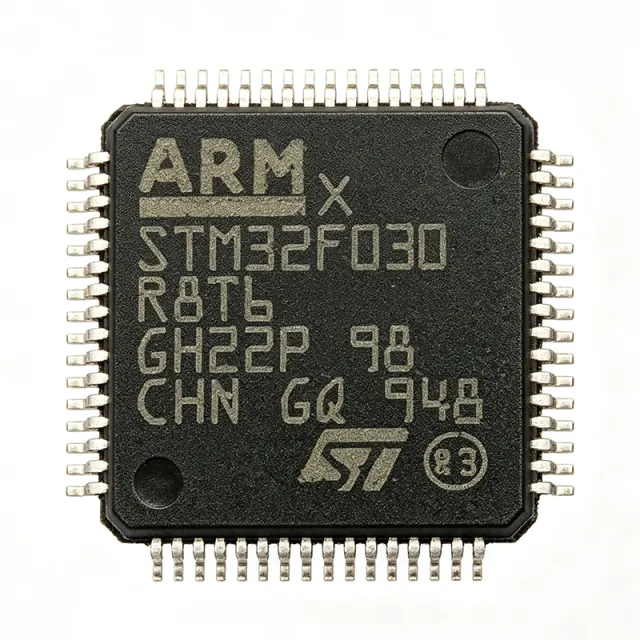
The STMicroelectronics STM32F030R is a value-line ARM Cortex-M0 32-bit RISC microcontroller operating at 48 MHz, integrating up to 64 KB of Flash memory and housed in a 64-pin LQFP package. Operating from a 2.4 V to 3.6 V supply, the device delivers 38.4 DMIPS while consuming only a few milliamps in run mode, making it a leading low-power option in the entry-level STM32 family. This particular variant is the STM32F030R8T6 (64-pin LQFP, 64 KB Flash, industrial -40C to +85C), one of the most widely adopted members of the STM32F030 series. A microcontroller (MCU) is a single-chip computer that integrates a processor core, memory (Flash for code, SRAM for data), and a rich set of programmable peripherals on a single die. The Cortex-M0 is the smallest and most energy-efficient member of the ARM Cortex-M processor family, designed for cost-sensitive, deterministic embedded applications. Within the ST portfolio, the STM32F0 sits below the Cortex-M3/M4 STM32F1/F3 lines and above the 8-bit STM8, occupying the mainstream 32-bit entry point. The STM32F030 specifically targets cost-down designs that previously used 8/16-bit MCUs but now require 32-bit performance, USB-less connectivity, and ST's strong STM32 tool ecosystem (CubeMX, HAL, Standard Peripheral Library). Key features include a 12-bit 1 MSPS ADC with up to 16 channels, multiple 16-bit and 32-bit timers (including PWM, input capture, and quadrature encoder support), two I2C, two SPI (one I2S-capable), one USB 2.0 Full-Speed (device mode, on R8/C0/C8/CB parts), one CAN 2.0B (RC0/RC8 variants), and up to 55 GPIO. An integrated 8 MHz HSI RC oscillator with 1% accuracy and a 40 kHz LSI reduce external component count. The 64-LQFP package provides 64 pins at 10 mm x 10 mm body, including dedicated pins for BOOT0, NRST, OSC_IN/OSC_OUT, and full SWD debug. The architecture pairs a 3-stage pipeline Cortex-M0 core with a 32-bit AHB-Lite bus and a multi-channel DMA controller. The Nested Vectored Interrupt Controller (NVIC) handles up to 32 maskable interrupts with deterministic 16-cycle latency. A cyclic redundancy check (CRC) peripheral, two watchdogs (IWDG/WWDG), and a 7-channel DMA accelerate data movement without CPU overhead. Typical applications include consumer appliances (washing machines, induction cookers), industrial sensor hubs, USB HID peripherals, low-cost CAN nodes, smart meters, and home automation. The compact LQFP-64 footprint and 48 MHz clock headroom make it a common choice for migration paths from 8-bit PIC/AVR designs into the STM32 ecosystem. When designing with the STM32F030R, ensure each VDD/VDDA pin pair has a 100 nF decoupling capacitor placed within 2 mm of the pin, and consider the BOOT0 strap resistor for boot mode selection. The 64-LQFP package has limited thermal headroom at high ambient temperatures, so verify junction temperature under worst-case load. This page synthesizes distributor pricing, drop-in pin-compatible alternatives, application companion parts, and practical design notes drawn from multiple sources, including the official ST datasheet, DigiKey listings, and ST community resources - not found in any single source.

طلب عرض سعر اتصل بنا
STM32F030R8T6 - 64KB Flash ARM Cortex-M0 48MHz MCU | STMicroelectronics
STM32F030R8T6

STM32F030R8T6 - 64KB Flash ARM Cortex-M0 48MHz MCU | STMicroelectronics

The STMicroelectronics STM32F030R8T6 is a 32-bit ARM Cortex-M0 value-line microcontroller from the STM32F0 series, integrating 64KB of Flash memory and 8KB of SRAM in a 64-pin LQFP package rated for industrial temperature operation. It runs at a maximum core frequency of 48 MHz, supports a 2.4V to 3.6V supply voltage, and exposes 51 GPIO pins for flexible peripheral expansion in cost-sensitive embedded designs. What is a microcontroller? A microcontroller (MCU) is a compact integrated circuit that combines a processor core, volatile and non-volatile memory, and programmable I/O peripherals on a single silicon die. The STM32F030R8T6 belongs to the broader STM32 family of 32-bit ARM Cortex-M microcontrollers, with its Cortex-M0 core positioning it in the entry-level, low-power tier that targets cost-sensitive applications replacing 8-bit/16-bit legacy MCUs. Key features include 64KB of Flash, 8KB of SRAM, an integrated 12-bit ADC with up to 16 channels, a 12-bit DAC, multiple 16-bit and 32-bit timers, two I2C, two SPI, and up to five USART interfaces, plus a hardware CRC calculation unit. The 64-pin LQFP package supports surface-mount assembly and provides generous analog and digital I/O for mixed-signal embedded boards. Architecturally, the device uses a 32-bit ARM Cortex-M0 core with single-cycle I/O access, achieving 0.9 DMIPS/MHz and supporting Thumb-2 instruction subsets for compact code density. Built-in peripherals include a real-time clock (RTC), DMA controller, and power-on reset/power-down reset (POR/PDR), with multiple low-power modes to extend battery runtime. The integrated 8 MHz HSI oscillator is factory-trimmed to within 1 percent accuracy, reducing the bill of materials for cost-driven designs. Typical applications include industrial control, consumer electronics, IoT edge nodes, home automation, motor control, and sensor interfaces. The wide peripheral set, small package, and low cost make it well suited to high-volume products where deterministic real-time response is required. When designing with this MCU, provide decoupling capacitors on every VDD pin (100 nF ceramic + 4.7 uF bulk), use the SWD interface for in-system programming and on-chip debug, and verify that the external crystal load capacitance matches the oscillator specification when an HSE source is required. This page synthesizes distributor pricing, drop-in package-compatible alternatives, and practical design notes beyond what the ST datasheet provides, delivering a consolidated reference for engineers evaluating the STM32F030R8T6.

USD $1.31 اتصل بنا
STM32F030R8T6TR - 64KB Flash ARM Cortex-M0 48MHz MCU | STMicroelectronics (Tape & Reel)
STM32F030R8T6TR

STM32F030R8T6TR - 64KB Flash ARM Cortex-M0 48MHz MCU | STMicroelectronics (Tape & Reel)

The STMicroelectronics STM32F030R8T6TR is a 32-bit ARM Cortex-M0 value-line microcontroller from the STM32F0 series, integrating 64KB of Flash memory and 8KB of SRAM in a 64-pin LQFP package rated for industrial temperature operation. It runs at a maximum core frequency of 48 MHz, supports a 2.4V to 3.6V supply voltage, and exposes 51 GPIO pins for flexible peripheral expansion in cost-sensitive embedded designs. What is a microcontroller? A microcontroller (MCU) is a compact integrated circuit that combines a processor core, volatile and non-volatile memory, and programmable I/O peripherals on a single silicon die. The STM32F030R8T6TR belongs to the broader STM32 family of 32-bit ARM Cortex-M microcontrollers, with its Cortex-M0 core positioning it in the entry-level, low-power tier that targets cost-sensitive applications replacing 8-bit/16-bit legacy MCUs. Key features include 64KB of Flash, 8KB of SRAM, an integrated 12-bit ADC with up to 16 channels, a 12-bit DAC, multiple 16-bit and 32-bit timers, two I2C, two SPI, and up to five USART interfaces, plus a hardware CRC calculation unit. The 64-pin LQFP package supports surface-mount assembly and provides generous analog and digital I/O for mixed-signal embedded boards. Architecturally, the device uses a 32-bit ARM Cortex-M0 core with single-cycle I/O access, achieving 0.9 DMIPS/MHz and supporting Thumb-2 instruction subsets for compact code density. Built-in peripherals include a real-time clock (RTC), DMA controller, and power-on reset/power-down reset (POR/PDR), with multiple low-power modes to extend battery runtime. The integrated 8 MHz HSI oscillator is factory-trimmed to within 1 percent accuracy, reducing the bill of materials for cost-driven designs. Typical applications include industrial control, consumer electronics, IoT edge nodes, home automation, motor control, and sensor interfaces. The wide peripheral set, small package, and low cost make it well suited to high-volume products where deterministic real-time response is required. When designing with this MCU, provide decoupling capacitors on every VDD pin (100 nF ceramic + 4.7 uF bulk), use the SWD interface for in-system programming and on-chip debug, and verify that the external crystal load capacitance matches the oscillator specification when an HSE source is required. This page synthesizes distributor pricing, drop-in package-compatible alternatives, and practical design notes beyond what the ST datasheet provides, delivering a consolidated reference for engineers evaluating the STM32F030R8T6TR.

USD $1.31 اتصل بنا
STM32F030RCT6 - 256KB Flash ARM Cortex-M0 MCU | STMicroelectronics
STM32F030RCT6

STM32F030RCT6 - 256KB Flash ARM Cortex-M0 MCU | STMicroelectronics

The STM32F030RCT6 is a 32-bit ARM Cortex-M0 microcontroller from STMicroelectronics, featuring a 48 MHz CPU, 256 KB of Flash memory, and 32 KB of SRAM in an LQFP-64 package. It operates from a 2.4V to 3.6V supply and offers a rich set of peripherals including multiple USARTs, SPIs, I2Cs, ADCs, timers, and GPIOs. Data verified as of 2026-08-05. What is a microcontroller? A microcontroller (MCU) is a compact integrated circuit designed to govern a specific operation in an embedded system. It contains a processor core, memory (Flash and SRAM), and programmable input/output peripherals on a single chip. The STM32F030RCT6 belongs to the STM32F0 series, which is part of the broader STM32 family of 32-bit ARM Cortex-M microcontrollers. This hierarchy places it within the embedded processing domain, where it serves as the central control unit for applications ranging from industrial automation to consumer electronics. Key features include a 48 MHz ARM Cortex-M0 core, 256 KB Flash, 32 KB SRAM, and a comprehensive set of peripherals: 5 USARTs, 2 SPIs, 2 I2Cs, 1 12-bit ADC with up to 16 channels, 8 timers, and up to 51 GPIOs. The device supports a wide operating temperature range of -40°C to +85°C and is available in an LQFP-64 package, making it suitable for space-constrained designs. Technically, the STM32F030RCT6 is built on a 90nm process technology, offering a balance of performance and power efficiency. The ARM Cortex-M0 core is a low-power, high-efficiency processor designed for cost-sensitive applications. The device includes a nested vectored interrupt controller (NVIC), a SysTick timer, and a memory protection unit (MPU) for enhanced reliability. It also features a 12-bit ADC with hardware oversampling, enabling high-resolution analog measurements. Typical applications include industrial control systems, motor control, consumer electronics, IoT devices, and home automation. The rich peripheral set and large Flash memory make it ideal for applications requiring complex firmware and multiple communication interfaces. For example, in an industrial sensor node, the STM32F030RCT6 can interface with sensors via I2C or SPI, process data, and communicate over USART or CAN. When designing with this device, ensure proper decoupling of the power supply pins with 100nF capacitors placed close to each VDD pin. The VDDA pin should be connected to a clean analog supply, and the VREF+ pin should be decoupled with a 1uF capacitor for accurate ADC conversions. The BOOT0 pin must be configured correctly to select the boot mode, and the NRST pin should have an external pull-up resistor and a 100nF capacitor for reliable reset. This page synthesizes distributor pricing, drop-in alternatives, and practical design notes not found in the STMicroelectronics datasheet, providing a comprehensive resource for engineers evaluating the STM32F030RCT6 for their next design.

طلب عرض سعر اتصل بنا
STM32F030RCT6TR - 256KB Flash ARM Cortex-M0 MCU | STMicroelectronics (Tape & Reel)
STM32F030RCT6TR

STM32F030RCT6TR - 256KB Flash ARM Cortex-M0 MCU | STMicroelectronics (Tape & Reel)

The STM32F030RCT6TR is a 32-bit ARM Cortex-M0 microcontroller from STMicroelectronics, featuring a 48 MHz CPU, 256 KB of Flash memory, and 32 KB of SRAM in an LQFP-64 package. It operates from a 2.4V to 3.6V supply and offers a rich set of peripherals including multiple USARTs, SPIs, I2Cs, ADCs, timers, and GPIOs. Data verified as of 2026-08-05. What is a microcontroller? A microcontroller (MCU) is a compact integrated circuit designed to govern a specific operation in an embedded system. It contains a processor core, memory (Flash and SRAM), and programmable input/output peripherals on a single chip. The STM32F030RCT6TR belongs to the STM32F0 series, which is part of the broader STM32 family of 32-bit ARM Cortex-M microcontrollers. This hierarchy places it within the embedded processing domain, where it serves as the central control unit for applications ranging from industrial automation to consumer electronics. Key features include a 48 MHz ARM Cortex-M0 core, 256 KB Flash, 32 KB SRAM, and a comprehensive set of peripherals: 5 USARTs, 2 SPIs, 2 I2Cs, 1 12-bit ADC with up to 16 channels, 8 timers, and up to 51 GPIOs. The device supports a wide operating temperature range of -40°C to +85°C and is available in an LQFP-64 package, making it suitable for space-constrained designs. Technically, the STM32F030RCT6TR is built on a 90nm process technology, offering a balance of performance and power efficiency. The ARM Cortex-M0 core is a low-power, high-efficiency processor designed for cost-sensitive applications. The device includes a nested vectored interrupt controller (NVIC), a SysTick timer, and a memory protection unit (MPU) for enhanced reliability. It also features a 12-bit ADC with hardware oversampling, enabling high-resolution analog measurements. Typical applications include industrial control systems, motor control, consumer electronics, IoT devices, and home automation. The rich peripheral set and large Flash memory make it ideal for applications requiring complex firmware and multiple communication interfaces. For example, in an industrial sensor node, the STM32F030RCT6TR can interface with sensors via I2C or SPI, process data, and communicate over USART or CAN. When designing with this device, ensure proper decoupling of the power supply pins with 100nF capacitors placed close to each VDD pin. The VDDA pin should be connected to a clean analog supply, and the VREF+ pin should be decoupled with a 1uF capacitor for accurate ADC conversions. The BOOT0 pin must be configured correctly to select the boot mode, and the NRST pin should have an external pull-up resistor and a 100nF capacitor for reliable reset. This page synthesizes distributor pricing, drop-in alternatives, and practical design notes not found in the STMicroelectronics datasheet, providing a comprehensive resource for engineers evaluating the STM32F030RCT6TR for their next design.

طلب عرض سعر اتصل بنا
STM32F031C6T6 - 48MHz 32KB Cortex-M0 MCU | STMicroelectronics
STM32F031C6T6

STM32F031C6T6 - 48MHz 32KB Cortex-M0 MCU | STMicroelectronics

The STMicroelectronics STM32F031C6T6 is a 32-bit ARM Cortex-M0 microcontroller operating at up to 48 MHz, with 32 KB of Flash memory and a 48-LQFP 7 x 7 mm package. It is designed for compact embedded systems requiring efficient control processing, GPIO, timers, analog conversion, and serial connectivity. The device belongs to the STM32F0 entry-level microcontroller family and combines a RISC processor core with embedded memory and peripherals in one integrated circuit. An embedded microcontroller is a self-contained programmable controller used to monitor inputs, execute control logic, and drive outputs in products such as instruments, appliances, industrial modules, and communication equipment. The STM32F031C6T6 uses the ARM Cortex-M0 architecture, a compact processor core designed for low-complexity control tasks, while its operating frequency supports responsive software execution and peripheral activity. Verified distributor information identifies the part as a 32-bit, 48 MHz microcontroller with 32 KB Flash organized as 32K x 8. The STM32F031x4/x6 family is described by STMicroelectronics as incorporating the ARM Cortex-M0 core and high-speed embedded resources. The exact RAM size, ADC resolution, timer count, supply range, and package pin assignments are not provided in the supplied verified excerpts and are therefore marked as data needed below. Typical design uses include sensor conditioning, motor or actuator sequencing, digital control panels, low-cost communications, LED control, and general embedded products. Firmware should be developed with the STM32 toolchain and configured around the exact datasheet pinout and peripheral characteristics. Hardware design must preserve the package footprint and verify every signal, power pin, decoupling requirement, and exposed-pin connection against the manufacturer datasheet. This page combines verified manufacturer and distributor information with explicit data gaps rather than inventing electrical values. It is intended to support initial component selection, sourcing, and comparison while directing engineers to the official STMicroelectronics documentation for final design release. The information is current as of 2026-10-23.

طلب عرض سعر اتصل بنا
STM32F031G4U6 - 48MHz Cortex-M0 MCU 16KB Flash | STMicroelectronics
STM32F031G4U6

STM32F031G4U6 - 48MHz Cortex-M0 MCU 16KB Flash | STMicroelectronics

The STMicroelectronics STM32F031G4U6 is an ARM Cortex-M0 32-bit RISC microcontroller operating at up to 48 MHz, integrating 16 KB of Flash memory and 4 KB of SRAM in a 28-pin UFQFPN (4x4 mm) package. The device operates from a 2.0 V to 3.6 V supply, supporting both 2.5 V and 3.3 V typical rails used by sensor, motor, and human-machine-interface (HMI) designs. The suffix "U6" denotes the UFQFPN-28 tape-and-reel packaging option qualified for industrial -40 °C to +85 °C operation. A microcontroller (MCU) is a single-chip processor that integrates a CPU core, program memory (Flash), data memory (SRAM), and peripheral interfaces such as timers, communication controllers, and analog blocks. Within the broader semiconductor taxonomy, an MCU belongs to the microcontroller family, which sits inside the integrated-circuit (IC) hierarchy and the embedded-computing product domain. Cortex-M0 is ARM's smallest and most energy-efficient core, designed for deterministic real-time control with a minimal instruction set and ultra-low gate count. Key specifications include a 12-bit ADC with up to 10 external channels, a 16-bit advanced-control timer for motor driving, multiple 16-bit and 32-bit general-purpose timers, communication interfaces (I2C, SPI, USART), an integrated voltage reference, brown-out reset (BOR), and a watchdog timer. The UFQFPN-28 footprint exposes 23 GPIO and embeds a 1-channel DMA controller for offloading data moves from the core, improving determinism in interrupt-driven loops. The architecture uses a single AHB-Lite bus matrix connecting the Cortex-M0 core, Flash, SRAM, and peripherals. The advanced-control timer supports complementary PWM outputs with dead-time insertion and an emergency stop input, making the part well-suited for brushless-DC (BLDC) and permanent-magnet synchronous motor (PMSM) commutation. The 12-bit ADC achieves a 1 µs conversion time and supports hardware oversampling to reach 16-bit effective resolution when required. Typical applications include BLDC and stepper motor control (small fans, pumps, e-bike throttles), sensor nodes and home-automation bridges, low-cost HMI panels and e-metering front-ends, industrial 24 V→3 V signal-conditioning modules, and consumer appliances requiring low pin-count, deterministic control. The wide 2.0–3.6 V range supports direct connection to a single Li-ion cell or to a regulated 3.3 V LDO downstream of a 5 V or 12 V bus. When designing with this MCU, plan the decoupling network (100 nF + 4.7 µF close to VDD pins) and ensure NRST is pulled up with the recommended 10 kΩ and a 100 nF capacitor for noisy industrial enclosures. The BOOT0 pin must be tied to GND through a 10 kΩ resistor on production boards to lock the part into main-Flash boot; floating BOOT0 is a common field-failure cause.

طلب عرض سعر اتصل بنا
STM32F031K4U6 - 48MHz Cortex-M0 16KB MCU | STMicroelectronics
STM32F031K4U6

STM32F031K4U6 - 48MHz Cortex-M0 16KB MCU | STMicroelectronics

The STMicroelectronics STM32F031K4U6 is a 32-bit ARM Cortex-M0 microcontroller operating up to 48 MHz, with 16 KB of Flash memory and 27 I/O pins, housed in a 32-pin UFQFPN 5 x 5 mm package. The device provides 2.5 V and 3.3 V supply options and is positioned as an entry-level embedded-control MCU for compact industrial, consumer, communications, and automation products. A microcontroller is a programmable semiconductor that integrates a processor core, memory, and peripherals on one device. The STM32F031K4U6 belongs to the hierarchy MCU -> embedded microcontroller -> ARM Cortex-M0 microcontroller -> STM32F0 series. Its Cortex-M0 architecture provides a 32-bit RISC processing environment while supporting peripherals commonly required for embedded products, including LIN, timers, PWM, SPI, UART/USART, I2C, IrDA, DMA, I2S, POR, and watchdog functions. The principal feature set includes a 48 MHz maximum operating frequency, 16 KB Flash program memory, a 32-pin compact package, and up to 27 I/O pins. The Flash-oriented organization of 16K x 8 supports embedded firmware storage, while the 5 x 5 mm UFQFPN package is suitable for space-constrained assemblies. Available sourcing information identifies this exact ordering code as a 2.5 V or 3.3 V device. The STM32F031K4U6 combines a general-purpose Cortex-M0 core with serial communication and timing resources suited to real-time control. Its reported peripherals include I2C, IrDA, LINbus, SPI, UART/USART, DMA, I2S, POR, PWM, and WDT. These interfaces allow the MCU to connect sensors, actuators, human-interface devices, communications transceivers, and audio converters without requiring several separate interface devices. Typical uses include compact sensor nodes, industrial control modules, LIN-connected peripherals, communication equipment, motor and actuator controllers, and small consumer products. The 48 MHz processing rate provides additional timing margin for interrupt-driven control and protocol handling, while the 27 available I/O pins support multiple digital connections on a compact board. Designers should verify the exact exposed-pad connection, decoupling requirements, clock configuration, and peripheral pin assignments against the manufacturer documentation before layout release. The target package is a 32-pin UFQFPN, and the thermal behavior of its exposed pad depends on the PCB copper area, solder mask, and thermal via arrangement. The verified excerpts do not provide the complete pin names, so no pin-level assignments are inferred here. This product page consolidates verified distributor pricing, package and memory details, sourced drop-in candidates, and practical selection guidance. It distinguishes documented STM32F031K4U6 attributes from compatibility claims that require schematic, firmware, ADC, clock, and low-power validation before production substitution.

طلب عرض سعر اتصل بنا
STM32F031K6T6 - 48MHz Cortex-M0 MCU | STMicroelectronics
STM32F031K6T6

STM32F031K6T6 - 48MHz Cortex-M0 MCU | STMicroelectronics

STMicroelectronics STM32F031K6T6 is an ARM Cortex-M0 32-bit RISC microcontroller operating at up to 48 MHz, with 32 KB of Flash memory, 4 KB of SRAM, and a 32-LQFP 7 x 7 mm package. The device also provides 25 I/Os, nine timers, a 12-bit ADC, one I2C interface, one SPI/I2S interface, one USART, and operation from 2.0 V to 3.6 V. A microcontroller is a programmable system-on-chip that combines a processor core, nonvolatile program memory, volatile data memory, peripherals, and general-purpose I/O in one package. The STM32F031 belongs to the STM32F0 access-line family, where ARM Cortex-M0 -> 32-bit RISC microcontroller -> embedded microcontroller -> semiconductor forms the relevant product hierarchy. Its compact package and mixed-signal peripherals suit cost-sensitive embedded-control products that require deterministic control without a higher-performance MCU. Key features include a 48 MHz ARM Cortex-M0 core, 32 KB of Flash for firmware storage, and 4 KB of SRAM for working memory. The 12-bit ADC supports analog measurement, while the I2C, SPI/I2S, and USART interfaces cover sensor buses, serial peripherals, and point-to-point communication. Nine timers support periodic and timing functions, and the 2.0 V to 3.6 V operating range permits integration with common 3.3 V embedded systems. The STM32F031K6 architecture emphasizes compact control rather than high-performance computation. Its 32-bit Cortex-M0 instruction set provides efficient control-loop execution, while the integrated analog and serial peripherals reduce the need for external components. Available SRAM and Flash should be checked against the final application, particularly when buffering samples, maintaining protocol stacks, or supporting bootloader features. Typical applications include compact sensor controllers, small motor-control systems, industrial monitoring nodes, digital control modules, battery-powered instruments, and communication equipment. The STM32F031K6T6 is particularly relevant where 48 MHz processing, 25 I/Os, and multiple serial interfaces are required within a 32-LQFP footprint. Designers should verify the exact pin assignment, alternate-function requirements, decoupling network, clock configuration, and peripheral instance mapping against the manufacturer datasheet. The 2.0 V minimum supply imposes a 3.3 V rail design constraint, and firmware should include reset, clock, ADC-calibration, and brownout handling appropriate to the selected power architecture. This page consolidates the verified manufacturer specifications, distributor availability references, cross-reference evidence, and engineering guidance into a structured selection resource. It distinguishes verified drop-in evidence from generic MCU alternatives and highlights the limits of using an unqualified third-party replacement in production.

طلب عرض سعر اتصل بنا
STM32F031K6U6 - 48MHz Cortex-M0 MCU 32KB Flash | STMicroelectronics
STM32F031K6U6

STM32F031K6U6 - 48MHz Cortex-M0 MCU 32KB Flash | STMicroelectronics

The STM32F031K6U6 is a 32-bit entry-level microcontroller from STMicroelectronics based on the ARM Cortex-M0 core, operating at up to 48 MHz with 32 KB of Flash memory and 4 KB of SRAM in a compact 32-pin UFQFPN (5x5 mm) package with exposed pad. A microcontroller (MCU) is a single-chip embedded processor combining a CPU core, memory, and programmable peripherals. The STM32F031K6U6 belongs to the STM32F0 entry-level family within the STM32 MCU ecosystem, positioned as a migration path from 8-bit and 16-bit MCUs to 32-bit ARM performance. It shares tooling, HAL libraries, and STM32CubeMX configuration software with the wider STM32 portfolio, simplifying future upgrades. Key features include a 12-bit ADC with up to 13 channels, 9 timers, and standard communication interfaces: one I2C, one SPI/I2S, and one USART. The device operates from a 2.0V to 3.6V single supply with integrated POR/PDR reset, and offers a CRC calculation unit and DMA controller for data movement without CPU intervention. Real-time performance is supported by a nested vectored interrupt controller (NVIC) and single-cycle multiplier. The Cortex-M0 architecture executes Thumb instruction sets with deterministic interrupt latency, making the device suitable for real-time control loops. The UFQFPN-32 (QFN family) surface-mount package provides a small 5x5 mm footprint with an exposed thermal pad for grounding, ideal for space-constrained boards. Operating temperature spans -40C to +85C for industrial reliability. Typical applications include industrial control, consumer appliances, IoT sensor nodes, small motor control, and power-management subsystems, where low cost, low power consumption, and adequate peripheral integration matter most. Design tip: decouple VDD pins with 100nF ceramics plus a bulk capacitor, feed VDDA from a clean analog supply to preserve ADC accuracy, and keep NRST properly filtered per the ST datasheet layout guidelines for EMI-robust designs.

طلب عرض سعر اتصل بنا
STM32F042C4T6 - 48MHz Cortex-M0 16KB MCU | STMicroelectronics
STM32F042C4T6

STM32F042C4T6 - 48MHz Cortex-M0 16KB MCU | STMicroelectronics

The STMicroelectronics STM32F042C4T6 is a 32-bit ARM Cortex-M0 microcontroller operating at up to 48 MHz, with 16 KB of Flash memory, 6 KB of SRAM, USB full-speed, CAN, and a 12-bit ADC, housed in a 48-LQFP 7 x 7 mm package. It is designed for compact embedded-control products requiring USB connectivity, CAN communication, and a broad set of serial peripherals. A microcontroller, or MCU, integrates a processor core, memory, peripherals, and communication interfaces on one semiconductor device. The STM32F0 family belongs to the Arm Cortex-M0 microcontroller hierarchy and combines a low-complexity 32-bit instruction set with deterministic embedded control. In the STM32F042C4T6, the CPU executes from embedded Flash while SRAM supports working data and stack operations. USB, CAN, USART, SPI, and I2C support connected products, industrial controls, and service equipment. The device combines a 48 MHz maximum operating frequency, 16 KB Flash, and 6 KB SRAM with a 12-bit ADC capable of handling up to 10 channels. USB 2.0 full-speed, CAN, multiple USART and SPI interfaces, I2C, timers, and a CEC-related feature make it suitable for compact USB-aware control nodes. The 48-LQFP package provides 48 externally accessible pins and is appropriate for designs requiring conventional leaded-package assembly and inspection. The STM32F042C4T6 is positioned as a mainstream Arm Cortex-M0 MCU with a 2.5 V to 3.6 V supply range, as identified in distributor listings. Its 48-pin LQFP footprint simplifies access to communication and general-purpose I/O compared with smaller packages. Designers should confirm the complete pin multiplexing, clock, USB, CAN, and analog specifications against the manufacturer datasheet before releasing a production board. Typical applications include USB-connected peripheral controllers, industrial communication modules, CAN nodes, data-acquisition equipment, consumer accessories, and compact embedded-control systems. The MCU can act as the central controller for a USB peripheral while using CAN or serial interfaces for local communication. Its 12-bit ADC supports analog monitoring, while timers and GPIO provide control and sensing connections. Design guidance focuses on preserving USB signal integrity and separating analog, digital, and return-current paths. Place USB differential routing over a continuous reference plane, keep the USB transceiver and decoupling components close to their relevant pins, and validate firmware clocks and peripheral initialization against the manufacturer reference procedure. This page consolidates verified distributor specifications, sourcing information, and engineering-oriented usage guidance.

طلب عرض سعر اتصل بنا
STM32F042C6T6 - 48MHz Cortex-M0 32KB Flash USB MCU | STMicroelectronics
STM32F042C6T6

STM32F042C6T6 - 48MHz Cortex-M0 32KB Flash USB MCU | STMicroelectronics

The STMicroelectronics STM32F042C6T6 is a 32-bit ARM Cortex-M0 microcontroller operating up to 48 MHz, with 32 KB of Flash memory, 6 KB of SRAM, USB full-speed device support, and CAN connectivity in a 48-LQFP package. It is designed for compact USB-connected embedded systems requiring a low-cost, low-power general-purpose MCU. A microcontroller integrates a CPU core, memory, and peripheral blocks into one semiconductor device. The STM32F0 family uses an Arm Cortex-M0 core within the broader 32-bit embedded microcontroller hierarchy, providing deterministic control performance, efficient interrupt handling, and a broad ecosystem of software development tools. The STM32F042C6T6 targets USB, CAN, industrial-control, consumer-electronics, and accessory applications. The device operates from a 2.5 V or 3.3 V supply, as identified in the distributor listing. Its 48 MHz maximum operating frequency supports responsive control loops and USB full-speed device communication compliant with USB 2.0. The integrated USB device peripheral includes an internal USB PHY and embedded DP pull-up, while the datasheet summary identifies battery-charging detection support according to the Battery Charging Specification Revision 1.2. The STM32F042x4/x6 family also provides a CAN peripheral, making the MCU appropriate for industrial and embedded communication systems. The 48-LQFP 7x7 mm package exposes the required GPIO, communication, power, debug, and clock connections in a widely manufacturable surface-mount format. Typical uses include USB-connected configuration tools, data acquisition modules, compact industrial controllers, CAN-connected sensor nodes, and USB peripheral accessories. The 32 KB Flash capacity is appropriate for applications with moderate firmware size, while the 48 MHz core provides useful performance margin for protocol handling and real-time control. Designers should confirm the exact pin multiplexing, crystal requirements, USB implementation guidance, and decoupling values against the manufacturer datasheet before layout. This page combines distributor availability data, manufacturer specifications, package information, and application guidance to support component selection and sourcing.

طلب عرض سعر اتصل بنا
STM32F042C6U6 - 48MHz, 32KB Flash Cortex-M0 MCU | ST
STM32F042C6U6

STM32F042C6U6 - 48MHz, 32KB Flash Cortex-M0 MCU | ST

The STMicroelectronics STM32F042C6U6 is an ARM Cortex-M0 32-bit microcontroller operating up to 48 MHz, with 32 KB Flash memory and a 48-pin UFQFPN 7 x 7 mm package. Its USB, CAN, timers, ADC, and communication interfaces make it suitable for connected embedded control, USB accessories, industrial sensing, and compact consumer products. The STM32F0 architecture combines a deterministic RISC core with extensive peripheral integration in a low-pin-count surface-mount package. A microcontroller is a semiconductor that integrates a processor core, program memory, data memory, and peripherals such as timers, serial interfaces, analog converters, and communication controllers. The STM32F042C6U6 belongs to the STM32F0 family, where the Cortex-M0 core sits at the lowest-complexity level of the ARM Cortex-M portfolio. This hierarchy makes the device appropriate for control-oriented products that need broad peripheral support without requiring a higher-performance application processor. Key verified features include a 48 MHz maximum operating frequency, 32 KB Flash, a 32-bit ARM Cortex-M0 core, and crystal-less USB full-speed support identified in the available datasheet preview. Distributor listings also identify USB and CAN functionality. The 48-UFQFPN package measures 7 x 7 mm and includes an exposed pad according to the supplied component listings, supporting compact layouts while providing a dedicated thermal and grounding connection area subject to the manufacturer's layout guidance. The STM32F0 architecture supports embedded firmware development around standard serial interfaces, analog measurement, timing, and USB communication. At 48 MHz, the MCU provides more timing margin for protocol handling, control loops, and peripheral coordination than lower-frequency STM32F0 devices. Because the verified data does not state SRAM size, ADC resolution, timer channels, or exact USB electrical limits, those values should be confirmed in the official STM32F042x4/x6 documentation before final design signoff. Typical uses include USB-to-serial or configuration accessories, low-cost CAN-connected nodes, industrial sensor controllers, compact motor-control auxiliaries, and USB-powered embedded products. The MCU is especially attractive when designers want STM32 tooling and firmware portability while retaining a compact UFQFPN footprint. Firmware, boot configuration, clocking, low-power behavior, and peripheral pin multiplexing must be selected from the manufacturer's device documentation rather than inferred from distributor summaries. For PCB implementation, follow the official UFQFPN land pattern and exposed-pad recommendations exactly. Place decoupling capacitors close to each applicable supply pin, route high-speed USB signals as a controlled differential pair, and preserve the manufacturer's thermal-pad copper and via guidance. Confirm oscillator, reset, boot, and USB requirements for the selected board configuration. This page synthesizes the verified distributor inventory, package information, architecture, and engineering considerations into a compact design reference. This product data is limited to facts present in the supplied verified web results and deliberately identifies unverified parameters instead of guessing. Lifecycle, electrical limits, pin names, memory-map details, and absolute maximum ratings require confirmation from STMicroelectronics before production release.

طلب عرض سعر اتصل بنا
STM32F042F6P7 - 48MHz Cortex-M0 MCU, 32KB Flash | STMicroelectronics
STM32F042F6P7

STM32F042F6P7 - 48MHz Cortex-M0 MCU, 32KB Flash | STMicroelectronics

STMicroelectronics STM32F042F6P7 is an ARM Cortex-M0 32-bit microcontroller operating up to 48 MHz, with 32 KB (32K x 8) Flash memory and USB, CAN, and other connectivity, in a 20-TSSOP package. It belongs to the STM32F0 family of compact, low-power embedded MCUs for cost-sensitive control applications. A microcontroller integrates a CPU core, program memory, data memory, peripherals, and communication interfaces on one semiconductor device. The STM32F0 series provides a simple architecture for embedded control, while this part adds USB and CAN connectivity for connected industrial, automotive, and consumer equipment. The STM32F042x4/x6 family description identifies the Cortex-M0 core and 48 MHz maximum operating frequency. Key verified features include a 32-bit ARM Cortex-M0 core, 48 MHz maximum clock frequency, and 32 KB Flash program memory. The 20-TSSOP package supports compact PCB layouts, and the exact suffix P7 identifies the supplied device ordering variant. The Mouser listing also identifies the part as a mainstream ARM Cortex-M0 USB-line MCU with 32 KB Flash, USB, and CAN. The STM32F042F6P7 combines a compact 20-pin TSSOP with general-purpose embedded-control capability and wired connectivity. It is suitable for designs that need more than basic GPIO control but do not require a high-pin-count package. The verified data does not specify RAM size, operating-voltage range, GPIO count, ADC details, timers, or package dimensions, so those values must be confirmed in the manufacturer documentation before final design release. Typical uses include USB-connected human-interface devices, CAN-connected industrial controls, compact sensor nodes, automotive accessories, low-cost communication equipment, and small controller boards. Its 48 MHz Cortex-M0 core provides useful processing headroom while retaining the simple programming model associated with ARM Cortex-M devices. Designers should treat the 20-TSSOP footprint, pin multiplexing, power requirements, clock strategy, and USB or CAN transceiver integration as the critical review points. A MCU cannot connect directly to a physical USB or CAN bus without the appropriate external circuitry, protection, routing, and signal-integrity implementation. This page combines verified manufacturer and distributor facts, transparent data gaps, package information, application guidance, and practical design cautions. It helps engineers distinguish confirmed STM32F042F6P7 characteristics from parameters that still require verification from the official datasheet.

طلب عرض سعر اتصل بنا
STM32F042K4T6 - 48MHz Cortex-M0 16KB MCU | STMicroelectronics
STM32F042K4T6

STM32F042K4T6 - 48MHz Cortex-M0 16KB MCU | STMicroelectronics

The STMicroelectronics STM32F042K4T6 is an ARM Cortex-M0 32-bit microcontroller with a 48 MHz clock, 16 KB Flash memory, and a 32-LQFP 7 x 7 mm package. It is part of the STM32F0 family and is described by distributor data as a mainstream MCU with USB, CAN, 2.5 V and 3.3 V supply options, and a 32-pin LQFP package. These characteristics place it in the connected embedded-control segment, where moderate processing speed and serial connectivity are more important than high flash capacity. What is an ARM Cortex-M0 microcontroller? An MCU is an integrated semiconductor containing a processor core, memory, peripherals, and interfaces on one package. The ARM Cortex-M0 is a compact 32-bit embedded processor core designed for cost-sensitive, energy-efficient control systems. In the STM32F0 family, it supports embedded control, USB communications, CAN networking, and general-purpose peripherals within a small power-management and processing footprint. Key features include a 48 MHz maximum CPU frequency and 16 KB of Flash memory. The verified distributor listing identifies 16 KB organized as 16K x 8 and identifies USB and CAN connectivity. The STM32F042K4T6 is also listed with 2.5 V and 3.3 V operating-supply descriptions in distributor data. Its 32-LQFP 7 x 7 mm package provides 32 external pins for power, clock, communication, and general-purpose I/O connections. The device is suited to compact USB-connected peripherals, CAN-based industrial interfaces, low-cost control panels, sensor hubs, and embedded instrumentation. Its 48 MHz Cortex-M0 core is appropriate for interrupt-driven control, protocol handling, and application logic where a higher-performance Cortex-M3 or Cortex-M4 core is unnecessary. The 16 KB Flash capacity requires attention when selecting firmware size, boot code, and application-code partitioning. For PCB implementation, confirm the exact pin assignment and exposed functionality against the manufacturer datasheet before routing USB, CAN, crystal, reset, and supply connections. The provided search data does not include a complete electrical timing table, absolute maximum ratings, transceiver details, or a verified pin-by-pin description; those values require manufacturer documentation. The 32-LQFP package is suitable for automated assembly and is distinct from STM32F042K4U6, which uses a different package option. This page synthesizes verified distributor specifications, package information, pricing references, available cross-reference candidates, and practical sourcing considerations for engineers evaluating the STM32F042K4T6. Confirm current stock, lifecycle status, and manufacturer documentation before production release.

طلب عرض سعر اتصل بنا
STM32F042K6T6 - 48MHz Cortex-M0 MCU 32KB Flash USB | STMicroelectronics
STM32F042K6T6

STM32F042K6T6 - 48MHz Cortex-M0 MCU 32KB Flash USB | STMicroelectronics

The STMicroelectronics STM32F042K6T6 is a 32-bit ARM Cortex-M0 microcontroller running at up to 48 MHz, integrating 32 KB of Flash memory and 6 KB of SRAM in a 32-pin LQFP (7x7 mm) package. It targets USB-enabled mainstream embedded designs requiring a low pin count, USB 2.0 Full-Speed Device with on-chip PHY, CAN 2.0B interface, and a rich set of peripherals including timers, ADC, comparators, and communication interfaces. A microcontroller (MCU) is a single-chip computer that integrates a CPU core, program memory (Flash), working memory (SRAM), and peripheral interfaces. Within the broader taxonomy, the STM32F042K6T6 sits at the intersection of embedded processor -> ARM Cortex-M0 core -> 32-bit RISC MCU -> mainstream connectivity line MCU. The Cortex-M0 architecture uses the Thumb/Thumb-2 instruction set and is designed for deterministic, low-power real-time control, making the F042 series ideal for USB Type-C accessories, human-interface devices, and small-form-factor sensor nodes. Key features include 32 KB Flash with read-while-write support, 6 KB SRAM with hardware parity, a 12-bit 1 Msps ADC with up to 13 external channels, two 16-bit timers, one 32-bit timer, an independent watchdog, a real-time clock, and a USB 2.0 Full-Speed Device interface with integrated PHY that eliminates the need for an external USB transceiver. The device operates from 2.0V to 3.6V and supports both 2.5V and 3.3V application rails, with multiple low-power modes (Sleep, Stop, Standby) suited to battery-powered products. Architecturally, the STM32F042K6T6 leverages ST's 90 nm embedded Flash process and the Cortex-M0 v6-M core with single-cycle multiplier, achieving 0.93 DMIPS/MHz. The integrated 4-16 MHz HSI oscillator with PLL, plus a 32 kHz LSI for the RTC, allow bill-of-material reduction by removing the external crystal in non-USB applications. The CAN 2.0B interface, combined with USB, makes this part uniquely positioned among Cortex-M0 devices for industrial control and automotive body networks. Typical applications include USB HID peripherals (keyboards, mice, custom HID), USB-to-UART bridges, USB-C audio accessories, CAN node endpoints in industrial networks, small motor control boards, smart-home sensor hubs, and USB-charged IoT endpoints. The 32-pin LQFP footprint is breadboard-friendly and supports hand-rework prototypes while remaining suitable for high-volume SMT assembly. Design consideration: because USB DP/DM pins are bonded to specific GPIO pins (PA11/PA12), designers must avoid remapping these to alternate functions when the USB peripheral is enabled. The integrated pull-up resistor on the DP line is software-controlled, simplifying bus-powered designs. For CAN applications, an external transceiver (e.g., SN65HVD230) is still required because the F042 provides only the protocol controller. This page synthesizes distributor pricing, drop-in same-package alternatives, and design considerations not found in a single datasheet excerpt.

طلب عرض سعر اتصل بنا
STM32F042K6U6 - 48MHz Cortex-M0 USB MCU | STMicroelectronics
STM32F042K6U6

STM32F042K6U6 - 48MHz Cortex-M0 USB MCU | STMicroelectronics

The STMicroelectronics STM32F042K6U6 is an ARM Cortex-M0 32-bit microcontroller operating at up to 48 MHz, with 32 KB of Flash memory and USB, CAN, and embedded-control peripherals, in a 32-pin UFQFPN package. The verified distributor listing identifies a 5x5 mm package and a 2.5 V/3.3 V supply class. This MCU belongs to the STM32F0 family and is positioned for compact embedded products requiring USB connectivity and a broad peripheral set. A microcontroller is an integrated circuit containing a processor core, memory, and peripherals on one device. The STM32F042K6U6 combines an ARM Cortex-M0 RISC core with embedded Flash and RAM resources, allowing a control system to execute firmware and interface with sensors, communications links, and actuators. In the hierarchy, it is a 32-bit microcontroller, embedded processor, semiconductor, and programmable control component. Verified features include a maximum 48 MHz operating frequency, 32 KB of Flash memory, USB, CAN, and an ARM Cortex-M0 CPU. The STMicroelectronics product page also describes high-speed embedded memory and the STM32F042x4/x6 device family. These features make the device relevant to USB-enabled human-interface equipment, industrial control nodes, communications modules, and low-cost embedded systems where a small package and integrated connectivity are useful. The U6 ordering code identifies the 32-pin UFQFPN option, while the exposed-pad package and tray presentation are reflected in the verified distributor data. The package is a surface-mount QFN-family component designed for PCB mounting. The exact RAM size, GPIO count, ADC resolution, supply limits, and pin names are not stated in the supplied verified data and must be confirmed from the manufacturer datasheet before design release. Typical design decisions include checking the USB clock configuration, CAN transceiver interface, bootloader workflow, and firmware peripheral mapping in the STM32CubeMX or equivalent STM32 toolchain. USB signal routing requires controlled impedance and careful placement of the USB data lines; CAN routing should account for transceiver requirements, termination, and protection. Designers should also confirm the exposed-pad thermal and assembly requirements from the manufacturer documentation. This product page consolidates the verified manufacturer identity, distributor specifications, package information, and sourcing context into one engineering reference. It does not substitute datasheet values that were not supplied in the verified web data. Confirm the official datasheet, errata, pinout, memory map, and electrical limits before PCB release or production qualification.

طلب عرض سعر اتصل بنا
STM32F051C6T7 - 48MHz ARM Cortex-M0 MCU, 32KB Flash | STMicroelectronics
STM32F051C6T7

STM32F051C6T7 - 48MHz ARM Cortex-M0 MCU, 32KB Flash | STMicroelectronics

The STMicroelectronics STM32F051C6T7 is an entry-level 32-bit ARM Cortex-M0 microcontroller in the STM32F0 Access Line, operating at up to 48 MHz with 32 KB of embedded Flash and 4 KB of SRAM. Housed in a 48-pin LQFP (7x7 mm) package, it operates from a 2.0 V to 3.6 V supply and integrates a high-performance RISC core with 1.25 DMIPS/MHz (0.9 DMIPS/MHz in Thumb mode) for deterministic embedded control. The -T7 industrial temperature grade spans -40 °C to +105 °C, while the part remains in active production on STMicroelectronics' mainstream MCU portfolio. An ARM Cortex-M0 microcontroller is a 32-bit RISC processor core implementing the ARMv6-M architecture, optimized for energy-efficient, deterministic real-time control. The Cortex-M0 belongs to the microcontroller (MCU) family within the broader taxonomy of microprocessors -> microcontrollers -> ARM Cortex-M series -> Cortex-M0. Cortex-M0 parts prioritize low cost, low power, and a Thumb-only instruction set, positioning the STM32F051C6T7 as a cost-down alternative to Cortex-M3/M4 parts where advanced DSP and floating-point are not required. Key features include up to 55 fast I/Os (5V-tolerant), an 11-channel 12-bit 1 µs ADC, one 12-bit DAC, two 16-bit timers, one 32-bit timer, an advanced-control PWM timer for motor control, two I²C, two SPI, one I²S, one HDMI-CEC, one USB 2.0 FS device (in companion STM32F052 variants, not on this 051C6), and a 4-channel DMA controller. A real-time clock (RTC), two watchdog timers, and a SysTick timer provide the timing backbone for safety-critical firmware. The integrated voltage regulator supports a low-power Sleep/Stop/Standby mode set with RTC retention. Architecturally, the device uses ST's 90 nm embedded Flash process and a bus matrix interconnecting the Cortex-M0 core, DMA, and the AHB/APB peripheral bridge. A single 8 MHz HSI oscillator (with 6-bit trim) plus a 40 kHz LSI and 4-32 MHz HSE crystal driver cover all common clocking topologies. The 12-bit ADC achieves 1 Msps with up to 19 multiplexed channels, and the 12-bit DAC supports buffered output for analog signal generation. Hardware CRC, a unique 96-bit device ID, and a JTAG/SWD debug port round out the on-chip resources. Typical applications include consumer electronics, motor control (small BLDC/PMSM with the advanced-control timer), USB HID peripherals (on 052x variants), home appliances, lighting, and low-cost IoT sensor nodes. The 48-pin LQFP footprint is friendly to 2-layer hobbyist PCBs and 4-layer industrial designs alike. When laying out the PCB, place a 100 nF decoupling capacitor within 2 mm of every VDD pin, keep the HSE crystal traces short, and provide a solid ground pour under the exposed-pad-adjacent pins to minimize EMI. Use SWD rather than JTAG to free up to 3 GPIOs for the application. This page synthesizes distributor pricing, drop-in same-package alternatives, and practical design notes that complement (not duplicate) the ST datasheet. - The maximum ADC conversion rate is 1 Msps at 12-bit resolution (scaled down to 800 ksps at full Vdd range). - The advanced-control timer (TIM1) supports complementary PWM outputs with programmable dead-time insertion. - The LQFP-48 package has a JEDEC MSL-3 moisture sensitivity level and is Pb-free (RoHS compliant). - Programming/debug is supported via ST-LINK/V2-1, J-Link, and the on-chip ROM bootloader (USART1 boot pins).

طلب عرض سعر اتصل بنا
STM32F051C6U6 - 48MHz Cortex-M0 MCU 32KB Flash 48-UFQFPN | STMicroelectronics
STM32F051C6U6

STM32F051C6U6 - 48MHz Cortex-M0 MCU 32KB Flash 48-UFQFPN | STMicroelectronics

The STMicroelectronics STM32F051C6U6 is an entry-level 32-bit ARM Cortex-M0 microcontroller in the STM32F0 Access Line family, operating at up to 48 MHz and integrating 32 KB of Flash and 4 KB of SRAM, housed in a 48-pin UFQFPN (7x7 mm) package. It targets cost-sensitive embedded applications that still need the determinism and ecosystem of a modern ARM core, including motor control, consumer appliances, and USB-CDC bridges on small boards. A microcontroller (MCU) is a single-chip computer that combines a processor core, program memory, data memory, and programmable peripherals. Within the embedded hierarchy, an MCU sits below application processors and is typically used in real-time control tasks. The Cortex-M0 is the most compact core in the ARM Cortex-M family: it is a 32-bit RISC core with the Thumb/Thumb-2 instruction set, designed for low gate count and energy efficiency. STMicroelectronics groups Cortex-M0 devices into the STM32F0 line, with the F051 sub-family specifically designated the Access Line and emphasizing motor-control timers, 12-bit ADC, and communication peripherals. Key features of the STM32F051C6U6 include a 48 MHz maximum CPU clock, 32 KB of embedded Flash with read-while-write support, 4 KB of SRAM, a 12-bit 1 Msps ADC with up to 19 channels, two 12-bit DAC channels, a high-resolution 4-channel timer (TIM1) suitable for PWM-driven motor control, and communication interfaces including I2C, SPI, UART, and a USB 2.0 Full-Speed device controller. The UFQFPN-48 (7x7 mm) package exposes 39 GPIO, has a 2.0-3.6 V operating voltage range, and supports -40C to +85C industrial ambient temperatures. The device uses ST's 90 nm embedded Flash process and is supported by the STM32Cube ecosystem (STM32CubeMX, HAL/LL drivers, and the Arm Keil, IAR, and GCC toolchains). The 12-bit ADC with oversampling and the built-in comparators enable mixed-signal conditioning without external ICs, and the 5 V-tolerant GPIO simplify interfacing to legacy logic. Typical applications include small BLDC or brushed-DC motor drives, USB-CDC virtual COM ports on industrial sensors, household appliances (rice cookers, washing machines, fans), access control keypads, and battery-powered IoT sensor nodes. Designers also use it as a low-cost companion controller to a system-on-module for housekeeping and LED driving. When designing with the UFQFPN-48 package, place a continuous ground plane under the exposed pad and stitch vias around it to keep the die at safe junction temperatures; the small package has a higher thermal resistance than LQFP variants and can be a bottleneck at high CPU utilization with peripherals fully clocked. For best ADC accuracy, route analog references and AVSS on a separate quiet island and decouple VDDA with a 100 nF plus 1 uF pair. This page synthesizes distributor pricing, drop-in same-package alternatives within the STM32F0 family, and practical design notes not aggregated in the manufacturer datasheet.

طلب عرض سعر اتصل بنا
STM32F051C8T6 - 48MHz 64KB MCU | STMicroelectronics
STM32F051C8T6

STM32F051C8T6 - 48MHz 64KB MCU | STMicroelectronics

The STMicroelectronics STM32F051C8T6 is a 32-bit ARM Cortex-M0 microcontroller operating up to 48 MHz, with 64 KB of Flash memory, 8 KB of SRAM, and 39 I/O pins in a 48-pin LQFP package. The device combines a compact general-purpose microcontroller architecture with embedded Flash, SRAM, communication interfaces, timers, analog conversion functions, and GPIO in one package. A microcontroller is a programmable semiconductor that integrates a CPU core, memory, peripherals, and I/O into a single device. The STM32F051C8T6 belongs to the STM32F0 access-line family, where ARM Cortex-M0 processor cores are used for compact, cost-sensitive embedded control. Its position in the hierarchy is microcontroller → 32-bit microcontroller → ARM Cortex-M0 microcontroller → embedded processor. Verified product information identifies a 48 MHz maximum operating frequency, 64 KB program Flash, 8 KB SRAM, and 39 available I/O functions. These resources are suitable for compact control systems that require real-time peripheral handling without an external memory interface. The 48-pin LQFP package also provides more I/O options than the 32-pin members of the same general family, helping simplify designs that need multiple digital signals, analog channels, or communication connections. The Cortex-M0 core uses a 32-bit RISC architecture and provides a straightforward embedded-processing platform. Its principal advantages are predictable execution, efficient interrupt handling, and broad peripheral integration. Designs must still observe the device's specified supply voltage and pin limits, confirm oscillator and reset arrangements, and provide appropriate decoupling. Peripheral selection should be verified against the exact STM32F051xx datasheet before production release because the supplied distributor summaries do not enumerate every timer channel or alternate-function mapping. Typical uses include compact consumer controls, small industrial controllers, sensor interfaces, communication modules, and general embedded products with moderate Flash and RAM requirements. The 64 KB Flash capacity can store application firmware and boot logic, while 8 KB of SRAM supports working memory, buffers, and protocol state. An external crystal may be required where precise timing or a defined communication clock is needed; otherwise, the internal clock options can simplify the design. Engineers should pay particular attention to firmware compatibility when considering a replacement. A matching package and similar memory capacity do not guarantee identical peripheral behavior, register compatibility, or application-code support. Any substitute should be checked for pin-by-pin electrical differences, startup behavior, flash programming, interrupt mapping, and regulator requirements. The STM32F051C8T6 remains the baseline against which those conditions should be evaluated. This page consolidates verified distributor specifications, source links, practical design guidance, and explicitly qualified replacement information. Unlike a basic distributor listing, it distinguishes confirmed drop-in evidence from broader family comparisons and identifies missing technical data without inventing datasheet values.

طلب عرض سعر اتصل بنا