المنتجات (46,000+)

STM32L476VGT3 - 80MHz Cortex-M4 MCU | STMicroelectronics
STM32L476VGT3

STM32L476VGT3 - 80MHz Cortex-M4 MCU | STMicroelectronics

The STMicroelectronics STM32L476VGT3 is an ultra-low-power 32-bit microcontroller based on the Arm Cortex-M4 processor, operating at up to 80 MHz and integrating 1 MB of Flash memory in a 100-pin LQFP package measuring 14 x 14 mm. The device combines a 32-bit RISC core, floating-point capability, extensive peripheral integration, and low-power operation in the STM32L4 product family. A microcontroller such as the STM32L476VGT3 integrates a processor core, memory, communication peripherals, timers, analog inputs, and GPIO into one compact component. Within the embedded-control hierarchy, it belongs to the ARM Cortex-M microcontroller class and the STM32L4 ultra-low-power family. This broad integration reduces the number of supporting components required for industrial control, data acquisition, communications, and embedded user-interface systems. Key features include an Arm Cortex-M4 core operating at up to 80 MHz, 1 MB of Flash organized as 1M x 8, and a 100-LQFP package. The STM32L476VG family also supports USB OTG, LCD interfaces, and DFSD according to the manufacturer product information. These capabilities make the device suitable for designs requiring a balance of processing performance, serial connectivity, display control, and compact embedded packaging. The Cortex-M4 architecture provides efficient 32-bit instruction execution while retaining a low-power design profile suited to embedded systems. The integrated 1 MB of Flash provides substantially more program storage than many small microcontroller designs, while the 80 MHz operating frequency supports responsive control loops and interrupt-driven peripheral handling. Engineers should account for the input-voltage options of 1.8 V, 2.5 V, and 3.3 V when designing power rails and external interfaces. Typical applications include industrial monitoring equipment, USB-connected data loggers, LCD-based human-interface panels, digital storage systems using DFSD, and low-power embedded controllers. The combination of USB OTG, substantial Flash, and a high-pin-count LQFP package is especially useful when a board must combine device connectivity, firmware storage, external memory, and numerous peripheral signals on one component. PCB design should preserve the package outline, exposed thermal considerations, and recommended decoupling arrangement from the manufacturer documentation. Signal routing should separate sensitive analog inputs from fast-switching digital nets, while firmware should enable clocks and peripherals only after the associated power rails are stable. Verify all I/O operating limits against the selected supply voltage. This product page combines the manufacturer device description with distributor package, memory, frequency, voltage, USB, LCD, and DFSD details. It also adds practical design guidance, structured comparisons, and same-package replacement considerations for engineers evaluating the STM32L476VGT3.

طلب عرض سعر اتصل بنا
STM32L476VGT6 - Ultra-Low-Power Cortex-M4 MCU 80MHz 1MB Flash | STMicroelectronics
STM32L476VGT6

STM32L476VGT6 - Ultra-Low-Power Cortex-M4 MCU 80MHz 1MB Flash | STMicroelectronics

The STM32L476VGT6 is an ultra-low-power 32-bit microcontroller from STMicroelectronics, based on the high-performance Arm® Cortex®-M4 32-bit RISC core with floating-point unit (FPU). It operates at a frequency of up to 80 MHz, delivering 100 DMIPS performance while maintaining exceptional energy efficiency. The device features 1 Mbyte of Flash memory and 128 Kbytes of SRAM, making it suitable for a wide range of battery-powered and energy-conscious applications. What is a microcontroller? A microcontroller (MCU) is a compact integrated circuit designed to govern a specific operation in an embedded system. It integrates a processor core, memory (Flash and SRAM), and programmable input/output peripherals on a single chip. Microcontrollers are the brains of countless electronic devices, from automotive engine controllers to wearable health monitors. The STM32L476VGT6 belongs to the STM32L4 series, which is optimized for ultra-low-power operation without compromising performance, positioning it within the broader hierarchy of embedded processors and controllers. Key features of the STM32L476VGT6 include its 80 MHz Arm Cortex-M4 core with FPU, 1 MB Flash, 128 KB SRAM, and a rich set of peripherals such as USB OTG FS, LCD controller, and digital filters for sigma-delta modulators (DFSDM). It supports a wide supply voltage range from 1.71V to 3.6V, enabling direct battery operation. The device also integrates advanced low-power modes, including Sleep, Low-power Run, and Stop modes, with typical current consumption in the microamp range, extending battery life in portable applications. Technically, the STM32L476VGT6 leverages ST's proprietary ultra-low-power technology, featuring multiple power domains and dynamic voltage scaling. The FPU accelerates mathematical computations, beneficial for signal processing and control algorithms. The device includes a 12-bit ADC with hardware oversampling, multiple timers, and communication interfaces (I2C, SPI, USART, CAN, and USB). The LCD controller supports up to 8x40 segments, ideal for direct display driving without external components. Typical applications include smart meters, medical devices (e.g., glucose monitors, hearing aids), industrial sensors, and IoT edge nodes. Its ultra-low-power consumption and rich analog peripherals make it ideal for battery-operated devices that require long operational life. The 100-pin LQFP package (14x14 mm) offers a compact footprint with ample I/O for complex designs. When designing with this MCU, pay attention to the power supply decoupling: place a 100 nF capacitor close to each VDD pin and a 4.7 uF bulk capacitor on the main supply. Also, utilize the low-power modes effectively by configuring the RTC and wakeup sources to minimize average current consumption.

طلب عرض سعر اتصل بنا
STM32L476ZET6 - 80MHz Cortex-M4 512KB MCU | ST
STM32L476ZET6

STM32L476ZET6 - 80MHz Cortex-M4 512KB MCU | ST

The STMicroelectronics STM32L476ZET6 is an ultra-low-power 32-bit microcontroller with an Arm Cortex-M4 processor operating up to 80 MHz, 512 KB of Flash memory, and a 144-pin LQFP package measuring 20 mm by 20 mm. It is designed for connected, low-power embedded systems that require strong processing performance, broad peripheral connectivity, and flexible operating-voltage support. An ultra-low-power microcontroller is a semiconductor device optimized to maintain computing and sensing performance while minimizing energy consumption. The STM32L4 series combines an Arm Cortex-M4 core, embedded Flash, SRAM, analog and digital peripherals, and multiple low-power operating modes within one integrated microcontroller package. This hierarchy places the STM32L476ZET6 in the MCU, embedded-controller, and power-conscious embedded-processing categories. Key features include a maximum CPU frequency of 80 MHz, 512 KB of Flash organized as 512K by 8 bits, an Arm Cortex-M4 RISC core, and support for 1.8 V, 2.5 V, and 3.3 V operation as identified for this device. The feature set includes an LCD interface, USB OTG, and a hardware floating-point unit according to the manufacturer and distributor product descriptions. These resources support firmware-heavy control systems, human-interface equipment, connected sensors, and portable instruments. The 32-bit Cortex-M4 architecture provides efficient handling of control loops, communication stacks, and digital signal calculations. The integrated FPU accelerates floating-point operations, while the 512 KB Flash capacity provides room for application code, boot code, configuration data, and protocol libraries. The STM32L4 family also emphasizes energy efficiency, making sleep-mode behavior and peripheral clock management important parts of the overall design strategy. Typical applications include industrial sensing and control, USB-connected data acquisition, environmental monitoring, medical instrumentation, display interfaces, and embedded communications gateways. A design using the STM32L476ZET6 can combine its 80 MHz processing capability with low-power peripherals while retaining 144 external pins for mixed-signal, serial, and general-purpose I/O expansion. PCB implementation should preserve the 144-pin LQFP land pattern and route decoupling, reset, clock, boot, and programming signals according to the manufacturer pin-description table. Because the device provides many I/O and peripheral functions, validate pin multiplexing, voltage domains, and power sequencing before committing the board layout. This product page combines the confirmed processor, memory, voltage, package, and interface characteristics with application guidance, comparison information, and drop-in replacement options. It is intended to help engineers assess board compatibility, firmware support, power requirements, and sourcing requirements before designing the STM32L476ZET6 into a new embedded platform.

طلب عرض سعر اتصل بنا
STM32L476ZGT6 - 80MHz Cortex-M4 1MB MCU | STMicroelectronics
STM32L476ZGT6

STM32L476ZGT6 - 80MHz Cortex-M4 1MB MCU | STMicroelectronics

The STMicroelectronics STM32L476ZGT6 is an ultra-low-power 32-bit microcontroller with an Arm Cortex-M4 processor, up to 80 MHz operating frequency, 1 MB of Flash memory, and 128 KB of SRAM in a 144-pin LQFP package measuring 20 mm by 20 mm. It combines 100 DMIPS compute performance with USB OTG FS, LCD support, an FPU, and an external switching-mode power supply option. A microcontroller is a programmable system-on-chip that integrates a processor core, memory, peripherals, and communication interfaces into one compact device. The STM32L4 family belongs to the STM32 ultra-low-power portfolio and is designed for embedded systems requiring broad peripheral connectivity, deterministic control, and low-power operation. Within that hierarchy, the Cortex-M4 core provides general-purpose embedded processing while the STM32L476 device adds extensive connectivity and low-power peripherals. Principal features include up to 80 MHz operation, 100 DMIPS performance, a single-precision hardware FPU, 1 MB of Flash, 128 KB of SRAM, and USB OTG FS connectivity. The 144-pin LQFP package exposes substantially more I/O than smaller packages, making the device suitable for systems that need parallel interfaces, multiple communication peripherals, LCD control, or a high pin count. Its 20 mm by 20 mm body also provides adequate routing space for a multilayer PCB. The Cortex-M4 architecture combines a 32-bit RISC core with DSP extensions and the hardware floating-point unit. This allows efficient control-loop execution, digital filtering, audio-oriented signal processing, and other workloads that benefit from single-precision arithmetic. At the same time, the STM32L476 family supports low-power operating modes that help reduce energy consumption during idle and active-control phases in embedded products. Typical applications include industrial control and automation equipment, human-machine interfaces with LCD displays, USB-connected data loggers, connected sensors, building-control terminals, and compact embedded systems requiring both substantial memory and a large GPIO count. USB OTG FS can support peripheral connectivity, while the LCD interface and extensive pin availability simplify designs that otherwise require additional interface controllers. PCB design should follow the manufacturer pin-definition and land-pattern guidance for the 144-pin LQFP package. Place decoupling capacitors close to the appropriate supply pins, keep sensitive analog and high-speed routing away from switching nodes, and verify that the selected external components support the device's power and clock requirements. Firmware should also be qualified for the intended operating conditions rather than validated only in a nominal laboratory setup. This page combines the official device description and datasheet characteristics with application guidance, package considerations, and same-footprint alternatives for engineers evaluating an STM32L476 design. It is intended to accelerate part selection while keeping memory, core, package, and peripheral compatibility requirements explicit.

طلب عرض سعر اتصل بنا
STM32L486JGY6TR - Ultra-low-power ARM Cortex-M4F MCU | STMicroelectronics
STM32L486JGY6TR

STM32L486JGY6TR - Ultra-low-power ARM Cortex-M4F MCU | STMicroelectronics

The STM32L486JGY6TR is an ultra-low-power 32-bit microcontroller from STMicroelectronics, based on the ARM Cortex-M4F core with FPU, operating at up to 80 MHz. It is part of the STM32L4 series, designed for high efficiency and long battery life in a wide range of applications. The device integrates 1 Mbyte of Flash memory and 128 Kbytes of SRAM, along with a rich set of peripherals including analog, digital, and communication interfaces. What is an ARM Cortex-M4F microcontroller? It is a 32-bit processor core designed for embedded systems, featuring a floating-point unit (FPU) for efficient handling of mathematical operations, and a memory protection unit (MPU) for enhanced security. The Cortex-M4F is part of the ARM Cortex-M family, which includes the M0, M0+, M3, M4, and M7 cores, each offering different performance and power trade-offs. In the system hierarchy, a microcontroller (MCU) integrates a processor core, memory, and peripherals on a single chip, enabling it to control electronic systems in applications ranging from consumer electronics to industrial automation. Key features of the STM32L486JGY6TR include its ultra-low-power modes (Sleep, Low-power run, Low-power sleep, Stop 0/1/2, Standby, and Shutdown), which are critical for battery-powered devices. It also features a 12-bit ADC with hardware oversampling, a 12-bit DAC, two comparators, and operational amplifiers. The device supports multiple communication interfaces: I2C, SPI, USART, UART, LPUART, SAI, CAN, USB OTG FS, and SDMMC. Additionally, it includes a true random number generator (TRNG), a CRC calculation unit, and a 96-bit unique ID. The STM32L486JGY6TR is manufactured using ST's 40nm process technology, which contributes to its low power consumption. The core operates at 1.8V to 3.6V, with a wide temperature range of -40°C to +85°C. The device is available in a 73-ball WLCSP package (0.4mm pitch), making it suitable for space-constrained designs. The package is lead-free and RoHS compliant. Typical applications include wearable devices, smart sensors, medical monitoring equipment, industrial sensors, and IoT edge nodes. The ultra-low-power modes and rich analog peripherals make it ideal for battery-operated devices that require long operational life. For example, in a wearable health monitor, the STM32L486JGY6TR can sample sensor data, process it with the FPU, and communicate via BLE (through an external module) while consuming minimal power. When designing with this device, pay attention to the power supply decoupling: place a 100nF capacitor close to each VDD pin and a 1uF capacitor on the main supply. Also, use the low-power modes effectively by configuring the RTC and wake-up sources to maximize battery life. The device supports a wide range of development tools, including STM32CubeMX and STM32CubeIDE, which simplify configuration and code generation.

طلب عرض سعر اتصل بنا
STM32L486QGI6 - 80MHz Cortex-M4 1MB MCU | STMicroelectronics
STM32L486QGI6

STM32L486QGI6 - 80MHz Cortex-M4 1MB MCU | STMicroelectronics

The STMicroelectronics STM32L486QGI6 is an ultra-low-power 32-bit microcontroller based on the Arm Cortex-M4 RISC core, operating at up to 80 MHz and integrating 1 MB of Flash memory in a 132-pin UFBGA (7 x 7 mm) package. Its key headline specifications are an 80 MHz maximum core frequency, 1 MB of Flash storage, and a compact 132-UFBGA package. A microcontroller is a programmable semiconductor that combines a processor core, embedded Flash, RAM, peripherals, and communication interfaces into one device. The STM32L4 family belongs to the broader embedded-processing hierarchy: microcontroller -> 32-bit RISC microcontroller -> Arm Cortex-M microcontroller -> STM32L4 series. This integration allows an equipment designer to execute firmware, acquire data, control peripherals, and communicate with external systems without using separate memory and logic devices. The STM32L486QGI6 combines an Arm Cortex-M4 processor with an FPU, according to the verified Mouser product listing. Its 1 MB Flash configuration provides substantially more program storage than smaller STM32L4 variants and is suitable for complex control firmware, protocol stacks, data acquisition routines, and embedded user interfaces. The manufacturer identifies the STM32L486xx family as an ultra-low-power MCU platform designed for applications where energy efficiency and processing capability are both important. Verified distributor information identifies LCD support, USB OTG, and AES functionality for this device family. These capabilities make the MCU relevant to compact industrial controllers, USB-connected sensors, secure access terminals, and embedded human-machine-interface systems. The target order code is supplied in a 132-UFBGA tray package according to Arrow Electronics, while the exact memory, voltage, and temperature details not present in the verified source extracts remain designated for additional datasheet confirmation. The principal design consideration is package-level planning. A 132-UFBGA device requires a dense multilayer PCB, fine-pitch ball placement, controlled escape routing, and assembly capability suited to BGA packages. Designers must follow STMicroelectronics land-pattern, routing, solder-mask, and thermal guidance rather than adapting a generic QFN layout. Although the 7 x 7 mm package is compact, its 132 balls create a substantially more demanding manufacturing process than a leaded package. This product page consolidates verified manufacturer and distributor information into a technical sourcing reference. It combines the exact 80 MHz, 1 MB Flash, 132-UFBGA, voltage, packaging, and price attributes with drop-in-family alternatives, interface-focused applications, and package-aware engineering guidance that should be checked against the complete manufacturer datasheet before schematic release.

طلب عرض سعر اتصل بنا
STM32L486RGT6 - ARM Cortex-M4F 80MHz MCU | STMicroelectronics
STM32L486RGT6

STM32L486RGT6 - ARM Cortex-M4F 80MHz MCU | STMicroelectronics

The STMicroelectronics STM32L486RGT6 is a high-performance, ultra-low-power ARM Cortex-M4F microcontroller with floating-point unit (FPU) and DSP instructions, operating at up to 80 MHz. It is part of the STM32L4 series, designed for applications requiring low power consumption without compromising performance. The device features 1 Mbyte of Flash memory and 128 Kbytes of SRAM, along with a rich set of peripherals including analog, digital, and communication interfaces. What is an ARM Cortex-M4F microcontroller? It is a 32-bit processor core from ARM Holdings that includes a floating-point unit (FPU) for hardware-accelerated single-precision math, and DSP instructions for signal processing. In the system hierarchy, it sits as the central processing unit (CPU) within a microcontroller (MCU), which integrates memory, peripherals, and I/O on a single chip. The Cortex-M4F is widely used in embedded systems where a balance of performance, power efficiency, and cost is required, such as in IoT devices, industrial control, and consumer electronics. Key features of the STM32L486RGT6 include: 1 Mbyte Flash, 128 Kbytes SRAM, 80 MHz CPU, ultra-low-power modes (down to 100 nA in shutdown), a 12-bit ADC with 5 Msps, a 12-bit DAC, multiple timers, and communication interfaces including USART, SPI, I2C, USB OTG FS, CAN, and SDMMC. It also integrates a hardware cryptographic accelerator (AES, DES, 3DES) and a true random number generator (TRNG) for security applications. The STM32L486RGT6 is built on ST's ultra-low-power technology, featuring multiple power modes (Sleep, Low-power run, Low-power sleep, Stop 0/1/2, Standby, Shutdown) that allow designers to optimize energy consumption. The device operates from 1.71V to 3.6V supply, making it suitable for battery-powered applications. Its advanced analog peripherals, including op-amps and comparators, enable sensor signal conditioning without external components. Typical applications include smart meters, medical devices, wearable fitness trackers, industrial sensors, and IoT edge nodes. The combination of low power, high performance, and security features makes it ideal for applications that require long battery life and secure data handling. When designing with this MCU, pay attention to the power supply decoupling: place a 100 nF capacitor close to each VDD pin and a 4.7 uF bulk capacitor. For low-power modes, configure the clock source and voltage regulator appropriately to achieve the desired current consumption. The STM32L4 series offers a comprehensive set of development tools, including STM32CubeMX and STM32CubeIDE, which simplify configuration and code generation.

طلب عرض سعر اتصل بنا
STM32L486RGT7 - 80MHz Cortex-M4 MCU | STMicroelectronics
STM32L486RGT7

STM32L486RGT7 - 80MHz Cortex-M4 MCU | STMicroelectronics

The STMicroelectronics STM32L486RGT7 is an ultra-low-power 32-bit Arm Cortex-M4 microcontroller with FPU, operating at up to 80 MHz, with 1 MB of Flash memory, USB OTG, AES-256, DFSDM, LCD support, and 64-LQFP (10 x 10 mm) packaging. The device combines 100 DMIPS-class processing performance with a broad set of low-power peripherals for embedded control, communications, sensing, and human-interface applications. An ultra-low-power microcontroller is a semiconductor device designed to conserve energy while executing control workloads between periods of active processing. The STM32L4 product family belongs to the MCU hierarchy, combines an Arm Cortex-M processor core with embedded Flash, SRAM, timers, communication peripherals, and low-power features, and supports both real-time control and connected embedded-product designs. The STM32L486RGT7 also integrates a floating-point unit for efficient arithmetic in control, audio, and signal-processing workloads. Key features include an Arm Cortex-M4 32-bit RISC core operating up to 80 MHz, 1 MB of Flash memory, 100 DMIPS processing performance, a single-precision FPU, and hardware AES-256 encryption. USB OTG expands the peripheral set for USB-connected data acquisition, configuration, or control interfaces. DFSDM supports digital-filtering and sigma-delta conversion workflows, while the LCD interface extends the device toward display-oriented embedded products. The STM32L486 architecture combines a 32-bit RISC processor, direct-memory-access capabilities, nested-vectored interrupt handling, and extensive peripheral integration. Its USB interface, digital filters, cryptographic accelerator, and display support reduce the need for external components in connected sensing systems. The 64-LQFP package provides a conventional leaded footprint with accessible pins for programming, communication, mixed-signal inputs, and general-purpose control. Typical applications include industrial sensor hubs, USB-connected test instruments, low-power industrial controllers, portable medical or laboratory equipment, compact human-interface systems, and secure embedded gateways. The combination of 80 MHz processing, 1 MB Flash, FPU, USB OTG, AES-256, DFSDM, and LCD support allows a single device to combine real-time acquisition, local processing, secure data transfer, and user-interface functions. PCB design should preserve the pin assignments and power requirements specified by the manufacturer datasheet. Place decoupling capacitors close to the supply pins, route sensitive analog and communication signals away from high-switching-current paths, and confirm the exposed programming and debug interface requirements before releasing the layout. Firmware, peripheral configuration, clock settings, and USB enumeration must also be validated on the assembled board. This page organizes the core MCU specifications, package information, sourcing workflow, and design guidance for engineers evaluating the STM32L486RGT7. It also identifies same-family drop-in candidates while making clear where memory capacity, temperature grade, or peripheral differences require engineering review before substitution.

طلب عرض سعر اتصل بنا
STM32L486VGT6 - ARM Cortex-M4F MCU 1MB Flash | STMicroelectronics
STM32L486VGT6

STM32L486VGT6 - ARM Cortex-M4F MCU 1MB Flash | STMicroelectronics

The STMicroelectronics STM32L486VGT6 is a high-performance, ultra-low-power ARM Cortex-M4F based microcontroller with 1MB of Flash memory and 128KB of SRAM, packaged in a 100-pin LQFP (VGT6 suffix). It operates at a maximum frequency of 80 MHz, delivering 100 DMIPS with DSP instructions and a hardware floating-point unit (FPU) for signal processing and control applications. What is an ARM Cortex-M4F microcontroller? It is a 32-bit processor core designed for embedded systems that require a balance of performance, energy efficiency, and advanced digital signal processing. The Cortex-M4F includes a single-precision FPU and DSP instructions, making it suitable for applications involving real-time control, sensor fusion, and audio processing. In the system hierarchy, it sits above simple 8-bit MCUs but below application processors, offering deterministic real-time behavior with low power consumption. Key features of the STM32L486VGT6 include an ultra-low-power mode with 100 nA shutdown current, a 12-bit ADC with 5 MSPS, two 12-bit DACs, multiple communication interfaces (USART, SPI, I2C, USB OTG FS, CAN, SAI), and a true random number generator (TRNG). It also integrates a cryptographic acceleration unit (AES, DES, and hash) for secure applications. The device supports a wide supply voltage range of 1.71V to 3.6V, making it ideal for battery-powered devices. The STM32L486VGT6 is built on ST's ultra-low-power technology, featuring multiple low-power modes (Sleep, Low-power Run, Low-power Sleep, Stop 2, Standby, Shutdown) that allow designers to optimize energy consumption. The FlexPowerControl feature enables independent power domains for the core, I/Os, and backup domain, providing flexibility in power management. The device also includes a 32-bit low-power timer, a real-time clock (RTC) with calendar, and a touch sensing controller. Typical applications include industrial sensors, smart meters, medical devices, wearable electronics, and IoT nodes. Its combination of low power, high performance, and rich peripherals makes it suitable for applications requiring long battery life without compromising on processing capability. For example, in a smart meter, the STM32L486VGT6 can handle metrology calculations, communication protocols, and display control while maintaining low average power consumption. When designing with this device, pay attention to the power supply decoupling: place a 100 nF capacitor close to each VDD pin and a 4.7 uF capacitor at the main supply. For low-power operation, configure unused GPIOs as analog inputs to avoid leakage currents. The device supports in-application programming (IAP) and in-circuit programming (ICP) via SWD or JTAG, facilitating firmware updates in the field.

طلب عرض سعر اتصل بنا
STM32L486ZGT3 - 80MHz Cortex-M4 1MB MCU | STMicroelectronics
STM32L486ZGT3

STM32L486ZGT3 - 80MHz Cortex-M4 1MB MCU | STMicroelectronics

STMicroelectronics STM32L486ZGT3 is an ultra-low-power Arm Cortex-M4 32-bit RISC microcontroller operating up to 80 MHz, with 1 MB of flash memory and a 144-pin LQFP 20 x 20 mm package. The device is configured for 1.8 V, 2.5 V, or 3.3 V operation and includes an FPU, LCD support, USB OTG, and AES capability. A microcontroller is a programmable system-on-chip containing a processor core, memory, and peripherals on one package. The STM32L4 family belongs to the broader hierarchy of embedded processors, 32-bit microcontrollers, and low-power embedded systems. STM32L486 devices combine general-purpose control performance with energy-oriented features suited to battery-powered, industrial, sensing, communications, and human-interface applications. Three headline characteristics define this particular device. Its Arm Cortex-M4 processor supports 32-bit execution at up to 80 MHz, while the single-bank 1 MB flash arrangement provides room for application code and firmware updates. Its 144-lead LQFP package exposes a broad set of GPIO and peripheral connections while supporting automated board assembly. The STM32L486 platform also provides USB OTG, AES, LCD, and floating-point features identified in the verified product and distributor information. The exact RAM capacity, operating-temperature limits, supply-current figures, ADC characteristics, timer counts, and detailed peripheral inventory were not included in the supplied verified excerpts. Those values remain intentionally unspecified in the specification table rather than being inferred from related devices. The available data instead confirms the device family’s ultra-low-power positioning and the target part’s 80 MHz maximum frequency, 1 MB flash configuration, USB OTG support, LCD support, and AES capability. Typical uses include industrial sensor controllers, compact data acquisition equipment, USB-connected peripherals, low-power instrumentation, LCD-equipped human-interface panels, and embedded communications equipment. The 144-pin package makes the MCU appropriate when a design needs numerous discrete signals rather than a small microcontroller with only a few exposed pins. Engineering designs must verify the exact pin functions, alternate-function mappings, decoupling requirements, clock tree, and peripheral electrical limits against the official STM32L486ZG documentation before layout release. Pin multiplexing also requires a consistent allocation across USB, LCD, debug, communications, and general-purpose I/O. Power sequencing and exposed 144-lead assembly demand careful board-level thermal and contamination controls. This page consolidates the verified manufacturer identity, package, core, memory, interface, voltage, and sourcing information into an engineering-oriented resource. It also identifies where drop-in family alternatives require firmware, feature, and peripheral verification rather than assuming that a shared package guarantees complete behavioral equivalence.

طلب عرض سعر اتصل بنا
STM32L496AEI6 - 80MHz Cortex-M4 512KB Flash MCU | STMicroelectronics
STM32L496AEI6

STM32L496AEI6 - 80MHz Cortex-M4 512KB Flash MCU | STMicroelectronics

The STMicroelectronics STM32L496AEI6 is an ultra-low-power 32-bit Arm Cortex-M4 microcontroller with FPU operating up to 80 MHz (100 DMIPS), integrating 512 KB of embedded Flash and 320 KB of SRAM in a 169-ball UFBGA (7x7 mm) package. It runs from a 1.71 V to 3.6 V supply and offers a -40 °C to 85 °C industrial temperature range. A microcontroller (MCU) is a single silicon device that bundles a CPU core, program memory, working RAM and a rich set of peripherals onto one package. In the power-management hierarchy an MCU belongs to the embedded processing family, sitting above simple 8-bit controllers and alongside DSP, FPGA and application-processor alternatives. The STM32L4 series is defined by ST's FlexPowerControl architecture, which keeps standby, shutdown and low-power-run currents at tens to hundreds of nanoamperes while retaining full Cortex-M4 performance. Key differentiators of the STM32L496AEI6 include 320 nA consumption in VBAT mode for RTC and 32 backup registers, a 25 nA shutdown mode with 5 wake-up pins, and a suite of integrated connectivity: USB OTG full-speed with crystal-less support, audio interfaces (SAI, I2S, SAI), crypto accelerators (AES, HASH, RNG), and support for external switched-mode power supplies through the SMPS pin. A 12-bit ADC, dual DAC and comparators round out the analog peripherals. Architecturally, the device combines a 4.17 MHz Cortex-M4 core with a flexible power scaler, multiple low-power modes, an LCD segment/display controller, and up to 108 I/O in the 169-ball option. Memory is organized with 320 KB of SRAM split across SRAM1/SRAM2, plus a 4 KB backup SRAM, while the 512 KB Flash supports dual-bank execution for in-field firmware updates. Typical applications include battery-powered IoT and wearable sensor nodes, low-power industrial data loggers, USB-connected portable instruments, compact audio players and USB-C PD accessory controllers, and medical monitoring devices where standby current dominates the power budget. When designing around this part, note that the 169-ball UFBGA footprint requires fine-pitch BGA assembly and careful via-in-pad layout; plan for a via array under the ball field to improve thermal and electrical performance, and confirm the SWD debug and bootloader access pins remain routable on a dense 7x7 mm land pattern. This page consolidates distributor availability, package details, same-package drop-in alternatives, and practical design notes that are not found together in the original manufacturer datasheet, giving engineers a single reference for sourcing and design decisions.

طلب عرض سعر اتصل بنا
STM32L496AGI3 - 80MHz Cortex-M4 1MB MCU | STMicroelectronics
STM32L496AGI3

STM32L496AGI3 - 80MHz Cortex-M4 1MB MCU | STMicroelectronics

STMicroelectronics STM32L496AGI3 is an ultra-low-power, 32-bit Arm Cortex-M4 microcontroller operating up to 80 MHz, with 1 MB of Flash memory and a 169-ball UFBGA package measuring 7 mm by 7 mm. The device combines a high-performance 32-bit RISC core, an integrated floating-point unit, USB OTG, LCD support, and DFSD capability in a compact package designed for low-power embedded systems. An ultra-low-power microcontroller is an integrated circuit that executes embedded control functions while minimizing energy consumption during active operation and low-power modes. The STM32L4 family belongs to the microcontroller hierarchy, combining a real-time processor core with memory, communications peripherals, timers, analog interfaces, and power-management functions. Its role is to sample inputs, execute control algorithms, manage connected peripherals, and provide deterministic embedded processing within one compact device. The principal specifications are an 80 MHz Arm Cortex-M4 core, 1 MB of Flash memory, and operation from a 3.3 V supply. The Cortex-M4 architecture supports 32-bit processing and floating-point instructions, making the device suitable for control workloads that benefit from efficient numerical computation. Additional listed capabilities include USB OTG, an LCD interface, and DFSD support, broadening its usefulness beyond basic digital control. The STM32L496AGI3 combines substantial Flash capacity with a relatively small 169-UFBGA land pattern. Its 32-bit architecture, integrated floating-point unit, and peripheral set allow software-driven motor, communications, user-interface, and industrial-control functions to be consolidated into one device. The 80 MHz operating rate provides additional compute headroom for interrupt-heavy control loops and protocol processing while the ultra-low-power positioning supports designs where energy efficiency is a primary requirement. Typical applications include industrial sensor controllers, USB-connected data-acquisition equipment, compact human-machine interfaces, digital control modules, communications equipment, and low-power embedded platforms. The 1 MB Flash capacity supports larger firmware images, while USB OTG, LCD support, and DFSD address common connectivity, display, and data-storage requirements without requiring several discrete interface controllers. PCB planning must account for the 169-ball UFBGA geometry, high-density escape routing, via access, and thermal performance. Place decoupling capacitors close to the appropriate supply pins, preserve a continuous ground reference beneath the device where layout rules allow, and validate the complete stack-up and footprint against the manufacturer package drawing. Firmware and peripheral assignments should be confirmed through the STM32L496AG product documentation.

طلب عرض سعر اتصل بنا
STM32L496AGI6 - 80MHz Cortex-M4F 1MB MCU | STMicroelectronics
STM32L496AGI6

STM32L496AGI6 - 80MHz Cortex-M4F 1MB MCU | STMicroelectronics

STMicroelectronics STM32L496AGI6 is an ultra-low-power 32-bit Arm Cortex-M4 microcontroller with floating-point unit, 80 MHz maximum operating frequency, 1 MB Flash memory, and a 169-UFBGA 7 x 7 mm package. It operates from a 1.71 V to 3.6 V supply and combines USB OTG FS, LCD, DFSD, audio, HASH, and external SMPS support according to the manufacturer datasheet. The STM32L496AGI6 is suitable for industrial embedded systems, low-power data acquisition, compact user interfaces, USB-connected controls, and secure-connected equipment. An ultra-low-power microcontroller is an embedded semiconductor that combines a processor core, memory, peripherals, and low-power operating modes in one integrated circuit. The STM32L4 family belongs to the Arm Cortex-M microcontroller hierarchy and uses the Cortex-M4F core, which adds single-precision floating-point instructions for control, signal-processing, and sensor workloads. Its low-power architecture supports battery-powered and energy-conscious designs without requiring a separate high-performance processor. The principal device features include 100 DMIPS class performance, up to 1 MB of Flash, 320 KB of SRAM, USB OTG FS, an Arm Cortex-M4F CPU with FPU, and FlexPowerControl low-power operation. Backup-domain operation retains RTC-related functionality and 32 x 32-bit backup registers with a VBAT supply current of 320 nA. Shutdown mode consumes 25 nA and supports five wake-up sources, making the MCU applicable to compact instruments and long-life battery equipment. The STM32L496AGI6 combines substantial compute and peripheral capability with a 1.71 V minimum operating voltage. This allows designers to use 3.3 V supplies directly while supporting lower-voltage power domains. Its integrated connectivity and security-oriented peripherals can reduce external component count in USB, display, storage, and authenticated data-processing designs. Exact pin assignments, peripheral availability, and operating limits must be confirmed against the STM32L496xx manufacturer datasheet before schematic capture. Typical applications include industrial sensor hubs, portable medical and laboratory instruments, USB OTG data loggers, compact human-machine interfaces, low-power edge nodes, and audio-capable embedded controls. The USB OTG FS interface is useful for configuration and data transfer, while LCD support and DFSD capability suit display-oriented and removable-storage designs. For designs requiring Ethernet, industrial communication, or low-power wireless links, the companion transceiver or radio must be selected separately. PCB planning should account for the 169-UFBGA 7 x 7 mm land pattern, exposed-pad thermal requirements, decoupling, signal integrity, and manufacturing capabilities. Place input and bulk decoupling capacitors close to the supply pins, preserve a low-impedance return path beneath the device where supported by the package drawing, and validate the escape-routing strategy before high-volume release. Firmware, boot configuration, supply sequencing, and peripheral pin multiplexing must also match the device variant and package. This product record combines manufacturer datasheet facts, distributor availability and pricing information, package constraints, application guidance, and a strict drop-in alternative assessment. That engineering-focused synthesis helps distinguish electrical capability from true PCB-level replacement suitability and identifies where procurement data or pin-level validation remains necessary.

طلب عرض سعر اتصل بنا
STM32L496QEI6 - 80MHz Cortex-M4 512KB MCU | STMicroelectronics
STM32L496QEI6

STM32L496QEI6 - 80MHz Cortex-M4 512KB MCU | STMicroelectronics

The STMicroelectronics STM32L496QEI6 is an ultra-low-power 32-bit Arm Cortex-M4 microcontroller with a maximum clock frequency of 80 MHz, 512 KB of embedded Flash memory, and a 132-UFBGA 7 x 7 mm package. Designed for energy-sensitive embedded systems, it combines real-time processing capability with integrated connectivity, security, and low-power features. The verified distributor data identifies a single-core Cortex-M4 architecture and USB OTG, LCD, and DSP-related capabilities. Its combination of performance, memory, and package density suits compact industrial controllers, connected sensors, human-interface systems, and low-power edge devices. An ultra-low-power microcontroller is a semiconductor device designed to complete control, sensing, communications, and data-processing tasks while minimizing energy consumption. The STM32L496 belongs to the STM32L4 family of low-power microcontrollers, combining a high-performance Arm Cortex-M4 core with peripherals for security, connectivity, analog measurement, timing, and human-machine-interface functions. This places it within the embedded-processing hierarchy: microcontroller, 32-bit RISC processor, semiconductor, and embedded-control platform. Key verified features include an 80 MHz Arm Cortex-M4 core, 512 KB Flash, a 132-UFBGA package, and ultra-low-power positioning. Distributor listings also identify USB OTG and LCD support, while the STMicroelectronics product family page describes the STM32L496xx devices as ultra-low-power Cortex-M4 MCUs operating up to 80 MHz. These features make the device suitable when an engineer needs substantial processing performance without moving to a larger general-purpose MCU architecture. The STM32L496QEI6 is manufactured in a 132-UFBGA 7 x 7 mm package, requiring careful PCB layout, fine-pitch routing, and assembly validation. Unlike a simple through-hole microcontroller, its dense package can reduce board area but increases sensitivity to solderability, via placement, thermal performance, and manufacturing capability. A complete design should follow the manufacturer pinout, recommended land pattern, decoupling strategy, and PCB guidelines in the STM32L496 documentation. Typical applications include industrial control and automation, USB-connected data acquisition, low-power sensor nodes, LCD-equipped user interfaces, building and energy systems, and compact embedded products. For battery- or energy-harvesting designs, the STM32L496 family is attractive because its low-power architecture can reduce the energy required between task wake-ups. The exact low-power current figures and peripheral specifications should be confirmed in the manufacturer datasheet before final design sign-off. A key design consideration is package and power-rail integrity. Place all required decoupling capacitors close to the device supply pins, route sensitive signals away from high-current switching paths, and preserve the manufacturer-defined exposed-pad and thermal layout. Verify pin multiplexing, alternate-function conflicts, clock configuration, USB requirements, and firmware support before releasing a PCB for production. This page combines verified distributor information with engineering guidance intended to make the STM32L496QEI6 selection process more transparent.

طلب عرض سعر اتصل بنا
STM32L496QGI3 - 80MHz 1MB Cortex-M4 MCU | STMicroelectronics
STM32L496QGI3

STM32L496QGI3 - 80MHz 1MB Cortex-M4 MCU | STMicroelectronics

STMicroelectronics STM32L496QGI3 is an ultra-low-power 32-bit Arm Cortex-M4 microcontroller with floating-point unit, operating up to 80 MHz, with up to 1 MB Flash and 320 KB SRAM in a 132-UFBGA 7 x 7 mm package. A microcontroller is a programmable system-on-chip that integrates a CPU core, memory, peripherals, and communication interfaces into one component. In the hierarchy, STM32L496QGI3 is an Arm Cortex-M4 MCU, an embedded microcontroller, and a semiconductor within the broader STM32L4 family. Its combination of processing performance, low-power modes, and extensive connectivity supports compact embedded systems. Key features include an Arm Cortex-M4 processor with FPU, 100 DMIPS performance, 1 MB Flash, and 320 KB SRAM. The device also supports USB OTG FS, audio, HASH, and an external SMPS. Its operating supply range is 1.71 V to 3.6 V, while the documented temperature options span -40 °C to 85 °C, 105 °C, or 125 °C, depending on the ordering variant. The STM32L496 architecture combines a high-performance 32-bit RISC core with low-power FlexPowerControl operating modes. Low-power behavior includes 320 nA in VBAT mode for the RTC and 32 x 32-bit backup registers, plus 25 nA shutdown consumption with five wakeup pins. These characteristics suit battery-operated and always-on products where standby current matters as much as active processing speed. Typical uses include industrial control, USB-connected data acquisition, human-interface equipment, sensor hubs, portable instruments, and low-power embedded gateways. The USB OTG FS interface can simplify host or device connectivity, while the large memory footprint supports firmware, data buffering, and application logic. The external SMPS option is useful when system power architecture requires more flexibility than a fixed internal regulator arrangement. For PCB design, use the manufacturer pin and package guidance for the 132-UFBGA land pattern, and verify ball assignments before routing. Decoupling, ground-plane continuity, and high-speed signal return paths are critical because a compact BGA package leaves limited routing space. Confirm the exact peripheral pin multiplexing, power sequencing, and exposed-pad connection from the manufacturer datasheet. This product page combines verified distributor identification and manufacturer datasheet specifications with package, sourcing, and design context. It is intended to help engineers compare the STM32L496QGI3 with same-package alternatives and plan a compliant, thermally sound implementation without treating unrelated MCUs as drop-in replacements.

طلب عرض سعر اتصل بنا
STM32L496RGT3 - Ultra-Low-Power ARM Cortex-M4 MCU 80MHz 1MB Flash | STMicroelectronics
STM32L496RGT3

STM32L496RGT3 - Ultra-Low-Power ARM Cortex-M4 MCU 80MHz 1MB Flash | STMicroelectronics

The STMicroelectronics STM32L496RGT3 is an ultra-low-power 32-bit ARM Cortex-M4 microcontroller with FPU operating up to 80 MHz (100 DMIPS), integrating 1 MB of Flash and 320 KB of SRAM in a 64-pin LQFP (10x10 mm) package. It supports a wide 1.71 V to 3.6 V supply range with FlexPowerControl, delivering 320 nA VBAT mode current for RTC and backup registers, and 25 nA Shutdown mode current with 5 wakeup pins. An ultra-low-power microcontroller (MCU) is a class of microcontrollers engineered to minimize active and standby power consumption, typically using sub-threshold transistor design, multiple low-power modes (Sleep, Stop, Standby, Shutdown), and integrated DC-DC converters. The STM32L4 family sits in the broader hierarchy of ARM Cortex-M microcontrollers (Cortex-M0/M0+/M3/M4/M7/M33) under the STMicroelectronics STM32 product line, which serves industrial, IoT, medical, and consumer embedded applications where battery life is critical. Key features of the STM32L496RGT3 include the Cortex-M4 core with single-precision FPU and DSP instructions, 1 MB Flash and 320 KB SRAM, integrated USB OTG FS, an LCD-TFT controller (8x40 or 4x44 with step-up), AES-256 hardware encryption, a true random number generator (TRNG), DFSDM (digital filter for sigma-delta modulators), and an external SMPS support interface for direct connection to an integrated switching mode power supply. The architecture combines an ART Accelerator (Adaptive Real-Time memory accelerator) for 0-wait-state execution from Flash, a Chrom-ART Accelerator for 2D graphics offload, and 12-bit ADC and DAC peripherals. The 80 MHz Cortex-M4 core delivers 100 DMIPS / 273 CoreMark performance while the L4 series achieves an industry-leading ULPBench score of 245, reflecting its ultra-low-power efficiency. Typical applications include wearable health devices, smart sensors, industrial HMI panels with LCD displays, USB-powered portable instruments, secure IoT endpoints with AES-256, low-power RF transceivers, and battery-backed metering systems. The 64-pin LQFP package provides ample GPIO and is suitable for hand-solderable prototypes. When designing with the STM32L496RGT3, select the appropriate low-power mode per the application duty cycle (Shutdown for idle months, Stop for sub-second wake, Standby for RTC-only operation), and follow ST's AN4621 reference for SMPS external inductor selection. The QFP64 footprint enables easy migration to other STM32L4-series devices in the same package. This page synthesizes distributor pricing, drop-in alternatives, and practical design notes not found in the manufacturer datasheet. Engineers should cross-check the QFP64 pinout against the STM32L496RG reference manual (RM0354) before board bring-up.

طلب عرض سعر اتصل بنا
STM32L496RGT6 - 80MHz Cortex-M4 MCU, 1MB Flash | STMicroelectronics
STM32L496RGT6

STM32L496RGT6 - 80MHz Cortex-M4 MCU, 1MB Flash | STMicroelectronics

The STMicroelectronics STM32L496RGT6 is an ultra-low-power 32-bit ARM Cortex-M4 microcontroller with FPU, operating at up to 80 MHz (100 DMIPS) and integrating 1 MB of Flash memory and 320 KB of SRAM in a 64-pin LQFP (10x10 mm) package. The device targets battery-powered and always-on applications where microamp sleep currents and a 1.71 V to 3.6 V supply range are decisive design constraints. An ultra-low-power microcontroller (MCU) is a single-chip embedded processor that combines a CPU core, non-volatile Flash memory, SRAM, and a rich set of analog and digital peripherals, optimized for minimal energy consumption. Within the power-management hierarchy of embedded systems, MCUs such as the STM32L4 series sit at the application-control layer, executing user firmware while managing sensors, displays, and connectivity with microamp-scale sleep currents. They are commonly contrasted with general-purpose Cortex-M parts and with low-power variants from competing vendors such as NXP, Microchip, and Renesas. Key features include ST's FlexPowerControl with 320 nA in VBAT mode and 25 nA Shutdown mode (5 wakeup pins), USB OTG Full-Speed, an integrated LCD controller (segment LCD up to 8x40), DFSDM (digital filter for sigma-delta modulators), hardware AES-256 and a HASH accelerator, and support for an external SMPS to reduce core dynamic power. Analog peripherals include a 12-bit ADC, 12-bit DAC, comparators, and operational amplifiers. Technically, the Cortex-M4 with single-precision FPU and DSP instructions executes DSP-heavy workloads such as audio filtering and sensor fusion, while the proprietary ART Accelerator (Adaptive Real-Time) keeps the 80 MHz core fed from Flash with zero-wait-state access for most code paths. The peripheral set includes multiple USART/UART, SPI, I2C, CAN, timers, 16-channel 12-bit ADC, DAC, comparators, op-amps, and low-power timers, plus the integrated DFSDM for high-resolution sigma-delta input chains. Typical applications include battery-powered metering, IoT sensor nodes, portable medical and wearable devices, industrial sensor transmitters, and consumer products with segment LCD displays. The combination of USB OTG, LCD, and DFSDM gives it particular traction in mid-tier IoT endpoints and handheld instrumentation. For design, leverage the DFSDM with external sigma-delta modulators for 16+ bit effective sensing, and size the power supply for the 100 mA-class peak core plus USB load currents. Use ST's STM32CubeMX and STM32CubeIDE plus the HAL/LL drivers to configure the ultra-low-power modes, and reserve PCB area for an optional external SMPS inductor. The 64-LQFP footprint is shared across the STM32L4 family, easing pin-compatible upgrades to higher-density variants such as the STM32L496ZGT6 (144-LQFP). This page synthesizes distributor pricing, drop-in family alternatives, and practical design notes not found in the manufacturer datasheet.

طلب عرض سعر اتصل بنا
STM32L496VET6 - 80MHz 512KB Cortex-M4 | STMicroelectronics
STM32L496VET6

STM32L496VET6 - 80MHz 512KB Cortex-M4 | STMicroelectronics

The STMicroelectronics STM32L496VET6 is an ultra-low-power 32-bit microcontroller built around an Arm Cortex-M4 processor with FPU, operating up to 80 MHz. It provides 512 KB of Flash memory, USB OTG FS connectivity, LCD support, audio peripherals, HASH capability, and external SMPS support in a 100-pin LQFP package measuring 14 x 14 mm. A microcontroller is a programmable semiconductor that integrates a CPU, memory, and peripherals into one compact device. The STM32L4 family belongs to the embedded-processing hierarchy of 32-bit MCU, Arm Cortex-M core, RISC processor, and embedded semiconductor. Its combination of processing performance and low-power operating modes suits products that need local control, communications, data acquisition, and user-interface support without a separate processor. Key features include an 80 MHz Arm Cortex-M4 core with FPU, 512 KB of Flash, a 1.71 V to 3.6 V operating supply range, and FlexPowerControl for low-power operation. The device also supports USB OTG FS, 12-bit ADC channels, LCD interfaces, audio functions, HASH, and external switched-mode power-supply support. These resources consolidate several embedded functions into one package while reducing external component count. The STM32L496VET6 provides up to 100 DMIPS through the STM32L496xx architecture. Its low-power modes are important for battery-operated and intermittently powered equipment: shutdown consumption reaches 25 nA, while VBAT mode consumes 320 nA while maintaining RTC operation and 32 x 32-bit backup registers. The processor's FPU accelerates floating-point calculations used in control loops, signal processing, and data formatting without requiring a separate DSP. Typical applications include industrial sensor controllers, USB-connected data-acquisition equipment, LCD-equipped human-interface panels, low-power edge instruments, portable measurement products, and compact embedded control systems. USB OTG FS is particularly useful for configuration, data transfer, and USB-hosted peripheral connectivity, while the LCD and audio interfaces support human-facing products. Design the power tree around the 1.71 V to 3.6 V operating range and account for startup, sleep, and shutdown current when estimating battery life. Place decoupling capacitors close to the supply pins, route USB differential signals with controlled impedance, and consult the manufacturer pin-definition table before assigning every 100-pin LQFP connection. This product page combines the manufacturer's core electrical specifications, package details, application guidance, qualified same-family alternatives, and practical PCB considerations. It supports faster part selection by organizing memory, core performance, low-power modes, interface capabilities, and replacement considerations in one engineering-focused reference.

طلب عرض سعر اتصل بنا
STM32L496VGT3 - 80MHz Cortex-M4 MCU | STMicroelectronics
STM32L496VGT3

STM32L496VGT3 - 80MHz Cortex-M4 MCU | STMicroelectronics

The STMicroelectronics STM32L496VGT3 is an ultra-low-power 32-bit Arm Cortex-M4 microcontroller with floating-point unit, operating at up to 80 MHz and delivering 100 DMIPS. It integrates 1 MB of flash memory, 320 KB of SRAM, USB OTG FS, audio interfaces, and analog peripherals in a 100-LQFP 14 x 14 mm package. Its operating supply range is 1.71 V to 3.6 V. An ultra-low-power microcontroller is a semiconductor controller designed to balance processing capability with minimum energy consumption. The STM32L496 belongs to the STM32L4 family and combines the Arm Cortex-M4 processor with embedded memory, communication interfaces, analog conversion functions, and low-power operating modes. This hierarchy places it within embedded processing, microcontroller, and power-management-aware system design. Principal device features include 1 MB of flash, 320 KB of SRAM, an Arm Cortex-M4 FPU core, and operation up to 80 MHz. The device also provides USB OTG 2.0 full-speed connectivity, two 12-bit DAC channels, two operational amplifiers with programmable gain, and two ultra-low-power comparators. Low-power characteristics include 320 nA consumption in VBAT mode and 25 nA consumption in shutdown mode with five wakeup pins. The peripheral set includes four I2C interfaces supporting FM+ operation at 1 Mbit/s, five USARTs, one LPUART, three SPIs, a Quad-SPI capability, two serial audio interfaces, and other communication resources. The 100-pin LQFP package provides enough external connectivity for industrial controllers, audio equipment, data-acquisition systems, and USB-enabled embedded products while supporting a broad operating-temperature option. Typical applications include USB-connected industrial data loggers, audio control systems, portable instruments, sensor-hub controllers, and low-power monitoring equipment. Engineers can use the Cortex-M4 FPU for DSP-oriented control loops, the DAC and operational amplifiers for analog signal conditioning, and the USB interface for configuration or data transfer. Power design must account for the 1.71 V to 3.6 V operating range, peripheral load current, and the difference between active and low-power consumption. Decoupling, controlled startup, unused-pin treatment, and thermal management should follow the pin definitions and application guidance in the manufacturer datasheet. This page combines the STM32L496VGT3 electrical characteristics, pin-oriented engineering guidance, same-family drop-in alternatives, and application comparisons to help designers evaluate integration, firmware constraints, and board-level implementation before releasing a PCB.

طلب عرض سعر اتصل بنا
STM32L496VGT6 - Ultra-Low-Power ARM Cortex-M4F MCU | STMicroelectronics
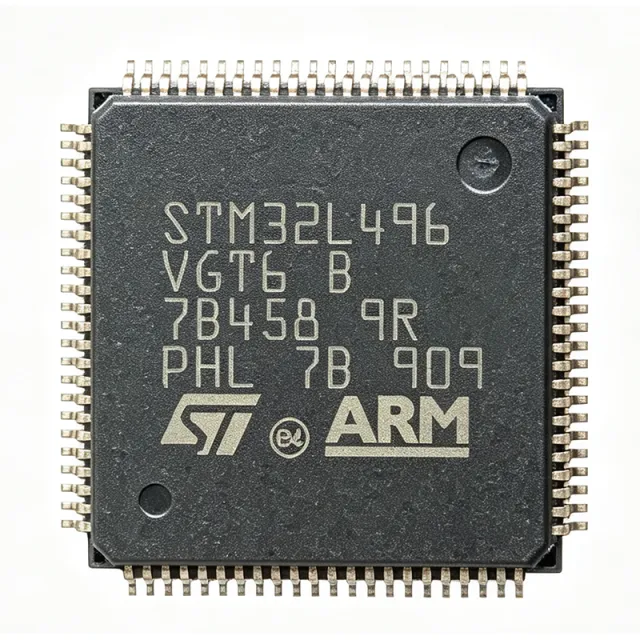
STM32L496VGT6

STM32L496VGT6 - Ultra-Low-Power ARM Cortex-M4F MCU | STMicroelectronics

The STM32L496VGT6 is an ultra-low-power 32-bit microcontroller from STMicroelectronics, based on the ARM Cortex-M4F core with FPU, running at up to 80 MHz. It integrates 1 MB of flash memory and 320 KB of SRAM, making it suitable for complex embedded applications requiring significant code and data storage. The device operates from a 1.71V to 3.6V supply and features a rich set of peripherals including multiple USARTs, SPIs, I2Cs, USB OTG FS, CAN, SDMMC, and advanced analog capabilities with two 12-bit ADCs, two DACs, and an internal voltage reference. What is an ultra-low-power microcontroller? An ultra-low-power microcontroller is a type of embedded processor designed to minimize energy consumption while maintaining computational performance. It belongs to the broader category of microcontrollers, which are integrated circuits containing a processor core, memory, and programmable peripherals on a single chip. In the system hierarchy, an ultra-low-power MCU sits above basic 8-bit controllers but below application processors, offering a balance of efficiency and capability for battery-powered and energy-harvesting devices. The STM32L496VGT6 exemplifies this class with multiple low-power modes, including Sleep, Low-power Run, and Shutdown, enabling extended battery life in portable and IoT applications. Key features of the STM32L496VGT6 include its 80 MHz ARM Cortex-M4F core with DSP instructions and single-precision FPU, 1 MB flash, 320 KB SRAM, and a comprehensive set of communication interfaces. It also features a Chrom-ART Accelerator for enhanced graphic performance, a true random number generator, and a cryptographic acceleration unit supporting AES, DES, and 3DES. The device is manufactured using ST's 40 nm process technology, contributing to its low power consumption and high integration density. Technically, the STM32L496VGT6 offers up to 100 DMIPS performance, with a CoreMark score of 273. It includes a flexible memory controller supporting external memory, and a large number of GPIOs (up to 114) in the LQFP100 package. The analog subsystem includes two 12-bit ADCs with hardware oversampling, two 12-bit DACs, and an internal voltage reference buffer. The device also supports a wide range of timers, including advanced-control timers for motor control and a low-power timer for wake-up from low-power modes. Typical applications include industrial sensors, smart meters, medical devices, wearable electronics, and IoT nodes. Its ultra-low-power modes and rich analog peripherals make it ideal for battery-powered data acquisition systems, while its connectivity options enable seamless integration into industrial networks and cloud platforms. When designing with this device, pay attention to the power supply decoupling and the selection of the appropriate low-power mode for your application. The STM32L496VGT6 supports a flexible clock tree with multiple PLLs, allowing optimization of performance versus power consumption. Ensure proper configuration of the voltage regulator range to balance performance and energy efficiency.

USD $9.55 اتصل بنا
STM32L496VGY6TR - 80MHz Cortex-M4 MCU 1MB Flash WLCSP-100
STM32L496VGY6TR

STM32L496VGY6TR - 80MHz Cortex-M4 MCU 1MB Flash WLCSP-100

The STMicroelectronics STM32L496VGY6TR is an ultra-low-power 32-bit ARM Cortex-M4 microcontroller with FPU, operating at up to 80 MHz and delivering 100 DMIPS, housed in a 100-ball WLCSP (4.62 x 4.14 mm) package. It integrates 1 MB of flash memory and 320 KB of SRAM, plus USB OTG FS, an LCD interface, and a digital filter for sigma-delta modulators (DFSDM). The device is part of the STM32L4 family and features an AES-256 hardware crypto accelerator and a hardware hash accelerator. An ARM Cortex-M4 microcontroller is a 32-bit RISC processor core designed for embedded applications, featuring low power consumption, deterministic interrupt response, and optional single-precision floating-point unit (FPU). The M4 sits within the broader Cortex-M family hierarchy: Cortex-M0/M3/M4 -> ARMv7-M architecture -> 32-bit MCU -> embedded processor -> semiconductor. The STM32L4 series specifically targets ultra-low-power applications, balancing processing performance with energy efficiency through multiple low-power modes including Shutdown at 25 nA. Key differentiating features include 1 MB flash, 320 KB SRAM, integrated SMPS step-down converter for dynamic voltage scaling, USB OTG FS, MIPI-DSI or parallel LCD interface support, two 12-bit ADCs at 5 Msps, two 12-bit DACs, DFSDM for audio/sensor applications, AES-256 and Hash accelerators, and the standard STM32 ecosystem (HAL/LL libraries, STM32CubeMX, IDE support). The WLCSP-100 package enables compact wearable and IoT designs where PCB area is critical. The Cortex-M4F core includes a single-precision FPU that accelerates DSP operations and floating-point math. The internal SMPS regulator improves efficiency over the traditional LDO regulator approach during active mode, enabling higher performance at lower power. The device supports multiple low-power modes (Stop, Standby, Shutdown) with the Shutdown mode consuming only 25 nA for battery-backed IoT endpoints. Typical applications include wearable fitness trackers, portable medical sensors, industrial IoT sensor nodes, USB-C powered accessories, LCD-based HMI panels, smart home sensor hubs, and audio interfaces leveraging the digital microphone support. The combination of USB OTG, LCD, and ultra-low power makes it particularly suited for battery-powered consumer and medical devices. When designing with this device, verify that the WLCSP-100 footprint matches your PCB capability (WLCSP requires advanced PCB process for routing and inspection). For prototypes or hand-assembly, consider the LQFP-64 or UFBGA-169 variants of the STM32L496 family instead. Provide a stable VDD and consider the SMPS inductor selection per ST application note AN4621. This page synthesizes distributor pricing, drop-in alternatives, and practical design notes not found in the manufacturer datasheet, providing actionable intelligence beyond standard spec repetition.

طلب عرض سعر اتصل بنا
STM32L496ZET6 - 80MHz Cortex-M4 512KB MCU | STMicroelectronics
STM32L496ZET6

STM32L496ZET6 - 80MHz Cortex-M4 512KB MCU | STMicroelectronics

STMicroelectronics STM32L496ZET6 is an ultra-low-power 32-bit Arm Cortex-M4 microcontroller with a floating-point unit, operating up to 80 MHz, 512 KB of flash memory, and 320 KB of SRAM in a 144-LQFP 20 x 20 mm package. It combines high processing performance with 100 DMIPS capability and supports USB OTG FS, audio, HASH, and an external switched-mode power supply interface. An ultra-low-power microcontroller is a semiconductor designed to balance useful processing performance with minimal energy consumption during active operation, sleep, and shutdown. The STM32L4 product family belongs to the hierarchy of embedded processing: Arm Cortex-M microcontroller, 32-bit microcontroller, embedded microcontroller, and semiconductor. This combination makes the STM32L496ZET6 suitable for connected industrial equipment, portable instruments, low-power controllers, and systems requiring a broad set of serial and analog peripherals. Key features include an 80 MHz Arm Cortex-M4 processor with FPU, 512 KB of program flash, and 320 KB of SRAM. The device operates from a 3.3 V supply as identified in the product listing, supports USB OTG FS, and includes hardware capabilities associated with audio and cryptographic HASH operations. Its 144-pin LQFP package provides a high pin count suitable for designs requiring extensive external connectivity. The STM32L4 architecture combines a 32-bit RISC core with integrated flash, SRAM, clock management, communication peripherals, and low-power modes. The manufacturer describes the STM32L496xx family as operating up to 80 MHz and delivering 100 DMIPS. Its integrated feature set can reduce the need for external interface or signal-conditioning components, although the exact peripheral mix and electrical limits for the selected device must be confirmed in the manufacturer pin-description and electrical-characteristics tables. Typical applications include industrial control modules, USB-connected data acquisition units, low-power embedded gateways, portable measurement equipment, and audio-capable embedded systems. The 80 MHz core supports responsive control and communication tasks, while 320 KB of SRAM provides useful working memory for protocol stacks, buffering, and real-time application code. PCB design should use the manufacturer recommended decoupling, clock, reset, and USB layout practices. Confirm all 144 pin assignments in the package pinout before routing, especially power, ground, analog, debug, and USB signals. Because LQFP lead pitch and pad geometry constrain assembly, verify the recommended land pattern and manufacturing rules before releasing artwork. This product record combines manufacturer and distributor technical information, lifecycle status, packaging details, application guidance, and a parameter comparison framework. It also highlights where engineering data must be confirmed in the STM32L496xx datasheet, helping designers evaluate the STM32L496ZET6 before schematic capture and PCB layout.

طلب عرض سعر اتصل بنا
STM32L496ZGT3 - 80MHz Cortex-M4 1MB MCU | STMicroelectronics
STM32L496ZGT3

STM32L496ZGT3 - 80MHz Cortex-M4 1MB MCU | STMicroelectronics

STMicroelectronics STM32L496ZGT3 is an ultra-low-power 32-bit Arm Cortex-M4 microcontroller with FPU operating at up to 80 MHz, offering up to 1 MB Flash, 320 KB SRAM, USB OTG FS, and audio support in a 144-LQFP 20 x 20 mm package. It is designed for embedded systems that need substantial memory, low-power operation, and broad peripheral connectivity. A microcontroller is a programmable semiconductor device that integrates a processor core, memory, and peripherals into one compact component. The STM32L4 series belongs to the Arm Cortex-M4 microcontroller family, combining real-time control capability with energy-saving operating modes. This hierarchy makes the STM32L496ZGT3 suitable for industrial controls, connected equipment, human-interface systems, and compact embedded platforms. Key features include an operating frequency of up to 80 MHz, a 100 DMIPS processing capability, and a floating-point unit. The device provides up to 1 MB of Flash configured as 1M x 8 and 320 KB of SRAM. Its USB OTG FS interface supports USB-connected data exchange, while integrated audio and digital signal processing resources suit mixed-signal and communication-oriented products. The STM32L496xx family uses STMicroelectronics FlexPowerControl for low-power operation. Supply operation is specified from 1.71 V to 3.6 V. Shutdown current is 25 nA with five wakeup pins, and VBAT mode consumes 320 nA while supporting the real-time clock and 32 x 32-bit backup registers. Available temperature options span -40 °C to 85 °C, 105 °C, or 125 °C depending on the selected orderable variant. Typical uses include industrial sensor controllers, USB-connected data loggers, audio-capable embedded equipment, low-power edge devices, and compact human-interface panels. The 144-pin LQFP package provides extensive I/O access compared with smaller microcontroller packages, making it useful where multiple communications, display, control, or analog interfaces are required. When laying out the board, follow the manufacturer pin and package guidance for the 144-LQFP footprint, place decoupling capacitors close to the appropriate supply pins, and confirm the selected external crystal, USB routing, and low-power peripherals against the datasheet. The large pin count also requires careful fan-out and assembly planning to avoid routing congestion. This page combines manufacturer specifications, exact-orderable-part identification, sourcing guidance, drop-in comparison points, and practical design considerations. It also highlights the distinction between true pin-compatible alternatives and parts that are only functionally similar, helping engineers make a board-level replacement decision without treating a different package or peripheral arrangement as a drop-in solution.

طلب عرض سعر اتصل بنا
STM32L496ZGT6 - 80MHz Cortex-M4 1MB MCU | STMicroelectronics
STM32L496ZGT6

STM32L496ZGT6 - 80MHz Cortex-M4 1MB MCU | STMicroelectronics

STMicroelectronics STM32L496ZGT6 is an ultra-low-power Arm Cortex-M4 32-bit microcontroller with FPU, operating at up to 80 MHz and delivering up to 100 DMIPS, with 1 MB of embedded Flash, 320 KB of SRAM, USB OTG FS, audio, HASH, and external SMPS support in a 144-pin LQFP package measuring 20 x 20 mm. An ultra-low-power microcontroller is a semiconductor designed to balance substantial processing capability with minimized energy consumption. The STM32L4 series belongs to the hierarchy of Arm Cortex-M4 MCU, 32-bit RISC microcontroller, embedded controller, and low-power system-on-chip. STM32L496ZGT6 combines that processing capability with sleep, low-power, shutdown, and RTC-oriented operating modes, making it suitable for battery-powered and energy-conscious embedded systems. Principal features include a 1.71 V to 3.6 V operating supply, a 32-bit Cortex-M4 processor with floating-point unit, 1 MB Flash, 320 KB SRAM, and USB OTG full-speed connectivity. The analog subsystem provides up to three fast 12-bit ADCs sampling at 5 Msps, two comparators, two operational amplifiers, two DAC channels, and an internal voltage-reference buffer. These resources reduce the need for external signal-conditioning and conversion components. The device also integrates two general-purpose 32-bit timers, two 16-bit PWM timers dedicated to motor control, seven general-purpose 16-bit timers, and two low-power timers. USB OTG FS, audio support, HASH, DFSD, and external SMPS capability broaden its use across data acquisition, secure control, industrial communication, and low-power consumer equipment. Its low-power architecture includes FlexPowerControl, 320 nA VBAT operation for the RTC and backup registers, and a 25 nA shutdown mode with five wakeup pins. Typical applications include industrial sensor nodes, USB-connected instrumentation, battery-powered data loggers, medical monitoring equipment, motor-control systems, and portable measurement products. The 144-pin LQFP provides ample external peripheral connectivity while supporting designs that need more I/O than smaller MCU packages. Designers should review the complete pin-description table, power-supply requirements, decoupling recommendations, clock configuration, and low-power constraints in the manufacturer datasheet before finalizing the PCB. In particular, preserve the external SMPS interface layout and assign wakeup pins carefully so shutdown-mode entry does not interfere with required system behavior. This page organizes the STM32L496ZGT6 core specifications, package information, design guidance, qualification factors, and same-footprint alternatives. It also distinguishes orderable temperature-grade variants from the selected STM32L496ZGT6 configuration so engineers can assess replacement compatibility without changing the LQFP-144 board footprint.

طلب عرض سعر اتصل بنا