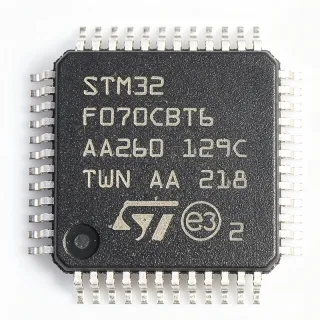
LPC2106BBD48 - 60MHz ARM7 MCU, 128KB Flash | NXP | Industrial
MPN: LPC2106BBD48 ✓ نشطLPC2106BBD48 نظرة عامة
A microcontroller is a programmable semiconductor that integrates a CPU core, memory, peripherals, and I/O into one device. The LPC2106 belongs to the 32-bit microcontroller hierarchy and uses the ARM7TDMI-S architecture. Within that architecture, the processor can execute 32-bit ARM instructions efficiently while also supporting 16-bit Thumb code, allowing compact routines where code density matters. The integrated flash supports self-programming and in-application programming workflows used for firmware updates and configuration storage.
Principal features include a 60 MHz ARM7TDMI-S core, 128 KB flash, and SRAM options of 16 KB, 32 KB, or 64 KB depending on the device variant. The LPC2106 family provides dedicated serial interfaces for UART, SPI, and I2C, along with multiple timer and counter blocks for periodic generation, capture, and motor-control functions. Its 48-lead LQFP exposes the required digital interfaces and external memory or peripheral signals while remaining compatible with conventional surface-mount assembly processes.
The CPU uses a Harvard-style architecture with a 128-bit-wide memory interface that supports efficient instruction execution at the maximum clock rate. Real-time emulation and embedded trace features assist development and diagnostics, while the peripheral set reduces the need for external interface devices in typical control systems. Because clock-dependent timing, power consumption, and electrical characteristics are not fully stated on the product page, designers should use the manufacturer datasheet for final timing, voltage, and peripheral-limit decisions.
Typical uses include industrial control panels, data acquisition equipment, communications modules, embedded gateways, and compact automation controllers. The 128 KB flash capacity is useful for moderate protocol stacks and application firmware, while the ARM7 16/32-bit instruction set is appropriate for real-time supervisory and peripheral-control tasks. Designers upgrading older ARM7 systems should also account for differences in peripheral behavior, development tools, and software-support policy rather than assuming that every register or application is unchanged.
A critical design consideration is PCB allocation around the 0.5 mm-pitch leads. Follow the manufacturer pin table and land pattern exactly, inspect every exposed power and ground connection, and provide the required bypass capacitors close to the device. For clock-sensitive or communication-heavy equipment, validate signal integrity, startup behavior, and firmware timing at the intended 60 MHz operating condition before production release.
This product page consolidates the core package, memory, processor, and sourcing details into an engineering-oriented reference. It also organizes design guidance, selection criteria, and package-compatible alternatives to support initial design decisions, footprint review, and legacy-platform maintenance without replacing the manufacturer datasheet.
بدائل مباشرة لـ LPC2106BBD48 — نفس الحزمة، متوافق دبوس بدبوس. تُستثنى القطع ذات الحزم المختلفة التي تتطلب تعديل PCB.
الطرازات في هذه السلسلة
طرازات من نفس السلسلة متوافقة تمامًا مع LPC2106BBD48 (نفس عامل الشكل والبصمة) — يختلف في Flash Organization, Package, Package Body Size, Package Pitch.
LPC2106FBD48
✅ بديل مباشرتواصل لمعرفة السعر
عرض ورقة البيانات ←LPC2106BBD48 الحدود القصوى والخصائص الكهربائية
| Product Type | Single-chip 32-bit microcontroller |
| Processor Core | ARM7TDMI-S |
| Architecture | 16/32-bit ARM |
| Maximum CPU Frequency | 60 MHz |
| Flash Memory | 128 KB |
| Flash Organization | 128 KB (128K × 8 bits) |
| SRAM Options in LPC2104/2105/2106 Family | 16 KB, 32 KB, or 64 KB |
| Programming Support | ISP/IAP programming |
| Package Type | LQFP-48 |
| Lead Count | 48 leads |
| Package Pitch | 0.5 mm |
| Package Body Dimensions | 7 mm × 7 mm × 1.4 mm |
| نوع التركيب | Surface mount |
| Temperature Grade | Commercial |
| Terminal Form | Gull wing |
| Package Shape | Square |
| Debug Features | Real-time emulation and embedded trace support |
دليل تكوين أطراف LPC2106BBD48 square
تكوين الأطراف لـ LPC2106BBD48 (حزمة square). تتضمن هذه الدائرة المتكاملة الرقمية GPIO وواجهات الاتصال (UART وSPI وI2C) وأطراف الطاقة. راجع ورقة بيانات الشركة المصنعة لوظائف الأطراف البديلة وخيارات التكوين. ضرورية لتصميم الأنظمة المدمجة وتخطيط PCB.

لا تتوفر بيانات مفصلة لمخطط التوصيلات لـ LPC2106BBD48.
راجع ورقة البيانات للحصول على تكوين الأطراف الكامل.
التطبيقات النموذجية
LPC2106BBD48 مناسب لـ 6 التطبيقs: Industrial Control Panels, Data Acquisition Modules, Communications Equipment, Embedded Gateways, Motor and Motion Controllers, Legacy Peripheral Upgrade.
Industrial Control Panels
The LPC2106BBD48 fits compact industrial control panels because its 60 MHz ARM7TDMI-S core can execute control logic, interface handling, and supervisory tasks from 128 KB of embedded flash. The 48-lead LQFP provides access to serial interfaces, timers, interrupts, and GPIO needed to monitor inputs and operate relays, indicators, or actuators. Real-time emulation and embedded trace support help diagnose timing and communication faults during commissioning. Before production release, verify the commercial temperature range, supply limits, and peripheral operating conditions against the enclosure environment and industrial EMC requirements.
موصى به
Data Acquisition Modules
LPC2106BBD48 is appropriate for data-acquisition front ends that must sample sensors, buffer results, and transfer data through a serial interface. Its 60 MHz processor provides headroom for acquisition sequencing and protocol handling, while the 128 KB flash stores configuration, calibration tables, and application code. The integrated timers and interrupt structure support periodic sampling without inefficient polling. Confirm the device's specified ADC and sensor-interface capabilities in the manufacturer datasheet, along with analog noise, reference, and acquisition timing requirements for the selected measurement chain.
موصى به
Communications Equipment
The LPC2106BBD48 can serve as the supervisory controller in communications equipment requiring deterministic embedded firmware, multiple serial interfaces, and compact packaging. UART, SPI, and I2C-oriented connectivity allows the MCU to coordinate transceivers, sensors, status indicators, and configuration storage. Its 128 KB flash is suitable for moderate protocol stacks and local control code, while the ARM7 Thumb mode can improve code density for auxiliary routines. Validate baud-rate tolerance, electrical levels, timing margins, and EMC performance in the final signal path.
موصى به
Embedded Gateways
LPC2106BBD48 fits embedded gateway designs that convert local serial or field-bus data into a higher-level network message while maintaining deterministic control behavior. The 60 MHz ARM7 processor supports protocol framing, status logging, and coordination between communication interfaces, and 128 KB flash accommodates gateway firmware and configuration parameters. Its real-time trace capability helps isolate intermittent timing issues in systems that must continue operating across network or sensor faults. Review the manufacturer documentation for watchdog, reset, brownout, and peripheral behavior before deploying unattended equipment.
موصى به
Motor and Motion Controllers
LPC2106BBD48 is applicable to compact motion-control subsystems where timers, interrupt handling, and deterministic execution are more important than a large application processor. The 60 MHz ARM7TDMI-S core can coordinate stepper-motor sequencing, position commands, limit inputs, and supervisory communications while the 48-pin LQFP preserves board space. The MCU is best used as the real-time controller rather than the direct high-current power stage. Confirm timer modes, pin multiplexing, electrical limits, and thermal conditions in the manufacturer datasheet for the selected drive topology.
موصى به
Legacy Peripheral Upgrade
LPC2106BBD48 can modernize a legacy peripheral controller when an existing product needs a faster 32-bit CPU, more capable timer and serial architecture, or more embedded flash than a small 8-bit MCU. The ARM7TDMI-S core supports 32-bit processing while retaining 16-bit Thumb execution for compact code, making it practical for protocol conversion, status aggregation, and supervisory functions. The LQFP-48 footprint also supports structured board-level upgrades where replacing the controller is preferable to redesigning the complete product. Validate peripheral compatibility, startup behavior, and legacy firmware dependencies before conversion.
موصى به
ملخص المنتجات الموصى بها
بيانات مرجعية هندسية لـ LPC2106BBD48 — المقارنة وإرشادات التصميم ومعلومات الامتثال.
دليل الاختيار
المقارنة مع البدائل
| المعامل | هذا المنتج | LPC2106FBD48 |
|---|---|---|
| Brand | NXP Semiconductors | NXP Semiconductors |
| Package | LQFP-48 (7x7 mm) | LQFP-48 |
| Processor Core | ARM7TDMI-S | ARM7TDMI-S |
| Flash Memory | 128 KB ISP/IAP | 128 KB ISP/IAP |
| RAM Options | 16 KB, 32 KB, or 64 KB | 16 KB, 32 KB, or 64 KB |
| Debug Features | Real-time emulation and embedded trace support | Real-time emulation and embedded trace support |
أبرز الفروقات
- Identified package-compatible LPC2106-family ordering alternative (مقابلLPC2106FBD48)
- 60 MHz 32-bit ARM7 control with embedded program memory (مقابلLPC2106FBD48)
- Commercial-temperature ordering variant for controlled environments (مقابلLPC2106FBD48)
ملاحظات التصميم
Use the manufacturer LQFP-48 land pattern and pin-connection table exactly. The package has 48 leads on a 0.5 mm pitch in a 7 mm × 7 mm body, so route fan-out carefully to preserve manufacturing clearance and reliable solder joints. Confirm exposed supply and ground pins, decoupling locations, and signal assignment from the official package drawing before releasing artwork.
Place the required bypass capacitors close to their associated power pins and route them using short, low-inductance paths. The exact supply voltage, capacitor values, and sequencing requirements must come from the manufacturer datasheet. Consider startup current, regulator headroom, and output-impedance effects together so transient loading does not cause unintended brownout or signal-integrity problems.
Do not treat the B-versus-F ordering code as a cosmetic change. Confirm the original device's temperature grade, operating range, qualification requirements, and assembly suffix before substituting LPC2106FBD48. Also verify that the software does not depend on undocumented peripheral differences, and compare reset, watchdog, clock, and debug behavior before committing to the alternate ordering code.
معلومات الامتثال
The manufacturer product page identifies the package and product family but does not provide RoHS, REACH, lead-free, halogen-free, conflict-minerals, or automotive qualification details for this MPN.