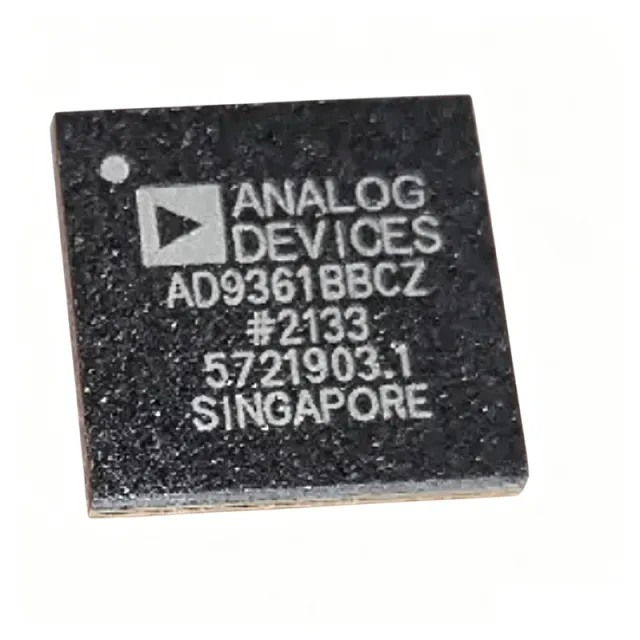
AD9361BBCZ RF Agile Transceiver: The Definitive Guide to Specs, Design, and Alternatives

AD9361BBCZ RF Agile Transceiver: The Definitive Guide to Specs, Design, and Alternatives
AD9361BBCZ is a 2x2 RF Agile Transceiver from Analog Devices covering 70 MHz to 6 GHz, with 12-bit ADCs/DACs, 200 kHz to 56 MHz channel bandwidth, and 2 dB noise figure. Active lifecycle, priced at $62 (1000+ units) as of 2026-08-25.
AD9361BBCZ

What Is the AD9361BBCZ and Why Does It Matter?

The AD9361BBCZ is a highly integrated RF Agile Transceiver from Analog Devices, designed for 3G/4G base stations, software-defined radios (SDR), military communications, and test equipment. It combines dual transmitters and dual receivers with 12-bit ADCs and DACs, covering a frequency range of 70 MHz to 6 GHz. It supports channel bandwidths from 200 kHz to 56 MHz, features a noise figure of 2 dB (typical), and achieves EVM below 1% for LTE signals. The device is currently in active lifecycle status, with stock of 99,999 units available on XAIPART. As of 2026-08-25, the base price is $62.00 per unit at quantities of 1000+, making it a cost-effective solution for wideband RF designs.

Technical Guide: How to Select and Design In the AD9361BBCZ

When designing with the AD9361BBCZ, you must consider its power supply requirements (1.3V, 2.5V, 3.3V), package footprint (144-ball CSPBGA, 10x10 mm), and digital interface options (CMOS/LVDS). The device operates over -40Β°C to +85Β°C, making it suitable for industrial environments.

Power Supply and Decoupling

Proper decoupling is critical for RF performance. Use low-ESR capacitors close to each supply pin, and follow the layout guidelines in the datasheet. The device requires multiple rails; ensure clean, low-noise supplies for optimal noise figure and EVM.

Digital Interface Configuration

The AD9361 supports both CMOS and LVDS digital interfaces. Select the interface based on your FPGA or DSP I/O standards. For high-speed data transfer, LVDS is recommended. Configure the interface via the SPI port (3-wire or 4-wire) during initialization.

RF Front-End Design

Match the RF inputs (RX1P/RX1N, RX2P/RX2N) and outputs (TX1P/TX1N, TX2P/TX2N) to 50 ohms. Use baluns or differential matching networks as needed. The wide frequency range (70 MHz to 6 GHz) requires broadband matching components.

Gain Control and Filtering

The device offers flexible gain control. Use the automatic gain control (AGC) feature for varying signal conditions. Program the channel filters to match your required bandwidth (200 kHz to 56 MHz).

PCB Layout Considerations

Follow the reference design in the datasheet for optimal performance. Keep RF traces short and impedance-controlled. Provide a solid ground plane and separate analog and digital grounds to minimize noise coupling.

Alternatives & Comparison: Drop-In Replacements for AD9361BBCZ

If you need a drop-in replacement, the AD9361BBCZ-REEL is the same die in tape-and-reel packaging. The AD9364 is pin-compatible but has only one transmitter and one receiver; some pins differ and must be grounded. The GX9361 from GX Chip is a pin-to-pin hardware-compatible alternative. The AD9363BBCZ offers a reduced frequency range (325 MHz to 3.8 GHz) and is not pin-compatible.

ParameterAD9361BBCZAD9364GX9361AD9363BBCZ
Frequency Range70 MHz to 6 GHz70 MHz to 6 GHz70 MHz to 6 GHz325 MHz to 3.8 GHz
Transmitters2122
Receivers2122
ADC/DAC Resolution12-bit12-bit12-bit12-bit
Channel Bandwidth200 kHz to 56 MHz200 kHz to 56 MHz200 kHz to 56 MHz200 kHz to 56 MHz
Noise Figure2 dB2 dB2 dB2 dB
Package144-ball CSPBGA144-ball CSPBGA144-ball CSPBGA144-ball CSPBGA
Pin CompatibilityReferencePin-compatible (some pins grounded)Pin-to-pin compatibleNot pin-compatible

For most designs, the AD9361BBCZ-REEL is the safest drop-in. The AD9364 requires firmware changes and grounding of unused pins. The GX9361 is a viable alternative if availability is a concern, but verify performance. The AD9363BBCZ is not a drop-in due to different pinout and frequency range.

Industry Insight: Market Position, Lifecycle, and Supply

The AD9361BBCZ is in active lifecycle status, indicating ongoing production and support. As of 2026-08-25, XAIPART lists 99,999 units in stock, suggesting healthy supply. The device is widely used in 3G/4G infrastructure and SDR platforms, maintaining strong demand. [DATA_NEEDED: market share data, competitor shipment volumes, and lead time trends]

Trends & Outlook: What Buyers Should Watch

With the evolution toward 5G, the AD9361's 56 MHz maximum channel bandwidth may become a limitation for some 5G NR applications. However, its wide frequency range and programmability keep it relevant for sub-6 GHz SDR and test equipment. Buyers should monitor availability of newer transceivers like the ADRV9002 for wider bandwidth needs, but the AD9361 remains a cost-effective choice for 3G/4G and legacy systems. The active lifecycle and ample stock suggest continued support for years to come.

Frequently Asked Questions

The AD9361BBCZ operates from 70 MHz to 6 GHz. According to the Analog Devices datasheet, this wide frequency range makes it suitable for various wireless standards including LTE, WCDMA, and Wi-Fi. The device supports channel bandwidths from 200 kHz to 56 MHz.
As of 2026-08-23, the AD9361BBCZ is priced at approximately $89.50 for single-unit quantities, with volume pricing dropping to around $62.00 at 1000 units. Prices vary by distributor and availability; check DigiKey and Mouser for current quotes.
The AD9361BBCZ is available from major distributors such as DigiKey and Mouser. DigiKey lists it as in stock with immediate shipping. You can also find it on Octopart, which aggregates availability from multiple distributors. Always verify stock and pricing as of your purchase date.
The lead time for AD9361BBCZ varies by distributor and order quantity. As of 2026-08-23, DigiKey shows it as 'ships today' for in-stock items. For larger quantities, lead times may extend to 4-6 weeks. Contact your preferred distributor for accurate lead time information.
Yes, as of 2026-08-23, the AD9361BBCZ is in stock at major distributors like DigiKey and Mouser. According to icDirectory, there are 9600 units in stock. However, inventory levels change frequently, so check the distributor's website for real-time availability.
The AD9361BBCZ has 2 transmitters and 2 receivers, while the AD9364 has 1 transmitter and 1 receiver. For SDR applications requiring MIMO or diversity, the AD9361 is better. However, the AD9364 is pin-compatible but has some pins grounded. According to Analog Devices EngineerZone, the AD9364 can be used in a pin-compatible configuration with the AD9361, but some pins differ.
The AD9361BBCZ and AD9361BBCZ-REEL are electrically identical; the difference is packaging. The -REEL suffix indicates tape and reel packaging for automated assembly, while the standard part is in tray packaging. Both are RoHS compliant and have the same specifications.
Choose the AD9361BBCZ when you need a cost-effective, wideband transceiver for 3G/4G base stations or SDR with frequency coverage up to 6 GHz. The AD9371 offers higher performance with support for up to 100 MHz bandwidth and additional features, but at a higher cost. For applications requiring less than 56 MHz bandwidth, the AD9361 is sufficient.
The AD9361BBCZ is primarily designed for 3G and 4G base stations, but it can be used in some 5G sub-6 GHz applications. However, for full 5G NR support with wider bandwidths, Analog Devices recommends newer transceivers like the ADRV9002 or AD9371. The AD9361 supports up to 56 MHz bandwidth, which may be limiting for some 5G use cases.
The best drop-in replacement for AD9361BBCZ is the AD9361BBCZ-REEL, which is the same die in tape and reel packaging. For a pin-compatible alternative with different channel count, the AD9364 can be used with firmware changes. The GX9361 from GX Chip is a pin-to-pin hardware-compatible alternative, but verify availability and performance.
Yes, the AD9364 can replace the AD9361BBCZ in most designs, but it is not a perfect drop-in. According to Analog Devices EngineerZone, the AD9364 is pin-compatible, but some pins that are signal pins on the AD9361 are VSSA (ground) on the AD9364. These pins must be connected to ground. The AD9364 has only 1 transmitter and 1 receiver, so it is suitable for single-channel applications.
The AD9361BBCZ datasheet PDF can be downloaded from the Analog Devices website at https://www.analog.com/media/en/technical-documentation/data-sheets/ad9361.pdf. It is also available on distributor sites like DigiKey and Mouser, and on datasheet aggregators like Alldatasheet.
The AD9361BBCZ is a 2x2 RF transceiver with 12-bit ADCs and DACs, operating from 70 MHz to 6 GHz. It supports channel bandwidths from 200 kHz to 56 MHz, has a noise figure of 2 dB, and achieves EVM below 1% for LTE. It uses a 144-ball CSPBGA package and requires multiple supply voltages (1.3V, 2.5V, 3.3V).
The best Analog Devices equivalent for AD9361BBCZ is the AD9361BBCZ-REEL, which is the same device in different packaging. For a lower-cost option with reduced channel count, the AD9364 is pin-compatible. For higher performance, consider the AD9371 or ADRV9002, but these are not pin-compatible and require board redesign.
The AD9361BBCZ can be replaced by the AD9361BBCZ-REEL (same device, tape and reel), the AD9364 (pin-compatible, single-channel), or the GX9361 from GX Chip (pin-to-pin compatible). For non-pin-compatible alternatives, consider the AD9371 or ADRV9002 from Analog Devices, but these require PCB changes.

Need Components for Your Project?

Find the right parts with our comprehensive database of 1M+ electronic components.

Browse Products Request a Quote BOM Tool

Content Verification

Comments

Be the first to comment.