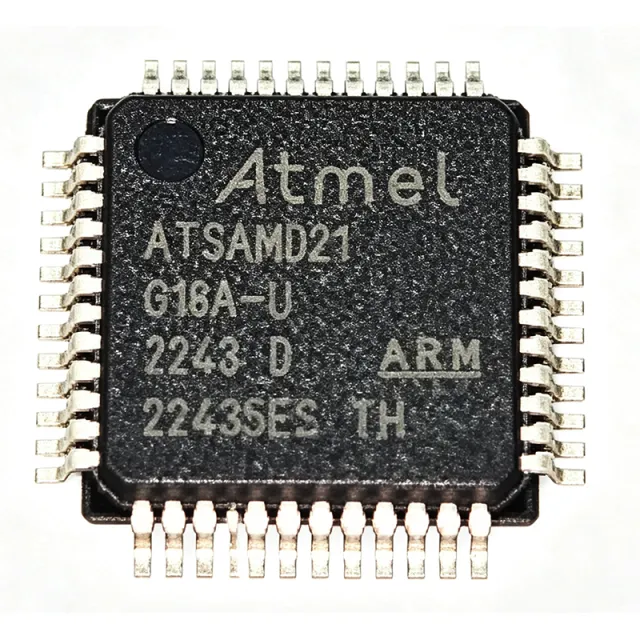
What Is the ATSAMD21G18A-AU and Why Do Engineers Choose It?
The Microchip Technology ATSAMD21G18A-AU is a low-power, high-performance 32-bit microcontroller built on the ARM Cortex-M0+ core, running at up to 48 MHz with 256 KB of flash memory and 32 KB of SRAM. It comes in a compact 48-pin TQFP (7x7 mm) surface-mount package, operates from a wide 1.62 V to 3.63 V supply range, and delivers 2.46 CoreMark/MHz of processing efficiency. As of 2026-08-30, the part is active in Microchip's lifecycle status and in stock at XAIPART with 99,999 units available, MOQ of 1, and volume pricing starting at $2.2273 per unit at the 1,000-piece tier. These verified specs make it a leading choice for home automation, smart metering, industrial sensor nodes, wearables, IoT edge devices, and education platforms — it is the same MCU that powers the Arduino Zero and MKR family boards.
Belonging to Microchip's SAM D21 family within the SMART ARM-based microcontroller portfolio, the ATSAMD21G18A-AU integrates a rich peripheral set: a 12-channel Direct Memory Access Controller (DMAC), a 12-channel Event System for inter-peripheral signaling without CPU intervention, up to five 16-bit Timer/Counters, multiple SERCOM serial interfaces configurable as USART, SPI, or I2C, a 12-bit ADC, a DAC, and capacitive-touch support for buttons, sliders, and wheels. Programming and debugging use a simple two-pin Serial Wire Debug (SWD) interface. The device is functional-safety (FuSa) ready per Microchip's documentation, RoHS-compliant with a green package, and drop-in compatible with the SAM D20 series. In this guide, we cover how to design it in, which parts replace it, and what buyers should watch — all anchored to verified data from the XAIPART product database and the official SAM D21 datasheet (DS40001882).
How Do You Select and Design In the ATSAMD21G18A-AU?
Confirm It Meets Your Resource Requirements
Start by matching your firmware footprint against 256 KB of flash and 32 KB of SRAM. The 256 KB flash comfortably holds complex communication stacks — TCP/IP or Zigbee-grade stacks, BLE host layers, MQTT-over-cellular wrappers, USB CDC code, or OTA bootloader code simultaneously. If your application fits in 64 KB or 128 KB, smaller pin-compatible variants (ATSAMD21G16B-AU, ATSAMD21G17A-AU) reduce cost; choosing the G18A preserves PCB reuse for firmware growth.
Leverage the Peripheral Architecture
The SERCOM architecture is the standout design feature: each SERCOM independently configures as USART, SPI, or I2C, letting one chip drive a radio over SPI, sensors over I2C, and a display over USART at the same time — a key reason home automation controllers adopt this part. The 12-channel Event System routes signals between peripherals without waking the CPU: an ADC conversion-complete event can trigger a timer or the DMAC while the core sleeps in standby. The 12-channel DMAC moves sensor data buffers with zero CPU load during active bursts. For analog designs, the 12-bit ADC samples transducer inputs (as in smart-meter current and voltage sensing) and the integrated DAC provides analog output without an external converter.
PCB Layout and Power Design Best Practices
Per verified design guidance from the product database: decouple all VDD pins with 100 nF capacitors placed close to each pin and add a 10 µF bulk capacitor on the main supply. Bring the SWD interface (SWCLK on pin 43/PA30, SWDIO on pin 44/PA31) out to a header for programming and debugging — this two-pin interface works with Atmel-ICE, PICkit 4, the EDBG debugger on Arduino Zero, or third-party CMSIS-DAP debuggers. The 1.62–3.63 V supply range tolerates noisy industrial rails and interfaces directly with battery-backed supplies, but note that operating temperature range is not listed in the current verified data — consult datasheet DS40001882 before finalizing thermal design: [DATA_NEEDED: operating temperature range].
Low-Power Design Techniques
For battery-powered designs, use standby sleep mode and configure SleepWalking peripherals so the DMAC and Event System operate while the CPU sleeps. An I2C sensor can wake the chip only on events, minimizing average current draw. Combined with 2.46 CoreMark/MHz efficiency, this minimizes energy per computation — critical for wearables and IoT nodes running on small cells.
Programming and Software Ecosystem
Development tools include Microchip Studio, the Arm GCC toolchain, Arduino IDE, and CircuitPython. The part's use in Arduino Zero and MKR boards gives engineers a mature ecosystem of core libraries and community support, and the SWD/EDBG debug path supports professional workflows. The two-pin SWD interface also simplifies field reprogramming through an external header on deployed IoT hardware.
Which Components Are Drop-In Alternatives to the ATSAMD21G18A-AU?
The verified alternatives all come from within Microchip's SAM D21 family, which explicitly supports footprint-compatible migration per datasheet DS40001882. No cross-brand part is pin-compatible in the 48-TQFP package; Cortex-M0+ competitors such as the STM32F030C8T6 offer similar performance (48 MHz, 32-bit core, LQFP-48) but use a different pinout, requiring PCB redesign and code porting.
| Parameter | ATSAMD21G18A-AU | ATSAMD21G18A-AUT | ATSAMD21G18B-AU | ATSAMD21G17A-AU | ATSAMD21G16B-AU | ATSAMD21G17D-AU |
|---|---|---|---|---|---|---|
| Core | ARM Cortex-M0+ | ARM Cortex-M0+ | ARM Cortex-M0+ | ARM Cortex-M0+ | ARM Cortex-M0+ | ARM Cortex-M0+ |
| Max Clock | 48 MHz | 48 MHz | 48 MHz | 48 MHz | 48 MHz | 48 MHz |
| Flash | 256 KB | 256 KB | 256 KB | 128 KB | 64 KB | 128 KB |
| SRAM | 32 KB | 32 KB | 32 KB | 32 KB | 32 KB | 32 KB |
| Package | 48-TQFP (7x7 mm) | 48-TQFP (7x7 mm) | 48-TQFP (7x7 mm) | 48-TQFP (7x7 mm) | 48-TQFP (7x7 mm) | 48-TQFP (7x7 mm) |
| Pin Compatible | — | Yes (identical die) | Yes | Yes | Yes | Yes |
| Key Difference | Base part, tray | Tape-and-reel | B silicon revision | Half flash | Quarter flash, B silicon | Newer D silicon |
Selection guidance: choose the ATSAMD21G18A-AUT for identical silicon in tape-and-reel packaging for automated pick-and-place assembly — it is electrically and mechanically interchangeable on the same PCB. Choose the ATSAMD21G18B-AU if you want 256 KB flash on the newer B silicon revision. Choose ATSAMD21G17A-AU (128 KB) or ATSAMD21G16B-AU (64 KB, B silicon) to cut cost when flash requirements are modest. The ATSAMD21G17D-AU offers the newest D silicon revision with 128 KB flash and the same peripheral set and pinout. All share the same 48-TQFP pinout, SERCOM peripheral set, and SWD debug interface.
What Is the Market Position, Lifecycle Status, and Supply Situation for the ATSAMD21G18A-AU?
Lifecycle status is active per the verified database. Supply is strong: XAIPART lists 99,999 units in stock with MOQ of 1, and the FAQ data confirms availability at DigiKey (ships same day), Mouser, and LCSC as of 2026-08-29, meaning standard lead time is essentially immediate from authorized distributors. Octopart lists 13 distributors carrying the part, and Microchip's microchipDIRECT channel serves production volumes. For large production quantities, extended factory lead times may apply — check microchipDIRECT for volume scheduling and secure supply agreements. For the ATSAMD21G18A-AU's market share ranking and long-term lifecycle forecast beyond the active status flag: [DATA_NEEDED: market share data and end-of-life forecast].
What Should Buyers Watch: Trends and Outlook for ATSAMD21G18A-AU Procurement?
Anchor your purchasing to the verified pricing structure as of 2026-08-30: $3.8182 at qty 1, $2.7576 at qty 10, $2.4394 at qty 100, $2.3333 at qty 500, and $2.2273 at qty 1,000 — a 42% unit-cost reduction from single-unit to 1K-tier volume. External market data as of 2026-08-29 shows LCSC at approximately $2.62 per unit and typical 1-9 unit pricing around $3.10 at major distributors, with volume rates below $2.30 at 1,000 pieces; pricing varies by distributor and stock position, so compare DigiKey, Mouser, and LCSC before committing. Buy through authorized channels to ensure traceability and avoid broker-only sourcing risks.
From a design standpoint, the FuSa-ready classification and RoHS-compliant green package support reliability-focused and environmentally regulated deployments. The mature ecosystem — Arduino Zero, MKR boards, CircuitPython, Microchip Studio, CMSIS-DAP tooling — reduces firmware development risk and keeps this platform viable for new designs. Watch silicon revisions: the family already spans A, B, and D revisions (G18A, G18B, G17D), so verify the revision on your incoming lots and confirm errata against the latest datasheet revision history from Microchip's official DS40001882 document.
Key Engineering Takeaways
The ATSAMD21G18A-AU pairs a 48 MHz Cortex-M0+ core with 256 KB flash and 32 KB SRAM in a 7x7 mm 48-TQFP, delivering 2.46 CoreMark/MHz from a 1.62–3.63 V rail. Its 12-channel DMAC, 12-channel Event System, and flexible SERCOM peripherals handle multi-protocol designs efficiently, while SleepWalking standby modes cut average current for battery products. With active lifecycle status, 99,999 units in stock at XAIPART (MOQ 1, from $2.2273 as of 2026-08-30), and five pin-compatible family alternatives, it remains a low-risk, well-supported choice for automation, metering, industrial, wearable, IoT, and educational designs.
Comments
Be the first to comment.
🔐 Please sign in to post a comment.
Don't have an account? Sign up