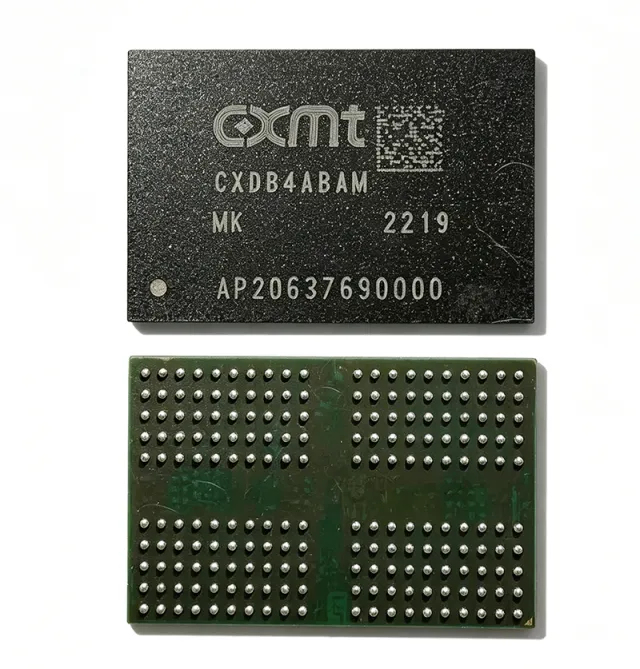
Quick Answers: What Is the CXDB4ABAM-MK and Is It Available Now?
The CXDB4ABAM-MK is an 8Gb LPDDR4X SDRAM from CXMT that operates at 3733 MHz and is housed in a BGA-200 (15x10x0.8 mm) package. It uses a 1.8V VDD1 core supply, a 1.1V VDD2 core supply, and a 0.6V VDDQ I/O supply. XAIPART lists the part as active with 99,999 units in stock, an MOQ of 1, and a verified price of $19.0909 per unit at qty 1000 as of 2026-08-20.
Selecting memory for a battery-powered product requires balancing bandwidth, power, and package area. The CXDB4ABAM-MK addresses those needs with 3733 MHz data rate, 8Gb density, dual-channel operation, on-die termination (ODT), 16n prefetch, and temperature-compensated self-refresh (TCSR). The 0.6V I/O rail is the defining LPDDR4X feature; CXMT states the part can reduce power consumption by up to 20% compared with LPDDR4. The exact operating temperature range, memory organization, CAS latency, and refresh rate are not in the XAIPART verified record, so open the manufacturer datasheet before final thermals and timing sign-off.
This guide covers selection checks, design-in steps, verified alternatives, lifecycle and stock data, and the specification trends LPDDR4X buyers should watch in 2026.
Technical Guide: How Do You Select and Design In the CXDB4ABAM-MK?
Start with a requirement table. Record the memory type, density, data rate, package, and supply voltages you need. Compare each row against the XAIPART verified values: LPDDR4X SDRAM, 8Gb, 3733 MHz, BGA-200, VDD1=1.8V, VDD2=1.1V, VDDQ=0.6V. The device is RoHS compliant and lead-free, which simplifies environmental compliance for new designs.
1. Package and Footprint Check
The 200-ball FBGA measures 15x10x0.8 mm. Board area is 150 mm2 (15 mm multiplied by 10 mm). The compact height of 0.8 mm helps thin smartphone and tablet designs. Because the package is surface mount, ensure your PCB assembly line supports BGA-200 inspection and rework. The verified pinout starts with VDD1 on A1, VSS on A2, DQ0 on B1, and DQ1 on B2. These first pins show where the core supply and initial data bits land.
2. Power Supply Architecture
Power the device from three rails: VDD1 at 1.8V, VDD2 at 1.1V, and VDDQ at 0.6V for the I/O. Place decoupling capacitors near the VDD1, VDD2, and VDDQ pins to minimize switching noise. The low 0.6V I/O voltage is the LPDDR4X advantage over standard LPDDR4 and is the reason CXMT can claim up to 20% power reduction versus LPDDR4. In battery-powered devices, use the active, standby, and deep power-down modes to extend run time.
3. Signal Integrity at 3733 MHz
At 3733 MHz, memory routing is a high-speed design task. Route CK_t (D1) and CK_c (D2) as a differential clock pair. Keep the CS signal (E1) clean because chip select integrity is critical. The command/address lines CA0 (E2), CA1 (F1), and CA2 (F2) should be matched to the controller's specified length. Use the built-in ODT to match bus impedance and reduce reflections. The 16n prefetch architecture increases throughput by fetching more data per access.
4. Self-Refresh and Temperature
TCSR keeps data intact by adjusting refresh behavior with temperature. This matters in automotive infotainment and other environments where the module may see wide temperature swings. The XAIPART record does not include the exact operating temperature range, so qualify the part using the latest datasheet. The device supports dual-channel operation for higher system throughput when the controller maps two channels to the memory device.
5. Application Notes by Target Product
In smartphones, the 3733 MHz data rate supports smooth multitasking and VR experiences, while the 8Gb density handles high-resolution displays. In tablets, the high bandwidth pairs with low power for video streaming. Set-top boxes use the bandwidth for HD video decoding and fast app loading. IoT devices benefit from the low-power LPDDR4X interface and compact BGA-200 package. VR headsets require low latency; the 3733 MHz bus helps deliver that throughput. Automotive infotainment systems can rely on TCSR to preserve data integrity over temperature. Download the datasheet from the CXDB4ABAM-MK datasheet link for layout and timing details.
Alternatives & Comparison: Which LPDDR4X Devices Are Drop-In Replacements?
The XAIPART alternatives list includes the base CXDB4ABAM, Samsung K4F8E304HB-MGCJ, Micron MT53B256M32D1NP-062, and Nanya NT6AN512M32AV-1G. None of these is marked as a confirmed drop-in replacement in the database. The notes specifically ask you to verify speed grade, pinout, and timing before substituting.
| Parameter | CXDB4ABAM-MK | CXDB4ABAM | K4F8E304HB-MGCJ | MT53B256M32D1NP-062 | NT6AN512M32AV-1G |
|---|---|---|---|---|---|
| Manufacturer | CXMT | CXMT | Samsung | Micron | Nanya |
| Memory type | LPDDR4X SDRAM | LPDDR4X base variant | LPDDR4X | LPDDR4X | LPDDR4X |
| Density | 8Gb | Not specified in XAIPART database | Not specified in XAIPART database | 8Gb | 8Gb |
| Data rate | 3733 MHz | May have different speed grade | Not specified in XAIPART database | Not specified in XAIPART database | Not specified in XAIPART database |
| Package | BGA-200, 15x10x0.8 mm | Not specified in XAIPART database | Similar package, verify pinout | Verify pin compatibility | Verify pin compatibility |
| Drop-in status | Reference part | Verify speed grade | Not necessarily drop-in; verify pinout and timing | Verify pin compatibility | Verify pin compatibility |
How to qualify any alternative: First, compare the BGA-200 pinout and package dimensions against the CXDB4ABAM-MK datasheet. Second, confirm the density and organization meet the system memory map. Third, verify the data rate and timing parameters, including CAS latency. Fourth, check VDD1, VDD2, and VDDQ supply compatibility. Fifth, validate the operating temperature range and self-refresh behavior. Finally, run signal-integrity simulation and a hardware bring-up test before freezing the BOM.
Industry Insight: What Is the Lifecycle and Supply Situation for CXDB4ABAM-MK?
The XAIPART database classifies CXDB4ABAM-MK as active, which means CXMT continues to produce the device. The stock record shows 99,999 units on hand and an MOQ of 1. Engineering teams can order a single unit for evaluation, then scale to production quantities.
As of 2026-08-20, the verified price tiers are: $32.7273 at qty 1, $23.6364 at qty 10, $20.9091 at qty 100, $20.00 at qty 500, and $19.0909 at qty 1000. The active lifecycle combined with high stock gives buyers a predictable sourcing picture for an 8Gb LPDDR4X memory. The XAIPART database does not publish manufacturer market-share or shipment estimates, so any competitive market-position claim would require separate industry data.
Trends & Outlook: What Should LPDDR4X Buyers Watch in 2026?
Watch the 'MK' suffix. CXMT uses the suffix to indicate a specific speed grade or configuration. The CXDB4ABAM-MK is verified at 3733 MHz; other CXDB4ABAM variants may run at different grades. Confirm the full part number before ordering.
Watch the 0.6V VDDQ trend. LPDDR4X keeps the I/O rail at 0.6V, which is central to the up-to-20% power savings versus LPDDR4. As edge AI and battery-powered products demand more memory bandwidth, the combination of 3733 MHz and low-voltage I/O keeps LPDDR4X relevant.
Watch the volume pricing curve. The verified price drops from $32.7273 at qty 1 to $19.0909 at qty 1000. That is a $13.6364 saving per unit, or 41.7% off the single-unit price. Production buyers should evaluate 1000-unit lots, while prototype teams can use the MOQ of 1.
Watch compatibility claims. Samsung, Micron, and Nanya alternatives appear in the XAIPART database, but the notes require pin and timing verification. Do not treat same-density LPDDR4X parts as automatic drop-ins for a CXMT device.
Watch power-management and temperature features. TCSR and dual-channel support matter for automotive infotainment and VR headsets. Since the verified record does not include the exact operating temperature range, request the latest datasheet and qualification report during design-in.
Related resources: CXDB4ABAM-MK product page, Memory ICs category, and LPDDR4X vs DDR5 technical guide.
Comments
Be the first to comment.
🔐 Please sign in to post a comment.
Don't have an account? Sign up