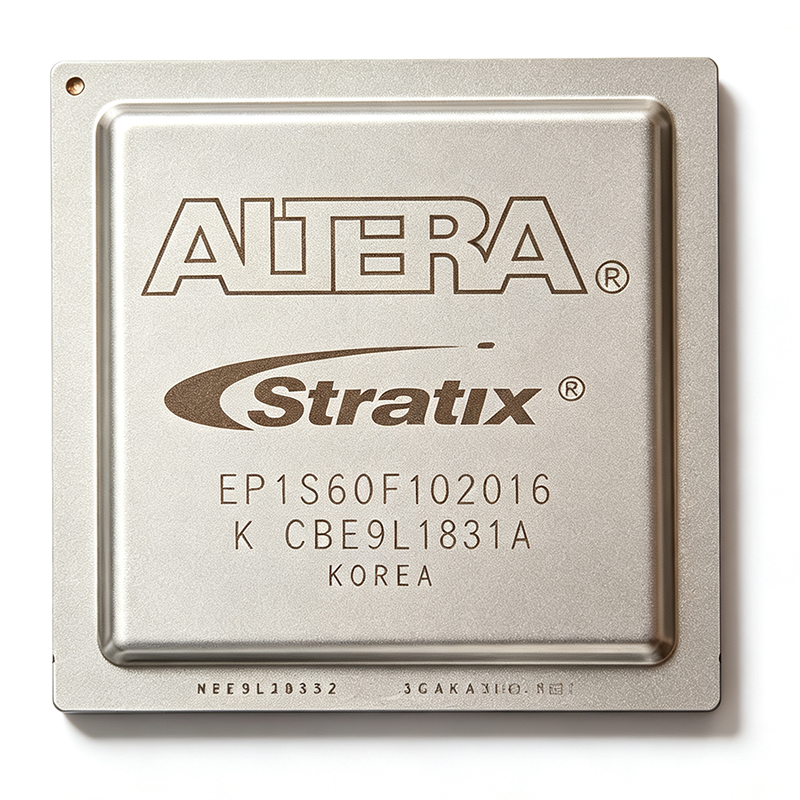
EP1S60F1020C5N: What Is It, What Are Its Key Specs, and Is It Available Today?
The EP1S60F1020C5N is an Intel (formerly Altera) Stratix family FPGA integrating 57,120 logic elements (LEs), 6,570 logic array blocks (LABs), and 5,215,104 bits of TriMatrix embedded RAM, fabricated on a 130 nm CMOS process and housed in a 1,020-ball FineLine BGA package measuring 33 x 33 mm with 1 mm ball pitch. It operates from a 1.425 V to 1.575 V core supply over a commercial 0 to 85 C junction temperature range, and the 'C5' suffix denotes the slowest commercial speed grade while 'N' denotes lead-free (Pb-free) termination. As of 2026-09-12, the part is listed on XAIPART with stock of 99,999 units, MOQ 1, and tiered pricing from $2,850 (qty 1) down to $2,050 (qty 1,000). Note that the device carries NRND (Not Recommended for New Designs) lifecycle status, so it is best suited for legacy sustaining production, repair, and cost-out redesign avoidance rather than new starts.
Within the Intel/Altera portfolio, the Stratix family sits above the cost-optimized Cyclone line and below the transceiver-rich Stratix GX/II/III/V variants. The EP1S60 occupies the high-density mid-range of the first-generation Stratix line. Its key differentiators include TriMatrix memory in three block sizes (512-bit M512, 4-Kbit M4K, 512-Kbit MRAM), embedded DSP blocks implementing 9-bit signed multipliers with accumulator chains, up to 12 high-speed transceiver channels (speed-grade dependent), and a clock network with up to 16 dedicated clock pins and 16 PLL blocks. Each LE contains a 4-input LUT, a programmable register, carry-chain logic, and register chain interconnect. The 1020-pin FBGA exposes nearly all device I/O, making it attractive for communications backplanes, ASIC prototyping, and high-density DSP systems.
How Do You Select and Design In the EP1S60F1020C5N?
Designing with the EP1S60F1020C5N starts with toolchain and configuration planning. The device requires Quartus II design software version 5.x or later with the Stratix device library installed; Quartus Prime 17.0+ in legacy support mode also supports it. Configuration bitstreams load through EPC16 or EPC8 configuration devices, JTAG, or passive serial from a microcontroller. Set the Quartus II fitter explicitly for the 1020-pin FBGA package, and make pin assignments respect each I/O bank's VCCIO groupings — the Quartus II Pin Planner auto-generates the full ball map after package selection.
Power budgeting is a critical design step. A 57K-LE Stratix at high utilization can exceed 5 W to 15 W of core power, so plan 1.5 V bulk decoupling of at least 330 uF low-ESR polymer capacitance plus per-pin high-frequency bypass ceramics. Decouple each VCC plane with bulk plus high-frequency ceramics; the PLL analog supply (typically 1.5 V) needs its own dedicated decoupling. The core rail must hold 1.425 V to 1.575 V, while VCCIO pins are banked to support 1.5 V, 1.8 V, 2.5 V, or 3.3 V I/O standards depending on bank configuration.
Choose the C5 speed grade when timing margin matters more than raw throughput — it is the slowest commercial grade (C6, C7, and C8 are progressively faster). For DSP-heavy designs, Quartus II auto-packs DSP inference patterns into the embedded 9-bit multiplier blocks and reports Fmax in the timing analyzer. For model-based design entry, Quartus DSP Builder integrates with MATLAB/Simulink. [DATA_NEEDED: fMAX figure per logic block for the C5 speed grade]
What Are the Drop-in Alternatives and How Do They Compare?
There is no cross-brand drop-in equivalent for the EP1S60F1020C5N: the Stratix logic fabric, DSP blocks, configuration bitstream format, and BGA ball map are Intel/Altera-proprietary. The only true drop-in replacements are other EP1S60 devices in the same 1020-ball FBGA package, verified in the XAIPART database:
| Parameter | EP1S60F1020C5N | EP1S60F1020C8N | EP1S60F1020I7N |
|---|---|---|---|
| Package | 1020-ball FBGA (33 x 33 mm, 1 mm pitch) | identical 1020-BGA | identical 1020-BGA |
| Logic Elements | 57,120 | 57,120 | 57,120 |
| Total RAM Bits | 5,215,104 | 5,215,104 | [DATA_NEEDED: RAM bits for I7N] |
| Speed Grade | C5 (slowest commercial) | C8 (fastest, +50% Fmax vs C5) | I7 (faster than C5) |
| Temperature Grade | Commercial 0 to 85 C | Commercial | Industrial |
| Drop-in? | — | Yes, identical ball map | Yes, identical package |
For new designs, the Stratix II EP2S60F1020C5 (same density class adapted to ALMs, 90 nm process, lower power, higher performance) or Cyclone V 5CEFA7F23I7 are recommended when lower cost and lower density are acceptable; for new high-density work, evaluate Stratix 10 or Cyclone 10 GX. Functional competitors such as the Xilinx Virtex-II Pro XC2VP60 or Virtex-4 SX55 require full PCB re-layout, RTL redesign, and toolchain migration (ISE/Vivado vs Quartus) — not drop-in substitutions. Also note that EP1S60F1020C5 (without the N) is electrically and pin-identical, differing only in tin-lead (SnPb) versus lead-free SAC solder balls.
What Is the Market Position, Lifecycle Status, and Supply Situation of the EP1S60F1020C5N?
The EP1S60F1020C5N carries NRND (Not Recommended for New Designs) lifecycle status. Intel continues to support it in Quartus Prime legacy mode, and configuration devices (EPC16/EPC8) remain part of the supported flow. Supply-wise, as of 2026-09-07 distributor listings reflect mixed inventory: authorized channels may show limited stock with 6-12 week factory lead time given NRND status, while open-market and broker channels (e.g., TrustedParts, Avaq, Bettlink) maintain spot inventory. XAIPART currently lists 99,999 units in stock with MOQ 1, priced at $2,850 at qty 1 down to $2,050 at qty 1,000 as of 2026-09-12. Because NRND parts carry quote-based and broker pricing variability, always confirm against a live inventory feed before placing production orders. [DATA_NEEDED: official Intel product discontinuation date and last-time-buy window]
What Should Buyers Watch Going Forward With the EP1S60F1020C5N?
Buyers sustaining EP1S60F1020C5N production should watch three things anchored to verified data. First, price escalation risk: the verified $2,850-to-$2,050 tier ladder (as of 2026-09-12) applies while authorized stock lasts; NRND status means future quotes may detach from these tiers. Second, qualify drop-in speed-grade substitutions now: EP1S60F1020C8N (fastest, +50% Fmax vs C5) and EP1S60F1020I7N (industrial temp) share the identical 1020-ball FBGA and 57,120 LE fabric, giving you alternate sources within the same footprint if C5 inventory tightens — and the lead-free 'N' versions satisfy RoHS requirements where the SnPb-ball EP1S60F1020C5 does not. Third, plan an end-of-life migration path: for new designs or long-life programs, Intel recommends Stratix II EP2S60F1020C5, Cyclone V 5CEFA7F23I7, Stratix 10, or Cyclone 10 GX, which require RTL and board rework but deliver lower power and higher performance than the 130 nm Stratix fabric. Finally, budget the full power envelope — 5 W to 15 W core at high utilization on a 1.425 V to 1.575 V rail — into any thermal and supply design before committing to the footprint.
Comments
Be the first to comment.
🔐 Please sign in to post a comment.
Don't have an account? Sign up