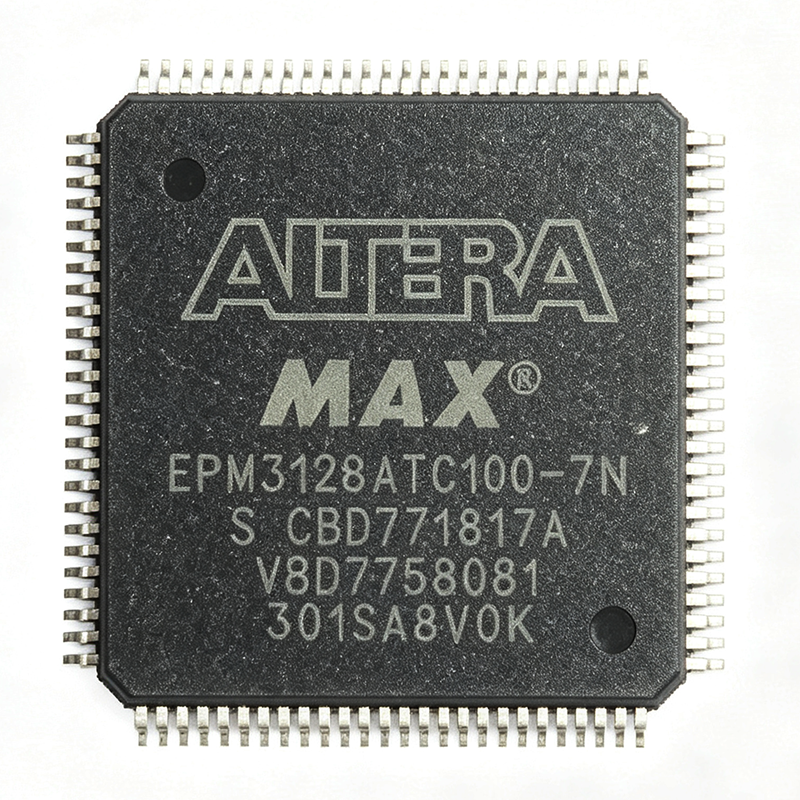
What Is the EPM3128ATC100-7N and Why Does It Still Matter in 2026?
The Intel (formerly Altera) EPM3128ATC100-7N is a 128-macrocell MAX 3000A family CPLD housed in a 100-pin TQFP package with 80 usable I/Os and up to 10,000 usable gates. It runs on a 3.3-V core with MultiVolt I/O supporting 5.0-V, 3.3-V, and 2.5-V logic levels, delivers a 7.5-ns pin-to-pin propagation delay (tPD) in the -7 speed grade, and clocks counters at up to 227.3 MHz. Its non-volatile EEPROM configuration is programmed in-system through the IEEE 1532 / JTAG interface, so the device is live the instant power is applied — no boot PROM required. Availability remains strong for legacy demand: XAIPART lists 99999 units in stock with MOQ 1 and pricing from $5.87 at qty 1 down to $3.52 at qty 1000 (as of 2026-09-12). Although the part carries an NRND (Not Recommended for New Designs) status, it remains a workhorse for address decoding, bus interfacing, glue-logic consolidation, PCI/ISA interface logic, industrial PLC I/O, and motor-control feedback conditioning.
This guide is a single decision-grade reference: verified specifications, design-in practices, application scenarios, replacement strategy, lifecycle insight, and sourcing guidance, all anchored to the verified product database and manufacturer datasheet.
What Are the Verified Specifications of the EPM3128ATC100-7N?
| Parameter | Value |
|---|---|
| Manufacturer | Intel (formerly Altera) |
| Family | MAX 3000A |
| Macro Cells | 128 |
| Usable Gates | Up to 10,000 |
| Number of I/Os | 80 |
| Propagation Delay (tPD) | 7.5 ns (-7 speed grade) |
| Counter Frequency (max) | 227.3 MHz |
| Core Supply Voltage | 3.3 V |
| I/O Interface Levels | 5.0 V / 3.3 V / 2.5 V (MultiVolt I/O) |
| In-System Programmability | Yes (IEEE 1532 / JTAG) |
| Program Memory Type | EEPROM (non-volatile) |
| Operating Temperature | 0C to +70C (Commercial) |
| Package | TQFP-100, Surface Mount |
| Logic Family | CMOS |
| Speed Grade | -7 |
| Number of LABs | [DATA_NEEDED: LAB count] |
| RoHS Status | [DATA_NEEDED: RoHS status] |
The MAX 3000A architecture organizes the 128 macrocells into Logic Array Blocks with a programmable AND/OR array and a product-term allocator that shares terms across outputs. Because the family shares a common architecture with MAX 7000/7000AE devices, designs migrate through Altera's legacy MAX+PLUS II and Quartus II toolchains with minimal friction.
How Do You Design In the EPM3128ATC100-7N? A Practical Technical Guide
Design-in success with this CPLD comes down to four areas: power integrity, I/O voltage domain planning, programming access, and timing budgeting.
Power supply and decoupling. The 3.3-V core supply must remain stable under simultaneous-switching I/O activity. Place bulk decoupling capacitance near the TQFP-100 power pins and distribute local 0.1-uF decouplers across the package perimeter. If any I/O bank is powered at a different MultiVolt rail, decouple each rail independently and sequence per the MultiVolt specification in the datasheet — the device supports 5.0-V tolerant I/O on a 3.3-V VCCIO, but not the reverse. For exact power-ramp requirements, consult the datasheet's operating conditions section: [DATA_NEEDED: power-up ramp rate specification].
I/O voltage domain planning. With 80 user I/Os and MultiVolt support for 5.0-V, 3.3-V, and 2.5-V levels, map each I/O bank to the logic family it must talk to before routing the PCB. A common pattern places the core on 3.3 V while one bank directly drives legacy 5-V TTL peripherals — eliminating discrete level shifters from the BOM. Confirm final pin-to-bank assignment against the datasheet's pinout on page 1.
Programming and configuration. In-system programming runs through the JTAG-compatible IEEE 1532 interface using a ByteBlaster or USB-Blaster download cable from MAX+PLUS II or the legacy Quartus II Web Edition toolchain. Reserve a 10-pin JTAG header on the board and keep the JTAG chain short. Because configuration lives in non-volatile EEPROM, no external boot memory is needed — a key advantage over SRAM FPGAs in instant-on systems.
Timing budgeting. Budget with the verified 7.5-ns maximum pin-to-pin delay for the -7 grade. For a 33-MHz PCI environment, the 30-ns cycle time leaves generous margin after the CPLD's decode delay. Counter logic validates up to 227.3 MHz. When a design sits near macrocell capacity (128), use the product-term allocator in the fitter and review the fitter report to confirm no term-expansion penalties push any path past 7.5 ns. Faster -5 and slower -10 grades in the same package let you trade speed against cost without a board spin.
Rework and handling. The TQFP-100 fine-line package demands hot-air rework with a matched nozzle and a pre-heated board to avoid lifted pads on multi-layer boards — a real concern for legacy repair shops stocking this part.
Where Is the EPM3128ATC100-7N Used? Six Verified Application Scenarios
1. Microcontroller address and bus decode. With 128 macrocells and 80 I/Os, the device decodes wide address buses and generates timing-controlled chip selects, offloading those tasks from the host CPU. The 7.5-ns tPD keeps decode latency below a single memory-access cycle, and EEPROM instant-on behavior ensures deterministic startup. Verified specs used: 128 macrocells, 80 I/Os, tPD 7.5 ns.
2. Glue-logic consolidation on legacy boards. One CPLD replaces dozens of 74-series TTL/CMOS discretes, shrinking board area, power, and BOM count. MultiVolt I/O bridges legacy 5-V peripherals to 3.3-V cores without level shifters, and JTAG ISP enables on-board rework without desoldering. Verified specs used: MultiVolt 5.0 V/3.3 V/2.5 V, IEEE 1532 ISP.
3. PCI/ISA peripheral interface logic. The part generates command, byte-enable, and parity signals; 80 I/Os route a full 32-bit PCI data/address bus plus control lines. The 7.5-ns tPD fits inside the 30-ns cycle of a 33-MHz PCI bus, and instant-on configuration matters because PCI enumeration expects peripherals ready before the host firmware scan. Verified specs used: 80 I/Os, tPD 7.5 ns, EEPROM non-volatile configuration.
4. Industrial control / PLC I/O expansion. Deterministic state machines handle input debouncing, output sequencing, and interlocks with no software-loop jitter. EEPROM instant-on supports fail-safe startup; the 0C to +70C commercial range suits cabinet-mounted equipment, while extended-temperature environments call for MAX II industrial-grade variants. Verified specs used: 0C to +70C operating range, deterministic tPD.
5. Motor-control feedback and PWM steering. The up-to-227.3-MHz counter frequency supports precise quadrature-encoder counting at high RPM, deterministic delays enable dead-time insertion and shoot-through protection, and MultiVolt I/O interfaces 5-V Hall sensors with 3.3-V DSP GPIOs from one device. Verified specs used: 227.3 MHz counter frequency, MultiVolt I/O, 128 macrocells.
6. Legacy system repair and replacement stocking. Because the part is NRND as of 2026-09-12, repair shops stock -5, -7, and -10 speed grades. The -10 grade substitutes where timing margins are relaxed; stocking both N and non-N finishes covers boards built under different RoHS regimes. Verified specs used: speed grades -5/-7/-10 in the same footprint [VERIFY_NEEDED: same-footprint claim applies to -5 and -10 variants], lifecycle NRND.
Design Example: Consolidating Address Decoding on a Mixed-Voltage Embedded Board
Problem: A legacy industrial controller uses a 5-V microprocessor, a 3.3-V DSP, and a bank of 5-V peripherals. Discrete 74-series decode logic consumes board area, adds propagation delay, and resists design changes.
Approach: Replace the discrete decode with a single EPM3128ATC100-7N. Power the core at 3.3 V; assign MultiVolt I/O banks so 5-V processor and peripheral signals connect directly while 3.3-V DSP GPIOs use another bank. Implement address decode, chip-select generation, and a watchdog state machine in the 128 macrocells. Program in-system through a JTAG header using IEEE 1532.
Calculations: Decode path timing: tPD = 7.5 ns maximum, well inside a single 100-ns memory cycle of a typical 10-MHz bus and inside a 30-ns 33-MHz PCI cycle. Counter-based timeout logic validated at up to 227.3 MHz, so watchdog clocking at even tens of MHz carries order-of-magnitude margin. BOM effect: dozens of discrete packages collapse to one TQFP-100 plus decoupling capacitors.
Results: Decode latency of at most 7.5 ns, instant-on operation from non-volatile EEPROM, direct 5-V/3.3-V interfacing without level shifters, and field-updatable logic through JTAG — all with 80 I/Os covering the full signal set.
Components: EPM3128ATC100-7N (main CPLD, qty 1), plus [DATA_NEEDED: recommended decoupling capacitor values and JTAG connector part numbers from verified database].
What Are the Alternatives to the EPM3128ATC100-7N?
The database's verified alternatives list is empty for this part at publication time. The manufacturer datasheet notes that the MAX 3000A family shares architecture with MAX 7000/7000AE devices, and the FAQ references same-family variant names (EPM3128ATC100-7, EPM3128ATC100-5N, EPM3128ATC100-10N, and the 64-macrocell EPM3064ATC100-10N), but no verified specification tables for those variants exist in this database. We will not fabricate comparison data.
| Parameter | EPM3128ATC100-7N (verified) |
|---|---|
| Family | MAX 3000A |
| Macro Cells | 128 |
| Usable Gates | Up to 10,000 |
| I/Os | 80 |
| tPD | 7.5 ns |
| Counter Frequency (max) | 227.3 MHz |
| Core Voltage | 3.3 V |
| Package | TQFP-100 |
| Price (qty 1 / qty 1000) | $5.87 / $3.52 as of 2026-09-12 |
Summary: Until verified spec data for sibling speed grades and competing parts is added, treat the EPM3128ATC100-7N as the single verified baseline. [DATA_NEEDED: verified spec tables for EPM3128ATC100-5N, EPM3128ATC100-10N, EPM3128ATC100-7, EPM3064ATC100-10N, and MAX II/MAX V migration targets.]
What Is the Lifecycle and Supply Situation for the EPM3128ATC100-7N?
The database records the lifecycle status as NRND (Not Recommended for New Designs), with a last_verified_date of 2026-09-12. Community threads from Altera/Intel describe the part as discontinued, so procurement should plan for a broker-supported tail rather than ongoing factory production. Supply today is healthy for legacy demand: XAIPART lists 99999 units in stock, MOQ 1, with tiered pricing of $5.87 (qty 1), $5.29 (qty 10), $4.70 (qty 100), $4.11 (qty 500), and $3.52 (qty 1000) as of 2026-09-12. Because pricing is sensitive to market availability under discontinued status, request quotes from multiple authorized stockists for production volumes, and formal lead times are not published as of 2026-09-12. [DATA_NEEDED: confirmed end-of-life date and last-time-buy deadline from Intel.]
What Should Buyers and Engineers Watch Next for the EPM3128ATC100-7N?
Three trends anchored to the verified data deserve attention.
1. Plan the migration path now. Intel directs new designs to MAX II or MAX V devices for lower power and migration continuity. Since the MAX 3000A shares architecture with MAX 7000/7000AE, toolchain familiarity transfers. Inventory of this part, however plentiful today (99999 units as of 2026-09-12), is finite once the discontinued tail depletes.
2. Price volatility under NRND. Tiered pricing from $5.87 to $3.52 (as of 2026-09-12) can move with broker demand. For repair operations with multi-year service commitments, buying to the 1000-unit tier locks the $3.52 floor and covers both N and non-N finish variants of legacy boards.
3. Speed-grade substitution strategy. The -7 grade's 7.5-ns tPD is the design default, but keeping the faster -5 and slower -10 grades qualified in the same TQFP-100 footprint lets procurement substitute on availability — the -10 is a slower, cheaper drop-in where timing margins permit, while the -5 covers tightened budgets. Verify each substitution against the actual fitter timing report before releasing a repair build. [VERIFY_NEEDED: pin-identical footprint claim across -5 and -10 variants.]
For current stock, tier pricing, and the datasheet PDF, see the EPM3128ATC100-7N product page, browse the FPGA & CPLD category, and read our MAX II / MAX V migration guide for next-generation alternatives.
Comments
Be the first to comment.
🔐 Please sign in to post a comment.
Don't have an account? Sign up