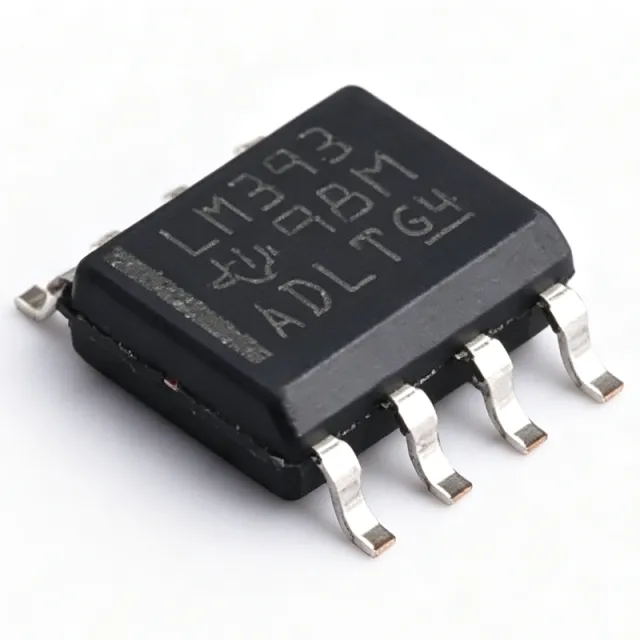
The Texas Instruments LM393DR is a dual differential comparator that integrates two independent, high-gain precision comparators on a single monolithic chip in an 8-pin SOIC surface-mount package. It operates from a single 2V to 36V supply or dual ±1V to ±18V supplies, delivers a typical 1 mV input offset voltage, draws only 0.4 mA per comparator, and provides open-collector outputs that sink up to 20 mA for flexible level shifting and wired-OR configurations. The part is in active lifecycle status and is available from XAIPART stock (99,999 units, MOQ 1) at $0.0545 for single units down to $0.0318 per unit at 1,000 pieces as of 2026-08-30. This pillar guide consolidates selection criteria, design-in best practices, drop-in alternatives, supply insight, and buying outlook into one authoritative resource for engineers and procurement teams.
What Are the Quick Answers Every LM393DR Buyer and Engineer Needs?
The LM393DR belongs to the general-purpose comparator family — a cousin of the operational amplifier optimized for fast saturated switching rather than linear amplification. Within the power-management and signal-conditioning landscape, it sits alongside the LM339 quad comparator and the LM2903 automotive variant. Its defining traits, all verified against the TI datasheet, are:
| Parameter | LM393DR Verified Value |
|---|---|
| Number of comparators | 2 |
| Supply voltage (single) | 2 V to 36 V |
| Supply voltage (dual) | ±1 V to ±18 V |
| Input offset voltage | 1 mV typ / 5 mV max |
| Input bias current | 25 nA typ |
| Supply current | 0.4 mA per comparator typ |
| Response time | 1.3 µs typ |
| Common-mode input range | V- to VCC − 1.5 V |
| Output type | Open-collector, rail-to-rail |
| Output sink current | 20 mA |
| Operating temperature | 0°C to +70°C |
| Package | SOIC-8 (D), surface mount |
| RoHS | Compliant |
Procurement highlights: the part is second-sourced by TI, ROHM Semiconductor, and others under the identical LM393DR ordering code, giving strong supply-chain resilience. Current XAIPART pricing as of 2026-08-30 is $0.0545 (qty 1), $0.0394 (qty 10), $0.0348 (qty 100), $0.0333 (qty 500), and $0.0318 (qty 1,000).
How Do You Select and Design In the LM393DR Correctly?
Step 1: Confirm Supply Architecture
The LM393DR runs from any single supply between 2V and 36V, or dual supplies of ±1V to ±18V. This spans everything from a dying coin cell (2V) to industrial 24V buses with margin. Supply current is approximately 0.4 mA per comparator and does not increase significantly with supply voltage — a rare trait that makes budgeting power in high-voltage designs straightforward.
Step 2: Always Fit Pull-Up Resistors on Both Outputs
The outputs are open-collector: they can only sink current, never drive high. Connect a pull-up resistor (typically 1 kΩ to 100 kΩ) from each output to your desired logic voltage — which may differ from the comparator supply, up to 36V. This enables direct interfacing to 3.3V or 5V MCUs from a 24V-supplied comparator, plus wired-OR fault aggregation.
Step 3: Add Hysteresis to Prevent Oscillation
When a slow-moving input crosses the threshold, the high-gain comparator chatters. Fix this with positive feedback: a high-value resistor (roughly 100 kΩ to 1 MΩ) from output to the non-inverting input creates a few millivolts of deadband. Also keep input leads short and place a 0.1 µF decoupling capacitor close to pin 8.
Step 4: Exploit the Ground-Sensing Input Range
The common-mode input range extends from V- (ground in single-supply operation) up to VCC − 1.5V. Ground-referenced sensor signals connect directly without biasing circuitry — a decisive advantage in low-side current sensing and battery monitoring.
Step 5: Respect the Limits
The 0°C to +70°C rating suits commercial and industrial indoor equipment only; for automotive or outdoor extremes, move to the LM2903IDR (−40°C to +125°C). The 1.3 µs typical response time is ample for 50/60 Hz zero-crossing work but inadequate for nanosecond-class timing.
Verified SOIC-8 Pinout
| Pin | Name | Function |
|---|---|---|
| 1 | OUT1 | Comparator 1 output (open-collector, requires pull-up) |
| 2 | IN1− | Inverting input, comparator 1 |
| 3 | IN1+ | Non-inverting input, comparator 1 |
| 4 | GND / V− | Ground or negative supply |
| 5 | IN2+ | Non-inverting input, comparator 2 |
| 6 | IN2− | Inverting input, comparator 2 |
| 7 | OUT2 | Comparator 2 output (open-collector, requires pull-up) |
| 8 | VCC / V+ | Positive supply, 2V to 36V |
This pinout is common to LM393 second sources from ROHM, onsemi, and STMicroelectronics, enabling true drop-in interchange.
What Are the Best Drop-In Alternatives and How Do They Compare?
Only consider alternatives verified as pin-compatible in SOIC-8. The table below compares the LM393DR with the alternatives in the XAIPART database:
| Part | Key Differentiator (verified) | Compatibility |
|---|---|---|
| LM393DR (TI) | Baseline: 2-36V, 1 mV typ offset, 1.3 µs response, 0°C to +70°C | Reference part |
| LM393BIDR (TI) | Improved B-version: 38V max rating, 0.37 mV offset, 3.5 nA bias, 200 µA/comparator, 1 µs response; drop-in per TI for LM293/LM393/LM2903 | Pin-to-pin, SOIC-8 |
| LM2903IDR (TI) | Automotive/industrial grade, −40°C to +125°C range | Same pinout |
| LM393ADR (TI) | A-version with tighter offset spec, −40°C to +85°C | Same pinout |
| LM393DR2G (onsemi) | Cross-brand second source, same SOIC-8 pinout and 2-36V operation | Pin-to-pin, SOIC-8 |
Selection guidance: choose the LM393BIDR when you need better precision, lower power, and faster switching at the same footprint; choose the LM2903IDR for extended temperature; choose the LM393DR2G for supply diversification. ROHM's own LM393DR is an exact second source of the identical part number. Vs. the LM339 quad: pick the LM393 when only two threshold detectors are needed to save board space and cost; both share open-collector outputs, 2V to 36V range, and ground-sensing inputs. Vs. fast comparators such as the TLV3501: the LM393 wins on cost (under $0.25 at qty 1, per the FAQ data), power (0.4 mA/comparator), and supply range, but loses decisively on speed.
What Is the LM393DR's Market Position, Lifecycle, and Supply Situation?
Lifecycle status is active in the XAIPART database. The bipolar junction-isolated process behind the LM393 has been an industry standard for decades, and multi-vendor second-sourcing (TI, ROHM, onsemi, STMicroelectronics under related order codes) delivers excellent availability and typically short lead times. XAIPART currently stocks 99,999 units with MOQ 1, and live tiered pricing is published as of 2026-08-30. [DATA_NEEDED: lifecycle forecast date, last-order date, and projected EOL from manufacturer PCN data]
What Should Buyers and Designers Watch Next for the LM393DR?
First, the LM393B transition: TI positions the B-version as a drop-in for LM293, LM393, and LM2903 with measurably better specs (0.37 mV offset, 3.5 nA bias, 200 µA/comparator, 1 µs response, 2 kV HBM ESD). New designs should evaluate it at the same footprint. Second, price stability: with five-tier pricing published as of 2026-08-30 and deep stock, buyers can lock volume pricing confidently at the $0.0318 (1k) tier. Third, temperature-grade migration: any design drifting toward automotive or outdoor deployment should pre-qualify the LM2903IDR's −40°C to +125°C range now. Fourth, verify second-source parametrics: minor differences between TI and ROHM versions can exist, so check critical specs against each datasheet. Anchor every decision to the verified numbers: 2-36V supply, 1 mV offset, 0.4 mA/comparator, 1.3 µs response, 20 mA sink — the spec set that has kept this part the economy threshold-detection standard.
Comments
Be the first to comment.
🔐 Please sign in to post a comment.
Don't have an account? Sign up