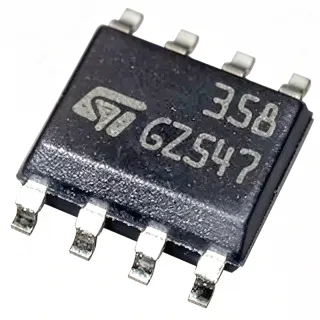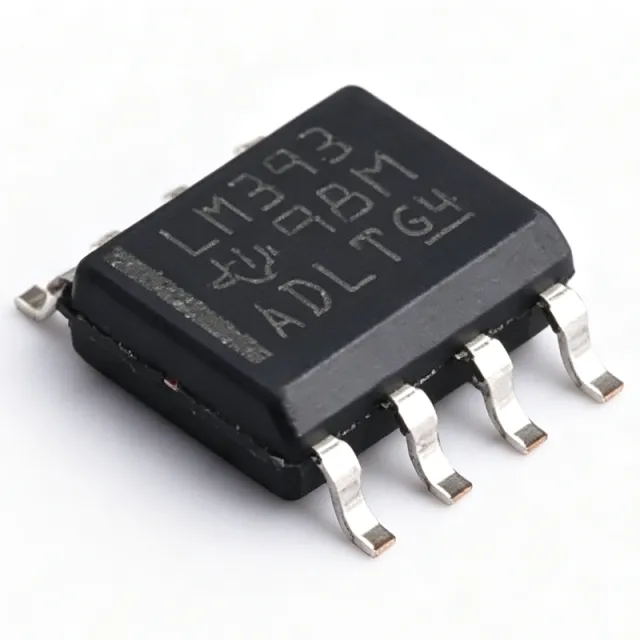
LM393DR - Dual Differential Comparator, 36V, Open-Collector SOIC-8 | Texas Instruments
MPN: LM393DR ✓ Active| Qty | Unit Price | Extended |
|---|---|---|
| 1 | $0.31 | $0.31 |
| 10 | $0.27 | $2.70 |
| 100 | $0.19 | $19.00 |
| 500 | $0.16 | $80.00 |
| 1,000 | $0.13 | $130.00 |
| 2,500 | $0.11 | $275.00 |
LM393DR Overview
A comparator is an analog building block that compares two input voltages and drives its output to indicate which is greater. Within the component taxonomy, the LM393 belongs to the general-purpose voltage comparator family, sitting as a faster-switching cousin of the operational amplifier optimized for saturated logic-level output rather than linear amplification. It belongs to the signal-conditioning and power-management hierarchy, alongside op-amps, voltage references, and supervisors.
Key features include a quiescent supply current of approximately 0.4 mA per comparator that is largely independent of supply voltage, a typical input offset voltage of 1 mV (improved to 0.37 mV on the LM393B revision), and a wide common-mode input range that includes ground (V-), enabling true single-supply ground-sensing. The open-collector output structure allows wired-OR logic and direct interfacing to TTL, CMOS, or any logic family by tying the pull-up to that family's supply rail up to 36V, independent of the comparator's own VCC.
The LM393DR is built on TI's mature junction-isolated bipolar process with a PNP input stage that gives it the low-input-bias-current robustness expected of a decades-old industry workhorse. Multiple second-source manufacturers including ROHM Semiconductor, STMicroelectronics, ON Semiconductor, and Diodes Incorporated produce pin-compatible LM393DR variants, providing true multi-source resilience. The improved LM393B/2903B silicon offers drop-in compatibility with better DC precision and 1 microsecond response time.
Typical applications include voltage-level detection, zero-crossing detectors, relaxation oscillators, window comparators, battery undervoltage/overvoltage monitors, and limit comparators in industrial, automotive, and consumer systems. It is also a staple in switched-mode power supply feedback, sensor threshold detection, and as a building block in PWM and 555-style timer circuits.
Design consideration: every open-collector output requires a pull-up resistor (typically 1 kOhm to 100 kOhm). Add a few millivolts of positive-feedback hysteresis to prevent output chattering when the input signal transitions slowly through the threshold.
Drop-in alternatives for LM393DR — same package, pin-to-pin compatible. Different-package parts requiring PCB rework are excluded.
Variants in this series
Same-series models that are drop-in compatible with LM393DR (same form factor and footprint) — differing in Operating Temperature Range, Output Type, Package.
Quick Comparison Tool — Select alternative parts for side-by-side comparison:
LM393BDR
✅ Drop-In📋 Reference alternative (not in catalog)
LM2903DR
✅ Drop-In📋 Reference alternative (not in catalog)
LM393DR
✅ Drop-In✓ In Stock
$0.11 / Unit
View Datasheet →LM393DT
✅ Drop-In✓ In Stock
$0.0461 / Unit
View Datasheet →LM393DR2G
✅ Drop-In📋 Reference alternative (not in catalog)
LM393DT
✅ Drop-In✓ In Stock
$0.0461 / Unit
View Datasheet →LM393DR Maximum Ratings & Electrical Characteristics
| Manufacturer | Texas Instruments |
| Part Number | LM393DR |
| Function | Dual Differential Comparator |
| Number of Channels | 2 |
| Output Type | Open-Collector |
| Supply Voltage (Single) | 2 V to 36 V |
| Supply Voltage (Dual) | ±1 V to ±18 V |
| Input Offset Voltage (typical) | 1 mV |
| Input Bias Current (typical) | 25 nA |
| Supply Current per Comparator | 0.4 mA (typical) |
| Response Time | 1.3 µs (typical) |
| Common-Mode Input Range | 0 V to VCC − 1.5 V |
| Operating Temperature Range | 0 °C to +70 °C |
| Package | SOIC-8 (D), 3.90 mm body width |
| Mounting Type | Surface Mount |
| ESD Rating (HBM, B-version) | 2 kV |
| RoHS Status | Compliant |
| Lead-Free | Yes |
LM393DR Pin Configuration
| Pin 1 | OUT_A — Open-collector output of comparator A (channel 1) |
| Pin 2 | IN-_A — Inverting input of comparator A |
| Pin 3 | IN+_A — Non-inverting input of comparator A |
| Pin 4 | GND — Negative supply or ground (V-) |
| Pin 5 | IN+_B — Non-inverting input of comparator B |
| Pin 6 | IN-_B — Inverting input of comparator B |
| Pin 7 | OUT_B — Open-collector output of comparator B (channel 2) |
| Pin 8 | VCC — Positive supply, 2 V to 36 V |
Typical Applications
LM393DR is suitable for 6 applications: Battery Voltage Monitor, Zero-Crossing Detector, Relaxation Oscillator, Window Comparator for Sensor Fault Detection, Square-Wave Inverter Feedback, RC Servo Position-to-PWM Converter.
Battery Voltage Monitor
The LM393DR is ideal for single-cell Li-ion or multi-cell lead-acid battery undervoltage/overvoltage protection. Its 2V to 36V supply range covers 1S to 6S battery packs without level translation. The open-collector output drives a logic-low alarm when the sensed voltage falls below the threshold set by an external resistor divider. The ground-sensing input range includes 0V, so the divider low-side can tie directly to the battery negative terminal. With 0.4 mA quiescent current per channel, the monitor adds negligible drain to the battery. Add a few millivolts of hysteresis via positive feedback to prevent alarm chatter as the battery voltage hovers near the threshold during load transients.
Recommended
Zero-Crossing Detector
The LM393DR is widely used in 50/60 Hz mains zero-crossing detection circuits for triac dimming and synchronous motor control. The differential inputs accept a scaled-down AC waveform shifted into the comparator's common-mode range, and the open-collector output produces a clean logic pulse at each mains zero crossing. The 1.3 µs response time is more than adequate for 50/60 Hz applications, and the 36V supply tolerance allows direct connection to rectified 24V rails. A pull-up resistor on the output creates a logic-level signal for a microcontroller's interrupt input, enabling phase-angle control and line-frequency synchronization without optocouplers.
Recommended
Relaxation Oscillator
The LM393DR is the standard comparator for simple astable relaxation oscillators producing square waves from a few Hz to tens of kHz. The classic topology ties the inverting input to a resistor-capacitor charging network, with the non-inverting input connected to a threshold divider. The open-collector output discharges the timing capacitor each cycle, producing a 50% duty cycle square wave (or adjustable with separate charge/discharge paths). Frequency is set by R and C, and the 36V supply allows wide frequency and amplitude ranges. This circuit is the workhorse of simple clock generators, tone generators, and LED flashers in low-cost designs.
Recommended
Window Comparator for Sensor Fault Detection
Two LM393DR channels can be combined into a window comparator that flags when a sensor signal falls outside an acceptable range, providing robust fault detection in industrial systems. The first channel flags under-range by comparing the signal to a low threshold, and the second flags over-range with a high threshold. Their open-collector outputs can be wired-OR together to a single fault line, simplifying the microcontroller interface. The 0V common-mode range allows sensing of ground-referenced signals without biasing. Typical use cases include 4-20 mA loop monitoring, RTD signal validation, and over-temperature/under-temperature alarm generation in HVAC controllers.
Recommended
Square-Wave Inverter Feedback
The LM393DR is used in simple square-wave or modified-square-wave DC-AC inverter feedback paths where it compares the output amplitude against a reference and modulates the switching frequency. Two channels inside one SOIC-8 package can monitor both halves of a push-pull output stage, generating the feedback error signal for a 555-style or microcontroller-based controller. The wide supply range accepts 12V, 24V, and 48V battery bus voltages. The open-collector output interfaces directly to the gate-drive logic without level translation. This topology is common in low-cost solar inverters, UPS systems, and emergency lighting inverters.
Recommended
RC Servo Position-to-PWM Converter
The LM393DR is used in hobby robotics to convert a potentiometer position into a 1-2 ms PWM servo control signal. The first channel reads the potentiometer wiper and compares it against a sawtooth waveform generated by the second channel acting as an astable oscillator. The result is a pulse-width modulated signal whose duty cycle tracks the potentiometer rotation, directly compatible with hobby RC servos and ESCs. The 5V operation is standard, and the SOIC-8 package is easy to hand-solder on perfboard. This is a classic educational circuit found in robotics textbooks and maker tutorials worldwide.
Recommended
Recommended Products Summary
Engineering reference data for LM393DR — comparison, design guidance, and compliance information.
Selection Guide
Comparison with Alternatives
| Parameter | This Product | LM393BDR | LM2903DR | LM393DR (ROHM) | LM393D (ST) | LM393DR2G (onsemi) |
|---|---|---|---|---|---|---|
| Package | SOIC-8 (D) | SOIC-8 (D) - same | SOIC-8 (D) - same | SOIC-8 (D) - same | SOIC-8 (D) - same | SOIC-8 (D) - same |
| Brand | Texas Instruments | Texas Instruments | Texas Instruments | ROHM Semiconductor | STMicroelectronics | onsemi |
| Channels | 2 | 2 | 2 | 2 | 2 | 2 |
| Supply Voltage (max) | 36 V | 38 V | 36 V | 36 V | 36 V | 36 V |
| Input Offset Voltage (max) | 5 mV | 0.37 mV | 5 mV | 5 mV | 5 mV | 5 mV |
| Response Time | 1.3 µs | 1 µs | 1.3 µs | 1.3 µs | 1.3 µs | 1.3 µs |
| Operating Temperature | 0 °C to +70 °C | -40 °C to +85 °C | -40 °C to +125 °C | 0 °C to +70 °C | 0 °C to +70 °C | 0 °C to +70 °C |
| Output Type | Open-Collector | Open-Collector | Open-Collector | Open-Collector | Open-Collector | Open-Collector |
Key Differentiators
- Industry-standard pinout with multiple second sources (vs TLV3201 (TI modern comparator))
- B-version upgrade available with identical footprint (vs LM393BDR (TI same-brand alternative))
- Wide 36V supply directly supports 24V industrial rails (vs TLV3202 (TI push-pull comparator))
Design Notes
Always add an external pull-up resistor on each open-collector output, sized between 1 kΩ (for fast edges and high noise immunity) and 100 kΩ (for low quiescent current). Without a pull-up, the output node floats when the comparator is off, and downstream logic may see a high or low state unpredictably. The pull-up may be tied to a different supply than VCC, up to 36V, which is a unique feature of the LM393 family for level shifting.
Add positive-feedback hysteresis (typically via a 100 kΩ to 10 MΩ resistor from output to non-inverting input) whenever the input signal transitions slowly through the threshold. Without hysteresis, even a few hundred microvolts of input noise around the threshold will cause the output to chatter at MHz rates, increasing supply current, radiating EMI, and possibly damaging downstream counters or logic. Hysteresis of 5-10 mV is usually sufficient for most sensor signals.
Place a 0.1 µF decoupling capacitor as close as possible to the VCC pin (pin 8) of the SOIC-8 package, with a short, low-inductance trace to the ground pin (pin 4). The LM393's internal output stage can draw brief high currents during transitions, and a poorly-decoupled supply can cause the comparator to mis-trigger or oscillate. For dual-supply designs, also add a bulk 1-10 µF electrolytic on each supply rail near the IC.
Do not apply an input voltage that exceeds VCC by more than 0.3V, or falls below ground (V-) by more than 0.3V, even when VCC is off. The LM393 has internal ESD clamp diodes on the inputs that will forward-conduct and may damage the part if driven beyond absolute maximum ratings. If the input signal can exceed these limits, add a series resistor (≥10 kΩ) to limit input current to less than 20 mA.
Compliance Information
LM393DR is commercial grade (0°C to +70°C), RoHS compliant, lead-free, and halogen-free per TI product page. For AEC-Q100 automotive qualification, consider the LM2903-Q1 (industrial temp range) or LM2903B-Q1 variants instead.