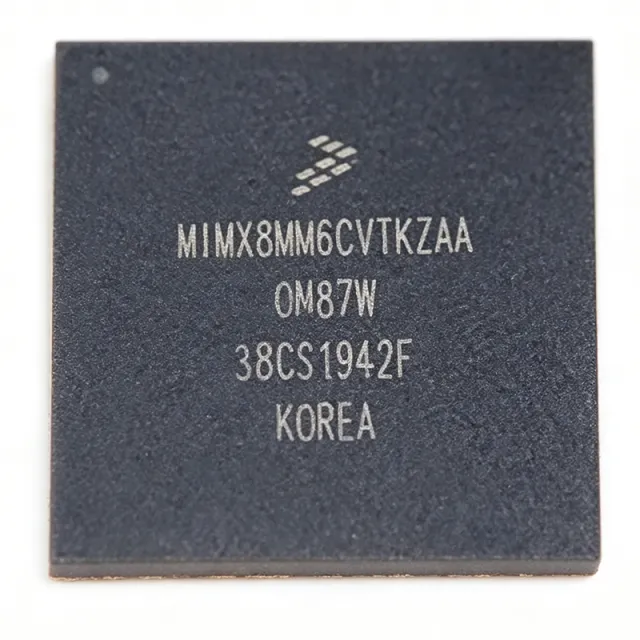
What Is the MIMX8MM6CVTKZAA and Why Do Engineers Choose It?
The MIMX8MM6CVTKZAA is an NXP Semiconductors i.MX 8M Mini applications processor that integrates a quad-core 64-bit ARM Cortex-A53 cluster running at 1.6GHz, a Cortex-M4F real-time co-processor, a 3D GPU (GC NanoUltra), a 2D GPU, and a 4K VPU in a 486-ball LFBGA package measuring 14x14 mm. Built on a 14LPC FinFET process, it supports LPDDR4/DDR4 memory and provides Gigabit Ethernet, USB 3.0, PCIe, and multiple display interfaces with ARM TrustZone secure boot. The part is in active lifecycle status and is available now at XAIPART: 99,999 units in stock, MOQ 1, priced from $24.50 at quantity 1 down to $16.40 at 1,000 units as of 2026-09-04.
As a senior electronics engineer, I classify this SoC as the workhorse of NXP's embedded Linux portfolio. It sits between the lower-power i.MX 6 series and the higher-performance i.MX 8M Quad/Plus, making it the default choice when a design needs multimedia, connectivity, and Linux-class compute without the power budget or cost of a flagship processor.
What Are the Key Specifications of the MIMX8MM6CVTKZAA?
The verified specification set below comes directly from the XAIPART product database and NXP's consumer datasheet.
| Parameter | Value |
|---|---|
| Core Processor | ARM Cortex-A53 (Quad Core, 64-bit) |
| Cores | 4 Core + Cortex-M4F |
| Core Frequency | 1.6 GHz |
| Co-processor | ARM Cortex-M4F |
| Architecture | 64-bit ARM |
| Family | i.MX 8M Mini |
| Process Technology | 14LPC FinFET |
| Package | 486-LFBGA (14x14 mm) |
| Memory Support | LPDDR4 / DDR4 |
| GPU | 3D GPU (GC NanoUltra) + 2D GPU |
| VPU | 4K video encode/decode |
| Interfaces | Gigabit Ethernet, USB 3.0, PCIe, display interfaces |
| Security | ARM TrustZone, secure boot |
| Grade | Consumer |
| Mounting Type | Surface Mount |
| Operating Temperature | [DATA_NEEDED: operating temperature range] |
| Supply Voltage | [DATA_NEEDED: supply voltage] |
Note that this is the consumer-grade variant. For extended industrial temperature requirements, NXP offers the MIMX8MM3CVTKZAA on the identical die and package.
How Do You Design In the MIMX8MM6CVTKZAA? A Practical Technical Guide
Power Sequencing and Decoupling
The 486-ball LFBGA i.MX 8M Mini demands careful power sequencing between its multiple internal rails. [VERIFY_NEEDED: exact rail sequence and voltage rails per rail] — consult NXP's IMX8MMIEC datasheet and hardware development guide for the authoritative power-up order. Place decoupling capacitors close to every power pin pair and maintain a solid ground plane under the package.
PCB Layout for a 14x14 mm LFBGA
The 0.8mm-pitch-class 486-ball BGA requires a multi-layer PCB — typically at least six layers for signal integrity with LPDDR4 at speed. Route LPDDR4 fly-by or point-to-point with matched lengths, and use thermal vias under the die-attach area to spread heat into internal copper planes. The 14x14 mm footprint keeps the SoC viable for compact, sealed enclosures in medical and industrial HMI hardware.
Memory Subsystem Selection
The MIMX8MM6CVTKZAA supports LPDDR4 and DDR4. Choose LPDDR4 for battery-powered or portable designs where low quiescent power matters; choose DDR4 for cost-optimized industrial boards with standard SODIMM-class or discrete DRAM. The LPDDR4 bandwidth is what feeds 4K frame buffers from the VPU and sustains multi-camera streams — size your DRAM configuration accordingly.
Heterogeneous Multicore Partitioning
Partition tasks deliberately between the quad Cortex-A53 cluster and the Cortex-M4F. Run embedded Linux on the A53 cores for application logic, containers, and UI, and offload deterministic real-time work — fieldbus polling, sensor sampling loops, encoder counting, radio timing — to the M4F. This asymmetric architecture is the core design pattern for smart home hubs, IoT gateways, and medical monitoring devices built on this SoC.
Security Design
Enable TrustZone-based secure boot from the first bootloader stage. This satisfies cloud onboarding requirements for IoT gateways and protects OTA firmware updates on always-on consumer hubs. For medical designs, TrustZone supports patient-data encryption at rest.
Thermal Management
The 14LPC FinFET process delivers improved power efficiency versus older planar nodes, enabling sub-watt typical consumption in fanless gateway enclosures [VERIFY_NEEDED: exact thermal design power figure]. For sustained 4K encode/decode workloads, verify junction temperature with your enclosure's thermal resistance and confirm limits against the datasheet.
What Are the Best Drop-in Alternatives to the MIMX8MM6CVTKZAA?
Only same-family NXP parts and the i.MX 8M Nano offer related sourcing paths; there is no cross-brand pin-compatible equivalent — SoCs are inherently non-substitutable across vendors without a PCB redesign.
| Parameter | MIMX8MM6CVTKZAA | MIMX8MM3CVTKZAA | MIMX8MM5CVTKZAA | MIMX8MM4CVTKZAA | MIMX8MM6DVTLZAA | MIMX8MN6CVTIZAA |
|---|---|---|---|---|---|---|
| Family | i.MX 8M Mini | i.MX 8M Mini | i.MX 8M Mini | i.MX 8M Mini | i.MX 8M Mini | i.MX 8M Nano |
| CPU | Quad A53 1.6GHz | Same die, 1.6GHz quad A53 | Lower speed grade (1.3GHz class) | Lower speed / reduced feature tier | Same quad die | Cost-reduced Nano variant |
| Co-processor | Cortex-M4F | Cortex-M4F | Cortex-M4F | Cortex-M4F | Cortex-M4F | Cortex-M7 instead of M4F |
| Package | 486-LFBGA (14x14 mm) | Same 486-LFBGA | Same package and pinout | Same 486-LFBGA pinout | 14x15 FCBGA — PCB rework required | Not pin-compatible |
| Drop-in compatible? | — | Yes, pin-to-pin | Yes | Yes | No | No |
| Best for | Consumer grade, cost-sensitive multimedia designs | Extended industrial temperature | Cost savings with less CPU headroom | Reduced feature tier | Designs already on 14x15 footprint | Headless cost-reduced IoT |
Bottom line: the MIMX8MM3CVTKZAA is the best drop-in replacement — same die, same 1.6GHz performance, same 486-LFBGA footprint, and identical software stack, with industrial qualification. The MIMX8MM5CVTKZAA and MIMX8MM4CVTKZAA drop in with reduced frequency. The MIMX8MM6DVTLZAA requires PCB rework; the MIMX8MN6CVTIZAA (Nano) is a cost-reduced path with reduced GPU/VPU and an M7 co-processor, not pin-compatible.
What Is the Market Position, Lifecycle Status, and Supply Situation of the MIMX8MM6CVTKZAA?
The MIMX8MM6CVTKZAA carries an active lifecycle status per NXP product information. Supply is healthy across multiple channels: icDirectory reported 35,950 pieces in stock updated Feb 09, 2026, DigiKey offers same-day shipping on stocked units as of 2026-08-29, and Octopart aggregates pricing from 9 distributors. XAIPART itself lists 99,999 units in stock with MOQ 1 as of 2026-09-04. Volume lead times should be confirmed directly with NXP or authorized distributors. [DATA_NEEDED: NXP official lifecycle/longevity commitment date for the i.MX 8M Mini family]
What Should Buyers Watch: Trends and Outlook for the i.MX 8M Mini Platform
- Tier pricing leverage: at $24.50 (qty 1), $22.30 (qty 10), $19.80 (qty 100), $17.90 (qty 500), and $16.40 (qty 1,000) as of 2026-09-04, the unit cost drops 33% from single-unit to 1k volume — plan procurement batches to hit the 500 and 1,000-unit tiers.
- Grade selection early: because the consumer-grade CVTKZAA and industrial-grade MIMX8MM3CVTKZAA share the same footprint and software, decide your temperature grade before layout freeze — the industrial variant is typically more expensive, so only pay for it if your environment demands it.
- AI upgrade path: for entry-level edge AI, quantized TensorFlow Lite models run realistically at several frames per second on the quad 1.6GHz Cortex-A53. When workloads grow, the same software stack migrates to the i.MX 8M Plus with its integrated NPU — preserve that migration option in your architecture.
- VPU-first media designs: the 4K hardware encode/decode frees all four A53 cores for application logic — never budget software codecs on this class of design; the VPU path dramatically cuts power in always-on signage deployments.
- Footprint discipline: avoid the MIMX8MM6DVTLZAA (14x15 FCBGA) unless your layout already uses that footprint; standardizing on the 14x14 mm 486-LFBGA keeps MIMX8MM3/4/5/6 all interchangeable.
Frequently Asked Questions
Full FAQ coverage appears in the structured FAQ section of this article, covering pricing, sourcing, datasheet download, drop-in replacements, industrial suitability, and edge AI capability — all answered with verified database values.
Comments
Be the first to comment.
🔐 Please sign in to post a comment.
Don't have an account? Sign up