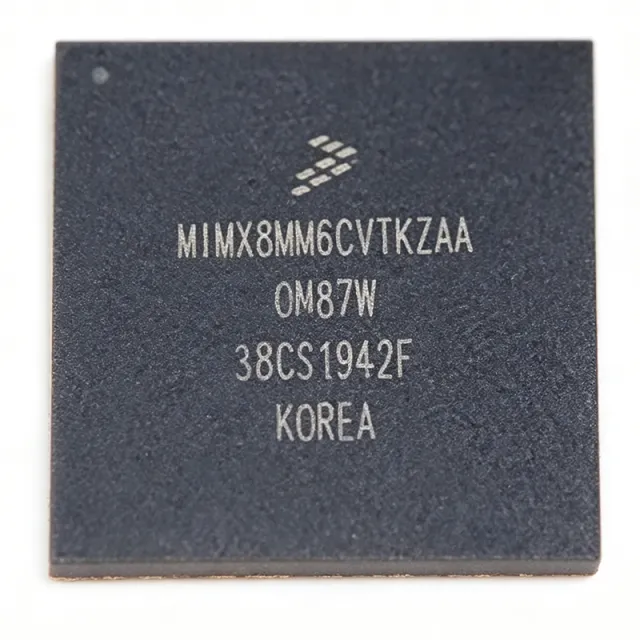
MIMX8MM6CVTKZAA - i.MX8MM Quad A53 1.6GHz SoC | NXP
MPN: MIMX8MM6CVTKZAA ✓ Active| Qty | Unit Price | Extended |
|---|---|---|
| 1 | $24.5 | $24.50 |
| 10 | $22.3 | $223.00 |
| 100 | $19.8 | $1,980.00 |
| 500 | $17.9 | $8,950.00 |
| 1,000 | $16.4 | $16,400.00 |
MIMX8MM6CVTKZAA Overview
An applications processor is a system-on-chip (SoC) designed to run operating systems such as embedded Linux and complex application software on ARM architecture. It integrates CPU cores, memory controllers, graphics, and I/O interfaces, serving as the main processing unit in smart home hubs, IoT gateways, and industrial control systems. The i.MX 8M Mini sits between the lower-power i.MX 6 series and the higher-performance i.MX 8M Quad/Plus in the embedded processor hierarchy.
Key features include the 64-bit quad-core Cortex-A53 cluster at 1.6GHz, a Cortex-M4F core for low-latency deterministic control, a 3D GPU (GC NanoUltra), a 2D GPU, and a 4K VPU for video encode/decode. Memory support covers LPDDR4/DDR4, and connectivity includes Gigabit Ethernet, USB 3.0, PCIe, and multiple display interfaces.
Technically, the 14LPC FinFET process delivers improved power efficiency versus older planar nodes. The heterogeneous multicore architecture partitions tasks between the A53 cluster and the M4F core, enabling efficient power management. TrustZone support provides secure boot and secure execution for secure IoT deployments.
Typical applications include smart home hubs, IoT gateways, industrial HMI, medical devices, and multimedia streaming devices, where combined CPU, GPU, VPU, and connectivity resources suit edge computing and AI inference.
Design tip: pay careful attention to power sequencing and thermal management. The 486-ball LFBGA requires a multi-layer PCB with thermal vias and a solid ground plane, plus proper decoupling capacitors near power pins for stable operation.
Drop-in alternatives for MIMX8MM6CVTKZAA — same package, pin-to-pin compatible. Different-package parts requiring PCB rework are excluded.
Quick Comparison Tool — Select alternative parts for side-by-side comparison:
MIMX8MM3CVTKZAA
📋 Reference alternative (not in catalog)
MIMX8MM5CVTKZAA
📋 Reference alternative (not in catalog)
MIMX8MM4CVTKZAA
📋 Reference alternative (not in catalog)
MIMX8MM6DVTLZAA
📋 Reference alternative (not in catalog)
MIMX8MN6CVTIZAA
📋 Reference alternative (not in catalog)
MIMX8MM6CVTKZAA Maximum Ratings & Electrical Characteristics
| Core Processor | ARM Cortex-A53 (Quad Core, 64-bit) |
| Cores | 4 Core + Cortex-M4F |
| Core Frequency | 1.6 GHz |
| Co-processor | ARM Cortex-M4F |
| Architecture | 64-bit ARM |
| Family | i.MX 8M Mini |
| Process Technology | 14LPC FinFET |
| Package | 486-LFBGA (14x14 mm) |
| Memory Support | LPDDR4 / DDR4 |
| GPU | 3D GPU (GC NanoUltra) + 2D GPU |
| VPU | 4K video encode/decode |
| Interfaces | Gigabit Ethernet, USB 3.0, PCIe, display interfaces |
| Security | ARM TrustZone, secure boot |
| Grade | Consumer |
| Mounting Type | Surface Mount |
MIMX8MM6CVTKZAA 486-lfbga (14x14 mm) Pin Configuration Guide
Pin configuration for MIMX8MM6CVTKZAA (486-lfbga (14x14 mm) package). This digital IC includes GPIO, communication interfaces (UART, SPI, I2C), and power pins. Refer to the manufacturer datasheet for alternate pin functions and configuration options. Essential for embedded system design and PCB layout.

No detailed pinout data available for MIMX8MM6CVTKZAA.
Refer to the datasheet for full pin configuration.
Typical Applications
MIMX8MM6CVTKZAA is suitable for 6 applications: Smart Home Hubs, IoT Edge Gateways, Industrial HMI Panels, Medical Monitoring Devices, Multimedia Streaming Devices, Edge AI Vision Systems.
Smart Home Hubs
The MIMX8MM6CVTKZAA fits smart home hubs because its quad Cortex-A53 cluster at 1.6GHz comfortably runs embedded Linux with multiple wireless protocol stacks and a local UI, while the Cortex-M4F manages Zigbee/Z-Wave radio timing with deterministic latency. The GC NanoUltra 3D GPU drives wall-panel touchscreens, and LPDDR4 bandwidth supports multi-camera doorbell streams. Placed on a 486-LFBGA board with 2GB LPDDR4, the 14LPC FinFET process keeps typical power low enough for always-on fanless enclosures, and TrustZone secure boot protects OTA firmware updates.
Recommended
IoT Edge Gateways
For IoT gateways aggregating Modbus, CAN, and Ethernet field devices to the cloud, the MIMX8MM6CVTKZAA offers the right balance: 1.6GHz quad A53 cores run containers and protocol translation, the M4F services time-critical fieldbus polling, and Gigabit Ethernet plus PCIe allow adding 5G or Wi-Fi modules. The 4K VPU is unnecessary overhead in many gateways but the FinFET efficiency yields sub-watt typical consumption for fanless DIN-rail enclosures. TrustZone-based secure boot and key storage satisfy cloud onboarding security requirements, and the same footprint scales to Nano or Plus variants as cost or AI needs change.
Recommended
Industrial HMI Panels
Industrial human-machine interface panels benefit from the MIMX8MM6CVTKZAA's combination of GPU-accelerated graphics and industrial connectivity. The GC NanoUltra renders Qt-based dashboards on 7-15 inch touch displays via the processor display interfaces, while the quad A53 cluster runs Linux with real-time patches and the M4F drives PWM, encoder counting, and safety interlock monitoring. At 1.6GHz with LPDDR4, boot-to-UI times under 5 seconds are achievable. For extended-temperature factory floors, engineers can drop in the industrial-grade MIMX8MM3CVTKZAA on the identical 486-LFBGA footprint without any PCB or software redesign.
Recommended
Medical Monitoring Devices
Portable and bedside medical monitoring devices use the MIMX8MM6CVTKZAA for its mix of compute, graphics, and low power. The 1.6GHz quad Cortex-A53 runs data acquisition, filtering, and trending algorithms, while the Cortex-M4F handles real-time sampling loops with deterministic jitter - critical for ECG and SpO2 waveform integrity. The GPU renders patient-facing UIs, and the low FinFET quiescent power extends battery runtime in portable designs. TrustZone supports patient-data encryption at rest, and the 14x14 mm BGA enables compact, sealed enclosures required for disinfectable clinical hardware.
Recommended
Multimedia Streaming Devices
The MIMX8MM6CVTKZAA is purpose-built for streaming media endpoints: its 4K VPU hardware-encodes and decodes H.264/H.265 streams without loading the CPU cores, freeing the quad A53 cluster for network stacks and application logic. The GC NanoUltra GPU composites UI overlays onto video planes, and USB 3.0 plus Gigabit Ethernet sustain the bandwidth needed for high-bitrate content. LPDDR4 memory interfaces provide the throughput for frame buffers at 4K resolutions. Compared with software codecs on general MCUs, the VPU path cuts power dramatically, extending life in always-on commercial display and digital-signage deployments.
Recommended
Edge AI Vision Systems
Entry-level edge AI vision nodes use the MIMX8MM6CVTKZAA to run quantized TensorFlow Lite models on the 1.6GHz quad Cortex-A53 cluster - object detection at several frames per second is realistic for lightweight models. The Cortex-M4F pre-processes sensor streams and manages camera triggers with deterministic timing, while LPDDR4 bandwidth feeds frame buffers from parallel or MIPI camera interfaces. The VPU handles H.265 recording of detection events locally. For heavier CNN workloads, the same software stack migrates up to the i.MX 8M Plus with its integrated NPU, preserving much of the application investment.
Recommended
Recommended Products Summary
Engineering reference data for MIMX8MM6CVTKZAA — comparison, design guidance, and compliance information.
Selection Guide
Comparison with Alternatives
| Parameter | This Product | MIMX8MM3CVTKZAA | MIMX8MM5CVTKZAA | MIMX8MM6DVTLZAA |
|---|---|---|---|---|
| Package | 486-LFBGA (14x14 mm) | 486-LFBGA (14x14 mm) - same | 486-LFBGA (14x14 mm) - same | FCBGA (14x15 mm) - different footprint |
| Brand | NXP Semiconductors | NXP Semiconductors | NXP Semiconductors | NXP Semiconductors |
| CPU Cores | Quad Cortex-A53 64-bit + Cortex-M4F | Quad Cortex-A53 + Cortex-M4F | Quad Cortex-A53 + Cortex-M4F | Quad Cortex-A53 + Cortex-M4F |
| Core Frequency | 1.6 GHz | 1.6 GHz | 1.3 GHz class | 1.8 GHz class |
| Temperature Grade | Consumer | Industrial | Consumer | Consumer |
| Drop-in Compatible | - | Yes - pin-to-pin | Yes - pin-to-pin | No - PCB rework required |
| Process Technology | 14LPC FinFET | 14LPC FinFET | 14LPC FinFET | 14LPC FinFET |
| Lifecycle Status | Active | Active | Active | Active |
Key Differentiators
- Industrial temperature option on identical silicon (vs MIMX8MM3CVTKZAA)
- Highest performance consumer speed grade in 486-LFBGA (vs MIMX8MM5CVTKZAA)
- 14LPC FinFET power efficiency (vs older planar-node i.MX 6 series)
Design Notes
The i.MX 8M Mini requires multiple rails (VDD_ARM, VDD_SOC, VDD_GPU, DRAM rails) with strict power-up sequencing. Use a dedicated PMIC such as NXP's PF8100/PF8201 family or verify any discrete solution against the datasheet sequencing tables. Improper sequencing can prevent boot or damage the 14LPC FinFET die. Include adequate bulk and ceramic decoupling at each ball-side supply group.
The 486-LFBGA 14x14 mm package dissipates heat through the PCB. Design a multi-layer stack (minimum 6 layers recommended) with a solid ground plane and an array of thermal vias under the package spreading into internal copper planes. For sustained 1.6GHz A53 workloads, verify junction temperature in the worst-case ambient; a top-side heatsink or thermal pad may be needed in sealed enclosures.
High-speed interfaces (LPDDR4 at multi-hundred-MT/s, USB 3.0, PCIe, Gigabit Ethernet) demand careful routing: length-match LPDDR4 byte lanes within datasheet tolerances, maintain 90-ohm differential pairs for USB 3.0 and PCIe, and reference them to continuous ground planes. Follow NXP's i.MX 8M Mini hardware design guide for via transitions and stackup recommendations.
Compliance Information
NXP active product; RoHS compliance per NXP standard environmental program. Obtain certificate of conformance from NXP product page for specific date codes.







