Quick Answers
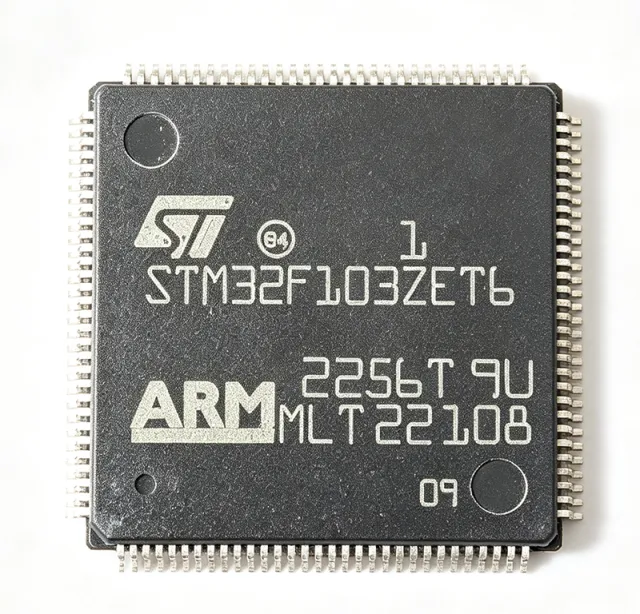
The STM32F103ZET6 is a high-performance 32-bit microcontroller from STMicroelectronics built around the ARM Cortex-M3 core. It operates at up to 72 MHz, integrates 512 KB of Flash memory and 64 KB of SRAM, and comes in a 144-pin LQFP package with 112 GPIOs. The device is currently in active lifecycle status, with 99,999 units in stock on XAIPART and a base price of $5.4848 at volume quantities (as of 2026-08-21). The MCU includes three 12-bit ADCs (21 channels), two 12-bit DACs, 12 DMA channels, and rich communication interfaces such as 5x USART, 3x SPI, 2x I2C, 1x CAN, USB 2.0 Full-Speed, and SDIO. This guide covers selection, design-in advice, verified alternatives, and market outlook for buyers and engineers.
Technical Guide: How to Select, Design In, and Use the STM32F103ZET6
Selecting the STM32F103ZET6 starts with three verified questions: Do you need the LQFP144 form factor? Do you require 512 KB of Flash and 64 KB of SRAM? And do your peripherals align with the available interfaces? The device offers 112 GPIOs, 21 ADC channels across three 12-bit ADCs, two 12-bit DACs, and 12 DMA channels. That combination supports complex real-time firmware for motor control, industrial automation, medical devices, consumer electronics, IoT gateways, test equipment, and automotive aftermarket products.
Power supply design
Supply voltage is 2.0 V to 3.6 V. The product description recommends placing a 100 nF capacitor close to each VDD pin and adding a bulk capacitor. The VDDA pin should be filtered with a ferrite bead and a capacitor to reduce analog noise. Separate VSS and VDD pins are distributed across the LQFP144 body, and multiple ground pins are available for stable current return.
Clock and oscillator layout
For HSE and LSE crystals, keep the oscillator traces short and isolated from switching signals. The verified pinout shows PF0/PF1 can carry OSC_IN/OSC_OUT, and PC14/PC15 can carry OSC32_IN/OSC32_OUT. Also, PD0/PD1 can serve as an oscillator function in some configurations. Careful layout minimizes EMI and ensures stable clocking, which is critical for the USB 2.0 Full-Speed interface and precision timing peripherals.
Boot and debug
The part can boot from Flash, system memory, or SRAM. Debugging is available through JTAG and Serial Wire Debug (SWD). The verified pinout exposes SWDIO on PA13 and SWCLK on PA14, plus JTAG pins on PA15, PB3, and PB4. Keep the debug interface accessible on production boards for firmware updates and field diagnostics.
Peripheral mapping and practical design notes
- Use advanced-control timers (TIM1/TIM8) with PWM dead-time insertion for motor control.
- Use the 12-bit ADC channels for current and voltage sensing; the 21-channel capacity covers multi-sensor systems.
- Use DMA channels for efficient peripheral-to-memory transfers without CPU loading.
- Use CAN, USART, SPI, I2C, and USB to connect to industrial networks, sensors, and hosts.
- Use the 112 GPIOs for user interfaces, memory-mapped devices, and parallel buses.
Because the STM32F103ZET6 is RoHS compliant, the part can be used in lead-free assembly flows.
Alternatives & Comparison: Drop-In Replacements
Engineers often want a second source or a variant with a different temperature range or packaging. The verified database lists these drop-in alternatives:
| Parameter | STM32F103ZET6 | STM32F103ZET7 | STM32F103ZET6TR | STM32F103ZET6Q | GD32F103ZET6 | APM32F103ZET6 |
|---|---|---|---|---|---|---|
| Manufacturer | STMicroelectronics | STMicroelectronics | STMicroelectronics | STMicroelectronics | GigaDevice | Cross-brand |
| Core | ARM Cortex-M3 | ARM Cortex-M3 | ARM Cortex-M3 | ARM Cortex-M3 | Cortex-M3 compatible | Cortex-M3 compatible |
| Package / Pin count | LQFP144 / 144 | LQFP144 / 144 | LQFP144 / 144 | LQFP144 / 144 | LQFP144 / 144 | LQFP144 / 144 |
| Flash / SRAM | 512 KB / 64 KB | 512 KB / 64 KB | 512 KB / 64 KB | 512 KB / 64 KB | Not in verified data | Not in verified data |
| Temperature range | -40C to +85C | -40C to +105C | Same die, tape/reel variant | -40C to +105C | Not in verified data | Not in verified data |
| Key differentiator | Baseline part | Extended temperature | Automated assembly option | Extended temperature | Pin-compatible second source | Pin-compatible second source |
For a true drop-in footprint, the ZET7, ZET6TR, ZET6Q, GD32F103ZET6, and APM32F103ZET6 all share the LQFP144 package/pinout. The ZET7 and ZET6Q extend the temperature range to -40C to +105C. The ZET6TR is the same die in tape-and-reel form. GD32 and APM32 offer cross-brand second sourcing, but you should verify firmware, ADC calibration, and timing behavior before production.
Industry Insight: Market Position, Lifecycle, and Supply
According to the XAIPART verified product database, the STM32F103ZET6 has an active lifecycle status. Current stock on XAIPART is 99,999 units, with a minimum order quantity of 1. The verified base price is $5.4848 at 1,080+ pieces as of 2026-08-21. The broader pricing ladder runs from $9.5455 at 1 unit down to $5.4848 at 1,080 units. This suggests a mature, widely stocked high-density STM32F103 part.
Detailed market-share percentages and specific inventory histories of distributors are not included in the verified data. However, the active lifecycle status combined with 99,999 units of available stock signals a healthy supply situation. The tape-and-reel variant (STM32F103ZET6TR) and extended-temperature variants (ZET7/ZET6Q) indicate that the platform is kept current for industrial and high-volume manufacturing.
Trends & Outlook: What Buyers Should Watch
The verified feature set points to continuing demand for high-density Cortex-M3 MCUs. Buyers should monitor three areas: extended-temperature variants, second-source availability, and volume pricing.
First, the STM32F103ZET7 and STM32F103ZET6Q extend the temperature range to -40C to +105C. If your end equipment must operate in hotter environments, these variants provide a same-package fallback.
Second, pin-compatible alternatives like GD32F103ZET6 and APM32F103ZET6 can be qualified as second sources. Because they share the LQFP144 pinout, you can maintain PCB layout while comparing firmware behavior and ADC accuracy.
Third, volume pricing becomes attractive at higher quantities. The price tiers drop from $9.5455 at 1 unit to $5.4848 at 1,080 units. Engineers planning production runs should evaluate procurement at the 360/720/1080-piece tiers.
Finally, the STM32F103 family remains an embedded workhorse. With 512 KB of Flash, 64 KB of SRAM, and 12-channel DMA, the STM32F103ZET6 can handle protocol stacks, control loops, and user interfaces without needing an external memory bus in many designs.
Comments
Be the first to comment.
🔐 Please sign in to post a comment.
Don't have an account? Sign up