The STM32F427VIT6 from STMicroelectronics is a high-performance 32-bit microcontroller built around an ARM Cortex-M4 core with floating-point unit (FPU). It runs at up to 180 MHz, delivering 225 DMIPS and 3.92 CoreMark/MHz, and integrates 2 MB of flash memory and 256 KB of SRAM on a single chip. The device is housed in an LQFP-100 package with 82 I/O pins, operates from a 1.8V to 3.6V supply across -40°C to +85°C, and carries RoHS compliance. Peripherals include 3x 12-bit ADCs at 2.4 MSPS, 2x 12-bit DACs, 14 timers, 6 USARTs, 4 SPIs, 3 I2Cs, 2 CANs, USB OTG FS/HS, an Ethernet MAC, a Chrom-ART graphics accelerator, and a cryptographic cell supporting AES, DES, 3DES, SHA-1, SHA-256, and MD5. The part is active in lifecycle status and in stock at XAIPART with 99,999 units, MOQ 1, priced from $11.1818 (qty 1) down to $6.5227 (qty 1000) as of 2026-08-30.
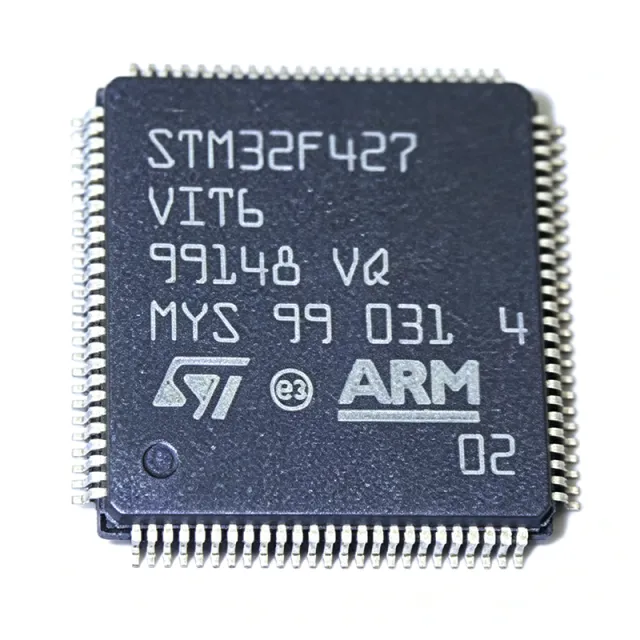
What Is the STM32F427VIT6 and Why Do Engineers Choose It?
The STM32F427VIT6 belongs to STMicroelectronics' STM32F4 series within the ARM Cortex-M family, a line known for balancing performance, power efficiency, and rich peripheral integration. As a high-end member of that series, it targets embedded systems that need real-time processing plus connectivity: industrial control, motor drives, medical devices, consumer electronics, and IoT gateways.
A microcontroller combines a processor core, flash and SRAM memory, and programmable I/O peripherals on a single chip. What distinguishes the F427VIT6 is the combination of DSP-friendly Cortex-M4 math (single-precision FPU plus DSP instructions), generous on-chip memory, and hardware acceleration blocks. The Chrom-ART Accelerator offloads graphics rendering from the CPU, while the cryptographic acceleration cell handles AES, DES, 3DES, SHA-1, SHA-256, and MD5 in hardware — critical for secure IoT communication without burning CPU cycles. A memory protection unit (MPU) adds system reliability for safety-conscious designs. The die is manufactured on a 90 nm process, balancing performance against power consumption.
| Parameter | STM32F427VIT6 (verified) |
|---|---|
| Core | ARM Cortex-M4 with FPU |
| Max Clock Speed | 180 MHz (225 DMIPS, 3.92 CoreMark/MHz) |
| Flash Memory | 2 MB |
| SRAM | 256 KB |
| Supply Voltage | 1.8V to 3.6V |
| Operating Temperature | -40°C to +85°C |
| Package | LQFP-100, 82 I/Os |
| ADC | 3x 12-bit, 2.4 MSPS |
| DAC | 2x 12-bit |
| Timers | 12x 16-bit, 2x 32-bit |
| Communication | 6x USART, 4x SPI, 3x I2C, 2x CAN, USB OTG FS/HS, Ethernet MAC |
| DMA | 2x DMA controllers, 16 streams each |
| Crypto Acceleration | AES, DES, 3DES, SHA-1, SHA-256, MD5 |
| RoHS | Compliant |
How Do You Design In the STM32F427VIT6? A Practical Technical Guide
Designing with the STM32F427VIT6 starts with power and analog cleanliness, then moves to memory, clocking, and peripheral allocation.
Power Supply and Decoupling
The MCU operates from 1.8V to 3.6V, which supports both regulated 3.3V rails and battery-powered designs. Decouple every VDD pin with 100 nF capacitors placed as close as possible to each pin — the LQFP-100 has multiple VDD/VSS pairs (for example pins 11/12, 23/24, 49/50, 73/74, 95/96 in the verified pinout). Filter VDDA (pin 34) with a ferrite bead and a 1 µF capacitor to keep analog noise out of the ADC and DAC supplies. VSSA (pin 32) and VREF+ (pin 33) should connect to a clean analog ground and reference. For high clock speeds and heavy peripheral use, provide adequate PCB copper area under the LQFP-100 for heat dissipation.
Debug, Boot, and Clocking
Serial debug uses SWDIO (pin 72) and SWCLK (pin 75). The boot configuration uses BOOT1, shared with PB2 (pin 37). The main crystal connects to PH0/OSC_IN (pin 25) and PH1/OSC_OUT (pin 26), while the 32.768 kHz RTC crystal uses PC14/OSC32_IN (pin 3) and PC15/OSC32_OUT (pin 4). Backup power for the RTC enters via VBAT (pin 1).
Peripheral Allocation Examples
Typical mappings from the verified pinout: USB OTG FS on PA11/PA12 (DM/DP, pins 70–71) with VBUS on PA9 (pin 68); CAN1 on PD0/PD1 (RX/TX, pins 80–81); I2C2 on PB10/PB11 (pins 47–48); SPI2 on PB12–PB15 (pins 51–54); USART3 on PD8/PD9 (pins 55–56); and I2S2 audio on PC6–PC9 (pins 63–66). Analog inputs such as PC0–PC3 (pins 28–31) route to the 12-bit ADCs for current or biosignal sensing.
Memory and Graphics Strategy
The 2 MB flash accommodates complex firmware including graphics libraries and communication stacks without external memory. For larger GUI frame buffers beyond the 256 KB SRAM, plan for external SDRAM — especially when using the Chrom-ART Accelerator for smooth display updates.
Which Applications Benefit Most From the STM32F427VIT6?
The verified application data highlights six strong use cases, each anchored to specific silicon features.
Industrial motor control: The Cortex-M4 FPU accelerates field-oriented control (FOC) while the 2.4 MSPS ADCs enable precise phase-current sensing. Advanced timers generate PWM with dead-time insertion for the inverter stage. The result is higher control-loop rates and better dynamic response — improved motor efficiency and reduced torque ripple versus lower-end MCUs. Isolate and filter analog signals to preserve ADC accuracy.
IoT gateway: The Ethernet MAC, USB OTG, and six USARTs handle concurrent connectivity. Hardware AES/SHA acceleration supports TLS without CPU degradation, and the 2 MB flash stores protocol stacks plus firmware updates. Use an external PHY (such as the LAN8720A referenced in the datasheet FAQ) for Ethernet and apply careful antenna layout for wireless modules.
Medical monitoring: Real-time ECG/EEG/SpO2 signal processing benefits from multiple ADC/DAC channels and the FPU's digital-filtering throughput, while the MPU and cryptographic cell support data security. Designs must address patient-safety isolation and applicable medical compliance requirements. [VERIFY_NEEDED: specific medical standard compliance claims beyond what the application data lists]
Audio processing: I2S interfaces connect to audio codecs; dual DMA controllers stream samples without CPU intervention. The FPU runs FIR filters, FFTs, and codecs in real time at low latency. Maintain separate analog ground planes and use high-quality codecs.
HMI and graphics: Chrom-ART offloads rendering so GUI frameworks such as TouchGFX or emWin run smoothly; 2 MB flash stores assets, with external SDRAM recommended for large frame buffers.
Robotics: Sensor fusion (e.g., Kalman filtering) and multi-motor PWM control exploit the FPU, 14 timers, and multiple SPI/I2C buses; an RTOS is recommended for task scheduling.
What Are the Best Drop-In Alternatives to the STM32F427VIT6?
The strongest replacements come from the same STM32F4 family, which shares the LQFP-100 footprint and pinout. Cross-brand options exist but require PCB changes.
| Alternative | Relationship to STM32F427VIT6 | Drop-In? | Key Consideration |
|---|---|---|---|
| STM32F427VIT6TR | Same silicon, tape-and-reel packaging | Yes | Identical electrically; choose TR for automated assembly |
| STM32F427VIT7 | Extended temperature range -40°C to +105°C | Yes | Use for harsher thermal environments |
| STM32F429VIT6 | Adds TFT-LCD controller, same core and memory | Yes | Better for direct-display designs |
| STM32F427VGT6 | Same core, 1 MB flash, 192 KB SRAM | Yes | Lower memory; cost-optimized builds |
| LPC4370FBD208 (NXP) | Cross-brand, 204 MHz Cortex-M4 | No | Different package and pinout; PCB redesign required |
| R7S721020VCBG (Renesas) | Cross-brand, 400 MHz Cortex-A9 | No | Different architecture and package |
The STM32F407VGT6 is also pin-compatible in LQFP-100, but offers lower specs: 168 MHz clock (vs 180 MHz), 1 MB flash (vs 2 MB), and 192 KB SRAM (vs 256 KB). It is a valid drop-in only if your firmware fits in 1 MB and does not need the Chrom-ART accelerator or hardware cryptography. Conversely, choose the F427 over the F407 when you need the higher clock, more memory, cryptographic acceleration, or graphics offload.
What Is the Market, Lifecycle, and Supply Situation for the STM32F427VIT6?
The STM32F427VIT6 carries an active lifecycle status, meaning STMicroelectronics continues to manufacture it and it is not approaching discontinuation. On the supply side, XAIPART currently lists 99,999 units in stock with MOQ 1, so single-piece prototype orders through volume production runs can ship immediately from inventory. Pricing is tiered and verified as of 2026-08-30: $11.1818 at qty 1, $8.0758 at qty 10, $7.1439 at qty 100, $6.8333 at qty 500, and $6.5227 at qty 1000. For broader market-share data, formal lifecycle forecasts, and second-source lead times across other distributors, see [DATA_NEEDED: third-party market share and distributor lead-time data].
What Should Buyers Watch Next? Trends and Outlook
Three trends anchor directly to this part's verified capabilities. First, secure connectivity: the on-chip AES/SHA cryptographic cell positions the F427VIT6 well for TLS-secured IoT gateways, a demand segment the application data explicitly identifies — buyers should confirm their security requirements map to the supported algorithms (AES, DES, 3DES, SHA-1, SHA-256, MD5). Second, graphics-rich HMI: the Chrom-ART Accelerator and 2 MB flash keep this part relevant for industrial panels; if your roadmap needs an integrated TFT-LCD controller, the pin-compatible STM32F429VIT6 is the natural upgrade path within the same footprint. Third, thermal headroom: designs moving toward harsher environments can migrate to the STM32F427VIT7 with its -40°C to +105°C range without a PCB change. On purchasing, the tiered price curve is meaningful — the per-unit price drops from $11.1818 at qty 1 to $6.5227 at qty 1000 (a ~42% reduction), so consolidating orders captures real savings. With 99,999 units in stock as of 2026-08-30, availability risk is currently low, but design-in teams building long-lifetime industrial products should still qualify the active-lifecycle status and reel-packaged TR variant for automated assembly lines.
Ready to source? Visit the STM32F427VIT6 product page on XAIPART for real-time stock and pricing, browse our microcontrollers category for the full STM32F4 family, and read our STM32 MCU selection guide to compare series options.
Comments
Be the first to comment.
🔐 Please sign in to post a comment.
Don't have an account? Sign up