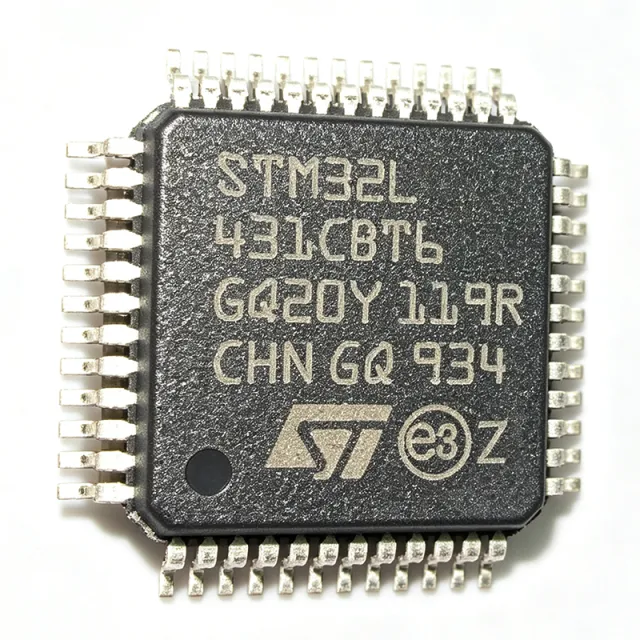
Quick Answers: What Is the STM32G431CBT6 and Is It Available Now?
The STM32G431CBT6 is a 32-bit microcontroller from STMicroelectronics based on an Arm Cortex-M4F core with FPU that runs at up to 170 MHz. It provides 128 KB of Flash memory and 32 KB of SRAM, is housed in a 48-pin LQFP (7x7 mm) package, and operates from 1.71 V to 3.6 V. The device is in active lifecycle status; XAIPART lists 99,999 units in stock with MOQ 1, and the 1,000-piece price is $3.9773 as of 2026-08-21.
Key features verified in the XAIPART database:
- Core: Arm Cortex-M4F with FPU and DSP instructions at 170 MHz.
- Memory: 128 KB Flash, 32 KB SRAM.
- Package: LQFP-48 (7x7 mm), 36 GPIO pins.
- Analog: 12-bit ADC with hardware oversampling up to 16-bit, two 12-bit DACs, op-amps, comparators.
- Timers: 10 timers including high-resolution timer (HRTIM) with 184 ps resolution.
- Connectivity: SPI, I2C, USART, CAN FD.
- Power and temperature: 1.71 V to 3.6 V supply, -40C to +85C operating range.
This comprehensive guide covers specification, design-in, drop-in alternatives, industry status, and market outlook. See the STM32G431CBT6 product page for the complete datasheet and stock information.
Technical Guide: How to Select, Design In, and Use the STM32G431CBT6
Selection Checklist
Select the STM32G431CBT6 when your application needs a balance of compute, memory, and analog integration. The 170 MHz Arm Cortex-M4F with FPU and DSP instructions can execute motor-control vector math and digital-power control loops in real time. 128 KB Flash is enough for complex firmware including STM32CubeG4 libraries, while 32 KB SRAM supports data buffers and RTOS tasks. The 36 GPIO pins and LQFP-48 package fit compact control boards.
Power, Grounding, and Decoupling
The datasheet-derived design guidance says to decouple VDD pins with 100 nF capacitors and a bulk capacitor. Feed VDDA (pin 10) from a clean analog supply to maintain ADC accuracy. The 1.71 V to 3.6 V operating range permits direct battery or 3.3 V rail operation. The maximum junction temperature is 125°C, so provide PCB copper area for high-current designs.
Reset, Boot, and Debug
NRST (pin 7) is the active-low reset input. BOOT0 (pin 43) selects boot mode. For programming and debugging, use SWDIO (pin 35) and SWCLK (pin 36). STM32CubeIDE, Keil MDK-ARM, IAR EWARM, and GCC toolchains are supported according to verified FAQ data; use an ST-LINK/V2 or V3 debugger.
Peripheral Design
For FOC motor control, the HRTIM generates PWM with 184 ps resolution, and the 12-bit ADC with hardware oversampling reaches up to 16-bit resolution for current sense. The CORDIC accelerator computes trigonometric functions for Park/Clarke transforms. For digital power supply designs, the HRTIM's 184 ps resolution gives precise frequency and duty control. Use the 16 DMA channels to move ADC samples and communication data without stalling the core. The device provides 10 timers, two 12-bit DACs, op-amps, and comparators, and communication interfaces for SPI, I2C, USART, and CAN FD.
Design Constraints
This part is standard-grade, not AEC-Q100 qualified, so do not use it in safety-critical automotive applications. It is RoHS compliant and operates from -40C to +85C. The official datasheet is available at STM32G431CB datasheet.
Alternatives & Comparison: Which STM32G431 Variant Should You Choose?
XAIPART lists three verified alternatives to the STM32G431CBT6. The STM32G431CBT6TR is the same device in tape-and-reel packaging, so it is a drop-in replacement for production. The STM32G431C8T6 offers 64 KB Flash instead of 128 KB, and the STM32G431C6T6 offers 32 KB Flash and 16 KB SRAM. Both C8T6 and C6T6 have the same pinout as the CBT6, so you can migrate without a PCB change if memory meets your needs.
| Parameter | STM32G431CBT6 | STM32G431CBT6TR | STM32G431C8T6 | STM32G431C6T6 |
|---|---|---|---|---|
| Flash memory | 128 KB | 128 KB | 64 KB | 32 KB |
| Pinout / package relationship | Reference LQFP-48 | Same device, tape-and-reel | Same pinout as CBT6 | Same pinout as CBT6 |
Memory is the biggest differentiator. Choose the CBT6/TR for complex motor control and digital power where 128 KB Flash and 32 KB SRAM provide headroom. The C8T6 works for mid-density designs; the C6T6 is best for small control applications where 64 KB class code is unnecessary. For tape-and-reel production, CBT6TR keeps the identical electrical behavior and footprint.
Industry Insight: What Is the Market Position and Lifecycle of STM32G431CBT6?
The STM32G431CBT6 lifecycle status in the XAIPART database is active. As of 2026-08-21, XAIPART holds 99,999 units in stock, with no minimum order barrier (MOQ 1). The verified pricing tiers are $6.8182 at qty 1, $4.9242 at qty 10, $4.3561 at qty 100, $4.1667 at qty 500, and $3.9773 at qty 1,000.
Distributor availability is confirmed in the verified FAQ data: the part is in stock at DigiKey and Mouser as of 2026-08-05, and large-order lead times are typically 8 to 12 weeks. Because the device is not AEC-Q100 qualified, its market position is strongest in industrial automation, motor control, digital power, consumer, and test/measurement applications rather than safety-critical automotive.
Trends & Outlook: What Should Buyers Watch for the STM32G431CBT6?
Buyers should watch the memory-capacity ladder around the STM32G431 family. The 128 KB Flash / 32 KB SRAM configuration remains a sweet spot for FOC motor control and LLC converter firmware, especially when paired with the 170 MHz Cortex-M4F FPU and the HRTIM's 184 ps resolution. The 12-bit ADC with up to 16-bit oversampling and CAN FD keep it ready for next-generation industrial and automotive non-safety communication.
Evaluate XAIPART stock against your production schedule: current 99,999-unit stock and MOQ 1 allow quick prototyping, but large orders may require 8 to 12 weeks lead time. For tape-and-reel assembly, order the TR variant. If memory requirements fall, the C8T6 and C6T6 are pin-compatible routes to lower cost. If your application requires functional safety certification, select an AEC-Q100-qualified device from STMicroelectronics; the STM32G431CBT6 is not qualified.
Comments
Be the first to comment.
🔐 Please sign in to post a comment.
Don't have an account? Sign up