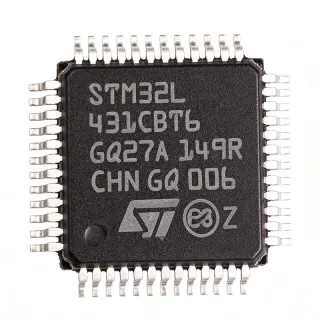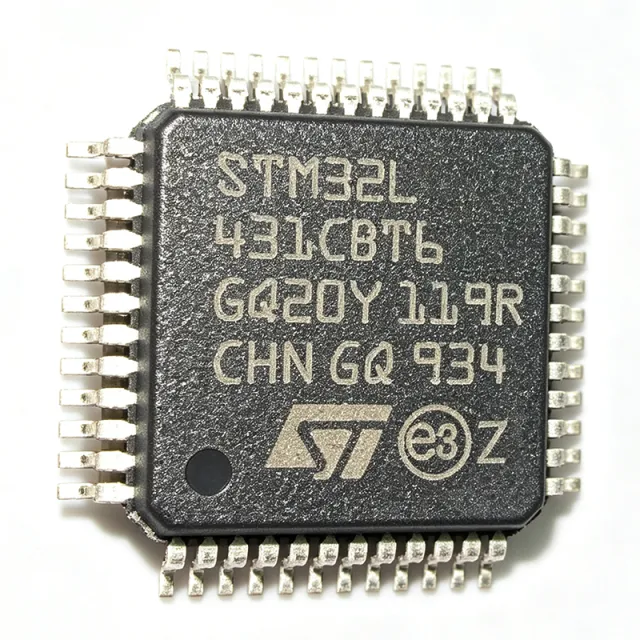
STM32G431CBT6 - 170MHz Arm Cortex-M4F MCU | STMicroelectronics
MPN: STM32G431CBT6 ✓ Active| Qty | Unit Price | Extended |
|---|---|---|
| 1 | $6.8182 | $6.82 |
| 10 | $4.9242 | $49.24 |
| 100 | $4.3561 | $435.61 |
| 500 | $4.1667 | $2,083.35 |
| 1,000 | $3.9773 | $3,977.30 |
STM32G431CBT6 Overview
What is a microcontroller? A microcontroller (MCU) is a compact integrated circuit designed to govern a specific operation in an embedded system. It contains a processor core, memory (Flash and SRAM), and programmable input/output peripherals on a single chip. The STM32G431CBT6 belongs to the STM32G4 series, which is optimized for mixed-signal control applications, combining digital signal processing (DSP) capabilities with advanced analog peripherals. This MCU sits within the broader hierarchy of embedded processors, from general-purpose microcontrollers to application-specific system-on-chips (SoCs).
Key features of the STM32G431CBT6 include a 170 MHz Arm Cortex-M4F core with DSP instructions and FPU, 128 KB Flash, 32 KB SRAM, and a rich set of peripherals. It integrates a 12-bit ADC with hardware oversampling (up to 16-bit resolution), two 12-bit DACs, operational amplifiers, comparators, and advanced timers. The device also supports multiple communication interfaces including SPI, I2C, USART, and CAN FD, making it versatile for industrial and automotive applications.
From a technical architecture perspective, the STM32G431CBT6 leverages the STM32G4 series' advanced analog and control peripherals, such as the high-resolution timer (HRTIM) for precise PWM generation, and the CORDIC hardware accelerator for trigonometric functions. The FPU and DSP instructions enable efficient execution of complex algorithms like motor control and digital power conversion. The device also includes a memory protection unit (MPU) and a cyclic redundancy check (CRC) unit for enhanced reliability.
Typical applications include motor control (e.g., field-oriented control of brushless DC motors), digital power supplies (e.g., LLC resonant converters), industrial automation, and consumer electronics. The STM32G431CBT6's combination of high clock speed, analog integration, and communication interfaces makes it ideal for these use cases.
When designing with this MCU, ensure proper decoupling of the VDD pins with 100nF capacitors and a bulk capacitor. The VDDA pin must be connected to a clean analog supply to maintain ADC accuracy. Also, consider the thermal performance of the LQFP-48 package; the maximum junction temperature is 125°C, so adequate PCB copper area is recommended for high-power applications.
This page synthesizes distributor pricing, drop-in alternatives, and practical design notes not found in the ST datasheet, providing a comprehensive resource for engineers evaluating the STM32G431CBT6.
Drop-in alternatives for STM32G431CBT6 — same package, pin-to-pin compatible. Different-package parts requiring PCB rework are excluded.
Variants in this series
Same-series models that are drop-in compatible with STM32G431CBT6 (same form factor and footprint) — differing in Communication Interfaces, Core, Package, ADC Resolution, DMA Channels.
Quick Comparison Tool — Select alternative parts for side-by-side comparison:
STM32G431CBT6TR
📋 Reference alternative (not in catalog)
STM32G431C8T6
📋 Reference alternative (not in catalog)
STM32G431C6T6
📋 Reference alternative (not in catalog)
STM32G431CBT6 Maximum Ratings & Electrical Characteristics
| Core | Arm Cortex-M4F with FPU |
| Maximum Clock Frequency | 170 MHz |
| Flash Memory | 128 KB |
| SRAM | 32 KB |
| Supply Voltage Range | 1.71 V to 3.6 V |
| Package | LQFP-48 (7x7 mm) |
| Operating Temperature Range | -40C to +85C |
| ADC Resolution | 12-bit (up to 16-bit with oversampling) |
| DAC Resolution | 12-bit |
| Number of Timers | 10 (including HRTIM) |
| Communication Interfaces | SPI, I2C, USART, CAN FD |
| GPIO Pins | 36 |
| DMA Channels | 16 |
| RoHS Status | Compliant |
| AEC-Q100 | Not qualified (standard grade) |
STM32G431CBT6 Pin Configuration
| Pin 1 | VBAT — Battery backup supply for RTC |
| Pin 2 | PC13 — GPIO or RTC tamper |
| Pin 3 | PC14 — GPIO or OSC32_IN |
| Pin 4 | PC15 — GPIO or OSC32_OUT |
| Pin 5 | PF0 — GPIO |
| Pin 6 | PF1 — GPIO |
| Pin 7 | NRST — Reset (active low) |
| Pin 8 | VDD — Digital power supply |
| Pin 9 | VSS — Ground |
| Pin 10 | VDDA — Analog power supply |
| Pin 11 | PA0 — GPIO/ADC |
| Pin 12 | PA1 — GPIO/ADC |
| Pin 13 | PA2 — GPIO/ADC |
| Pin 14 | PA3 — GPIO/ADC |
| Pin 15 | PA4 — GPIO/DAC |
| Pin 16 | PA5 — GPIO/DAC |
| Pin 17 | PA6 — GPIO/SPI |
| Pin 18 | PA7 — GPIO/SPI |
| Pin 19 | PB0 — GPIO/ADC |
| Pin 20 | PB1 — GPIO/ADC |
| Pin 21 | PB2 — GPIO |
| Pin 22 | PB10 — GPIO/I2C |
| Pin 23 | PB11 — GPIO/I2C |
| Pin 24 | VSS — Ground |
| Pin 25 | VDD — Digital power supply |
| Pin 26 | PB12 — GPIO/SPI |
| Pin 27 | PB13 — GPIO/SPI |
| Pin 28 | PB14 — GPIO/SPI |
| Pin 29 | PB15 — GPIO/SPI |
| Pin 30 | PA8 — GPIO/TIM |
| Pin 31 | PA9 — GPIO/USART |
| Pin 32 | PA10 — GPIO/USART |
| Pin 33 | PA11 — GPIO/USB/CAN |
| Pin 34 | PA12 — GPIO/USB/CAN |
| Pin 35 | PA13 — SWDIO |
| Pin 36 | PA14 — SWCLK |
| Pin 37 | PA15 — GPIO/JTDI |
| Pin 38 | PB3 — GPIO/JTDO |
| Pin 39 | PB4 — GPIO/JTRST |
| Pin 40 | PB5 — GPIO |
| Pin 41 | PB6 — GPIO/I2C |
| Pin 42 | PB7 — GPIO/I2C |
| Pin 43 | BOOT0 — Boot mode selection |
| Pin 44 | PB8 — GPIO/CAN |
| Pin 45 | PB9 — GPIO/CAN |
| Pin 46 | VSS — Ground |
| Pin 47 | VDD — Digital power supply |
| Pin 48 | PC14 — GPIO/OSC32_IN |
Typical Applications
STM32G431CBT6 is suitable for 6 applications: Motor Control, Digital Power Supplies, Industrial Automation, Consumer Electronics, Automotive (Non-Safety), Test and Measurement.
Motor Control
The STM32G431CBT6 is ideal for field-oriented control (FOC) of brushless DC (BLDC) motors. Its 170 MHz Cortex-M4F core with FPU and DSP instructions enables fast execution of complex control algorithms like FOC and sensorless observers. The high-resolution timer (HRTIM) generates precise PWM signals with 184 ps resolution, essential for smooth motor operation. The 12-bit ADC with hardware oversampling (up to 16-bit) provides accurate current sensing, while the CORDIC accelerator speeds up trigonometric calculations for Park/Clarke transforms. In a typical FOC implementation, the MCU reads phase currents via the ADC, computes the rotor position using an encoder or Hall sensors, and updates PWM duty cycles in real-time. The device's rich analog peripherals, including operational amplifiers and comparators, allow direct interfacing with current shunt amplifiers without external components. Performance-wise, the STM32G431CBT6 can achieve control loop frequencies of 20 kHz or higher, ensuring low torque ripple and high efficiency. Designers should ensure proper decoupling of the analog supply (VDDA) and use a dedicated ground plane to minimize noise in current sensing. The device's 128 KB Flash provides ample space for motor control libraries and data logging, making it a robust choice for industrial and automotive motor drives.
Recommended
Digital Power Supplies
The STM32G431CBT6 excels in digital power supply applications, such as LLC resonant converters and active clamp flyback converters. Its high-resolution timer (HRTIM) with 184 ps resolution enables precise frequency and duty-cycle control, critical for resonant converters. The fast 12-bit ADC (up to 16-bit with oversampling) samples output voltage and current at high speed for closed-loop regulation. The CORDIC accelerator computes trigonometric functions needed for phase-shift modulation and zero-voltage switching (ZVS) timing. In a typical LLC converter, the MCU generates complementary PWM signals for the primary switches, adjusts switching frequency to regulate output voltage, and monitors input/output currents for protection. The device's 170 MHz clock ensures control loop bandwidths of several tens of kHz, achieving fast transient response. The integrated operational amplifiers and comparators can be used for current sensing and overcurrent protection without external components. The STM32G431CBT6's 128 KB Flash allows implementation of complex control algorithms, including digital compensation and fault handling. Designers should pay attention to the ADC sampling time and use DMA to minimize CPU overhead. The device's wide operating voltage range (1.71V to 3.6V) and industrial temperature range make it suitable for server power supplies, telecom rectifiers, and battery chargers.
Recommended
Industrial Automation
The STM32G431CBT6 is well-suited for industrial automation applications, including PLCs, sensors, and actuators. Its 170 MHz Cortex-M4F core provides high computational throughput for real-time control and communication protocols. The device supports multiple communication interfaces, including SPI, I2C, USART, and CAN FD, enabling seamless integration into industrial networks. The 12-bit ADC with oversampling allows precise analog signal acquisition from sensors, while the DACs can generate analog output signals for actuators. The advanced timers can generate PWM for controlling valves, pumps, and other actuators. In a typical PLC I/O module, the MCU reads digital inputs, processes logic, and drives outputs via relays or transistors. The STM32G431CBT6's 128 KB Flash and 32 KB SRAM provide ample space for firmware and data buffers. The device's industrial temperature range (-40C to +85C) and robust design make it reliable in harsh environments. Designers should implement proper ESD protection on communication lines and use isolated interfaces (e.g., digital isolators) for safety. The device's low power consumption in sleep modes is beneficial for battery-powered sensors. Overall, the STM32G431CBT6 offers a balanced combination of performance, peripherals, and connectivity for industrial automation.
Recommended
Consumer Electronics
The STM32G431CBT6 is used in consumer electronics such as smart home devices, wearables, and audio equipment. Its high clock speed and DSP capabilities enable audio processing, sensor fusion, and user interface control. The device's low power consumption in standby mode (typically a few microamps) extends battery life in portable devices. The integrated DACs can generate audio signals directly, while the ADC can sample microphone inputs. The communication interfaces (SPI, I2C, USART) allow connection to displays, touch controllers, and wireless modules. In a smart speaker, the MCU handles voice commands, audio playback, and network connectivity. The STM32G431CBT6's 128 KB Flash is sufficient for audio codecs and application firmware. The device's small LQFP-48 package (7x7 mm) is suitable for space-constrained designs. Designers should optimize power consumption by using low-power modes and disabling unused peripherals. The device's wide supply voltage range (1.71V to 3.6V) allows direct battery operation. Overall, the STM32G431CBT6 provides a cost-effective solution for high-performance consumer products.
Recommended
Automotive (Non-Safety)
The STM32G431CBT6 is suitable for automotive applications that do not require functional safety certification, such as body control modules, lighting control, and infotainment. Its 170 MHz Cortex-M4F core handles complex control algorithms and communication protocols like CAN FD. The device's wide operating temperature range (-40C to +85C) and robust design meet automotive environmental requirements. The integrated ADC and DACs enable analog signal processing for sensors and actuators. The CAN FD interface supports high-speed in-vehicle networking. In a body control module, the MCU manages lighting, wipers, and door locks. The STM32G431CBT6's 128 KB Flash provides ample space for application code. Designers should note that this device is not AEC-Q100 qualified, so it is not recommended for safety-critical applications. For automotive-grade requirements, consider the STM32G431CBT6Q (AEC-Q100 qualified). The device's low power consumption is beneficial for always-on modules. Overall, the STM32G431CBT6 offers a balance of performance and cost for non-safety automotive electronics.
Recommended
Test and Measurement
The STM32G431CBT6 is used in test and measurement equipment such as data loggers, signal generators, and multimeters. Its high-speed ADC (up to 4 Msps) and DACs enable precise signal acquisition and generation. The 170 MHz core processes data quickly for real-time analysis. The device's multiple timers can generate precise timing signals for triggering and synchronization. The communication interfaces (USB, SPI, UART) allow data transfer to a host PC. In a data logger, the MCU samples analog signals at high rates, stores data in SRAM or external memory, and transmits it via USB. The STM32G431CBT6's 128 KB Flash can store firmware for complex measurement algorithms. The device's low noise analog peripherals ensure accurate measurements. Designers should use a clean analog supply (VDDA) and proper grounding to minimize noise. The device's industrial temperature range makes it suitable for field instruments. Overall, the STM32G431CBT6 provides high performance and precision for test and measurement applications.
Recommended
Recommended Products Summary
Engineering reference data for STM32G431CBT6 — comparison, design guidance, and compliance information.
Selection Guide
Comparison with Alternatives
| Parameter | This Product | STM32G431CBT6TR | STM32G431C8T6 | STM32G431C6T6 |
|---|---|---|---|---|
| Package | LQFP-48 | LQFP-48 - same | LQFP-48 - same | LQFP-48 - same |
| Flash Memory | 128 KB | 128 KB | 64 KB | 32 KB |
| SRAM | 32 KB | 32 KB | 32 KB | 16 KB |
| Maximum Clock Frequency | 170 MHz | 170 MHz | 170 MHz | 170 MHz |
| ADC Resolution | 12-bit (16-bit with oversampling) | 12-bit (16-bit with oversampling) | 12-bit (16-bit with oversampling) | 12-bit (16-bit with oversampling) |
| Number of Timers | 10 (including HRTIM) | 10 (including HRTIM) | 10 (including HRTIM) | 10 (including HRTIM) |
| Communication Interfaces | SPI, I2C, USART, CAN FD | SPI, I2C, USART, CAN FD | SPI, I2C, USART, CAN FD | SPI, I2C, USART, CAN FD |
| GPIO Pins | 36 | 36 | 36 | 36 |
Key Differentiators
- Larger Flash and SRAM compared to STM32G431C6T6 (vs STM32G431C6T6)
- Same package and pinout as STM32G431C8T6 (vs STM32G431C8T6)
- Tape-and-reel variant available (vs STM32G431CBT6TR)
Design Notes
Decouple each VDD pin with a 100nF ceramic capacitor placed as close as possible to the pin, and add a 4.7uF bulk capacitor. The VDDA pin must be connected to a clean analog supply, ideally through a ferrite bead, and decoupled with a 1uF capacitor. Ensure the VSSA pin is connected to a separate analog ground plane to minimize noise coupling into the ADC.
For the LQFP-48 package, use a 4-layer PCB with a solid ground plane. Route high-speed signals (SPI, USART) with controlled impedance if necessary. Keep the crystal oscillator (if used) close to the MCU and away from high-current traces. Provide a thermal pad on the PCB for the exposed pad (if present) to improve heat dissipation.
Do not leave unused GPIO pins floating; configure them as outputs or enable internal pull-ups/pull-downs. Ensure the BOOT0 pin is properly pulled low for normal boot from Flash. When using the ADC, avoid switching digital I/O during conversion to prevent noise. Also, verify that the supply voltage does not exceed 3.6V, as this can damage the device.
Compliance Information
RoHS and REACH compliant per STMicroelectronics product page. Not AEC-Q100 qualified; automotive-grade variant is STM32G431CBT6Q.