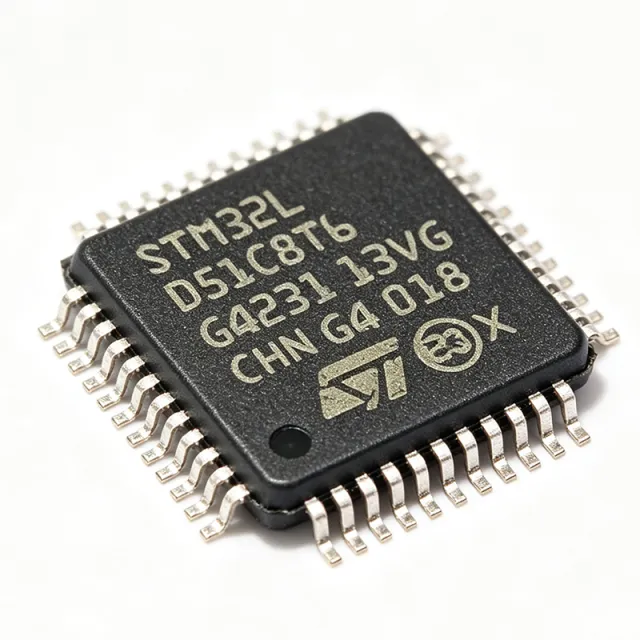
Quick Answers: What Is the STM32L051C8T6?
The STM32L051C8T6 is an ultra-low-power 32-bit ARM Cortex-M0+ microcontroller from STMicroelectronics, running at up to 32 MHz with 64 KB Flash, 8 KB SRAM, and a 1.8 V to 3.6 V supply range. It draws only 0.29 µA in Standby mode and 3.4 µA in Stop mode with RTC, and it integrates a 12-bit ADC with 10 channels, I2C/SPI/USART, timers, and a calendar RTC. The device is available now in an LQFP-48 (7x7 mm) package, has an active lifecycle status, and XAIPART shows 99,999 units in stock with a 1-unit price of $1.6909 as of 2026-08-20. See the STM32L051C8T6 product page for live stock and datasheet access.
This pillar guide combines selection, design, alternative, market, and outlook data in one resource. Use it to confirm whether the STM32L051C8T6 fits your low-power design before you open a datasheet.
Technical Guide: How Do You Select, Design In, and Use the STM32L051C8T6?
Begin with the verified selection envelope: ARM Cortex-M0+ core at up to 32 MHz, 64 KB Flash, 8 KB SRAM, 1.8 V to 3.6 V supply, and -40°C to +85°C operating range. The LQFP-48 package measures 7x7 mm and is RoHS compliant. If your application fits these limits, the STM32L051C8T6 is a strong low-power candidate.
Power Supply Design
The 1.8 V to 3.6 V range lets you power the MCU directly from two alkaline cells or one lithium-ion cell without a regulator. Keep VDDA (pin 8) and VSSA (pin 7) clean for the 12-bit ADC. Connect VBAT (pin 1) to a backup battery for RTC retention. Use local decoupling on VDD, VDDA, and VBAT. The device also includes brown-out reset (BOR) and power-on reset (POR) for reliable operation.
Low-Power Modes
The verified modes are Sleep, Low-power run, Low-power sleep, Stop, and Standby. Standby current is 0.29 µA; Stop mode with RTC is 3.4 µA. In a battery application, pick Stop with RTC when you need calendar wakeups, and pick Standby when leakage is the most critical budget.
Clock and RTC Design
OSC_IN and OSC_OUT (pins 4 and 5) accept the main external clock. A 32.768 kHz crystal on PC14/PC15 (pins 2 and 3) supports the calendar RTC. Configure the clock tree in STM32CubeMX; the 32 MHz ceiling is enough for sensor processing, and running at a lower clock can reduce power.
Peripheral Mapping
Verified pinout examples include USART1 on PA9/PA10, I2C1 on PB6/PB7, and SPI1 signal pins around PA4-PA7 and PB3-PB5. The 12-bit ADC has 10 channels, with inputs including PA0, PA1, PB0, and PB1. It also supports hardware oversampling, which can increase effective resolution for low-frequency signals. The timer block includes five 16-bit timers and one 32-bit timer. Use PA13 (SWDIO) and PA14 (SWCLK) for debugging.
| Function | Pin | Pin Name |
|---|---|---|
| Backup supply | 1 | VBAT |
| RTC crystal | 2 | PC14 / OSC32_IN |
| RTC crystal | 3 | PC15 / OSC32_OUT |
| External clock in | 4 | OSC_IN |
| Reset | 6 | NRST |
| Analog ground | 7 | VSSA |
| Analog power | 8 | VDDA |
| Ground | 22/44 | VSS |
| Power supply | 23/45 | VDD |
| USART1 TX | 29 | PA9 |
| USART1 RX | 30 | PA10 |
| SWD data | 33 | PA13 / SWDIO |
| SWD clock | 34 | PA14 / SWCLK |
| I2C1 clock | 39 | PB6 |
| I2C1 data | 40 | PB7 |
| Boot select | 41 | BOOT0 |
| RTC tamper | 46 | PC13 |
This table lists the functionally critical pins; the full pin description is in the datasheet and on the product page.
Verified Application Fit
The database lists six verified application areas: IoT sensor nodes, smart home devices, portable medical monitors, industrial sensor interfaces, wearable devices, and energy harvesting systems. All six depend on low current consumption and flexible communication. For other low-power MCUs, browse the microcontrollers category.
Example Design: Battery-Powered IoT Node
In a sensor node, wake the MCU periodically, sample a sensor with the 12-bit ADC, send data through I2C/SPI/USART to a radio, and return to sleep. At 0.29 µA standby, the MCU's own sleep leakage is 2.54 mAh per year. Stop mode with RTC at 3.4 µA is 29.8 mAh per year. These sleep budgets fit a coin-cell powered IoT node when active current is duty-cycled.
Alternatives & Comparison: Which Drop-In Replacements Exist?
The verified alternatives list includes three same-package variants: STM32L051C8T6TR is the tape-and-reel variant with the same die and package; STM32L051C8T7 offers the same package with an extended temperature range (-40°C to +105°C); STM32L051C8T6D is the same package with a die revision that has minor errata fixes. If you need more memory, the FAQ confirms that STM32L071C8T6 provides 192 KB Flash and 20 KB SRAM in the same LQFP-48 package and is pin-compatible. Before choosing, review the ultra-low-power MCU selection guide.
| Parameter | STM32L051C8T6 | STM32L071C8T6 |
|---|---|---|
| Flash memory | 64 KB | 192 KB |
| SRAM | 8 KB | 20 KB |
| Package | LQFP-48 (7x7 mm) | LQFP-48 (7x7 mm) |
| Pin compatibility | Baseline device | Pin-compatible |
| Additional features cited in verified FAQ | 12-bit ADC, RTC, low-power modes | True RNG and more timers |
Use the STM32L071C8T6 when memory density or a true RNG is required. For production packaging, temperature range, or die revision needs, the C8T6TR, C8T7, and C8T6D variants are the drop-in choices from the verified database.
Industry Insight: What Is the Market Position and Supply Situation?
The verified XAIPART database shows an active lifecycle status for the STM32L051C8T6. Inventory is 99,999 units, minimum order quantity is 1, and the verified price tiers are $1.6909 at 1 unit, $1.0803 at 100 units, and $0.9864 at 1000 units as of 2026-08-20. The price reaches $0.9773 at 1500 units. The FAQ cites a typical lead time of 8-12 weeks for large orders, with stock potentially available from distributors for immediate shipment.
The STM32L0 family is positioned specifically in the ultra-low-power segment. The six verified application areas — IoT sensor nodes, smart home devices, portable medical monitors, industrial sensor interfaces, wearables, and energy harvesting — all point to battery or energy-constrained designs. An active lifecycle with large available stock suggests this part remains a safe choice for both new and existing low-power products.
Trends & Outlook: What Should Buyers Watch Next?
Watch the memory boundary first. 64 KB Flash and 8 KB SRAM fit compact sensor firmware, but larger protocol stacks or over-the-air updates may push you to the pin-compatible STM32L071C8T6 with 192 KB Flash and 20 KB SRAM. Watch packaging variants: C8T6TR suits tape-and-reel production, C8T7 extends the temperature range to -40°C to +105°C, and C8T6D incorporates a revised die with minor errata fixes.
The 0.29 µA standby current, 3.4 µA Stop-with-RTC current, 1.8 V to 3.6 V supply range, and 12-bit ADC make the STM32L051C8T6 attractive for energy harvesting, wearables, and long-life IoT nodes. Buyers who are planning battery-powered sensor products should verify final active current and radio duty cycle, then choose the packaging variant that matches their production flow.
Comments
Be the first to comment.
🔐 Please sign in to post a comment.
Don't have an account? Sign up