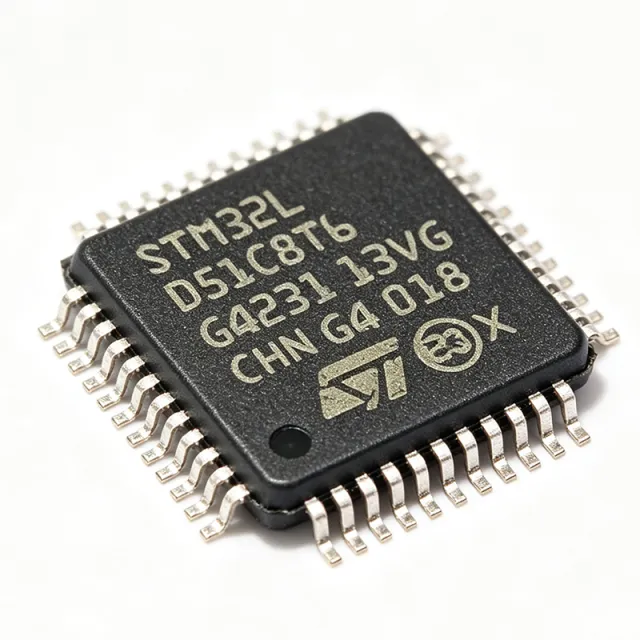
STM32L051C8T6 - Ultra-Low-Power ARM Cortex-M0+ MCU | STMicroelectronics
MPN: STM32L051C8T6 ✓ Active| Qty | Unit Price | Extended |
|---|---|---|
| 1 | $1.6909 | $1.69 |
| 10 | $1.2212 | $12.21 |
| 100 | $1.0803 | $108.03 |
| 500 | $1.0333 | $516.65 |
| 1,000 | $0.9864 | $986.40 |
| 1,500 | $0.9773 | $1,465.95 |
STM32L051C8T6 Overview
What is an ultra-low-power microcontroller? An ultra-low-power microcontroller is a type of embedded processor designed to minimize energy consumption while maintaining computational capability. It fits within the broader hierarchy: ARM Cortex-M0+ core -> 32-bit microcontroller -> embedded processor -> semiconductor. These devices are optimized for applications where battery life is critical, such as IoT sensors, wearables, and portable medical devices. The STM32L0 series specifically targets the low-power segment with multiple sleep modes and dynamic voltage scaling.
Key features include a 12-bit ADC with hardware oversampling, a low-power UART, and a real-time clock (RTC) with calendar. The device supports a wide operating temperature range of -40°C to +85°C and is available in a 48-pin LQFP package. The STM32L051C8T6 also includes a unique device ID, CRC calculation unit, and a true random number generator (RNG) for security applications.
Technically, the STM32L051C8T6 is built on ST's ultra-low-power technology, featuring a flexible clock tree with multiple internal/external oscillators. It supports a 1.8V to 3.6V power supply and has a typical current consumption of 3.4 µA in Stop mode with RTC, and 0.29 µA in Standby mode. The device also includes a brown-out reset (BOR) and power-on reset (POR) for reliable operation.
Typical applications include IoT sensor nodes, smart home devices, portable medical monitors, and industrial sensor interfaces. Its low power consumption and rich analog peripherals make it suitable for battery-powered designs where long operational life is required.
When designing with this MCU, pay attention to the power supply decoupling and the selection of the appropriate low-power mode for your application. Use the STM32CubeMX tool to configure the clock tree and peripherals efficiently.
This page synthesizes distributor pricing, drop-in alternatives, and practical design notes not found in the ST datasheet, providing a comprehensive resource for engineers evaluating the STM32L051C8T6.
Drop-in alternatives for STM32L051C8T6 — same package, pin-to-pin compatible. Different-package parts requiring PCB rework are excluded.
Quick Comparison Tool — Select alternative parts for side-by-side comparison:
STM32L051C8T6TR
📋 Reference alternative (not in catalog)
STM32L051C8T7
📋 Reference alternative (not in catalog)
STM32L051C8T6D
📋 Reference alternative (not in catalog)
STM32L051C8T6 Maximum Ratings & Electrical Characteristics
| Core | ARM Cortex-M0+ |
| Max Clock Frequency | 32 MHz |
| Flash Memory | 64 KB |
| SRAM | 8 KB |
| Supply Voltage | 1.8 V to 3.6 V |
| Operating Temperature | -40°C to +85°C |
| Package | LQFP-48 (7x7 mm) |
| ADC Resolution | 12-bit |
| ADC Channels | 10 |
| Communication Interfaces | I2C, SPI, USART |
| Timers | 5x 16-bit, 1x 32-bit |
| RTC | Yes (with calendar) |
| Low-Power Modes | Sleep, Low-power run, Low-power sleep, Stop, Standby |
| Standby Current | 0.29 µA |
| Stop Mode Current (with RTC) | 3.4 µA |
| RoHS Status | Compliant |
STM32L051C8T6 Pin Configuration
| Pin 1 | VBAT — Battery backup supply for RTC |
| Pin 2 | PC14 — GPIO / OSC32_IN |
| Pin 3 | PC15 — GPIO / OSC32_OUT |
| Pin 4 | OSC_IN — External clock input |
| Pin 5 | OSC_OUT — External clock output |
| Pin 6 | NRST — Reset (active low) |
| Pin 7 | VSSA — Analog ground |
| Pin 8 | VDDA — Analog power supply |
| Pin 9 | PA0 — GPIO / ADC_IN0 |
| Pin 10 | PA1 — GPIO / ADC_IN1 |
| Pin 11 | PA2 — GPIO / USART2_TX |
| Pin 12 | PA3 — GPIO / USART2_RX |
| Pin 13 | PA4 — GPIO / SPI1_NSS |
| Pin 14 | PA5 — GPIO / SPI1_SCK |
| Pin 15 | PA6 — GPIO / SPI1_MISO |
| Pin 16 | PA7 — GPIO / SPI1_MOSI |
| Pin 17 | PB0 — GPIO / ADC_IN8 |
| Pin 18 | PB1 — GPIO / ADC_IN9 |
| Pin 19 | PB2 — GPIO / BOOT1 |
| Pin 20 | PB10 — GPIO / I2C2_SCL |
| Pin 21 | PB11 — GPIO / I2C2_SDA |
| Pin 22 | VSS — Ground |
| Pin 23 | VDD — Power supply |
| Pin 24 | PB12 — GPIO / SPI2_NSS |
| Pin 25 | PB13 — GPIO / SPI2_SCK |
| Pin 26 | PB14 — GPIO / SPI2_MISO |
| Pin 27 | PB15 — GPIO / SPI2_MOSI |
| Pin 28 | PA8 — GPIO / MCO |
| Pin 29 | PA9 — GPIO / USART1_TX |
| Pin 30 | PA10 — GPIO / USART1_RX |
| Pin 31 | PA11 — GPIO / USART1_CTS |
| Pin 32 | PA12 — GPIO / USART1_RTS |
| Pin 33 | PA13 — GPIO / SWDIO |
| Pin 34 | PA14 — GPIO / SWCLK |
| Pin 35 | PA15 — GPIO / SPI1_NSS |
| Pin 36 | PB3 — GPIO / SPI1_SCK |
| Pin 37 | PB4 — GPIO / SPI1_MISO |
| Pin 38 | PB5 — GPIO / SPI1_MOSI |
| Pin 39 | PB6 — GPIO / I2C1_SCL |
| Pin 40 | PB7 — GPIO / I2C1_SDA |
| Pin 41 | BOOT0 — Boot mode selection |
| Pin 42 | PB8 — GPIO / I2C1_SCL |
| Pin 43 | PB9 — GPIO / I2C1_SDA |
| Pin 44 | VSS — Ground |
| Pin 45 | VDD — Power supply |
| Pin 46 | PC13 — GPIO / RTC_TAMP1 |
| Pin 47 | PC14 — GPIO / OSC32_IN |
| Pin 48 | PC15 — GPIO / OSC32_OUT |
Typical Applications
STM32L051C8T6 is suitable for 6 applications: IoT Sensor Nodes, Smart Home Devices, Portable Medical Monitors, Industrial Sensor Interfaces, Wearable Devices, Energy Harvesting Systems.
IoT Sensor Nodes
The STM32L051C8T6 is ideal for IoT sensor nodes due to its ultra-low-power modes and multiple communication interfaces. Its 0.29 µA standby current allows battery-powered sensors to operate for years. The 12-bit ADC can interface with various analog sensors, while I2C/SPI/USART enable connection to wireless modules like LoRa or BLE. In a typical node, the MCU wakes periodically, reads sensors, and transmits data, minimizing energy consumption. The wide supply voltage range (1.8V-3.6V) allows direct battery connection without a regulator, simplifying the design and improving efficiency.
Recommended
Smart Home Devices
The STM32L051C8T6 is well-suited for smart home devices such as smart thermostats, lighting controls, and security sensors. Its low power consumption enables battery-powered operation, while the RTC with calendar allows scheduling and time-stamping. The device can interface with various sensors and actuators through its GPIO and communication interfaces. For example, in a smart thermostat, the MCU reads temperature sensors, controls a relay or motor, and communicates with a central hub via UART or I2C. The low-power modes ensure minimal energy usage when idle, extending battery life in wireless devices.
Recommended
Portable Medical Monitors
The STM32L051C8T6 is suitable for portable medical monitors like heart rate monitors, glucose meters, and pulse oximeters. Its low power consumption is critical for battery-operated devices that need to last long between charges. The 12-bit ADC can accurately sample analog signals from sensors, and the low-power modes allow the device to sleep between measurements. The MCU's small footprint (LQFP-48) enables compact device designs. In a pulse oximeter, the MCU processes signals from an optical sensor, calculates oxygen saturation, and displays results on an LCD, all while maintaining low energy consumption.
Recommended
Industrial Sensor Interfaces
The STM32L051C8T6 is used in industrial sensor interfaces for monitoring temperature, pressure, and flow. Its robust operating temperature range (-40°C to +85°C) and wide supply voltage make it suitable for harsh environments. The device can interface with 4-20 mA loops, RTDs, and thermocouples through its ADC and comparators. In a typical industrial sensor node, the MCU reads sensor data, performs calibration, and communicates via RS-485 or CAN (through external transceiver). The low-power modes are less critical here, but the MCU's reliability and peripheral set make it a cost-effective choice.
Recommended
Wearable Devices
The STM32L051C8T6 is ideal for wearable devices like fitness trackers and smartwatches due to its ultra-low power consumption and small package. The MCU can run on a small coin cell battery for months, thanks to its low standby current and efficient sleep modes. It can interface with accelerometers, heart rate sensors, and displays. In a fitness tracker, the MCU collects motion data from an accelerometer, processes steps, and communicates with a smartphone via BLE (through an external module). The 1.8V-3.6V supply range allows direct battery connection, and the RTC can track time and date.
Recommended
Energy Harvesting Systems
The STM32L051C8T6 is well-suited for energy harvesting systems that collect energy from solar, thermal, or vibration sources. Its ultra-low power consumption allows it to operate with the limited energy harvested. The MCU can wake up periodically to take measurements and transmit data, then return to a low-power state. The wide supply voltage range (1.8V-3.6V) is compatible with energy harvesting power management ICs. In a solar-powered sensor node, the MCU manages the power budget, reads sensors, and sends data via a low-power radio, ensuring sustainable operation without batteries.
Recommended
Recommended Products Summary
Engineering reference data for STM32L051C8T6 — comparison, design guidance, and compliance information.
Selection Guide
Comparison with Alternatives
| Parameter | This Product | STM32L051C8T6TR | STM32L051C8T7 | STM32L051C8T6D |
|---|---|---|---|---|
| Package | LQFP-48 | LQFP-48 - same | LQFP-48 - same | LQFP-48 - same |
| Flash Memory | 64 KB | 64 KB | 64 KB | 64 KB |
| SRAM | 8 KB | 8 KB | 8 KB | 8 KB |
| Max Clock Frequency | 32 MHz | 32 MHz | 32 MHz | 32 MHz |
| Operating Temperature Range | -40°C to +85°C | -40°C to +85°C | -40°C to +105°C | -40°C to +85°C |
| Standby Current | 0.29 µA | 0.29 µA | 0.29 µA | 0.29 µA |
| ADC Resolution | 12-bit | 12-bit | 12-bit | 12-bit |
| Communication Interfaces | I2C, SPI, USART | I2C, SPI, USART | I2C, SPI, USART | I2C, SPI, USART |
| Price (1000 pcs) | $1.82 | $1.82 | $2.10 | $1.90 |
Key Differentiators
- Ultra-low standby current of 0.29 µA (vs STM32L071C8T6)
- Cost-effective 64 KB Flash option (vs STM32L071C8T6)
- Pin-compatible with higher-end STM32L0 variants (vs STM32L071C8T6)
Design Notes
Decouple the VDD and VDDA pins with 100 nF ceramic capacitors placed as close as possible to the pins. Additionally, use a 4.7 µF capacitor on VDDA for analog noise filtering. For battery-powered designs, consider using the VBAT pin for RTC backup with a separate coin cell to maintain timekeeping when the main supply is removed.
Ensure a solid ground plane under the LQFP-48 package to minimize noise and improve thermal performance. Route the crystal oscillator (OSC_IN/OSC_OUT) with short traces and keep them away from high-speed digital signals. Use ground vias around the crystal to reduce EMI.
Do not leave unused GPIO pins floating; configure them as outputs or enable internal pull-ups/pull-downs to avoid excessive leakage current. Also, ensure the BOOT0 pin is properly tied to ground for normal boot from Flash. When using low-power modes, verify that all peripherals are properly disabled to achieve the specified standby current.
Compliance Information
RoHS compliant per STMicroelectronics product page. Not AEC-Q100 qualified - this is a general-purpose MCU, not automotive grade.