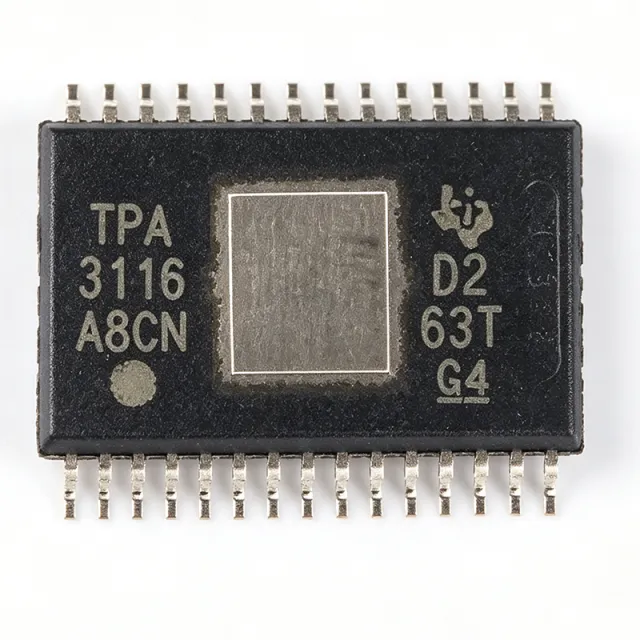
What Is the TPA3116D2DADR and Why Do Designers Choose It?
The TPA3116D2DADR is a filter-free, analog-input Class-D stereo audio amplifier from Texas Instruments that delivers 2 x 50 W into 4-ohm speakers in BTL mode — or 100 W mono into a 2-ohm load in parallel-BTL (PBTL) mode — from a single 4.5 V to 26 V supply. It comes in a 32-pin HTSSOP (DAD) package with an exposed thermal pad, mounts as a surface-mount device, and achieves better than 85% typical switching efficiency. As of 2026-09-04, the part is in active lifecycle status with 99,999 units in stock on XAIPART, priced at $3.45 for a single unit down to $2.20 at 1,000 pieces, with an MOQ of 1.
As a switching amplifier, the TPA3116D2DADR's output transistors operate as switches rather than linear elements. This is why it routinely replaces bulky Class-AB output stages plus heat sinks in compact speaker systems: at 100 W total audio output, worst-case dissipation is roughly 9 W, manageable on a two-layer PCB with adequate copper pour. Key features include an integrated feedback loop that tolerates speaker inductance without an external LC output filter, SpeakerGuard amplitude limiting that protects speakers from over-power events, and AM-avoidance modulation that keeps switching harmonics out of the AM broadcast band — a decisive advantage in radio-adjacent and automotive audio designs.
Differential analog inputs improve common-mode noise rejection near Bluetooth/RF circuitry, and integrated short-circuit protection, thermal shutdown, and undervoltage lockout raise system robustness without external protection circuitry in most designs. Typical applications include Bluetooth and active speakers, soundbars, TV audio, portable PA and karaoke systems, and automotive infotainment speaker drivers. The device uses an AD modulation topology with 250 kHz-class switching, supports master/slave synchronization for multi-channel designs, and manages power-supply pumping through its BTL configuration at low frequencies.
How Do You Select and Design In the TPA3116D2DADR?
Selection starts with your supply rail and speaker impedance. The verified supply range of 4.5 V to 26 V covers 12 V automotive rails, 19-24 V laptop-adapter and wall-adapter supplies, and 5 V USB-powered designs at correspondingly reduced output power. The full 2 x 50 W into 4 ohms rating applies near the upper end of the supply range. If you need maximum SPL from a single woofer, configure the device in PBTL mode to drive 100 W into 2 ohms.
Thermal design is the most critical engineering task. The exposed thermal pad of the 32-pin HTSSOP package must solder to a solid ground pour with an array of thermal vias — this PCB copper is the primary heat path. At 2 x 50 W with better than 85% Class-D efficiency, estimated dissipation is roughly 9 W worst case (delivering 100 W total). A well-designed two-layer PCB with at least 1 square inch of copper under the pad keeps the junction within limits; under-provisioned layouts can trigger thermal shutdown. No external heat sink is typically required at full output when the layout follows these guidelines.
Power distribution requires equal attention. Place supply decoupling — at least 10 uF bulk plus 0.1 uF ceramic — close to each PVCC pin to minimize supply ripple and EMI during bass transients. Estimate peak supply current early: 2 x 50 W into 4 ohms requires roughly 8-10 A peak from the supply, so verify your adapter or battery stack can deliver it. Configure the DC volume/gain pins per the datasheet gain-select table for your chosen speaker impedance.
On the output side, the filter-free architecture with integrated feedback means most designs need no LC filter between amplifier and speaker. Short speaker leads in typical active-speaker designs radiate negligible EMI. If speaker wiring is long or passes near sensitive circuitry, add a small ferrite bead or an optional LC filter per TI's datasheet layout guidance to further reduce conducted and radiated emissions. The AM-avoidance modulation scheme already keeps switching harmonics out of the AM band, simplifying coexistence with AM radios.
For multi-channel systems (4.1 and 5.1 active speakers), use the master/slave-capable architecture to synchronize switching clocks across multiple devices so Class-D channels do not produce audible intermodulation beat tones. Because the TPA3116D2, TPA3118D2, and TPA3130D2 share a uniform family pinout, one PCB layout can serve different channel power classes by swapping the IC — a meaningful development-effort saving. Differential inputs also allow balanced interconnect between the preamp board and power-amp board across the cabinet.
For sourcing and board assembly, order the DADR reel variant for production runs or the TPA3116D2DAD cut-tape variant for prototypes; both are the same die. See the TPA3116D2DADR product page on XAIPART for current stock and tier pricing, and download the official datasheet from TI's literature server at https://www.ti.com/lit/ds/symlink/tpa3116d2.pdf, titled 15-W, 30-W, 50-W Filter-Free Class-D Stereo Amplifier Family With AM Avoidance, which covers the full TPA31xxD2 family with electrical characteristics, application circuits, and PCB layout recommendations.
Which Alternatives Can Replace the TPA3116D2DADR?
The best drop-in replacement is the TPA3116D2QDADRQ1, the AEC-Q100 automotive-qualified version in the identical 32-pin HTSSOP (DAD) package with matching pinout and the same 2 x 50 W ratings. The TPA3116D2DAD (same die, tube packaging) is also pin-identical. Family members TPA3118D2DAD and TPA3130D2DAP differ in output power and should be treated as functional — not pin-for-pin guaranteed — substitutes unless verified against the shared datasheet. All verified options are compared below.
| Parameter | TPA3116D2DADR | TPA3116D2QDADRQ1 | TPA3116D2DAD | TPA3118D2DAD | TPA3130D2DAP | TPA3126D2DAD |
|---|---|---|---|---|---|---|
| Output Power | 2 x 50 W / 4 ohm | 2 x 50 W / 4 ohm (identical ratings) | 2 x 50 W / 4 ohm (identical) | 2 x 30 W / 8 ohm (-40%) | 2 x 15 W (-70%) | Lower output power class [VERIFY_NEEDED: exact rating] |
| Package | 32-pin HTSSOP (DAD) | 32-pin HTSSOP (DAD), same pinout | 32-pin HTSSOP (DAD), same die | Same family pinout and package | Same 32-pin HTSSOP footprint family | Same package family |
| Qualification | Standard | AEC-Q100 automotive | Standard | Standard | Standard | Standard |
| Drop-in Compatible | — | Yes (drop-in) | Yes (drop-in) | Functional substitute only | Functional substitute only | Verify gain/power deltas before substitution |
| Notable Trait | Full-power reference part | Automotive-grade same die | Tube/tray packaging variant | Runs without heat sink on dual-layer PCB at 2 x 30 W / 8 ohm | Runs without heat sink on single-layer PCB | Appears in TI's comparison tool listing |
Summary: if your board is already laid out for the TPA3116D2DADR, only the QDADRQ1 and DAD variants are guaranteed drop-in substitutions. For lower-power designs accepting a layout change, the TPA3118D2 (2 x 30 W / 8 ohm) and TPA3130D2 (2 x 15 W) offer the same filter-free Class-D architecture and SpeakerGuard protection in the same family footprint. The TPA3126D2DAD shares the package family but sits in a lower output class; verify gain and power deltas against the datasheet before committing.
What Is the Market Position, Lifecycle, and Supply Situation for the TPA3116D2DADR?
Lifecycle status for the TPA3116D2DADR is Active — there is no last-time-buy or end-of-life notice in the XAIPART database for this part. Supply is currently deep: XAIPART lists 99,999 units in stock with an MOQ of 1, and authorized distributors including DigiKey (product ID 3305528) and Mouser (stock number 595-TPA3116D2DAD) list it as in stock and shipping today as of the August 2026 data. Tier pricing as of 2026-09-04 runs $3.45 at quantity 1, $3.10 at 10, $2.72 at 100, $2.45 at 500, and $2.20 at 1,000 pieces; for volume quotes above 1,000 pieces, request an RFQ.
The part is also, by wide adoption, the most-used IC in DIY Class-D amplifier boards (commonly available as 2 x 50 W and 2 x 120 W-peak modules), which reinforces both demand and secondary-market availability. That popularity has a downside: popular Class-D amplifiers like this are commonly counterfeited in the gray market, so purchase only from authorized channels such as XAIPART, DigiKey, or Mouser to guarantee genuine Texas Instruments parts. Builders should also confirm their module has genuine copper pour under the thermal pad, since counterfeit or thin-copper boards frequently trigger thermal shutdown at sustained high output. [DATA_NEEDED: long-term lifecycle forecast or contractual longevity data from TI]
What Should Buyers and Engineers Watch Going Forward?
Watch three things, all anchored to the verified specifications. First, supply-voltage matching: the 4.5-26 V range means output power scales with your rail — at a 12 V battery the achievable output is proportionally lower than at 26 V, which matters for SPL budgets in PA and portable designs. Budget for that in your acoustic spec rather than assuming full rated output everywhere.
Second, thermal layout discipline as volumes scale. At better than 85% efficiency the device needs no heat sink, but the exposed-pad copper pour and thermal-via array remain mandatory at 2 x 50 W. If your production house offers only thin copper or reduced-layer boards, consider the TPA3118D2 or TPA3130D2, which run without heat sinks on dual-layer and single-layer PCBs respectively at their lower power classes — enabled by the uniform family pinout that lets one layout serve multiple power classes.
Third, qualification and substitution risk. For any automotive design, specify the TPA3116D2QDADRQ1 up front — it is AEC-Q100 qualified and drop-in identical, covering cold-crank transients, 13.8 V alternator operation, and load-dump events handled upstream. Keep the Q1 variant on your approved-vendor list even for non-automotive products, since TI's E2E audio forum confirms it as the sanctioned substitution path; just verify the automotive-grade datasheet deltas for your exact operating conditions before release. Finally, monitor pricing: with the spread from $3.45 (qty 1) to $2.20 (qty 1,000) as of 2026-09-04, consolidating purchases above 100 pieces captures a 21% unit-cost reduction, and RFQs above 1,000 pieces can improve on the published tiers.
Comments
Be the first to comment.
🔐 Please sign in to post a comment.
Don't have an account? Sign up