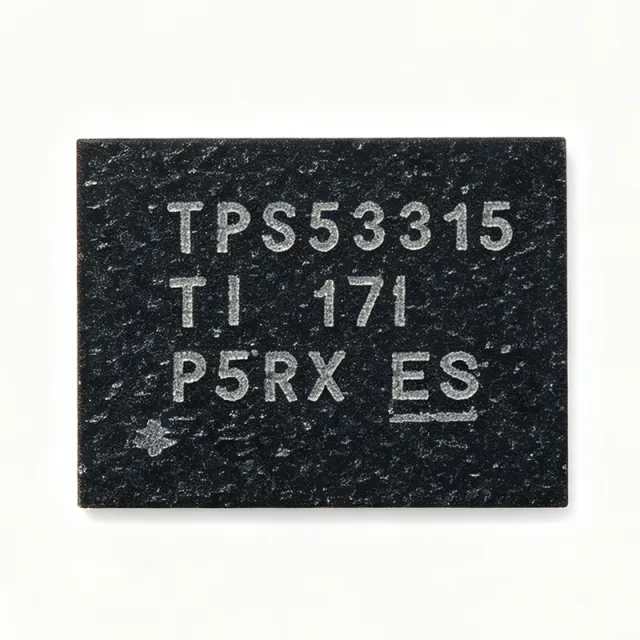
The Texas Instruments TPS53915RVER is a 12-A synchronous step-down (buck) switching regulator with adaptive on-time D-CAP3 control, packaged in a 28-pin VQFN with exposed thermal pad. Verified key specifications include a 1.5-V to 18-V power-stage input with a 4.5-V to 25-V bias input, an adjustable 0.6-V to 5.5-V output at 12 A continuous, 0.5% reference accuracy at 0.6 V, integrated 13.8-mOhm high-side and 5.9-mOhm low-side MOSFETs, a 400-kHz PMBus-trimmed default switching frequency, and PMBus configuration of voltage margining, soft-start, UVLO, and fault reporting. As of 2026-08-30, the part is active in lifecycle status, in stock at 99,999 units on XAIPART with MOQ 1, priced at $6.10 (qty 1) down to $3.48 (qty 1000+). This pillar guide merges a technical design-in guide, alternatives comparison, industry insight, and sourcing outlook into one authoritative resource.
What Are the Quick Answers Buyers and Engineers Need About the TPS53915RVER?
The full FAQ lives in the structured FAQ block and product page, but here are the highest-value direct answers up front. The TPS53915RVER is a TI SWIFT point-of-load synchronous buck converter that delivers 12 A continuous from a 1.5-18 V input (4.5-25 V bias) with a 0.6-5.5 V adjustable output. It uses D-CAP3 adaptive on-time control for fast transient response with low-ESR ceramic output capacitors and very low external component count. Configuration runs over PMBus (SWIFT voltage margining, soft-start time, power-on delay, VDD UVLO level, and fault reporting), with factory trim setting the default 400-kHz switching frequency. The best drop-in replacement is the TPS549A20, which is pin-to-pin compatible and functionally equivalent per TI's E2E power management forum, though it is specified over a wider temperature range and may require minor external component changes. For current stock and pricing, XAIPART lists 99,999 units at $6.10 single-piece and $3.48 at 1000-piece volume, as of 2026-08-30; check the TPS53915RVER product page for live availability.
How Do You Select and Design In the TPS53915RVER?
Start with the electrical window. The power-stage input (PVIN) accepts 1.5 V to 18 V, so the converter connects directly to 5-V, 12-V, and intermediate bus rails. The separate bias input (VDD, pin 13) accepts 4.5 V to 25 V, which lets a 12-V bus feed the power stage while the bias rail tolerates up to 25 V — useful in industrial systems with 24-V rail transients. The regulated output spans 0.6 V to 5.5 V, covering sub-1-V core voltages for DSPs, FPGAs, and ASICs up to standard 5-V logic rails, at up to 12 A continuous.
Understand the control topology. D-CAP3 adaptive on-time control modulates the high-side on-time based on output voltage ripple and inductor current, which delivers three practical benefits: fast load-transient response on the order of microseconds, easy loop stabilization with low-ESR ceramic output capacitors, and very low external component count compared with traditional voltage-mode PWM controllers. The device is factory-trimmed to enable PMBus commands with a default 400-kHz switching frequency, which balances efficiency against small magnetics in telecom and server designs.
Respect the thermal design. The integrated MOSFETs — 13.8 mOhm on the high side and 5.9 mOhm on the low side — carry the full 12 A, so the exposed thermal pad (EP) must be soldered to GND copper to achieve the required heat dissipation at full load. Provide adequate PCB copper area under the VQFN-28 and place the converter close to the load. For FPGA core rails, a 1-2 uH inductor with ceramic output capacitance is the typical application choice per the verified application data.
Configure PMBus correctly before layout. The PMBus interface supports voltage margining and adjustment, soft-start time, power-on delay, VDD UVLO level, and fault reporting. Verify PMBus resistor straps or serial configuration choices against the datasheet sequencing guidance before committing the layout. Note that pins 27 and 28 (TRIM/TEST) form the factory test-and-trim interface and may be grounded; consult the TI datasheet's pin configuration section for the full 28-pin map before routing.
How Does the TPS53915RVER Compare With Its Alternatives?
Only TI-provided data supports this comparison. The table summarizes the verified alternatives from the database.
| Parameter | TPS53915RVER | TPS549A20RVER | TPS53915EVER | TPS53632GRSMR |
|---|---|---|---|---|
| Relationship | Base part | Pin-to-pin compatible, functionally equivalent (per TI E2E) | Same die, extended-temperature ordering variant | Same family class, higher current, not pin-compatible |
| Output current | 12 A continuous | [DATA_NEEDED: full specs] | [DATA_NEEDED: full specs] | [DATA_NEEDED: full specs] |
| Package | VQFN-28 exposed pad | VQFN-28 (per TI E2E forum note) | [DATA_NEEDED: package] | [DATA_NEEDED: package] |
| Substitution note | — | Wider temperature spec; minor external component changes possible | Drop-in within TPS53915 family | Requires redesign; different footprint |
Practical guidance: for a true drop-in replacement, choose the TPS549A20 (same VQFN-28 footprint, functionally equivalent) and verify PMBus trim settings before substitution. For extended-temperature builds of the identical silicon, the TPS53915EVER is the same-die ordering variant. No exact pin-compatible cross-brand equivalent is documented for the TPS53915's VQFN-28 PMBus SWIFT pinout; comparable 12-A-class synchronous buck converters from other vendors require PCB re-layout. Reverse substitution matters too: a TPS53915 placed in a TPS53513 socket defaults to 400 kHz with pins 27-28 grounded, but a TPS53513 will not gain PMBus functionality in the reverse direction.
What Is the Market Position, Lifecycle Status, and Supply Situation?
The TPS53915RVER carries an active lifecycle status in the verified database, meaning TI is still producing the part and no discontinuation notice applies. Supply data as of 2026-08-30 shows 99,999 units in stock at XAIPART with MOQ 1, and pricing tiers of $6.10 (qty 1), $5.49 (qty 10), $4.72 (qty 100), $4.05 (qty 500), and $3.48 (qty 1000+). Verified FAQ data states the part is typically in stock at DigiKey and Mouser with same-day shipping options as of 2026-08-29. [DATA_NEEDED: long-term lifecycle forecast, forecasted demand trends, and manufacturer lead-time projections — not provided in verified data.]
What Trends Should Buyers Watch, Anchored to Verified Specs?
Three buyer-relevant trends emerge from the verified data. First, PMBus-manageable point-of-load conversion is now table stakes for hyperscale and carrier-grade systems: the TPS53915's PMBus voltage margining, soft-start, UVLO, and fault reporting directly serve system health controllers and predictive maintenance programs. Second, single-stage conversion from 12-V distributed buses down to sub-1-V core rails reduces conversion stages and board space — the 1.5-18 V input plus 0.6-5.5 V output window plus 12-A capability is exactly the envelope server, telecom, and FPGA designs demand. Third, watch family-level substitution risk: because the TPS53915 is factory-trimmed for PMBus at 400 kHz while mode-pin-set alternatives like the TPS53513 behave differently in the same socket, always validate trim behavior on any second-source decision. For pricing momentum, the 42% spread between single-unit ($6.10) and 1000-piece ($3.48) pricing as of 2026-08-30 rewards consolidated production buys — monitor the live TPS53915RVER listing and browse the broader DC-DC converters category for family comparisons, with full electrical details in the official TI TPS53915 datasheet.
Comments
Be the first to comment.
🔐 Please sign in to post a comment.
Don't have an account? Sign up