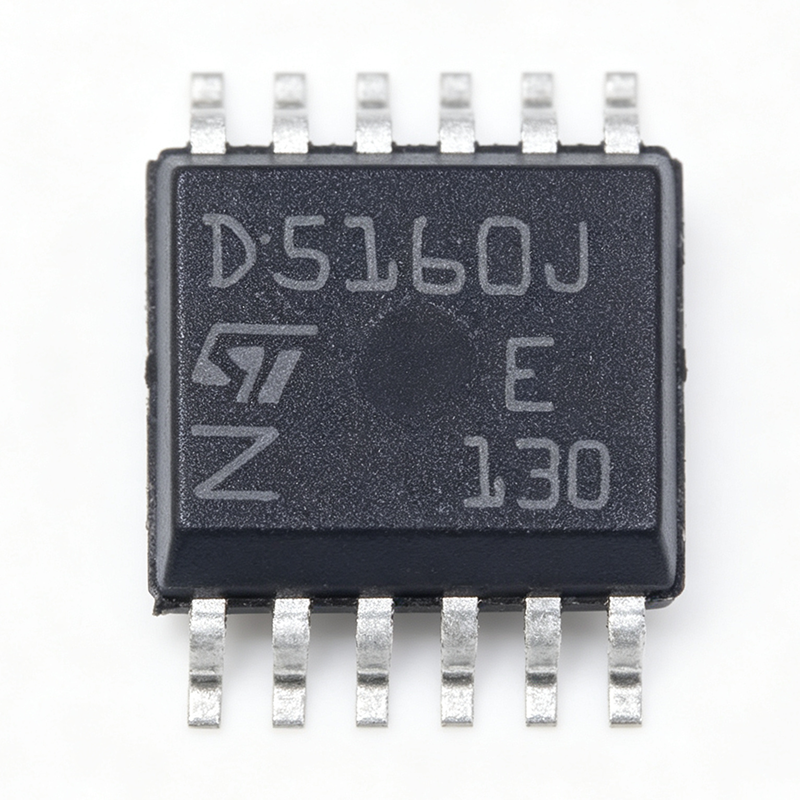
What Is the VND5160J-E and Why Should Engineers Choose It?
The VND5160J-E is a dual-channel automotive high-side driver from STMicroelectronics that integrates a vertical MOSFET power stage with full protection and diagnostics in a PowerSSO-12 surface-mount package. Key verified specifications include a continuous output current of 16A (with proper thermal management), a supply voltage range of 4.5V to 36V covering both 12V and 24V electrical systems, a typical RDS(on) of 60 mOhm at 25°C, and a standby current of only 5 µA. The device is built on STMicroelectronics' VIPower M0-5 technology, is AEC-Q100 qualified and RoHS compliant, and operates from -40°C to +150°C, making it suitable for under-hood applications. As of 2026-09-12, the VND5160J-E is active in lifecycle status, in stock with 99,999 units available on XAIPART, priced at $1.65 per unit at 1,000-piece quantities (MOQ: 1), with single-unit pricing at $2.58.
High-side drivers like the VND5160J-E connect a load to the positive supply rail, providing switching, protection, and diagnostic functions. In automotive body control modules, they replace discrete relays and fuses with a more reliable semiconductor solution, reducing component count while adding real-time fault reporting through the integrated status output. The device drives resistive, inductive, and capacitive loads, with an active VCC pin voltage clamp that protects against low-energy spikes — a critical feature for inductive loads such as solenoids and DC motors.
How Do You Design In and Use the VND5160J-E? A Practical Technical Guide
Designing with the VND5160J-E starts with understanding its architecture: two high-side channels controlled by 3.0V CMOS-compatible inputs, each capable of handling demanding automotive loads. The PowerSSO-12 package offers a junction-to-ambient thermal resistance of 40°C/W, which allows high-current operation without external heatsinking in many applications — but only with proper PCB copper area for heat dissipation, especially when driving currents above 10A.
The device pinout assigns the key functional pins as follows: Pin 1 is VCC (supply voltage input), Pin 2 is OUTPUT1, Pin 3 is OUTPUT2, Pin 4 is INPUT1, Pin 5 is INPUT2, Pin 6 is STATUS (an open-drain fault status output), and Pins 7 and 8 are GND (with Pin 8 serving as the exposed pad). The exposed pad doubles as the primary thermal path, so solder it to a generously sized ground plane. The complete pin table with all package details lives on the VND5160J-E product page.
Follow these design-in steps:
- Thermal design: With 40°C/W junction-to-ambient thermal resistance, calculate temperature rise as RDS(on) × I² × Rth. For a design check, the datasheet is available at https://www.st.com/resource/en/datasheet/vnd5160j-e.pdf. Ensure adequate PCB copper area, particularly above 10A continuous current.
- Control interface: Drive INPUT1 and INPUT2 from a 3.0V-compatible microcontroller GPIO. The inputs are 3.0V CMOS compatible, so no level shifting is typically required in 3.3V or 5V logic systems.
- Diagnostics wiring: Connect the open-drain STATUS pin to a microcontroller input with a pull-up resistor. This enables real-time fault detection of overcurrent, overtemperature, short-circuit, and open-load conditions — open-load detection works in both the ON and OFF states.
- Decoupling and transients: Place proper decoupling capacitors on the supply and output pins to minimize voltage transients during switching. The active VCC pin voltage clamp protects the device against low-energy inductive spikes, supporting inductive loads with one side connected to ground.
- PWM dimming: For LED lighting, apply a PWM signal to the input for dimming. The device's protection features prevent damage from short circuits during switching events.
- Load wiring: The high-side configuration connects the load between output and ground, simplifying chassis wiring in automotive and industrial installations — a major advantage over low-side switching where chassis-ground switching can create corrosion and diagnostic ambiguity.
Compared to a discrete MOSFET solution, the VND5160J-E eliminates external gate drivers, current-sense circuits, and protection logic, which improves reliability and reduces bill-of-materials count. Choose the integrated device when you need protection, diagnostics, and 5 µA standby current in one compact package; choose discretes only when you need [VERIFY_NEEDED: use cases beyond the verified spec set, e.g., very high voltage or ultra-low RDS(on) requirements].
What Are the Best Alternatives to the VND5160J-E?
The verified alternatives from the XAIPART database include the VND5160JTR-E (the identical device in tape-and-reel packaging), plus two lower-current STMicroelectronics variants and one different-topology device. All comparisons below use only verified database values.
| Parameter | VND5160J-E | VND5160JTR-E | VND5160AJ-E | VND5160B-E | BTS7960B |
|---|---|---|---|---|---|
| Topology | Dual-channel high-side | Dual-channel high-side | High-side | High-side | Half-bridge |
| Output current | 16 A (with thermal management) | 16 A (with thermal management) | 5 A | 8 A | [DATA_NEEDED: output current] |
| RDS(on) | 60 mOhm typ at 25°C | 60 mOhm typ at 25°C | 160 mOhm | 100 mOhm | [DATA_NEEDED: RDS(on)] |
| Package | PowerSSO-12 | PowerSSO-12 | PowerSSO-12 | PowerSSO-12 | TO-263-7 |
| Pin-compatible | — | Yes (identical device) | Yes, verify specs | Yes, verify specs | No (different package/topology) |
Selection guidance: For a drop-in replacement, the VND5160JTR-E is the direct answer — it is electrically identical, with the 'TR' suffix indicating tape-and-reel packaging for automated assembly. Choose the VND5160AJ-E when your load only requires 5A and you can accept the higher 160 mOhm RDS(on); choose the VND5160B-E for 8A-class loads at 100 mOhm. Always verify pinout and specifications against the datasheet before substituting the 'A' or 'B' variants. The BTS7960B is not pin-compatible and uses a half-bridge topology suited to bidirectional motor control rather than high-side load switching.
For bidirectional DC motor control (e.g., window lifts with up/down motion), a full H-bridge configuration with two high-side and two low-side drivers is required — a single VND5160J-E channel cannot reverse a motor.
Where Does the VND5160J-E Stand in the Market? Lifecycle, Supply, and Availability
The VND5160J-E carries an active lifecycle status in the XAIPART database, confirming STMicroelectronics continues to manufacture it for automotive and industrial customers. It is AEC-Q100 qualified, which anchors it firmly in the automotive supply chain where long product lifecycles demand multi-year component availability. Supply is currently strong: XAIPART lists 99,999 units in stock as of 2026-09-12, with an MOQ of 1, so prototypes and low-volume builds can order single pieces. Distribution is broad — the device is available from major distributors such as DigiKey, Mouser, and LCSC; as of 2026-08-19, LCSC listed it at $2.5781 and DigiKey listed in-stock items as 'ships today.' For high-volume production, tiered pricing on XAIPART reaches $1.82 at 500 units and $1.65 at 1,000 units (as of 2026-09-12). [DATA_NEEDED: manufacturer lifecycle forecast date and last-time-buy information — not provided in the database.]
What Should Buyers Watch Next? Trends and Outlook for the VND5160J-E
Three trends anchored to the VND5160J-E's verified specifications deserve buyer attention. First, the shift from relay-based load control to intelligent semiconductor switching continues in body electronics: the device's integrated overcurrent, overtemperature, short-circuit, and open-load detection, plus its 5 µA standby current, directly address the always-on diagnostic and low-quiescent-drain requirements of modern battery-powered modules. Expect demand for such integrated smart drivers to grow in BCM and BMS designs. Second, the wide 4.5V to 36V supply range means one design covers both 12V and 24V systems — valuable for platforms that ship into passenger-car, commercial-vehicle, and industrial markets, and relevant as 24V partial architectures expand. Third, pricing at scale matters: at $1.65/unit at 1,000 pieces versus $2.58 single-unit (as of 2026-09-12), consolidating onto the VND5160JTR-E tape-and-reel format for automated assembly reduces both unit cost and placement cost. Buyers should monitor distributor stock levels in real time — while current stock of 99,999 units is deep, AEC-Q100 qualified drivers frequently see allocation during automotive demand surges. [VERIFY_NEEDED: any forward-looking market growth claims are not supported by the provided data and should be verified before publication.]
Comments
Be the first to comment.
🔐 Please sign in to post a comment.
Don't have an account? Sign up