উপশ্রেণী

📁 ADC/DAC 4,000+ পণ্যগুলি 📁 অ্যামপ্লিফায়ার IC 3,600+ পণ্যগুলি 📁 Analog Computation 1 পণ্যগুলি 📁 অডিও কোডেক 18 পণ্যগুলি 📁 অডিও IC 2 পণ্যগুলি 📁 ক্লক ও টাইমিং 1,000+ পণ্যগুলি 📁 Comparator ICs 1 পণ্যগুলি 📁 DSP 1,300+ পণ্যগুলি 📁 ডেটা অ্যাকুইজিশন IC 2 পণ্যগুলি 📁 ডিজিটাল পটেনশিওমিটার 4 পণ্যগুলি 📁 ডিসপ্লে ড্রাইভার ও কন্ট্রোলার 1 পণ্যগুলি 📁 FPGA ও CPLD 8,600+ পণ্যগুলি 📁 ইন্টারফেস IC 5,600+ পণ্যগুলি 📁 LED ড্রাইভার 1 পণ্যগুলি 📁 লজিক IC 790+ পণ্যগুলি 📁 মেমরি IC 870+ পণ্যগুলি 📁 মাইক্রোকন্ট্রোলার 22,000+ পণ্যগুলি 📁 মাইক্রোপ্রসেসর 4 পণ্যগুলি 📁 মোটর ড্রাইভার 1 পণ্যগুলি 📁 অন্যান্য 0 পণ্যগুলি 📁 সেন্সর এবং ডিটেক্টর ইন্টারফেস 1 পণ্যগুলি 📁 বিশেষায়িত IC 15 পণ্যগুলি 📁 ভিডিও IC 14 পণ্যগুলি
পণ্য (48,000+)

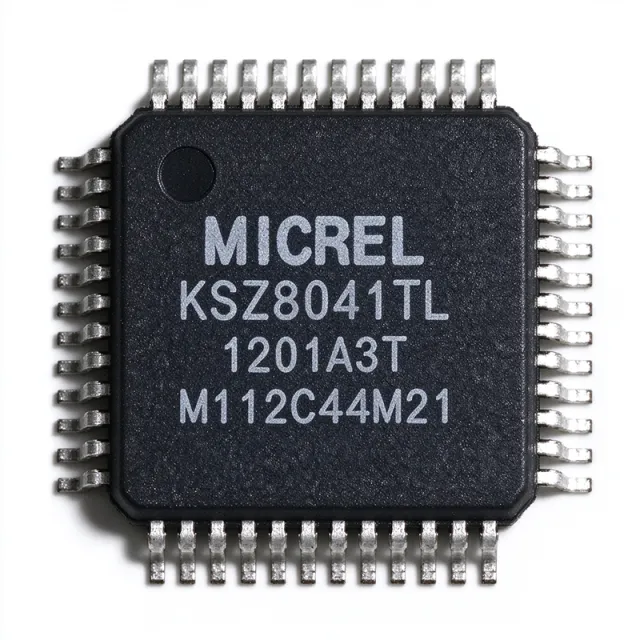
KSZ8041TLI - 10/100 Ethernet PHY | Microchip Technology
KSZ8041TLI

KSZ8041TLI - 10/100 Ethernet PHY | Microchip Technology

The Microchip Technology KSZ8041TLI is a single-channel 10Base-T/100Base-TX Ethernet physical-layer transceiver with full MII, RMII, and SMII interfaces, supplied in a 48-pin TQFP package. The device operates from a single 3.3 V supply and supports IEEE 802.3 and IEEE 802.3u Ethernet operation at 10 Mbps and 100 Mbps. Its integrated mixed-signal design is intended to extend signaling distance while reducing power consumption in compact embedded networking equipment. An Ethernet PHY is the physical-layer component that converts digital data from a MAC or Ethernet controller into analog signaling for a copper network, while receiving and converting incoming signals back into digital data. In the broader hierarchy, the KSZ8041TLI is an Ethernet interface transceiver, a network interface IC, and a semiconductor for Ethernet connectivity. It is appropriate for industrial control, embedded systems, communications equipment, and other designs requiring a dedicated 10/100 Ethernet front end. The verified device information identifies support for auto-negotiation through hardware pin strapping on pin 42 or software using register 0h bit 12. Auto-negotiation follows Clause 28 of the IEEE 802.3u specification and allows link partners to select the highest common operating mode. The same 48-pin TQFP package also supports MII, RMII, and SMII host interfaces, allowing designers to match the PHY to different MAC architectures. The KSZ8041TLI is designed for surface-mount implementation and uses a 3.3 V single-supply architecture. Its mixed-signal approach supports the 10Base-T and 100Base-TX physical layers while controlling power use compared with discrete implementations. The product page also identifies HP Auto MDI/MDIX support, which simplifies connection to both straight-through and crossover cable arrangements in many network designs. Typical uses include embedded Ethernet controllers, industrial automation modules, serial-to-Ethernet equipment, printer controllers, set-top boxes, and communication appliances. When designing around this PHY, verify the exact MAC interface mode, pin strapping requirements, magnetics selection, and termination network against the manufacturer datasheet. The verified data confirms the functional family and package but does not provide a complete pin list, recommended magnetics part numbers, or detailed timing values. This product record combines verified distributor and manufacturer information with practical interface-selection guidance, same-package alternatives, pricing context, and design cautions. The comparison and notes help distinguish temperature, packaging, and interface-option differences without treating functionally similar parts as automatically drop-in replacements.

USD $3.61 স্টক অনুপস্থিত
KSZ8041TLI-S - 10/100 Ethernet PHY | Microchip | TQFP-48
KSZ8041TLI-S

KSZ8041TLI-S - 10/100 Ethernet PHY | Microchip | TQFP-48

The Microchip Technology KSZ8041TLI-S is a single-supply 10BASE-T and 100BASE-TX Ethernet physical-layer transceiver with MII, RMII, and SMII interfaces, packaged in a 48-pin TQFP measuring 7 x 7 mm. It supports 10 Mb/s and 100 Mb/s Ethernet connectivity and incorporates automatic MDI/MDI-X handling for link partner compatibility. An Ethernet physical-layer transceiver, commonly called an Ethernet PHY, converts digital data into the electrical signaling used by 10BASE-T and 100BASE-TX networks. It belongs to the network interface controller and Ethernet transceiver hierarchy, operating between a network media-access controller and the transformer-coupled Ethernet line. The KSZ8041 supports MII, RMII, and SMII host interfaces, allowing integration with controllers operating in parallel, reduced-pin, or source-synchronous signaling configurations. The principal benefits of the KSZ8041TLI-S are its 10/100 Mb/s dual-rate support, three digital host-interface choices, single-supply operation, and mixed-signal design. The manufacturer describes the mixed-signal implementation as extending signaling distance while reducing power consumption. Automatic MDI/MDI-X support also removes the need to configure transmit and receive pairs manually when either straight-through or crossover cabling is used. The device integrates the analog PHY circuitry and digital host-interface functions required for a compact Ethernet front end. Its 48-pin TQFP-48 package provides separate interface and power-related connections on a conventional surface-mount footprint. Because it is a single transceiver, it does not by itself provide two independent copper ports, multi-port switching, or packet processing. Those functions belong to the network controller, switch, or higher-level system around the PHY. Typical uses include embedded control systems, industrial automation equipment, communications modules, print systems, and compact network interfaces that require 10BASE-T or 100BASE-TX connectivity. The MII interface supports designs with a broad parallel signal set, RMII reduces host-side pin requirements, and SMII supports systems configured for source-synchronous signaling. Selection should account for the host controller's supported physical interface and the electrical requirements of the magnetic network interface. Place the PHY, its supporting passive components, and the Ethernet magnetic device according to the manufacturer's reference layout. Keep high-speed host-interface traces short and controlled, provide the specified supply and decoupling arrangement, and account for magnetics and connector placement when defining the Ethernet channel. Verify signal integrity, return loss, insertion loss, and radiated emissions over the intended network interface before production release. This page organizes the official product information, package details, replacement comparisons, interface selection guidance, and practical integration notes into one engineering-focused resource. It also distinguishes confirmed drop-in options from functional alternatives so that footprint, interface, and parameter compatibility can be checked before a PCB substitution is approved.

RFQ যোগাযোগ
KSZ8041TLI-TR - 10/100 Ethernet PHY | Microchip Technology (Tape & Reel)
KSZ8041TLI-TR

KSZ8041TLI-TR - 10/100 Ethernet PHY | Microchip Technology (Tape & Reel)

The Microchip Technology KSZ8041TLI-TR is a single-channel 10Base-T/100Base-TX Ethernet physical-layer transceiver with full MII, RMII, and SMII interfaces, supplied in a 48-pin TQFP package. The device operates from a single 3.3 V supply and supports IEEE 802.3 and IEEE 802.3u Ethernet operation at 10 Mbps and 100 Mbps. Its integrated mixed-signal design is intended to extend signaling distance while reducing power consumption in compact embedded networking equipment. An Ethernet PHY is the physical-layer component that converts digital data from a MAC or Ethernet controller into analog signaling for a copper network, while receiving and converting incoming signals back into digital data. In the broader hierarchy, the KSZ8041TLI-TR is an Ethernet interface transceiver, a network interface IC, and a semiconductor for Ethernet connectivity. It is appropriate for industrial control, embedded systems, communications equipment, and other designs requiring a dedicated 10/100 Ethernet front end. The verified device information identifies support for auto-negotiation through hardware pin strapping on pin 42 or software using register 0h bit 12. Auto-negotiation follows Clause 28 of the IEEE 802.3u specification and allows link partners to select the highest common operating mode. The same 48-pin TQFP package also supports MII, RMII, and SMII host interfaces, allowing designers to match the PHY to different MAC architectures. The KSZ8041TLI-TR is designed for surface-mount implementation and uses a 3.3 V single-supply architecture. Its mixed-signal approach supports the 10Base-T and 100Base-TX physical layers while controlling power use compared with discrete implementations. The product page also identifies HP Auto MDI/MDIX support, which simplifies connection to both straight-through and crossover cable arrangements in many network designs. Typical uses include embedded Ethernet controllers, industrial automation modules, serial-to-Ethernet equipment, printer controllers, set-top boxes, and communication appliances. When designing around this PHY, verify the exact MAC interface mode, pin strapping requirements, magnetics selection, and termination network against the manufacturer datasheet. The verified data confirms the functional family and package but does not provide a complete pin list, recommended magnetics part numbers, or detailed timing values. This product record combines verified distributor and manufacturer information with practical interface-selection guidance, same-package alternatives, pricing context, and design cautions. The comparison and notes help distinguish temperature, packaging, and interface-option differences without treating functionally similar parts as automatically drop-in replacements.

USD $3.61 স্টক অনুপস্থিত
KSZ8051MLL - 100Mbps MII Ethernet PHY | Microchip Technology
KSZ8051MLL

KSZ8051MLL - 100Mbps MII Ethernet PHY | Microchip Technology

Microchip Technology KSZ8051MLL is a single-supply 10Base-T/100Base-TX Ethernet physical-layer transceiver with full MII support, 100 Mbps data rate, and a 48-LQFP 7 x 7 mm package. It operates from a 3.3 V supply with a specified 3.135 V to 3.465 V range and is designed for transmission and reception over standard Category 5 unshielded twisted-pair cable. An Ethernet physical-layer transceiver, or PHY, converts logical data transmitted by a MAC or controller into signals suitable for copper Ethernet wiring and converts received cable signals back into digital data. The KSZ8051MLL belongs to the 10/100 Ethernet PHY category, within interface ICs and the broader Ethernet communications hierarchy. Its full MII interface provides parallel control, data, and status connections to a network controller. The principal operating characteristics are a 100 Mbps maximum data rate, one transmitter and one receiver, and a 3.3 V supply. Manufacturer information identifies support for 1.8 V, 2.5 V, and 3.3 V interface operating levels, depending on the configuration and connected controller. The commercial-temperature version operates from 0°C to +70°C and is supplied in a surface-mount 48-LQFP package. The integrated PHY reduces the amount of external circuitry required for a 10/100 Ethernet endpoint. It handles physical signaling to the network medium while the associated controller manages packet processing and the higher-level protocol stack. Full MII support makes it appropriate for designs that require a conventional parallel Ethernet interface rather than a serial reduced-media interface. Typical applications include industrial Ethernet equipment, embedded network controllers, print servers, IP cameras, building-control gateways, and compact communication modules. The 100 Mbps rate supports Fast Ethernet networks, while MII connectivity allows direct integration with controllers such as LAN9353T/PT and related Ethernet interface devices. PCB implementation requires careful separation between the digital MII signals and the analog magnetics interface. Place network-side filtering and magnetics close to the connector, observe the recommended copper and layout practices in the manufacturer datasheet, and keep high-current and high-speed return paths controlled to reduce radiated emissions and susceptibility to external noise. This page combines the manufacturer product information, interface characteristics, package details, drop-in candidates, and practical Ethernet design guidance. It is intended to help engineers verify mechanical compatibility, MII requirements, supply conditions, and thermal constraints before integrating the KSZ8051MLL into a Fast Ethernet design.

RFQ যোগাযোগ
KSZ8051MLL-TR - 100M Ethernet PHY with MII | Microchip
KSZ8051MLL-TR

KSZ8051MLL-TR - 100M Ethernet PHY with MII | Microchip

The Microchip Technology KSZ8051MLL-TR is a single-supply 10BASE-T/100BASE-TX Ethernet physical-layer transceiver with full Media Independent Interface support, supplied in a 48-lead LQFP package measuring 7 mm by 7 mm. It operates from a 3.3 V supply and is designed for automotive Ethernet applications qualified to AEC-Q100 standards. The integrated PHY provides a physical interface between a 10/100 Ethernet MAC and a CAT-5 or better unshielded twisted-pair network. An Ethernet physical-layer transceiver, or Ethernet PHY, is the circuit that converts digital Ethernet data into signals suitable for transmission over twisted-pair cabling and converts received analog signals back into digital data for the MAC. The KSZ8051 belongs to the interface-IC hierarchy: Ethernet PHY → Ethernet transceiver → physical-layer transceiver → semiconductor. Its MII interface connects directly to an Ethernet MAC while the analog PHY side connects to an RJ45 magnetics or network connector section. Key features include support for both 10 Mb/s and 100 Mb/s Ethernet rates, full MII support, single-supply 3.3 V operation, and AEC-Q100 qualification. The 48-LQFP surface-mount package provides a defined lead arrangement and exposed routing space for power, ground, data, control, and analog network connections. These characteristics make the device suitable for automotive Ethernet nodes, industrial control equipment, embedded gateways, and industrial network switches. The KSZ8051 is a highly integrated PHY solution intended to reduce board cost and simplify PCB layout. A 3.3 V-only system architecture eliminates the need for a separate 5 V transceiver rail. The full MII interface provides a conventional parallel connection to an Ethernet controller, allowing the PHY to support legacy 10/100 Ethernet designs without introducing a proprietary serial interface. Typical applications include 100BASE-TX vehicle-network gateways, industrial Ethernet controllers, embedded communication modules, network-interface adapters, and factory automation equipment. Automotive deployments benefit from the manufacturer’s AEC-Q100 qualification, while industrial designs can use the same PHY for equipment operating near 10BASE-T or 100BASE-TX networks. The principal design task is preserving signal integrity from the PHY through the magnetics and connector while providing a low-impedance 3.3 V plane across the LQFP leads. Place input and output decoupling capacitors close to their associated power pins, route the MII clock and data signals as matched-length groups, and maintain continuous ground-plane return paths beneath and between the PHY and network-interface circuitry. This page combines the manufacturer’s device classification, package information, automotive qualification status, sourcing lifecycle information, and practical PCB guidance with clearly qualified drop-in replacement analysis. It distinguishes electrically and mechanically interchangeable options from related Ethernet PHYs that require redesign.

RFQ যোগাযোগ
KSZ8051MLLI-TR 3.3V 10/100 Ethernet PHY | Microchip
KSZ8051MLLI-TR

KSZ8051MLLI-TR 3.3V 10/100 Ethernet PHY | Microchip

The Microchip Technology KSZ8051MLLI-TR is a 3.3 V, single-supply 10Base-T/100Base-TX Ethernet physical-layer transceiver with full MII support, packaged in a 48-LQFP 7 mm × 7 mm industrial-grade package. It combines a highly integrated 10/100 Ethernet PHY, copper-pair physical interface, and media-independent digital interface for embedded Ethernet equipment. An Ethernet physical-layer transceiver, commonly called an Ethernet PHY, is the interface between a digital network controller and twisted-pair Ethernet cabling. A PHY handles line coding, signal conditioning, and communication with the physical medium. The KSZ8051 belongs to the Ethernet PHY hierarchy, where it sits beneath the Ethernet transceiver category and above the 10Base-T/100Base-TX copper interface. Its full MII interface connects it to an Ethernet MAC or other compatible digital controller. The KSZ8051MLLI-TR supports 10Base-T and 100Base-TX operation from a 3.3 V supply. Full MII support exposes the required digital control and data signals to the connected MAC while keeping the Ethernet physical interface within the dedicated PHY. The integrated solution reduces external magnetics and discrete interface requirements, helping simplify board layouts for industrial control, networking, communications, and automotive-oriented equipment. The Microchip product family combines low power consumption, integrated 10/100 Ethernet capability, and flexible interface support in a compact surface-mount package. The MLLI variant is identified as industrial grade, while the broader KSZ8051 family is described by Microchip as AEC-Q100 standard qualified for automotive applications. Package, temperature, qualification, and ordering requirements should therefore be matched to the specific product variant and end-use requirements. Typical uses include industrial Ethernet controllers, embedded network modules, factory automation equipment, serial-to-Ethernet systems, IP cameras, access-control terminals, and automotive communications modules. In each case, the PHY supports copper Ethernet connectivity while the system MAC handles higher-layer traffic and protocol processing. Board designers must also implement appropriate magnetic isolation and line-side network protection according to the manufacturer application guidance. Place input, output, and crystal-related components exactly as specified in the manufacturer reference circuit, and route differential TX and RX pairs as controlled-impedance, tightly coupled traces. Maintain the required spacing between PHY and magnetics, use a continuous ground reference, and follow the pin-description table in the manufacturer datasheet when assigning connector and magnetic-component connections. This product overview combines the core KSZ8051 operating characteristics with practical PCB, interface, and sourcing guidance. It helps engineers distinguish the full-MII 48-LQFP device from smaller-package alternatives and identify where verified drop-in alternatives are genuinely pin-compatible rather than merely functionally similar.

RFQ যোগাযোগ
KSZ8051MNL - 10/100 Ethernet MII PHY | Microchip Technology
KSZ8051MNL

KSZ8051MNL - 10/100 Ethernet MII PHY | Microchip Technology

The Microchip Technology KSZ8051MNL is a single-supply 10BASE-T/100BASE-TX automotive Ethernet physical-layer transceiver with a full Media Independent Interface (MII), supplied in a 32-pin QFN package measuring 5 mm by 5 mm. It is designed to connect an Ethernet MAC or equivalent controller to standard CAT-5 unshielded twisted-pair cabling while supporting 10 Mbps and 100 Mbps operation. An Ethernet physical-layer transceiver is the network-interface circuit that converts digital data from a media-access controller into differential signaling suitable for twisted-pair cabling, then converts received signals back into digital data. Within the broader hierarchy of Ethernet interface components, the KSZ8051MNL belongs to the PHY class, sits below the network interface controller, and ultimately forms part of a complete Ethernet communication system. The KSZ8051 family is AEC-Q100 standard qualified for automotive applications. The manufacturer describes the KSZ8051 as a highly integrated PHY solution that reduces board cost and simplifies layout through on-chip termination resistors for the differential pairs. It also integrates a low-noise regulator that supplies the 1.2 V core. These features place more of the analog network interface inside the package while reducing the number of external support components needed on the PCB. The KSZ8051MNL provides the full MII interface, distinguishing it from the KSZ8051RNL version, which uses the Reduced Media Independent Interface. This distinction is important during product selection because RMII and MII are not interchangeable bus arrangements. The MII version is appropriate when the connected controller exposes the required parallel MII signals, clocks, and control lines. Typical uses include automotive Ethernet gateways, vehicle domain controllers, infotainment platforms, industrial Ethernet equipment, and other 10/100BASE-TX endpoints. In an automotive design, the device can support a wired network connection while the AEC-Q100 qualification provides an automotive-oriented component option. Its integrated 1.2 V regulator and on-chip termination simplify the analog implementation, although the power supply, magnetic-component interface, decoupling, and signal-integrity layout still require careful implementation. For layout, follow the manufacturer datasheet when assigning the 32 QFN connections and routing the MII and differential Ethernet signals. Keep the 1.2 V bypass capacitor close to its supply pin, route the differential pairs as a controlled-impedance pair, and provide the magnetic-interface network recommended by the datasheet. These practices reduce board-area requirements and help preserve the performance of the integrated PHY. This product page combines the manufacturer’s device description, package and interface information, documented automotive qualification, source links, and practical implementation guidance. It also distinguishes the MII KSZ8051MNL from RMII and migration-related devices so engineers can identify the appropriate family member without relying on a superficial package-size match.

RFQ যোগাযোগ
KSZ8051MNL-TR - 10/100 Ethernet PHY | Microchip Technology
KSZ8051MNL-TR

KSZ8051MNL-TR - 10/100 Ethernet PHY | Microchip Technology

The Microchip Technology KSZ8051MNL-TR is a single-supply 10BASE-T/100BASE-TX automotive Ethernet physical-layer transceiver packaged in a 32-QFN (5 x 5 mm) package. It provides one Ethernet transceiver, full MII connectivity, and IEEE 802.3 management interface support for automotive Ethernet links over twisted-pair cabling. The device is AEC-Q100 standard qualified and incorporates an internal 1.2 V supply for its analog core. An Ethernet physical-layer transceiver, or Ethernet PHY, converts digital frames exchanged with a network controller into electrical signals suitable for twisted-pair transmission and reconstructs incoming signals for the MAC. The PHY sits between the Ethernet MAC and the transformer-coupled network cable, implementing the physical signaling required by 10BASE-T and 100BASE-TX networks. The KSZ8051 therefore belongs to the interface-IC hierarchy: Ethernet PHY, network interface, integrated circuit, and semiconductor. The KSZ8051 supports both 10BASE-T and 100BASE-TX operation from a single supply. Its full Media Independent Interface provides parallel data, control, and status connections to a compatible Ethernet controller. IEEE 802.3 MDIO management support allows an upper-layer controller to monitor and control PHY status. According to the Microchip product page, the highly integrated PHY reduces board cost and simplifies layout, while the internal 1.2 V rail eliminates the need for a separate 1.2 V supply at the device level. The automotive qualification is a defining feature for this family. Automotive electronic systems require predictable operation across demanding temperature, vibration, and EMC environments. AEC-Q100 qualification makes the KSZ8051 suitable for qualified vehicle-network designs when the complete system also satisfies applicable automotive EMC and network requirements. The MNL suffix identifies the 32-QFN device, and the -TR suffix identifies the tape-and-reel ordering option. Typical uses include automotive Ethernet gateways, body and chassis controllers, infotainment systems, vehicle access networks, and industrial or embedded Ethernet equipment using MII-connected controllers. In these systems, the PHY handles the physical layer while the host controller handles frames, protocol processing, and higher-layer networking. The MII boundary keeps the PHY suitable for controllers designed around a parallel bus rather than a serial Media Independent Interface. Layout is especially important because the PHY interfaces directly to a cable transformer through differential analog pins. Decoupling capacitors should be placed at the supply pins, the 1.2 V output should be decoupled as directed by the reference design, and the analog pair should follow the manufacturer’s differential-routing and return-path guidance. Keeping switching circuitry and high-current paths away from the PHY reduces susceptibility to radiated and conducted noise. This page consolidates the device function, qualified automotive positioning, package details, interface information, migration considerations, practical layout guidance, and confirmed same-footprint alternatives. It also distinguishes a true replacement from a related 32-QFN Ethernet PHY whose pins or registers differ, helping engineers avoid replacements that require schematic or firmware changes.

RFQ যোগাযোগ
KSZ8051MNLI-TR - 10/100 Ethernet PHY | Microchip
KSZ8051MNLI-TR

KSZ8051MNLI-TR - 10/100 Ethernet PHY | Microchip

The Microchip KSZ8051MNLI-TR is a single-channel 10Base-T/100Base-TX Ethernet physical-layer transceiver with a full MII interface, single 3.3 V supply, and a 32-pin QFN package measuring 5 mm by 5 mm. It is an AEC-Q100-standard-qualified Ethernet PHY designed for automotive Ethernet equipment. An Ethernet physical-layer transceiver, commonly called an Ethernet PHY, converts logical data transmitted by a host controller into signals suitable for twisted-pair cabling and converts received cable signals back into digital data. In the hierarchy of electronic components, the KSZ8051 is an Ethernet interface IC, a physical-layer transceiver, and a semiconductor integrated into automotive networking and industrial communication equipment. The KSZ8051MNLI-TR supports 10Base-T and 100Base-TX operation while exposing a full Media Independent Interface to the host controller. Its 3.3 V single-supply operation simplifies power planning, and the 5 mm by 5 mm QFN package limits board area compared with larger Ethernet transceiver packages. The exposed-pad construction supports heat dissipation when the PHY is placed near a high-temperature automotive controller. Automotive qualification is a defining feature of this device. AEC-Q100-standard qualification indicates that the KSZ8051 family is intended for automotive environmental and reliability requirements. The package is specified as a surface-mount 32-QFN with an exposed pad, and the package height is 0.90 mm. These physical characteristics make the device suitable for compact electronic control units, infotainment platforms, vehicle gateways, and automotive domain controllers. Typical implementations place the KSZ8051 between a 100Base-TX Ethernet transformer and an Ethernet-capable microcontroller or SoC. The full MII interface provides separate management, transmit, and receive paths. Designers must account for the line-side transformer, magnetic isolation, controlled-impedance traces, termination, decoupled supply rails, and exposed-pad layout when constructing a production board. The KSZ8051MNLI-TR is marked obsolete by the manufacturer. New designs should therefore confirm lifecycle requirements before committing to it, while existing automotive and industrial products may require an exact-footprint continuity strategy. The tape-and-reel ordering suffix identifies the production packing format, while the base device suffix identifies the package, temperature, and qualification configuration. This product page combines the manufacturer’s device positioning, package details, qualification information, lifecycle status, and cross-reference analysis with practical guidance for Ethernet-PHY implementation. It also distinguishes same-footprint continuity candidates from assemblies that require broader electrical and firmware review before substitution.

RFQ যোগাযোগ
KSZ8051MNLU-TR - 3.3V 10/100 Ethernet PHY | Microchip
KSZ8051MNLU-TR

KSZ8051MNLU-TR - 3.3V 10/100 Ethernet PHY | Microchip

The Microchip KSZ8051MNLU-TR is a single-port 10Base-T/100Base-TX Ethernet physical-layer transceiver designed for 3.3V operation and packaged in a 32-QFN package measuring 5 mm by 5 mm. It provides one transceiver channel, Full MII connectivity to a network controller, and support for 10 Mbps and 100 Mbps data rates over standard Category 5 unshielded twisted-pair cabling. An Ethernet physical-layer transceiver, commonly called an Ethernet PHY, converts logical data transmitted by a network controller into signals suitable for copper cabling and recovers those signals at the receiving endpoint. The KSZ8051 belongs to the physical-layer function within the Ethernet network interface hierarchy, where it works alongside a MAC or Ethernet controller. Its highly integrated architecture reduces the external circuitry required for a 10/100 Ethernet copper interface. The KSZ8051 family is AEC-Q100 standard qualified for automotive applications and uses a single 3.3V supply. Key operating parameters include support for 10Base-T and 100Base-TX, one Ethernet channel, a Full MII interface, and a 32-QFN 5 mm by 5 mm package. These characteristics make the device suitable for compact automotive Ethernet nodes, body modules, infotainment platforms, and industrial network equipment operating with 10/100 Ethernet links. The device is designed to connect to an Ethernet controller through a Full MII interface. This interface provides the parallel data path between the MAC and PHY, allowing the KSZ8051 to handle the physical encoding and line signaling required by 10Base-T and 100Base-TX networks. Its single-port configuration supports one physical Ethernet cable connection per device, making board partitioning straightforward when a system requires multiple independent network ports. Automotive Ethernet equipment, including gateways, domain controllers, infotainment modules, and vehicle networking equipment, can use the KSZ8051 when a 10/100 Mbps copper connection is sufficient. Industrial controls, building automation, embedded communication equipment, and test systems are additional suitable environments because the device combines a compact package with a standardized Full MII host interface. PCB implementation should prioritize a controlled 3.3V supply, correct exposed-pad soldering, and the manufacturer-recommended magnetics and passives around the copper PHY interface. Keep high-current digital return paths separated from sensitive transformer-side circuitry, and use the pin-description table in the manufacturer datasheet when assigning tracks. Automotive designs must also account for the qualified temperature grade and all applicable environmental requirements. This page organizes the KSZ8051MNLU-TR electrical facts, package details, comparison points, and replacement guidance with practical design information for engineers evaluating the Microchip PHY. It is intended to support faster sourcing and board-design decisions while keeping the distinction between the base MNLU device and its ordered -TR tape-and-reel configuration clear.

RFQ যোগাযোগ
KSZ8051RNL-TR - 10/100 Ethernet PHY | Microchip Technology
KSZ8051RNL-TR

KSZ8051RNL-TR - 10/100 Ethernet PHY | Microchip Technology

Microchip Technology KSZ8051RNL-TR is a single-supply 10BASE-T/100BASE-TX Ethernet physical-layer transceiver with an RMII v1.2 interface, supporting data rates up to 100 Mbps in a 32-QFN 5 x 5 mm package. The device is AEC-Q100 qualified for automotive applications and includes a 50 MHz reference-clock output to the MAC, with an option to use an externally supplied 50 MHz reference clock. An Ethernet physical-layer transceiver, or Ethernet PHY, converts digital MAC-layer data into signals suitable for twisted-pair cabling and recovers those signals at the receiving endpoint. In the signal-chain hierarchy, the KSZ8051 sits between an Ethernet MAC controller and a network transformer or integrated magnetic device. It implements the physical signaling required by IEEE 802.3 networks while leaving frame processing and higher-layer protocol work to the MAC. Key features include support for both 10BASE-T and 100BASE-TX links, full RMII operation, MDC/MDIO management access, and back-to-back mode for copper repeater or media-converter designs. The integrated PHY reduces external circuitry and simplifies board layout. Its single-supply architecture also simplifies power planning compared with multi-rail Ethernet transceiver designs. The KSZ8051RNL includes the transmit and receive functions required for copper Ethernet. According to the manufacturer datasheet, the 10BASE-T drivers use wave shaping and pre-emphasis, with a typical 10BASE-T output amplitude of 2.5 V peak. In RMII mode, the PHY can present a 50 MHz reference to the MAC or accept a 50 MHz reference from the system, supporting common embedded and automotive Ethernet architectures. Typical uses include automotive Ethernet nodes, industrial controllers, network interface controllers, media converters, and 100 Mbps copper repeaters. Back-to-back operation allows two KSZ8051RNL devices to form a copper repeater, while an RMII-compatible KSZ8041 can support a media-converter arrangement. These use cases benefit from the combination of IEEE 802.3 signaling, AEC-Q100 qualification, MDC/MDIO management, and compact 32-QFN packaging. PCB design should preserve the differential signal integrity of each Ethernet pair, provide the required magnetic-device interface, and follow the manufacturer's reference schematic for decoupling and exposed-pad connections. Power routing must accommodate the transceiver's operating supply range, and clock and RMII traces should be laid out to minimize timing disturbance and edge-rate crosstalk. This page consolidates the KSZ8051RNL-TR functional characteristics, same-footprint family variants, application guidance, and practical design considerations into a concise engineering reference for Ethernet PHY selection and PCB implementation.

RFQ যোগাযোগ
KSZ8051RNLI-TR - 10/100 Ethernet PHY | Microchip Technology
KSZ8051RNLI-TR

KSZ8051RNLI-TR - 10/100 Ethernet PHY | Microchip Technology

Microchip Technology KSZ8051RNLI-TR is a single-supply 10Base-T/100Base-TX Ethernet physical-layer transceiver with one transmitter and one receiver, full-duplex operation, and RMII interfacing. The device is supplied in a 32-pin QFN package with an exposed pad and is identified by Microchip as AEC-Q100 standard qualified for automotive applications. Its 1.8 V, 2.5 V, and 3.3 V supply options place it in the Ethernet interface IC and physical-layer transceiver category. An Ethernet PHY is the physical-layer component that converts digital frame data into signals suitable for transmission over twisted-pair cabling, while converting received signals back into digital data for the Ethernet MAC. The KSZ8051 supports both 10 Mb/s and 100 Mb/s operation, providing compatibility with 10/100Base-TX networks, industrial Ethernet equipment, automotive electronics, and embedded systems that use an RMII interface to an Ethernet controller. The KSZ8051 family integrates a highly integrated PHY solution in a compact 32-QFN package. Key characteristics include a single 1/1 transceiver arrangement, full-duplex operation, and support for 1.8 V, 2.5 V, and 3.3 V supply rails. Its automotive qualification makes the family suitable for applications requiring an AEC-Q100-qualified Ethernet physical layer, although system designers must also verify operating-temperature, interface, and automotive-qualification requirements for the exact orderable suffix. The RMII interface reduces the number of parallel signals required between the PHY and the Ethernet MAC. This can simplify routing on compact embedded boards compared with parallel MII implementations, but it also requires careful clock, data, and power sequencing. The exposed pad provides the primary thermal and electrical connection from the QFN package to the PCB and should be connected according to the manufacturer land pattern. Typical uses include automotive Ethernet gateways, industrial controllers, network adapters, embedded Linux platforms, and connected equipment operating over standard 10/100Base-TX copper cabling. In an automotive design, the PHY may sit beside a qualified Ethernet controller, allowing data to move between a host processor and an external network while maintaining a compact surface-mount footprint. Designers should preserve the manufacturer’s recommended decoupling and high-speed trace geometry, connect the exposed pad to the designated ground plane, and keep the RMII clock and data routes away from noisy power-converter nodes. Because this orderable number is obsolete and no longer manufactured, long-lived automotive or industrial programs should confirm lifecycle handling and replacement planning through the Request a Quote form on this page. This page combines the manufacturer product description, lifecycle status, package details, cross-reference information, and application-specific design guidance. It also distinguishes true package-compatible alternatives from broader Ethernet PHY options so engineers can assess replacement decisions against footprint, interface, qualification, and feature requirements before modifying a production design.

RFQ যোগাযোগ
KSZ8051RNLU-TR - 100BASE-TX Automotive Ethernet PHY | Microchip
KSZ8051RNLU-TR

KSZ8051RNLU-TR - 100BASE-TX Automotive Ethernet PHY | Microchip

The Microchip Technology KSZ8051RNLU-TR is a single-supply 10Base-T/100Base-TX Ethernet physical-layer transceiver designed for automotive networking and industrial equipment. It supports 100BASE-TX operation at 100 Mb/s, provides a full RMII interface, and is packaged in a 32-QFN 5 x 5 mm surface-mount package. The device is AEC-Q100 standard qualified for automotive applications. An Ethernet physical-layer transceiver, commonly called an Ethernet PHY, converts between digital data supplied by a network controller and analog signals carried over twisted-pair cabling. The PHY belongs to the Ethernet interface hierarchy, where it sits between an RMII-compatible MAC or microcontroller and a 10/100BASE-T network. Its primary function is line coding, signal conditioning, clock recovery, and recovery of data from the physical network medium. The KSZ8051 combines 10BASE-T and 100BASE-TX support in one highly integrated device. Its single-supply architecture reduces the number of external rails required in compact automotive electronic control units. The full RMII connection supports a conventional reduced media-independent interface between the PHY and the host controller, helping simplify software integration and provide a standard path for exchanging transmit, receive, management, and clock signals. AEC-Q100 standard qualification is the principal differentiator for automotive use. This qualification addresses the reliability requirements associated with automotive operating environments rather than guaranteeing a specific temperature range for every ordering code. The integrated design can reduce board area and component count compared with discrete magnetics, bias circuitry, and signal-conditioning networks. Microchip describes the KSZ8051 as a highly integrated PHY solution intended to reduce board cost and simplify layout. Typical uses include automotive infotainment, body-control modules, head units, vehicle gateways, and industrial Ethernet equipment requiring 100 Mb/s twisted-pair connectivity. The part is also appropriate for compact embedded controllers that expose an RMII interface and need a dedicated Ethernet front end. In these systems, the host processor handles the network protocol stack while the KSZ8051 performs the physical-layer signal exchange over CAT5e or compatible twisted-pair cabling. PCB implementation requires careful separation between digital RMII signals and the analog magnetics interface. The manufacturer layout guidance and datasheet pin description should be followed for 50-ohm impedance control, differential-pair routing, crystal or clock source configuration, grounding, and magnetic-component placement. Decoupling capacitors should be positioned directly beside the relevant supply pins to minimize high-frequency supply noise on the sensitive analog and digital sections of the PHY. This page organizes the automotive Ethernet PHY capabilities, sourcing information, practical layout guidance, and qualified same-footprint alternatives into one engineering reference. The comparison tables also distinguish package, interface, qualification, and application differences so engineers can evaluate replacement options without confusing similar suffixes or redesign-level alternatives with true drop-in choices.

RFQ যোগাযোগ
KSZ8061MNXI - 10/100 Ethernet PHY | Microchip | 32-QFN
KSZ8061MNXI

KSZ8061MNXI - 10/100 Ethernet PHY | Microchip | 32-QFN

Microchip Technology KSZ8061MNXI is a single-chip 10Base-T/100Base-TX Ethernet physical-layer transceiver supporting 10 Mb/s and 100 Mb/s operation over unshielded twisted-pair cable. The device uses a 3.135 V to 3.465 V supply range and is offered in a 32-pin QFN package with an exposed pad measuring 5 mm by 5 mm. Its integrated Ethernet transceiver combines a physical-layer device with digital signaling for network-interface equipment. An Ethernet PHY, or physical-layer transceiver, is the circuit that converts digital Ethernet data into signals suitable for twisted-pair cabling and reconstructs incoming signals for the digital MAC controller. Within the Ethernet hierarchy, the PHY connects the data-link and physical layers, while the MAC handles frame processing and higher-layer software support. The KSZ8061 therefore serves as the physical interface between a network controller and an RJ45-based copper Ethernet connection. The KSZ8061 family includes Microchip Quiet-WIRE technology, which provides internal filtering intended to reduce line-side EMI. This filtering can simplify magnetics selection and improve signal quality in compact network products. The PHY supports both 10 Mb/s and 100 Mb/s rates, making it suitable for embedded controllers, industrial equipment, access devices, printers, IP telephones, and embedded Ethernet systems that require a compact copper-network interface. The KSZ8061 integrates the functions required for 10Base-T and 100Base-TX physical signaling, while the host controller supplies the digital Ethernet interface and network-management functions. Its 3.3 V-class operating range is compatible with conventional 3.3 V digital systems when signal levels and power sequencing are designed accordingly. The 32-QFN package reduces board area compared with larger leaded packages and requires careful layout of high-frequency and mixed-signal connections. Typical implementations place the PHY close to the network connector and route differential transmit and receive pairs according to the manufacturer reference design. The Ethernet magnetics, RJ45 connector, center-tap termination, isolation components, and exposed-pad ground connection all influence signal integrity. Placement should minimize return-path discontinuity and keep high-current or switching nodes away from the differential pairs. Thermal design should account for dissipation in the PHY, magnetics, and connector assembly rather than relying only on the nominal ambient temperature. Use the exposed pad and its PCB land pattern for heat spreading, provide a low-impedance ground plane, and follow the manufacturer layout and grounding guidance. Confirm final compliance with the applicable EMC and network-interface requirements for the finished product rather than the component alone. This page combines the exact package and interface information, sourcing guidance, application-focused engineering guidance, and a strict comparison of identified same-package options. It helps engineers determine whether the KSZ8061MNXI fits a 10/100 copper-Ethernet design and how to plan the supporting PCB, magnetics, grounding, and compliance work.

RFQ যোগাযোগ
KSZ8061MNXI-TR - 10/100 Ethernet PHY | Microchip | 32-QFN (Tape & Reel)
KSZ8061MNXI-TR

KSZ8061MNXI-TR - 10/100 Ethernet PHY | Microchip | 32-QFN (Tape & Reel)

Microchip Technology KSZ8061MNXI-TR is a single-chip 10Base-T/100Base-TX Ethernet physical-layer transceiver supporting 10 Mb/s and 100 Mb/s operation over unshielded twisted-pair cable. The device uses a 3.135 V to 3.465 V supply range and is offered in a 32-pin QFN package with an exposed pad measuring 5 mm by 5 mm. Its integrated Ethernet transceiver combines a physical-layer device with digital signaling for network-interface equipment. An Ethernet PHY, or physical-layer transceiver, is the circuit that converts digital Ethernet data into signals suitable for twisted-pair cabling and reconstructs incoming signals for the digital MAC controller. Within the Ethernet hierarchy, the PHY connects the data-link and physical layers, while the MAC handles frame processing and higher-layer software support. The KSZ8061 therefore serves as the physical interface between a network controller and an RJ45-based copper Ethernet connection. The KSZ8061 family includes Microchip Quiet-WIRE technology, which provides internal filtering intended to reduce line-side EMI. This filtering can simplify magnetics selection and improve signal quality in compact network products. The PHY supports both 10 Mb/s and 100 Mb/s rates, making it suitable for embedded controllers, industrial equipment, access devices, printers, IP telephones, and embedded Ethernet systems that require a compact copper-network interface. The KSZ8061 integrates the functions required for 10Base-T and 100Base-TX physical signaling, while the host controller supplies the digital Ethernet interface and network-management functions. Its 3.3 V-class operating range is compatible with conventional 3.3 V digital systems when signal levels and power sequencing are designed accordingly. The 32-QFN package reduces board area compared with larger leaded packages and requires careful layout of high-frequency and mixed-signal connections. Typical implementations place the PHY close to the network connector and route differential transmit and receive pairs according to the manufacturer reference design. The Ethernet magnetics, RJ45 connector, center-tap termination, isolation components, and exposed-pad ground connection all influence signal integrity. Placement should minimize return-path discontinuity and keep high-current or switching nodes away from the differential pairs. Thermal design should account for dissipation in the PHY, magnetics, and connector assembly rather than relying only on the nominal ambient temperature. Use the exposed pad and its PCB land pattern for heat spreading, provide a low-impedance ground plane, and follow the manufacturer layout and grounding guidance. Confirm final compliance with the applicable EMC and network-interface requirements for the finished product rather than the component alone. This page combines the exact package and interface information, sourcing guidance, application-focused engineering guidance, and a strict comparison of identified same-package options. It helps engineers determine whether the KSZ8061MNXI-TR fits a 10/100 copper-Ethernet design and how to plan the supporting PCB, magnetics, grounding, and compliance work.

RFQ যোগাযোগ
KSZ8061RNBW - 10/100 Ethernet PHY | Microchip | 32-QFN
KSZ8061RNBW

KSZ8061RNBW - 10/100 Ethernet PHY | Microchip | 32-QFN

The Microchip Technology KSZ8061RNBW is a single-channel 10BASE-T/100BASE-TX Ethernet physical-layer transceiver with a 32-QFN 5 x 5 mm package and 3.3 V supply operation. It supports data rates of 10 Mb/s and 100 Mb/s over unshielded twisted-pair cable, integrating the digital media-access-control-side interface, analog transmit and receive channels, filtering, and link-management functions in one device. An Ethernet physical-layer transceiver, commonly called an Ethernet PHY, is the interface between a network controller and physical copper cable. The PHY belongs to the Ethernet interface IC hierarchy, where a link-layer controller transfers frames through the PHY to a 10/100BASE-TX network. Its primary roles are line coding, signal shaping, receive equalization, link detection, and recovery of valid data from the physical medium. The KSZ8061 offers two supported Ethernet speeds, 10 Mb/s and 100 Mb/s, in a compact 32-QFN package measuring 5 x 5 mm. It operates from a 3.3 V supply and incorporates Quiet-WIRE internal filtering, a Microchip feature intended to reduce line noise and improve signal quality in network equipment. These characteristics make the device suitable for compact Ethernet endpoints that require 10/100BASE-TX connectivity without a separate magnetics-based implementation. The KSZ8061 family integrates the physical-layer functions required for transmission and reception over unshielded twisted-pair media. Full-duplex operation is supported, while internal Quiet-WIRE filtering addresses unwanted signal content on the line. The small 5 x 5 mm QFN footprint supports dense equipment layouts, but its exposed thermal and electrical requirements still demand careful PCB planning and controlled layout of high-speed differential nets. Typical uses include industrial Ethernet controllers, embedded network equipment, network interface cards, print servers, IP cameras, and compact communications equipment. In these systems, the KSZ8061 provides the physical copper interface while an Ethernet MAC or communications controller handles frame processing. Designers should pair it with suitable magnetics or an integrated network interface arrangement and implement a manufacturer-recommended 100-ohm differential transmission environment. PCB implementation requires short, symmetric differential routing from the PHY to the network connector or magnetics, continuous reference planes, controlled impedance, and unobstructed return paths. Decoupling capacitors should be connected close to the supply and ground pins. Differential pair routing, isolation from noisy switching circuitry, and verification with Ethernet compliance testing are more important than raw component count when achieving reliable 100BASE-TX performance. This product page organizes the KSZ8061RNBW specifications, application guidance, verified source links, and carefully scoped replacement information. It also identifies the electrical, package, lifecycle, and pin-level details that should be confirmed in the manufacturer datasheet before schematic release or PCB layout.

RFQ যোগাযোগ
KSZ8061RNBW-TR - 10/100 Ethernet PHY | Microchip | 32-QFN (Tape & Reel)
KSZ8061RNBW-TR

KSZ8061RNBW-TR - 10/100 Ethernet PHY | Microchip | 32-QFN (Tape & Reel)

The Microchip Technology KSZ8061RNBW-TR is a single-channel 10BASE-T/100BASE-TX Ethernet physical-layer transceiver with a 32-QFN 5 x 5 mm package and 3.3 V supply operation. It supports data rates of 10 Mb/s and 100 Mb/s over unshielded twisted-pair cable, integrating the digital media-access-control-side interface, analog transmit and receive channels, filtering, and link-management functions in one device. An Ethernet physical-layer transceiver, commonly called an Ethernet PHY, is the interface between a network controller and physical copper cable. The PHY belongs to the Ethernet interface IC hierarchy, where a link-layer controller transfers frames through the PHY to a 10/100BASE-TX network. Its primary roles are line coding, signal shaping, receive equalization, link detection, and recovery of valid data from the physical medium. The KSZ8061 offers two supported Ethernet speeds, 10 Mb/s and 100 Mb/s, in a compact 32-QFN package measuring 5 x 5 mm. It operates from a 3.3 V supply and incorporates Quiet-WIRE internal filtering, a Microchip feature intended to reduce line noise and improve signal quality in network equipment. These characteristics make the device suitable for compact Ethernet endpoints that require 10/100BASE-TX connectivity without a separate magnetics-based implementation. The KSZ8061 family integrates the physical-layer functions required for transmission and reception over unshielded twisted-pair media. Full-duplex operation is supported, while internal Quiet-WIRE filtering addresses unwanted signal content on the line. The small 5 x 5 mm QFN footprint supports dense equipment layouts, but its exposed thermal and electrical requirements still demand careful PCB planning and controlled layout of high-speed differential nets. Typical uses include industrial Ethernet controllers, embedded network equipment, network interface cards, print servers, IP cameras, and compact communications equipment. In these systems, the KSZ8061 provides the physical copper interface while an Ethernet MAC or communications controller handles frame processing. Designers should pair it with suitable magnetics or an integrated network interface arrangement and implement a manufacturer-recommended 100-ohm differential transmission environment. PCB implementation requires short, symmetric differential routing from the PHY to the network connector or magnetics, continuous reference planes, controlled impedance, and unobstructed return paths. Decoupling capacitors should be connected close to the supply and ground pins. Differential pair routing, isolation from noisy switching circuitry, and verification with Ethernet compliance testing are more important than raw component count when achieving reliable 100BASE-TX performance. This product page organizes the KSZ8061RNBW-TR specifications, application guidance, verified source links, and carefully scoped replacement information. It also identifies the electrical, package, lifecycle, and pin-level details that should be confirmed in the manufacturer datasheet before schematic release or PCB layout.

RFQ যোগাযোগ
KSZ8061RNDW - 10/100 Ethernet PHY | Microchip | 32-QFN
KSZ8061RNDW

KSZ8061RNDW - 10/100 Ethernet PHY | Microchip | 32-QFN

Microchip Technology KSZ8061RNDW is a single-channel 10BASE-T/100BASE-TX Ethernet physical-layer transceiver with a stated operating data rate of 10 Mb/s to 100 Mb/s. It is packaged in a 32-pin QFN with exposed pad (EP), measuring 5 mm by 5 mm, and operates from a 3.3 V supply. The KSZ8061 family uses Quiet-WIRE internal filtering to reduce line noise and is designed for data transmission and reception over unshielded twisted-pair cable. An Ethernet physical-layer transceiver, or Ethernet PHY, converts digital data into signals suitable for twisted-pair cabling and recovers digital data from received signals. In the system hierarchy, the PHY connects a network medium interface to an Ethernet MAC or controller. KSZ8061RNDW belongs to the 10/100 Ethernet PHY category within interface ICs, rather than operating as a general-purpose transceiver or a complete Ethernet controller. The key specified features are support for 10BASE-T and 100BASE-TX, one Ethernet transceiver channel, a 3.3 V supply, and a compact 32-QFN EP package. Quiet-WIRE filtering is a significant family-level feature because it is intended to reduce cable-side emissions and improve robustness against environmental interference. The exposed pad supports thermal transfer when the device is soldered to an appropriately designed ground plane, although exact thermal and electrical limits must be confirmed from the manufacturer datasheet before design release. The KSZ8061 integrates the physical-layer functions required to communicate with a 10BASE-T or 100BASE-TX network medium. These functions include signal transmission, reception, line coding, and cable-side filtering. Its 5 mm by 5 mm package supports space-constrained industrial and embedded equipment while exposing a thermal and electrical path through the EP. Design engineers must follow the manufacturer's hardware checklist for magnetics, termination, layout, decoupling, and exposed-pad implementation. Typical applications include industrial Ethernet controllers, embedded control systems, factory automation equipment, network adapters, print servers, and compact communication modules. The device is appropriate where a system requires a single 10/100 copper-Ethernet port rather than multi-gigabit operation. For new designs, verify the required cable category, auto-negotiation behavior, isolation requirements, regulator tolerance, and environmental temperature range against the complete manufacturer documentation. The principal PCB concern is preserving the controlled impedance and symmetry of the differential transmit and receive pairs. Place the PHY, magnetics, supporting passives, and the Ethernet connector according to the Microchip hardware design checklist, with particular attention to return paths and exposed-pad grounding. Avoid substituting package or suffix variants without checking the ordering code, temperature range, tape-and-reel configuration, and pin-compatible application requirements. This page combines manufacturer product information, package identification, interface-function details, engineering guidance, and qualified drop-in alternatives. It also highlights the verification points that separate a nominal Ethernet PHY match from a production-ready replacement, including pin compatibility, electrical parameters, packaging, thermal implementation, and lifecycle status.

RFQ যোগাযোগ
KSZ8061RNDW-TR - 10/100 Ethernet PHY | Microchip | 32-QFN (Tape & Reel)
KSZ8061RNDW-TR

KSZ8061RNDW-TR - 10/100 Ethernet PHY | Microchip | 32-QFN (Tape & Reel)

Microchip Technology KSZ8061RNDW-TR is a single-channel 10BASE-T/100BASE-TX Ethernet physical-layer transceiver with a stated operating data rate of 10 Mb/s to 100 Mb/s. It is packaged in a 32-pin QFN with exposed pad (EP), measuring 5 mm by 5 mm, and operates from a 3.3 V supply. The KSZ8061 family uses Quiet-WIRE internal filtering to reduce line noise and is designed for data transmission and reception over unshielded twisted-pair cable. An Ethernet physical-layer transceiver, or Ethernet PHY, converts digital data into signals suitable for twisted-pair cabling and recovers digital data from received signals. In the system hierarchy, the PHY connects a network medium interface to an Ethernet MAC or controller. KSZ8061RNDW-TR belongs to the 10/100 Ethernet PHY category within interface ICs, rather than operating as a general-purpose transceiver or a complete Ethernet controller. The key specified features are support for 10BASE-T and 100BASE-TX, one Ethernet transceiver channel, a 3.3 V supply, and a compact 32-QFN EP package. Quiet-WIRE filtering is a significant family-level feature because it is intended to reduce cable-side emissions and improve robustness against environmental interference. The exposed pad supports thermal transfer when the device is soldered to an appropriately designed ground plane, although exact thermal and electrical limits must be confirmed from the manufacturer datasheet before design release. The KSZ8061 integrates the physical-layer functions required to communicate with a 10BASE-T or 100BASE-TX network medium. These functions include signal transmission, reception, line coding, and cable-side filtering. Its 5 mm by 5 mm package supports space-constrained industrial and embedded equipment while exposing a thermal and electrical path through the EP. Design engineers must follow the manufacturer's hardware checklist for magnetics, termination, layout, decoupling, and exposed-pad implementation. Typical applications include industrial Ethernet controllers, embedded control systems, factory automation equipment, network adapters, print servers, and compact communication modules. The device is appropriate where a system requires a single 10/100 copper-Ethernet port rather than multi-gigabit operation. For new designs, verify the required cable category, auto-negotiation behavior, isolation requirements, regulator tolerance, and environmental temperature range against the complete manufacturer documentation. The principal PCB concern is preserving the controlled impedance and symmetry of the differential transmit and receive pairs. Place the PHY, magnetics, supporting passives, and the Ethernet connector according to the Microchip hardware design checklist, with particular attention to return paths and exposed-pad grounding. Avoid substituting package or suffix variants without checking the ordering code, temperature range, tape-and-reel configuration, and pin-compatible application requirements. This page combines manufacturer product information, package identification, interface-function details, engineering guidance, and qualified drop-in alternatives. It also highlights the verification points that separate a nominal Ethernet PHY match from a production-ready replacement, including pin compatibility, electrical parameters, packaging, thermal implementation, and lifecycle status.

RFQ যোগাযোগ
KSZ8081MLXCA - 3.3V 10/100 Ethernet PHY | Microchip Technology
KSZ8081MLXCA

KSZ8081MLXCA - 3.3V 10/100 Ethernet PHY | Microchip Technology

The Microchip Technology KSZ8081MLXCA is a single-supply 10BASE-T/100BASE-TX Ethernet physical-layer transceiver with a 100 Mbps data rate, a 3.135 V to 3.465 V operating-voltage range, and a 48-LQFP 7 mm × 7 mm package. It transmits and receives Ethernet data over standard Category 5 unshielded twisted-pair cable. An Ethernet physical-layer transceiver, commonly called an Ethernet PHY, converts digital data into electrical signals suitable for twisted-pair networking and converts incoming signals back into digital data. In the network hierarchy, the KSZ8081 belongs to Ethernet interface ICs, where it provides the physical-layer function between a media-access controller and a network cable. The KSZ8081 supports both 10BASE-T and 100BASE-TX operation from one integrated PHY. Its single-supply 3.3 V architecture reduces the number of external supply rails required in compact equipment, while the 48-LQFP package provides 48 electrical and thermal-pad-related package positions for a conventional surface-mount PCB layout. The device is intended for 10/100 Ethernet rather than gigabit Ethernet. Microchip describes the KSZ8081 as a highly integrated PHY that reduces board cost and simplifies implementation of 10BASE-T/100BASE-TX network ports. This integration is valuable in industrial controllers, embedded systems, access equipment, and communication products where an Ethernet connection must coexist with a digital host controller over a compact board area. Typical uses include industrial Ethernet control systems, embedded gateways, serial-to-Ethernet equipment, network-connected test instruments, building-control interfaces, and compact communication modules. The PHY can be paired with a suitable Ethernet media-access controller, and its CAT-5 UTP compatibility supports conventional copper Ethernet infrastructure. PCB design should follow the pin-description and layout guidance in the manufacturer datasheet, particularly for the differential TX and RX pairs, crystal or clock circuitry, decoupling, and the exposed thermal pad. Maintain controlled-impedance routing for the 100BASE-TX differential pairs and provide low-impedance power and ground planes around the transceiver. This product page combines the manufacturer’s PHY description with package, voltage, temperature, and cross-reference details, then organizes the engineering trade-offs around PCB layout, network compatibility, documentation, and genuine same-footprint alternatives. These practical considerations help shorten component-selection and hardware-validation work.

RFQ যোগাযোগ
KSZ8081MLXCA-TR - 3.3V 10/100 Ethernet PHY | Microchip Technology (Tape & Reel)
KSZ8081MLXCA-TR

KSZ8081MLXCA-TR - 3.3V 10/100 Ethernet PHY | Microchip Technology (Tape & Reel)

The Microchip Technology KSZ8081MLXCA-TR is a single-supply 10BASE-T/100BASE-TX Ethernet physical-layer transceiver with a 100 Mbps data rate, a 3.135 V to 3.465 V operating-voltage range, and a 48-LQFP 7 mm × 7 mm package. It transmits and receives Ethernet data over standard Category 5 unshielded twisted-pair cable. An Ethernet physical-layer transceiver, commonly called an Ethernet PHY, converts digital data into electrical signals suitable for twisted-pair networking and converts incoming signals back into digital data. In the network hierarchy, the KSZ8081 belongs to Ethernet interface ICs, where it provides the physical-layer function between a media-access controller and a network cable. The KSZ8081 supports both 10BASE-T and 100BASE-TX operation from one integrated PHY. Its single-supply 3.3 V architecture reduces the number of external supply rails required in compact equipment, while the 48-LQFP package provides 48 electrical and thermal-pad-related package positions for a conventional surface-mount PCB layout. The device is intended for 10/100 Ethernet rather than gigabit Ethernet. Microchip describes the KSZ8081 as a highly integrated PHY that reduces board cost and simplifies implementation of 10BASE-T/100BASE-TX network ports. This integration is valuable in industrial controllers, embedded systems, access equipment, and communication products where an Ethernet connection must coexist with a digital host controller over a compact board area. Typical uses include industrial Ethernet control systems, embedded gateways, serial-to-Ethernet equipment, network-connected test instruments, building-control interfaces, and compact communication modules. The PHY can be paired with a suitable Ethernet media-access controller, and its CAT-5 UTP compatibility supports conventional copper Ethernet infrastructure. PCB design should follow the pin-description and layout guidance in the manufacturer datasheet, particularly for the differential TX and RX pairs, crystal or clock circuitry, decoupling, and the exposed thermal pad. Maintain controlled-impedance routing for the 100BASE-TX differential pairs and provide low-impedance power and ground planes around the transceiver. This product page combines the manufacturer’s PHY description with package, voltage, temperature, and cross-reference details, then organizes the engineering trade-offs around PCB layout, network compatibility, documentation, and genuine same-footprint alternatives. These practical considerations help shorten component-selection and hardware-validation work.

RFQ যোগাযোগ
KSZ8081MLXIA - 3.3V 10/100 Ethernet PHY | Microchip
KSZ8081MLXIA

KSZ8081MLXIA - 3.3V 10/100 Ethernet PHY | Microchip

The Microchip Technology KSZ8081MLXIA is a single-channel, single-supply 10BASE-T/100BASE-TX Ethernet physical-layer transceiver operating from a 3.3 V supply. It supports data rates of 10 Mbps and 100 Mbps and is packaged in a 48-pin LQFP measuring 7 x 7 mm. The KSZ8081 is designed for transmission and reception over standard CAT-5 unshielded twisted-pair cable. An Ethernet physical-layer transceiver, commonly called an Ethernet PHY, converts digital data into electrical signals suitable for twisted-pair cabling and converts received signals back into digital data. Within the network interface hierarchy, the PHY operates below the MAC controller and connects the digital Ethernet interface to an external transformer, magnetics, and RJ45 connector. The KSZ8081 therefore belongs to the integrated-circuit, network-interface, and Ethernet physical-layer categories. The KSZ8081 integrates the drivers required for 10BASE-T and 100BASE-TX operation, allowing both rates to use the same magnetic component. Its 10BASE-T drivers perform internal wave shaping and pre-emphasis and generate a typical 10BASE-T signal amplitude of 2.5 V peak. The device also supports RMII, providing a standardized parallel interface for connection to an Ethernet MAC in embedded systems. The highly integrated PHY architecture is intended to reduce board space and simplify 10/100 Ethernet connectivity. The industrial-temperature ordering option supports operation from -40 °C to +85 °C. A 48-LQFP package provides 48 external connections for supply rails, digital interface signals, analog transmit and receive functions, clock and reset control, and exposed device-support functions. Typical uses include industrial control equipment, embedded Ethernet modules, factory automation controllers, network interface adapters, print servers, and embedded systems requiring a 10/100 Ethernet copper connection. The PHY is appropriate when the system already provides a compatible Ethernet MAC or controller and needs a standardized physical layer for CAT-5 cabling. Designers should follow the manufacturer datasheet for the RMII strap resistors, clock requirements, magnetic-device selection, center-tap termination, analog supply filtering, and exposed-pad layout. The analog and digital supply domains should be decoupled as specified, and the magnetic and connector network should preserve the differential signal path needed for reliable 100BASE-TX operation. This page combines the manufacturer device information, exact ordering details, temperature distinctions, interface characteristics, and documented rollover considerations into a design-focused reference. It also identifies the limits of claimed drop-in alternatives so engineers can avoid assuming that a functional Ethernet PHY is electrically and mechanically interchangeable with the KSZ8081MLXIA.

RFQ যোগাযোগ
KSZ8081MNXCA - 10/100 Ethernet PHY | Microchip | QFN-32
KSZ8081MNXCA

KSZ8081MNXCA - 10/100 Ethernet PHY | Microchip | QFN-32

The Microchip Technology KSZ8081MNXCA is a single-channel 10BASE-T/100BASE-TX Ethernet physical-layer transceiver with Full MII interfacing, operating from a single 3.3 V supply in a 32-lead QFN package measuring 5 x 5 mm. The KSZ8081 family provides the physical-layer interface between an Ethernet MAC and twisted-pair cable while supporting both 10 Mbit/s and 100 Mbit/s operation. An Ethernet PHY is an interface integrated circuit that converts digital MAC signals into electrical signaling suitable for copper cabling and converts received cable signals back into digital data. In the hierarchy, the KSZ8081 is an Ethernet physical-layer transceiver, an interface IC, a network-interface component, and a semiconductor. It sits between a network controller or embedded processor with an MII interface and a CAT-5 unshielded twisted-pair network connection. The device supports both 10BASE-T and 100BASE-TX data rates on standard CAT-5 UTP cabling. Its Full MII connection provides parallel data and control signaling to the host Ethernet controller, while the integrated PHY reduces the number of external interface components required on a network port. The 32-QFN package includes an exposed pad for improved heat conduction and supports a compact 5 x 5 mm PCB footprint. The KSZ8081 family is designed for space-constrained Ethernet equipment requiring a conventional copper twisted-pair port. The manufacturer describes the KSZ8081 as a highly integrated PHY that reduces board cost and space, making it appropriate for industrial controllers, embedded systems, access equipment, and compact network interfaces. A 25 MHz crystal can be used to generate the required clocks in applicable family configurations, including the 50 MHz RMII reference output identified for the KSZ8081RNB. Typical implementations place the PHY close to the RJ45 connector and magnetic network interface, with short differential copper traces routed to maintain Ethernet signal quality. Decoupling should follow the manufacturer's recommended circuit, and the exposed pad requires a properly designed ground and thermal-via arrangement. Component values and layout must be checked against the current manufacturer datasheet before release to production. The KSZ8081MNXCA is intended for designs using a 3.3 V Ethernet PHY with Full MII host signaling. Engineers should verify the exact MII clocking mode, magnetics selection, cable-length support, and diagnostic behavior against the device configuration required by the target system, particularly when using a different suffix or package option. This product page combines the principal electrical, package, interface, application, and replacement information needed for initial design selection. It also distinguishes true package-compatible options from related KSZ8081 variants and highlights the checks that should be completed before any PHY replacement is approved for an existing PCB.

RFQ যোগাযোগ
KSZ8081MNXIA-TR - 10/100 Ethernet PHY | Microchip
KSZ8081MNXIA-TR

KSZ8081MNXIA-TR - 10/100 Ethernet PHY | Microchip

The Microchip Technology KSZ8081MNXIA-TR is a single-supply 10Base-T/100Base-TX Ethernet physical-layer transceiver in a 32-QFN 5 x 5 mm package. The verified distributor listing identifies it as a one-transceiver Full MII Ethernet device for transmitting and receiving data over standard CAT-5 unshielded twisted-pair cable. Its integrated PHY reduces board space by combining the physical-layer functions required for a 10/100 Ethernet copper interface. What is an Ethernet PHY? An Ethernet physical-layer transceiver converts digital data from a network controller into electrical signaling for twisted-pair cabling and converts received cable signals back into digital data. A 10Base-T/100Base-TX PHY supports 10 Mbps and 100 Mbps Ethernet operation over CAT-5 UTP, while the host interface connects the PHY to a network controller or embedded processor. In the hierarchy of semiconductor components, the KSZ8081 is an Ethernet interface IC, then a network physical-layer transceiver, then a communication semiconductor. The verified product information specifies a 32-QFN 5 x 5 mm package and single-supply operation. The KSZ8081 family is designed for compact Ethernet equipment, embedded systems, industrial controllers, communications equipment, and network interface designs. Its 10/100 capability provides compatibility with legacy 10 Mbps networks as well as Fast Ethernet links. The Full MII designation in the verified DigiKey listing identifies the host-side interface category; detailed pin functions, voltage ranges, temperature limits, and timing parameters must be taken from the manufacturer datasheet. The KSZ8081MNXIA-TR is intended for designs using Ethernet magnetics and an RJ45 connector. The verified manufacturer product page describes support for transmission and reception over standard CAT-5 UTP. Hardware design must preserve the differential TX and RX pairs, provide the required decoupling, and follow the KSZ8081 hardware design guidance. Microchip's published KSZ8081 hardware design checklist notes that pin 2 of the RJ45 is RX- and should route through the magnetics to RXM pin 4 of the KSZ8081MNX when using the specified arrangement. A key design consideration is that Ethernet PHY operation depends on a clean 3.3 V supply, correct magnetics, controlled impedance, and compliant physical-layer layout. Use the manufacturer datasheet and hardware design checklist for the authoritative pinout, exposed-pad connection, capacitor values, supported media, and interface timing. Do not infer undocumented electrical values from distributor descriptions. This page combines verified distributor identity and package information with manufacturer-level application context and practical Ethernet layout guidance for engineers evaluating the KSZ8081MNXIA-TR.

RFQ যোগাযোগ