উপশ্রেণী

পণ্য (46,000+)

MC33993DWBR2 - 22-Ch Switch Detection Interface | NXP
MC33993DWBR2

MC33993DWBR2 - 22-Ch Switch Detection Interface | NXP

The NXP MC33993DWBR2 is a Multiple Switch Detection Interface (MSDI) IC that monitors the closing and opening of up to 22 switch contacts, housed in a 32-pin SOIC Wide (SOIC W / DWB) package with tape-and-reel packaging and AEC-Q100 automotive qualification. It supports a supply voltage range of 5.5V to 26V (with 4.5V to 5.5V compatibility via SPI configuration), and communicates with the host MCU through an SPI (Serial Peripheral Interface) bus up to 8 MHz. A Multiple Switch Detection Interface (MSDI) is a type of specialized automotive interface IC that scans multiple mechanical or electronic switch inputs and reports their state to a microcontroller. It belongs to the broader hierarchy of interface ICs -> communication ICs -> automotive semiconductors, and is engineered to replace discrete pull-ups and multiplexing circuits with a single robust solution. This category of IC dramatically reduces wiring harness complexity in body control modules by allowing many switches to share a common return path. Key features include 22 input channels with programmable wetting current (typically 1 mA, 6 mA, or 16 mA selectable via SPI), built-in debounce timers, an analog-to-digital mode for ratiometric measurement, an interrupt output to wake the host MCU on state change, and robust automotive transient immunity. The 32-pin SOIC W (DWB) package supports -40C to +125C automotive operating temperature range and is qualified per AEC-Q100 standards. The MC33993 uses a sequential scanning architecture where each switch input is multiplexed through an internal analog front-end, then compared to programmable thresholds. The SPI register map provides status, configuration, and interrupt control. Two programmable wetting current sources ensure reliable operation with both dry-contact and electronic switches by preventing contact oxidation. Typical applications include automotive body control modules for window switches, door lock and mirror controls, steering wheel button clusters, HVAC control panels, and seat adjustment switches. The device replaces discrete resistor networks and dozens of MCU pins, freeing the host processor for higher-level functions while maintaining low quiescent current (<=100 uA typical standby). When designing with this part, ensure the SPI master clock does not exceed 8 MHz and configure wetting current to match the switch contact type. For battery-connected applications, add reverse-battery and load-dump protection per system requirements. This page synthesizes drop-in alternatives, parametric comparison data, and practical design notes not found in the manufacturer datasheet alone.

RFQ যোগাযোগ
MC34018DW - Voice-Switched Speakerphone IC | NXP | 28-SOIC
MC34018DW

MC34018DW - Voice-Switched Speakerphone IC | NXP | 28-SOIC

NXP Semiconductors MC34018DW is a voice-switched speakerphone integrated circuit designed for telephone-line communication equipment. It provides a 5.4 V supply rating, 9 mA supply current, 100 mW power dissipation, and a 35 dB speech network standard in a 28-pin SOIC package. The device is listed as obsolete and targets legacy telephony designs rather than new voice-over-IP products. A voice-switched speakerphone circuit is an analog telephone interface that activates the microphone during speech and transfers audio to the loudspeaker when the remote party talks. It prevents local transmitted speech from being reproduced through the speaker, reducing acoustic feedback while allowing hands-free conversation. In the system hierarchy, the MC34018DW is a telecom interface IC, a voice-network analog front end, and an integrated application-specific semiconductor. The MC34018DW integrates the switching and speech-network functions needed for a compact telephone speakerphone. Its principal characteristics include one internal circuit, a 5.4 V nominal supply, approximately 9 mA supply current, and an operating-temperature range of -20 °C to +60 °C. These ratings identify the part as a commercial-grade, legacy line interface intended for telephone handsets, analog desk phones, and related communications equipment. The 28-pin SOIC construction supports conventional surface-mount assembly while providing separate connections for microphone, speaker, line, and control functions. The commercial temperature range accommodates standard indoor telecom equipment but not extended automotive or industrial environments. The reported 100 mW dissipation is modest, making copper heat spreading generally less important than correct analog routing and protection around the telephone line. Typical uses include analog corded telephones, speakerphone terminals, telephone answering equipment, and legacy two-wire line interfaces. Because the MC34018DW is obsolete, new designs should normally evaluate current speech-processing or telephone-interface ICs instead of creating a new dependency on this legacy device. Existing production equipment can benefit from careful footprint, pin-function, and lifecycle review before selecting a replacement. For a drop-in substitution, engineers must verify the complete 28-pin schematic, microphone and speaker biasing, line-interface topology, supply tolerances, control thresholds, and thermal conditions. A similar speech-network function alone does not establish pin-to-pin compatibility. The manufacturer datasheet remains the controlling reference for connection details and application limits. This page organizes the documented MC34018DW characteristics, practical telecom use cases, sourcing information, and replacement-selection guidance. It also distinguishes verified drop-in alternatives from merely related voice-processing parts so engineers can avoid PCB respin or unexpected control-interface changes.

RFQ যোগাযোগ
MC3403D - Quad 30 V 1 MHz Op Amp | Texas Instruments
MC3403D

MC3403D - Quad 30 V 1 MHz Op Amp | Texas Instruments

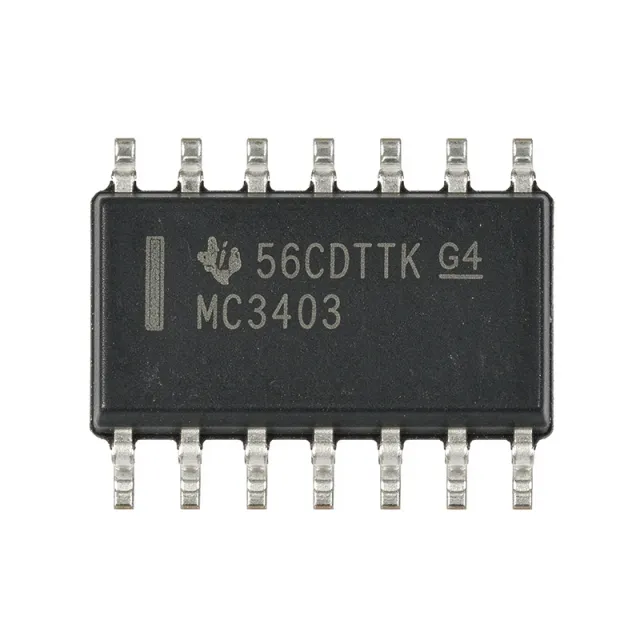
The Texas Instruments MC3403D is a quad, general-purpose bipolar operational amplifier built for single-supply and dual-supply analog systems. The device provides four amplifiers in a 14-SOIC package, operates from ±2.5 V to ±15 V according to the cited distributor specification, and supports a 1 MHz gain-bandwidth product. Its four-circuit integration reduces package count while providing true differential inputs and push-pull output capability. What is a quad operational amplifier? A quad operational amplifier combines four independent amplifier sections in one IC. These amplifiers serve as the active gain elements in sensors, buffers, analog filters, comparators, and feedback-control circuits. The MC3403 belongs to the operational-amplifier hierarchy, which is part of the broader amplifier-IC and signal-conditioning categories used in industrial control, instrumentation, audio, and communications equipment. Key verified features include four amplifier circuits, 1 MHz operation, 0.6 V/µs slew rate, a 14-pin SOIC package, and operation from −25 °C to 85 °C. The push-pull output stage supports bidirectional output-current drive in suitable loads, while the quad configuration gives designers four reusable analog channels in one package. These attributes make the MC3403D practical for low-to-moderate-frequency analog signal paths where four similar amplifier functions are required. The MC3403’s electrical characteristics are described as similar to the popular UA741 family, but its architecture is specifically useful in single-supply applications. Compared with a basic dual-supply-only op amp, the part offers a practical path to operating from a single rail in many circuits. Designers must still check input common-mode limits, output swing, supply current, noise, offset behavior, and stability against the manufacturer datasheet for the exact operating condition. Typical uses include sensor buffering, low-frequency active filtering, audio preamplification, transducers, analog control loops, and general instrumentation. For a new design, confirm the required input and output voltage ranges, acceptable slew rate, load impedance, noise performance, and temperature limits. For a replacement, verify the exact pinout, supply range, common-mode range, and output-swing requirements rather than relying only on the amplifier count. A key practical consideration is decoupling. Place the required supply bypass capacitors close to the power pins and keep sensitive input and feedback traces short. The MC3403D is a general-purpose amplifier, not a precision or high-speed device; use a more specialized amplifier when low offset, low noise, high speed, rail-to-rail operation, or extended temperature performance is mandatory. This page consolidates verified manufacturer and distributor information, drop-in alternatives, application guidance, package details, and selection considerations for engineers evaluating MC3403D. It is intended to support procurement and design review without substituting unsupported specifications for missing datasheet data.

USD $0.41 স্টক অনুপস্থিত
MC3403DG - Quad 1MHz Op Amp, 3-36V | onsemi
MC3403DG

MC3403DG - Quad 1MHz Op Amp, 3-36V | onsemi

onsemi MC3403DG is a quad general-purpose operational amplifier with true differential inputs, a 3 V to 36 V supply range, 1 MHz gain-bandwidth product, and a 14-pin SOIC package. It provides four amplifiers in one package and is designed for single-supply signal-conditioning, buffering, filtering, current-sensing, analog measurement, and precision-control circuits. An operational amplifier, or op amp, is a voltage-amplified differential building block whose open-loop gain falls with frequency. The MC3403 family belongs to the broader hierarchy of analog amplifier ICs used to amplify small differential signals, buffer high-impedance sources, implement active filters, and close feedback loops around sensors or actuators. Its true differential inputs make the device particularly useful when a useful output must follow the difference between two input voltages rather than either input alone. The quad configuration provides four amplifiers in one 14-pin SOIC, reducing board area and simplifying multi-channel designs. Key characteristics include operation from 3 V to 36 V, a 1 MHz gain-bandwidth product, and a maximum input offset voltage of 10 mV as listed by Mouser. The part is identified as a standard general-purpose amplifier and is suitable for instrumentation, buffer-amplifier, measurement, filtering, and precision-control applications. Its single-supply capability is particularly useful in cost-sensitive systems where one supply rail must support the complete analog signal chain. Differential inputs allow subtraction, current-loop monitoring, sensing across resistive elements, and amplification of sensor outputs without external input networks. Because the package contains four amplifiers, designers can use matched functional channels for simultaneous acquisition, multi-axis sensing, or multiple filter stages while preserving consistent board organization. Typical uses include 4-20 mA process-control inputs, resistive sensor conditioning, active low-pass or band-pass filters, buffered sensor outputs, general-purpose instrumentation, and current-shunt measurements. The 3 V minimum supply supports modern 3.3 V systems, while the 36 V maximum provides additional headroom for industrial supply rails. Commercial-temperature operation is identified in distributor listings, although the exact temperature limits require confirmation from the manufacturer datasheet. When laying out a MC3403DG circuit, place input, feedback, and compensation components close to the relevant SOIC pins and provide adequate return paths for each amplifier channel. Decoupling capacitors should connect between the supply pins and ground with short traces, and unused amplifier inputs should be tied to a defined potential rather than left floating. Check output-current, input-common-mode, noise, and stability requirements against the complete operating conditions before finalizing the design. This product page combines verified manufacturer and distributor information, a complete 14-pin pinout, practical single-supply design guidance, and a parameter-based comparison with available 14-pin quad amplifier alternatives. It also distinguishes confirmed electrical characteristics from parameters that still require verification in the manufacturer datasheet.

RFQ যোগাযোগ
MC3403DR - Quad 30 V 1 MHz Op Amp | Texas Instruments (Tape & Reel)
MC3403DR

MC3403DR - Quad 30 V 1 MHz Op Amp | Texas Instruments (Tape & Reel)

The Texas Instruments MC3403DR is a quad, general-purpose bipolar operational amplifier built for single-supply and dual-supply analog systems. The device provides four amplifiers in a 14-SOIC package, operates from ±2.5 V to ±15 V according to the cited distributor specification, and supports a 1 MHz gain-bandwidth product. Its four-circuit integration reduces package count while providing true differential inputs and push-pull output capability. What is a quad operational amplifier? A quad operational amplifier combines four independent amplifier sections in one IC. These amplifiers serve as the active gain elements in sensors, buffers, analog filters, comparators, and feedback-control circuits. The MC3403 belongs to the operational-amplifier hierarchy, which is part of the broader amplifier-IC and signal-conditioning categories used in industrial control, instrumentation, audio, and communications equipment. Key verified features include four amplifier circuits, 1 MHz operation, 0.6 V/µs slew rate, a 14-pin SOIC package, and operation from −25 °C to 85 °C. The push-pull output stage supports bidirectional output-current drive in suitable loads, while the quad configuration gives designers four reusable analog channels in one package. These attributes make the MC3403DR practical for low-to-moderate-frequency analog signal paths where four similar amplifier functions are required. The MC3403’s electrical characteristics are described as similar to the popular UA741 family, but its architecture is specifically useful in single-supply applications. Compared with a basic dual-supply-only op amp, the part offers a practical path to operating from a single rail in many circuits. Designers must still check input common-mode limits, output swing, supply current, noise, offset behavior, and stability against the manufacturer datasheet for the exact operating condition. Typical uses include sensor buffering, low-frequency active filtering, audio preamplification, transducers, analog control loops, and general instrumentation. For a new design, confirm the required input and output voltage ranges, acceptable slew rate, load impedance, noise performance, and temperature limits. For a replacement, verify the exact pinout, supply range, common-mode range, and output-swing requirements rather than relying only on the amplifier count. A key practical consideration is decoupling. Place the required supply bypass capacitors close to the power pins and keep sensitive input and feedback traces short. The MC3403DR is a general-purpose amplifier, not a precision or high-speed device; use a more specialized amplifier when low offset, low noise, high speed, rail-to-rail operation, or extended temperature performance is mandatory. This page consolidates verified manufacturer and distributor information, drop-in alternatives, application guidance, package details, and selection considerations for engineers evaluating MC3403DR. It is intended to support procurement and design review without substituting unsupported specifications for missing datasheet data.

USD $0.41 স্টক অনুপস্থিত
MC3403DT - Quad 36V 1MHz Op Amp IC | STMicroelectronics
MC3403DT

MC3403DT - Quad 36V 1MHz Op Amp IC | STMicroelectronics

The STMicroelectronics MC3403DT is a low-cost, low-power quad bipolar operational amplifier with four true differential amplifier sections, a 1 MHz gain-bandwidth product, and single-supply operation from 3 V to 36 V. The device is packaged in a 14-pin SOIC and can also operate from dual supplies of ±18 V. Its short-circuit-protected outputs, internally compensated Class AB output stages, and input bias current of 500 nA maximum make it suitable for general-purpose analog signal conditioning. An operational amplifier is an amplifier IC that compares two input voltages and drives its output to represent their difference. A differential input stage rejects common-mode signals, while internal frequency compensation simplifies closed-loop design. The MC3403 combines four amplifiers in one package, placing it in the hierarchy of quad op amp, operational amplifier, analog amplifier IC, and semiconductor. Its broad supply range also makes it a bridge between classic 741-class circuitry and newer low-voltage single-supply systems. Key features include four independent amplifier channels, true differential inputs, 1 MHz gain-bandwidth performance, operation down to a 3 V single supply, and operation up to a 36 V single supply. Each output stage uses a Class AB topology for reduced crossover distortion, while short-circuit protection improves robustness when an output is driven into a difficult load. The internally compensated design supports direct use as a voltage follower or noninverting amplifier without external frequency-compensation components. The MC3403 family combines the general-purpose behavior of the UA741 with lower supply-current demand and improved suitability for single-supply operation. Each channel presents differential inputs, allowing signals to be referenced around the supply midpoint in single-supply circuits. Because the amplifiers are not rail-to-rail, input and output common-mode limits remain important when the signal approaches either supply rail. Designers should use the manufacturer data sheet for exact electrical limits, input-offset voltage, slew rate, output-current capability, and channel-matching characteristics. Typical uses include sensor-signal conditioning, low-frequency active filters, instrumentation amplifiers, audio preamplifiers, transducers, analog control loops, and general instrumentation. Four amplifiers in one package can implement a complete filter, multi-stage gain block, comparator-style signal conditioning, or several independent channels when board area and component count are priorities. The SOIC-14 package also supports conventional through-hole PCB assembly rather than requiring a fine-pitch surface-mount land pattern. When designing around the MC3403DT, begin with the required input and output common-mode range at the actual supply voltage. Place supply-bypass capacitors near the device, maintain a stable reference point for single-supply signals, and verify stability for the selected gain, load, and feedback network. Avoid relying on rail-to-rail operation, and check the maximum total supply voltage when combining bipolar or dual-supply systems. This product page combines the manufacturer operating limits, package information, sourcing details, pin-level guidance, drop-in comparison criteria, and practical circuit considerations into one engineering reference. It also identifies where a new design should remain with the MC3403 family and where a lower-voltage or differently characterized amplifier offers a better fit.

RFQ যোগাযোগ
MC3403N - Quad 30V 1MHz Op Amp | Texas Instruments
MC3403N

MC3403N - Quad 30V 1MHz Op Amp | Texas Instruments

The Texas Instruments MC3403N is a quad general-purpose operational amplifier built for single- and dual-supply systems, with four amplifiers, a 30 V maximum supply rating, 1 MHz typical gain-bandwidth product, and operation from -25°C to 85°C. It is supplied in a 14-pin PDIP package. An operational amplifier is an analog integrated circuit that uses high-gain differential feedback to amplify the difference between two input voltages. The MC3403 belongs to the broader amplifier hierarchy: operational amplifier, analog IC, semiconductor, and general-purpose signal-conditioning component. Its quad construction reduces package count when a design needs several independent gain stages, buffers, or comparators. The verified product information identifies wide supply-voltage support, a true differential input stage, internal frequency compensation, low input bias current, a Class AB output stage, and short-circuit protection. The 1 MHz gain-bandwidth product is suitable for general-purpose audio, control, and instrumentation circuits rather than precision or high-speed applications. Because all four amplifiers share one package, supply pins and exposed signal pins must be routed carefully on mixed analog and digital boards. The 30 V supply capability permits operation from conventional single supplies or split dual supplies, making the device useful in legacy industrial, audio, and control designs. However, exact input common-mode limits, output swing, input offset voltage, supply-current, noise, and slew-rate values are not stated in the supplied verified excerpts; those parameters require confirmation in the manufacturer datasheet before final circuit sign-off. Typical applications include four-channel audio preamplification, low-frequency active filtering, sensor-signal conditioning, industrial control loops, and general buffer or gain stages. In each case, the 1 MHz bandwidth should be compared with the closed-loop gain and required settling behavior. A four-amplifier package can reduce board area, but it does not eliminate the need to check common-mode range, output swing, stability, and supply-decoupling requirements at every amplifier section. Design with a local bypass capacitor near the supply pins, maintain the required input common-mode range, and verify output-voltage headroom under the intended load. Do not infer precision performance from the word general-purpose. This product page consolidates the verified manufacturer identity, distributor listing, package, temperature range, supply rating, and replacement research while explicitly marking unavailable detailed electrical parameters. The alternatives listed here are limited to candidates supported by the supplied cross-reference data and are presented as package-compatible engineering options; final qualification should confirm pinout, supply limits, input/output ranges, offset, bandwidth, slew rate, and lifecycle status against the selected manufacturer datasheet.

RFQ যোগাযোগ
MC3403NG4 - 30V 1MHz Quad Op Amp | Texas Instruments
MC3403NG4

MC3403NG4 - 30V 1MHz Quad Op Amp | Texas Instruments

The Texas Instruments MC3403NG4 is a quad, general-purpose operational amplifier with four amplifiers in a 14-pin plastic dual-inline package. It supports supply voltages up to 30 V, operates over a -25°C to 85°C temperature range, and provides a gain-bandwidth product of 1 MHz. The MC3403NG4 is therefore suitable for instrumentation, control, data acquisition, and audio-signal conditioning applications that require multiple amplifiers on one board. An operational amplifier is an active semiconductor device that uses high-gain differential amplification with negative feedback. Within the broader semiconductor hierarchy, an operational amplifier belongs to the analog amplifier and signal-conditioning category. Its inverting and non-inverting inputs determine how an external feedback network sets the closed-loop gain, while output-current capability and slew rate determine how quickly the amplifier can charge or discharge the load connected at the output. The MC3403 provides four amplifier sections, reducing the package count and board area required for multi-channel analog systems. Its 30 V maximum supply rating provides useful headroom for industrial control equipment, while the 1 MHz gain-bandwidth product supports moderate-frequency feedback networks. The specified -25°C to 85°C operating range covers many commercial and industrial environments where a wider-temperature grade is not required. Each amplifier section provides differential inputs and an output, allowing the device to implement inverting, non-inverting, summing, differential, and feedback-control circuits. Because all four sections share one package, the power rails and bypass network also serve the complete device. PCB designers should preserve symmetry between paired input and feedback components and route sensitive input traces away from output and supply-current paths to reduce parasitic pickup. Typical uses include industrial process-control loops, multichannel sensor amplification, low-frequency audio preamplification, instrumentation signal conditioning, and active filtering. The quad organization is particularly useful when four related channels must operate under a common supply. For applications requiring higher precision, lower offset, faster settling, lower noise, or rail-to-rail output operation, a newer precision amplifier family should be evaluated before committing the MC3403NG4 to the design. The most important design tradeoff is generality versus precision. The MC3403NG4 provides four inexpensive, widely applicable amplifier sections, but its 1 MHz bandwidth and legacy general-purpose architecture are not ideal for demanding sensor-front-end accuracy or high-speed signal chains. Verify input common-mode range, output swing, output-current capability, offset voltage, noise, slew rate, and stability requirements against the manufacturer datasheet for the operating conditions. This product record combines the manufacturer’s device description with application-oriented guidance for package layout, bypassing, input routing, selection tradeoffs, and drop-in evaluation. It is structured to help engineers confirm whether a legacy quad amplifier still satisfies the electrical and environmental requirements of a new instrumentation, industrial-control, audio, or data-acquisition design.

RFQ যোগাযোগ
MC3403NS - Quad 30V 1MHz Op Amp | Texas Instruments
MC3403NS

MC3403NS - Quad 30V 1MHz Op Amp | Texas Instruments

Texas Instruments MC3403NS is a quad general-purpose operational amplifier rated for 30 V supply operation, 1 MHz gain-bandwidth product, and operation from -25°C to 85°C. The device is offered in a 14-pin SOIC package and contains four amplifiers, each with a Class AB output stage, true differential inputs, and internal frequency compensation. It supports single-supply operation from 3 V to 36 V or dual-supply operation, making it suitable for industrial control, instrumentation, audio, and signal-conditioning systems. An operational amplifier is an analog signal-processing IC that compares an inverting input with a non-inverting input and amplifies the voltage difference between them. Operational amplifiers belong to the amplifier IC hierarchy, combining high open-loop gain, negative feedback, signal amplification, filtering, buffering, and active transducer conditioning. Their internal frequency compensation removes the need for an external dominant-pole capacitor in ordinary closed-loop applications. The MC3403NS provides four low-power amplifiers in one package, reducing board area compared with discrete single or dual amplifier implementations. Its low input bias current is useful when the source impedance is relatively high, while short-circuit protection improves robustness in feedback-controlled circuits. The 30 V rating and wide supply range support legacy industrial systems operating from higher-voltage rails than typical modern 3.3 V or 5 V analog circuits. Technically, each channel uses a true differential input stage and a Class AB output stage. Internal frequency compensation supports stable operation in standard closed-loop configurations, including inverting and non-inverting amplifiers. The 1 MHz gain-bandwidth product limits closed-loop bandwidth according to the selected noise gain, so higher gain reduces usable bandwidth. The wide common supply range also allows ±15 V dual-supply operation in legacy analog systems. Typical uses include four-channel sensor conditioning, general-purpose voltage amplification, audio preamplification, active filtering, data acquisition front ends, and industrial control interfaces. Multiple independent channels can process several low-frequency signals while sharing one supply and package. Where source impedance is high, input bias current and offset characteristics should be checked before selecting the amplifier. A primary design consideration is rail headroom. The output cannot swing fully to either supply rail, and single-supply designs must include sufficient voltage at the output for the downstream load. Place bypass capacitors close to the supply pins, keep feedback loops compact, and verify stability, output swing, and input common-mode range across temperature. This page combines the manufacturer specifications with package guidance, practical circuit considerations, comparison criteria, and sourcing information for engineers evaluating the MC3403NS. The technical guidance emphasizes how its 30 V supply capability, 1 MHz bandwidth, four-channel integration, and 14-pin SOIC footprint affect replacement and design decisions.

RFQ যোগাযোগ
MC3403P - Quad 36V 1MHz Operational Amplifier | onsemi
MC3403P

MC3403P - Quad 36V 1MHz Operational Amplifier | onsemi

The onsemi MC3403P is a low-cost quad operational amplifier with true differential inputs, internally compensated operation, and a 14-pin plastic DIP package. It contains four amplifiers in one package and operates from a single supply or from split dual supplies, with a maximum single-supply rating of 36 V corresponding to dual operation up to ±18 V. Its 1 MHz gain-bandwidth product supports general-purpose signal conditioning at frequencies up to 1 MHz. An operational amplifier is an analog integrated circuit that amplifies the voltage difference between its inverting and non-inverting inputs. The MC3403 belongs to the general-purpose bipolar operational-amplifier family within the broader amplifier IC and semiconductor hierarchy. Unlike circuits built around the classic UA741, the MC3403 was designed with practical single-supply operation in mind. True differential inputs also allow the amplifier to reject common-mode signals when suitable feedback networks and operating conditions are used. The MC3403P provides internally compensated amplifiers, short-circuit-protected outputs, and a Class AB output stage designed for minimal crossover distortion. Maximum input bias current is specified at 500 nA, making the device practical for higher-impedance sensing paths when leakage and bias-current errors are controlled. Its internally compensated architecture removes the need for an external compensation capacitor in the standard closed-loop configurations shown in typical applications. Each of the four amplifier sections supports common inverting, non-inverting, summing, and difference-amplifier arrangements. The 1 MHz gain-bandwidth product means bandwidth decreases as closed-loop gain increases; designers should therefore account for gain-bandwidth behavior when targeting precision, pulse, or audio-frequency signals. The 36 V maximum supply also provides ample headroom for industrial and educational circuits, although the actual common-mode and output-swing limits must be observed at lower supply voltages. Typical uses include low-frequency audio amplification, active filtering, sensor signal conditioning, waveform generation, and general instrumentation. The four independent amplifiers can implement a complete signal chain in one package, reducing board space compared with four separate single or dual amplifier ICs. In AC-coupled audio and instrumentation circuits, input and feedback components can be selected around the required gain and bandwidth rather than relying on a fixed internal compensation network. Designers should verify the MC3403P pinout before PCB assembly and observe the datasheet limits for input voltage, common-mode range, output swing, supply current, and temperature. A stable bypass capacitor near the supply pins is advisable, and the unused amplifier sections should be configured according to the manufacturer’s recommended practice rather than left floating. Because this is a through-hole DIP device, insertion and soldering require adequate clearance around the package and between adjacent board components. This product record combines verified manufacturer and distributor information, same-footprint alternatives, package and pinout details, and practical selection guidance. It is intended to help engineers identify the MC3403P quickly for legacy industrial, audio, education, and prototype designs while making package constraints and replacement limits explicit.

RFQ যোগাযোগ
MC3403PG - Quad 1 MHz Operational Amplifier | onsemi
MC3403PG

MC3403PG - Quad 1 MHz Operational Amplifier | onsemi

The onsemi MC3403PG is a general-purpose quad operational amplifier with true differential inputs, a 1 MHz gain-bandwidth product, and a 0.6 V/us slew rate. The device operates from a single supply over a 3 V to 36 V range and is packaged in a 14-pin dual inline package for through-hole assembly. An operational amplifier is an analog signal-conditioning IC used to amplify voltage differences, buffer sensor outputs, and support feedback-control networks. The MC3403 belongs to the operational-amplifier hierarchy, which includes differential-input amplifiers, analog amplifiers, and integrated analog ICs. Its four amplifiers can perform independent signal-conditioning functions while sharing one package and supply connection. The principal features of the MC3403PG include four internally compensated operational-amplifier circuits, true differential inputs, a 1 MHz gain-bandwidth product, a 0.6 V/us slew rate, and operation from a single supply as low as 3 V or as high as 36 V. The electrical characteristics are similar to the popular MC1741C, but the MC3403 adds the advantages required in modern single-supply circuitry. Split-supply operation is also possible when the total voltage between the supply terminals remains within the device's operating range. Because this is a general-purpose amplifier rather than a precision or rail-to-rail part, the input common-mode range, output swing, offset voltage, and stability behavior should be checked against the actual signal and load before final circuit approval. Typical uses include four-channel sensor conditioning, low-frequency active filters, audio preamplification, transducer interfaces, general feedback-control loops, and instrumentation. The 14-DIP format is particularly suitable for through-hole prototypes, educational equipment, legacy control boards, and industrial assemblies where a through-hole quad amplifier simplifies socketed construction and servicing. When laying out a MC3403PG circuit, connect each amplifier's supply pins to the same supply network and place suitable bypassing capacitance close to those pins. Keep sensitive input routing away from high-current switching nodes, and verify that the selected feedback network remains stable with the actual source impedance and load capacitance. This product record combines the MC3403PG specifications, package information, sourcing guidance, candidate replacements, and application-oriented design notes in one place. The comparison tables and selection guidance help engineers distinguish true same-package alternatives from devices that would require board or signal-chain changes.

RFQ যোগাযোগ
MC3403PT - Quad Low-Power Op Amp | STMicroelectronics
MC3403PT

MC3403PT - Quad Low-Power Op Amp | STMicroelectronics

STMicroelectronics MC3403PT is a four-circuit, low-power bipolar operational amplifier packaged in a 14-pin TSSOP. Each amplifier supports single-supply operation to +36 V and dual-supply operation to ±18 V, providing broad flexibility for industrial, analog-control, instrumentation, and signal-conditioning designs. The device offers a 1 MHz gain-bandwidth product, internally compensated operation, short-circuit-protected outputs, and a Class AB output stage. An operational amplifier is an analog integrated circuit that uses high-gain feedback to amplify the difference between two input voltages. Within the broader semiconductor hierarchy, the MC3403PT belongs to the operational-amplifier family, which falls under analog amplifier ICs and signal-processing semiconductors. The quad configuration places four independent amplifiers in one package, reducing board area in designs requiring multiple buffered or gain-stage channels. The principal features of the MC3403PT include a maximum input bias current of 500 nA, internal compensation, short-circuit-protected outputs, and a minimum Class AB output stage for reduced crossover distortion. Its 1 MHz gain-bandwidth product supports general-purpose amplification at low and moderate frequencies. Single-supply operation up to +36 V is especially useful when the signal source and load share a positive reference without a negative rail. The bipolar input stage supports operation from dual supplies of ±18 V or a single supply up to +36 V. Internal compensation simplifies circuit construction because separate external compensation components are not required for ordinary closed-loop amplifier use. Four independent channels can also be configured as voltage followers, non-inverting or inverting amplifiers, differential stages, comparators in suitable circuits, or general analog signal-conditioning elements. Typical uses include low-frequency sensor amplification, industrial control loops, audio preamplification, active filtering, transducers, sample-and-hold stages, and general-purpose analog boards. The quad package is particularly useful when a design needs several channels with the same supply architecture. Engineers should also evaluate output swing, slew rate, input common-mode range, and load capability against their particular signal chain. For layout, place input and output paths away from high-current switching nodes and connect the supply pins to a low-impedance bypass network. Stable feedback networks and properly grounded unused channels help prevent oscillation or unintended signal coupling. Use the manufacturer pin table and electrical-characteristics curves to verify the final operating points. This product page combines manufacturer and distributor technical information, package and pin details, lifecycle-oriented sourcing guidance, application analysis, and validated drop-in alternatives. It also highlights the differences engineers should evaluate before replacing the MC3403PT on an existing 14-pin TSSOP layout.

RFQ যোগাযোগ
MC3403PW - Quad 1MHz 30V Op Amp | Texas Instruments
MC3403PW

MC3403PW - Quad 1MHz 30V Op Amp | Texas Instruments

The Texas Instruments MC3403PW is a four-circuit general-purpose operational amplifier with a 1 MHz gain-bandwidth product, a 30 V maximum supply rating, and operation from -25°C to 85°C. The device is packaged in a 14-pin TSSOP, making MC3403PW suitable for compact analog signal-processing circuits that require four amplifiers in one package. An operational amplifier is an analog integrated circuit that amplifies the voltage difference between its two inputs while providing high input impedance, low output impedance, and stable operation with feedback. The MC3403 family combines four amplifiers with a low-power class AB output stage, true differential inputs, internal frequency compensation, and short-circuit protection. It sits within the operational-amplifier category as a general-purpose amplifier for instrumentation, control, and signal-conditioning systems. Key characteristics include four independent amplifier channels, a 1 MHz gain-bandwidth product, support for single and dual supplies, a true differential input stage, and internal frequency compensation. The -25°C to 85°C operating-temperature range supports industrial and commercial equipment when the surrounding system provides suitable thermal conditions. Its 14-pin TSSOP also reduces board area compared with four separate single-amplifier packages. Each amplifier is frequency compensated, so applications using voltage gain do not require an external compensation network. The class AB output stage is designed to support linear operation while the short-circuit-protection feature improves resilience in feedback-controlled circuits. Because the device is intended for general-purpose signal amplification, external precision resistors, compensation, output isolation, and protection components may still be needed when driving loads, extending bandwidth, or meeting application-specific noise and accuracy targets. Typical uses include low-frequency sensor conditioning, feedback-control loops, current-voltage signal conversion, analog summing and difference circuits, and four-channel buffer arrangements. The integrated quad structure is especially useful where several independent analog paths must fit on a compact PCB, such as industrial measurement modules, instrumentation interfaces, and embedded control systems. PCB layout should keep feedback resistors close to their corresponding amplifier pins, provide a solid ground return, and route high-impedance input nodes away from switching nodes. Decoupling capacitors should be placed close to the supply pins. Designers should verify output swing, input common-mode range, load capability, stability, and supply limits for the intended operating points using the manufacturer datasheet. This page combines the manufacturer product information, distributor product records, package details, application guidance, and available same-footprint comparison information to support component selection and board-level planning. It also identifies which electrical parameters require confirmation from the complete Texas Instruments datasheet before final design release.

RFQ যোগাযোগ
MC34071D - 44V Single-Supply Operational Amplifier | onsemi
MC34071D

MC34071D - 44V Single-Supply Operational Amplifier | onsemi

The onsemi MC34071D is a single-supply operational amplifier designed for operation from 3.0 V to 44 V, with a 4.5 MHz gain-bandwidth product and a 13 V/µs slew rate. The device is packaged in an 8-pin SOIC and uses bipolar fabrication rather than JFET input devices. Its combination of high bandwidth, fast slew rate, and a wide supply-voltage range makes it suitable for industrial instrumentation, signal conditioning, data acquisition, and control systems that operate from elevated supply voltages. An operational amplifier is a high-gain differential amplifier used to amplify small input signals, buffer sensors, drive analog stages, and implement feedback-control networks. The MC34071 belongs to the broader hierarchy of operational amplifier, analog amplifier, signal-conditioning IC, and semiconductor. Although the MC34071 family can operate from split supplies, it is particularly suited to single-supply operation, which simplifies circuits whose signal reference is close to the lower supply rail. The family provides 4.5 MHz of gain-bandwidth product, a 13 V/µs slew rate, and fast settling time without using JFET device technology. The specified single-supply performance is defined at 5.0 V. The amplifiers are also functional at 3.0 V at 25°C, although bandwidth, slew rate, DC gain, and other parameters may change in that operating region. This distinction is important when designing at the minimum supply voltage. The bipolar process supports operation from a single 5.0 V supply or higher while accommodating input and output signals referenced toward ground. The wide 44 V maximum supply rating provides additional operating headroom for industrial systems while retaining the usual bipolar advantages of low input-voltage noise and accurate behavior around the output operating point. Designers should still use the manufacturer datasheet limits for input common-mode range, output swing, supply current, and stability with the selected gain and load. Typical uses include sensor-interface amplifiers, low-side current measurement, industrial control loops, audio and communications signal conditioning, active filtering, and general-purpose analog processing. Because the amplifier is optimized for single-supply operation, input and output signal levels must remain inside the datasheet common-mode and output-swing limits. Input common-mode limits depend on supply voltage and gain, so a signal that is valid at 5 V may not remain valid at 3 V. The main design consideration is supply headroom. Use decoupling close to the supply pins, verify that the selected feedback network remains stable at the intended noise gain, and check output-current capability for the load and output-voltage conditions. The MC34071 is not intended to replace a rail-to-rail input or output amplifier where signals exceed its specified common-mode or swing limits. This page combines verified manufacturer and distributor information with practical selection criteria, sourcing guidance, and verified same-package alternatives. It highlights where the MC34071D fits, where its non-rail-to-rail architecture requires careful signal-range review, and which replacement MPNs should be checked against the full datasheet before substitution.

RFQ যোগাযোগ
MC34071DG - 4.5MHz, 13V/us Single Op Amp | onsemi
MC34071DG

MC34071DG - 4.5MHz, 13V/us Single Op Amp | onsemi

onsemi MC34071DG is a single general-purpose operational amplifier with a 4.5 MHz gain-bandwidth product, 13 V/us slew rate, and single-supply operation from 3.0 V to 44 V. The device is manufactured in bipolar technology and is packaged in an 8-pin SOIC. An operational amplifier is an active analog component that uses high-gain feedback to amplify voltage differences between its input terminals. The MC34071 family combines wide supply-voltage tolerance, high bandwidth, and fast slew rate in a general-purpose amplifier, making it suitable for signal conditioning, instrumentation, filtering, and feedback-control circuits. Its common-mode input range includes ground potential, allowing practical operation from a single positive supply. Key specifications include 4.5 MHz gain-bandwidth product, 13 V/us slew rate, fast settling time, and bipolar fabrication without JFET input devices. The single amplifier supports both split-supply and single-supply configurations, while its input common-mode capability makes it useful in systems where signals remain close to the negative supply rail. The MC34071 is designed for applications requiring higher speed than conventional general-purpose amplifiers. Its 4.5 MHz bandwidth supports moderate-frequency signal paths, and the 13 V/us slew rate provides faster large-signal response than many standard precision amplifiers. The bipolar process also provides a conventional input-bias-current characteristic of approximately 100 nA for the listed device family. Typical applications include low-level signal amplification, active filters, sensor conditioning, audio preamplifier stages, and general feedback amplifiers. The device can also serve in industrial control and instrumentation circuits where a single supply and operation near ground are important. Split-supply operation remains possible when the circuit requires a bipolar output range. When designing around the MC34071DG, check input and output voltage limits against the selected supply, including the effects of transient overshoot. Keep feedback compensation values consistent with the closed-loop gain, and place input and output components close to the device pins. Verify the final design for stability across the intended gain, temperature, and load range. This page consolidates the manufacturer product information, distributor availability references, cross-reference candidates, and application guidance for engineers evaluating the MC34071DG. It highlights the electrical envelope, package details, replacement considerations, and practical design decisions needed to determine whether this single-supply bipolar amplifier fits a new or existing circuit.

RFQ যোগাযোগ
MC34071P - 3-44V Single Operational Amplifier | onsemi | 8-DIP
MC34071P

MC34071P - 3-44V Single Operational Amplifier | onsemi | 8-DIP

The onsemi MC34071P is a single operational amplifier designed for single-supply operation from 3.0 V to 44 V, with an 8-pin DIP package. It is a general-purpose bipolar operational amplifier intended for instrumentation, buffering, signal conditioning, and control applications where a wide supply range and single-supply operation are useful. The device is specified for a 5.0 V single-supply condition while remaining functional down to 3.0 V at 25°C, although bandwidth, slew rate, and DC gain can change in that lower-voltage region. An operational amplifier is an analog integrated circuit that uses high-gain differential amplification to compare an inverting input with a non-inverting input. The MC34071P provides one amplifier circuit in an 8-DIP package, placing it within the hierarchy of operational amplifier, analog amplifier, and integrated circuit. Its single-supply capability simplifies circuits that operate from batteries, industrial control rails, test equipment, and other systems that do not provide a centered or negative supply. The MC34071P is associated with a 5 mV input offset voltage specification in distributor listings and uses quality bipolar fabrication in the onsemi MC33071, MC34071, and related family. The family includes dual and quad versions for designs that require multiple amplifier channels, but channel count and package differ when comparing those family members with the single MC34071P. The 8-DIP package is a through-hole package with a nominal 0.300-inch, 7.62 mm lead pitch, making it suitable for conventional PCB layouts and prototype boards. Typical uses include sensor signal conditioning, low-frequency active filtering, industrial instrumentation, audio and communications support circuits, and general voltage amplification. Because the amplifier can operate from a single supply, the input and output signal ranges must be checked against the supply rails. Designers should also account for input common-mode limits, output swing, bias-current effects, noise, stability, and the power dissipation produced by the selected supply voltage and load. The MC34071P is most appropriate when a through-hole single op amp is preferred and the design needs wide single-supply headroom. Its counterpart MC34071APG is the most directly identified cross-reference candidate in the available information. Before substituting any part, confirm the complete pinout, electrical limits, common-mode behavior, output swing, and stability requirements against the target circuit. This page consolidates the verified onsemi datasheet information, distributor package identification, and cross-reference findings into a practical component record. The key engineering distinction is not simply the 3.0 V to 44 V supply capability, but the combination of a single amplifier, bipolar implementation, through-hole 8-DIP construction, and the need to design the signal path around single-supply input and output limits.

RFQ যোগাযোগ
MC34071PG - 44V Single Op Amp, 4.5MHz | onsemi
MC34071PG

MC34071PG - 44V Single Op Amp, 4.5MHz | onsemi

The onsemi MC34071PG is a single operational amplifier with a 3 V to 44 V single-supply operating range, 4.5 MHz gain-bandwidth product, and 13 V/µs slew rate, supplied in an 8-pin PDIP package. It is designed for general-purpose instrumentation and signal-conditioning applications where wide supply-voltage tolerance, fast slew, and a conventional bipolar input stage are useful. An operational amplifier, or op amp, is a voltage-controlled differential amplifier used to amplify or buffer signals in electronic systems. The MC34071 belongs to the broader hierarchy of operational amplifiers, analog amplifiers, and signal-chain semiconductors. Its wide supply range allows it to operate from conventional 5 V and 12 V rails as well as higher industrial voltage systems, although the complete circuit must remain within the device's absolute maximum ratings. Key characteristics include a 4.5 MHz gain-bandwidth product, 13 V/µs slew rate, single-ended input configuration, and a general-purpose amplifier design. The manufacturer describes the MC34071 series as using quality bipolar fabrication and innovative design concepts. The bipolar approach supports conventional op-amp behavior and is useful in applications requiring signal amplification, buffering, active filtering, and general analog control functions. The device's fast settling performance and 13 V/µs slew rate make it more responsive than slow precision-oriented amplifiers. This is beneficial for instrumentation and feedback loops that need to follow changing input waveforms. Designers should still account for input and output voltage limits, common-mode range, output-current capability, supply decoupling, and stability when driving capacitive or nonlinear loads. Typical uses include industrial process-control instrumentation, sensor signal conditioning, audio and communications support circuits, active filters, voltage followers, and general laboratory measurement equipment. Because the MC34071PG is a through-hole PDIP device, it is especially convenient for prototyping, educational systems, repair work, and applications where socketed or manually soldered assembly is acceptable. For reliable operation, decouple the supply pins close to the device and provide stable reference and feedback paths. Avoid forcing the output beyond its rated output-voltage swing, and check the input common-mode range over the complete operating range. Use the manufacturer pin description and electrical characteristics tables when assigning PCB nets and designing around input offset, bias current, supply current, and output-drive limits. This product page combines manufacturer specifications, package information, design guidance, drop-in alternatives, and a parameter-by-parameter comparison to support faster component selection and PCB-level planning for MC34071PG-based analog circuits.

RFQ যোগাযোগ
MC34072D - 4.5 MHz Single Op Amp, 3-44 V | onsemi
MC34072D

MC34072D - 4.5 MHz Single Op Amp, 3-44 V | onsemi

The onsemi MC34072D is a single, general-purpose operational amplifier optimized for wide supply-voltage operation. It provides a 4.5 MHz gain-bandwidth product, a 13 V/µs slew rate, and operation from 3.0 V to 44 V in an 8-pin SOIC package. The MC34072D also supports fast settling to 0.1% within 1.1 µs and an input common-mode range that includes ground. An operational amplifier is a high-gain, active differential amplifier whose inverting and non-inverting inputs control an output voltage. Within the broader semiconductor hierarchy, an operational amplifier is an analog integrated circuit used for signal conditioning, current-to-voltage conversion, feedback control, filtering, and buffered drive stages. The MC34072 belongs to a family of single-supply, bipolar operational amplifiers designed to combine broad rail-voltage capability with relatively high bandwidth. The principal features of the MC34072D include 4.5 MHz gain bandwidth, 13 V/µs slew rate, 1.1 µs settling time to 0.1%, and a low 3.0 mV maximum input offset voltage for the A-suffix grade. It operates from 3.0 V to 44 V, and its input common-mode range includes the negative supply rail, which simplifies single-supply signal-chain design. Output swing extends from approximately -14.7 V to +14 V under the conditions listed by the manufacturer. The bipolar fabrication of the MC34071, MC34072, and MC34074 families supports the combination of wide bandwidth, high slew rate, and common-mode operation that extends to ground. This characteristic is particularly useful when signals remain close to the lower supply rail or when the amplifier must process bipolar sensor signals from a unipolar-powered acquisition circuit. Input bias current and noise specifications should be checked against the source impedance in the selected gain configuration. Typical uses include low-voltage sensor interfaces, industrial process-control loops, audio preamplifier stages, active filters, and general instrumentation. Its 3.0 V to 44 V operating range also makes it suitable for industrial systems that operate from a 5 V, 12 V, 24 V, or higher regulated rail. The device can be used where the required signal bandwidth remains below the amplifier's closed-loop bandwidth for the selected noise-gain setting. Designers should verify output-current capability, output-swing limits, input common-mode range, and stability at the intended gain and capacitive-load conditions. Keep feedback-loop layouts compact, place compensation or decoupling components close to the relevant pins, and avoid operating near the output-swing limits when driving low-impedance downstream loads. This page consolidates the MC34072D electrical characteristics, confirmed ordering variants, package information, and application guidance with comparison notes for engineers evaluating drop-in operational-amplifier alternatives.

RFQ যোগাযোগ
MC34072DG - Dual 44V Op Amp | onsemi | Industrial Amplification
MC34072DG

MC34072DG - Dual 44V Op Amp | onsemi | Industrial Amplification

onsemi MC34072DG is a dual general-purpose operational amplifier optimized for single-supply operation from 3.0 V to 44 V. It provides two amplifiers in an 8-pin SOIC package, with 4.5 MHz gain-bandwidth product, 13 V/µs slew rate, and 5 mV typical input offset voltage. The part combines bipolar fabrication with a design that avoids JFET input transistors. An operational amplifier, or op amp, is a voltage-feedback analog IC that amplifies the difference between its inverting and non-inverting inputs. The op amp belongs to the broader hierarchy of amplifier IC, analog IC, semiconductor, and signal-conditioning component. Its gain, input offset, slew rate, common-mode range, output swing, and noise determine how accurately it can process low-level signals in instrumentation, control, sensing, and signal-conditioning circuits. The MC34072 family is particularly useful when a circuit must operate from a single positive supply while accepting signals near ground. Its 3.0 V to 44 V supply range provides flexibility for industrial control systems, test equipment, sensor interfaces, and power-supply feedback networks. The 4.5 MHz gain-bandwidth product supports higher-frequency closed-loop operation than a basic precision amplifier, while the 13 V/µs slew rate improves large-signal response. Two independent amplifiers are integrated in one 8-pin SOIC, reducing component count and board area. MC34072DG is a commercial-temperature, standard general-purpose amplifier. The dual configuration provides separate input and output pins for channels A and B. Typical applications include buffer stages, active filters, transducers, current sensing, sample-and-hold circuitry, comparators, and general-purpose signal conditioning. The dual channel can also support independent signal paths, cascaded stages, or two channels of a differential or multichannel measurement system. Single-supply operation requires careful attention to the input common-mode range and output swing. Inputs must remain inside the amplifier's valid common-mode region, and the output must be biased appropriately when processing signals centered near 0 V. Decoupling capacitors should be placed close to the supply pins, while feedback components should be kept compact to minimize parasitic coupling and preserve the intended bandwidth and stability behavior. This page combines the manufacturer product information, exact MC34072DG orderable-part listings, package information, replacement references, application guidance, and engineering design notes. It also distinguishes package-compatible ordering variants from the dual MC33072DG option so that form, fit, function, and qualification requirements can be checked before PCB substitution.

RFQ যোগাযোগ
MC34072PG - Dual 44V Op Amp with 13V/us | onsemi
MC34072PG

MC34072PG - Dual 44V Op Amp with 13V/us | onsemi

onsemi MC34072PG is a dual general-purpose operational amplifier with a 3 V to 44 V supply range, 4.5 MHz gain-bandwidth product, and 13 V/us slew rate in an 8-pin PDIP package. The device provides two amplifiers with single-ended outputs and uses quality bipolar fabrication without JFET input technology. An operational amplifier is an amplifier IC that uses high-gain differential feedback to control an output voltage. The MC34072 family belongs to the broader operational amplifier, analog IC, and semiconductor hierarchies. It can operate from split supplies or a single supply and is particularly suited to circuits requiring higher supply tolerance than typical low-voltage rail-to-rail amplifiers. The 4.5 MHz gain-bandwidth product supports useful closed-loop bandwidth at practical gain settings, while the 13 V/us slew rate allows outputs to change quickly without requiring JFET inputs. The manufacturer lists a 5 mV input offset-voltage figure for the commercial-temperature MC34072PG, and its bipolar construction is suited to general-purpose analog signal conditioning. The MC34072 series combines precision bipolar performance with relatively high operating-voltage capability and fast settling behavior. Each amplifier can serve as an inverting or non-inverting stage, and the two independent channels allow simultaneous processing of related signals. This architecture is useful when a board needs one amplifier for filtering and another for buffering or gain control. Typical uses include industrial sensor interfaces, low-frequency active filters, audio preamplifier stages, transducer amplifiers, feedback-control loops, and general instrumentation powered from industrial supply rails. The 44 V maximum supply also makes the device relevant to legacy 24 V control systems, provided the selected operating voltage and dissipation remain within the device ratings. Place bypass capacitors close to the supply pins and route feedback components away from input and output traces to reduce oscillation risk. Confirm output swing, input common-mode range, load current, and thermal dissipation for each amplifier channel. Dual packages require evaluation of channel-to-channel behavior, not only the aggregate device rating. This product page combines the MC34072PG operating characteristics with engineering-focused pin, packaging, replacement, and design guidance. It supports faster selection by placing verified headline specifications beside the practical constraints that determine whether the dual amplifier can operate safely in a target circuit.

RFQ যোগাযোগ
MC34118DW - Voice-Switched Speakerphone IC | NXP | 28-SOIC
MC34118DW

MC34118DW - Voice-Switched Speakerphone IC | NXP | 28-SOIC

The NXP Semiconductors MC34118DW is a telecom integrated circuit designed for voice-switched speakerphone systems and packaged in a 28-lead SOIC. It integrates the functions required for stand-alone telephone-line speakerphone operation, including direct interfacing to Tip and Ring through a coupling transformer. The device can also work with a handset speech network and additional featurephone functions. Operation from an external power supply or directly from the telephone line provides design flexibility for dedicated and featurephone equipment. A voice-switched speakerphone IC is a telephone-network interface device that detects speech activity and controls the direction of audio between the microphone and loudspeaker paths. It eliminates the need for a manually operated push-to-talk control when both parties remain within microphone pickup range. This category of telephone interface IC sits within communication ICs and ultimately within the broader integrated-circuit hierarchy, combining analog signal conditioning, gain control, and telephone-line switching in one package. The MC34118DW supports telephone-line-powered operation, typically requiring 5.0 mA from the line, as well as operation from a conventional power supply. Its gain in the transmit and receive paths is adjusted externally at the microphone and speaker amplifiers. Component values in the manufacturer datasheet should therefore be treated as starting points, with final gain, stability, and distortion set through prototype measurement in the completed speech network. The 28-lead SOIC package supports direct Tip and Ring interfacing through a coupling transformer, enabling a compact stand-alone speakerphone implementation. Its architecture is suited to analog telephone terminals, extension speakerphone designs, and featurephones that add a hands-free monitoring function to an existing handset speech network. It can also support two-way monitoring functions where the microphone and loudspeaker paths are controlled automatically according to voice activity. Important application choices include telephone-line-powered products, externally powered analog phones, and featurephones requiring a dedicated voice-switched monitoring path. The interface is not a general-purpose audio amplifier or DTMF decoder; it is specifically a telephone speech-network controller. Peripheral filtering, the coupling transformer, microphone and speaker amplifiers, and external gain-setting components remain essential parts of a complete implementation. When laying out a design, place the MC34118DW close to the telephone-network and speech-signal components and keep sensitive microphone inputs away from the loudspeaker drive path. Validate gain, sidetone balance, line-power budget, and stability on the final board because transformer selection and component tolerances strongly influence acoustic performance. Use the pin-description and application-circuit tables in the manufacturer datasheet when assigning PCB tracks. This page consolidates the verified package and operating details, cross-reference alternatives, and practical design guidance for engineers evaluating the MC34118DW in analog telephony equipment.

RFQ যোগাযোগ
MC34119D - Low-Power Class AB Audio Amplifier | NXP
MC34119D

MC34119D - Low-Power Class AB Audio Amplifier | NXP

The NXP MC34119D is a low-power, mono Class AB audio amplifier integrated circuit designed primarily for telephone equipment, including speakerphones. It operates from a 2 V minimum supply, supports a nominal range of 2 V to 16 V or ±1 V to ±8 V, and provides differential speaker outputs to increase usable output swing at low supply voltages. The device is supplied in an 8-pin SOIC package according to the distributor product listing. An audio amplifier is an integrated circuit that accepts a low-level analog audio signal and delivers enough current and voltage to drive a speaker or another acoustic transducer. The MC34119 belongs to the Class AB amplifier category, where the output transistors conduct during the signal cycle for improved efficiency than a continuously biased Class A design. Its telephone-oriented architecture supports portable and line-powered equipment where low supply voltage and compact implementation are important. The verified feature set includes a shutdown function, a single mono output channel, and differential speaker outputs. Differential outputs are particularly useful in telephone and speakerphone designs because they increase output swing into a differentially connected transducer. The manufacturer datasheet also identifies a 2.0 V minimum supply, allowing operation from low-energy source rails. The Class AB output stage is intended to balance output capability against power consumption in compact audio systems. MC34119D applications include telephone speakerphones, compact voice terminals, intercom equipment, and other low-voltage audio products. In these systems, the amplifier converts a microphone or line-level signal into a differential drive capable of energizing a small speaker. Designers should account for the external output-coupling capacitors shown in the manufacturer application circuit when connecting a speaker, and should verify the shutdown-control polarity and timing before sequencing the device. The most important design consideration is ensuring that the supply, input signal, output network, and speaker load remain within the limits defined by the manufacturer datasheet. Because the target is a legacy low-power audio amplifier, purchasing decisions should also account for lifecycle status, stock, and long-term sourcing rather than assuming availability from an active-production family. This page consolidates the verified package, supply-voltage, amplifier-class, shutdown, and differential-output information with practical selection guidance. It also distinguishes confirmed facts from parameters that require confirmation in the original MC34119 manufacturer datasheet, helping engineers evaluate MC34119D without relying on incomplete distributor summaries.

RFQ যোগাযোগ
MC34119P - 2-16V Mono Class AB Audio Amp | NXP
MC34119P

MC34119P - 2-16V Mono Class AB Audio Amp | NXP

NXP MC34119P is a low-power, 1-channel Class AB audio amplifier IC designed for telephone equipment, including speakerphones, with a 2 V to 16 V supply range and differential speaker outputs in an 8-pin DIP package. It provides a practical solution where low supply voltage, low quiescent current, and efficient single-speaker drive are required. The available ordering information identifies the device as an NXP USA Inc. 8-PDIP mono audio amplifier. An audio amplifier IC is a semiconductor that accepts a small audio signal and delivers enough voltage and current to drive a loudspeaker or other audio transducer. A Class AB amplifier combines the low crossover distortion of class-A operation with improved efficiency compared with a continuously biased class-A stage. In the MC34119P, differential speaker outputs are intended to maximize output swing at low supply voltages, making the device especially relevant to compact telephone and communications equipment. The MC34119P operates from 2.0 V to 16 V, as documented in the retrieved manufacturer and distributor information. Its typical quiescent supply current is 2.7 mA for battery-powered designs, while shutdown reduces the typical quiescent current to 65 µA. A chip-disable input provides a direct means of placing the amplifier in its low-power state. These features allow the amplifier to remain useful when system power is constrained by a telephone line or battery source. Its architecture uses one Class AB output channel and differential speaker outputs rather than a conventional single-ended output arrangement. Differential drive can provide greater useful voltage swing into the speaker for a given supply, which is important at the 2 V minimum supply. This is a system-level advantage in speakerphone products where loudness and battery efficiency must coexist. Exact continuous output power, output impedance, gain settings, and distortion limits were not included in the retrieved source snippets and must be confirmed in the full manufacturer datasheet before final design sign-off. Typical uses include telephone speakerphones, telephone-line powered communications products, small intercom stations, compact voice monitors, and portable low-voltage audio equipment. The device is also suitable where standby consumption matters, because the shutdown function can isolate the amplifier from the active signal path. For these applications, the 2 V minimum operating voltage and differential output capability align particularly well with low-power, single-speaker systems. The primary design consideration is output-device and load compatibility. Engineers should verify speaker impedance, output power at the available supply voltage, thermal conditions, gain configuration, bypass capacitors, and shutdown logic against the complete MC34119 datasheet. Because the supplied text identifies an 8-DIP footprint but does not enumerate individual terminal functions, the pin assignment and exposed circuit details should not be inferred solely from this page. This product page consolidates the verified MC34119P package, voltage, topology, shutdown, and low-power information with practical application guidance, sourcing considerations, and honest drop-in replacement analysis. Its key value is separating confirmed MC34119P characteristics from unverified specifications and avoiding unsupported claims about substitutes that may require different EMI performance or pin behavior.

RFQ যোগাযোগ
MC34184M - Low-Power Quad JFET Op Amp | onsemi
MC34184M

MC34184M - Low-Power Quad JFET Op Amp | onsemi

The onsemi MC34184M is a low-power, quad, JFET-input operational amplifier characterized by 210 uA of supply current per amplifier, a 4.0 MHz gain-bandwidth product, and a 10 V/us slew rate. Housed in onsemi's legacy MC34184M package, the device combines low input bias current with high input resistance for instrumentation, signal-conditioning, and low-frequency analog systems. A JFET-input operational amplifier is a voltage-amplifier device whose input stage uses junction field-effect transistors. This input architecture provides high input resistance and low input bias current while supporting relatively low supply-current operation. Within the power-management and analog-signal hierarchy, the MC34184M belongs to the operational-amplifier family and functions as a high-impedance buffer or closed-loop gain stage between sensors, transducers, analog switches, and downstream conversion or control circuitry. The primary performance characteristics of the MC34184M include a 4.0 MHz gain-bandwidth product, 10 V/us slew rate, and approximately 210 uA of supply current per amplifier. Its JFET input stage provides high input resistance, low input offset voltage, and high open-loop gain according to the Motorola MC34184 datasheet. These characteristics make the amplifier appropriate for precision current-voltage conversion, low-level signal amplification, active filtering, and feedback networks operating at low or moderate frequencies. The family architecture also supports practical instrumentation requirements because low input bias current reduces disturbance of high-impedance sources. A high gain-bandwidth product allows useful closed-loop bandwidth above the audio range when configured with conventional compensation and suitable external resistors. The 10 V/us slew rate improves handling of moderately fast signal edges, although the 4.0 MHz bandwidth places the device in the general-purpose precision-amplifier class rather than the high-speed operational-amplifier class. Typical applications include bridge-sensor signal conditioning, biomedical instrumentation, photodiode and phototransistor amplifiers, audio preamplification, active filters, sample-and-hold stages, and low-frequency closed-loop control loops. In each case, the amplifier should be evaluated for input common-mode range, output swing, noise, offset, stability, and supply compatibility under the actual operating conditions. Designers should verify the package dimensions, pin numbering, electrical limits, and common-mode range against the manufacturer documentation before layout. Input and feedback resistors must also be selected for low thermal noise and acceptable bias-current error. Bias compensation may be useful when source resistance is high enough that input bias current produces a material offset across the source impedance. This page organizes the core MC34184M electrical characteristics, practical application guidance, comparison parameters, and design considerations into one engineering-focused reference. It supports early architecture selection while preserving the need to verify production details, lifecycle commitments, and assembly-specific information with the manufacturer before releasing a design.

RFQ যোগাযোগ