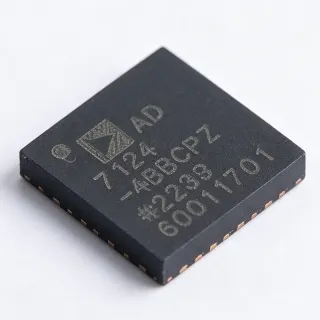
AD9278BBCZ - 8-Channel 12-Bit 65-MSPS AFE | Analog Devices
MPN: AD9278BBCZ ✓ সক্রিয়AD9278BBCZ সারাংশ
An analog front end is an integrated signal-processing IC positioned between an analog input and a digital processor. Its functional hierarchy is AFE → receiver signal chain → data converter → ADC/DAC → semiconductor. The AD9278 combines eight complete receive channels rather than requiring separate amplifiers, filters, converters, and quadrature demodulators, reducing board area and simplifying digital calibration.
The principal features include eight independently processed LNA, VGA, AAF, ADC, and I/Q demodulator channels. The converters provide 12-bit resolution across a programmable speed range of 10 MSPS to 65 MSPS, allowing one design to cover multiple bandwidth and sample-rate requirements. The serial interface is identified as SPI-compatible, while the distributor specification identifies a 50 MSPS operating point. Programmable gain and quadrature demodulation support receiver architectures where frequency conversion and signal-level adjustment are required.
Power efficiency depends on the selected operating mode. The manufacturer describes 88 mW per channel in TGC mode at 40 MSPS and 32 mW per channel in CW mode. The TGC channel input-referred noise is listed as 1.3 in the product characteristics, with the complete measurement bandwidth and unit defined in the manufacturer documentation. The AD9278 also uses a SiGe BiCMOS process, integrating high-frequency analog circuitry with digital control and output functions.
Typical uses include phased-array radar, communications receivers, digital beamforming, instrumentation, and broadband signal analysis. Eight parallel channels are particularly useful when several antenna or sensor inputs must be sampled coherently. At 65 MSPS, each 12-bit channel produces 780 MSPS of digital throughput before considering control, framing, and protocol overhead.
PCB implementation requires careful high-speed layout around the 144-ball CSP-BGA. Use the manufacturer’s land pattern and reference design, route clocks as controlled-impedance nets, and keep analog inputs and power distribution away from high-speed output crossings. The BGA also requires a thermal strategy based on actual dissipation, ball-grid layout, PCB copper, and enclosure temperature rather than package size alone.
This page consolidates the manufacturer product description, distributor package and interface details, power-mode characteristics, application guidance, and engineering trade-offs. It also distinguishes verified device characteristics from replacement decisions that require a separately qualified pin-to-pin cross-reference.
এর জন্য ড্রপ-ইন বিকল্প AD9278BBCZ — একই package, pin-to-pin compatible। ভিন্ন package-এর যেসব পার্টে PCB rework প্রয়োজন সেগুলো বাদ দেওয়া হয়েছে।
এই পণ্যের জন্য কোনো ড্রপ-ইন বিকল্প পাওয়া যায়নি।
বিকল্প অনুরোধ করুনAD9278BBCZ সর্বোচ্চ রেটিং ও বৈদ্যুতিক বৈশিষ্ট্য
| Product Type | Octal RF analog front end with integrated ADC and I/Q demodulator |
| Number of Channels | 8 channels |
| ADC Resolution | 12 bits |
| Maximum Sampling Rate | 65 MSPS |
| Minimum Sampling Rate | 10 MSPS |
| Nominal Interface Rate | 50 MSPS |
| Integrated LNA | 1 per channel |
| Variable Gain Amplifier | 1 per channel |
| Anti-Aliasing Filter | 1 per channel |
| Analog-to-Digital Converter | 1 per channel |
| I/Q Demodulator | 1 per channel |
| TGC Mode Power | 88 mW per channel at 40 MSPS |
| CW Mode Power | 32 mW per channel |
| Process Technology | SiGe BiCMOS |
| প্যাকেজ | 144-ball CSP-BGA, 10 mm × 10 mm |
| মাউন্টিং টাইপ | Surface Mount |
| RoHS স্ট্যাটাস | Compliant |
| Lead-Free Status | Lead Free |
AD9278BBCZ 144-ball csp-bga, 10 mm × 10 mm পিন কনফিগারেশন গাইড
AD9278BBCZ (144-ball csp-bga, 10 mm × 10 mm প্যাকেজ)-এর পিন কনফিগারেশন। এই অ্যানালগ কম্পোনেন্টে ইনপুট, আউটপুট ও পাওয়ার সাপ্লাই পিন রয়েছে। অফসেট নাল, কম্পেনসেশন ও এনেবল পিন কনফিগারেশনের জন্য প্রস্তুতকারকের ডেটাশিট দেখুন। সিগন্যাল কন্ডিশনিং ও অ্যামপ্লিফায়ার সার্কিটের জন্য আদর্শ।

এর জন্য বিস্তারিত পিনআউট ডেটা পাওয়া যায়নি AD9278BBCZ.
দেখুন ডেটাশিট সম্পূর্ণ পিন কনফিগারেশনের জন্য।
সাধারণ ব্যবহার
AD9278BBCZ এর জন্য উপযুক্ত 6 অ্যাপ্লিকেশনs: Phased-Array Radar Receiver, Digital Beamforming Front End, Communications Receiver, Instrumentation and Signal Analysis, Broadband RF Data Capture, Multi-Channel Sensor Acquisition.
Phased-Array Radar Receiver
The AD9278BBCZ suits phased-array radar because each of its eight channels integrates an LNA, VGA, anti-aliasing filter, 12-bit ADC, and I/Q demodulator. Operating from 10 MSPS to 65 MSPS allows the receiver to digitize a useful portion of the intermediate-frequency band while limiting external analog-chain size. The principal engineering requirement is coherent operation across all eight channels, which calls for a low-jitter reference, matched clock routing, and careful length matching. Power also scales by channel: the documented TGC consumption is 88 mW per channel at 40 MSPS, so the PCB thermal design must account for all eight active channels rather than one isolated converter.
Digital Beamforming Front End
Eight parallel AD9278BBCZ channels provide the simultaneous digitized samples required by digital beamforming architectures. The integrated VGA allows received signal levels to be adjusted before conversion, while the I/Q demodulator performs frequency translation in the analog domain and reduces the burden on the downstream digital processor. With 12-bit resolution and rates up to 65 MSPS, each channel produces 780 MSPS of raw sample throughput at the upper limit. Calibration routines should account for channel gain, phase response, and clock alignment, and the PCB should preserve symmetry between analog inputs, decoupling, and digital return paths to limit channel-to-channel mismatch.
Communications Receiver
The AD9278BBCZ is appropriate for communications receivers that require several conversion channels in a compact RF assembly. Combining the LNA, VGA, anti-aliasing filter, converter, and I/Q demodulator reduces the number of components between the antenna or RF front end and the digital baseband processor. Its 10 MSPS-to-65 MSPS range supports multiple intermediate-frequency and channel-bandwidth strategies without changing the converter family. Interface timing, output data volume, and thermal dissipation should be evaluated together: eight channels at the maximum rate create a demanding data path, while the documented CW-mode power of 32 mW per channel can be advantageous in fixed-gain receiver configurations.
Instrumentation and Signal Analysis
The AD9278BBCZ can serve as the acquisition front end in instrumentation that must analyze multiple RF or IF channels with consistent conversion characteristics. Eight integrated channels allow a compact instrument to capture several inputs simultaneously, and the 12-bit ADC resolution provides a practical balance between dynamic range, conversion rate, and power. The anti-aliasing filter is particularly important when wide-band input content could fold into the measurement band. Designers should characterize full-scale input, gain settings, bandwidth, and settling behavior for each mode. PCB layout should keep the eight analog paths symmetric and route the SPI control and high-speed output signals away from sensitive analog inputs.
Broadband RF Data Capture
For broadband RF data-capture systems, the AD9278BBCZ combines analog conditioning and 12-bit conversion in eight channels without requiring a separate converter for every input. Its maximum 65 MSPS rate supports sampling of substantial intermediate-frequency bandwidth, while the adjustable rate extends the design envelope to 10 MSPS for lower-bandwidth modes. The integrated I/Q demodulator is useful when the desired output is baseband I and Q rather than a direct high-rate real sample stream. A successful implementation must budget data-transfer bandwidth, FPGA or processor resources, clock jitter, and thermal rise; eight channels operating continuously at the upper conversion limit can become the dominant system-level power and routing constraint.
Multi-Channel Sensor Acquisition
The AD9278BBCZ can acquire eight synchronized channels for coherent sensor, vibration, or industrial test systems when the source signals fall within the supported analog bandwidth and 10 MSPS-to-65 MSPS conversion range. Its per-channel LNA, VGA, and anti-aliasing filter simplify repeatable analog preparation before digitization. For multi-sensor work, clock synchronization is more important than raw conversion speed because small timing skew can create measurement error in phase-sensitive calculations. Use a low-jitter clock source, matched input routing, and a calibration process that records channel delay and gain. The surface-mount CSP-BGA also requires a thermal design that accounts for the selected TGC or CW mode and the board’s copper area.
এর জন্য ইঞ্জিনিয়ারিং রেফারেন্স ডেটা AD9278BBCZ — তুলনা, ডিজাইন গাইডেন্স এবং কমপ্লায়েন্স তথ্য।
নির্বাচন গাইড
বিকল্পের সাথে তুলনা
| পারামিটার | এই পণ্য | AD9276 |
|---|---|---|
| Brand | Analog Devices | Analog Devices |
| Channel Count | 8 channels | 8 channels |
| ADC Resolution | 12 bits | 12 bits |
| Maximum Sampling Rate | 65 MSPS | 80 MSPS |
| Integrated Signal Chain | LNA, VGA, AAF, ADC, and I/Q demodulator per channel | LNA, VGA, AAF, ADC, and I/Q demodulator per channel |
মূল পার্থক্যসমূহ
- Eight fully integrated receiver channels (বনামAD9276)
- 65 MSPS maximum conversion rate (বনামAD9276)
- Documented low-power operating modes (বনামAD9276)
ডিজাইন নোট
Estimated: eight channels at the documented TGC value of 88 mW per channel and 40 MSPS produce 704 mW before additional device-level consumption. Confirm the actual dissipation in the selected operating mode, calculate the junction rise using the package thermal data and PCB thermal resistance, and provide copper spreading beneath the 10 mm × 10 mm CSP-BGA. Validate the assembly under maximum ambient temperature and worst-case channel activity.
Implement the CSP-BGA land pattern and routing exactly as specified by Analog Devices. Place input, output, and decoupling networks according to the recommended reference layout, use an appropriately dense escape-routing strategy from the ball grid, and preserve via symmetry to limit discontinuity on high-speed nets. Because there are 144 balls in a compact 10 mm × 10 mm package, fabrication capability, thermal-via placement, and assembly inspection should be reviewed before layout release.
Treat the clock and serial-output network as controlled-impedance structures, with return paths referenced to a continuous ground plane. Keep switching outputs away from analog inputs and supply nodes, minimize stubs, and validate the interface timing at the highest supported data rate. For coherent multi-channel operation, use a low-jitter clock and match channel trace lengths where phase alignment is part of the measurement or beamforming objective.
Separate analog and digital supply-return paths where the manufacturer application guidance permits it, and place high-frequency decoupling at the relevant package balls rather than at a remote bulk-capacitor location. Confirm regulator noise, startup sequencing, and allowable supply range against the electrical-characteristics tables before selecting components. Do not size the thermal solution from TGC mode if the final receiver operates predominantly in the lower-power CW mode.
Avoid selecting a converter solely by sample rate. The AD9278BBCZ also integrates eight channels of LNA, VGA, anti-aliasing filter, I/Q demodulator, and ADC, so analog bandwidth, input level, gain range, clocking, output interface, and package must match the receiver architecture. Likewise, do not treat the AD9276 comparison as a drop-in substitution until its package, pinout, timing, and electrical limits have been checked against the AD9278 documentation.
কমপ্লায়েন্স তথ্য
The component listing identifies RoHS-compliant and lead-free construction. No automotive qualification, REACH declaration, halogen-free declaration, or conflict-minerals declaration is stated.