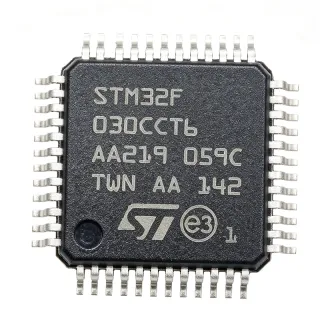
MKE15Z32VFP4 - 48MHz Cortex-M0+ MCU with 32KB Flash | NXP
MPN: MKE15Z32VFP4 ✓ সক্রিয়MKE15Z32VFP4 সারাংশ
A microcontroller is an integrated semiconductor that combines a processor core, program memory, data memory, and peripherals on one device. The Arm Cortex-M0+ is a compact 32-bit processor architecture designed for cost-sensitive embedded control. Within the product hierarchy, the MKE15Z32VFP4 belongs to the Kinetis KE microcontroller family, the MCU category, and the broader embedded semiconductor market.
The device provides 32 KB of flash for firmware and 4 KB of SRAM for working data. Its NXP Touch sensing interface supports capacitive-touch products, while its CAN controller supports industrial networking and vehicle-oriented embedded systems. The 48 MHz Cortex-M0+ core provides useful processing headroom for control loops, human-interface firmware, communications, and sensor management without requiring a higher-complexity processor.
The MKE15Z32VFP4 is manufactured in a 40-HVQFN surface-mount package. This package supports compact PCB layouts while exposing the required I/O, power, ground, reset, and programming connections. Because the MCU integrates multiple analog and communication functions, component count can be reduced in designs that otherwise require separate touch controllers or CAN interface devices.
Typical uses include capacitive human-interface panels, industrial control modules, building controls, appliance interfaces, and CAN-connected embedded equipment. The combination of touch sensing, CAN control, 32 KB flash, and 4 KB RAM makes the part suitable for compact controllers whose firmware size and peripheral requirements fit the KE1xZ feature set.
Designers should confirm the exposed-pad connection, pin multiplexing, operating-voltage limits, clock configuration, and programming requirements in the NXP datasheet before layout release. Allow adequate PCB routing for touch electrodes, maintain recommended decoupling close to the supply pins, and verify that the selected firmware and development tools support the KE15Z device.
This page combines manufacturer and distributor information with application guidance, engineering design notes, and drop-in replacement criteria. It helps engineers distinguish true pin-compatible alternatives from devices that merely offer similar processing speed, memory capacity, or communication features.
এর জন্য ড্রপ-ইন বিকল্প MKE15Z32VFP4 — একই package, pin-to-pin compatible। ভিন্ন package-এর যেসব পার্টে PCB rework প্রয়োজন সেগুলো বাদ দেওয়া হয়েছে।
এই পণ্যের জন্য কোনো ড্রপ-ইন বিকল্প পাওয়া যায়নি।
বিকল্প অনুরোধ করুনMKE15Z32VFP4 সর্বোচ্চ রেটিং ও বৈদ্যুতিক বৈশিষ্ট্য
| Product Type | 32-bit ARM Cortex-M0+ microcontroller |
| Manufacturer | NXP Semiconductors |
| Product Family | Kinetis KE1xZ |
| Processor Core | Arm Cortex-M0+ |
| Architecture | ARM 32-bit |
| Maximum Stated Operating Frequency | 48 MHz |
| Flash Memory | 32 KB |
| Flash Organization | 32K x 8 bits |
| RAM | 4 KB |
| Touch Interface | NXP Touch (TSI) |
| CAN Control | Integrated CAN controller |
| Nominal Supply Voltage | 5 V |
| প্যাকেজ | 40-pin HVQFN, 5 mm x 5 mm |
| পিন সংখ্যা | 40 pins |
| মাউন্টিং টাইপ | Surface mount |
| Device Status | Active |
| RoHS স্ট্যাটাস | Compliant |
| USB Capability | Integrated USB |
| Analog and Low-Power Features | Integrated analog peripherals and low-power optimization |
MKE15Z32VFP4 40-pin hvqfn, 5 mm x 5 mm পিন কনফিগারেশন গাইড
MKE15Z32VFP4 (40-pin hvqfn, 5 mm x 5 mm প্যাকেজ)-এর পিন কনফিগারেশন। এই ডিজিটাল IC-তে GPIO, কমিউনিকেশন ইন্টারফেস (UART, SPI, I2C) এবং পাওয়ার পিন রয়েছে। বিকল্প পিন ফাংশন ও কনফিগারেশন অপশনের জন্য প্রস্তুতকারকের ডেটাশিট দেখুন। এমবেডেড সিস্টেম ডিজাইন ও PCB লেআউটের জন্য অপরিহার্য।

এর জন্য বিস্তারিত পিনআউট ডেটা পাওয়া যায়নি MKE15Z32VFP4.
দেখুন ডেটাশিট সম্পূর্ণ পিন কনফিগারেশনের জন্য।
সাধারণ ব্যবহার
MKE15Z32VFP4 এর জন্য উপযুক্ত 6 অ্যাপ্লিকেশনs: Capacitive Control Panels, CAN-Connected Industrial Controls, Appliance User Interfaces, Building Control Modules, Sensor Hubs, USB-Conditioned Embedded Products.
Capacitive Control Panels
The MKE15Z32VFP4 fits capacitive human-interface panels because its NXP Touch sensing interface handles touch acquisition while the 48 MHz Arm Cortex-M0+ core processes events, indicators, and application logic. Its 32 KB of flash can retain control firmware and configuration data, and 4 KB of RAM supports working state and interface buffers. Using one MCU for touch and system control can reduce external controller count and simplify the PCB. Keep the touch electrode routing away from switching and high-current paths, follow the recommended grounding arrangement, and validate sensitivity in the final enclosure and power-supply configuration.
CAN-Connected Industrial Controls
The MKE15Z32VFP4 is appropriate for compact industrial controllers that need deterministic wired communication and local control. Its integrated CAN controller avoids a separate communication IC, while the 48 MHz Cortex-M0+ core can supervise sensors, actuator logic, diagnostics, and communication tasks. The 4 KB of RAM is suitable for modest message and control buffers, while 32 KB of flash supports a focused firmware image. Account for CAN transceiver requirements, termination, isolation, bus protection, and grounding in the system design. Confirm that the chosen operating condition and peripheral assignment meet the target equipment’s environmental requirements.
Appliance User Interfaces
The MKE15Z32VFP4 can serve as the central controller in a compact appliance that combines capacitive buttons or sliders with CAN-connected modules. The NXP Touch interface supports direct control-panel integration, and the 5 V-class device architecture is appropriate for systems powered from regulated 5 V rails. The Cortex-M0+ core manages panel events, motor or relay sequencing, fault detection, and communication. Its 32 KB flash accommodates a focused user-interface and control application without requiring a larger MCU. Validate the regulator startup behavior, analog noise coupling into touch channels, and exposed-pad thermal design before production release.
Building Control Modules
The MKE15Z32VFP4 suits distributed building-control modules that need local I/O, touch controls, and network communication in a small PCB area. The integrated CAN interface supports connection to a wired building network, while the 48 MHz Cortex-M0+ core provides enough performance for supervisory control, logging, and periodic sensor processing. The 32 KB flash and 4 KB RAM fit focused embedded workloads without the overhead of a higher-end MCU. Plan the module around a stable 5 V supply, appropriate bypass capacitors, protected external connections, and thermal margins. Review the electrical limits for the final ambient temperature and enclosure temperature rise.
Sensor Hubs
The MKE15Z32VFP4 can act as a compact sensor hub for industrial or consumer equipment that combines capacitive sensing with CAN-based communication. The 48 MHz Cortex-M0+ processor can sample sensors, apply filtering, manage thresholds, and publish status messages while the 4 KB SRAM holds working buffers. Its integrated analog and low-power resources can simplify a design intended for optimized embedded operation. The 32 KB flash provides room for control routines and calibration parameters. Check the accuracy and acquisition requirements of every analog signal separately, calibrate touch behavior in the finished assembly, and avoid placing sensitive routes beside fast-edge or switching-converter circuitry.
USB-Conditioned Embedded Products
The MKE15Z32VFP4 is suitable for embedded products that need a low-power Arm Cortex-M0+ control core, local touch controls, and USB connectivity. Its 32-bit processor can manage configuration, logging, peripheral supervision, and firmware updates, while the integrated USB capability avoids a separate host or device controller. The 40-pin HVQFN package supports compact board layouts in controls, accessories, and service equipment. USB implementation still requires careful signal routing, compliant connector and protection components, correct bus-power design, and firmware support for the intended USB role. Confirm the required host or device features against the manufacturer documentation before schematic approval.
এর জন্য ইঞ্জিনিয়ারিং রেফারেন্স ডেটা MKE15Z32VFP4 — তুলনা, ডিজাইন গাইডেন্স এবং কমপ্লায়েন্স তথ্য।
নির্বাচন গাইড
বিকল্পের সাথে তুলনা
| পারামিটার | এই পণ্য |
|---|---|
| Package | 40-pin HVQFN, 5 mm x 5 mm |
| Brand | NXP Semiconductors |
| Processor Core | Arm Cortex-M0+ |
| Maximum Stated Operating Frequency | 48 MHz |
| Flash Memory | 32 KB |
| RAM | 4 KB |
| Touch Interface | NXP Touch (TSI) |
| CAN Control | Integrated CAN controller |
| USB Capability | Integrated USB |
| Device Status | Active |
মূল পার্থক্যসমূহ
- Combines capacitive touch, CAN control, and USB in one compact MCU (বনামGeneric 48 MHz Cortex-M0+ MCU)
- Balanced memory configuration for compact embedded control (বনামLower-memory 32 MHz Cortex-M0+ MCU)
- Space-efficient 40-pin surface-mount implementation (বনামLarger-lead-count through-hole microcontroller)
ডিজাইন নোট
Use the exact 40-pin HVQFN land pattern and exposed-pad geometry defined by NXP rather than adapting a generic 40-pin QFN footprint. Connect the exposed pad according to the manufacturer's recommended land pattern and thermal guidance. Place the device-side decoupling capacitors close to the supply and ground pins, keep sensitive analog and touch routes away from high-current paths, and provide unobstructed copper around the package where thermal performance is required.
Treat touch electrodes as sensitive analog nets. Use short routes, a continuous ground reference beneath or near the sensing area, and the recommended spacing between electrodes and switching circuitry. Validate electrode geometry, trace length, component placement, connector grounding, and shield structure in the final enclosure. Changes to the housing, panel, or power-supply layout can materially affect touch sensitivity and repeatability.
Build the 5 V supply path around the manufacturer's input-voltage range, current limit, and decoupling recommendations. Confirm startup sequencing, brownout behavior, and the tolerance of the upstream regulator at the lowest input voltage and highest operating temperature. For CAN-connected equipment, account for the transceiver's supply and bus-current demand when sizing the regulator and local bypass network.
Do not treat a related Kinetis KE15Z ordering code as interchangeable merely because it has the same core and memory. Confirm package dimensions, pin names, exposed-pad requirements, alternate-function mappings, and peripheral availability in the manufacturer pin table. A firmware migration may also require changes to startup code, clock initialization, pin multiplexing, and peripheral drivers even when the memory organization is unchanged.
Estimate the junction-temperature rise using the actual PCB copper area, ambient temperature, and measured or calculated device dissipation before releasing the design. The 5 mm by 5 mm HVQFN can conduct heat through its exposed pad, but thermal performance depends strongly on the PCB stack-up, via arrangement, copper spreading, enclosure, and airflow. Keep processors away from heat-generating regulators or power devices when possible.
কমপ্লায়েন্স তথ্য
RoHS compliance is identified in the product listing. No additional compliance claims are asserted without explicit manufacturer documentation.