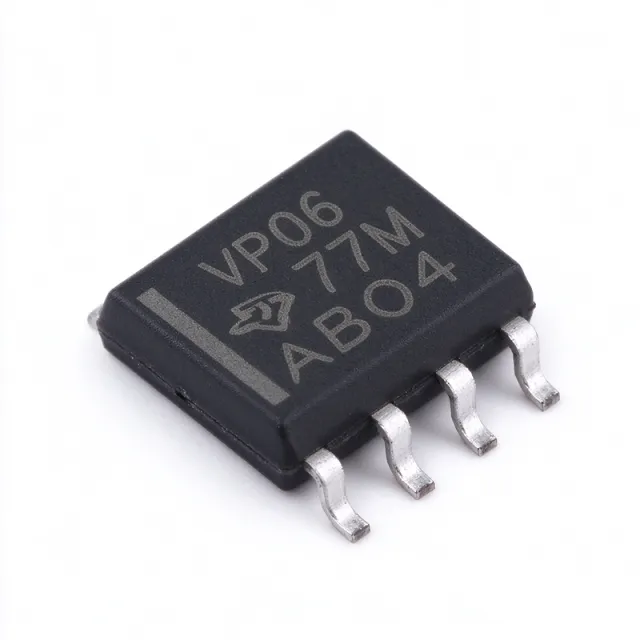
SN65173D
SN65173D - Quad Differential Line Receiver | Texas Instruments
Texas Instruments SN65173D is a monolithic quadruple differential line receiver with 3-state outputs, packaged in a 16-pin small-outline integrated-circuit package. It accepts four differential signal pairs and supports balanced digital-data transmission interfaces covered by TI A/EIA-422-B, TIA/EIA-423-B, TIA/EIA-485-A, and related ITU recommendations. The receiver's -40°C to +85°C temperature range suits industrial equipment, instrumentation, industrial automation, and communications systems. The SN65173D is the taped-and-reel ordering option identified for the D package in the SN55173, SN65173, and SN75173 device family.
A differential line receiver is an interface IC that compares two complementary signal lines and converts their voltage difference into a logic-level output. In the broader semiconductor hierarchy, the SN65173D belongs to the receiver category, then to line-driver and transceiver interface ICs, and ultimately to interface semiconductors. Differential signaling rejects common-mode noise, reduces sensitivity to ground offsets, and supports reliable data transfer over cables or backplanes. A quadruple receiver consolidates four channels into one package, reducing board area when several links share a communications subsystem.
The principal feature of the SN65173D is its four-channel differential input arrangement with 3-state outputs. The 3-state output capability permits the receiver outputs to be placed into a high-impedance state when the shared bus is disabled, allowing multiple devices to share a data path under suitable bus-management conditions. Its monolithic construction provides four receivers on one die, while the compact 16-pin package supports conventional surface-mount assembly. The manufacturer identifies the D package as available in taped-and-reel form.
The SN65173 family is designed for balanced multipoint data transmission where common-mode rejection is important. Its applications include industrial control networks, data-processing equipment, test systems, and interfaces using differential signaling. Compatibility with the listed EIA/TIA and ITU recommendations provides an established framework for signal voltage, loading, and bus behavior. Exact input thresholds, common-mode range, propagation delay, output timing, enable logic, and supply-current limits should be confirmed in the manufacturer datasheet before final circuit sign-off.
Typical uses include industrial serial links, data-acquisition equipment, instrumentation interfaces, and embedded control systems. In a multi-drop bus, the receiver can monitor a differential pair at a remote device while retaining a tri-state output for controlled bus participation. Designers should confirm that all attached transmitters, receivers, terminations, and grounding arrangements satisfy the applicable standard, particularly on long cables or electrically noisy factory environments.
A principal design consideration is the distinction between receiver enable and bus-driver enable. The SN65173D is a receiver only, so it requires a separate line driver when the design must transmit on the same physical bus. Its differential inputs and single-ended logic outputs also require an intentional grounding and signal-integrity strategy. Use the datasheet pin-description and typical-application diagrams when assigning traces and logic functions, and check timing margins across the complete transmitter-to-receiver path.
This page consolidates the verified package, temperature, receiver-function, family-option, and application information into a design-oriented reference. It also identifies the closest package-compatible alternatives, highlights the distinction between receiver-only and transceiver solutions, and provides comparison and implementation guidance that helps engineers select the correct device before PCB layout.
RFQ
Contact