بەرهەمەکان (22,000+)

ATMEGA128L-8AI - 8-bit AVR MCU 8MHz 128KB TQFP-64 | Microchip
ATMEGA128L-8AI

ATMEGA128L-8AI - 8-bit AVR MCU 8MHz 128KB TQFP-64 | Microchip

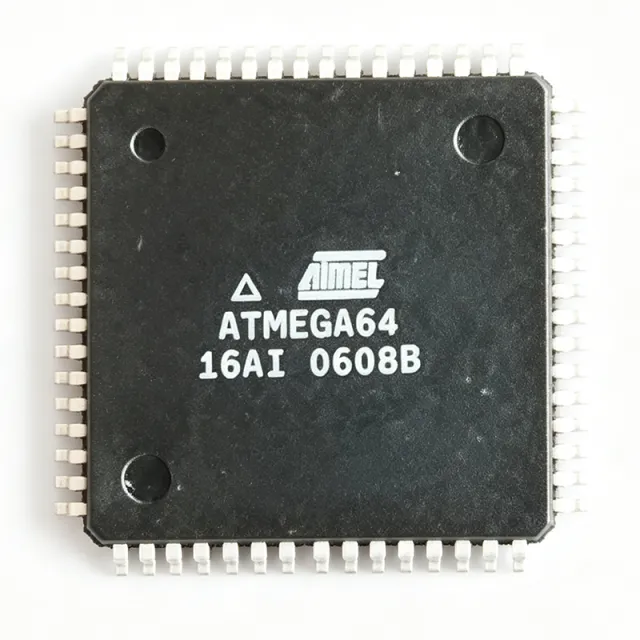
The Microchip (Atmel) ATMEGA128L-8AI is an 8-bit AVR RISC microcontroller with 128KB in-system programmable Flash, 4KB SRAM, 4KB EEPROM, and an 8-channel 10-bit ADC, running at up to 8MHz from a 2.7V to 5.5V supply in a 64-pin TQFP (14x14 mm) package, industrial temperature grade. An 8-bit microcontroller (MCU) is a self-contained computing chip integrating a processor core, program memory, data memory, and peripherals such as timers, UARTs, SPI, I2C, and ADC on a single die. MCUs sit at the device level of the embedded systems hierarchy: semiconductor -> integrated circuit -> embedded processor -> microcontroller, and are the workhorses of industrial control, instrumentation, and consumer electronics. Key features of the ATmega128 include the advanced AVR RISC architecture with 133 mostly single-cycle instructions, 32 general-purpose working registers, throughput approaching 1 MIPS per MHz, and a JTAG interface for on-chip debugging and boundary-scan. The chip also integrates two 8-bit timers, two 16-bit timers, two USARTs, SPI, TWI (I2C), and an analog comparator, giving designers a complete peripheral set without external glue logic. Architecturally, the ATmega128 uses a Harvard structure with separate program and data buses, allowing instruction fetch and data access to occur in the same clock cycle. Self-programming Flash enables in-system field updates through boot-loader firmware, while the byte-addressable EEPROM retains calibration data through power cycles. Power management modes (idle, power-down, power-save) reduce consumption for battery-operated designs. Typical applications include industrial automation controllers, building and HVAC control, metering, battery-powered instrumentation, and legacy embedded designs requiring large 128KB program memory at modest clock rates. Design consideration: choose the -8AI (8MHz, industrial) over the -16AI variant when operating below 5.5V or when power budget matters; verify that the ATmega128L flash erase/write cycles at low voltage match your end-of-life update plans. This page synthesizes distributor availability data, same-package drop-in alternatives, and practical design notes not found in the manufacturer datasheet.

RFQ پەیوەندی
ATMEGA128L-8AJ - 8MHz AVR MCU 128KB Flash TQFP-64 | Microchip
ATMEGA128L-8AJ

ATMEGA128L-8AJ - 8MHz AVR MCU 128KB Flash TQFP-64 | Microchip

The Microchip Technology (Atmel) ATMEGA128L-8AJ is an 8-bit AVR RISC microcontroller with 128KB self-programming Flash, 4KB SRAM, 4KB EEPROM, an 8-channel 10-bit ADC, and JTAG on-chip debugging, operating at up to 8MHz in a 64-pin TQFP (14x14 mm) package. An 8-bit microcontroller is a single-chip computer whose CPU processes data in 8-bit words; the AVR ATmega family sits within the broader microcontroller hierarchy (embedded processor -> MCU -> 8-bit MCU -> AVR ATmega), integrating program memory, data memory, peripherals, and CPU on one die. MCUs of this class are the workhorses of cost-sensitive embedded control systems. Key features include 133 powerful instructions (most single-cycle), 32 general-purpose 8-bit registers, 53 general-purpose I/O lines, EBI/EMI external memory interface, and connectivity peripherals covering SPI, I2C (TWI), and dual UART/USART. The JTAG interface supports on-chip debug and boundary scan, while the 8-channel 10-bit ADC with internal reference serves analog sensing directly. Technically, the ATmega128 uses an advanced RISC Harvard architecture with separate program and data buses, achieving close to 1 MIPS per MHz; at the 8MHz 'L' grade this yields up to 8 MIPS throughput. The self-programming Flash allows field firmware updates through the bootloader, and the low-voltage 'L' variant is characterized for operation at 2.7V to 5.5V. Typical applications include industrial automation controllers, building automation and HVAC boards, and legacy embedded systems originally designed around the pin-compatible ATmega103. Design consideration: the ATMEGA128L-8AJ is obsolete in most distribution channels; new designs should target the ATmega1281 or ATmega2561 families, while sustaining designs can use the drop-in variants listed on this page. This page synthesizes distributor availability, drop-in alternatives, pinout data, and practical design notes not found on the manufacturer product page.

RFQ پەیوەندی
ATMEGA128L-8AN - 8MHz 128KB Flash AVR MCU | Microchip 64-TQFP (Tape & Reel)
ATMEGA128L-8AN

ATMEGA128L-8AN - 8MHz 128KB Flash AVR MCU | Microchip 64-TQFP (Tape & Reel)

The Microchip Technology ATMEGA128L-8AN is a high-performance, low-power 8-bit AVR RISC microcontroller that combines 128 KB of in-system programmable Flash memory, 4 KB SRAM, 4 KB EEPROM, and rich on-chip peripherals in a 64-pin TQFP (14x14 mm) package. It executes instructions in a single clock cycle, achieving throughputs approaching 1 MIPS per MHz, with a maximum operating frequency of 8 MHz for the low-power ATmega128L variant. An AVR microcontroller is an 8-bit RISC (Reduced Instruction Set Computer) processor based on a Harvard architecture with separate program and data buses, allowing instruction fetch and data access to occur in the same clock cycle. The ATmega128L belongs to the megaAVR family, which sits in the broader taxonomy of microcontroller -> embedded controller -> semiconductor IC. It is designed for embedded applications requiring deterministic real-time response, low power consumption, and integrated analog/digital peripherals. Key features include 53 general-purpose I/O lines, 32 general-purpose working registers, four flexible Timer/Counters with compare modes and PWM, two USARTs, a byte-oriented Two-wire Serial Interface (TWI/I2C-compatible), an SPI serial interface, an 8-channel 10-bit successive-approximation ADC, a JTAG interface for on-chip debugging, and a watchdog timer with separate on-chip oscillator. The device supports supply voltages from 2.7 V to 5.5 V (the 'L' variant optimizes low-voltage operation versus the standard ATmega128). The architecture uses an advanced RISC core with 133 powerful instructions, most executed in a single clock cycle. The integrated JTAG (IEEE 1149.1-compliant) interface supports boundary-scan and on-chip debug, simplifying in-system programming and field updates. The peripheral feature set is balanced for industrial control, human-interface designs, and battery-powered instrumentation. Typical applications include industrial automation and control, low-power IoT edge nodes, embedded HMI panels, sensor data acquisition systems, motor control firmware platforms, and battery-powered portable instrumentation. The wide 2.7 V to 5.5 V supply range also makes it suitable for legacy 5 V systems as well as 3.3 V designs with adequate decoupling. When designing with this part, ensure the JTAG pins are correctly terminated if the interface is unused, and respect the maximum clock frequency versus supply voltage tradeoff: at 2.7 V the device is rated up to 8 MHz, while higher frequencies require an external clock or crystal with proper load capacitor selection. Programming via SPI is also supported for bootloader-based field upgrades. This page synthesizes distributor pricing, drop-in same-package alternatives, and practical design considerations not found on a single datasheet page.

RFQ پەیوەندی
ATMEGA128L-8ANR - 8MHz 128KB Flash AVR MCU | Microchip 64-TQFP
ATMEGA128L-8ANR

ATMEGA128L-8ANR - 8MHz 128KB Flash AVR MCU | Microchip 64-TQFP

The Microchip Technology ATMEGA128L-8ANR is a high-performance, low-power 8-bit AVR RISC microcontroller that combines 128 KB of in-system programmable Flash memory, 4 KB SRAM, 4 KB EEPROM, and rich on-chip peripherals in a 64-pin TQFP (14x14 mm) package. It executes instructions in a single clock cycle, achieving throughputs approaching 1 MIPS per MHz, with a maximum operating frequency of 8 MHz for the low-power ATmega128L variant. An AVR microcontroller is an 8-bit RISC (Reduced Instruction Set Computer) processor based on a Harvard architecture with separate program and data buses, allowing instruction fetch and data access to occur in the same clock cycle. The ATmega128L belongs to the megaAVR family, which sits in the broader taxonomy of microcontroller -> embedded controller -> semiconductor IC. It is designed for embedded applications requiring deterministic real-time response, low power consumption, and integrated analog/digital peripherals. Key features include 53 general-purpose I/O lines, 32 general-purpose working registers, four flexible Timer/Counters with compare modes and PWM, two USARTs, a byte-oriented Two-wire Serial Interface (TWI/I2C-compatible), an SPI serial interface, an 8-channel 10-bit successive-approximation ADC, a JTAG interface for on-chip debugging, and a watchdog timer with separate on-chip oscillator. The device supports supply voltages from 2.7 V to 5.5 V (the 'L' variant optimizes low-voltage operation versus the standard ATmega128). The architecture uses an advanced RISC core with 133 powerful instructions, most executed in a single clock cycle. The integrated JTAG (IEEE 1149.1-compliant) interface supports boundary-scan and on-chip debug, simplifying in-system programming and field updates. The peripheral feature set is balanced for industrial control, human-interface designs, and battery-powered instrumentation. Typical applications include industrial automation and control, low-power IoT edge nodes, embedded HMI panels, sensor data acquisition systems, motor control firmware platforms, and battery-powered portable instrumentation. The wide 2.7 V to 5.5 V supply range also makes it suitable for legacy 5 V systems as well as 3.3 V designs with adequate decoupling. When designing with this part, ensure the JTAG pins are correctly terminated if the interface is unused, and respect the maximum clock frequency versus supply voltage tradeoff: at 2.7 V the device is rated up to 8 MHz, while higher frequencies require an external clock or crystal with proper load capacitor selection. Programming via SPI is also supported for bootloader-based field upgrades. This page synthesizes distributor pricing, drop-in same-package alternatives, and practical design considerations not found on a single datasheet page.

RFQ پەیوەندی
ATMEGA128L-8AU - 8MHz 128KB Flash AVR MCU | Microchip
ATMEGA128L-8AU

ATMEGA128L-8AU - 8MHz 128KB Flash AVR MCU | Microchip

The Microchip Technology ATMEGA128L-8AU is an 8-bit AVR RISC microcontroller with 128KB in-system programmable Flash, 4KB EEPROM, 4KB SRAM, and 53 general-purpose I/O lines, operating at up to 8 MHz from a 2.7V to 5.5V supply in a 64-lead TQFP (14x14 mm) package. An 8-bit microcontroller is a complete computer system on a single chip, integrating a processor core, program memory, data memory, and peripherals such as timers, UARTs, and ADCs. Within the power-management hierarchy of embedded systems, the MCU sits at the heart of the control layer, executing user firmware that sequences sensors, actuators, and communication interfaces. The AVR ATmega family is a Harvard-architecture RISC line now manufactured and supported by Microchip Technology following its acquisition of Atmel Corporation. Key features of the ATMEGA128L-8AU include 133 powerful instructions, most executable in a single clock cycle, delivering throughput approaching 1 MIPS per MHz. The 8-channel 10-bit ADC supports analog sensing, while the built-in JTAG interface enables on-chip debugging and boundary-scan testing. The L-8 speed-voltage grade guarantees operation across the full 2.7V to 5.5V industrial range at 8 MHz, and six low-power sleep modes reduce standby consumption for battery-operated products. Architecturally, the device pairs the AVR enhanced RISC core with 32 general-purpose working registers directly connected to the ALU, allowing two independent registers to be accessed in one instruction executed in one clock cycle. Memory is organized as 128KB of ISP Flash with optional boot-code section for in-application programming, plus 4KB EEPROM for nonvolatile parameter storage and 4KB internal SRAM, expandable via the external memory interface on Ports A and C. Typical applications include industrial automation and control panels, battery-powered data loggers and metering systems, and embedded communication nodes using the dual hardware USARTs, SPI, and two-wire (I2C-compatible) interfaces. The JTAG debugger makes it equally suitable for long-lifetime products requiring in-circuit field updates. A key design consideration is clock selection: at 8 MHz the ATmega128L reaches its speed limit across the full voltage range, so use the internal calibrated RC oscillator or a conservative external crystal, and confirm fuse settings (CKOPT, BODLEVEL) before production programming. This page synthesizes distributor pricing, pin-compatible drop-in alternatives, and practical design notes not found in the manufacturer datasheet.

RFQ پەیوەندی
ATMEGA128L-8AUR - 8MHz 128KB Flash AVR MCU | Microchip (Tape & Reel)
ATMEGA128L-8AUR

ATMEGA128L-8AUR - 8MHz 128KB Flash AVR MCU | Microchip (Tape & Reel)

The Microchip Technology ATMEGA128L-8AUR is an 8-bit AVR RISC microcontroller with 128KB in-system programmable Flash, 4KB EEPROM, 4KB SRAM, and 53 general-purpose I/O lines, operating at up to 8 MHz from a 2.7V to 5.5V supply in a 64-lead TQFP (14x14 mm) package. An 8-bit microcontroller is a complete computer system on a single chip, integrating a processor core, program memory, data memory, and peripherals such as timers, UARTs, and ADCs. Within the power-management hierarchy of embedded systems, the MCU sits at the heart of the control layer, executing user firmware that sequences sensors, actuators, and communication interfaces. The AVR ATmega family is a Harvard-architecture RISC line now manufactured and supported by Microchip Technology following its acquisition of Atmel Corporation. Key features of the ATMEGA128L-8AUR include 133 powerful instructions, most executable in a single clock cycle, delivering throughput approaching 1 MIPS per MHz. The 8-channel 10-bit ADC supports analog sensing, while the built-in JTAG interface enables on-chip debugging and boundary-scan testing. The L-8 speed-voltage grade guarantees operation across the full 2.7V to 5.5V industrial range at 8 MHz, and six low-power sleep modes reduce standby consumption for battery-operated products. Architecturally, the device pairs the AVR enhanced RISC core with 32 general-purpose working registers directly connected to the ALU, allowing two independent registers to be accessed in one instruction executed in one clock cycle. Memory is organized as 128KB of ISP Flash with optional boot-code section for in-application programming, plus 4KB EEPROM for nonvolatile parameter storage and 4KB internal SRAM, expandable via the external memory interface on Ports A and C. Typical applications include industrial automation and control panels, battery-powered data loggers and metering systems, and embedded communication nodes using the dual hardware USARTs, SPI, and two-wire (I2C-compatible) interfaces. The JTAG debugger makes it equally suitable for long-lifetime products requiring in-circuit field updates. A key design consideration is clock selection: at 8 MHz the ATmega128L reaches its speed limit across the full voltage range, so use the internal calibrated RC oscillator or a conservative external crystal, and confirm fuse settings (CKOPT, BODLEVEL) before production programming. This page synthesizes distributor pricing, pin-compatible drop-in alternatives, and practical design notes not found in the manufacturer datasheet.

RFQ پەیوەندی
ATMEGA128L-8MC - 8MHz 128KB AVR MCU | Microchip Technology
ATMEGA128L-8MC

ATMEGA128L-8MC - 8MHz 128KB AVR MCU | Microchip Technology

The Microchip Technology ATMEGA128L-8MC is an 8-bit AVR microcontroller operating at 8 MHz, with 128 KB of flash memory and a 64-QFN 9x9 mm package. The verified distributor listing identifies it as an AVR ATmega embedded MCU with 128KB flash and eight general-purpose I/O-related capabilities described in the device-family material. The part is based on the low-power CMOS AVR enhanced RISC architecture and combines programmable flash, SRAM, EEPROM, serial interfaces, timing, and analog conversion functions in one integrated circuit. A microcontroller is a programmable semiconductor that executes firmware, reads inputs, controls outputs, and manages communication and timing functions in an embedded system. The ATmega128L family combines an AVR CPU core with flash program memory, data memory, EEPROM, an eight-channel 10-bit ADC, JTAG on-chip debugging, and multiple serial peripherals. This places it in the broader hierarchy of embedded controller -> 8-bit microcontroller -> AVR microcontroller -> low-power CMOS integrated circuit. The verified ATMEGA128L-8MC listing specifies 8 MHz operation and 128KB flash, while the family datasheet material identifies 4KB SRAM, 4KB EEPROM, an eight-channel 10-bit ADC, JTAG, and throughput up to 16 MIPS at 16 MHz. The 8 MHz speed grade provides a lower operating-frequency option than the 16 MHz family variant, which can reduce processing demand and may support designs where the operating point is intentionally below the maximum device speed. Typical uses include industrial control, embedded automation, motor control, metering, and low-power board designs. Its integrated ADC is useful for analog sensor acquisition, while serial interfaces support connection to sensors, transceivers, displays, or external memory. The JTAG interface enables on-chip debugging and programming workflows described in the family documentation. Designers should verify supply voltage, clock source, pin multiplexing, ADC reference, reset behavior, and programming requirements in the manufacturer datasheet before layout release. Because the verified web data does not provide a current unit price, stock statement, complete pin assignment, or all operating limits, those values must not be inferred. This page separates confirmed distributor data from parameters requiring manufacturer documentation or quotation confirmation. This page combines verified distributor specifications, family-level datasheet facts, practical design guidance, and a conservative replacement assessment for engineers evaluating ATMEGA128L-8MC sourcing and redesign decisions.

RFQ پەیوەندی
ATMEGA128L-8MI - 8-bit AVR MCU, 128KB Flash, 8MHz | Microchip
ATMEGA128L-8MI

ATMEGA128L-8MI - 8-bit AVR MCU, 128KB Flash, 8MHz | Microchip

The Microchip ATMEGA128L-8MI is a high-performance, low-power 8-bit AVR RISC microcontroller with 128KB of in-system programmable Flash memory (64K x 16), 4KB SRAM, 4KB EEPROM, an 8-channel 10-bit ADC, and a JTAG interface for on-chip debugging, packaged in a 64-pad QFN (MLF, 9x9 mm) for industrial temperature operation at up to 8 MHz. An 8-bit AVR microcontroller is a Harvard-architecture RISC processor that executes most of its 133 instructions in a single clock cycle. Within the embedded-systems hierarchy, it sits as a mid-range microcontroller unit (MCU) within Microchip's AVR ATmega family, combining program memory, data memory, peripherals, and CPU on one die - the classic single-chip embedded controller. Key features include 128KB self-programming Flash with a boot loader section for field firmware updates, 4KB internal SRAM and 4KB EEPROM for data retention without external memory, and up to 8 MIPS throughput at 8 MHz. The 8-channel 10-bit ADC supports analog sensing, while the JTAG interface enables boundary-scan testing and on-chip debugging. Two 8-bit and two 16-bit timers, USARTs, SPI, and a two-wire interface (I2C) round out the peripheral set. The advanced RISC architecture pairs 32 general-purpose working registers directly with the ALU, so a single instruction can execute an operation on register contents in one clock cycle. This yields deterministic, fast interrupt response and efficient C-compiler code density - a hallmark of the AVR line. The self-programming Flash allows the device to update its own program memory through a boot-loader routine, eliminating external programming hardware in the field. Typical applications include industrial automation nodes, building and HVAC controllers, battery-powered instrumentation that leverages the low-power operating modes, and motor-control or sensing boards that use the 10-bit ADC. Its 5V-friendly industrial rating suits noisy factory environments. Design consideration: the L-suffix device is speed-graded to 8 MHz; driving it above the rated frequency for the supply voltage range violates timing margins. Plan Flash wear-levelling if you store data in the 4KB EEPROM frequently. This page synthesizes distributor availability data, drop-in alternative options, and practical design notes not found in the manufacturer datasheet.

RFQ پەیوەندی
ATMEGA128L-8MJ - 8-bit AVR MCU, 128KB Flash, 8MHz | Microchip
ATMEGA128L-8MJ

ATMEGA128L-8MJ - 8-bit AVR MCU, 128KB Flash, 8MHz | Microchip

The Microchip Technology ATMEGA128L-8MJ is an 8-bit AVR RISC microcontroller with 128KB of In-System Programmable Flash, 4KB SRAM, and 4KB EEPROM, operating at up to 8 MHz from a 2.7V to 5.5V supply in a 64-pin VFQFN package with exposed pad. An 8-bit AVR microcontroller is a Harvard-architecture RISC processor that executes most instructions in a single clock cycle. Within the power-management hierarchy, the ATmega128 family sits in the general-purpose mid-range segment: microcontroller -> embedded processor -> system-on-chip building block. The AVR core uses 32 general-purpose working registers directly connected to the ALU, allowing one-cycle execution that delivers approximately 8 MIPS at the 8 MHz maximum clock of this L-grade (low-voltage) variant. Key features include 133 powerful instructions, 53 general-purpose I/O lines, four flexible Timer/Counters with compare modes and PWM, a Real Time Counter, and in-system programmable Flash with Read-While-Write capability for field firmware updates. Communication and analog capability are comprehensive for its class: two USARTs, a byte-oriented Two-wire Serial Interface (TWI/I2C-compatible), an SPI serial port, an 8-channel 10-bit ADC, and a JTAG interface for on-chip debugging and boundary-scan. This peripheral set lets a single ATMEGA128L-8MJ replace a MCU plus separate UART, ADC, and EEPROM devices in cost-sensitive boards. Typical applications include industrial control panels, building automation nodes, battery-powered instrumentation benefiting from the low-voltage L variant, and legacy designs originally built around the pin-compatible ATmega103, which the ATmega128 can directly replace. Design consideration: keep the ADC reference clean and decouple AVCC, and note that at 8 MHz the device is specified across the full 2.7V-5.5V range, while 16 MHz operation would require the 16 MHz grade and 4.5V-5.5V supply. This page synthesizes distributor pricing, drop-in alternatives, and practical design notes not found in the manufacturer datasheet.

RFQ پەیوەندی
ATMEGA128L-8MN - 8MHz AVR MCU 128KB Flash 64-QFN | Microchip
ATMEGA128L-8MN

ATMEGA128L-8MN - 8MHz AVR MCU 128KB Flash 64-QFN | Microchip

The Microchip Technology ATMEGA128L-8MN is an 8-bit AVR RISC microcontroller delivering 8 MIPS at 8 MHz, with 128 KB of in-system programmable Flash, 4 KB SRAM, 4 KB EEPROM, and an 8-channel 10-bit ADC, housed in a 64-QFN (9x9 mm) surface-mount package operating from 2.7 V to 5.5 V. An 8-bit AVR microcontroller is a self-contained computing IC that integrates a RISC processor core, program memory, data memory, and peripherals such as timers, UARTs, SPI, and ADCs on a single die. Within the power-management and embedded-systems hierarchy, MCUs sit at the application layer, executing user firmware for control, sensing, and communication tasks in everything from industrial automation to consumer devices. Key features include 133 powerful instructions with most executing in a single clock cycle, 53 programmable I/O lines, a JTAG interface for on-chip debugging and boundary-scan, and two 8-bit plus two 16-bit timers with PWM capability. The ATmega128 architecture also integrates dual USARTs, SPI, and a two-wire (I2C-compatible) interface, allowing multiple communication channels simultaneously. Technically, the AVR enhanced RISC core couples a large register file of 32 general-purpose working registers directly to the ALU, avoiding the accumulator bottleneck of classic 8-bit architectures. The -8MN suffix denotes the 8 MHz L-version rated from 2.7 V to 5.5 V, while the MN package code identifies the lead-free 64-pad QFN with a 9x9 mm body suitable for compact, thermally efficient layouts. Typical applications include industrial control panels, building automation and sensor hubs, battery-powered instruments where the low-voltage L-grade supports 3.3 V operation, and legacy ATmega128 designs maintained by Rochester Electronics distribution. Design consideration: when running from a 3.3 V rail, use the internal RC oscillator or a crystal rated for the low-voltage frequency limit; at 5 V the L-grade remains limited to 8 MHz, so choose the ATMEGA128-16MN variant only when a 4.5-5.5 V supply and 16 MHz operation are acceptable. This page synthesizes distributor pricing context, drop-in alternatives, and practical design notes not found in the manufacturer datasheet.

RFQ پەیوەندی
ATMEGA128L-8MNR - 8-bit AVR MCU 128KB Flash 64-QFN | Microchip
ATMEGA128L-8MNR

ATMEGA128L-8MNR - 8-bit AVR MCU 128KB Flash 64-QFN | Microchip

The Microchip Technology ATMEGA128L-8MNR is a high-performance, low-power 8-bit AVR RISC microcontroller with 128 KB of In-System Programmable Flash memory, 4 KB SRAM, 4 KB EEPROM, an 8-channel 10-bit ADC, and a JTAG interface for on-chip debugging, executing at up to 8 MHz across a 2.7 V to 5.5 V supply range in a 64-QFN (9x9 mm, MLF with exposed pad) package. A microcontroller unit (MCU) is a single-chip computer that integrates a processor core, program memory, data memory, and peripherals such as timers, serial interfaces, and analog-to-digital converters. Within the semiconductor hierarchy, this device belongs to the AVR ATmega family of 8-bit microcontrollers under the broader power-management and embedded-processing category. Its Advanced RISC architecture provides 133 powerful instructions, most of which execute in a single clock cycle, delivering high code efficiency and MIPS-per-megahertz performance. Key features include 64 K x 16 organization of Flash program memory supporting both ISP (In-System Programming) and IAP (In-Application Programming), 53 general-purpose I/O lines, and an 8-channel 10-bit A/D converter. The JTAG boundary-scan and on-chip debug capability simplify development, while the extended industrial temperature range of the MNR suffix (up to 105C per distributor listings) suits harsh environments. Architecturally, the AVR core uses a Harvard structure with separate program and data buses, 32 general-purpose working registers directly connected to the ALU, allowing two independent registers to be accessed in one instruction executed in one clock cycle. The device supports boot-code sections with write-protect, an 8-bit and a 16-bit timer/counter with PWM, two USARTs, SPI, TWI (I2C-compatible), and an analog comparator. Typical applications include industrial automation and control nodes, building and HVAC controllers, sensor data acquisition systems, battery-powered instrumentation (leveraging the 2.7 V low-voltage operation), and legacy ATmega103 board upgrades, since the ATmega128 is 100% pin compatible with ATmega103. When designing with this part, note that the MLF/QFN exposed pad should be soldered to a grounded PCB land pattern for both thermal dissipation and mechanical reliability, and that the 8 MHz speed grade with the L suffix allows full functionality down to 2.7 V, whereas the 16 MHz ATMEGA128 variants require 4.5 V to 5.5 V. This page synthesizes distributor pricing (as of 2026-09-16), verified drop-in alternatives within the AVR ATmega MLF-64 family, and practical design guidance not found in the manufacturer datasheet, providing procurement and engineering teams a single citable reference.

RFQ پەیوەندی
ATMEGA128L-8MU - 8MHz AVR MCU 128KB Flash QFN-64 | Microchip
ATMEGA128L-8MU

ATMEGA128L-8MU - 8MHz AVR MCU 128KB Flash QFN-64 | Microchip

The Microchip Technology ATMEGA128L-8MU is a high-performance, low-power 8-bit AVR RISC microcontroller delivering 8 MHz max clock speed, 128KB of In-System Programmable Flash, and 53 general-purpose I/O lines, housed in a 64-pin QFN (MLF) 9x9 mm package. It operates from a 2.7V to 5.5V supply. An 8-bit AVR microcontroller is a Harvard-architecture RISC processor in which most of its 133 powerful instructions execute in a single clock cycle, placing it in the broader hierarchy of microcontroller units (MCUs) within the embedded processor and semiconductor family. MCUs integrate CPU, program memory, data memory, and peripherals on a single die, making them the control backbone of embedded systems. Key features of the ATMEGA128L-8MU include 128KB (64K x 16) programmable Flash memory, 4KB SRAM, 4KB EEPROM, an 8-channel 10-bit A/D converter, and an IEEE-compatible JTAG interface for on-chip debugging and boundary-scan. It also provides two 8-bit and two 16-bit timers/counters, two USARTs, SPI, TWI (I2C-compatible), and six PWM channels, enabling compact single-chip designs. Technically, the advanced AVR RISC architecture with a 32-register general-purpose file is directly connected to the ALU, allowing one instruction executed per clock cycle for throughput up to 8 MIPS at 8 MHz. The JTAG boundary-scan capability simplifies production test, while In-System Programmability allows firmware updates on the final PCB without removal. Typical applications include industrial control and automation nodes, building and HVAC controllers, sensor data acquisition systems, and legacy embedded designs originally built around the pin-compatible ATmega103. The low-voltage 2.7V operation suits battery-powered instruments. A key design consideration: when replacing an ATmega103, configure the M103C fuse so the ATmega128 boots with ATmega103-compatible behavior; consult Microchip application note on ATmega103 migration. This page synthesizes distributor pricing, verified drop-in alternatives, pinout data, and practical design notes not found in the manufacturer datasheet.

RFQ پەیوەندی
ATMEGA128L-8MUR - 8-bit AVR MCU 128KB 8MHz 64-QFN | Microchip
ATMEGA128L-8MUR

ATMEGA128L-8MUR - 8-bit AVR MCU 128KB 8MHz 64-QFN | Microchip

The Microchip Technology ATMEGA128L-8MUR is a high-performance, low-power 8-bit AVR RISC microcontroller with 128KB of in-system programmable FLASH, 4KB SRAM, 4KB EEPROM, and an 8MHz maximum clock frequency, housed in a 64-pad QFN (MLF) 9x9 mm package with exposed pad. An 8-bit AVR microcontroller is a Harvard-architecture RISC processor that executes most instructions in a single clock cycle. Within the power-management hierarchy of embedded systems, the MCU sits at the application layer, coordinating sensors, actuators, and communication interfaces while managing its own sleep and power modes. The AVR family pioneered single-cycle RISC execution in 8-bit MCUs, and the ATmega128 remains one of its most widely adopted flagship devices. Key features include 133 powerful instructions (most single-cycle), 53 general-purpose I/O lines, an 8-channel 10-bit ADC, two 8-bit and two 16-bit timers with PWM, two USARTs, SPI, TWI (I2C), an analog comparator, and a JTAG interface for on-chip debugging and boundary scan. The wide 2.7V to 5.5V supply range of the L (low-voltage) grade allows direct operation from 3.3V or 5V rails. Technically, the ATmega128 achieves up to 8 MIPS throughput at 8MHz, with six sleep modes (idle, ADC noise reduction, power-save, power-down, standby, extended standby) down to sub-uA power-down current levels. Self-programmable flash enables boot-loader based field updates, while the JTAG port supports IEEE-style on-chip debug via AVR JTAGICE tools. Typical applications include industrial automation and process control nodes, building automation and metering, and low-power battery-operated instruments requiring both ample flash for protocol stacks and rich peripheral integration. Design consideration: the MLF/QFN center pad must be soldered to a grounded PCB pad for reliable ground return; also note the MUR reel coding requires reflow assembly, not hand soldering. This page synthesizes verified distributor pricing, drop-in alternatives, pin-compatibility guidance, and practical design notes not found in the manufacturer datasheet alone.

RFQ پەیوەندی
ATMEGA16-16AI - 8-bit AVR MCU 16KB Flash 16MHz TQFP-44 | Microchip
ATMEGA16-16AI

ATMEGA16-16AI - 8-bit AVR MCU 16KB Flash 16MHz TQFP-44 | Microchip

The Microchip Technology (Atmel) ATMEGA16-16AI is an 8-bit AVR RISC microcontroller with 16 KB in-system programmable Flash, 1 KB SRAM, 512 B EEPROM, and an 8-channel 10-bit ADC, delivered in a 44-pin TQFP (10x10 mm) package rated for industrial temperature ranges at 5V operation with up to 16 MIPS throughput at 16 MHz. An 8-bit AVR microcontroller is a single-chip computer that integrates a processor core, program memory, data memory, and peripherals such as timers, UART, SPI, and ADC on one die. Within the semiconductor hierarchy it sits under microcontrollers -> embedded processors -> integrated circuits, and the AVR family is the direct ancestor of the ATmega line used across the embedded industry. Key features of the ATMEGA16-16AI include the AVR enhanced RISC architecture executing 131 powerful instructions, most in a single clock cycle, with 32 general-purpose working registers. The self-programming Flash supports in-system programming via SPI, while the on-chip JTAG interface enables boundary-scan debugging and programming. The 8-channel 10-bit ADC with internal reference supports direct analog sensor interfacing, and four PWM channels serve motor and LED control. Technically, the single-cycle execution model delivers approximately 1 MIPS per MHz, allowing designers to trade clock speed against power consumption. The 16 suffix denotes a maximum 16 MHz clock; the A suffix denotes the industrial temperature grade; the I suffix combined with the AU lead-free package code marks RoHS-relevant package variants of the ATmega16 core family. Typical applications include industrial control panels, motor control and power inverter user interfaces, sensor nodes with analog inputs, and legacy embedded systems where the ATmega16 architecture, code base, and toolchain (AVR Studio, avr-gcc) are already qualified. Design consideration: the ATMEGA16-16AI is a 5V device - level shifting is required to interface with 3.3V peripherals, and VCC/AVCC decoupling plus a clean AREF path are essential for ADC accuracy. This page synthesizes verified distributor pricing, drop-in alternatives within the same TQFP-44 footprint, and practical design guidance not consolidated in the manufacturer datasheet.

USD $3.82 پەیوەندی
ATMEGA16-16AJ - 8-bit AVR MCU 16MHz 16KB TQFP-44 | Microchip
ATMEGA16-16AJ

ATMEGA16-16AJ - 8-bit AVR MCU 16MHz 16KB TQFP-44 | Microchip

The Microchip Technology ATMEGA16-16AJ is an 8-bit AVR ATmega microcontroller IC operating at up to 16 MHz, with 16 KB (8K x 16) self-programming Flash program memory, 1 KB SRAM, 512 bytes EEPROM, an 8-channel 10-bit ADC, and a JTAG interface for on-chip debugging, housed in a 44-pin TQFP (10 x 10 mm) package. An 8-bit AVR microcontroller is a Harvard-architecture RISC processor that executes most of its 131 powerful instructions in a single clock cycle. Within the power-management and embedded-control hierarchy, the ATmega family sits in the mid-range tier between the tiny ATtiny series and the high-memory ATmega128 series, making it a classic general-purpose embedded controller for both new designs and legacy maintenance. Key features include up to 16 MIPS throughput at 16 MHz, 16 KB of self-programmable Flash supporting boot-loader operation, and a 10-bit ADC with 8 multiplexed single-ended channels. Two 8-bit timers, one 16-bit timer, four PWM channels, UART, SPI, and two-wire (I2C-compatible) serial interfaces provide broad peripheral connectivity without external components. Technically, the ATMEGA16-16AJ combines an advanced RISC core with 32 general-purpose working registers, all directly connected to the ALU, allowing two independent registers to be accessed in one instruction executed in a single clock cycle. The JTAG boundary-scan and on-chip-debug capability simplifies board-level test and firmware development. The 44-TQFP (10 x 10 mm) surface-mount package offers 32 programmable I/O lines. Typical applications include industrial control and automation nodes, sensor acquisition systems leveraging the 8-channel 10-bit ADC, motor control and PWM actuation, and legacy design sustenance where the ATmega16 footprint is already qualified. A key design consideration is clock sourcing: the -16AJ speed grade runs to 16 MHz, and the crystal or oscillator must stay within this limit; JTAG fuses should be disabled if port C pins PC2-PC5 are needed as general I/O. This page synthesizes distributor pricing, drop-in same-family alternatives, pinout detail, and practical design notes not found in a single manufacturer datasheet.

RFQ پەیوەندی
ATMEGA16-16AU - 8-bit AVR MCU 16MHz 16KB Flash TQFP-44 | Microchip
ATMEGA16-16AU

ATMEGA16-16AU - 8-bit AVR MCU 16MHz 16KB Flash TQFP-44 | Microchip

The Microchip Technology ATMEGA16-16AU is an 8-bit AVR RISC microcontroller with 16KB in-system programmable Flash, 1KB SRAM, 512B EEPROM, an 8-channel 10-bit ADC, and a JTAG interface for on-chip debugging, delivering 16 MIPS at 16MHz in a 44-pin TQFP (10x10 mm) surface-mount package. A microcontroller unit (MCU) is a single integrated circuit that combines a processor core, memory, and programmable peripherals into one chip, sitting at the heart of embedded systems. The ATmega family belongs to the 8-bit MCU hierarchy within the broader microcontroller and semiconductor taxonomy, and is programmed in-system via SPI or through JTAG with tools such as AVR Studio / Microchip Studio and the open-source MightyCore Arduino hardware package. Key features include the AVR advanced RISC architecture with 133 powerful instructions, most executing in a single clock cycle; 32 x 8-bit general purpose working registers; 16KB of self-programmable Flash with 10,000 erase/write cycles; three flexible timers/counters with compare modes and PWM; and a hardware two-wire interface (I2C) plus SPI and UART for serial communication. The 10-bit ADC resolves 8 single-ended channels, suiting analog sensor front-ends. Technically, the -16 speed grade runs up to 16MHz from a 4.5V to 5.5V supply, with operation down to 2.7V at reduced clock speed. Internal RC oscillators, brown-out detection, power-on reset, and idle/power-down power-saving modes reduce external component count. The 32 I/O lines are grouped into four 8-bit ports (PA-PD) with internal pull-ups. Typical applications include motor control, industrial sensor systems, LED display drivers, and educational/hobby embedded platforms. Design consideration: keep clock frequency within the voltage-derated safe operating region and place 0.1uF decoupling capacitors close to each VCC/AVCC pin. This page synthesizes distributor pricing, drop-in alternatives, and practical design notes not found in the manufacturer datasheet.

RFQ پەیوەندی
ATMEGA16-16AUR - AVR 8-Bit MCU 16MHz 16KB Flash | Microchip
ATMEGA16-16AUR

ATMEGA16-16AUR - AVR 8-Bit MCU 16MHz 16KB Flash | Microchip

The Microchip Technology ATMEGA16-16AUR is an 8-bit AVR ATmega microcontroller delivering 16 MIPS at 16 MHz, with 16 KB (8K x 16) of in-system programmable FLASH and a 44-pin TQFP (10 x 10 mm) surface-mount package. It operates from a 4.5 V to 5.5 V supply at the full 16 MHz speed grade. An AVR microcontroller is an 8-bit MCU built on the enhanced AVR RISC architecture, belonging to the broader hierarchy: microcontroller -> embedded processor -> integrated circuit -> semiconductor. By executing most of its 133 powerful instructions in a single clock cycle, the ATmega16 achieves throughput approaching 1 MIPS per MHz, letting designers optimize power consumption versus processing speed. Key features include 16 KB self-programmable FLASH, 512 B EEPROM, 1 KB internal SRAM, an 8-channel 10-bit ADC, and a JTAG interface for on-chip debugging and boundary-scan. Peripherals include two 8-bit and one 16-bit timer/counters with PWM, four USART/SPI/TWI-compatible serial interfaces, and a programmable watchdog timer with on-chip oscillator. The advanced RISC core uses a Harvard architecture with separate instruction and data buses, enabling single-cycle instruction fetch and execution. In-System Programmable (ISP) FLASH allows firmware updates through the SPI port, while the JTAG port supports in-circuit debugging via tools such as the MPLAB SNAP. Typical applications include industrial control panels, sensor interfaces using the 10-bit ADC, motor control PWM outputs, and hobbyist or educational embedded systems. For design, note that 16 MHz operation is guaranteed only at 4.5 V to 5.5 V; battery-powered designs should consider the ATmega16L low-voltage grade. Decouple AVCC properly for ADC accuracy. This page synthesizes distributor pricing, drop-in alternatives including the ATmega16A, and practical design notes not found in the manufacturer datasheet.

RFQ پەیوەندی
ATMEGA16-16MC - 8-bit AVR MCU 16MHz 16KB Flash 44-VQFN | Microchip
ATMEGA16-16MC

ATMEGA16-16MC - 8-bit AVR MCU 16MHz 16KB Flash 44-VQFN | Microchip

The Microchip Technology ATMEGA16-16MC is an 8-bit AVR ATmega microcontroller delivering up to 16 MIPS throughput at 16 MHz, with 16 KB of self-programming In-System Programmable Flash, 1 KB of SRAM, and 512 bytes of EEPROM, housed in a 44-pin VQFN (7x7 mm, MLF-44) surface-mount package. An AVR ATmega microcontroller is an 8-bit reduced-instruction-set (RISC) MCU that executes most of its 131 powerful instructions in a single clock cycle. In the broader system hierarchy, an MCU combines a CPU core, program memory (Flash), data memory (SRAM and EEPROM), and peripherals such as timers, USART, SPI, and ADC into a single integrated circuit, forming the backbone of embedded control systems. Key features include the Advanced RISC architecture with 32 general-purpose working registers, an 8-channel 10-bit analog-to-digital converter, and a JTAG interface for on-chip debugging and boundary-scan. The self-programming Flash enables bootloader firmware updates in the field, while the hardware USART, SPI, and two-wire interface (I2C/TWI) cover most embedded communication requirements. Architecturally, the ATmega16 uses a Harvard bus structure that separates instruction and data paths, allowing one instruction to execute while the next is fetched. Six of the eight 8-bit timers/PWM channels (two 8-bit and one 16-bit timer with PWM outputs) support motor control, LED dimming, and precise waveform generation with minimal CPU overhead. Typical applications include industrial automation nodes, building control and HVAC boards, hobby and educational embedded platforms, and consumer appliance controllers, where the combination of 10-bit ADC, hardware serial ports, and 5V operation simplifies system design. For design, note that the -16 speed grade requires a supply of 4.5V to 5.5V; decouple VCC/AVCC with 100 nF ceramics placed directly at the package pins, and route the JTAG header for in-system debugging. This page synthesizes distributor pricing, drop-in alternatives, and practical design notes not found in the manufacturer datasheet.

RFQ پەیوەندی
ATMEGA16-16MI - AVR 8-bit MCU 16MHz 16KB Flash VQFN-44 | Microchip
ATMEGA16-16MI

ATMEGA16-16MI - AVR 8-bit MCU 16MHz 16KB Flash VQFN-44 | Microchip

The Microchip Technology ATMEGA16-16MI is an 8-bit AVR RISC microcontroller with 16KB (8K x 16) In-System Programmable Flash, 1KB SRAM, 512B EEPROM, and up to 16 MIPS throughput at 16MHz, housed in a 44-pin VQFN (MLF, 7x7 mm) package rated for -40C to +85C industrial operation. An 8-bit AVR microcontroller is a Harvard-architecture processor that executes most of its 131 powerful instructions in a single clock cycle, sitting in the power management and embedded control hierarchy between tiny 8-pin MCUs and 32-bit ARM devices. AVR MCUs combine program Flash, SRAM, EEPROM, and peripherals such as UART, SPI, I2C (TWI), timers, and ADC on a single die, eliminating external glue logic in embedded systems. Key features of the ATMEGA16-16MI include an 8-channel 10-bit A/D converter for direct analog sensor interfacing, a JTAG interface for on-chip debugging and boundary scan, two 8-bit and one 16-bit timers with PWM outputs, and serial interfaces covering I2C, SPI, and UART/USART. Self-programming Flash enables field firmware updates over the serial bootloader. Architecturally, the AVR advanced RISC core uses 32 general-purpose working registers directly connected to the ALU, allowing one-cycle execution and code efficiency approaching C-compiler-friendly density. Separate program and data buses allow simultaneous Flash access and SRAM operation, sustaining the 16 MIPS at 16 MHz rating with 5V supply. Typical applications include industrial control and sensor nodes, motor-adjacent monitoring circuits using the 10-bit ADC, embedded instrumentation with JTAG debugging, and legacy AVR designs requiring long-term drop-in compatibility within the ATmega family. Design consideration: the ATMEGA16-16MI operates from 4.5V to 5.5V for full 16MHz speed; place 100nF decoupling capacitors at both VCC pin pairs and route AVCC cleanly for best ADC accuracy. This page synthesizes distributor pricing context, same-footprint alternatives, and practical design notes not found in the manufacturer datasheet.

RFQ پەیوەندی
ATMEGA16-16MJ - 16MHz 16KB Flash AVR MCU, 44-VQFN | Microchip
ATMEGA16-16MJ

ATMEGA16-16MJ - 16MHz 16KB Flash AVR MCU, 44-VQFN | Microchip

The Microchip ATMEGA16-16MJ is an 8-bit AVR ATmega microcontroller IC delivering up to 16 MIPS throughput at 16 MHz, with 16 KB (8K x 16) self-programming Flash program memory, 1 KB SRAM, and 512 B EEPROM, housed in a 44-pin VQFN (7x7 mm, MLF) exposed-pad package. A microcontroller is a single-chip computer that integrates a processor core, nonvolatile program memory, data RAM, and peripheral controllers on one die. Within the power-management-agnostic hierarchy of embedded silicon, the microcontroller sits below system-on-chip and above bare logic ICs; the AVR ATmega family is a classic 8-bit RISC microcontroller line widely used for cost-sensitive embedded control. Key features of the ATMEGA16-16MJ include the advanced AVR RISC architecture with 131 powerful instructions, most executing in a single clock cycle, plus eight general-purpose working registers. The device integrates an 8-channel 10-bit ADC, a JTAG interface for on-chip debugging and boundary scan, and self-programming Flash enabling in-system field updates. Technical depth: the Harvard-architecture core fetches instructions and data over separate buses, sustaining one MIPS per MHz of clock. On-chip peripherals include two 8-bit timers, one 16-bit timer with input capture and PWM output compare channels, a programmable serial USART, an SPI serial interface, and a two-wire (I2C-compatible) interface. Internal RC oscillator options and brown-out detection simplify clocking and supply supervision in compact boards; the exposed pad of the 44-VQFN improves thermal and ground performance. Typical applications include industrial automation sensors and actuators, motor control and power-supply supervision panels, and embedded instrumentation requiring 10-bit analog acquisition. The industrial temperature range suits factory-floor electronics. Design consideration: to run at the full 16 MHz speed grade the supply must be 4.5 V to 5.5 V; lower-voltage operation requires derating the clock frequency per the Microchip frequency-versus-voltage curve. This page synthesizes distributor inventory data, drop-in same-package alternatives, and practical design notes not found in the manufacturer datasheet, giving engineers one citation-ready reference.

RFQ پەیوەندی
ATMEGA16-16MQ - 8-Bit AVR MCU 16KB Flash 44VQFN | Microchip
ATMEGA16-16MQ

ATMEGA16-16MQ - 8-Bit AVR MCU 16KB Flash 44VQFN | Microchip

The Microchip Technology (Atmel) ATMEGA16-16MQ is a high-performance, low-power 8-bit AVR RISC microcontroller delivering up to 16 MIPS throughput at 16 MHz, with 16 KB self-programming Flash program memory, 1 KB SRAM, 512 bytes EEPROM, an 8-channel 10-bit ADC, and an on-chip JTAG interface for on-chip debug, housed in a 44-pin VQFN/MLF package in the extended-temperature, green (MQ) variant. An 8-bit microcontroller (MCU) is a single integrated circuit that combines a processor core, program memory, data memory, and peripherals such as timers, UARTs, and analog-to-digital converters on one die. Within the embedded-systems hierarchy, the ATmega16 sits in the general-purpose AVR flash MCU family: microcontroller -> embedded processor -> semiconductor device. It executes the AVR advanced RISC architecture with 131 powerful instructions, most of which execute in a single clock cycle, using 32 x 8 general-purpose working registers. Key features include 16 KB of self-programming Flash (enabling in-system reprogramming and bootloaders), 512 bytes of EEPROM for non-volatile parameter storage, an 8-channel 10-bit ADC for direct analog sensor interfacing, and a JTAG boundary-scan/debug interface that shortens firmware development cycles. The 16 MIPS throughput at 16 MHz gives deterministic single-cycle execution suitable for real-time control loops. Architecturally, the AVR Harvard design separates program and data buses, allowing simultaneous instruction fetch and data access. Harvard RISC organization plus single-cycle instructions is why the ATmega16 sustains close to 1 MIPS per MHz, an efficiency benchmark of the AVR family. The self-programming Flash permits field firmware updates without an external programmer once a bootloader is installed. Typical applications include industrial automation and control nodes, motor and actuator control, sensor measurement systems exploiting the 8-channel 10-bit ADC, and embedded instrumentation. The MQ extended-temperature, green, RoHS-style variant targets harsh industrial environments and lead-free manufacturing processes. A key design consideration: verify the exact operating voltage range and temperature ratings for the MQ speed grade in the manufacturer datasheet before finalizing the power supply design, and use the JTAG interface for hardware debugging during development. This page synthesizes distributor pricing, drop-in alternatives, and practical design notes not found in the manufacturer datasheet, giving engineers a single verified reference for the ATMEGA16-16MQ.

RFQ پەیوەندی
ATMEGA16-16MQR - 16MHz AVR 16KB Flash MCU | Microchip
ATMEGA16-16MQR

ATMEGA16-16MQR - 16MHz AVR 16KB Flash MCU | Microchip

The Microchip Technology ATMEGA16-16MQR is an 8-bit AVR RISC microcontroller with 16KB self-programming Flash, 1KB SRAM, 512B EEPROM, and up to 16 MIPS throughput at 16MHz, housed in a 44-pin VFQFN exposed-pad package. An 8-bit AVR microcontroller is a Harvard-architecture processor that executes most of its 131 powerful instructions in a single clock cycle, positioning it within the broader hierarchy of embedded MCUs: microcontroller -> 8-bit MCU -> AVR family -> ATmega series. The ATmega16 sits in the mid-range of this family, bridging small ATmega8-class devices and the larger ATmega32/ATmega128 parts. Key features include 32 programmable I/O lines, an 8-channel 10-bit ADC, a JTAG interface for on-chip debugging and boundary scan, plus brown-out detect, power-on reset, PWM, and watchdog timer peripherals. Connectivity covers SPI, I2C (TWI), and UART/USART, enabling straightforward integration with sensors, memories, and communication modules. Technically, the advanced RISC architecture pairs 32 general-purpose working registers with a single-cycle ALU, delivering deterministic execution that simplifies real-time firmware timing. In-system self-programming via boot-loader support allows field firmware updates without a external programmer socket cycle. Typical applications include industrial control panels, automotive body electronics, motor control auxiliaries, and instrumentation front ends where the 10-bit ADC and robust peripherals reduce external component count. Design consideration: the 16MHz speed grade requires a supply of 4.5V to 5.5V; lower-voltage designs must downgrade to slower speed grades. This page synthesizes distributor pricing, drop-in alternatives, and practical design notes not found in the manufacturer datasheet.

RFQ پەیوەندی
ATMEGA16-16PC - 8-bit AVR MCU 16MHz 16KB Flash DIP-40 | Microchip
ATMEGA16-16PC

ATMEGA16-16PC - 8-bit AVR MCU 16MHz 16KB Flash DIP-40 | Microchip

The Microchip Technology (Atmel) ATMEGA16-16PC is a low-power, 8-bit AVR RISC microcontroller with 16KB of In-System Programmable Flash, 1KB SRAM, 512B EEPROM, an 8-channel 10-bit ADC, and a JTAG interface for on-chip debugging, delivering up to 16 MIPS throughput at 16 MHz in a 40-pin PDIP package rated for the industrial temperature range. An 8-bit microcontroller is an integrated circuit that combines a processor core, program memory, data memory, and peripherals on a single chip. The ATmega16 belongs to the AVR ATmega family, which sits within the broader hierarchy of microcontrollers, embedded processors, and semiconductors. The AVR core executes most of its 131 powerful instructions in a single clock cycle, using 32 general-purpose working registers directly connected to the ALU for high code efficiency. Key features include 16KB self-programming Flash with true read-while-write operation, a 10-bit successive-approximation ADC with an internal 2.56V reference option, four PWM channels via 8-bit Timer/Counter0, 16-bit Timer/Counter1, and Timer/Counter2, plus USART, SPI, and TWI (I2C) serial interfaces. The JTAG boundary-scan capability supports IEEE 1149.1-compliant test access and on-chip-debug. Architecturally, the ATmega16 uses a Harvard structure with separate program and data buses. Boot-section Flash enables in-system reprogramming, while three sleep modes (Idle, ADC Noise Reduction, Power-down) plus extended standby options support low-power designs. Typical applications include industrial control panels, hobby and education boards, sensor interfaces, and legacy equipment maintenance, where the through-hole DIP-40 package simplifies prototyping and socketed replacement. A key design consideration: the PDIP package lacks an exposed thermal pad, but at 16 MHz and 5V the power dissipation is modest; always decouple VCC and AVCC with 0.1uF ceramics. This page synthesizes distributor pricing, drop-in alternatives, and practical design notes not found in the manufacturer datasheet.

RFQ پەیوەندی
ATMEGA16-16PI - 8-bit AVR MCU 16KB 16MHz DIP-40 | Microchip
ATMEGA16-16PI

ATMEGA16-16PI - 8-bit AVR MCU 16KB 16MHz DIP-40 | Microchip

The Microchip Technology ATMEGA16-16PI is an 8-bit AVR RISC microcontroller with 16KB in-system programmable Flash, 1KB SRAM, 512B EEPROM, and up to 16 MIPS throughput at 16 MHz, packaged in a 40-pin PDIP for through-hole mounting with an industrial temperature range of -40C to +85C. An 8-bit microcontroller (MCU) is a single integrated circuit that combines a processor core, program memory, data memory, and peripherals such as timers, ADCs, and serial interfaces on one chip. Microcontrollers sit at the heart of embedded systems, below application processors and above discrete logic in the system hierarchy, and the AVR family pioneered the modern single-cycle RISC MCU architecture now maintained by Microchip Technology after its acquisition of Atmel. Key features of the ATMEGA16-16PI include 131 powerful instructions, most executing in a single clock cycle, 32 general-purpose working registers, an 8-channel 10-bit ADC, three timers/counters (two 8-bit, one 16-bit), and a JTAG interface for on-chip debugging. Serial connectivity covers SPI, UART, USART, and TWI (I2C), giving the part flexible interconnect options for legacy and new designs. Technical depth: the AVR enhanced RISC core is fully static and executes C-friendly code efficiently, with in-system self-programming flash enabling field firmware updates. The ATmega16 die delivers near-1-MIPS-per-MHz efficiency, and the 40-PDIP package makes it a favorite for prototyping, breadboarding, and through-hole industrial boards. Typical applications include industrial control and automation, hobbyist and educational platforms (supported by the MightyCore Arduino hardware package), motor control interfaces, and measurement instruments leveraging the 10-bit ADC. Design consideration: for reliable operation at 16 MHz, use the full-swing crystal oscillator option with correct fuse settings, and provide 100 nF decoupling on VCC and AVCC pins. This page synthesizes distributor pricing, drop-in alternatives, and practical design notes not found in the manufacturer datasheet.

RFQ پەیوەندی